

Michigan's economy may cloud President Barack Obama's spring commencement address at University of Michigan
When President Barack Obama steps to the podium May 1 to deliver the spring commencement address at the University of Michigan, he’ll peer out over a crowd of 3,500 graduates.
Half of them will leave Michigan.
Michigan’s talent exodus and unemployment crisis paint an uncertain economic backdrop for Obama’s speech.
His address - the first appearance by a sitting U.S. president at U-M’s Ann Arbor campus since George H.W. Bush visited in 1991 - comes as even the most talented of graduates are struggling to find jobs.
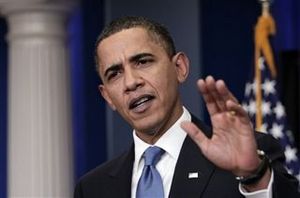
U.S. President Barack Obama will deliver the University of Michigan's commencement address on May 1.
The Associated Press
Some 46 percent of Michigan’s top public university alumni leave the state within 8 months of graduating, according to a 2008 study by Ann Arbor-based nonpartisan think tank Michigan Future Inc.
“I don’t think he needs to hear this, but I think a lot us want to hear about jobs, and are we going to get them after we graduate?” said U-M graduate student Evangeline Harvey, who is graduating this spring with a master’s in education. “I have a feeling that that’s one of his reasons for doing this.”
The content and tone of Obama’s speech won’t be clear for months.
But business leaders, politicians and students in the Ann Arbor region said they hope the president discusses Michigan’s jobs crisis and how to help reconstruct the state’s economic infrastructure.
Obama will be greeted by a Michigan economy suffering from an unemployment crisis. Michigan’s unemployment rate in December was 14.6 percent, according to the state.
|
Commencement coverage |
“The Ann Arbor region is certainly dealing with the same economic stress that the rest of the state and the rest of the country is dealing with,” said Michael Finney, CEO of economic development group Ann Arbor SPARK. “The good news is we are doing some things proactively that have the potential to favorably impact our fortunes here. So our hope is that we’ll have the chance to showcase some of those things to him.”
U.S. presidents usually use the platform provided by a commencement address to inspire graduates, deliver broad policy speeches and, occasionally, unveil new programs and strategies.
In 1964, for example, President Lyndon Johnson included the first mention of his “Great Society” proposal in his commencement address at U-M.
Obama has declared that his focus in 2010 is stimulating job growth and passing health care reform.
Michigan state Rep. Pam Byrnes, D-Lyndon Township, said Obama needs to discuss ways to prop up small companies that are having difficulty getting bank financing.
“We need some specifics,” Byrnes said. “We’ve got some serious problems with getting small businesses lines of credit and support. That is key to our revitalization because it’s going to be through the small businesses that we’re going to help turn Michigan around.”
Rich Sheridan, CEO of Ann Arbor-based software firm Menlo Innovations, said small businesses are the powerhouse of job growth.
“The president can make big ideas move forward,” Sheridan said. “Everybody’s pretty convinced that it’s going to be small businesses that start growing up that’s going to be where most of the job growth is going to come from.”
Economy, economy, economy
Cynthia Wilbanks, U-M’s vice president for government relations, said Obama’s decision to come to Michigan to deliver the address fits with his focus on revitalizing the economy.
“I have an expectation that he will describe the challenges of the current economy and global world that we’re in, the role that students play, that graduates play, the expectation that they will assume leadership roles in helping to shape a better future,” Wilbanks said. “I think he will do that very well. I wouldn’t be surprised if he took a little time to reflect on Michigan as perhaps an epicenter of the way in which the economy is transitioning and has to cope with the challenges.”
Michigan’s challenges were globally publicized in 2009 with the federally financed bankruptcies of homegrown automakers General Motors and Chrysler.
The U.S. government got an equity stake in GM and Chrysler in exchange for providing $65 billion in emergency loans to help them avoid liquidating.
Obama, faced with the unpopularity of the loans, has largely avoided discussing the auto companies in recent months.
But David Cole, chairman of Ann Arbor-based Center for Automotive Research, said Washington needs to continue to support Michigan’s manufacturing base.
The administration must “really focus on the importance of manufacturing in our economy,” Cole said. “That, to me, is something that we have not had in an administration in many years.”
Stimulus spending in Ann Arbor
Meanwhile, Obama’s appearance at U-M comes as the university is celebrating its reception of more than $100 million in federal economic stimulus funds. About half of that came from the National Institutes of Health, and $19.5 million is devoted to a new solar energy research center.
Two local nonprofits - Ann Arbor-based Merit Network and Ypsilanti-based Clean Energy Coalition - have collectively landed about $48 million in stimulus funding, as well.
Finney said those projects were critical to stimulating growth here.
But he also argued that the region needs to be cultivating a wide range of high-tech jobs that provide a wealth of opportunities for talented workers.
“What I’m hoping is that we have a chance to see him embrace the challenges we have here in Michigan and by embracing those challenges, he outlines plans from his administration to take steps to help support some of the efforts that we have going here in our region,” Finney said. “Finding ways to stimulate the economy through these knowledge-based employment opportunities is such a big-time opportunity.”
Leveraging governmental resources to create jobs is controversial, however.
Ann Arbor native Ron Weiser, chairman of the Michigan Republican Party, questioned the effectiveness of the stimulus package - despite the millions funneled to the local area.
“In the end, you can take money from the government and hire people with it,” he said. “But the way that you grow the economy is that you have the private sector create jobs. The public sector can’t continue to pay for them because the money’s got to come from someplace.”
Weiser called for Obama to focus his address in May on how to reassemble a vibrant economy.
“We just came out of a year that was the most severe year we’ve had since the Great Depression. Focusing on jobs is absolutely critical for this state,” Weiser said.
Convincing graduates to stay
Creating jobs is the first step to convincing young talented workers to stay in Michigan after graduating from college.
Stephen Rapundalo, a Democratic member of Ann Arbor City Council and executive director of Ann Arbor-based MichBio, the state’s life sciences association, said Obama’s team needs to find ways to “maintain the country’s level of competitiveness and leadership in innovation.”
That starts with providing great job opportunities to young people, he said.
“I think we need to have some kind of stimulus package version for job creation,” Rapundalo said. “Some kind of incentives that help small companies hire these young graduates and preferably keep them here within Michigan’s borders rather than see them leave to pursue careers elsewhere.”
As U-M graduates eye the president on stage May 1, they’re sure to be pondering their own futures - and whether there’s room for them in Michigan.
Some will leave.
“What I’m encouraged by is the number of people that have had a connection with the state, tested themselves beyond the borders of the state and, after some period of years, decided to return to the state and make a difference, make a mark and contribute to the state’s economy,” Wilbanks said.
“I do think there’s evidence that people are thinking that once they leave, it’s not forever.”
Contact AnnArbor.com’s Nathan Bomey at (734) 623-2587 or nathanbomey@annarbor.com. You can also follow him on Twitter or subscribe to AnnArbor.com Business Review's weekly newsletter.
Comments
ContreMilice
Wed, Feb 17, 2010 : 2:16 p.m.
Blaine Coleman writes: Think about the millions already killed by Bush and Obama, in: Iraq, Palestine, Afghanistan, Pakistan, Yemen, and, Somalia. First of all, if one bounces about figures, back them up. You say, millions? Prove it with hard statistical data. And Obama's trillion-dollar wars on the Middle East. Trillions? Back it up with hard statistical data. Also, theres no US war on Palestine. The only war there is the one started by terrorist thugs such as Hamas and Hezbollah. Coleman: I have the impression they would be glad to empty the entire federal treasury just to keep killing Muslims. That is the direction Obama is going. The next President, Palin, will be just as big a killer of Muslims. The fact ignored in those hyperbolic, unproved statements is that more Moslems kill other Moslems than any other group on the planet. And, I hope the statement that Palin will be our next president is as false as the unsubstantiated statements in the post on which I am commenting.
Carl Duncan
Tue, Feb 16, 2010 : 2:49 p.m.
Tea Party! Have words already picked out for sign: Too close For An I.C.B.M. Switching to pitch fork.
Big Game
Mon, Feb 15, 2010 : 3:07 p.m.
CLOWNFISH I will give you some of that, but there are lots of grants given that benefit only the grant recipient and not the general public that pays for them. I was not talking specifically about stimulus money. I was speaking more to nonprofits that receive grants.
clownfish
Mon, Feb 15, 2010 : 12:35 p.m.
I have little problem with symbiotic relationships. Maybe you meant parasitic relationships?
clownfish
Mon, Feb 15, 2010 : 12:27 p.m.
BG, I measure the benefits by the reduced wear and tear on my car from driving down the newly repaved I-94. I measure the benefits by seeing employees still working at stimulus funded work sites and suppliers to those sites. I feel the benefits in my back pocket when I pay my COBRA bill.
Big Game
Mon, Feb 15, 2010 : 10:54 a.m.
Clown fish In the wild they all form symbiotic mutualisms Symbiotic relationships include those associations in which one organism lives on another. Sounds a lot like what is wrong with this country! Seriously how do we measure the benefit of all these government grants handed out. I don't care if it was from the Reagan,Bush,Clinton or Obama administration.
clownfish
Mon, Feb 15, 2010 : 9:46 a.m.
What is interesting is that Obamas ratings are similar to Reagans in his first year, better than Bush's prior to 9/11, better than congress and far superior to a former 1/2 term governor who would not know a fact if it it jumped off her hand and bit her in her (should be growing) nose.
clownfish
Mon, Feb 15, 2010 : 9:35 a.m.
Recovery Act fixed I-94 before it became like a secondary dirt road and more people were killed. I specifically know of two local small companies that would have laid off people were it not for "Obama money". Those people would still have been getting govt money, but they would have been sitting at home collecting it and it would have been a whopping $362/week. Now they are spending their earnings at more local businesses. INSIDETHEHALL where did you protest when the previous admin was running up the debt? Where you outraged at the socialism of your money being spent to build roads, hospitals and schools in Iraq the way you seem to be outraged at that being done here in the USA? MIPATRIOT-specifically which constitutional rights has Obama stripped from you? Did you protest when Bush stripped you of your right to be free from unreasonable searches by the federal govt? Where you in one of the "free speech" zones he created to keep people from assembling to exercise their first amendment rights? Can you list the legislation proposed by Obama that would rid us of our guns? Or is this more propaganda from people that have approval ratings in the teens and have no new ideas themselves beyond "cut taxes and drown Michigan in a bathtub".
Big Game
Mon, Feb 15, 2010 : 8:46 a.m.
Two local nonprofits - Ann Arbor-based Merit Network and Ypsilanti-based Clean Energy Coalition - have collectively landed about $48 million in stimulus funding, as well. Ca anyone tell us what the salaries of the CEO'S of these two "nonprofits" are? We have all seen the lifestyles of some famous "nonprofit" CEO'S. How many JOBS has this $48 million in stimulus money generated? That is a lot of money for two companies to pocket!
Mipatriot
Sun, Feb 14, 2010 : 9:45 p.m.
OK, enough of the bickering. Obama just doesn't belong here, in Michigan, at a time of the state's worst unemployment. Like his stimulus solutions, once he leaves, the boost to the city's economy will quickly dissipate by Sunday afternoon. Libs: admit that you were tricked to vote for Obama by his promises that he knew he couldn't/wouldn't fulfill, admit that you will soon be paying more in taxes ("not a dime more, not one thin dime" said our currently "agnostic" president), that he is continuing down the same path as Bush in the middle east wars (e.g., an Iraq-like surge, in Afghanistan, right now), closing Gitmo-Cuba while opening a Gitmo-Illinois prison; and the list goes on and on. So join us in protest, across the street from the UM Stadium, on Commencement Day. Let's tell Obama, in a respectful way and within our First Amendment rights, to take his radical ideas and false hopes and promises somewhere else (we're not buying that anymore!), to stop the profligate spending, and to preserve the Constitution that this republic was founded on.
Dan Stevens
Sun, Feb 14, 2010 : 9:23 p.m.
There's lots that can be done on the state level, too, to improve the jobs situation. Check out www.michiganturnaroundplan.com for some great ideas. In particular: lower the costs of doing business (which are so high right now that they're discouraging employers from investing in our state): eliminate the personal property tax, reduce the MBT, and shift the revenue base partially to a tax on some services. Our tax policy is based on the past. We need one that will drive us into the future.
voiceofreason
Sun, Feb 14, 2010 : 3:16 p.m.
I agree with the double standard brought up by Silly Sally. For a place that claims to be open to free speech and all viewpoints, my time at UofM showed me exactly the opposite. Many liberal groups on campus are unable to win on the merits of arguments, so they choose to ridicule and shout and stifle the opposing arguments. I liked many things about the UofM, but for the school to move forward, a more open exchange of ideas must be ensured.
tdw
Sun, Feb 14, 2010 : 2:28 p.m.
@stunhsif nothing wrong with being a redneck.One of the richest men in this county ( and probbaly the state )is a redneck hillbilly
Silly Sally
Sun, Feb 14, 2010 : 2:13 p.m.
E.G said, while I support Obama politically, I don't want my graduation turning into a protest or political event." Very true, and he (or she) is correct. This is a graduation for 3,500 UM students. One question though, If this was 2 years ago when President Bush was president, would he have kept quiet if Bush had come to Ann Arbor? I doubt it. I still remember about 4 years ago when Supreme Court Justice Anton Scalia spoke in Rackham and th crowd overflowed to the steps. They set up speakers on the steps and protesters yelled so loud that Scalia could not be heard, even though I was 5 feet from the speakers. Some liberals do not want free speech, just their viewpoint expressed.
bunnyabbot
Sun, Feb 14, 2010 : 1:22 p.m.
The unemployment numbers for Michigan don't show all those that have given up looking for work or have left the state. If about half the graduates leave the state than our unemployment numbers are grossly understated. I hope there are protesters from all over the state lining up for his motorcade. additionally, comments about right and left are stupid, most people are in the middle, a lot of people don't like the amount of spending and spending that is going on. The stimulus hasn't helped anyone. Jobs "saved" is the dumbest thing I have heard, never before has that term been used except by this administration, there isn't even a way to quantify such a claim!
The Grinch
Sun, Feb 14, 2010 : 1:06 p.m.
BTW, Stunshif, I don't think it has anything to do with your keeping the thermostat too low! But have a nice Valentine's day, anyway.;-)
John Galt
Sun, Feb 14, 2010 : 12:57 p.m.
May 1? May Day, Communist Holiday? Obama? How appropriate he spend it in the "People's Paradise" of Ann Arbor. Yes, A large Tea Party Protest is in order.
The Grinch
Sun, Feb 14, 2010 : 12:53 p.m.
Yeah, stunshif, that all happened in the last 13 months. And I'm laughing at the profound ignorance and hypocrisy of the tea-baggers.
InsideTheHall
Sun, Feb 14, 2010 : 12:37 p.m.
EG - There is no angst from the right. We are regular folk tired of being driven to socialism by the LEFT. We have every right to gather and express our point of view. The Michigan grad ceremony has a long history of allowing alternative viewpoints to counter the commencement speaker. It's the Michigan tradition.
stunhsif
Sun, Feb 14, 2010 : 12:21 p.m.
" to cheer the man who saved our nation from the Shrub regime and its henchmen" I am laughing so hard right now my stomach is cramping up. Yessiree. Barack Hussein Obama has saved us all. Thank goodness for 15% unemployment in Michigan and over 10% nationally.Out of control spending and in two years we will have runaway inflation. Keep up the great work Mr. President!
The Grinch
Sun, Feb 14, 2010 : 12:08 p.m.
And I'll be in Michigan Stadium with 100K of my best friends (if the Secret Service will allow a full house--limits they place on the crowd will be the only thing that prevents it) to cheer the man who saved our nation from the Shrub regime and its henchmen.
Commoncents
Sun, Feb 14, 2010 : 11:57 a.m.
Grinch: You are incorrectly assuming that if someone is against one political parties policies they automatically agree with everything the other major political party does. In addition to that, two wrongs don't make a right, exercise some common sense man.... If I don't have anything going on during May 1st I'll be at the Tea Party demonstration...
xmo
Sun, Feb 14, 2010 : 11:23 a.m.
How about a "May Day" parade in the workers paradise? Come on comrades let's celebrate!
shawnsbrain
Sun, Feb 14, 2010 : 10:18 a.m.
Inside the hall. Count me in along with a couple dozen of my friends so far just this morning. If the new grads want some meaningful encouragement maybe they will come and learn what this country was founded on. Power to us normal folks!!!
Technojunkie
Sun, Feb 14, 2010 : 10:16 a.m.
If Obama wants to help small businesses he can start by simplifying the federal tax code. Big businesses can afford the legions of accountants, lawyers and lobbyists to deal with the capricious federal bureaucracy that stifles the small businessman that would compete with them. Funny about that. I favor a Flat Tax plan. Others favor a national sales tax (Fair Tax). Either would be better than the lunacy of spending hundreds of $billions on unproductive work each year complying with Washington's whims. Since the Democratic Party is funded by the overhead class I doubt this will happen.
mmggttnn
Sun, Feb 14, 2010 : 9:28 a.m.
Since half the graduates leave the State after graduating, why doesn't the State cut UM's revenue in half?
The Grinch
Sun, Feb 14, 2010 : 8:58 a.m.
Radius: You mean kind of like shrub telling us to do the patriotic thing after 9/11 and join the amed forces??? No, wait, he told us to... SPEND MONEY.
The Grinch
Sun, Feb 14, 2010 : 8:47 a.m.
Not up to it, eh? I'm not surprised.
Commoncents
Sun, Feb 14, 2010 : 8:46 a.m.
It'd be interesting to me to see if he mentions what the kids should be doing financially in his speech. Will he suggest they rack up big purchases like luxury cars, fancy suits, etc. on credit so that they can give the appearance of success for those job interviews? Gotta go into debt now in order to be successful in the future! Right? err.... wait.... InsideTheHall: Are you serious? I'd consider.
stunhsif
Sun, Feb 14, 2010 : 8:41 a.m.
Guessing there will be a lot more than 15 or 20. Too early in the morning for me to be eating who hash!!! Have a splendid day Mr. Grinch :-)
The Grinch
Sun, Feb 14, 2010 : 8:34 a.m.
WOW!! Three!! Really?? Maybe you'll have 15 or 20 by May 1.
stunhsif
Sun, Feb 14, 2010 : 8:23 a.m.
@InsideTheHall, I have three other commited to being there at this point, hopefully many more by May 1. Look forward to meeting you there!
InsideTheHall
Sun, Feb 14, 2010 : 8:13 a.m.
Tea Party May 1 on the DIAG high noon. Let's greet Obama and send our message loud and clear!