

New Ann Arbor SPARK CEO Paul Krutko lays out job creation philosophy
(Editor's note: AnnArbor.com executive vice president Laurel Champion serves on Ann Arbor SPARK's Board of Directors and Executive Committee.)
Paul Krutko has no interest in a passive strategy to creating jobs.
Krutko, the new CEO of Ann Arbor SPARK, the region’s economic development group, said he believes in an “intentional” regional approach to boosting the economy. That includes encouraging a network of incubators, helping startup companies attract investment and strategically luring outside companies to expand locally.
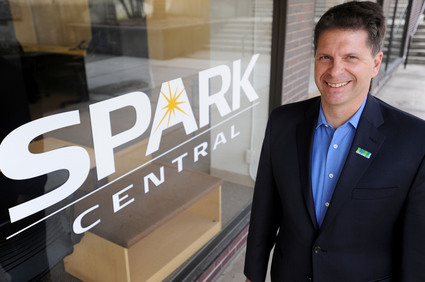
New Ann Arbor SPARK CEO Paul Krutko said that business incubators like SPARK Central, located on Liberty Street in downtown Ann Arbor, play an important role in assisting the growth of promising companies.
Angela J. Cesere | AnnArbor.com
With that in mind, he said one of first priorities is to speak with executives from the 150 biggest companies in the Ann Arbor area to find out how their companies are doing and what they need to survive and grow.
It’s a strategy that worked for San Jose, Calif., before Krutko even joined the city to lead its economic development efforts. San Jose is the home of web auction firm eBay, which was cultivated in a local startup incubator.
“The lesson of eBay and Silicon Valley is that intentional innovation — intentional entrepreneurial development strategies, gardening — is something that does work,” Krutko said.
Nonetheless, governmental officials are increasingly saying that they can’t afford to offer expensive tax incentive packages to companies to convince them to expand.
Michigan Gov. Rick Snyder, who co-founded SPARK in 2005 and served as its chairman until 2009, wants to eliminate most of the state’s business tax credits and limit them to a capped annual pool of incentives. He recruited former SPARK CEO Michael Finney to serve as CEO of the Michigan Economic Development Corp. and replicate many of SPARK’s initiatives on a statewide basis.
SPARK has an annual core operating budget of about $3 million, including about $1 million in tax revenue and funds from local universities, municipalities, businesses and nonprofits. The group manages three business incubators housing several dozen startup companies, provides grassroots services and retraining to entrepreneurs and communicates regularly with existing companies to convince them to stay and expand in the Ann Arbor area.
Krutko, who started his new job April 18, recently spoke with AnnArbor.com’s Nathan Bomey about his economic development philosophy, Snyder’s tax credits proposal and why fundraising is one of his key priorities. Excerpts:
Paul Krutko
Ann Arbor SPARK's new CEO
- Age: 55
- Work history: Chief development officer at the city of San Jose from 2002 to 2010; worked for municipal economic development and downtown development offices in Jacksonville, Fla. from 1997 to 2002 and Cleveland from 1990 to 1997.
- Outside work: Serves as secretary/treasurer of the International Economic Development Council.
- Education: Bachelor’s degree in urban planning and design from the University of Cincinnati's College of Design, Architecture and Art.
- Why he left San Jose: Krutko says he was at the age where he could draw a pension and that he had a difference in philosophy with the city manager and governor. Local news reports indicated that Krutko violated a city policy, but Krutko and SPARK chairman Stephen Forrest have declined to share details.
AnnArbor.com: SPARK has been going in a regional direction and focusing on the fact that economic development involves not just your local community but the entire state. How do you feel about that philosophy? What role should SPARK have statewide?
Paul Krutko: Personally and professionally I don’t see any misalignment with the direction that SPARK is going in.
At the International Economic Development Council … we have been talking about the need for economic gardening, entrepreneurship, innovation-based approach as opposed to the hunting approach, which is the olden days of economic development.
(With that strategy, you) put some unsustainable economic incentives on the table, then you go off and whack a company over the head and drag them back to your home community. That is still prevalent in economic development.
The approach SPARK is taking — that Mike initiated here with the governor and the rest of the leadership of this community — is the approach we’re advising other communities in the United States to take.
If you look at Silicon Valley, there are 20 to 30 municipal jurisdictions that make up Silicon Valley. The companies themselves don’t recognize the municipal boundaries, nor do the employees.
I’m a firm believer in regional collaboration. Our competitive frame now, both nationally and globally are regions, not individual municipalities.
AnnArbor.com: What were the lessons of eBay and other similar situations in Silicon Valley that are applicable to what we’re trying to do here?
Krutko: In the ‘90s, there became a concern about the diversification of the (Silicon Valley) economy. San Jose, in particular — well before I got there — made strategic investments. The city invested in a software incubator downtown. It was able to spawn a hundred companies and caused Adobe to locate its headquarters in downtown San Jose.
The lesson of eBay and Silicon Valley is that intentional innovation — intentional entrepreneurial development strategies, gardening — is something that does work.
And that the key is to be located in a place that has other environmental factors that will be successful. And I would argue that that’s one of the things that really sets Ann Arbor apart.
The University of Michigan has one of the largest research budgets in the United States, if not the world. It has intentionality — from the president to my chairman, Steve Forrest — that it is the university’s role to be engaged in getting those technologies out and commercializing products.
That’s not something that every aspiring community who wants to have this kind of innovative economy has that rich resource.
You can’t underestimate the importance of quality of life today. Talent is incredibly mobile, but place still matters. Where they go for lunch and what kind of recreational amenities they have, and what the quality of life overall is very important. So that’s another substantive asset that this region has. This is a great place to live.
AnnArbor.com: Skeptics say that without the venture capital we’re just going to hit a roadblock time and time again. Do you view the low level of venture capital available here as a significant obstacle or is it just something that will come in time?
Krutko: If you have good ideas and solid business plans, you can get access to capital. The question isn’t, is there money? There is money. I think we’ll be able to find capital for the entrepreneurs.
One of the positive things — and not to oversell it — is that I do have connections back to Silicon Valley. And we’re going to be telling a pretty compelling story about why they should be here.
AnnArbor.com: You’ve had a few different SPARK executives leave before you even got here, so you’ve got a leadership void. How important is it that you fill that at this point?
Krutko: It’s critical. It’s not a bad thing to have the former CEO of the organization move on to the state and to take people with him who are going to be able to take things that were born (at SPARK) to the state level. That’s a good thing.
There has been some preliminary recruitment here. There are some names and resumes for me to look at.
I’m still trying to make sure I understand where we are and we may not structure ourselves exactly the same way, but I haven’t made any decisions. I’m still getting input.
AnnArbor.com: Do you think SPARK’s incubator network is healthy, strong and should be expanded? Have you assessed that?
Krutko: One of my goals is … how we can scale and amplify the platform that’s been built here? So one of the key things that I’m going to put a lot of my personal time into is our funding situation and what opportunities we have to raise additional funds to look to scale and amplify.
At this point, SPARK is in a good financial position. Our stakeholders are generally pleased with what’s SPARK is doing and how they’re supporting it. The key thing for us to do more is to make sure we have an adequate resource base to do more.
AnnArbor.com: Is there any concern that SPARK’s current funding base is too reliant on tax dollars or money from public universities that are struggling to pay the bills?
Krutko: In the conversations that I’ve heard so far, there is this commitment and a sense that the resources that are being made available from those public and university sources are appropriate and important investments for those entities to make.
This is a community that gets that these investments are absolutely vital to the ongoing and growing economic vitality of this region. These are investments that need to be made. And so I think that we’re in a solid position.
AnnArbor.com: SPARK has some critics, people who are skeptical that what’s being done here is worthwhile. What would you say to them?
Kruko: I would say to them that benchmarking against other economic development efforts around the nation, others are trying to emulate what SPARK is doing.
Others around the nation know about Ann Arbor now, know that these kinds of business support and entrepreneurial programs are here, know that Ann Arbor is really open for business and wants to have a vibrant innovative economy.
You could take an approach of doing nothing and hope that this would all happen on its own. If eBay hadn’t found a home in an incubator and somebody hadn’t given them some resources to get started, would eBay exist? Maybe, maybe not. I’d rather bet on being intentional about your economic future than just letting the world economy happen to you.
The future isn’t foreordained. Many places that were the centers of the global economy 40 or 50 years ago aren’t now. And things can change dramatically because of how fast products get to market now, the volatility in terms of innovation.
AnnArbor.com: Certainly Michigan knows that.
Krutko: Yeah. We’ve got a great set of assets and we’re going to be intentional about trying to bring our economy back in a diversified way that will help inoculate us against the fact that we were so heavily concentrated.
AnnArbor.com: Are you comfortable with the governor’s proposal to eliminate most of the tax credits and keep it to a capped pool of incentives?
Krutko: I understand the proposal better after having a conversation with Mike. What the governor is saying is that: Is it sustainable to provide tax incentives that have (to be paid out over) many, many years? … It’s clear to me that Mike is working with the governor to build a war chest (of incentives).
I like the notion that if you’re going to make an upfront decision about investing, you do that and the company then functions as a normal company. I think that’s the way to go.
Contact AnnArbor.com's Nathan Bomey at (734) 623-2587 or nathanbomey@annarbor.com. You can also follow him on Twitter or subscribe to AnnArbor.com's newsletters.
Comments
Norman Peal
Mon, May 2, 2011 : 12:50 a.m.
The only SURE WAY to create jobs is to ABOLISH ALL ZONING BOARDS. Unless this step is taken, Nothing will ever happen. I'm tempted to repeat myself to drive the point home. It must be done. And a movement to flood all empty rental space with Micro Factories should begin immediately. As an example : Retro furniture, and decor, ALL American Made Tools...and we just suffered a HUGE loss when we imported MILLIONS of Dollars worth of Bad Capasitors (Google It) , the point being : going green means NOT filing our dumps with cheap substandard short-lived imports. Also, the act of importing and exporting is a HUGE WASTE OF FUEL. Stop It.
timjbd
Tue, May 3, 2011 : 3:24 p.m.
I don't know about abolishing zoning boards but I certainly agree that unused space should be put back into production. That's one obvious thing every American can agree on (even as many load their SUV's full of cheap Chinese-made crap at Walmart).
leaguebus
Sun, May 1, 2011 : 8:46 p.m.
I would try a venture like AA Spark before I handed business a $1.7B tax break. What we forget is that the $1.7B is not just this year but each and every year hereafter. Big business is not interested in building jobs in Michigan or any other state. That is why the multi-nationals are taking our tax breaks and building factories in China and hiring many more Chinese than they are hiring Americans. Caterpillars CEO came out and threatened Illinois because they raised their business tax rates. In 2010, 60% of their hiring was overseas, this was before the tax rise. Now all the states around Illinois are building tax packages to try to lure Caterpillar from Illinois, what will the company do with that money? Use it to build overseas. What Michigan needs to do is to start rebuilding our educational system to become the best in the country. Then, AA Spark and other local incubators will have a highly educated work force to complement their initiatives. Ann Arbor is already far ahead of this game, but education needs to be enhanced state wide so all kids get the chance for a good job. It takes dollars to do this and cutting our Universities and K-12's every year to give tax breaks to business makes no sense at all. We are in a downward spiral and we either raise taxes or stop giving large tax breaks to segments of the economy that don't deserve them.
sig.melvin
Sun, May 1, 2011 : 7:05 p.m.
I undersatnd that Sillicon valley is now located in china?
runbum03
Sun, May 1, 2011 : 6:48 p.m.
Why am I under the impression that Mr. Paul Krutko is drawing a full pension in addition to his $300,000 pay "package ." Imagine, getting paid a grand a day to pontificate, bloviate, and regurgitate economic wisdom. And in Michigan this is only an "average" salary for a so-called economic developer. I, too, can pontificate, bloviate, and regurgitate with the best of them. Sign me up.
debling
Sun, May 1, 2011 : 5:41 p.m.
The pool of incentives should be shallow ... say empty ... zip ... zero ... nothing. Tax payer money should never be used to subsidize private businesses. Come to Ann Arbor if it makes sense, but we are not paying you.
Alan Goldsmith
Sun, May 1, 2011 : 4:28 p.m.
"As a taxpayer whose dollars have been 'captured' (taken from our school funding) I challenge Mr. Krutko to provide transparency on the job creation numbers claimed by SPARK. It's time for a hard look and some accountability on the real performance of this entity. There must be an audited, absolutely independent accounting of the jobs created by SPARK so taxpayers can see if their tax dollars are being well spent." Townie, good question. One AnnArbor.com might have asked the new SPARK chief and if there are any plans for this. But the reported didn't ask.
DKAA
Sun, May 1, 2011 : 3:47 p.m.
I can certainly understand the pent up frustration in our "region" and in Ann Arbor specifically. Incubator company efforts often take a long time to develop into substantive economic engines. Most don't, either because of inadequate capitalization, inadequate business strategy and execution or sometimes because some other (larger) company likes what it sees and buys the fledgling operation. We have seen successes here, though and, as importantly, we have seen the excitement on behalf of those individuals bold enough to launch out. That has to be encouraged. The truth is that we, locally and regionally need a SPARK to keep the efforts going. While a business plan and direction for SPARK are important, so is a little time. Monday will be two weeks for Mr. Krutko. Monday will also be two weeks since I planted some seeds in my garden with the expectation that I'll be harvesting something worthwhile in the future. I certainly haven't stood musing over my garden bed wondering why I haven't seen results yet. For my part, I'm willing to give him some time to see what the harvest will produce
timjbd
Sun, May 1, 2011 : 3:24 p.m.
"That's not something that every aspiring community who wants to have this kind of innovative economy has that rich resource." Did he really say that or did you misquote him? "And that the key is to be located in a place that has other environmental factors that will be successful." That's a paragraph? Does he want the 'other environmental factors' to be successful? "I'm a firm believer in regional collaboration. Our competitive frame now, both nationally and globally are regions, not individual municipalities." You mean like NAFTA? How big a region? It's safe to say- at this stage- that NAFTA was not too good for Michigan. Is he there to help companies export labor to Mexico? China? Dexter? This was a fusillade of buzzwords, catch phrases and doublespeak ostensibly to keep from actually having to say anything. I think I know less now about Spark than I did before I read this. And I didn't know much. I'll never get back the 20 minutes I spent reading (and then re-reading) this interview, trying to figure out what information you were attempting to extract from him/impart on us. Yes. I gave up.
fishermon
Sun, May 1, 2011 : 3:14 p.m.
We need another Henry Ford. Someone who wants to be in Michigan, stay in Michigan and who has the ability to find the means to finance his endeavor and create thousands of jobs for the future. That is the spark we need to cure Micigan"s economic ills.
sig.melvin
Sun, May 1, 2011 : 7:09 p.m.
Somuch for HIRE MICHIGAM FIRST..Statebudget director from UTAH , now this guy from californa..etc
Alan Goldsmith
Sun, May 1, 2011 : 2:07 p.m.
Thanks for pulling my post about the softball questions. Must have hit a nerve.
Cash
Sun, May 1, 2011 : 3:56 p.m.
Alan, I read it earlier. Good post and SPOT on.
Alan Goldsmith
Sun, May 1, 2011 : 2:02 p.m.
No questions about San Jose? And the reason our new SPARK guy left his position?
sig.melvin
Sun, May 1, 2011 : 7:08 p.m.
Check the san Jose newspapers and wikipedia . quiet a story!
Cash
Sun, May 1, 2011 : 1:09 p.m.
Oakland County is experiencing a nice comeback. Perhaps the spark has ignited off to the northeast. And: "AnnArbor.com: Is there any concern that SPARK's current funding base is too reliant on tax dollars or money from public universities that are struggling to pay the bills? Krutko: In the conversations that I've heard so far, there is this commitment and a sense that the resources that are being made available from those public and university sources are appropriate and important investments for those entities to make. " Bwahahaaa..doesn't say who he is conversing with does he? The Q and A is more like a PR release.
deb
Sun, May 1, 2011 : 1:44 p.m.
I agree, if you were to skim the article you would think krutko founded ebay or had something to do with the development, bet he asked the reporter if they could talk about ebay
Wolf's Bane
Sun, May 1, 2011 : 12:44 p.m.
Lots of lip service, no real concrete agenda. Yeah, spark.
Townie
Sun, May 1, 2011 : 11:24 a.m.
As a taxpayer whose dollars have been 'captured' (taken from our school funding) I challenge Mr. Krutko to provide transparency on the job creation numbers claimed by SPARK. It's time for a hard look and some accountability on the real performance of this entity. There must be an audited, absolutely independent accounting of the jobs created by SPARK so taxpayers can see if their tax dollars are being well spent. SPARK has not been willing to do this -- why is that? Waiting to see if SPARK will step up to accountability and transparency. Will AA.com push for this? We'll see.
alternativeview99
Sun, May 1, 2011 : 3:38 p.m.
Some time ago, I found what I think was a 2008 annual report from Spark listing the companies it helped. Most of them appeared to be R&D companies. I can't help but wonder how many Michigan citizens returned to work as a result of this support. Our country is in trouble because we have drained the incomes and purchasing power of the middle class. When the middle class couldn't work more hours, take women out of the home and put them to working, or borrow against their homes and other wealth any longer to compensate....they had to reduce purchasing . Their incomes have been deteriorating for a long time as the income of our country becomes concentrated at the top. When the debt bubble broke, this caused businesses to lay off more workers further reducing the purchasing power of the middle-class. This lack of purchasing power caused more companies to lay off workers and threw us into a recession. So....I don't see the value of supporting business until you can show me who will buy it's products and sustain it's growth. Yes, I know this makes many people quake. They believe supporting business is great. But, is it? It seems to me we need to focus on restoring the purchasing power of the middle class. Idle workers have to be a complete waste to society. So, support business.....but....support them by restoring the purchasing power they need to sustain themselves. When I see what companies do with the money we give them directly, it seems to end up in the hands of a few in the form of bailouts to support executive salaries and does little to create the kind of jobs we need to restore purchasing power to the middle class..... which is needed to sustain any recovery in a meaningful way. In fact, Michigan laws seem to keep working to remove that purchasing power. Of course, this is just my view of it. So, I would agree, we need a bit more transparency concerning the restoration of purchasing power to the middle class.