

University of Michigan opens business incubator at ex-Pfizer site to boost its startup companies
The University of Michigan today officially opened a 16,000-square-foot business incubator at the former Pfizer site in northern Ann Arbor, part of a plan to boost its own startup companies and establish tighter ties with industry.
The incubator, which the university is calling its "Venture Accelerator," leases space to early-stage startup companies that have licensed intellectual property from the university.
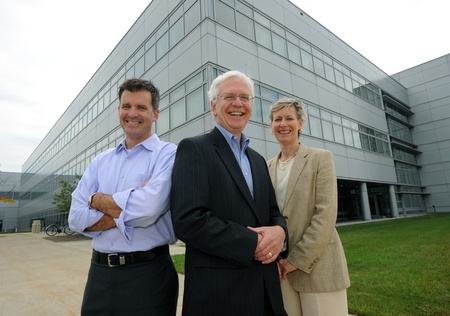
U-M Technology Transfer Office executive director Ken Nisbet (center), Michigan Venture Center director Jim O'Connell and Tech Transfer licensing director Robin Rasor stand outside the new Venture Accelerator at the former Pfizer site.
Lon Horwedel | AnnArbor.com
The first company to use the space, a medical device venture called Life Magnetics, is renting 1,400 square feet of laboratory space. Another four companies are close to finalizing leases for space: Phrixus Pharmaceuticals, 3D Biomatrix, Civionics and EngXT.
U-M President Mary Sue Coleman described the incubator as an example of the university’s commitment to using the 2-million-square-foot former Pfizer complex to establish tighter relationships with commercial partners in an entrepreneurial fashion.
“The University of Michigan is firmly dedicated to accelerating the transformation of our economy through creativity and entrepreneurship in the community,” Coleman told a group of 500 U-M executives and business leaders gathered at the accelerator this afternoon. “We are eager to collaborate with companies to drive transformative research that can change the world.”
The establishment of the venture accelerator, first reported by AnnArbor.com in September, expands the Ann Arbor region’s network of business incubators.
That network includes Ann Arbor SPARK’s three incubators: TechArb, a space for companies led by U-M students; Tech Brewery, an incubator that caters to individual entrepreneurs and very early-stage ventures, mostly in the information technology sector; and the Michigan Research Institute, which offers incubator space to high-tech companies in Pittsfield Township.
The Venture Accelerator will be operated by U-M's Tech Transfer Office and is located next to the Tech Transfer Office and the Business Engagement Center — an arrangement that officials purposely constructed to allow startup tenants to get expert advice and resources from U-M’s entrepreneurial experts.
“As part of the bigger picture, we’re here trying to take great technology and trying to apply it in the best way we can,” said Ken Nisbet, executive director of the Tech Transfer Office. “We’ve done that forever but never had a formal space, and we thought that was one more piece to fit into the total puzzle.”
The incubator is expected to have up to five startup companies within a few weeks. Nisbet said that eventually, the site could have 15 to 20 startups. Those companies are expected to stay at the incubator for 12 to 36 months and, ideally, grow to the stage where they can move out and establish their own offices.
U-M’s Tech Transfer Office helps about 10 companies a year spin out of the university. Nisbet said the goal is not to generate a higher number of startups but to improve the quality of those startups.
“We’re thinking about half of them would like to be here,” Nisbet said. “When they launch, hopefully they’re going to be far more sustainable and grow quicker and have an economic impact.”
Jim O’Connell, director of the Tech Transfer Office’s Michigan Venture Center, which offers advice and resources to U-M startups and prospective faculty entrepreneurs, said the incubator is not meant to be a competitor in the commercial real estate market.
“You can definitely find cheaper space in industrial parks around town. That’s not where we’re trying to position this,” he said. “This is about adding value that you can’t find (elsewhere).”
With the Venture Accelerator, the Tech Transfer Office and the Business Engagement Center, U-M now has about 500 employees housed at the ex-Pfizer site, which the university bought for $108 million in June 2009.
Ora Pescovitz, CEO of the U-M Health System and the university’s executive vice president for medical affairs, said the university is on track to have nearly 1,000 employees at the site within a year.
“What I see is immeasurable, infinite potential,” she said.
Contact AnnArbor.com's Nathan Bomey at (734) 623-2587 or nathanbomey@annarbor.com. You can also follow him on Twitter or subscribe to AnnArbor.com's newsletters.
Comments
deb
Thu, Jan 20, 2011 : 3:23 p.m.
"Under legislation passed in the 1970s, the state's fire protection fund is supposed to allocate money to help municipalities like Ann Arbor pay for fire services using a formula based on the percentage of tax-exempt property in the city. Ann Arbor, like many communities that are home to public institutions such as the University of Michigan, does not receive anywhere near the amount of state funding the formula calls for — a sore point for city officials. Profit said "it's pretty unfair" for the state to ask the taxpayers of Ann Arbor to pay for the fire protection services of a large statewide research and education institution. "We're not going to quit on it," he told Hieftje and council members. "As many of you know, we started from zero after Governor Engler vetoed the entire thing 10 years ago now, and we've brought it back to about 65 percent of full funding." <a href="http://www.annarbor.com/news/revenue-sharing-at-risk-for-ann-arbor-as-state-officials-look-to-trim-budget-consultant-says/">http://www.annarbor.com/news/revenue-sharing-at-risk-for-ann-arbor-as-state-officials-look-to-trim-budget-consultant-says/</a> In 2004, the University also purchased a $300,000 fire truck for Local 693, according to University spokesman Rick Fitzgerald. "In addition, the fire department also receives money from the state government, though the funding is decreasing and the payments haven't been made in full for several years, according to Schroeder. Because the department is under financial pressures, Schroeder said the union would like to partner with the University in a "cooperative agreement" to improve safety. <a href="http://www.michigandaily.com/content/u-says-it-will-not-create-firefighter-unit" rel='nofollow'>http://www.michigandaily.com/content/u-says-it-will-not-create-firefighter-unit</a> They need to pay their share, and their share from the past years
Bacon Bits
Wed, Jan 19, 2011 : 4:01 p.m.
Before complaining about the City not getting taxes (etc. etc.), one should consider that without U-M many of these companies would likely not exist. This is an "incubator" for very early stage start-ups. A lot of these companies will not be successful, but the ones that are successful will move out and employ Michigan workers. These start-ups hold the promise of becoming successes and helping Michigan's economy. To begrudge the lack of taxes is penny-wise but pound-foolish. Look at the bigger potential and how this enterprise might spring some job growth in the future.
Lady Audrey
Wed, Jan 19, 2011 : 3:45 p.m.
Okay, I'm going to post the same comment here I made in the other article about this development at the NCRC site because we need to reinforce critical thinking skills. Really? You think Pfizer paid its "fair share"? They had so many concessions from the city to stay in AA that you ann arborites were taking it on the chin for a multinational company. And where did it get you? They left anyway. Focus on the fact that these are MICHIGAN companies moving into the NCRC to help them get started and established in MICHIGAN. They will hire people who will then work in MICHIGAN, buy our goods, our homes and contribute to the economy. I'm so sick of how dumb people in Ann Arbor can be.
bugjuice
Wed, Jan 19, 2011 : 2:29 p.m.
This is little more than a redistribution of wealth from the public to the private. Wait a minute, the University of Michigan already acts like a private business. Skates on municipal taxes, isn't required to follow local zoning and building requirements, regards the rest of the city as its backyard, pays its CEO outrageous salary...
Somewhat Concerned
Wed, Jan 19, 2011 : 2:24 p.m.
With a city income tax, new businesses will simply locate outside Ann Arbor, if they make a profit. Startups in incubators are unlikely to be making a dime of profit. This incubator is a typical UM approach. Giant publicity, a big party, statements from the U's President and other big shots, a couple of examples of people trying something, and less substance than an interview with Tom Cruise. There is more than cheap space when what startups need is sound advice about the business of being a company. The startups have smart scientists or engineers but they don't have a clue about how to build a company. The U is terrible at providing that advice because at the U this area is all about turf and politics. Mary Sue Coleman and Ora Pesovitz have no idea how to start a company. The people running tech transfer are not good at it. Most of the people on campus who have done it and who spend every day on it are on the outs with the big shots because the big shots know that those people know they, the big shots, don't know what they're talking about when they give speeches, so most of the people who have done it aren't involved with this incubator or most of the money-eating projects like this favored by the big shots who don't like be shown up. You have to hope this incubator that is not the first one with U connections will do a good job of growing jobs and getting the U's science and technology to the people but it's not likely for the same reason the U's other efforts on those lines haven't done well. It's the politics of who at the top likes you and isn't afraid of being shown up for having only their emperor's clothes on. Meanwhile, people who have a track record and who have credibility outside the confines of the President's office are doing just fine without the U's so-called help. Heaven help you if you are a scientist or engineer at the U pushed into the U's system that decreases that chance you will hit it big.
limmy
Wed, Jan 19, 2011 : 1:41 p.m.
Nephilim...That is why we need a city income tax. Tons of people are spending their days in Ann Arbor without contributing any money in the form of taxes. It is time the city began charging the people who actually use the services instead of just those of us who own property in the city. Personally, I am extremely tired of financially supporting this place so that every Tom, Dick, and Harry can go home to a township subdivision to escape financial responsibility.
Nephilim
Wed, Jan 19, 2011 : 2:48 a.m.
Let me guess, even though the university is getting paid for these business' to be there, they will not have to pay any taxes to the city because the "great" U of M owns the property and doesn't have to pay taxes.
Lady Audrey
Wed, Jan 19, 2011 : 11:21 p.m.
I hardly think we can compare commercial tenants at the Michigan Union with fledgling enterprises that are no more than an idea and a couple of entrepreneurs.
Nathan Bomey
Wed, Jan 19, 2011 : 4:25 a.m.
That's right -- companies that rent space from U-M-owned property don't pay real property taxes. This is similar to the arrangement at the Michigan Union, for example, where commercial retail tenants lease space and, thus, don't have to pay real property taxes to the city. Some previous coverage: <a href="http://www.annarbor.com/business-review/post-83/">http://www.annarbor.com/business-review/post-83/</a> <a href="http://www.annarbor.com/business-review/university-of-michigan-gets-first-commercial-tenant-for-former-pfizer-site/">http://www.annarbor.com/business-review/university-of-michigan-gets-first-commercial-tenant-for-former-pfizer-site/</a>
Rod Johnson
Wed, Jan 19, 2011 : 3:29 a.m.
I want to know the answer to that too. Nathan, this would be a good thing to report on.
AlphaAlpha
Wed, Jan 19, 2011 : 1:37 a.m.
Bioengineered fix for Asian Carp? Priceless.