

Why the University of Michigan is now a safer investment than U.S. government
The University of Michigan now has a better reputation as a safe place to invest than the United States government.
U-M's bond rating remains stable at AAA per the assessment of ratings agency Standard & Poor's, which on Friday announced that it had downgraded the U.S. credit rating, undercutting financial markets and sending stocks tumbling today.
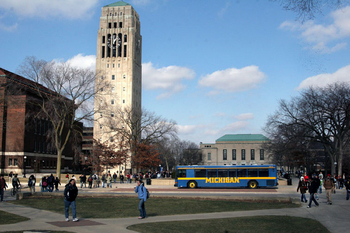
The University of Michigan is a safer place to invest than the U.S. government, according to Standard & Poor's.
That U-M has been able to maintain its AAA credit rating is a testament to enormous financial stability supported by a $6.6 billion endowment and selective cost cutting under President Mary Sue Coleman in recent years.
U-M's financial prudence stands in stark contrast to Washington's profligacy.
"The University of Michigan has a very positive balance sheet, more assets than liabilities, and I guess that’s the opposite of the U.S. government," said Don Grimes, a U-M economist.
At the same time, the university, which plans a $1.6 billion core budget in 2011-12, is still investing selectively. It's continued its massive building boom, expanding, renovating and adding facilities, including the $175 million North Quad complex and a forthcoming $116 million facelift for East Quad.
In addition, U-M paid $108 million in 2009 to acquire the 174-acre ex-Pfizer complex in northern Ann Arbor and plans to add 3,000 employees to staff the site by 2019.
Collectively, the actions underscore the broader point: U-M is more powerful financially than it's ever been before, despite the financial crisis.
That said, of course, U-M's endowment has surely lost millions — perhaps hundreds of millions — as the stock market has contracted in recent days.
But the endowment bounced back after the financial crisis of late 2008 and early 2009 — and the U.S. economy isn't in nearly as bad shape today as it was then, Grimes said. He cited high corporate profits as a sign of general economic stability.
"My hunch — and it’s just a hunch — is that (the economy) will turn out a little better in the fall of this year than what everybody thinks right now in terms of real GDP and sales," he said.
Nonetheless, in light of S&P's downgrade of U.S. debt, is U-M concerned that its AAA rating could be in jeopardy, too? A credit downgrade, in theory, can increase the cost of borrowing.
In addition to the broader troubles in the economy, the state of Michigan is cutting its funding commitment to the university by $47.5 million — the latest in a series of cuts. But the university raised tuition by 6.7 percent to help make up for the shortfall — much like the government can raise taxes to cut deficits, a reality that has historically given confidence to ratings agencies.
Timothy Slottow, U-M's executive vice president and chief financial officer, was not available for comment.
U-M spokesman Rick Fitzgerald said he was not prepared to discuss whether the university is concerned about the impact of the U.S. credit downgrade on its own credit.
“But the university has had a AAA bond rating through some other really bad times in both our state and our nation economically,” Fitzgerald said.
Meanwhile, the city of Ann Arbor — whose credit rating, AA+, is now the same as the U.S. government — is "monitoring the federal situation," chief financial officer Tom Crawford said.
"Given S&P’s actions with the U.S., there could be an impact on locals, but it’s really too early to estimate the chance or probability," Crawford said in an email. "I would imagine the AAA entities would be looked at first."
Eastern Michigan University's bond rating in April was affirmed at A1, a few notches below AAA, by Moody's, which upgraded the university's credit outlook from negative to stable. S&P rates EMU's credit ratings as A-.
"I do not believe that S&P's downgrade of the U.S. from AAA to AA+ will impact EMU's credit ratings," EMU chief financial officer John Lumm said in an email. "As a public university, EMU's ratings could potentially be impacted if the agencies were to change their ratings for the state of Michigan."
Contact AnnArbor.com's Nathan Bomey at (734) 623-2587 or nathanbomey@annarbor.com. You can also follow him on Twitter or subscribe to AnnArbor.com's newsletters.
Comments
Tru2Blu76
Sat, Aug 13, 2011 : 5:03 a.m.
Not that the U.S. Congress and President (actually both past and present) don't own a share of the blame: but let's for a moment look at such entities as U.S. corporations. These "entities" are always assuring us about (1) their advertising and (2) their "financial wisdom" - which they claim means we should let them alone to run just about everything themselves and finally (3) their idea of "competition." First: we know that just about all corporate advertising is dishonest. That is, when it comes to matching actual value with claimed or implied value. Second: the corporations who boast about their "financial wisdom" often turn out to be in financial trouble themselves. Third: "competition" is supposed to mean (according to these corporate entities) that two or more companies competing in the same market ultimately improve value. This is a "principle" which "guarantees" the result. Hah! Look at the examples: telecom companies compete frenetically - but our telecom system is EIGTH in the industrialized world. This has gone on for decades: yet the U.S. is stuck in EIGTH PLACE. The same result of competition applies to: houses, automobiles, TV sets, and a raft of other major services like: medical care. So - when it comes to "confidence" - we see what a joke all this is - whether looking at government or private corporations. Don't let the line about raising taxes (or tuition) lead you to forget that companies must raise prices (or lower wages) to remain stable, either. A price raise is just another word for "use tax." Topping it all off: companies today like to talk about lowering wages and benefits, making the case that "irresponsible employees and unions" just have to learn to live on less. At least when government raises taxes: they don't at the same time lower your salary and benefits! And we wonder why "consumer / voter confidence&qu
Mike
Sat, Aug 13, 2011 : 1:34 a.m.
Basically, this article says that the UofM has always had a great credit rating and always will. How this differentiates from previous arguments about the credit rating of the US government is unclear. There are some very good reasons for why there might be very serious impacts on the UofM finances. First, a large building expansion with attendant infrastructure costs. Second, increasing public skepticism about the Return On Investment of a college degree. Thirdly, an impending decline of government grant money. Fourthly, the UofM Medical Center is heavily invested in an unsustainable business, health care. In short, liabilities are expanding and revenues are going to decline. Universities are the next bubble. Believe it. The impact on Ann Arbor will be substantial.
John B.
Mon, Aug 15, 2011 : 8:27 p.m.
Student loans are probably the next bubble, so that lends even more credence to what you say....
Tru2Blu76
Sat, Aug 13, 2011 : 5:07 a.m.
Hope you're wrong - but what you say does make sense.
groland
Thu, Aug 11, 2011 : 4:37 p.m.
Technically, the US cannot default since our debt is in US dollars. The treasury can always print more money. I am not saying that is a good idea. However, one clear way out of debt is through inflation. We pay back debts with money that is worth less. It will be inevitable.
sig.melvin
Thu, Aug 11, 2011 : 3:56 p.m.
yeah live is just a bowl of cherries ..yes for the U of M and a profesor making $ 800 000 a year , yes live is grand! by the way is there a tuion increase this year? Why? let see the balance sheet from U of M. And All the charity Income. Alumin etc...
julieswhimsies
Tue, Aug 9, 2011 : 6:56 p.m.
Does U of M's massive ad campaign for their hospitals bother anyone else other than me? I see these ads in National Magazines...on TV, and elsewhere! They are a non-profit making huge profits yearly.
Tru2Blu76
Sat, Aug 13, 2011 : 5:13 a.m.
Just FYI: first, advertising is the way to go for success in any enterprise. Second: "non-profit" doesn't mean assets must be balanced against liabilities. In other words: so long as U of M (or any U) can make a case for providing valued services, they're being honest within that framework. U of M in particular has proven masterful in projecting an authoritative, admirable image. If you examine human affairs as a whole: "faith" plays the biggest role. The phrase, "full faith" underpins our currency. So long as the majority believes in a thing: that is the reality.
Kai Petainen
Tue, Aug 9, 2011 : 4:48 p.m.
neat article!
jhammer
Tue, Aug 9, 2011 : 3:43 p.m.
Just wait until they realize raising tuition 6-7% a year is unsustainable as new students are unwilling/unable to obtain loans, and they can no longer cover the rising cost of pensions/benefits that they've promised. The University is a microcosm of the nation, just a few years behind. Welcome to the world of sustainable growth. A place where we should have lived all along.
Not from around here
Tue, Aug 9, 2011 : 5:53 p.m.
As long as UM has a good supply of foreign student that can easily afford the education that our domestic students can't they'll be OK. U of M stopped being and education option for most of the states youths a while ago.
15crown00
Tue, Aug 9, 2011 : 2:49 p.m.
congratulations to the BLUE BRAINS.Bet lot of peoples credit is better than that of our USA.
Christopher Barbeau
Tue, Aug 9, 2011 : 1:13 p.m.
Anyone find it a logical absurdity that ANY company / investment in the US can now have a rating better than the entity that guarantees the very underlying currency?
John B.
Tue, Aug 9, 2011 : 9:32 p.m.
Yup. Utter nonsense, brought to you by the same yahoos that said that repackaged junk sub-prime mortgages were AAA-rated investments. Yeah, right....
Gorc
Tue, Aug 9, 2011 : 12:07 p.m.
For those of you who want to keep pointing fingers at the "other side" it is unproductive and sad. Those who can only critize the other side are no different than OUR ineffective politicians in Washington D.C. who ignored the debt issue and could not come up with real solutions to our financial problems. Standard & Poor's down grade and the stock market drop since last week is a wake up call.
Not from around here
Tue, Aug 9, 2011 : 5:51 p.m.
I agree, we need to disolve the Dems and Repubs hold on the goverment. Unfortuntly untill all of the 60 and older baby boomer/hippy/ me generation people pass, good luck.
clownfish
Tue, Aug 9, 2011 : 11:58 a.m.
Then the US govt should do what UM did to receive such lauding from our conservative friends...raise revenue! Just like any business would do.
Not from around here
Tue, Aug 9, 2011 : 5:50 p.m.
Maybe they will after all the Multi Millionaire Democratic baby boomer congress people leave. Right now all the wealth is in the hands of Democrats so don't expect anything more than finger pointing.
KJMClark
Tue, Aug 9, 2011 : 5:10 a.m.
Have to agree with David - S&P downgrades US bonds, and investors... ditch stocks and jump into US bonds. Wouldn't concerned investors sell bonds and move to alternatives like stocks? Should interest rates be rising? Here's an idea: let's make the ratings agencies financially responsible for the quality of their ratings. Further, let's require the folks working at the ratings agencies to be certified in ratings and analysis, and also financially responsible for the quality of the ratings. Then when they botch the job, they all get fired and lose their 401k investments for their incompetence. Instead, we get S&P rating Lehman an A investment up to the month they went bankrupt. The good folks at S&P should be among the folks doing the perp walk. I'll be concerned when Fitch follows suit. They're at least semi-competent.
quetzalcoatl
Tue, Aug 9, 2011 : 3:01 a.m.
S&P, Fitch, Moody's and AIG are more responsible for the TARP and the meltdown than almost any other corporations. Getting the S&P Seal of Approval didn't do much good for the mortgage business, did it? Might be time to cash in on UM and head for the hills, looking for some kind of stable bolt-hole like Venezuelan cocoa futures or black-footed ferret futures.
nickcarraweigh
Tue, Aug 9, 2011 : 2:55 a.m.
As soon as UM sets up a printing press on campus and runs out of trillions of ......... bucks? maizes-and-blues? wolverines? ...... that I can take the store and buy groceries with, why, I'll believe this story. Anyway, ain't S&P the same company that old me Countrywide Mortgage was stellar? Somebody's drinking ALL the Kool-Aid, but it ain't me.
julieswhimsies
Tue, Aug 9, 2011 : 6:59 p.m.
Also a victim of Countrywide.
bhall
Tue, Aug 9, 2011 : 1:09 a.m.
@Nathan, You mentioned selective cost cutting and a healthy endowment as two reasons why U-M has a stellar credit rating. How could you overlook the MOST important factor! Unlike the U.S. government, the U-M can increase revenues. It can raise taxes, er, tuition! And U-M raises tuition every year! Before you praise U-M's conservative fiscal policies, why don't you see how much U-M has raised tuition since 2000. Then come back and see how much federal taxes have been raised since 2000. Two very different pictures.
bhall
Tue, Aug 9, 2011 : 3:05 a.m.
Look at U-M's grey book -- the balance sheet -- from the past few years. The net increase in money raised by tuition hikes is always -- always! -- greater than the money cut by the state each year. The spin by U-M is it needs to raise tuition because of state cuts, but that doesn't tell the whole story. If that was the case, then tuition would not be as high as it is now. My point is the government can't raise taxes now because of politics in Washington. Heck, the conversation is about how much of a tax reduction from the Bush era should be preserved. And don't forget, Obama gave us a tax cut through the stimulus. U-M, on the other hand, has increased revenues by increasing tuition. To me, that difference is the salient point that should be explored in more detail, not explained away with the U-M spinjob that it's only raising tuition because of cuts in state funding.
Nathan Bomey
Tue, Aug 9, 2011 : 2:49 a.m.
@bhall You must have missed this piece of the story, which has been in the piece since it was published: >>In addition to the broader troubles in the economy, the state of Michigan is cutting its funding commitment to the university by $47.5 million — the latest in a series of cuts. But the university raised tuition by 6.7 percent to help make up for the shortfall — much like the government can raise taxes to cut deficits, a reality that has historically given confidence to ratings agencies.
rcastentman
Tue, Aug 9, 2011 : 12:51 a.m.
UM is in fine shape....for now. But if the feds start cutting dollars for research, it's not going to be pretty in A2. Just sayin...
Oregon39_Michigan7
Tue, Aug 9, 2011 : 12:43 a.m.
"US Savings Bonds have an AAAA rating." Warren Buffet. Sorry, I'll take Mr. Buffet's word over S&Ps any day. Speaking of, I think I'll go and enjoy a Blizzard (see what I did there?)
Not from around here
Tue, Aug 9, 2011 : 5:34 p.m.
Also Buffet is a huge Finanical and Public supporter of Obama. He's say what ever he needs to to keep the Dem's in charge of the gravy train. (just a reminder, the top 5 richest people in the country paided little to no taxes and backed Obama)
1998pa
Tue, Aug 9, 2011 : 7:14 a.m.
If you want to take anyone's word on bonds, you'll want to take Bill Gross', not Warren Buffett's. Buffett is a savant when it comes to investing in businesses; that's his gift. Gross manages more than a quarter trillion dollars in his Total Return Fund with PIMCO. He's probably forgotten more about bonds than most others in the field know. Gross has been critical of U.S. policy toward debt and been bearish on bonds. He applauded S&P's downgrade. (Anyone who doesn't either doesn't understand debt or doesn't understand the severity of the United States' problem). That said, even Buffett was criticizing the dollar earlier this year: "I would recommend against buying long-term fixed-dollar investments," Buffett, chairman and chief executive officer of Berkshire, said March 25 in New Delhi. "If you ask me if the U.S. dollar is going to hold its purchasing power fully at the level of 2011, 5 years, 10 years or 20 years from now, I would tell you it will not."
David Briegel
Tue, Aug 9, 2011 : 12:37 a.m.
Macabre, Yes, for the last 10 years with the largest tax cuts in history, our economy has performed so magnificently that your position is to double down for more! it worked so well the first time! If only the fringe of your party had revolted in 2003-4, Shrub never would have been re-elected and we would be living in paradise now. And don't forget, your position is that a lot of poor people took advantage of those poor unsuspecting Wall St innocents that just fell off the turnip truck causing our economic collapse. Pathetic! And you always like to overlook the fact that Reagan tripled the debt and Bush more than doubled it. But Bridges to Nowhere were patriotic? So, Nathan, now you can do some reporting and find out why your headline is simply innacurate.
Not from around here
Tue, Aug 9, 2011 : 5:32 p.m.
So DB, the Dem's have been in control for 2 years now and done...Nothing. Maybe Oblame-a could ask his wealth backers to pay their fair share. The Top five wealthest people in this country paid no taxes and were big time Obama supporters. Sounds like pay back to me.
eagleman
Tue, Aug 9, 2011 : 3:27 a.m.
You simplify things , Briegel. The cause of the meltdown can be found as much on main street as on Wall Street. If the American people lived within their means this economy would be not in such a precarious position. We all have been greedy. Living in paradise? Based on what the Dems did in the years 08-10', I'd say the debt would still be large and the economy would still be struggling. I have no reason to believe that the Democrats would have done any better than Bush.
Macabre Sunset
Mon, Aug 8, 2011 : 11:23 p.m.
Let's make no mistake about this. The policies of increasing the debt, and printing masses of new, unsecured, currency, have greatly devalued the savings of the middle and upper classes. This has had the effect of the largest tax increase in the history of our country. And Obama isn't done yet. Hopefully, the rating reduction is a wake-up call, but I see no signs from the White House that he's listening.
Not from around here
Tue, Aug 9, 2011 : 7:22 p.m.
And ERMG, as far as all of those Billionaires lobbied for increasing taxes. they don't need to Lobby-just pay them! If they are so in favor of higher taxes, why not just instruct there accountants to pay the goverment what they owe. Look, I'd rather beleaves Facts over statment any days so ERMG lets look at some fact: What party has the richest members of Congress-The Dem's What party has the most millionaires in Congress-The Dem's Who did the five wealthest people in America publically support in the Last elections?-the Dem's and Obama. Actions speak louder than words. If these people really were interested in raising revenue all they have to do is tell there accounts to stop burying money in loopholes.
Not from around here
Tue, Aug 9, 2011 : 7:16 p.m.
ERMG, well maybe we also shouldn't have gone into Lybia also Hmmm, and how much time does Obama need to fufill his promises, another term? how about two more terms? The hypocracy abounds. What happened to all of those stop the war yard signs and protest in front of goverment building? What happened to the Big Media coverage of marches?
Edward R Murrow's Ghost
Tue, Aug 9, 2011 : 6:01 p.m.
Not From around here: It took Bush 8 years to create the foreign policy disasters in A-stan and Iraq. We are nearly out of Iraq and are trying to stabilize the situation in A-stan before we depart. Maybe we shouldn't have gone into either in the first place? The billionaires you have listed have all publicly lobbied for increased taxes, esp. Gates, Soros, and Buffett. Good Night and Good Luck
Not from around here
Tue, Aug 9, 2011 : 5:44 p.m.
Well bhall, I'm glad Obama came in and end those two wars like he prommised and made sure to keep us out of any further expensive military action...oh wait, nevermind
Not from around here
Tue, Aug 9, 2011 : 5:29 p.m.
Clownfish, he's listening. In the middle of the mess yesterday didn't he announce we're going to give $105 Mill to Africa in Aid. Don't expect him to increase taxes on the rich. To do so would upset Soros, Buffet, Ellison, Walton, Winfrey, Gates and teh other multi millionaire Democrats that supported his political career.
Edward R Murrow's Ghost
Tue, Aug 9, 2011 : 5:04 p.m.
"Did I say Bush was a good or frugal president? Obama makes him look like one by comparison, though." Only if one does not know and understand the numbers and, admittedly, there are a lot of those around. Good Night and Good Luck
clownfish
Tue, Aug 9, 2011 : 12:30 p.m.
"but I see no signs from the White House that he's listening." Really? Aug 8 speech, July 25 speech, months of working with congress (or trying to). What is the hold-up? Intransigent GOP politics.
bhall
Tue, Aug 9, 2011 : 4:03 a.m.
@eagleman, your statement is factually incorrect. Obama's stimulus (ARRA) put us in the red for $719 billion. In comparison, the tax cuts since 2001 put us in the red for $2.4 TRILLION. And, borrowing to pay for wars in Iraq and Afghanistan put us in the red for another $1.3 TRILLION. Here's the breakdown of all the factors that contributed to the debt by the Pew Charitable Trusts: <a href="http://www.pewtrusts.org/news_room_detail.aspx?id=85899359317" rel='nofollow'>http://www.pewtrusts.org/news_room_detail.aspx?id=85899359317</a> If you're looking to wake up one party to the ramifications of debt, well, I hope the Republicans are listening, because the GOP is the grand old party of debt. What did Cheney say, "Deficits don't matter." Apparently they don't when the Republicans are in the White House. We're all going to pay for that now.
Macabre Sunset
Tue, Aug 9, 2011 : 4:02 a.m.
Did I say Bush was a good or frugal president? Obama makes him look like one by comparison, though.
eagleman
Tue, Aug 9, 2011 : 3:21 a.m.
bhall, Obama in two years has added more to the annual deficit than Bush did in 8. the Democrats are not making things better.
bhall
Tue, Aug 9, 2011 : 1:02 a.m.
Macabre, You post like you're not aware that most of the debt comes from cutting taxes while borrowing money to pay for two wars, an expansion of government entitlement programs through a prescription drug benefit that had no revenue source attached to it, and an expansion of discretionary spending. Those were NOT Obama policies. The stimulus is a much smaller piece of the pie.
jcj
Mon, Aug 8, 2011 : 11:15 p.m.
Why anyone would put much stock in S & P is beyond me. They as much as anyone are responsible for most of the financial mess we are in now.
David Briegel
Mon, Aug 8, 2011 : 11:03 p.m.
How would you financial geniuses explain the fact that the entire world is STILL investing in American bonds?? Remember, these are the same fine, upstanding citizens who rated all the Golman Sachs and their Criminal Wall St brethern's JUNK AAA. How'd that work for ya? And not one single bankster went to prison. NOT ONE!! xmo, they always have been. You should know that much!
Not from around here
Tue, Aug 9, 2011 : 5:26 p.m.
Acccording to the AP China and Asia are responsible for the slight up tick in bond sales. At this point its more of a mortgage payment for China rather than investment. And as much as you want to, you cannot imprison people if they haven't committed a crime.
eagleman
Tue, Aug 9, 2011 : 3:20 a.m.
RIght now they are investing, but as we all know things can change. It is the height of stupidity to depend on foreigners to continue to "bet" on us. We must reign in our expenses and raise taxes. It cannot be any other way.
xmo
Mon, Aug 8, 2011 : 10:38 p.m.
Where are all of the BAD stories about Ms Coleman's cost cutting? Is she with the "TEA PARTY" staving seniors and children while robbing the poor? You make it sound like it is a good think to have a strong financial statement? Is AnnArbor.com is turning Republican/Tea party?
eagleman
Tue, Aug 9, 2011 : 3:19 a.m.
Well, xmo, the way this economy is going ALL of us are going to need public assistance. Unfortunately, we won't have the money to pay for it..
Stephen Landes
Tue, Aug 9, 2011 : 12:06 a.m.
Not sure if I read this correctly, but are you saying it is a Democrat thing to have a weak financial statement?
Lizard
Mon, Aug 8, 2011 : 10:25 p.m.
Have Mary Sue Coleman run for President of the United States.
eagleman
Tue, Aug 9, 2011 : 3:15 a.m.
Why was she right, Mr. Briegel? Because you said so? I did not realize you were the final arbiter of right and wrong.
rcastentman
Tue, Aug 9, 2011 : 12:48 a.m.
She would have to take a pay cut!
David Briegel
Mon, Aug 8, 2011 : 11:04 p.m.
S L, she was right about that one!
Smart Logic
Mon, Aug 8, 2011 : 11:01 p.m.
Oh, heavens no. She'd send mass e-mails telling everyone the voters were wrong, like she did when affirmative action was done away with.
a2citizen
Mon, Aug 8, 2011 : 10:11 p.m.
Is that change I can believe in?
Not from around here
Tue, Aug 9, 2011 : 5:19 p.m.
from a freind of mine yesterday: When Reagan was President, we still had Bob Hope and Johnny Cash. Now during the Obama administration we have no Hope or Cash. I don't care what side of the Political Fence you sit on, thats funny!
clownfish
Tue, Aug 9, 2011 : 11:54 a.m.
MACABRE, can you cite a raise in your taxes by the Obama admin?
Macabre Sunset
Mon, Aug 8, 2011 : 11:24 p.m.
I had some spare change a while back, but Obama came and took it away.
bedrog
Mon, Aug 8, 2011 : 9:22 p.m.
Although i think you were being metaphorical, if not and the UM does sell shares that have liquidity I'm in!!