

Food movement vs. foodies: keeping young people in Michigan
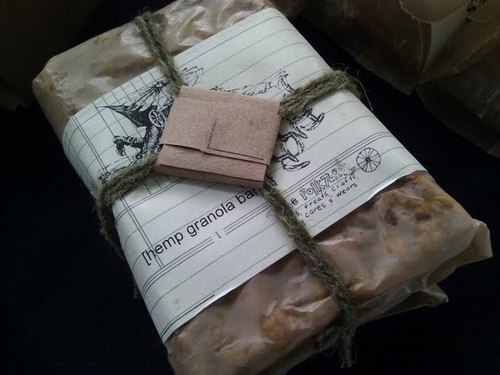
Courtesy of the Cottage Food Bill - Folk Tory Hemp Granola Bar
From the Real Time Farm website
Is Ann Arbor really a "foodie" town? Many people would say it is, and not as a compliment. Lately it seems "foodie" refers to the well-heeled set who enjoy parties with wine that's more expensive than I can afford and cheese so rare I'll never taste it. If you're a foodie, you'd probably give your first born child for the chance to have some herb-infused foam and parmesan marshmallows at El Bulli.
Foodie is a term that divides.
But there is also something being called a "food movement" that can unite. It's a host of new ventures like Eat, Mark's Carts, The Brinery and Harvest Kitchen that are bringing investment in the community and jobs to young people; it's programs like Double Up Food Bucks and Prescription for Health that are providing fresh produce to people eligible for food assistance; it's community involvement in projects like Agrarian Adventure, Edible Avalon and Friday Mornings@SELMA that are turning ideals into reality.
This food movement is fueling some really creative economic and demographic change in our area. Change that may even have the potential to stop Ann Arbor from hemorrhaging its young people to Portland.
I need to keep that hope in mind with the endless stream of radio hosts theorizing on the effects of a coming government shutdown and dire predictions for gas prices over $4 per gallon. That uncertain future brings sharp focus to this quote from Lester Brown on possible economic collapse and how much food we don't have to sustain ourselves through it:
"Probably the best place to be in this situation would be on a subsistence farm in a village in Sub-Saharan Africa or someplace that's not much affected by what happens in the rest of the world. I think most people don't realize how vulnerable we are. For example, the food supply in the average city in the United States, if it's not daily renewed, would run out in about three days. There's not much of a buffer there. The system can come apart pretty fast."
So if the supply trucks stop running, for whatever reason, just three days worth of food on our grocery store shelves? In a county that spends over $1 billion dollars per year on its food, in a state with a $64 billion dollar per year agriculture industry, that doesn't seem like very much. (That $63 billion number was in 2007. Jennifer Holton of the MDA informs me that the most recent data from a 2009 MSU Study Shows 12% Growth in Agri-Food Industry "Food and agriculture sector generates $71.3 billion for the state economy.")
At the same time that I start wondering about surviving the post-apocalypse, there are dozens of signs, little green seedlings, that demonstrate community food security is a concept that is taking root here — new farms, new markets, new ideas, new opportunities.
The number of CSA (Community Supported Agriculture) farms continues to grow. We've reached more than two dozen CSAs in our area now. The folks at LocalHarvest published a great animation demonstrating a nationwide trend in the Growth of CSA 1984-2011.
Earlier this week, the Ann Arbor Farmers' Market Commission voted unanimously to recommend moving forward on a Wednesday evening farmers' market, to be piloted from May through September from 4:30-8:30 p.m.
The original report by Mary Morgan, Idea for Night Farmers Market Floated, seems to have been picked up by the New York Times. Market manager Molly Notarianni mentioned at the commissioner's meeting that she was interviewed by the Times for a piece they'll be running on the trend in night time markets — as places young people want to hang out.
This evening market will be an opportunity for new vendors and will be unencumbered by the byzantine rules of seniority that have kept out and marginalized many of the new, young and progressive entrepreneurs at the current Ann Arbor Farmers' Market.
For example, the Folk Tory, a new-school humanized version of the "factory," and a collaborative effort is producing "herbal and medicinal teas, vegan and gluten-free baked goods made with all natural ingredients." I have been loving their delicious Chai Latte Muffins, hemp granola bars and energizing Intergalactic Space Suit Tea.
Hopefully ArborCycle, the bicycle powered produce delivery and courier service run by Ed Weymouth, will be able to get some good visibility at the new market. The service is an innovative way to get your produce or your CSA farm share home. It's $8 for produce delivery within one to three miles, with discounted rates for 10 trips.
It's encouraging that we have new farms in our area that are pioneering new approaches to a resilient food system — one that has more than three days worth of food in it.

Skinny Farm Neighborhood Supported Agriculture Farm
From the Skinny Farm Website
Skinny Farm of Scio is a partnership between a young guy and an older guy which is tying the community aspect of the CSA even more closely to a specific location, calling itself a "Neighborhood Supported Agriculture" or NSA farm. Skinny Farm of Scio is looking for members who live within a mile and half. 

They say: "At Skinny Farm, we take it (the CSA) a step further… um, closer, by adopting what we call a Neighborhood Supported Agriculture (NSA) model. We like this concept because it brings neighbors together instead of keeping them separate."
The Family Farm is a new 24-week biodynamic CSA in Belleville. The fact that The Family Farm is run by a young woman puts it among the fastest growing farm demographics in the country. The fact that she is an African American puts her among the rarest demographics.
In addition to the CSA, they are selling eggs, chicken, pork, honey, mushrooms and produce by the pound. Thanks to their hoophouse, their first CSA delivery will happen the first week of May — several weeks before most others — and will include sugar snap peas, Osaka purple mustard greens, kale, turnip greens, spinach, collard greens, radishes, sunflower shoots, salad mix, endive, head lettuce, chives, carrots and kohlrabi.
The CSA costs $600, and they say: "We offer weekly deliveries, on Monday to The Jolly Pumpkin in Ann Arbor and at both Ypsilanti Farmers Markets on Tuesdays and Saturdays. The season lasts for 24 weeks from May to November. We supply two custom tote bags for produce as well as newsletters containing recipes, farm news and topical articles. In addition to the weekly share, members will have the opportunity to purchase additional farm generated items, such as honey, eggs and mushrooms, although it is our desire to provide these items in some of the CSA shares."
And if that weren't enough, they're going to be farming some aquaponic shrimp!
Green Things Farm CSA is launching this spring from the Tilian Farm Development Center's Four Season Farmer Development Program, together with Bending Sickle Farm (pork and poultry CSA) and Seeley Farm (wholesale greens). Green Things Farm CSA, the joint effort of a young couple, will offer three 15-week CSA seasons.
Summer will include May - September; fall will be September - December; and Winter is to be determined. Each 15 week season will cost $500, or $350 for a partial share.
They say: "We are currently offering two different distribution points for CSA shares. Thursday from 4-6:30 at Habe Mills Pine Lodge, 411 Longshore Drive, across from the Argo Canoe Livery and Saturday from 2-4 p.m. at the Tilian Farm Development Center, 3792 Pontiac Trail."
The Tilian Farmer Development Program is among the most exciting pieces of all. Demonstrating that it is indeed possible re-build a healthy food system using the tools at hand, it's a collaborative effort between Ann Arbor Township and the community that is giving young people a path to having a farm of their own. And giving our region the potential for community food security. Does Portland have that?
Kim Bayer is a freelance writer and culinary researcher. Contact her at kimbayer@gmail.com.
Comments
Tom
Mon, Apr 11, 2011 : 3:16 a.m.
I don't really agree with the comment: "Lately it seems 'foodie' refers to the well-heeled set who enjoy parties with wine that's more expensive than I can afford and cheese so rare I'll never taste it. If you're a foodie, you'd probably give your first born child for the chance to have some herb-infused foam and parmesan marshmallows at El Bulli." I most definitely consider myself a foodie, but what that means to me is that I appreciate and enjoy food. Certainly a nice glass of wine or a good steak is part of that, even parmesan marshmallows. But it also means a good coney island or french fry or can of spaghetti o's, all of which can be great under the right circumstances. What defines a foodie to me is a person who takes the time to not just eat their food, but know about it and where it comes from, taste it, know what they like & don't like about it, and know how they might or might not use it combination with other foods.