

Low-Carbon Diet Challenge encourages reflection about food and sustainability
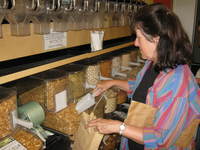
Jan Wright fills up on bulk food at the People’s Food Coop so that she can make one meal per week without disposable packaging for the Low-Carbon Diet Challenge.
When Lynn Meadows looked for more ways to be green, she started to look closer at her food. While you may think the only thing green about your dinner plate is the broccoli, it turns out that your diet choices make a massive impact on your carbon footprint.
Lynn participated in the Interfaith Council for Peace and Justice Low-Carbon Diet Challenge and said the challenge made her “more conscience of my food choices, especially the food I throw away and the packaging.”
To encourage people to eat in more environmentally-conscious ways the ICPJ Climate Change and Earth Care task force created the Low-Carbon Diet Challenge. The challenge invites individuals to sign up for one or more diet commitments and stick to them for a month.
The diet commitments included no meat one day a week, vegan (no animal products) one day a week, two meals a week made with only local food, no packaging for one meal a week, only organic foods for one meal a week or no food waste for one whole week.
“I only recently realized how big an impact my food choices, especially meat, made on the environment,” said Jan Wright, one of the 77 challenge participants.
Wright, who chose to do the “no packaging” option, found that “because we have a co-op where I can bring my own containers and buy a lot of things in bulk, it made it easier (to eat meals without packaging), but I still had to think pretty hard — especially about what to use for flavorings.”
The director of ICPJ, Chuck Warpehoski, explains the reason for the challenge: “We’ve all heard the phrase, ‘think global, act local.’ There are no issues more global than climate destabilization, and no actions more local than the food we put on our dining room tables.”
These choices can have a tremendous impact. Eating vegetarian one day a week for a year can save 84,000 gallons of water and 7,700 square feet of rain forest. Not only that, livestock production is responsible for nearly a fifth of the world’s greenhouse-gas emissions!
Al Connor, another challenge participant, echoes the “act local” theme. “One thing I love is the concept of food not traveling 1,500 miles to the dinner table. Buying and eating local is something that I am passionate about.”
Beyond the environmental benefits, participants are also eligible for a drawing at the end of the challenge for either a $50 gift certificate donated from People’s Food Co-op or a $25 gift certificate donated by Pilar’s Tamales.
Carol Milstein who chose to eat locally shared about her and her husband’s eating choices.
“We really try to eat locally, belonging to three CSAs, and don’t buy asparagus in January! We do our best to eat seasonally, although we’re not always 100 percent. I do look at where the food comes from.”
Eddie Hurst, a longtime vegetarian who is passionate about the environment, said she, “hopes to bring the idea of the challenge to her church to spread the word.”
ICPJ’s Climate Change and Earth Care group will be right there with her as it plans to bring issues of food and its relationship to climate change to local congregations during the coming year.
ICPJ volunteers promoted the challenge at local farmers’ markets and the Ann Arbor Green Fair. They discussed diet impacts with people who had never considered the environmental impact of their meals and some who had strived to eat in a low-carbon footprint way for many years.
With food traveling thousands of miles to get to your table and enormous amounts of energy going into creating one pound of beef, our diet choices are worth rethinking.
Emily Solan is an intern at the Interfaith Council for Peace and Justice.
Comments
Cas
Wed, Aug 17, 2011 : 6:04 p.m.
Just stop eating! We're all too fat anyway and not eating really saves a lot of money.
Kent Jocque
Wed, Aug 17, 2011 : 2:40 p.m.
There's been a comment or two about the health benefits of the vegetarian life style. If you're interested in finding out more about vegetarianism, here's the Wikipedia link: <a href="http://en.wikipedia.org/wiki/Vegetarianism" rel='nofollow'>http://en.wikipedia.org/wiki/Vegetarianism</a>. On a personal note. Eating is one of the things over which I have almost complete control. What I eat is a reflection of me.
Rork Kuick
Wed, Aug 17, 2011 : 2:02 p.m.
According to the American Dietetic Association: "It is the position of the American Dietetic Association that appropriately planned vegetarian diets, including total vegetarian or vegan diets, are healthful, nutritionally adequate and may provide health benefits in the prevention and treatment of certain diseases. Well-planned vegetarian diets are appropriate for individuals during all stages of the life-cycle including pregnancy, lactation, infancy, childhood and adolescence and for athletes." Here's a pretty good article summarizing some scientific research, which we really don't have enough of: <a href="http://www.sciencebasedmedicine.org/index.php/red-meat-is-it-hazardous-to-health/" rel='nofollow'>http://www.sciencebasedmedicine.org/index.php/red-meat-is-it-hazardous-to-health/</a> I eat meat and personally kill and butcher various animals, but limit it largely for environmental reasons. It doesn't have to be choice between lots or nothing.
Technojunkie
Wed, Aug 17, 2011 : 12:59 p.m.
Vegetarian diets are unhealthy, especially if your ancestors were dependent on food animals. Northern Europeans who attempt vegetarianism are asking for trouble. The nutritional deficiencies of vegetarianism can cause psychological problems, one reason why the National Socialist leadership (who were militant vegetarians) went so insane. Red meat is by far the best source of carnitine, etc. By all means buy local and organic. Buy pasture fed meats over far less healthy grain fed meat raised in CAFOs (Concentrated Agricultural Feeding Operations). Read up on Paleolithic diets that mimic what humans evolved on. Understand that a properly integrated farm like <a href="http://www.polyfacefarms.com/story/" rel='nofollow'>http://www.polyfacefarms.com/story/</a> (Joel Salatin's farm) wastes very little and produces far higher quality food with far less petroleum than industrialized farms. Support the farmers in this area who get this. Unfortunately, federally subsidized grain terribly distorts the food market and promotes unhealthy food and wasteful industrial monoculture farming.
Technojunkie
Thu, Aug 18, 2011 : 2 p.m.
Sarah Rigg: some Paleo people do eat insects, mostly further south where the big bugs are more abundant. I doubt it was practical for my northern ancestors. But hey, knock yourself out. The general theme is to eat meat, veggies and healthy fats (not industrialized fats like corn and soybean oils, etc) but some people do like to get creative. I'm stronger and slimmer than when I started Paleo.
Sarah Rigg
Wed, Aug 17, 2011 : 1:17 p.m.
It's thought that about 10-15 percent of calories in primitive diets comes from insects. You planning to start incorporating that into your diet, too, technojunkie?