

Vegan Recipes of the Week: Spelt Bread and Chocolate Peanut Butter Pillows
Emily Weingarten | Contributor
I’m going to take a lighter approach this week and offer you two new recipes, one a continuation of creATE’s Adventures With Sourdough, and the other the start of a new creATE theme, vegan cookies.
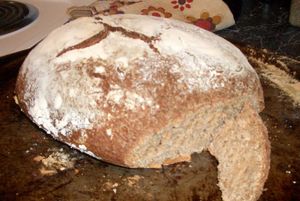
Last week, I switched gears in my sourdough bread activities to try spelt sourdough bread. Here’s a bit of history on spelt, before I explain the process of making the actual bread, which turned out to be quite involved. Spelt is one of the most ancient grains, first grown around 5000 B.C.E. in ancient Mesopotamia. In Europe, spelt is very popular and is known by many names, including “Farro” in Italy and “Dinkle” in Germany. Besides having funny names overseas and a great, nutty flavor in baked goods, spelt has a higher fiber, protein and B-vitamin content than wheat. Its tough hull makes it difficult to process by modern methods, protecting the grain from pollutants and insects, and thereby decreasing the need for pesticides. Spelt has a lower gluten content than some processed wheat products, so those with gluten sensitivities may be able to eat spelt.
Making the spelt bread was more labor-intensive than the basic whole-wheat sourdough I wrote about in previous entries. The results, however, were well worth the effort. I’d recommend starting your spelt bread in the late afternoon or early evening.
In a large bowl, mix together 5 cups whole spelt flour and 1½ teaspoons salt. In another bowl, mix together 1 ½ cup distilled water, 2 tablespoons agave nectar or other natural sweetener, and ¼ cup sourdough starter. Add the wet ingredients to the dry ingredients and mix until a moist dough forms. Cover the bowl with a plastic bag and let sit for one hour in a warm place.
After one hour, uncover the dough, stretch it and fold in half. Repeat 3-4 times. Cover again, let the dough sit for thirty more minutes and repeat. Repeat this process two more times for a total of four “stretch-and-fold” periods.
Cover the dough with a plastic bag and let sit for twelve hours or overnight.
The next morning, place the dough on a lightly floured board. Fold the sides of the dough upwards and pinch the sides together at the top. Place the dough top side down in a lightly floured bowl, cover, and let sit for 1½ hours.
Emily Weingarten | Contributor
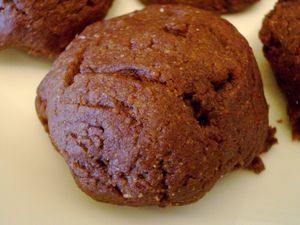
Having just purchased the book Vegan Cookies Invade Your Cookie Jar by Isa Chandra Moskowitz and Terry Hope Romero and finding that the recipes in the book have completely changed my vegan baked goods, I’m going to try to also publish one vegan cookie recipe each week. Here’s the recipe for the "Peanut Butter Chocolate Pillows" I baked last week:
Chocolate dough:
½ cup oil
½ cup brown sugar
¼ cup maple syrup or other natural sweetener
¼ cup nondairy milk
½ tsp vanilla extract
1½ cups flour
½ cup cocoa powder
½ tsp. baking soda
Peanut butter filling:
¾ cup peanut butter
¼ cup agave nectar
¼ cup nondairy milk
Preheat oven to 350 degrees. In a large bowl, combine the oil, sugar, maple syrup, nondairy milk, and vanilla and mix until smooth. Stir in flour, cocoa powder, and baking soda until mixture forms a moist dough.
To make the filling, mix together all ingredients in a medium bowl until uniform. Divide into 24 balls.
To assemble the cookies, scoop a tablespoon of dough and flatten with your hands to form a round disk. Place a peanut butter ball in the middle and wrap the dough around the filling to form a “pillow.” Place the cookies on a lightly oiled baking sheet and bake for 10 minutes. Let cookies cool on the cookie sheet for a few minutes before moving to a wire rack to cool completely. Enjoy!
Emily Weingarten is a contributor to AnnArbor.com's Food and Drink section. You can follow Emily's blog at http://a2create.blogspot.com and contact Emily at emilyweingarten@gmail.com.
Comments
Suki
Mon, Mar 22, 2010 : 11:20 a.m.
The cookies sound scrumptious and I'm going to try them -- thanks! I'm a vegetarian, not a vegan, but I also try to limit the amount of saturated fat in my diet. I had basically given up on baking goodies because the combination of butter, eggs, and other ingredients with saturated fat added up to too much (and of course, who can eat just one cookie?). Recently I started baking again, using the vegan approach. It doesn't eliminate saturated fats, but does cut back on them enough that I can enjoy, in moderation, some of my old favorites, including chocolate chip cookies! I bought and highly recommend a cookbook called "The Joy of Vegan Baking". Not only does it have good recipes and beautiful pictures, but it also has a very comprehensive section on alternatives to dairy and what works best for different types of foods.