

NEA chairman visits Chelsea, praises community's use of arts to boost economy
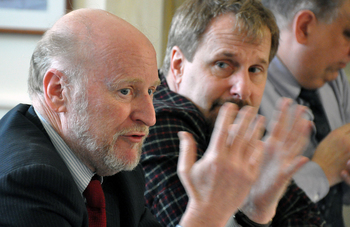
Rocco Landesman, left, chairman of the National Endowment for the Arts, speaks during his stop in Chelsea today, while actor/playwright Jeff Daniels listens.
Roger LeLievre | for AnnArbor.com
National Endowment for the Arts Chairman Rocco Landesman stopped in Chelsea Monday, telling business, community and arts leaders that the example they are setting in making the arts an area economic engine “is something I can take back to Washington and shine the spotlight on.”
As part of his Art Works tour across America, Landesman visited the Purple Rose Theatre with its founder, actor/playwright Jeff Daniels; stopped by the River Gallery; and attended a roundtable discussion on arts participation at the Common Grill attended by local business, community and arts leaders.
Landesman said there are 3 elements a community needs to succeed in such an economic development effort — a tradition of artistic engagement, a strong private-sector commitment, and a local political structure that understands the importance of the arts as an economic force.
“You have all 3, and that’s one of the reasons you are so successful,” he said. “You really are a poster child for everything we are talking about at the NEA.”
Landesman said the Art Works tour gives him the chance to listen to success stories about how the arts have become an economic engine in smaller communities such as Chelsea, and many of those at the roundtable were happy to share their experiences with him.
Jim Myles, owner of the Chelsea House Victorian Inn bed and breakfast, said two-thirds of his business is tied to people coming into town to see shows at the Purple Rose. Chelsea Mayor Jason Lindauer said that from an economic standpoint “the cachet a city has because of its arts adds to the quality of life and to the economy.”
Playwright David MacGregor, whose play “Gravity” is now in production at the Purple Rose, said part of the economic appeal of the arts to a community is that “you can’t outsource a theater, a restaurant or a bed and breakfast. People are coming to the realization that arts are a viable economic engine.”
Craig Common, owner of the Common Grill, talked about the Sounds and Sights series, held outdoors on Thursday nights in the summer, that he said draws 1,000-1,500 people to Chelsea each week. “Everybody benefits from the people who enjoy the music — the restaurants, the galleries, the people in the community,” he said.
Daniels agreed. “Like Craig said, (from that one event) 1,000-1,500 people are walking through Chelsea that wouldn’t have been walking through there on Thursday night, and every one of them has a wallet or a purse…. In our case, 35-40,000 people a year come through the Purple Rose doors 44 weeks a year and they all are looking to have a good time.”
Landesman said he has been working to change the false impression that arts jobs aren’t real jobs.
“I’ve been going around the country for a couple of months, trying to learn and observe what is going on. What I have been saying everywhere is ‘art works’ … art is a part of the real economy, and arts workers are real workers,” he said.
“There are 5.7 million full-time arts related jobs in this country and it’s important that the federal government, local governments, foundations and the people understand that this is part of the real economy.
“It’s my job and the NEA to make that point again and again until people are tired of hearing it. Many people work in the arts and have fulfilling, rewarding jobs, and those are real jobs,” he added.
Landesman will continue his tour in Detroit on Tuesday, where his stops will include tours of the Compas Center, the Alfred Taubman Center for Design Education, the Henry Ford Academy School for Creative Studies and the Museum of Contemporary Art Detroit. His visit will end with a reception and performance by musicians from the Sphinx Organization at the Detroit Institute of Arts.
Fran Brennan, representing U.S. Rep. Mark. H. Schauer (D-7th District), said after the Monday roundtable that Chelsea is unique in that it has created a formula “that is very positive and economically successful. If that was something you could bottle… Chelsea expresses its ideas in a very cohesive manner.”
Daniels said he was delighted with Landesman’s visit: “The fact that the NEA and Rocco came at all — that they called us — (means) we already won. ... It’s a red-letter day for me personally to have Rocco make the trip here.”
Roger LeLievre is a freelance writer who covers entertainment for AnnArbor.com.
Comments
clownfish
Wed, Mar 24, 2010 : 8:47 a.m.
Other than a director, were there any actual working artists at this forum? I can tell you from personal experience, making a living as an artist in Michigan right now is about as tough as it gets. While it is great Rocco came to talk and listen, without paying customers artists will be joining factory workers in the unemployed statistics. People are holding tight to what money they have, and who can blame them? Art is luxury, one of the first things to go in a budget when times grow tight. Chelsea Gallery is one example, gone and no longer offering an outlet for artists. As with many commodities, please buy local when possible!
oncebitten
Tue, Mar 23, 2010 : 3:18 p.m.
in4mation: Yes I do think that Chelsea can be used as a role model for other cities of its size. It is a small community, but that size has become one of the reasons for it's success. The people who come here from other areas come to enjoy what Chelsea offers; a very pretty downtown area with a variety of different shops, arts, eateries. All within walking distance from one another. Whether people are interested in the architecture, the theater, the Art Gallery, shops that offer everything from antiques to beading and gardening supplies to restaurants and ice cream - they can take in almost everything in a day. The economy has impacted people, they still want to get out and do things; however they aren't spending big money going on extended vacations - instead they plan day trips to places that are interesting and relatively inexpensive. Or an evening out at a smaller venue that has all of the talent that they'd find in a larger city. Chances are - if people come to Chelsea they will spend money at the shops and restaurants. That keeps our economy going. And the most interesting thing I've always oticed about ths small city is that people may come here more in the spring, summer and fall - but even in winter there is activity on our streets and in our downtown area. Many small towns have the potential to become like Chelsea - instead they almost solely upon their local residents to keep the economy going and as a result - many experience failing business, shuttered shops and a loss of residents due to the poor economy. Places like that are a bit dreary, not a place anyone wants to vist. But Chelsea - it's bright, the people are really nice and people enjoy being here. Funny - at one time when I'd tell people I was from Chelsea - they'd ask me where it's at. Now - people KNOW Chelsea and they always tell me how much they like it. It's always been the place I've wanted to live, but becuase of the growth of our arts, theater and the business' that are here - it's become a better place and a very 'sound' small community.
Tamara Real
Tue, Mar 23, 2010 : 12:53 p.m.
The people who live Santa Fe, NM or Stratford, Canada know that the arts can be a solid foundation for an economy. I think folks here don't realize just how pervasive or economically significant our cultural sector is. According to a study conducted by Ann Arbor SPARK in 2008, the creative economy accounts for nearly 1 out of 5 jobs in Washtenaw County and produces 10% of the county's entire payroll. In just the nonprofit sector alone, the arts in Washtenaw County had a $165 million economic impact (using 2002 numbers). Although that number may have changed in recent years, it still isn't chump change. Part of what Chairman Landesman is trying to do with this tour is help folks appreciate how the arts contribute to the economic well-being of their communities.
PSierra
Tue, Mar 23, 2010 : 12:28 p.m.
This is a good time to comment on the outstanding quality of the work being done by River Gallery. I've been to museums and galleries in many, many countries and their presentation and style is as good as any there is, anywhere. Most know how outstanding the Purple Rose is. But do you know about River Gallery? Absolutely world class.
A2lover
Tue, Mar 23, 2010 : 8:43 a.m.
It's quite a coup for the Purple Rose to have the Chairman of the NEA visit, a testament to the work produced there, although their play selection leaves something to be desired at times. If only "local people" realized that there is some good, professional theatre going on around the area - Williamston, Tipping Point for example - and supported it, perhaps Mr. Landesman's dream of "making the arts an area economic engine" might come true.
a2grateful
Tue, Mar 23, 2010 : 7:36 a.m.
"... is it really possible to "boost" an economy with Art?" Ann Arbor art fair... does it boost the local economy? Chelsea art activities... do they boost the local economy? Top of the Park music free music festival... does it boost the local economy? In these cases, I would opine, "Yes, absolutely." There are many more examples than just these. They do not form the economy, yet they certainly boost it. How about U of M schools of art? They not only boost local economy, they export art and artists all over the world. Many local arts are weather based. Kudos to Chelsea for their year-round support and nurturing of local art. Many arts are joy based. Yes, the arts can boost an economy. Certainly they boost the human spirit, which boosts all facets of living, including the economy.
oncebitten
Mon, Mar 22, 2010 : 7:20 p.m.
W. Vida: Believe it or not - weekends are pretty busy in Chelsea. We do get a lot of people coming in from out of town to visit. The Purple Rose, the River Gallery and Common Grill are among those reasons. The River Gallery supports our Art Programs at the schools and at the Center for the Arts in Chelsea. The CCA has programs for music and art. While I don't think and would never say that these places are the sole draw for Chelsea, they do add to the community in a way that helps contribute to the community as a whole. Okay - I love Chelsea. So I'm baised. But it is a cool little city. (That's strange - I will always think of it as a Village.)
W. Vida
Mon, Mar 22, 2010 : 6:01 p.m.
Purple Rose is a good thing for Chelsea but is it really possible to "boost" an economy with Art? It seems like that is sort of a weak economic foundation.