

Ralph Stanley playing The Ark, still carrying the standard for classic bluegrass
Ralph Stanley has always been a man of few words. Indeed, between his stoic personality and his status as one of the most important figures in the history of Appalachian music / bluegrass, he’s always preferred to let his music do the talking.
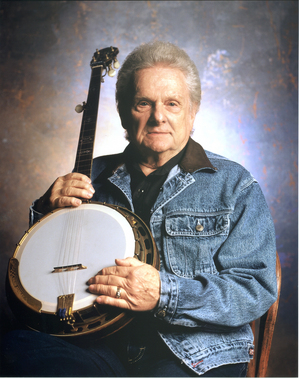
Ralph Stanley
Which is why many Stanley aficionados were probably surprised when they heard that he was writing an autobiography. That book, “Man of Constant Sorrow: My Life and Times,” was released in October, and takes part of its title from one of Stanley’s most famous songs.
In his review of the book, The New York Times’ Charles McGrath wrote that the autobiography “is a lot like the man himself: warm, folksy, down to earth, plainspoken, a little blunt and prickly at times. Mr. Stanley talks of how death ‘brung together’ his mother and father, and how he was ‘borned and raised way back in the hills.’ About musical talent, (Stanley) writes: ‘It tends to run in families like a good line of dogs, and there ain’t nothing you can do to change that.’”
Stanley, one of the idiom’s elders at age 82, comes to The Ark on Saturday with the current incarnation of his longtime group, the Clinch Mountain Boys.
Stanley has been one of the most in-demand artists on the bluegrass circuit for 60 years — but he experienced a big spike in popularity among the mainstream several years ago, after his mournful reading of the traditional mountain song “O Death” on the soundtrack album for “O Brother Where Art Thou” won a Grammy in 2002. The album was a multi-platinum performer that helped revive an interest in both bluegrass and the pre-bluegrass old-time mountain-music style.
Ralph Stanley performing "O Death" live in Indiana last June:
Stanley himself became something of a “star” at age 74 when he performed the song on that year’s Grammy broadcast. Soon after his star rose among the new masses of freshly minted Appalachian-music fans, he headlined the 2002 Down From the Mountain tour, which was essentially a live version of the “O Brother” soundtrack album. Then, in 2004, he again hit the road in a high-profile capacity, co-headlining the Great High Mountain Tour, which combined the music of “O Brother” with songs from the soundtrack to the film “Cold Mountain.”
PREVIEW |
Stanley has also been making hay while the sun shines in terms of recordings since “O Brother” thrust him into the spotlight. Since then, more than 10 Stanley CDs have been released — including new recordings, live discs, retrospectives and reissues.
Last September, for example, Rounder Records reissued a remastered, remixed version of “Can't You Hear the Mountains Calling,” a set of traditional Appalachian songs first released in 1985, and which showcase the close-harmony singing of Stanley and Charlie Sizemore. In ’08 came a live album, “FestivaLink Presents Ralph Stanley & The Clinch Mountain Boys.”
In 2007, he released “Mountain Preacher’s Child” — a collection of bluegrass-gospel standards that were mostly recorded between ’79 and ’85. And the year before that, he released a newly recorded Carter Family tribute album. That was fitting, since the Carter Family and the Stanley Brothers are considered to be the 2 most important musical families in the history of country / bluegrass music: Ralph and his brother Carter formed The Stanley Brothers & the Clinch Mountain Boys way back in the ‘40s.
Carter, who was much more gregarious and entrepreneurial than Ralph, died in 1966, which forced the introspective Ralph to step forward after 20-some years of being content to let Carter be the group’s driving force and charismatic leader. But something else happened after Carter’s death: Ralph began down-playing the speedy, high-stepping bluegrass sprints that Carter favored, and began focusing on the more brooding, pre-bluegrass mountain ballads of the 1920s-‘30s.
“Yeah, I suppose I brought the music back to its roots a bit,” Stanley told me a few years ago in an interview for The Ann Arbor News. “I went back and got the older songs. And we never did a capella (singing) with Carter. I was the first one to start doing that again.” One longtime local Stanley fan is Charlie Roehrig, who sings and plays guitar for the venerable Ann Arbor bluegrass band, the RFD Boys.
Roehrig recalls first seeing Stanley in 1972 at the Bill Monroe Bean Blossom Bluegrass Music Festival in Indiana. “He had Keith Whitley on guitar and Ricky Skaggs on mandolin, when they were both just teenagers,” remembers Roehrig. “At the time, I was more of a Jim and Jesse fan — I liked their sweet, high-tenor sound, and what struck me about Ralph and the band at that time was how mournful they sounded, and how much soul they had.
“You know how bluegrass is often characterized as having that ‘high lonesome sound’? Well, Ralph’s voice isn’t high, but I think it’s the most lonesome voice I’ve ever heard sing this kind of music. He’s just got one of those natural tenor voices that just gives me the chills,” effuses Roehrig. “Even on the songs where he isn’t singing the lead part, you can really hear his voice in the mix, and you’re very aware of it. He doesn’t have to be singing the lead for his voice to sound noteworthy and amazing.”
When the book came out, Stanley talked to the Times about his longevity — and said that the secret, for him, was that he never changed.
“I give myself credit for being in this business for so long,” said Stanley. “I started out the way I was raised, in the old-time mountain style, and I’ve never wavered from it. I’ve always stuck to my roots. I think that means a whole lot to the audience — the people knows exactly what to expect.”
Kevin Ransom is a free-lance writer who covers music for AnnArbor.com. He can be reached at KevinRansom10@aol.com.