

How to keep your basement dry
This weekend’s weather has brought many questions to AnnArbor.com in regards to how to keep your basement dry.
There are several reasons a basement could experience water problems and many alternatives in fixing them.
Fortunately there are inexpensive tips to help keep “Niagara Falls” out of your home.
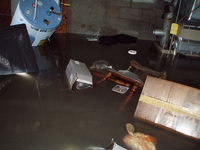
This March photo by the Massachusetts Dept. of Environmental Protection shows a home heating fuel release following heavy rains and flooding in Winchester, Mass.
Photo by flickr user Massachusetts Dept. of Environmental Protection
1. Be sure your downspouts are slanted away from your home. Fortunately, I have seen many homeowners who repaired their own basement leak by spending an extra $10 on gutter extensions, after they were given $3,000 estimates to dig up their foundation to correct the leak.
2. The landscape must slant away from your home. Take a walk around the perimeter of your home and look behind the bushes - you may be surprised. If you have a small problem area, dig up the grade approximately two or three feet down and lay down 1 mill plastic. Then refill in with pea gravel and top soil. Pack tightly and repeat. Make sure the grade slopes away from your home.
3. Sump pump. Every home with a sump pump should have a backup sump pump that is tested regularly. There are several pumps on the market ranging from $70-$500. The price is dependent on quality and the additional “bells and whistles.”
- Check the rating. Commonly measured in horse power (HP) and Gallons Per Minute (GPM), these ratings will determine the amount of water that can be flushed in a given period of time. The more water the higher the horse power. Common HP ranges from 1/6 to 1/2 hp.
- The sump pump housing should not be sheet metal. Choose a non corrosive such as cast bronze, alloy or stainless steel.
- Is noise an issue? A submersible pump maybe a good choice. Not only can these pumps be more energy efficient, but also they can they have lower motor noise. Now you’ll be able to hear the TV clearer in that finished basement. These pumps are typically more expensive than a pedestal sump pump.
4. Get a sump pump alarm. Typically ranging from $12-$80, these alarms will activate and notify the homeowners once water level is too high.
5. Have a backup plan with a backup sump pump system, but choose carefully. In the event of power failure or a broken float, a backup sump pump will prevent basement flooding by engaging a second separate pump. There are two basic types: battery powered and water powered.
- Water powered. The water-powered backup sump pump is triggered by water pressure to operate, not electricity. If a storm cuts off your power, this pump will automatically turn on. Be aware, many of our readers have a well system and cannot use a water supplied backup, which leaves the battery system as the other alternative.
- Battery backup. This system can be slightly more affordable and easier to install. However the battery has a limited life span. Because most backup systems are rarely be used, ensure it has a battery control unit test system to alert when the batteries dies or have failed components.
6. Slight wall leak?
- Occasionally leaks in small cracks or holes such as rod holes can be fixed permanently for less than $50. Take a small cork and stuff it in to the hole and fill it with hydrolic cement.
- In my own home, we had water dripping down the walls that was cured by a basement water-leaking sealer such as Drylok or Easy Living Basement Waterproofing Paint.
There are several reasons for a basement to leak such as a broken drain tile, cracks in the foundation or an uneven foundation. In these events, there are professional waterproofing companies that specialize in keeping your basement dry. As with any contractor working in your home, be sure to do your homework - verify license and insurance and check with the Better Business Bureau and references.
Paul is a State of Michigan Licensed Builder. Paul serves as President and founding member of Nationally franchised HandyPro Handyman Service, servicing Washtenaw, Wayne and Oakland Counties. www.handypro.com. Listen to Paul every Saturday at 11 a.m. on “It’s Your Home, Let’s Talk About It” WAAM Talk 1600AM. Email questions or comments to kpaul@handypro.com
Comments
Andrew Comai
Wed, Jun 9, 2010 : 3:04 p.m.
Hydraulic is spelled wrong in your article and you pointer on sheet metal housings on a sump pump makes no sense ( you say it should not be sheet metal before your recommend sheet metal). Metals you mention aren't non-corrosive, they are corrosion resistant or are non- corrosible. "Corrosive" should be used to describe the agent that causes corrosion. Anyway, most sump pumps are made of plastic ( not on your list) and my made in the USA painted Cast Iron seems to work very well even with a bit of corrosion.