

Mission Possible: Green building fest to offer house tours, lectures, demos and more
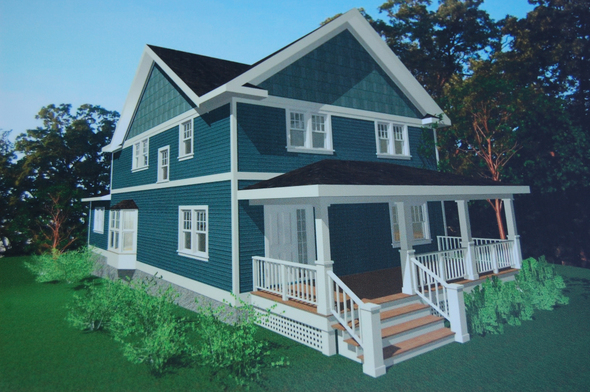
An artist's rendering of what the Meadowlark Builders' LEED platinum certified modular house on Jefferson Court on the Old West Side of Ann Arbor will look like when completed. It was being assembled this week on the site.
“People tend to think of modular houses as Cracker Jack houses,” Selby said.
Instead, picture a 2,600-square-foot, two-story, highly energy-efficient, custom-made home with a large front porch, bay windows, a walk-out basement with green building touches such as no-VOC paint and finishes, paperstone counters (a recycled product) and carpet with natural backing.
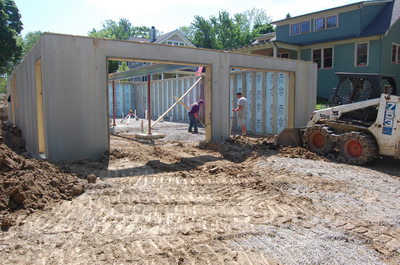
Workers prepare the site last week for the the Meadowlark Builders' LEED platinum certified modular house on Jefferson Court on the Old West Side of Ann Arbor.
Janet Miller | For AnnArbor.com
The house will be one of three stops on the 2011 Mission Zero Fest scheduled for June 11-12. The fest will include lectures, workshops, discussion and product demonstrations on green building and a tour of three of Ann Arbor’s greenest houses: Mission Zero, America’s oldest net zero energy house; the Nautilus House, a whimsical 1953 tri-level house near Nichols Arboretum that won LEED platinum certification and the Jefferson Court house.
The Jefferson Court house breaks stereotypes about modular building, Selby said. It starts with a Superior brand wall foundation, where the layers of concrete and insulation are separated to make them thermally isolated for a tighter building envelope. Foam between the layers creates a thermal break so cold air doesn’t enter in the winter and the air conditioned air doesn’t escape in the summer.
The siding will be fiber cement, a super durable material that’s considered green because of its long-life.
A geothermal system will provide heating and cooling and there will be an energy recovery ventilation system that allows for fresh air while conserving energy. There will also be a plumbing distribution system that controls the delivery of hot water, making it more efficient and cutting waste. There are even motion sensors in the bathrooms that signal hot water.
While Meadowlark Builders will finish the house, most of the structure was built inside the General Housing Corp.’s Bay City factory under Meadowlark’s specifications. The house was delivered, with plumbing and electrical wiring already in place, in four sections that are bolted together.
Because of the efficiencies of the factory - there are no weather delays and little waste - the house will cost about $75,000 less than had it been traditionally constructed on site, Selby said.
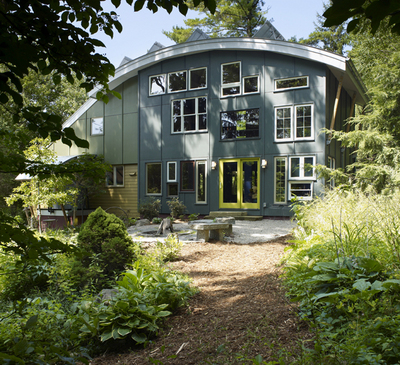
The Nautilus House, an artistic and deeply green remodel, is one of the three houses on the Mission Zero tour.
Courtesy photo
There will be two other tour stops:
>> Kelly and Matt Grocoff’s Mission Zero house, named one of USA Today’s seven Best Green Houses of 2010 and America's oldest Net Zero energy home. Net zero houses at least break even when it comes to energy consumption. The Grocoff’s 110-year-old house produces an estimated 600 kWh more than it consumes and they have no utility bill. The fest will be based at the Mission Zero house, 217 S. Seventh St.
>> Nautilus House: North of Geddes Avenue, this artistic and deeply green remodel is Michigan's second LEED platinum residential remodel. Ann Arbor’s Architectural Resources designed the project and the builder was Meadowlark. Geothermal heating and cooling, a striking wall of mismatched “found” windows, tight building envelope, solar panels and thermal siphoning tower makes this a green project. Also, brick from the original masonry chimney was recycled as the new brick floor of the bio-solarium.
For more information about the fest or to buy tickets ($8 in advance), go to web.me.com/kellygrocoff/missionzerohouse/Tour_Info.html. Tickets are available at Downtown Home and Garden and Nicola’s Books.
Comments
shepard145
Sat, Jun 11, 2011 : 12:37 a.m.
PART 2 Your green tinted glasses may be blinding you to the real market, which is energy efficient homes designed by adults for adults. Solar and wind are for fools when the real goal is to use the cheapest, most reliable power possible. Here are the smartest "investments" for those so inclined to invest in anything until after November 2012: 1. Invest in the time to vote out democrats who have and are conspiring to skyrocket the cost of energy because the fools think they control the earths weather; 2. Invest in good windows and an envelope that includes rigid insulation; 3. Insist on a mechanical system designed by an experienced residential PE for layout, equipment and controls; 4. Invest in a more controllable and/or zoned HVAC system then the typical - maybe include an integrated wood stove if you're the type; 5. Invest in trees to shade your house; 6. Make sure your attic is well ventilated; Recycled anything, water savers, low VOC anything and just about everything else the eco crowd wants to sell you is probably eco nonsense. If you Meadowlark focuses it's marketing on energy efficient homes, you as eco warriors also won't have to answer any thorny questions about how eco carbon wasteful it is to build any new homes when the state is already over built by thousands. ...because there's nothing more eco neutral then a house that was never built. LOL
shepard145
Sat, Jun 11, 2011 : 12:22 a.m.
Your welcome - you could do even better by investing in an architect with some actual talent but that's your call. Ann Arbor has a handful of them. The basis for this house seems to be the absurd claim that US consumers control the earth's temperature with the purchasing choices they make. "Carbon neutral" is code for "clueless eco loon with more money than sense". How can you as an eco warrior justify using the world's "dwindling natural resources" or whatever to over build new homes when years of existing houses are still on the market at bargain prices? …that seems like the ultimate in wasted carbon that can never be overcome up by the sustainable delta between the them? ....LOL, I know - and Gore has three mansions and a private jet! wink wink I would strongly debate your ROI claims for a LEED anything house. The requirements normally demand big cash up front for debatable very very long term future returns, sticking the buyer with the surprises when things don't pan out. One of the reasons for this is that wasteful eco activism and social justice costs built into everything pushed by the USGBC – it goes far beyond sustainability. For example, try to explain their "certified wood" scam to the average home buyer and most will throw you and your clipboard off the porch. That is true for many points, few of which make any economic sense. I would also love to see evidence that your homes are healthier for the average family. Building with products low or free of VOC's and formaldehyde was not a health issue until it needed to be. It was another part of the "global warming" – "greenhouse gas" scam but later rebranded to give it more traction for the regulators – no science required.
Doug Selby
Fri, Jun 10, 2011 : 4:01 a.m.
Thanks for giving us credit for good design Shepard145 - I appreciate it. Consider that this home, at over 3600 heated and cooled square feet in a compact footprint, will heat and cool for about $55/month. With a reasonable future investment in solar panels, this house can go net-zero and cost the owners nothing to operate, and less to maintain the home as it is built with good durable materials. The green investments in this home will return about 7% on investment even at modest energy price increases, and when taken over 20 or 25 years this home will return tens of thousands more than the original investment. The occupants will also get to live in a measurably healthier, more comfortable home that has had the mechanical systems designed for performance. As it turns out, many people just want a home that performs a lot better and gives them money back. Some of them also believe, as do I, that conserving natural resources and being resourceful is a good thing, and will only make our country stronger. So it's just the way some people think, it doesn't make us gullible. And for the record nobody's got a whole lot of extra money these days!
shepard145
Fri, Jun 10, 2011 : 2:01 a.m.
Meadowlark deservces credit for designing a LEED house that doesnt look like a tin can or factory. ...but ask yourselves WHY residential green construction matters? What about them is important to you? Why do you want to save water with rainwater toilets in a state where water is beyond plentiful? LEED houses are an absolute JOKE and represent nothing but a foolish waste of time, effort and money. American builders are the best in the world at building economically efficient housing and they laugh at this "green building" garbage unless they think they can make a buck with the gullible Prius drivers who have more money then sense.
A2K
Thu, Jun 9, 2011 : 1:16 p.m.
This is very inspiring! Husband and I have a dream to build one of these in 10 years...and I think we'll be able to do it! <a href="http://www.formworksbuilding.com/photos.html" rel='nofollow'>http://www.formworksbuilding.com/photos.html</a> with rainwater toilets, solar-heated water, and a few other things...hopefully these local green builders will be bigger, better, more skilled, and raring to go on our project :O)