

5 additions that turned heads at Michigan Stadium over the past two decades
The Big House of today looks very different than the stadium of 20 years ago.
In the past two decades, University of Michigan officials have installed and uninstalled a decorative halo around Michigan Stadium, spent more than $2 million on a grass field only to revert to artificial turf 12 years later and added 81 luxury boxes to the stadium, even though a recent college president said he was opposed to the idea.
The stadium that holds the world record for attendance levels at a football game is undergoing another visual change: officials plan to install a $2.8 million scoreboard outside the stadium by fall 2013.
Here's a look at some additions (and demolitions) that changed the visual impact of the stadium through the years.
Ann Arbor News file photo
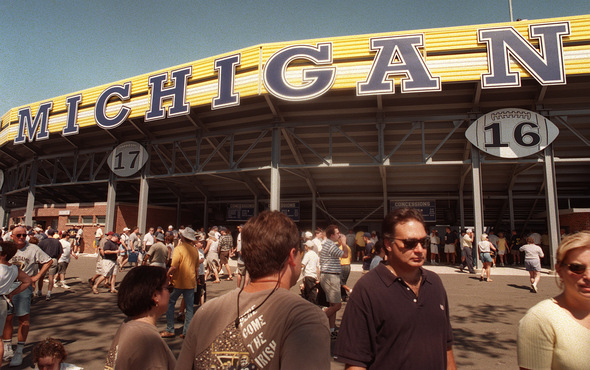
The halo
The halo is probably Michigan Stadium's most disliked addition, drawing bitter criticism from fans and alumni. The halo was torn down before the fall 2000 season, just two years after it debuted.
It included icons and letters over seven feet tall, spelling out words like 'Victors' and 'Michigan.' According to Ann Arbor News articles, it cost about $50,000 to remove the letters and another $50,000 to repair the affected areas of the stadium.
Lee Bollinger, U-M president at the time, told the press that "the depth of the criticism and concern" convinced officials to dismantle the halo.
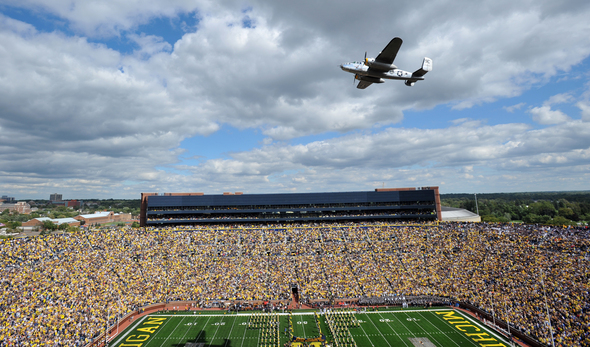
Michigan Stadium luxury boxes were constructed as part of the recent $227 million renovation.
AnnArbor.com file photo
Luxury boxes
In 2010, U-M unveiled a $227 million renovation of Michigan Stadium. The renovation included the addition of club seating and 81 luxury boxes — the first such boxes in stadium history. The boxes, located on the east and west sides of the stadium, changed the exterior view of the stadium, which had previously included bleacher seats and a press box. The original 1950s-era press box was demolished in 2009 as a part of the renovation.
The luxury boxes were installed 10 years after former U-M President Lee Bollinger told reporters that the school had no plans for such an addition.
"The character of football at the University of Michigan must remain collegiate," he told the Ann Arbor News.
Former athletic director Bill Martin, who oversaw the construction of the premium seating, said the boxes were necessary in order to finance the renovation project without a significant increase in ticket prices, according to an Ann Arbor News article from 2009.
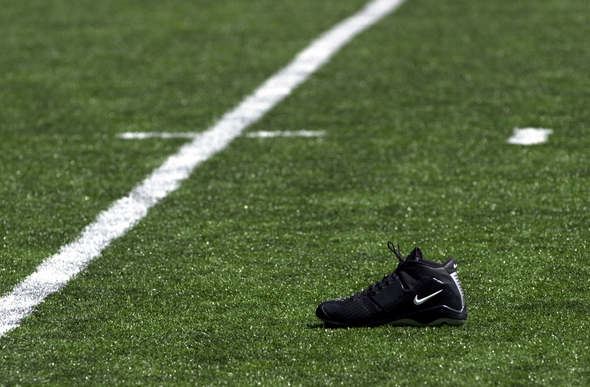
In this 2003 photo, former U-M football player LaMarr Woodley ran out of his shoe during the season opener, supposedly because the traction on the new turf was "so good."
Ann Arbor News photo
Turf changes
In 1969, U-M installed artificial 'tartan turf' in Michigan Stadium for the first time at a cost of $250,000, according to archives. Artificial turf was installed again in 1975 and 1982, but in 1991 the school returned to grass. That year crews planted 8,000 square yards of sod at a cost of $2.25 million, according to U-M archives.
Ann Arbor News articles indicate that the grass turf was difficult to maintain, and in 2003 Michigan Stadium switched back to artificial turf, which cost $620,000 to install, according to archives. The stadium still contains artificial turf today.
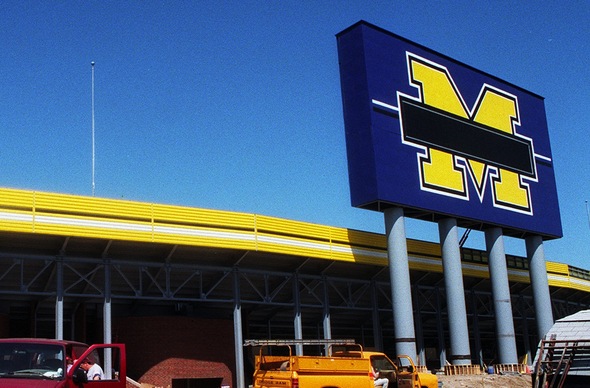
One of Michigan Stadium's two scoreboards used to have a marquee on the back.
Ann Arbor News file photo
Old scoreboards
Michigan installed its first video boards on the south and north ends of Michigan Stadium in 1998. While the arena had held electronic scoreboards since the 1930s, the video boards were larger and more high-tech than any of the school's previous installments.
One board included a thin, horizontal marquee that highlighted game dates and upcoming events. Athletic director Dave Brandon said earlier this month that the marquee was "frankly not very useful and not very appealing," but that a the new $2.8 million iteration planned would likely be more successful.
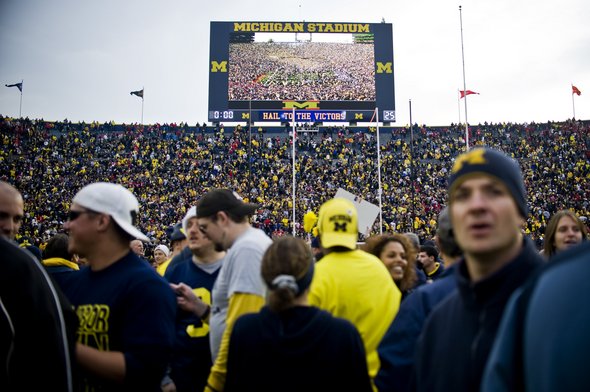
New scoreboards at Michigan Stadium were installed in 2011.
New scoreboards
These two new 4,000-square-foot Michigan Stadium scoreboards were installed before the start of the 2011 season. The two LED video boards are the largest scoreboards in university history and were used last season to show real-time game play, highlight student athletes in non-revenue sports and run public service announcements.
The boards and sound system are part of a $20 million package that also included new scoreboards for U-M's basketball and hockey venues.
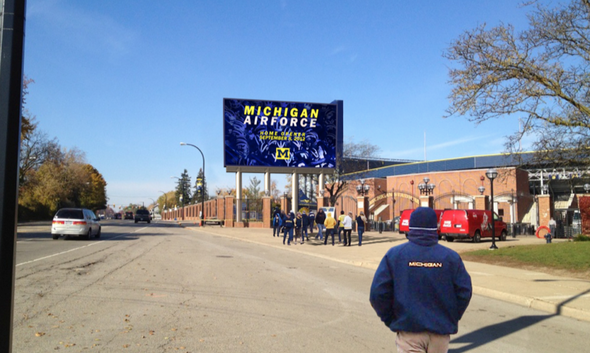
A rendering of the proposed $2.8 million marquee to be installed at Michigan Stadium this year.
Photo courtesy of University of Michigan
Coming: $6 million paint job and $2.8 million marquee
Brandon recently announced plans to repaint Michigan Stadium and install a 48-foot-wide marquee outside the arena. The marquee, he told regents last week, would highlight upcoming athletic events and non-revenue sports.
""It's not at all unusual for athletic campuses ... to have some sort of display board activity," Brandon said on July 19.
Kellie Woodhouse covers higher education for AnnArbor.com. Reach her at kelliewoodhouse@annarbor.com or 734-623-4602 and follow her on twitter.
Comments
Cptn.cakeeater
Sun, Jul 29, 2012 : 1:18 p.m.
Think there is any chance they just might sell advertisments? Its all about the $$$$$$$.
alnan
Sat, Jul 28, 2012 : 6:51 p.m.
GADS!!! That is all I can say!!! GADS!!! Do not do this!!!! Please!!!!
Doug
Sat, Jul 28, 2012 : 6:40 p.m.
Another "Halo" project that will be dismantled when the public makes fun of it. But, the athletic department has to do something with their money.
boo
Sat, Jul 28, 2012 : 6:30 p.m.
I agree with most that the marquee is not a good idea. Remember that the marquee is not for us. It's for the recruits. they like the glitter and glow. If you recall, a number recruits actually liked the halo. And if it means we get a few more 5 star recruits, you can bet Davey boy will do it. Because in the end, those 5 star recruits bring BIG MONEY to the athletic department.
Billy Bob Schwartz
Sun, Jul 29, 2012 : 1:54 a.m.
yes, but couldn't it be built on an elevator that would take it under the ground, and could be elevated for show when recruits come to town, and then put away until next time? Please!!?
The OSU
Sat, Jul 28, 2012 : 6:26 p.m.
Once again, Blue has missed the point. Stadiums periodically need to be refurbished and that inherently includes change. (The warm glow of gas lamps was lost when the electric bulb became commonplace. That doesn't mean that "old is good" and the "new is bad." It's just different.) Preserving the past is important ONLY when something is worth preserving. What is architecturally significant about Michigan Stadium? Not much. It's big, I'll grant you that. Other than that, it's just a big oval set of bleacher set into a depression in the ground. By contrast, Ohio Stadium, the renown "Horseshoe" is architecturally interesting and its inherent character needed preservation during renovation. Point #2: "Walmart Wolerines???" I've always known Blue alums to be elitist and arrogant, looking down at any land-grant school. But know you're making fun of your own supporters merely because they might not have had the opportunity to attend your precious "Michigan." Bottom line: "The Michigan Miystque" exists only in your own mind. The rest of the world thinks it's a joke.
Billy Bob Schwartz
Sun, Jul 29, 2012 : 1:52 a.m.
ohio....by horsesho are you referring to that big red fish in Columbus? BTW, isn't it interesting that the school that chose the horse chestnut as their school mascot chose to build a stadium that once looked like a horseshoe? Look harder next game: it's now a big red bluegill. Beautifully so, I must say. Guess I'll stop right there with the horse references. The Michigan Mystique also exists in the minds of the 45,000 or so who apply for admission each year. Well, and in the mind of the world. And, well, in the mind of ohioans, too, I think.
MRunner73
Sat, Jul 28, 2012 : 10:25 p.m.
You gotta admit, after surveying the landscape, the concept and eventual construction of a large football stadium on a hill top setting was quite ingenious. That was back in 1927 in then, rural Ann Arbor. I do agree with your point #2 so as a Michigan Alum, I welcome ALL supporters. Exception being your bottom line. All college football fan bases think alike in regards to the team they support. GO BLUE!!
Deborah Gibson
Sat, Jul 28, 2012 : 4:46 p.m.
Does the energy demands of the big house electricity affect the West side grid of Ann Arbor? or does it have its own power? How many more led lights (several thousand) in the new marquees ? Just wondered.
Tag
Sat, Jul 28, 2012 : 6:20 p.m.
I suspect it has it's own power source. Recall the power outage last year that effect the new scoreboard.
hail2thevict0r
Sat, Jul 28, 2012 : 4:39 p.m.
So basically....every addition done in the last 15 years. The article should just be titled, "every addition to Michigan Stadium has always been criticized".
jwally
Sat, Jul 28, 2012 : 4:19 p.m.
"Former athletic director Bill Martin, who oversaw the construction of the premium seating, said the boxes were necessary in order to finance the renovation project without a significant increase in ticket prices, according to an Ann Arbor News article from 2009." . If my memory is correct, 2 years ago seats were $50 ($65 for premium games) plus the mandatory Preferred Seat Donation fee. This year seats are $75 ($90 for premium games) plus PSD. I would call that significant. Of course Bill is gone and Dollar Dave is now in charge
Stuart Brown
Sat, Jul 28, 2012 : 11:54 p.m.
Your right to imply Bill Martin was lying with the above quote. By my calculations, the $25 per ticket increase in price pays for double the $225 million renovation in 30 years (I assume 5% interest with 3% annual increases in the ticket prices.) Interesting how part of that $225 million construction cost included 81 luxury suits which will generate at least $5 million per year in additional revenue. Not only is the average ticket holder paying for the improvements he/she will experience, but the cost of constructing the luxury boxes as well! There is nothing collegiate about Michigan Football, profits rule and chumps pay through the nose!
Tom Todd
Sat, Jul 28, 2012 : 4:04 p.m.
Dave for President
aataxpayer
Sat, Jul 28, 2012 : 3:30 p.m.
See www.nytimes.com/2010/03/02/technology/02billboard.html?pagewanted=all for more info, both for and against digital billboards and about digital billboard distraction. FHA studies are being completed this summer - should we wait a while and get the results?
MRunner73
Sat, Jul 28, 2012 : 4:13 p.m.
Yes, I can wait and I wonder what group is funding those studies and who is compling those statistics.
aataxpayer
Sat, Jul 28, 2012 : 3:22 p.m.
The marquee is going to distract drivers and will likely result in serious injuries to pedestrians. This is a very bad idea.
MRunner73
Sat, Jul 28, 2012 : 4:11 p.m.
Have you ever seen the marquees at Times Square in NYC? How about the Strip in Las Vegas? They would be considered far worse distractions to any marquee on Stadium Blvd. I haven't ever heard or read about numerous traffic accidents or harm to the many thousands of pedrestians in those aforementioned cities. I can only wonder about some of logic applied in this case. I hope you see my point.
Jake
Sat, Jul 28, 2012 : 3:20 p.m.
Now it's time to add a couple seating decks to the south end zone and find other ways to keep the noise inside the stadium
jpud
Sat, Jul 28, 2012 : 3:06 p.m.
Just like professional sports have salary caps, the NCAA nees to insitute budget caps on collegiate sports. Frankly, when a school with a budget of 120 million dollars a year plays a school with an ahletic budget of 12 million dollars where is the "sport" in that? KEEP COLLEGIATE SPORTS COLLEGIATE. The University needs to step up and exert insitutional control over the athletic department, before an external force does. The values of the atheltic department need to reflect the academic, not corporate values of the institution. We had a gem like Fenway Park, and we let some fools destroy it.
Blue Marker
Sun, Jul 29, 2012 : 2:02 a.m.
Remember all the "other" sports football pays for. Just sayin'
MRunner73
Sat, Jul 28, 2012 : 4:03 p.m.
How you seen how large and rather gaudy some High School football stadiums look like in parts of Ohio and the Deep South? It just doesn't stop at the collegiate level anymore. I'll take Fenway Park or Wrigley Stadium anytime. Old Tiger Stadium had a larger seating capacity than Comerica.
alterego
Sat, Jul 28, 2012 : 2:44 p.m.
I'm pretty sure that no one will be tempted to throw rocks and other objects at a roadside marquee. Plus I'm sure that neighbors will enjoy seeing the light show at all hours of the night. Hopefully it will have speakers to blast The Victors or beep randomly.
Tag
Sat, Jul 28, 2012 : 6:18 p.m.
Exactly what neighbors? It's on a completely non-residential block. I'd estimate that the nearest residential home is over 1/4 mile away.
MRunner73
Sat, Jul 28, 2012 : 2:25 p.m.
Michigan Stadium is the face of the Athletic Department. I hesitate to say the face of the University and some will argue such that is also the case. Just like the Auto Industry progessed from the Model-T to the the vehicles we drive today, so it is that Michigan Stadium has undergone periodic renovations to keep up with the times. I wonder how many people would rather go back to the old "brick" style cell phone over today's smart phone. The analogy fits regarding the status of Michigan Stadium. Bottom line: The series of reovations to Michigan Stadium is all about progress and keeping up with the times. Name one stadium in the Big Ten that hasn't had any reovations in the past decade and I'll show you an athletic program in the douldrums. Bring on the new marquee, too. GO BLUE!!
MRunner73
Sat, Jul 28, 2012 : 3:59 p.m.
jcj: your four points about changes are spot on and I sure wish we could go back to those days. If we had the same volume of traffic and demand for gasoline back 40 to 50 years ago, perhaps we'd be only paying half a buck a gallong for that stuff. As right as you are, the comparisons you make actually proves my point.
jpud
Sat, Jul 28, 2012 : 3:14 p.m.
Renovations need to be done in good taste. Some have, some have not. The marquee is a garish afront to decency, more like an atrocity that one would see outside a Las Vegas brothel than a tiara that befits a distinguished University athletic program. If you want Vegas, go to Vegas. Actually, let's send the AD their on our dime to scout out some more brilliant ideas for how he can jazz up collegiate sports.
jcj
Sat, Jul 28, 2012 : 3:08 p.m.
MRunner73 Billy Bob has it right! Not all change is good. When I was a kid we did not have to lock the door! When I was a kid gas was about 20 cents a gallon! When I was a kid I learned how to do math without a calculator! When I was a kid I could get into M Stadium for $1.
a2roots
Sat, Jul 28, 2012 : 3 p.m.
I am all for renovations. They have been much needed and for the most part well done. However, the addition of this marquee is not a renovation and it adds nothing to either the stadium or Crisler arena. Who is the target population that will benefit from it and or find it useful? It is an absolute waste of money and if put up will end up being torn down.
Billy Bob Schwartz
Sat, Jul 28, 2012 : 2:54 p.m.
MR...Not all changes are positive. Yes, there will be changes, and it could be argued that they are for the better. Still, Michigan Stadium has always been classy, in a way that alumni and fans really appreciate. When they decided to put brick pavers on the grassy areas around the Stadium, it was a change, and in some ways an improvement, but for sure it was classy. The same goes for most of the other changes at the Stadium. Yet, there have been some that probably don't fit the cell phone analogy. One was the halo. Two was the rich guys sky seats. Three is this incredibly graceless electronic billboard. I don't care about the money. I don't care about change. I do care about crass additions to our wonderful athletic campus that are done only to show off. That's not Michigan.
a2roots
Sat, Jul 28, 2012 : 2:14 p.m.
Awful idea, bad location, will look really stupid, waste of money, serves little purpose and will eventually be torn down if the short sighted ones put it up. Don't do it!!!!
a2cents
Sat, Jul 28, 2012 : 2:03 p.m.
The entire E. Stadium Bridge Project with untold man hours of labor will cost only 10x the price of the marquee. That's nuts ! Something's amiss...
jgtrueblue
Sat, Jul 28, 2012 : 1:41 p.m.
Why are the "season ticket holders with preferred seating premiums" who fund the football stadium along with ALUMNI, not being asked for opinions regarding this marquee? This addition is an atrocity, garish and completely out of line for the class of Michigan Stadium and tradition. Simply, why are the AD and the Regents who REPRESENT the Alumni and donors, the only ones who make a decision as such?
MRunner73
Sat, Jul 28, 2012 : 2:33 p.m.
The short answer, jg, it that the system simply doesn't work that way. Perhaps, an uproar like the halo where the fans did speak out and the Athletic Department made the correct reaction to take it down, would this marquee project fail. I for one, am for it, but I hope once it gets erected, you and others will find it not so repulsive.
stevejd66
Sat, Jul 28, 2012 : 2:09 p.m.
Like "jcj" said (above), paraphrased: Give a juvenile a bunch of "free" cash and just watch what he spends it on. It appears as though Brandon will have 5 to 10 million "free" cash every year from now on. Get ready for more "garishments", on an annual basis.
Brad
Sat, Jul 28, 2012 : 1:09 p.m.
Turned heads, and in the case of the "halo" turned stomachs. Oh, yes and the new "scoreboard" ...
David Briegel
Sat, Jul 28, 2012 : 1:03 p.m.
And don't forget the most important decision that must be made before every game. Which outfit shall we pick from our ever expanding wardrobe?
Matt Whale
Sat, Jul 28, 2012 : 1 p.m.
Where are the Michigan letters now surrounding the halo? I didn't like the halo but I would like to have one of the letters.
A2comments
Sat, Jul 28, 2012 : 12:58 p.m.
The marquee is a bad idea.
J
Sun, Jul 29, 2012 : 2:34 p.m.
Good idea, bad design
Lac Court Orilles
Sat, Jul 28, 2012 : 12:56 p.m.
Michigan Stadium is awesome, period! Alumni are proud. And . . . all the Walmart Wolverines that didn't even go to Michigan and take our seats before we can buy a ticket to see our school play appreciate it too.
jcj
Sat, Jul 28, 2012 : 3:01 p.m.
Say's something about the "Alumni" if they can't even out smart us "Walmart Wolverines" We do thank you for your seats! But they will never be your seats UNTIL you pay for them!
Brad
Sat, Jul 28, 2012 : 1:08 p.m.
So how does it feel to have the "Walmart Wolverines" always getting the better of you like that?
PersonX
Sat, Jul 28, 2012 : 12:29 p.m.
If only the president of UM knew even half as much about her faculty as she does about members of the football team, staff and their stadium, the real mission of the University would be much better served ....
jcj
Sat, Jul 28, 2012 : 12:11 p.m.
Why do they do it? Because they can! Give a 10 year old five hundred dollars and watch what he spends it on.
average joe
Sat, Jul 28, 2012 : 12:37 p.m.
Agree completely. But other than "It's not at all unusual for athletic campuses ... to have some sort of display board activity", what is the real purpose of the marquee? Will it sell more tickets to non-major sports? Perhaps, but how many of those tickets are to be sold to pay for it?
xmo
Sat, Jul 28, 2012 : 12:03 p.m.
Spartan Stadium has grass and they sell that kind of grass to other stadiums around the world but it is too difficult to maintain at Michigan? What about being Green and saving the planet? I guess it is just to Difficult!
Tag
Sat, Jul 28, 2012 : 6:14 p.m.
Because of the design of the stadium, a big bowl in the ground, the university has found it nearly impossible to keep a quality real grass playing surface. The floor of the stadium is actually below the local water table and pumps are continuously running to provide drainage. The current artificial turf is a terrific product that's both attractive to the fans and a excellent playing surface.
jwally
Sat, Jul 28, 2012 : 3:54 p.m.
If you look closely at slow motion reply during a game and you will see what appears to be a splash of black dust fly when players hit the surface of the turf. This is from ground up old car tires that are placed below the artificial grass. The added rubber provides more cushion, traction, and drainage to the surface. More cushion means less injuries. Putting old tires into an athletic playing surface is better than having them sit in a dump for years and years. You may even say that it is "green".
silo
Sat, Jul 28, 2012 : 1:50 p.m.
More wasteful of resources than difficult: renovating the underlayment of the field, demolition of the drain tiles, hauling in soil... irrigation, fertilization, mowing... disposal, water, chemicals, runoff, gasoline...
Tom Todd
Sat, Jul 28, 2012 : 12:37 p.m.
too much work
brimble
Sat, Jul 28, 2012 : 11:20 a.m.
Michigan Stadium looks as good today as it ever has. Its evolution has resulted in a fairly elegant look today. That marquee is a more than little garish -- a little Las Vegas -- though.
annarbortownie
Sat, Jul 28, 2012 : 10:56 a.m.
I like the new renovations though I am not sure Michigan really needed sky boxes. As for the marquee's... where's the "Bill Board Bandit when we need him. Ann Arbor townies will remember him!!! The marquee looks like a huge eyesore!
aareader
Sat, Jul 28, 2012 : 10:34 a.m.
Will this marquee be addition #6 "to turn heads" ... away? Where is the spirit of Bollinger today? "The character of football at the University of Michigan must remain collegiate," he told the Ann Arbor News.
Bob W
Sat, Jul 28, 2012 : 10:27 a.m.
Having now seen a rendering of the proposed "marquee" and its location I think it's a terrible idea and investment. Almost as garish as the infamous halo.
alterego
Sat, Jul 28, 2012 : 2:48 p.m.
I bet you could pay someone $20K for 100 years to change the letters daily on a really nice looking sign board to announce upcoming athletic events.
MRunner73
Sat, Jul 28, 2012 : 2:37 p.m.
kilroy, the traffic hazard agruement has no basis. If that were the case, the marquee as proposed would would never be constructed. I wish you safe travels if you ever drive past it in the future, after it is completed.
kilroy
Sat, Jul 28, 2012 : 11:35 a.m.
I agree completely. It looks like it will be an enormous distraction to drivers and therefore a traffic hazard.