

10 questions for Ann Arbor City Council Member Stephen Kunselman
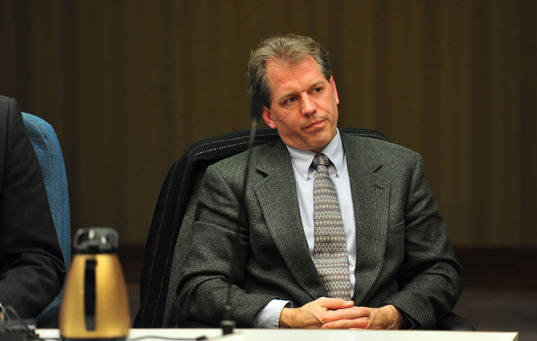
Stephen Kunselman, D-3rd Ward, recently returned to the Ann Arbor City Council after a one-year absence. He's already making waves.
Ryan J. Stanton | AnnArbor.com
After a one-year hiatus, Stephen Kunselman squeezed his way back onto the Ann Arbor City Council in November by beating incumbent Leigh Greden by a six-vote margin in the Democratic primary.
Already in his first two months back, the 3rd Ward council member is making waves - often as a critic of his own city government and sometimes the Lone Ranger during debates. For instance, when council members voted last month to move forward with designs for an estimated $750,000 sculpture by a German artist in front of the new police-courts building, Kunselman was the lone dissenter.
Kunselman sat down with AnnArbor.com to catch up on what's making him tick and what's ticking him off. Read on.
Q: How do you feel you're making a difference being back on council?
A: The big issue I see myself having made a huge difference on is that our budget is going to be more transparent. We heard at the last meeting that Roger Fraser is talking about posting the budget information online, and I think this is a direct correlation of my asking the questions. Our charter states that we are to receive on the 10th of every month a budget update of what's been spent, what's coming in for each month. That had not been done for years and the fact that it's now going to be done is a direct correlation of my being back on council.
In addition to that, I think the Public Art Commission now has greater scrutiny over how they've been operating. Again, it's a direct correlation of the questions that I ask at the council table about where the money's going and where it's coming from.
Q: You've shown you're not afraid to speak your mind at City Council meetings, even if it means criticizing the city you serve. Why do you do it?
A: I think it's important that the hard questions be asked. What I find very interesting about this council compared to my time before is that when I first ran in '06, I was running on a platform of how there needed to be discussion at the council table because, as we found out a few years after that, a lot of the decisions were being made via e-mail prior to the council meeting. Now that that is no longer the case, I've had this "Oh, my God" moment, "They just won't shut up." And they seem to talk and talk, and the meetings are going a lot longer. But the substance is not necessarily there. There's a whole lot of posturing, a whole lot of politicking. I bring substance to the table and will ask very hard questions so that the public at least knows that my thoughts are in line with their thoughts. It is a new dynamic, it does make for longer meetings, but I guess that's what I signed up for.
Q: Let's talk about the Library Lot. What's your take on what's happening there with the RFP process and the debate between open space and development? Is the fix in for a hotel and conference center?
A: I think it would be a strong statement to say there's a fix in. What I see is that this is just the same old script that council uses to go in a direction that they all think is important for economic development. Let's remember, economic development is not a function of our city charter. It is not a core service. And it is something that apparently these number of council members who are pushing this want to engage in because the idea and the power associated with wheeling and dealing is something that sometimes consumes some politicians. I've never engaged in that. I don't feel that's appropriate at all with my city tax dollars.
So again, this is just the same old script. They did that at the Y site and we've seen what's happened there. We're losing money on an annual basis by paying interest-only payments for the Y property. We will lose money by subsidizing the convention center. The idea that this is what people want is absurd.
Q: What do you want to happen with the Library Lot?
A: I've always been a great fan of public-public partnerships and I have said from day one that we need to work with the public library and the public schools and even the AATA. We have a big piece of land in the middle of our community that should be multipurpose and the DDA has all the ability, under our state enabling legislation, to finance the construction of a new public library. Unfortunately, there is not a whole lot of interest, probably because there have been other promises likely made of how that's going to come about. I think a public library on that site would be best.
Q: Let me shift gears to the city budget. According to the latest projections, there is a need to trim the budget by millions of dollars or find a way to generate millions of dollars in new revenue. What should happen?
A: First of all, I think we need to cut back the number of funds. I think what has happened under this administration is there's a number of funds that have been created and then the politicians say, "Oh, we can't touch those funds." That's not true. There's about 70 funds within our budget right now and I've asked to have each one of them identified to indicate which ones are receiving general fund money. For example, if we cut the economic development fund that was paying for Google parking, which is actually being increased under this proposed budget to over $4 million, then that's money coming from the general fund, and when money is taken from the general fund, it's taking money from our core services. It's taking money from police and fire, it's taking money from parks and rec, it's taking money from staff and downtown, so I think we're being misled and I don't like it.
I will be looking very closely at these funds. The affordable housing trust fund should be given to the Ann Arbor Housing Commission. The Housing Commission provides over 50 percent of our affordable housing, yet we have let it languish and deteriorate to standards that are unacceptable, yet council holds on to a big pot of money so that they can dole out to developers who keep making promises about affordable housing, yet not one project, not one affordable housing unit has been built in the last few years because of this. So they need to get out of the way and get that money back to where it can be used appropriately.
Q: You've taken some criticism for being unwilling to take a 3 percent pay cut. How do you justify asking the rank-and-file to take a 3 percent pay cut when you yourself are not willing?
A: First of all, I take what the local compensation committee presents. The mayor played politics with this. He knew full well that he had no authority to make council give 3 percent back. Again, it's all political grandstanding. For all those political grandstanding politicians talking about how they're going to give money back to the city, unfortunately I'm not in the same boat as them. If you remember, many of them spent their own money to get on the council and raised tens of thousands of dollars for their campaigns. Many of them have the money. I don't.
In addition to that, I haven't overspent. I voted against a budget in '07 that added three firemen to the department and also increased the administrative fee on our tax bill. I voted against that. They voted for it. And so I think before we start talking about 3 percent pay cuts, they should also talk about cutting spending. I don't know where the money is coming from to build the Fuller Road transit center that they're talking about, but again that's millions of dollars coming from the general fund. Cut those spending ways and then maybe we can talk about the fact that we don't need to ask all of our employees to take 3 percent pay cuts.
Q: You mentioned political grandstanding. In your opinion, how much does the fact this is an election year for the mayor and five other council members come into play with the discussions that are going on right now?
A: It's quite obvious that this is what's playing into this political grandstanding. And I think that's what sets me apart from all of them. I'm not about to play politics with the people and the money. Having been a public servant in the public sector, I know all too well what politicians can do. It's all about reputation. The political grandstanding just feeds into the community's discontent, that they're not focusing on the real issues. And so I think the fact that this is an election year, we're going to see some more hesitancy on the part of these politicians as we get close to the campaign season. I would say come around May and June, we'll start seeing council slow down a little bit and wait until they get through the August primary before they start ramrodding projects through again.
Q: In the last campaign season, you made some promises to work to restore credibility, trust and transparency to city government. How do you rank your progress so far?
A: I've brought forth the effort to have the monthly budget reports. The fact that that's now happening is a huge endeavor that I helped push. I will say what needs to be said no matter how hard it is to say it. I have to be a little bit more gentle I think because I don't want to feed the fringe elements of anger, because that's not productive and I do have to work with my colleagues. But it's about getting the information to the public and I think I do that pretty well.
Q: Making friends on the City Council doesn't seem to be your first priority. You at some times appear to be a thorn in some council members' sides. How do you feel your colleagues see you and how important is that to you?
A: There's a big difference between politics and friends. I think all of my colleagues on council are good people. I'm not going to question that. They're all nice people and after meetings we share some laughs. That's the only way we're going to get things done. The irony is I would say almost 80 to 90 percent of the votes are all unanimous. It's the spending the money on going in directions that some of us disagree on and that's actually very good when that comes through democracy. We need that healthy competition at the table when it comes to debating.
Q: Last question. What can the citizens of Ann Arbor expect out of you in the next year? Any tricks up your sleeve?
A: No tricks. I'll be working hard to make sure that we provide our core services, making sure that we do not venture into speculative development, making sure that we are not trying to provide services outside the city. For example, with the composting operation, there's a proposal to expand that operation to serve Waste Management's clients out of Wayne County. There's an example of a speculative business venture. I don't think that it's fair for my tax dollars to be subsidizing a compost operation that Waste Management then utilizes to service the communities in Wayne County, knowing that they can't make money at it. I think you'll see me again speaking clearly on the issues at the table of debates and making sure staff is providing the information necessary to make good sound decisions.
Ryan J. Stanton covers government for AnnArbor.com. Reach him at ryanstanton@annarbor.com or 734-623-2529.
Comments
Kaye Mears Garthwaite
Sun, Jan 31, 2010 : 8:40 a.m.
Seriously! $750,000 for a statue when the council in it's missguided wisdom is now going to charge merchants for street lighting and a fee for companies delivering products to downtown businesses! How can our downtown business owners survive this this type of stupid leadership. Time to have a complete turnover of council members. We won't forget your actions when it's time to vote again.
David
Fri, Jan 29, 2010 : 1:48 p.m.
I happen to work with Stephen at U of M. Nobody can ever accuse the man of not caring. In my opinion I see that he wants what is in the best interest of the people, not the mobsters that ran the city into the ground with complete financial stupidity. In the midst of the worst economy in the history of our country we have idiots building a new city hall and making plans to build a $750,000 sculpture while Stadium Drive is closed down to one lane because the bridge needs major repairs. Ann Arbor Leadership comes across as complete idiots to many people. How do you think millions of alumni and tourists think when they see the fiscal decisions being made? Ann Arbor leadership doesn't have it's priorities on track. How could a city be run so poorly? Fix the bridge idiots! Open the road. Stop spending money you don't have on stuff we don't need.We need to get to work. Utilize the vacant office space we have in Ann Arbor. Many of you deserve to be fired. I'm mad as hell and I'm not taking it any more. Go ahead and complain about Stephen and you are shooting yourself in the foot. He is the voice of the people. We are sick of your crap and we are coming to town hall if you don't get your act together! For those of you with no integrity, your days are numbered as an elected official in this town. The truth will come out and you will seek work elsewhere!
katie
Thu, Jan 28, 2010 : 9:41 a.m.
Wow, are the priorities of the council here wrong! I'm just astonished at the kind of money being spent on projects like the underground parking lot, Fuller road transit center, various building projects, and art. (I have a B.A. in art, so I'm not against art!). But cutting essential services such as police and fire, or cutting services that serve the citizens such the senior center and selling our parks are just wrong priorities. I've been to several city council meetings and at each one it appears that the council tends to side with developers and their high-roller projects. This is bubble thinking. All the bubbles have burst, guys. We need to reign in this kind of spending and head toward a more frugal future. I will likely leave Ann Arbor once I retire, since I worry about ever increasing taxes on a fixed income. How do you think people who are struggling to pay their mortgages feel about all these building projects coming out of their taxes? The 3% issue points to these priorities. Three percent is not a lot for those who have more-than-adequate resources. It may make the difference between not being able to pay your mortgage or buy a prescription drug for those who have barely adequate resources. I say "Keep up the transparency and being outspoken about the priorities of the city council, Stephen!" I voted for you and will do so again. (Actually, I voted against the arrogance evidenced by Greden. But I'm thrilled to have these priorities addressed by the person I voted for.)
sasquatch
Wed, Jan 27, 2010 : 11:52 p.m.
Until the guy gets the Burns Park ice rink back up and running, he's done nothing. Lets get our priorities straight.
Jack Edelstein
Wed, Jan 27, 2010 : 10:03 p.m.
Kunselman should not be expected to take a 3% pay cut -- and neither should the other two council members who voted against the new city hall. On the other hand, those council members who voted for this financially irresponsible endeavor should be expected to have more than 3% deducted from their pay -- enough to make up for the three who would be exempt. That would be the beginning (but just the beginning) of some accountability.
a2grateful
Wed, Jan 27, 2010 : 5:53 p.m.
Politician grandstanding with absolutely NO substance would be the current Hieftje folly... an abandonment of municipal responsibility in order to pursue psychotic real estate development and insane expenditures with no public benefit...
Jody Durkacs
Wed, Jan 27, 2010 : 4 p.m.
Kudos to Kunselman. I love the fact that he seems to really be against the excessive spending the city council has gotten into in the last decade. City government is not a corporation. Profit should not be its primary motive. Someone who timidly accepts every new pet project and proposal would get us more of the same. That is NOT what we need. Keep it up, Steve!
townie
Wed, Jan 27, 2010 : 3:44 p.m.
From what I've read, Pfizer was paying about $4 million per year to the City in taxes (real and personal property). There was a settlement that reduced the total amount for 2008 and 2009 by $2.1 million, so theoretically the City's figures for 2008 and 2009 already show this partial hit. The bigger story is that from 2002 to 2009, total City revenue increased 22%, while expenses increased 37% and debt service more than tripled. The gap between revenue increases and expenditure increases is far wider than anything caused by Pfizer's departure. City expenditures are simply out of control.
Tom Teague
Wed, Jan 27, 2010 : 2:55 p.m.
Thank you for the link. I looked at the Fiscal Year 2009 revenue report and it did show an increase. The city's FY09 ended June 30 2009 just after Pfizer completed the sale of its property here to the University of Michigan. Is there another document that shows property tax revenue increasing after the sale was completed?
Lokalisierung
Wed, Jan 27, 2010 : 2:37 p.m.
Thanks Townie. Seems they went up alright...wow.
townie
Wed, Jan 27, 2010 : 2:25 p.m.
Lokalisierung: Check out a2politico's post on this subject. http://www.a2politico.com/?p=2746 Or, if the commentary turns you off, go on the City's website to get the source material: http://www.a2gov.org/government/financeadminservices/Pages/Home.aspx
a2grateful
Wed, Jan 27, 2010 : 2:14 p.m.
Is it time for the Hieftje folly status quo to end? Only if the City is to refocus its vision and mission as a service-oriented municipality. Thanks to ALL of the most recently elected council representatives for questioning debating, and dissenting, in regards to Hieftje folly.
Lokalisierung
Wed, Jan 27, 2010 : 2:08 p.m.
"but property tax revenue and fee revenues have both increased substantially." property tax has gone up...Even with Pfizer leaving?
townie
Wed, Jan 27, 2010 : 1:35 p.m.
Despite what the administrator, mayor, and council majority would have you think, City revenues have actually INCREASED over the past several years. State revenue-sharing has gone down, but property tax revenue and fee revenues have both increased substantially. Problem is, this administration and council have allowed spending to increase even more than revenue. Look at the IT and legal department budgets, as prime examples. Look at all the high-paid managers added to what was supposed to be a streamlining of city operations. Rather than cut these areas, or curb spending on huge capital projects, this administration prefers to scare and divide the public with threats of firefighter layoffs, park land sales, senior center closings, and other cuts in basic services. While we're out here fighting over the crumbs and seeing our fees increase for everything, they're wasting money on public "art," and contemplating even more speculative development. The symbolic 3% council payback is all theater and just another distraction. Basic services, which used to be funded by our high taxes, are shifting ever further into fee-based services (yet taxes are not reduced). Every unit of government is being scrutinized by the administration, not on the value provided by the unit to citizens, but rather on how much of a "profit" that unit makes. Non-productive overhead (layers of high-paid management) is spread across every line item in the budget. That way, all those high-paid managers can never be identified as the source of any particular unit's cost overruns which insulates them from the budget ax. City managers and council have completely lost sight of the mission of government, which is to provide basic services for citizens, using the tax revenues provided by those citizens. Kunselman still has a lot to prove to me, but it is very refreshing to see someone on Council who will actually dare to ask a question at a Council meeting. He might miss the mark sometimes, but at least he's not a rubber stamp. Holding our current adminstrator's feet to the fire by demanding the monthly budget reports Council should have been getting for years is a good start.
uawisok
Wed, Jan 27, 2010 : 12:49 p.m.
"Let's remember, economic development is not a function of our city charter. It is not a core service. And it is something that apparently these number of council members who are pushing this want to engage in because the idea and the power associated with wheeling and dealing is something that sometimes consumes some politicians. I've never engaged in that. I don't feel that's appropriate at all with my city tax dollars." I agree completley with this statement...this is the DDA's arena....city goverment needs to deliver basic city services with transparent oversight!!Which we have had questionable results!!
Moose
Wed, Jan 27, 2010 : 12:28 p.m.
"I have no tolerance for people who complain just for the sake of complaining." Pot? Meet kettle.
B. Corman
Wed, Jan 27, 2010 : 12:19 p.m.
Stirring the pot for the sake of drama, is a waste of my tax dollars, a waste of city resources and a waste of time. Asking questions that have no definite answers that help solve the problem but rather actually confuse the situation more is a way of stalling progress and avoiding the job of making tough decisions. It is obstructionist, not helpful.
Lokalisierung
Wed, Jan 27, 2010 : 12:15 p.m.
"After all the employees are having to live with 3% each paycheck." I assume you meant 3% less each paycheck which isn't true.
B. Corman
Wed, Jan 27, 2010 : 12:05 p.m.
There is a difference between a devil's advocate with new ideas vs being a devil's advocate who grandstands and complains all the time. I have no tolerance for people who complain just for the sake of complaining. If someone comes up with a real, viable, practical, alternative to a problem not just a perfect world, pie in sky dream of an idea, then one isn't a devil's advocate, they are being innovative.
iceman
Wed, Jan 27, 2010 : 11:59 a.m.
Keep stiring the pot Steve.Truth good! Politics bad! Get Council to cut to the chase. Not exactly what I wanted to say, but thats as polite as I can say it!
Moose
Wed, Jan 27, 2010 : 11:44 a.m.
Many people believe we need more devil's advocates on council. People need representatives who ask tough questions, explore opposing views and say no when the rest of the sheep on council believe and do whatever Hieftje and Fraser tell them.
B. Corman
Wed, Jan 27, 2010 : 11:30 a.m.
More councilmembers like Steve? Please NO! He is not a leader, but an obstructionist. He wants to make his reputation by telling everyone else who steps up to the plate and makes hard and sometimes unpopular decisions, that they are wrong just so he can grandstand. According to Kunselman in his answers above he says that the councilmembers seem to talk and talk and when council is discussing the issues that they are politically grandstanding. Hello? Since when is discussing the issues at length politically grandstanding? Your complaint about their discussion is a form of grandstanding. Obviously you dont understand the meaning of the word. Kunselman is now the fault guy, he will find fault with everything, regardless if there is any fault to find. Perfect example, when council wants to do something in support of the staff and union employees that will be taking pay cuts, Kunselman says NO. This should be an easy symbolic decision, but he cant bring himself to agree with anything the other councilmembers do. If you dont currently have the money in your bank account, write a check every paycheck for the 3%. After all the employees are having to live with 3% each paycheck. No matter the issue Kunselman will be the Devil's advocate. I don't respect that in the least.
Johnnyringo
Wed, Jan 27, 2010 : 11 a.m.
Interesting comments about the library lot convention center "plan." The more I read about it the more concerned I become. It is absurd to conclude that this town would support a convention center. More absurd to read about how it is supposed to be funded with taxpayers left holding the bag when it turns out to not meet its' revenue projections. I am worried about city officials cramming through a "Valiant Production" just so they can feel like power brokers.
Moose
Wed, Jan 27, 2010 : 10:46 a.m.
Thanks, Steve. I don't agree with everything you've said, but I and many others appreciate your willingness to speak honestly and from your heart. Ann Arbor could use several more council members like Steve.
TruthAlert
Wed, Jan 27, 2010 : 10:45 a.m.
The arrogance of this guy is amazing especially considering that 2/3 of the voters voted against him. He takes credit for getting the budget on-line. Perhaps if he checked the Citys website, hed know that tons of budget info has been on-line for years. Hes against the City doing economic development? Wow, thats scary. Perhaps he's not aware of the recession. And he refuses to give back 3% of his pay a mere $400 per year until millions are slashed from the City Budget? I suggest that he look up the word leadership in the dictionary.