

$100,000 donor steps forward to save Ann Arbor Pioneer's Argus Planetarium
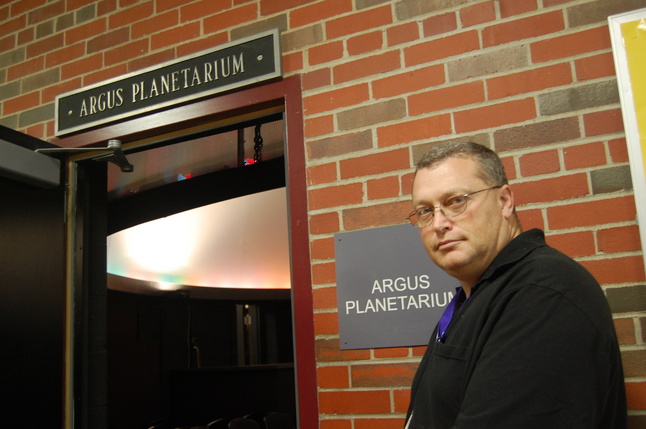
Argus Planetarium Director Ron Robinson, pictured here in December, says a $100,000 donation from IMRA will save the 56-year-old planetarium from closing.
Janet Miller | AnnArbor.com file photo
Pioneer High School’s Argus Planetarium could receive a new name and a $100,000 donation for new equipment to keep it up and running.
Without the donation, the planetarium, a point of pride for the community, could suffer the fate of other planetariums in the state, said Argus Planetarium Director Ron Robinson.
“It takes a lot of vision to look at a program like this and find value,” he said. “Planetariums are going the way of the dodo bird. For someone to say this is important not only for students but for the public to have around — that takes thinking outside the box. It takes commitment to say: This is a jewel in Ann Arbor and we cannot let it fail.”
Last week, the Ann Arbor Public Schools received word of a donation made to the district’s education foundation for the specific purpose of funding critical upgrades to the planetarium.
IMRA, a global company specializing in ultrafast fiber laser technology, pledged the money and is expecting shared naming rights of the planetarium in return.
The new name, The Argus IMRA Planetarium, must be approved by the Board of Education to take effect. The school board will entertain the idea at a first reading during Wednesday’s regular meeting. A second reading and tentative approval is scheduled for Nov. 7.
According to school board policy, a facility can be named in honor of an entity that has provided significant financial contributions to the district. The Argus Camera Company received naming rights 56 years ago when it funded the construction of the planetarium.
About a year ago, AAPS sounded the alarm that $80,000 in technology upgrades was necessary to safeguard the planetarium’s status as the oldest continually operating planetarium at any school or college in the western hemisphere.
Robinson said the planetarium ultimately is comprised of three parts: the Digistar 3 Host Machine or computer system used to run the planetarium programs, the cove lighting around the dome, and the digital projector.
The Digistar Host Machine was installed in 2002 and has a useable life of about 10 years, Robinson said, explaining the system also runs through its four hard drives about every six months.
Those hard drives no longer are produced and no longer can be replaced, however. So for the past year, the system has operated “as if it’s had a gremlin inside,” Robinson said.
“One day it would be the graphics machine, the next day it wouldn’t talk to the projector — we really never knew which part was going to go when,” he said, adding to a certain extent, the failing infrastructure impacted how the district could use the planetarium for curriculum purposes.
“Some of the glitches I was able to do behind the scenes while talking to a class. I’d just keep talking while frantically trying to fix whatever technical issues the machine was having. Other times the program had to be interrupted and rebooted.”
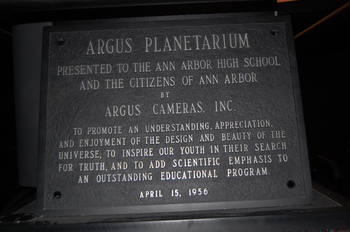
This sign outside of Pioneer High School's Argus Planetarium soon may be updated with a new name and history.
Janet Miller | AnnArbor.com file photo
The money from IMRA will cover upgrading the Digistar 3 system to Digistar 5, the installation of new cove lighting and new signage to represent the new name.
Funds also will be set aside to cover the cost of opening the planetarium to the community for shows, Margolis said. Robinson added the district used to invite students in from parochial schools and neighboring districts to use the planetarium, until it started failing last fall.
AAPS also hopes the planetarium will generate additional revenue for the district down the road by hosting public events, he said.
The upgraded technology also will allow the district to get rid of the “big bulky hardware in the room” and add up to another 15 seats, for a total of 50. Robinson said this will help the district cut costs by having two classrooms attend a show at once, which also could save on busing.
He explained Digistar 5 can be operated from an iPad, which allows him to walk around the room and interact with students during a show, rather than be stuck in one corner operating the program from a large console.
The capabilities with the new Digistar 5 system are great, Robinson said. He said the planetarium experience is no longer simply about teaching the nighttime sky. “We can do so much more than that now.”
There are astronomical topics for all ages including the study of the Earth, space and geophysical science, as well as biology and history.
Danielle Arndt covers K-12 education for AnnArbor.com. Follow her on Twitter @DanielleArndt or email her at daniellearndt@annarbor.com.
Comments
Bulldog
Thu, Oct 25, 2012 : 10:33 a.m.
You're wrong about having two classes attend at once. Two classes no longer make up "50" students. Two classes make up at least "60" students.
sc8
Thu, Oct 25, 2012 : 1:01 a.m.
Indeed, what a great donation. I'm glad the that such a project is able to serve the community despite the fact that technology bond was on the ballot, and that we have athletic programs which do not tarnish the district in the media. I'm sure Eve Claar and Dottie Davis would not tolerate anything that would put Ann Arbor schools in a bad light.
LXIX
Wed, Oct 24, 2012 : 11:51 p.m.
Smart investment ! Since the recent discovery of an Earth-like planet circling around Alpha Centauri - the nearest star to Sol (your star the sun) - kids can now continue to learn a little bit more about their space future. I don't think the Pattengill kids got to go anywhere (of course they did. Shools had a ton of money and big donors like Argus). Now IMRA leads the way for other Ann Arbor companies to follow.
Jaime Magiera
Wed, Oct 24, 2012 : 8:46 p.m.
There are a couple comments here that allude to the planetarium being unknown or forgotten (in my case, forgotten, having been there as a PHS student). Lets change that. Lets spread the word about this great resource.
redwingshero
Wed, Oct 24, 2012 : 6:41 p.m.
I can remember going to the planetarium as a student at Eberwhite and at Slauson. Glad to see Mr. Robinson still have the same drive to teach as he did my 9th grade earth science class back in the fall of 98'. I am glad it will get the upgrade/funding it needs. I wonder if they still show students the yellow cake?
sc8
Thu, Oct 25, 2012 : 1:04 a.m.
That would be "still HAS the same drive..."
justcurious
Wed, Oct 24, 2012 : 3:08 p.m.
Having grown up in Ann Arbor I can honestly only remember visiting the planetarium maybe two times....and that was when I was not even a teenager yet. I'm curious how many in the community visit now. I do recall that Argus employed a lot of Ann Arbor people.
justcurious
Wed, Oct 24, 2012 : 4:43 p.m.
Well Craig, if I had a choice I would definitely rather visit Cranbrook than Pioneer High. But back then it probably would not have mattered. Just leaving school for a field trip would have been good enough.
Craig Lounsbury
Wed, Oct 24, 2012 : 3:28 p.m.
when I was in elementary school or maybe middle school in Ypsilanti in the mid 60's we took a field trip to Cranbrook to the planetarium. I wonder why we went there instead of right down the road?
Craig Lounsbury
Wed, Oct 24, 2012 : 2:59 p.m.
i have no problem with the idea but it occurs to me that eventually the place could be the Argus IMRA Google Apple Ford Samsung Honda Kellogg Planetarium
alarictoo
Wed, Oct 24, 2012 : 7:07 p.m.
Hmmmm... Odd that you did not mention GM or Chrysler. ;^)
Craig Lounsbury
Wed, Oct 24, 2012 : 2:42 p.m.
Please tear it down and start from scratch. Your making me look bad. Sincerely, The Down Town Library Branch. ;)
a2miguy
Wed, Oct 24, 2012 : 2:25 p.m.
Terrific news. Although it is a shame to me that such a valuable educational tool has to be "saved from the wrecking ball" by a donation. I'm with DonBee... seems a little better managment of money could've saved this planetarium. That said, kudos to IMRA for stepping up!
Michael Alexander
Wed, Oct 24, 2012 : 2:09 p.m.
If this planetarium was installed in 1956 when Argus donated the money, it's probably not the oldest in the US. I helped my father install the planetarium at Washburn University sometime before that, probably in 1952 or 1953. It was certainly before 1956 since it was before I was in high school. It still seems to be in operation, see . The Crane Observatory is interesting too. The telescope was a very good one when it was installed about 100 years ago, although (like the one at the old observatory in Ann Arbor) it is not very useful for research now.
Indymama
Wed, Oct 24, 2012 : 4:52 p.m.
Michael....you misread the story...the planetarium installed in AAHS in 1956 WAS the First planetarium installed in a High School!! Some Universities had them earlier, but NO High School had one prior to 1956 when the "new" Ann Arbor High building was built and opened in 1956 (in January) The first students moved in mid-year, so the first graduating class from the new building was 1956. The first c;lass that had attended a full year of classes in the new building when they graduated was the Class of 1957.
DonBee
Wed, Oct 24, 2012 : 1:40 p.m.
First - Thank you to IMRA. The school children in Ann Arbor will appreciate this gift for the next 20 years or so. Your donation is something special for the community. Second - AAPS prioritized $11 million in bond and sinking fund money last year for grandstands, locker rooms and weight rooms for varsity sports, but none for the Planetarium. What does that say about district priorities? OBTW - the renovation in question legally fits in either funding "bucket" according to the response query with the state.
alarictoo
Wed, Oct 24, 2012 : 7:06 p.m.
Don't forget that the $100K could have been nearly covered if the new sup had been paid the same rate as the old sup, and cabinet members had not received those raises last year.
Dog Guy
Wed, Oct 24, 2012 : 1:05 p.m.
Naysayers take note: the "technology millage" is producing results.
DonBee
Wed, Oct 24, 2012 : 1:44 p.m.
There is no Technology Millage money here Dog Guy. This is an outside donation. In walking thru buildings last week, I saw some new hardware - all in the hands of administrators - none in the hands of students yet.
Ron Granger
Wed, Oct 24, 2012 : 12:53 p.m.
"The Digistar Host Machine was installed in 2002 and has a useable life of about 10 years, Robinson said, explaining the system also runs through its four hard drives about every six months. Those hard drives no longer are produced and no longer can be replaced, however. So for the past year, the system has operated "as if it's had a gremlin inside," Robinson said." -- I recall this story coming up before, and many of us were skeptical of those claims. What hard drives, *exactly*, does it use? There are usually ways to migrate. Why does it "run through" its hard drives every six months? Do they overheat? That is probably a simple fix. A quick search reveals quite a few schools and organizations using the Digistar 3. It is nice that they are getting some funding. But how long until the new tech is obsolete? Typically, the newer the tech, the shorter the lifespan. The stars haven't changed - older projector technology still works. If the new system runs off an ipad, how long until the next mandatory upgade?
Jaime Magiera
Wed, Oct 24, 2012 : 8:43 p.m.
No need to attack Ron Granger. He (we) learned something new and everyone here is the better for it. Thank you Ron Robinson for the info!
Ron Granger
Wed, Oct 24, 2012 : 2 p.m.
Ron, thank you for your informative reply! It still seems there should be a way to hack it together, but I'll have to take your word for it.
Ron Robinson
Wed, Oct 24, 2012 : 1:36 p.m.
comment continued: I can not thank IMRA enough for their vision and leadership in seeing that such a program continues. We were leaders in 1956, and we will continue that in the future. Ron, I'm glad you took the time to comment.
Ron Robinson
Wed, Oct 24, 2012 : 1:35 p.m.
Hi Ron, To try and answer your questions, the drives that the D3 use are a special type of IDE drives. The D3 is networked together in such a way the if the drive can't deal with serving up a certain amount of data it stops working. Back in 2002, the motherboards, drives, and such were cutting edge for their time. Well cutting edge does not always mean "Tested". I like cars that have been out for a year or two before I buy them so the issues are worked out, well hardware doesn't always work that way. Most computer equipment even when it works well has about a ten year life span. My last home laptop went after 8 years. The hard drives we had been getting we re-manufactured drives. The last batch was the last we could find came form overseas and was their last they had. The motherboards on the D3 are not talking to each other as they should. A company in Texas could make us the 4 boards needed at a cost $5000 a board. They are the only company in the states that would even touch it. The list goes on and on, but the bottom line is its dead. The new D5 uses tried, off the shelf, hardware, which has been tested. E&S, to their credit, uses that on all their equipment now. Currently 25 schools/public planetariums are getting the D5 to replace their D3's. Since we were the first D3 install in the world, ours has done well. Your quote about older technology still working has some merit. Our Spitz A-1 worked well for 40+ years. Our district was the last to use a A-1 in the world. Most of the A-1 had been retired 15-20 years before that. The last planetarium to use older style projection equipment closed to the public here in southern michigan. The was the Ella Sharp Planetarium in Jackson. They were using the A3-P. Their Planetarium Director was looking to upgrade to the digital style.
bobslowson
Wed, Oct 24, 2012 : 12:11 p.m.
I remember as an elementary Eberwhite student taking a field trip to that planetarium. Then when I got to Pioneer it seemed familiar. It is a true gem in the Ann Arbor public schools. I'm so glad a donor was able to step up so children of future generations can visit.
vivian
Wed, Oct 24, 2012 : 12:08 p.m.
That's great news--a planetarium is a splendid thing for Pioneer to have, and I'm glad a donor has stepped up to keep it going. Several space scientists I know have told me that they were inspired to study astronomy and astrophysics by early visits to planetaria. The things these scientists are now working on may someday help solve seemingly intractable problems here on earth. Kudos to all whose vision has brought about the preservation of the Argus Planetarium.
Jaime Magiera
Wed, Oct 24, 2012 : 8:52 p.m.
Indeed. In fact, the well-known astrophysicist Neil Degrasse-Tyson was inspired as a child by his trips to the Hayden Planetarium in NY - which he is now the director of!
Susan Montgomery
Wed, Oct 24, 2012 : 10:53 a.m.
Wonderful news! One misspelling to correct, " to take affect", should be "effect" -
Danielle Arndt
Wed, Oct 24, 2012 : 11:13 a.m.
Thanks for the catch! It's been fixed.
Carole
Wed, Oct 24, 2012 : 10:40 a.m.
This is absolutely marvelous. In a time where everything is on equipment that could all go into the neverneverland, keeping out planetarium open is a must. Thank you to the donors who will provide students the opportunity to star gaze.
Billy
Wed, Oct 24, 2012 : 10:30 a.m.
"Without the donation, the planetarium, a point of pride for the community, could suffer the fate of other planetariums in the state, said Argus Planetarium Director Ron Robinson." A point of pride for the community? Huh?
newsmuse
Thu, Oct 25, 2012 : 1:58 a.m.
This has been a wonderful program for students in grades 3 and 6 and at the high schools. Parents, if you have the chance, volunteer to go as a chaperone. Billy- let's hope it really does open up to our community so that you can also see it. Meanwhile U of M has a wonderful planetarium program that is open to the public.
aamom
Wed, Oct 24, 2012 : 7:28 p.m.
You've got to get out more Billy.
Billy
Wed, Oct 24, 2012 : 11:29 a.m.
I'm willing to bet 90% or more of the citizens of this city aren't even aware that there is a planetarium at PiHi. That's my point.....
Wake Up A2
Wed, Oct 24, 2012 : 10:52 a.m.
1956.... That means it is the oldest planetarium in a school on this side of the planet. When I went to school, they told us it was the first in a high school in the world...... I would say we have pride keeping this open......
Wake Up A2
Wed, Oct 24, 2012 : 10:17 a.m.
Good for IMRA and Good for the district. I am glad to see something like this continue. It is also nice to see a local company stepping up and having vision. From what I know of people involved they worked very hard to put it all together. My daughter has never stopped talking about her experience in both 3rd and 10th grade at the Argus. Ron is right, A true Jewel......
Jaime Magiera
Wed, Oct 24, 2012 : 8:49 p.m.
redwingshero, I used to go to the Jackson Planetarium for the laser light shows. They had a great Pink Floyd based show - whoohooo!
redwingshero
Wed, Oct 24, 2012 : 6:49 p.m.
Klayton- it was there in the 90's and I went there multiple times as an AAPS student. The only other one I am aware of is the planetarium at Parkside middle school in Jackson. It's supposed to be pretty sweet.
Klayton
Wed, Oct 24, 2012 : 4:31 p.m.
I went to Pioneer in the 1990s and have never heard of this planetarium. Not sure if it was open in 90's but I definitely never did any kind of learning activity there. This is the first time I have heard of the planetarium. I have mixed feelings about this donation because on one hand I think it sounds like a good resource (although we do have another one in town) but that is a lot of money that could have gone purchased an iPad for every kid at my child's elementary school.
Wake Up A2
Wed, Oct 24, 2012 : 11:07 a.m.
"Funds also will be set aside to cover the cost of opening the planetarium to the community for shows, Margolis said. Robinson added the district used to invite students in from parochial schools and neighboring districts to use the planetarium, until it started failing last fall." - Notice it was open to other schools and at some point to the public. Two years ago my friends home school group went to the Argus. I think you need to ask.
Billy
Wed, Oct 24, 2012 : 10:34 a.m.
I was never even aware of the planetarium at PiHi because IT IS NOT OPEN TO THE PUBLIC.... The only planetarium I'm aware of...and have been to MANY times...is in the Natural History museum at U of M. That is what I have fond memories of in my childhood. That is why my child will have his first planetarium experience because it IS open to the public.