

Ann Arbor Transportation Authority begins planning to create a countywide organization
As it develops a master transit plan for the region, the Ann Arbor Transportation Authority wants to transform itself from an Ann Arbor-focused organization into a larger, countywide agency.
CEO Michael Ford earlier this week provided an update on that process along with several ideas for how a transition might work, but officials underscored they are still in the early planning stages and haven't figured out how to fund a countywide entity.
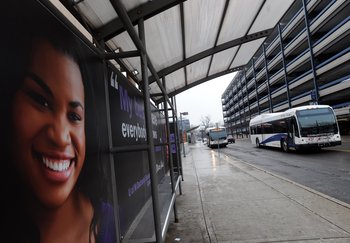
As it considers a new master transit plan, the Ann Arbor Transportation Authority is also considering transforming itself into a county-wide agency. Here, AATA buses pull up outside the Blake Transit Center along Fourth Avenue in downtown Ann Arbor.
Melanie Maxwell | AnnArbor.com
“There has been almost unanimous support,” he said. “We’ve found that people really like the idea of a countywide transit system and they appreciate the need (for) a countywide organization to run that system. There is trepidation that involves anything about going to taxpayers for additional money, so there’s also caution there, but we’ve gotten agreement that the plan and a countywide organization is the way to go."
Ford offered a tentative timeline on Tuesday that called for the establishment of the new authority and dissolving the current authority within a year, though officials said it could take longer than that.
Starting this week, AATA is holding additional meetings with local and county officials.
The scenario Ford presented on Tuesday would spread representation on a new board among communities throughout the county based on population and geography. Under that plan, Ann Arbor had seven representatives; Ypsilanti and Pittsfield Township each had one representative; Ypsilanti Township and Augusta Township each had two and five other outlying regions each had one.
One of the initial points along the timeline is drafting a statement of intent, which would go for a vote before the Washtenaw County Board of Commissioners within several months. Following that, Ann Arbor Mayor John Hieftje would appoint the current seven-person board to the new board as Ann Arbor’s representatives. The other regions would then begin appointing representatives.
Benham said municipalities grouped together in the various regions would collectively decide how to appoint a representative to the board.
If enough municipalities opt to participate in the new authority, it would amend its articles and adopt a millage resolution to go in front of voters, possibly in the Feb. 28, 2012 election. If that millage passed, all AATA assets and liabilities would be transferred to the new authority. If the millage failed, the authority could remain as it is today, or try again.
Benham said he doesn’t yet know what kind of millage would be put in front of voters. Over the next 30 days, officials will be working to develop a list of potential funding sources. A new board would then work to implement the fleshed-out master transit plan and figure out the best way to fund it,, Benham said.
“Clearly the plan needs additional money,” Benham said. “You aren’t going to get double the service with no additional money."
Tom Perkins is a freelance writer for annArbor.com. Reach the news desk at news@annarbor.com or 734-623-2530.
Comments
local guy
Mon, Mar 14, 2011 : 1:20 a.m.
Here's the bottom line: whether we go for a county-wide public transit system or not, we're going to spending more on transportation in the coming decades. Do we want to spend it all on more and wider roads and just permit urban sprawl (which, by the way, also increases the cost of providing utilities and other public services to isolated communities), or do we want to invest in a more comprehensive transportation model or plan that, in the long run, will save us money and increase the economic vitality of our overall region (which in turn, increases our income and property values)? We should look at this seriously and with open minds, and not shoot down anything that may cost money. Investing in our infrastructure is critical to our future, and we should not assume it's going to burdensome to local taxpayers. We're not raising taxes today. If we do, it's still quite a bit down the road as we recover from the economic slump which all of the economists say is now on the up-tick.
local guy
Mon, Mar 14, 2011 : 1:19 a.m.
I'm not saying let's give AATA a blank check, but let's recognize that some change may be in our best interest, and let's see how we can achieve it. Funding surely is an issue, and as AATA proceeds with its process, it'll have to answer questions about funding. Creating a county board is a first step to developing an answer to this question. AATA can't do it by itself. A modest tax county wide, though, could be the foundation of a much more vibrant system. Remember, just because you or I don't take a bus doesn't mean that we don't benefit from having a good public transit system. No vibrant economic region exists without decent public transit. AATA is not suggesting that we have busses go all over the county. The concepts call for a better/enhances fixed route system, supplemented by various options making virtually everyone in the out-county connected to the system. Kids, seniors, students and workers will be able to get within their communities by vans and other services, and folks will be able to connect to other options (express busses, fixed route busses, etc.) to get between communities, to the airport, to Brighton, etc. Does this cost money? Yes, but this will evolve over 30 years, in increments, with much of the capital coming from the feds, the state, and perhaps private investors, and still having local monies support less than half of the operating costs.
local guy
Mon, Mar 14, 2011 : 1:14 a.m.
Sent from my iPad On Mar 12, 2011, at 2:39 PM, "Boonin, Robert" wrote: I would be better if those blogging read the report about the transit master plan or attended one of the many community meetings held to discuss it. The study revealed many flaws in our transit design when viewed as a county vs. just Ann Arbor and Ypsi. Many people lack adequate transit to get around the community. Seniors are isolated and have difficulty getting to doctors, stores and entertainment. Commuters are getting jammed on the highways and parking is expensive. Do you know that building another lane on US 23 between here and Brighton would cost more than all of the capital improvements mentioned in the scenarios developed by AATA? Having a regional transit system spurs planned growth, which makes our overall infrastructure more efficient. Transit is a complex issue, and AATA has studied this closely and has developed three options for what we may wish to see happen here over the next 30 years. Our roads are jammed and our busses on major routes are often packed. AATA is relying on public input to determine the direction it/we should take in providing us with the transit needs we want and from which we will benefits. Frankly, I'm not sure how the process could have been more transparent and inclusive of community input. It's ironic that when government goes out of its way to keep us involved and informed that it appears that many of us still gripe. We shouldn't leap to be critical of the concepts without more information to consider. Also, if we choose to keep our transit in the form of the 20th century and not recognize a need to reconfigure the system, then we're free to do so at that ballot box. Just beware of the consequences. If we're not willing to recognize a need to live in the 21st century, we'll fade away and eventually become irrelevant.
jcj
Mon, Mar 14, 2011 : 12:27 a.m.
I hope the population is never high enough to support mass transit. When it is we will have lost what makes us at least somewhat desirable.
EcoRonE
Sun, Mar 13, 2011 : 4:54 p.m.
For sustainable mass transit, the plan has to be conceived within a wider context than the AATA. It requires much higher population densities than even exist in Ann Arbor which is why city residents have to provide such a large subsidy. Without county wide planning for transportation corridors with adjacent dense residential/work/retail areas, this plan is bound to require a heavy tax subsidy most of which will come from AA residents, not the outlying areas. It's a ridiculous plan by an overpaid CEO approved by committees and boards that have no planning credentials and do not understand sustainable principles.
Mike
Sun, Mar 13, 2011 : 2:51 p.m.
Monorail! monorail! monorail! - Bart Simpson reference For those who don't get the reference, I have a simple observation. All the city buses have advertising signs that obscure the windows. This is not a fund raising strategy. It is to prevent the public from seeing that the inside of city buses are all empty. It's hilarious. Here, in the middle of a budget crisis we have a deficit running organization driving empty buses all over the city. And, if that isn't enough now they want to run empty buses all over the county. Brilliant!
local guy
Mon, Mar 14, 2011 : 1:28 a.m.
You're off on this one. They haven't covered windows in years, and if you look at the busses as they are in town during peak times, they're over flowing!
jcj
Sun, Mar 13, 2011 : 4:11 a.m.
A few of the accomplishments of the AATA Board Ann Arbor Transportation Authority board meeting (Aug. 19, 2010): On the occasion of its first meeting scheduled at the downtown location of the Ann Arbor District Library – which is to become its usual meeting place – the AATA board failed to achieve a quorum. Three of seven board members were present. The Ann Arbor Transportation Authority has offered a one-year contract with a salary of $160,000 to Michael G. Ford to become the agency's new CEO. June 2009. The salary offered Ford is almost $28,000 more than the $132,433 former Executive Director Greg Cook made when he resigned in March 2007. During his report to the board, Rich Robben, chair of the planning and development committee, described how the Sept. 14, 2010 meeting of the PDC had included significant discussion about the inclusion of merit pay increases for non-union staff at the AATA. [AATA union employees will receive a 3.5% increase effective Jan. 1, 2011.] Michael Ford indicated that up to 3% was included in that budget version. He noted that the budget document currently under review included monies for a lump sum bonus for management employees, but restated other Board members' concerns over legacy costs and political implications associated with making merit increases permanent. The initial budget proposal brought to the committee included no merit increases for non-union employees, while the second version included a 3% merit pay allocation. Ms. Dale objected to not providing merit increases for staff based merely on some other entities having to face salary freezes or reductions Ms. Dale added that people are more likely to look at how the organization is spending large amounts of money in the community versus the $70,000 or less that would go toward employee raises Full Story <a href="http://annarborchronicle.com/2010/09/26/aata-approves-budget-um-agreement/" rel='nofollow'>http://annarborchronicle.com/2010/09/26/aata-approves-budget-um-agreement/</a>
KJMClark
Sun, Mar 13, 2011 : 2:33 a.m.
We really need more transit service, but the concept suffers from a 'chicken and egg' problem. Until the service is in place and working well, people won't support more transit. But without support, AATA can't afford to expand. This will all stay stuck in this stalemate until gas prices go a good bit higher, at least $4 per gallon, maybe $5. That shouldn't take too long, but even then people will gripe that they can't afford the millage because gas is too expensive. Eventually gas will get so expensive that a majority will demand the service to get some relief from high gas prices. Doesn't look like we're quite there yet.
Joe
Sun, Mar 13, 2011 : 1:53 a.m.
Why does mass transit have to make money? You don't demand that highways make a profit, yet you're willing to sink millions of dollars into them. If only you had to actually pay what it costs to own and operate your car, you might not be so offended by the idea of investing in infrastructure that would make our area more attractive to live and work in. The return on investment is much higher for mass transit than it is for automotive transit.
local guy
Mon, Mar 14, 2011 : 1:23 a.m.
Great point. Roads are empty half the day and many folks don't driven, yet we all subsidize them. Drivers don't pay for their use.
jcj
Sun, Mar 13, 2011 : 12:44 p.m.
I don't know what school of thought you graduated from. Let's keep it simple. In Ann Arbor what how many people ride the bus every hour? How many people use the roads? What is the cost to the public per person? End of discussion.
leaguebus
Sun, Mar 13, 2011 : 1:41 a.m.
The same old naysayers on everything that involves more tax money (except the Snyder tax increase on the poorer people in this state) chime in with the negative comments. Gosh it would be great if everyone made as much money as all of you and can afford a car and $3.60 a gallon gas, but many can't and that's one reason why the AATA has proposed this. I have paid the AATA millage since it's inception, have used busses, not my car, to get to work and hope this plan can be pulled together.
mtlaurel
Sun, Mar 13, 2011 : 12:34 a.m.
the population of Mich is not growing...stuff is being cut-the bus system is okay how it is...work on other areas of more vital need. that will be a tacky place for a "conference" center-across from a big honking bus station center. I go to conferences and seminars-people like nice views, relaxing surroundings..who are you kidding.
jcj
Sun, Mar 13, 2011 : 12:19 a.m.
BTW If you want to become one of these "thriving metropolitan areas" I think you are in the minority. I am happy we are not any of those places.
jcj
Sun, Mar 13, 2011 : 12:16 a.m.
@foobar417 "To put it in starker terms, almost every wealthy, thriving metropolitan area in the US has mass transit. And areas that do not are almost all lagging economically. " Would you care to name those "thriving metropolitan areas"? And now where is the advantage? Ann Arbor unemployment rate 6.6 % San Francisco 6.7 % Washington DC 7.0 % Philadelphia 7.5 % Atlanta 7.6 % Los Angeles 7.7 % Miami 7.8% Houston 7.9 % Chicago 8.1 % New York 8.3 % Portland , OR 8.5 % San Jose CA 9.3 % Oakland 10.5 %
jcj
Sun, Mar 13, 2011 : 3:44 a.m.
Assuming you have enough money left after paying your taxes to go to school. I am not against going back to school. But look in the unemployment lines. There are many with educations standing there. "Just because expanding and operating mass transit is expensive doesn't mean it's not a wise investment." I don't disagree too much with that statement. But spending money you don't have is seldom a wise investment. Borrowing money to "make money" was a big part of the problem we are in now.
foobar417
Sun, Mar 13, 2011 : 2:37 a.m.
@jcj A better analogy is that it's like going back to school when you've lost your job. Yes, in the short term, it's painful, but in the long term, it should improve your economic position in a sustainable fashion.
jcj
Sun, Mar 13, 2011 : 1:17 a.m.
"Almost all of those areas have done much better than Michigan over the past 20 years" I thought we were talking about Washtenaw County. What part of the $465 million was the state going to kick in? Now if the rest of the state is going to invest in this I might rethink my position. "The AATA plan is looking forward for the next 30 years" That's kind of like me investing in the stock market when my house is in forfeiture!
foobar417
Sun, Mar 13, 2011 : 12:54 a.m.
Mass transit is a long-term investment. Almost all of those areas have done much better than Michigan over the past 20 years. And when the economy bounces back, almost all will almost certainly bounce back much faster than SE Michigan, because we waste our precious resources on sprawl, long commutes, and aging infrastructure. The AATA plan is looking foward for the next 30 years. If this area has any hope of growing and thriving, we will need a tax and regulatory environment favorable to a diverse group of businesses, an attractive and liveable community, smart investment in mass transit, and dense settlement patterns. Snyder is trying to do the first point, although deinvestment in schools may undermine the second. Ann Arbor and Washtenaw County investment in parks and recreation and the greenbelt is an attempt to do the second point. The AATA is trying to do the third, with the hope that the fourth will follow from that.
jns131
Sat, Mar 12, 2011 : 11:58 p.m.
What would be really nice is for those of us who live near the edge of Willow Run and Michigan who want to get out to Canton via Michigan. To that Target shopping area. If that area builds like I see it? Nice. I do know Wayne county has a mass transit system that amazes me. I was told that some of the children who need a ride? Can get one via mass transit. This would be nice. Great idea AATA.
foobar417
Sat, Mar 12, 2011 : 11:38 p.m.
All forms of transit are subsidized to some extent. Governments routinely subsidize airlines, road networks, and mass transit. The motivations for subsidizing mass transit range from social equity (providing transportation to those too poor and/or infirm to employ another form of transportation) to careful calculus of the true societal costs (e.g. mass transit reduces the overall burden on size and maintenance burden of road network of private automobiles, potentially reducing the overall tax burden on tax payers). To put it in starker terms, almost every wealthy, thriving metropolitan area in the US has mass transit. And areas that do not are almost all lagging economically. There's a difference between throwing money away and investing. Just because expanding and operating mass transit is expensive doesn't mean it's not a wise investment.
packman
Sat, Mar 12, 2011 : 11:17 p.m.
Where does it stop? How much is too much? When will we stop subsidizing? At what point do we really look at the tax dollars that being wasted? Does it make public transportation proponents feel good? Do they enjoy entering into ventures that would fail commercially so they can feel good? Spending other people's money for losing causes is addictive it seems to me.
Macabre Sunset
Sat, Mar 12, 2011 : 8:51 p.m.
First Washtenaw County... next, the World! If only we can give them enough money, soon AATA will be providing vital services as far away as Lagos, Nigeria. Remember, folks, it takes a millage.
Steve Bean
Sat, Mar 12, 2011 : 7:03 p.m.
Stephen, are you open to the possibility that getting the job done in AA might depend on getting it done countywide? AATA vehicles don't operate in a vacuum. Vehicles from all over the county come into the city and negatively impact our bus service. It could be the other way around, where countywide bus service could have a positive impact on both city and township traffic levels, not to mention air quality and noise pollution levels.
aes
Sun, Mar 13, 2011 : 12:09 a.m.
What you say above makes no sense whatsoever to me. I am a bus rider and agree with other commenters that first we should improve the service we have---before expanding countywide. I don't believe that vehicles from all over the county negatively impact our bus service. It takes a great imagination to even think of that as a possibility.
DonBee
Sun, Mar 13, 2011 : 12:07 a.m.
So long as I am willing to go to work at the exact time the 1 morning bus will come by my house, I suppose I could ride the bus. But, if for some reason I am a couple minutes late, well, I walk. The problem with the plan is that the density of most of the county is too low to support bus runs and so the frequency will be so low, it will be almost impossible for people to use it. This is reality. Several studies show that a frequency of less than once every 30 minutes shows a serious drop in interest in riding public transit. This frequency cannot be sustained on most of the out of city routes. They would lose more than then they do on the service now.
CynicA2
Sat, Mar 12, 2011 : 9:07 p.m.
I used a combination AATA and UM busses to commute for years - it took 2-3 times as long the 12-15 minute trip by car, and was at least 3 times more aggravating. I value my time a little more than that, as do most others. Both cars and busses produced now are more economical than before and emit only a fraction of what they emitted 20 yrs. ago.
jcj
Sat, Mar 12, 2011 : 8:20 p.m.
"countywide bus service could have a positive impact on both city and township traffic levels, not to mention air quality and noise pollution levels." Not a chance!
sbbuilder
Sat, Mar 12, 2011 : 7:57 p.m.
Ugh, I meant IMPROVE air quality.....
sbbuilder
Sat, Mar 12, 2011 : 7:47 p.m.
Mr Bean Have you noticed poor air quality in Ann Arbor? I've lived in places like Ankara and Seoul, and those places have bad air quality. I don't think adding more buses will diminish air quality a whit. As to noise pollution: Cars are so quiet nowadays, you can hardly hear them. Oh, except large deisel vehicles like transit buses. Now, those are both noisy and stinky.
Stephen Landes
Sat, Mar 12, 2011 : 6:15 p.m.
To add to my own comment -- AATA cannot plan bus routes that can take me from NE A2 to the Briarwood area in less than an hour. Twenty years ago the trip was only 45 minutes. So AATA's service has degraded substantially in the last twenty years yet now they want to expand to the whole county? Try getting the job done in A2 first and then we can talk about expansion.
Stephen Landes
Sat, Mar 12, 2011 : 6:12 p.m.
I would like to know what the AATA's statutory authority is for considering expanding beyond Ann Arbor. Where in their charter do they have permission to begin planning that kind of expansion? If they are doing so now using funds we've voted for local service then they are likely violating spending controls. I don't recall ever being asked for voter approval to use funds for purposes outside AATA's mandated service area.
Joel Batterman
Sat, Mar 12, 2011 : 4:22 p.m.
Folks, we can't afford NOT to bring transit countywide. Of course it's important that we maintain and improve transit service within the City as well as beyond. But pretending that Saline and Dexter aren't part of the same region as Ann Arbor is just ludicrous. Transit that extends beyond Ann Arbor and Ypsi is a no-brainer that's long overdue. If we don't build it, we can kiss our future goodbye. The year is not 1955.
5c0++ H4d13y
Sun, Mar 13, 2011 : 12:45 p.m.
What math are you using to say "we can't afford NOT". Show me some numbers that show unless we tax X amount and spend it on Y then we will save Z dollar or it will cost us Q amount of money so we better do it or we'll regret it.
Basic Bob
Sun, Mar 13, 2011 : 12:53 a.m.
sbbuilder, you're right, it won't help commuters from Adrian (good example for the hinterlands). It will help some people get around without a second or third car, which is way more than a few pennies, but less than a jumbo load payment.
sbbuilder
Sat, Mar 12, 2011 : 7:55 p.m.
Basic Bob I'm sure you've seen morning traffic on the highways streaming into AA. Have you any idea how far away the average person lives who commutes to AA? I could name five people off the bat who commute from Jackson. Others I know come from Toledo, Adrian, even Lansing. How will bus service help those people? Lastly, and I hope you were not serious, for those who both live and work in AA, saving a few pennies here and there by using the bus will not make a scintilla of difference in helping pay down a mortgage that is several tens of thousands underwater. I find that suggestion frankly both out of touch and a little like Ms Antoinette.
Basic Bob
Sat, Mar 12, 2011 : 5:58 p.m.
Right, if people could take the bus to work instead of driving, they could spend the money saved to keep their homes. For many jobs, a car is NOT required, as long as you can get there. People that choose to live in the hinterlands won't take the bus. They also choose not to have fluoridated water, sewers, cable, natural gas, and quick response to emergencies. But those county residents who live in urbanized areas (most of us) would have a choice that does not currently exist.
jcj
Sat, Mar 12, 2011 : 5:40 p.m.
"we can't afford NOT to bring transit countywide" We? You got a mouse in your pocket? We can't afford TO spend $15.5 million each year so buses can drive around with 6-8 people on them! "But pretending that Saline and Dexter aren't part of the same region as Ann Arbor is just ludicrous." I guess you are right people who live in Ann Arbor would be flocking to all the jobs in Dexter and Saline! Oh this would be for the people in Dexter and Saline coming to Ann Arbor for jobs? Well that clinches it whatever I can do to subsidize the surrounding communities.
sbbuilder
Sat, Mar 12, 2011 : 5:03 p.m.
Right now, Mr Batterman, there are hundreds of people who are kissing their homes goodbye. What do you have to say to them? There are perhaps thousands more who are significantly upside-down on their mortgages. What do you have to say to them? You're right, though, this isn't '55. Back then, we were the powerhouse industrial nation of the world. The Big Three dominated the rest of the world combined. GM was the world's largest corporation. Our future is already in grave jeopardy. You guys seem intent on making sure there is no future.
jcj
Sat, Mar 12, 2011 : 2:18 p.m.
""There has been almost unanimous support," he said. "We've found that people really like the idea of a countywide transit system and they appreciate the need (for) a countywide organization to run that system." Well Mr Benham. Read the comments here and it debunks your "almost unanimous support" comment. "One of the initial points along the timeline is drafting a statement of intent" Well hows this for a "statement of intent". We the people of Washtenaw County and Ann Arbor in particular have a long range plan that calls for keeping and controlling just enough of our money to buy a few scraps of food!
InsideTheHall
Sat, Mar 12, 2011 : 2:06 p.m.
We can't afford it! Until AATA can turn a "real" profit without being subsidized this needs to be opposed and shut down.
Joe
Sun, Mar 13, 2011 : 3:30 a.m.
Transportation never makes a profit. Should we stop investing in highways, roads, bridges, parking lots, etc., since they've never returned a profit? Maybe you'd want a mass transit system if you had to pay ten dollars every time you got on the highway.
outdoor6709
Sat, Mar 12, 2011 : 1:41 p.m.
I now get the point of the AATA expansion plans. "all AATA assets and liabilities would be transferred to the new authority" Ann Arbor is once again trying pass its financial obligations to other people to pay for. Hey AA News, how about getting out front of this story and telling the taxpayers what those current and future liabilites are? My guess is the pension fund is under funded and AATA cannot afford the promises it has made. Also you might tell us how much we will be on the hook for without any benifit. How about the AA does not get a vote on this expansion?
Steve Hendel
Sat, Mar 12, 2011 : 1:18 p.m.
I trust that the City's millage will drop to $-0- if there is a county-wide levy.
DonBee
Sat, Mar 12, 2011 : 2:36 p.m.
Steve - A tax drop in Ann Arbor? You MUST be new to the country. The city has NEVER met a tax they did not like.
sbbuilder
Sat, Mar 12, 2011 : 1:03 p.m.
Sounds like they've got it all figured out! Great. They've got the master plan. They've got committees. They've got focus groups and discussion forums. They've got everything, in fact, except for that one nagging detail: funding. But, hey, why let little details like that get in your way? Full steam ahead. Damn the torpedoes. Onward to a brighter transportation future. DonBee asked on another thread what planet these guys are living on. I think, according to string theory, they are instead living in one of those multiple parallel universes. We just happen to have our paths intersect for a short time. Pretty soon, they'll get spun back out into whatever alternate dimension they came from.
McGiver
Sat, Mar 12, 2011 : 12:37 p.m.
The AATA is smoking more than diesel fumes if they think those of use in surrounding townships are goiing to support this. We can't get the county to plow snow or grade our muddy roads and they think we are going to put up bus stops out here?
Top Cat
Sat, Mar 12, 2011 : 9:24 p.m.
Very well said. Thanks-
DonBee
Sat, Mar 12, 2011 : 2:35 p.m.
McGiver - I have an idea, let's put snow plows on the fronts of the AATA buses and then charge for snow plowing. Might help cover the 75% shortfall in what riders pay to ride.
Brad
Sat, Mar 12, 2011 : 12:14 p.m.
"[...] Arbor Transportation Authority is also considering transforming itself into a county-wide agency" Sounds good to me. I'd love to have the rest of the county assist with the 75%-per-ride subsidy that we AA taxpayers get soaked for. Of course, I doubt the rest of the county is going to put up with that nonsense. I have a better idea. Why don't they "transform" AATA into something that's cost-effective?
sbbuilder
Sat, Mar 12, 2011 : 12:55 p.m.
Brad Much closer to 85% subsidy.
Alan Goldsmith
Sat, Mar 12, 2011 : 11:32 a.m.
I get it. Ann Arbor would continue to pay it's generous transportation tax, then we'd also have a 'county' millage on top and then the quality of A2 service would drop to cover our country and 'burb friends. The most dangerous words in the English language--'Ann Arbor Mayor John Hieftje will be appointing board members'. See AAPAC, DDA, et. al for his brilliance in THAT regard.