

AATA hires international consultant to help develop transit master plan for Washtenaw County
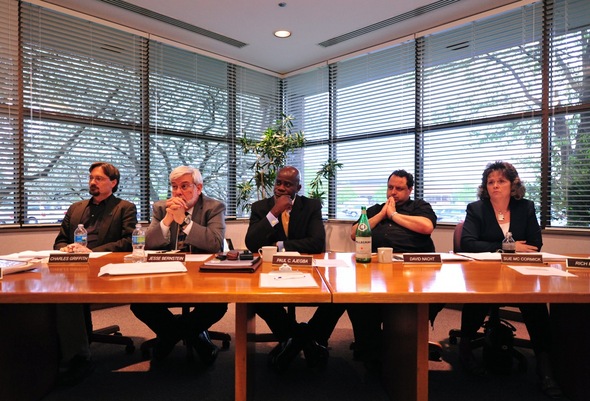
From left to right are five of the seven members of the AATA governing board: Charles Griffith, Jesse Bernstein, Chairman Paul Ajegba, David Nacht and Sue McCormick.
Ryan J. Stanton | AnnArbor.com
Ann Arbor transportation officials moved forward Wednesday night on efforts to create a new countywide transit master plan, calling upon the aid of an international consulting firm.
The Ann Arbor Transportation Authority's governing board voted 6-1 to enter into a $399,805 contract with Steer Davies Gleave to develop the plan. The firm has 15 offices worldwide — the three closest being in Boston, New York and Vancouver.
The plan is expected to provide a roadmap for the AATA as it continues to make its push to expand and become the transit provider for all of Washtenaw County.
"I'm excited because we're going to be spending the rest of the year developing this vision," said board member Jesse Bernstein, former president of the Ann Arbor Area Chamber of Commerce. "The first step is to listen and talk to everybody we can."
AATA staff recently developed and advertised a request for proposals and identified Steer Davies Gleave as meeting all of the job requirements for the best value.
By the same 6-1 split on Wednesday, the board approved a contract for marketing and public relations services in support of developing the transit master plan. AATA CEO Michael Ford is authorized to spend up to $350,000 for the services of The Rossman Group, Ilium Associates and re:group over a three-year period.
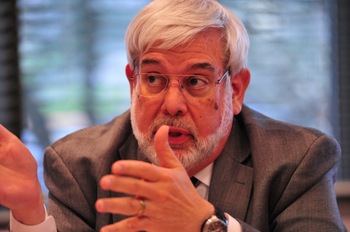
AATA board member Jesse Bernstein said he's excited to hire an international firm that can bring experience from around the world to Ann Arbor.
Ryan J. Stanton | AnnArbor.com
The three firms will be used at different times to help with public relations, education and marketing projects.
AATA officials said the need for professional marketing and public relations services has greatly increased due to so many efforts under way. That includes the transit master plan, park-and-ride expansions, WALLY, east-west commuter rail talks, Fuller Road Station, Blake Transit Center, Central Campus transit center improvements, Washtenaw Avenue transit hub and others.
"Everybody has different projects happening, but we need to make sense of it and we need the community to be a part of that conversation, and I think the transit master plan is what will make that happen," said Mary Stasiak, community relations manager for AATA.
AATA's board adopted a resolution in November that laid out a new vision statement for the organization, signifying a push to expand countywide.
"The Ann Arbor Transportation Authority shall be the public transportation provider for Washtenaw County," the statement reads. "Our customers shall see AATA's expanded services as the preferred option for traveling to destinations within the county, as well as to and from the county. AATA will offer appropriate modes of transportation with the most efficient use of resources. These services shall enhance the quality of life for Washtenaw County stakeholders while promoting the economy, safeguarding the environment, and strengthening communities."
It's likely the AATA will proceed with a countywide millage campaign to fund whatever services the community identifies as priorities in the master plan process. Stasiak said the steps taken Wednesday night will play an important part in achieving the AATA's long-term mission.
"It's really important that the board has made these decisions because creating a vision for the county for public transportation really has never occurred, and we need to get the input from all the residents of the county," she said. "And by hiring this consultant to do that, we believe that they're going to be bringing to the table all kinds of ways to connect with the community."
Stasiak said the transit master plan would look at the community's transportation wants and needs for the next 30 years.
"Having a transit master plan going out 30 years is important to preserve the unique character of the communities who want to maintain their rural nature," she said. "It helps to prevent urban sprawl. If you don't have a plan for transportation and for transit, what happens is density starts to crawl and it starts to move into the areas that people are trying to preserve."

Treasurer Ted Annis was the only board member to oppose the $750,000 worth of expenses approved Wednesday night.
Ryan J. Stanton | AnnArbor.com
Board member Ted Annis, the agency's treasurer, dissented in each of the 6-1 votes Wednesday night, calling the measures "premature." He noted the AATA still is working on a north-south connector study to determine whether the Plymouth Road and State Street corridors should be enhanced.
"I'd like to see the connector study be completed, and I'd like to see a little more substance before we start talking it up in the community because we don't know what we're doing yet," he said. "I'm a little bit concerned about getting the public all excited and talking about things and then have it go the way of the SEMCOG situation. I would not advertise it until we know more."
Stasiak said the connector study will provide valuable input for the master plan.
"What the connector study is doing is really focusing on one particular corridor and what types of transit would operate along that particular corridor," she said. "And so it actually will inform types of transit that would happen along a particular corridor, so it actually works in combination."
At the start of Wednesday's meeting, Eli Cooper, transportation program manager for the city of Ann Arbor, gave a presentation on the Fuller Road Station — a joint project between the city and the University of Michigan currently in the planning stages.
Cooper's presentation mostly revisted information already shared at previous City Council meetings. He acknowledged he failed to point out in his last presentation that one of the seven major elements of the project is parking for 1,000 vehicles — a net increase of about 750 spaces on the site.
AATA board secretary Charles Griffith asked Cooper what the status was on discussions with Amtrak about co-locating at the new site. Cooper said Amtrak is excited to move its existing station, and he expects that transition will occur fairly easily when the timing is right. But it won't be part of the first phase of the project, estimated to cost $43 million.
The city is planning a modest first phase with accommodations for bicycles and buses. Cooper said the train station most likely would be built down the road as part of a second phase of work costing another $30 million to $40 million. U-M is paying for 78 percent of the total project costs.
Board member David Nacht said he doesn't have any faith that there will be regular train service between Ann Arbor and Detroit due to failures by the Southeast Michigan Council of Governments to secure funding. He asked: Why build a station if trains won't come?
Cooper said he's confident the failure to grant funding recently is only a temporary setback. Making a case for the need for rail service to Ann Arbor, he pointed out that 25,000 to 30,000 Wayne County residents commute to work in Washtenaw County. He also said 1,200 people have indicated they would take advantage of a north-south train from Howell to Ann Arbor.
Ryan J. Stanton covers government for AnnArbor.com. Reach him at ryanstanton@annarbor.com or 734-623-2529.
Comments
JoeNuke
Sun, Apr 25, 2010 : 9:43 p.m.
Several issues with this: 1. Thanks, Ryan for noting the fare increases. However, given that fares constitute just more than half of the AATA cost, any expansion in this service requires incremental tax support. Why is this a good idea? Why are all fares subsidized so heavily, instead of need based? 2. Nearly $750,000 on consultants now, to "market" this "vision." Whose vision? Are taxpayers truly represented as stakeholders on AATA board? Where is accountability for decision making, and how is it exercised? Does anyone else see the AATA ads in local print or hear them on radio? These are non-informative (i.e. they do not give information about using AATA), they merely promote AATA at the expense of users and taxpayers. 3. RE: "... gas prices will rise..." With any rise in fuel costs, AATA costs also rise. By the way, fares can pay for this rise, if AATA is more fuel efficient than personal cars - fares would rise far less than fuel price increase. Big "if", though. 4. Let's put 1200 daily users of N/S light rail into context. What would they pay? Am I correct in recalling projected operating costs of more than $5,000,000 per year? $4,000 per year per rider (more?) (or $20 per day at 200 days). Why don't we see some analysis when these ideas are launched? Because it would be horrifying? 5. I am concerned that the AATA board is not accountable to taxpayers, yet is spending tax dollars. This needs better oversight. We should have learned for past examples from this agency and other public boards.
GoblueBeatOSU
Thu, Apr 22, 2010 : 5:48 p.m.
John Q...I'm not an expert on the subject...that is why I used a question "?" mark...I was asking a question. To answer your question, I would start with the Transportation Research Institute at The University of Michigan. Per their web site their mission is "o contribute to the integration of transportation into the larger society to enhance the overall values and goals of the public". The web site suggested they were doing studies in India and Spain. Sounds like little Ann Arbor would be easy for them. So I ask, did the AATA Board ever approach the U of M Transportation Institute to help with the AA study? http://www.umtri.umich.edu/about.php and as an additional thought. The $400,000 the AATA board just sent out of state could have been used to pay three or more people right here in Ann Arbor. Increasing the employment base just a little, but adding back to the community.
Anonymous Due to Bigotry
Thu, Apr 22, 2010 : 5:02 p.m.
Here's some free consultation for them: Institute massive taxes on auto travel so that cars become too expensive for 90% of the population. After that, 90% of residents around here will ride the bus and they'll finally have the resources/justification for this fantasy bus system that some people want.
Steve Hendel
Thu, Apr 22, 2010 : 4:50 p.m.
I don't imagine that if the Ann Arbor Public Schools could not get voter approval for an "enhancement millage", that a transportation millage stands any more chance than the proverbial snowball...of being approved by Washtenaw County voters.
a2miguy
Thu, Apr 22, 2010 : 4:19 p.m.
@CynicA2 - while everything you rattled off might be true, none of it is reason to abandon expansion and improvement of transit in this region. @Val Losse - did you even bother to look at any exchanges rates before making that silly statement about the value of the dollar? Didn't think so.
CynicA2
Thu, Apr 22, 2010 : 4:09 p.m.
The upshot of all this is - we don't need to be squandering scarce tax dollars on some pie in the sky scenario for the county, which probably will never come to pass, anyway. Besides, if gasoline ever gets to $6/gal., there will be no jobs or people of modest means anywhere near SE Michigan. All this regional planning crap is just rearranging the deck chairs on the Titanic. Fix the roads and bridges and be done with it. We don't need to spend another dime on bureaucrats and consultants.
CynicA2
Thu, Apr 22, 2010 : 3:58 p.m.
@logo - If you had more than a cursory knowledge of the energy business (especially the oil and gas business), you wouldn't make such ludicrous statements about the future of oil and gas prices. Nowhere is it written in stone what they will do over the next year or three, anymore than it is written in stone whether or not there will be a worldwide economic recovery over the same timeframe. Prices for oil and gas in the early 1980s peaked, (along with other commodities) and declined drastically thereafter for almost 20 years, while the world economy grew, the tech boom blossomed, and more cars and trucks racked-up more and more miles. 9/11 and the resulting invasion of Iraq, along with EZ money from the Fed, is what fueled the boom in commodities, housing, and the BRIC nations over the past decade. There is no real shortage of fossil fuels now, or for the foreseeable future - there are, however, some very large pools of speculative money capable of creating temporary price spikes in the futures markets, much like an elephant in a wading pool.
Val Losse
Thu, Apr 22, 2010 : 3:54 p.m.
The money may come from the Federal Government. Where the heck do they get that money. Ooooops. Thats right they print it. H'mmm so what is the value of your dollar now? It is taxes if you must be told over and over again. Our money. Again and again.
kenUM
Thu, Apr 22, 2010 : 3:20 p.m.
I guess AATA appointed themselves as the transportation provider for Washtenaw County last year sometime during a board meeting. With regards to the "County Wide" bus service; has AATA EVER stated what they are proposing, this can't be rocket science, I do not understand why AATA needs so many consultants. For what they spend on the consultants and the additional administrators thay want to hire; they could run County Wide Service without the need to vote on it. As I recall several years ago AATA ran to Saline and Chelsea, both failed miserably. BTW isn't the current Chelsea Express failing now, but rather then letting it die they (AATA) are going to run it themslves; so how will County Wide service be any better? How much money is AATA spending on the Fuller Road Station and the Central Campus Transit Center that they feel the need to run the show? Just more of MY TAX MONEY BEING FLUSHED!
logo
Thu, Apr 22, 2010 : 2:15 p.m.
Much of the money spent by AATA comes from the federal govt. This does too and it is dedicated for planning and guess what... studies. There may not be a company in Michigan that can do this work. Maybe posters here don't understand that gas will be going back up to $4, then $5 per gallon in a year or two now that the world wide economy is starting to rebound. By 2015 it could easily be $6 per gallon. How will low wage employees get to work? County wide buses, trains linking cities across the state is the way Michigan needs to go. Good move AATA.
Val Losse
Thu, Apr 22, 2010 : 2:02 p.m.
What gives? The unemployment rate in Michigan is over 15% and the AATA hires a foreign company to do a study that a local company could do. Maybe we should make the AATA board unemployed and hire a foreign board to run the AATA.
John Q
Thu, Apr 22, 2010 : 1:07 p.m.
"Isn't there anyone in Michigan that could do this work? Not one person at the University of Michigan, or the other colleges are qualified for this?" Sounds like you're an expert on such things. Please enlighten us to the qualified local firms/individuals who could do this work.
Stephen Landes
Thu, Apr 22, 2010 : 1:05 p.m.
$800,000 of tax payer money for...nothing. To the AATA Board: if you have to spend $350,000 teaching us about how wonderful all your plans are then maybe they are too complicated or unattractive. I'm so glad the Board is excited about working on the master plan. They should be excited when they vote themselves $450,000 to play with. If we really have to hire a consultant maybe we could do ourselves a favor by hiring locally -- if not a private sector consultant how about the Transportation Research Institute. At least we would be keeping the money in our community. At least one member of the Board still has a grasp on reality and demonstrated same by voting NO.
bunnyabbot
Thu, Apr 22, 2010 : 11:41 a.m.
I am past beginning to think anyone who sits on a committee, board or council is high.
Ignatz
Thu, Apr 22, 2010 : 11:37 a.m.
Not a bad idea hiring experts to do this. You know, people with experience. As for it not being local, where in Michigan is there a decent mass transit sytem? One has to go where the knowledge is.
Alan Benard
Thu, Apr 22, 2010 : 11:30 a.m.
One must hire outside the Detroit area, as there is no credible mass-transportation system here apart from Ann Arbor. And it certainly may be possible that firms working with mass-transportation in countries where it is properly supported may have better ideas to offer a city serious about improving its own system, despite the odds.Could all you experts please name three Michigan-based consulting firms capable of doing this job?
GoblueBeatOSU
Thu, Apr 22, 2010 : 11:25 a.m.
What are these people thinking? Sending $400,000 of our tax dollars out of state? Isn't there anyone in Michigan that could do this work? Not one person at the University of Michigan, or the other colleges are qualified for this? When are WE (the taxpayers) going to learn? We need to take back control of the government in the City of Ann Arbor....we can't allow them to send our money to Germany and everywhere else? We need to vote out the current elected positions with the order to remove board members like the AATA. What a waste of our tax dollars....more consultants...for what....
Ryan J. Stanton
Thu, Apr 22, 2010 : 10:53 a.m.
Click here to download a letter Annis sent to Cooper today regarding the Fuller Road Station.
Woman in Ypsilanti
Thu, Apr 22, 2010 : 10:19 a.m.
Sometimes subsidizing things like bus service to Ypsilanti makes sense if one looks at all of the factors. For example, there are a lot of low paying jobs in Ann Arbor. Where do you think dishwashers, cooks, busboys, etc live? Ypsilanti is a cheaper place to live than Ann Arbor so many people who work in lower paying jobs find it necessary to live in Ypsilanti. Many of those people rely on public transportation to get to their jobs. If the buses stopped running to Ypsilanti, it would mean a smaller pool of workers for low paying jobs in Ann Arbor which could force employers to pay higher wages which, in turn, would get passed on to the customers of those businesses in the form of increased prices. It is possible that the money spent subsidizing transportation to Ypsilanti is less than what people would pay in the form of increased prices at stores, restaurants, gas stations, etc in Ann Arbor. Of course, I don't know if that is the case. How would one know, you ask? You hire a consultant! Preferably a consultant with a good track record even if that means hiring a non-local company. The AATA board needs to have information before they try something as ambitious as a county-wide transportation system.
SMAIVE
Thu, Apr 22, 2010 : 9:59 a.m.
Sounds to me like they're selling the cheese before the bull is in the barn. Oops!
SonnyDog09
Thu, Apr 22, 2010 : 9:23 a.m.
Geez...A central committee with a thirty year plan is even more likely to fail that a central committee with a five year plan. This is a waste of time and money. If this wasn't so sad, it would be funny.
Mikey2u
Thu, Apr 22, 2010 : 9:18 a.m.
The AATA Board's actions are both funny and sad at the same time.
Ryan J. Stanton
Thu, Apr 22, 2010 : 8:31 a.m.
Here's our last story on AATA's fares being raised from $1.25 to $1.50, since the issue was raised.
belboz
Thu, Apr 22, 2010 : 8:14 a.m.
It is bad enough that AATA is subsidized to the point that monthly riders may as well be given a lease on a car. Riders cover %10 percent of the true cost. The rest is covered through taxes. A $30 monthly pass has a true cost of $300. So, how about AATA study ways to reduce cost. One way is to not blow over $300k on another master plan.
a2grateful
Thu, Apr 22, 2010 : 8:10 a.m.
OK... here's the plan... buy some busses... drive them on the roads... construct routes that serve mass-transit demand... cancel routes that have no demand... Now, pay me $450,000, please... : 0 : {
John Hritz
Thu, Apr 22, 2010 : 7:49 a.m.
More (perhaps smaller) buses during peak periods, 15 minute service until 10pm, free rides on a circulator "Link bus" with a parking structure stub, fare cards. For intracity service, if you can't model demand with bus service, its hard to imagine how light rail will be an improvement. Wimax on motor coaches is cheaper than negotiating rights-of-way. I wonder how many runs you could have done on $350,000? Where's my check?
DagnyJ
Thu, Apr 22, 2010 : 7:40 a.m.
I am going to become an international consultant. Looks like a great gig. How stupid are AATA board members to hire a consultant and raise fares at the same time?
tdw
Thu, Apr 22, 2010 : 7:29 a.m.
Although I get tired of the elietist anti-Ypsi attitude of Ann Arborites you folks paying for Ypsi bus service are being played for a bunch of suckers
jmac
Thu, Apr 22, 2010 : 7:19 a.m.
Is Ann Arbor even talking to Washtenaw County abou this? Is the county even interested/in agreement with this AATA county-wide plan? How about a joint venture so that Ann Arbor doesn't bear all of the financial burden for this?
JSA
Thu, Apr 22, 2010 : 7:16 a.m.
I doubt these people understand that the overwhelming majority of the citizens outside of Ann Arbor want anything to do with AATA much less support any county wide tax to support it. Where the AATA finds the money to waste on something like this, something the AATA has no business in the first place promoting, is a source of amazement. Why the citizens of Ann Arbor let this was continue I don't understand. More grasping Ann Arbor bureaucrats. It makes me ill.
jcj
Thu, Apr 22, 2010 : 6:34 a.m.
If only I were young again! I would start a multi interest consulting company and move out of the country. That way I would always have a job in Ann Arbor. Its just too bad we never have local consultants available. Better yet maybe we could appoint or vote into these positions people with enough background to make some decisions on their own. This city spends more on consulting fees per capita than any city in the country! ( I don't know that to be the case but it seems like it)
a2since73
Thu, Apr 22, 2010 : 6:32 a.m.
Hiring consultants and the building new buildings demonstates the importance - perhaps the power - of a bureaucratic entity.
bruno_uno
Thu, Apr 22, 2010 : 6:18 a.m.
It's also disappointing that Ann Arbor always has to hire some big international company, there are plenty of capable consultants locally.
Steve Hendel
Thu, Apr 22, 2010 : 6:08 a.m.
It is truly mind-boggling how much money is being spent by various governmental entities in S E Michigan on transportation studies, consultants, etc., many of which appear to be overlapping. Are Ann Arbor taxpayer funds being used to finance the AATA's latest delusions of grandeur? When did the AATA get appointed the transit provider for the entire County?