

AATA initiates process of incorporating new countywide transit authority called Washtenaw Ride
Correction: AATA officials hope to put a countywide transit tax before voters sometime in 2013, possibly as soon as May.
After years of talking about a countywide expansion, it took the Ann Arbor Transportation Authority's board members a matter of minutes to make up their minds Tuesday night.
In a historic 7-0 vote, the board decided to initiate the process of incorporating a new countywide transit authority called the Washtenaw Ride.
"It's an important step in the journey, but it's a step that's been a long time coming," said AATA board member Eli Cooper, the city's transportation program manager.
"It's time," agreed Jesse Bernstein, outgoing chairman of the AATA's governing board. "We've spent two years talking to lots of folks. We have set up a structure to involve the whole county in the discussion and start having people seated at the table with us."
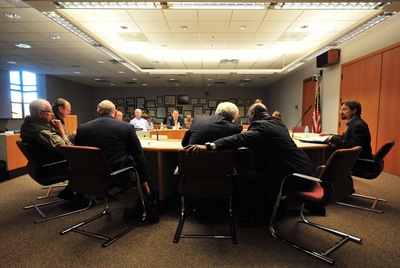
In a historic 7-0 vote, the AATA's governing board decided to initiate the process of incorporating a new countywide transit authority called the Washtenaw Ride.
Ryan J. Stanton | AnnArbor.com
Once that's done, cities and townships throughout the county will have 30 days to decide if they want to opt out before a countywide transit tax request goes before voters next year, possibly as soon as May.
"I am very pleased that we're going to have the mandatory 30-day period where local units have the option of opting out," Bernstein said. "We also have probably several months that we can continue talking with them about the possibility of opting back in to be part of the original plan."
As a creature of the city of Ann Arbor, the AATA is what's known as an Act 55 authority. The plan is to morph into a countywide Act 196 authority.
Ford said the AATA's seven-member Act 55 board will continue meeting to conduct the business of the AATA, but a new Act 196 board will begin meeting Oct. 11.
"There are a lot of policy issues, electing officers, bylaw issues — there are just a number of housecleaning issues," Ford said of the work the Act 196 board must tackle.
While the AATA has spent the last couple of years crafting a countywide transit plan, Ford said it will be up to the new 196 board — which includes seven AATA board members and eight other board members from throughout the county — to decide what to present to voters.
"There's a lot of work to do," Ford said. "Getting everybody at the table and having representation is an important part of that process. As we continue to go on, we realize not everybody might want to be in the first stage of this, but the door is always open and we believe this is the right thing to do."
Six townships — Bridgewater, Northfield, Salem, Saline, Sharon and Sylvan — already have chosen not to participate in the countywide transit discussions. Superior Township also has inquired about opting out of the countywide millage and instead purchasing transit services via contract.
If all jurisdictions in the county participated, a 0.584-mill countywide transit tax could raise about $7.7 million in the first year. That would come on top of the more than $9.1 million Ann Arbor taxpayers already pay annually to fund the AATA under the city's 2.056-mill transit tax.
The city's existing millage would remain in place to help fund the new countywide transit authority, which would replace the AATA. AATA officials estimate the countywide assessment would cost the owner of a $200,000 home an additional $58 per year.
AATA officials predict ridership would increase by 3.6 million trips per year — to an estimated 9.6 million — within five years of a new countywide transit system.
The countywide plan includes projected operating and capital expenses that total nearly $223 million over the next five years.
The plan proposes an array of public transit improvements throughout the county, including a 56 percent increase in service hours in Ann Arbor and Ypsilanti, more frequent service, more routes and fewer transfers, more affordable fare choices, and extended weekend and late-night service.
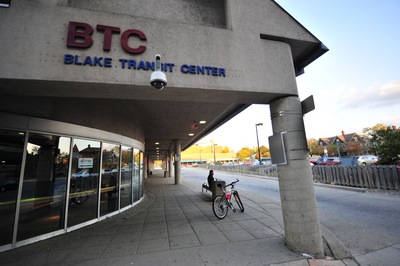
With ridership growing, the AATA plans to demolish and rebuild the Blake Transit Center in downtown Ann Arbor soon.
Ryan J. Stanton | AnnArbor.com
Communities that choose to participate in the countywide authority will share in board representation, the new and expanded services, and the costs, if funding is approved by voters.
"We've sent out information telling them how that works and what they need to do," Ford said. "We'll be following up just to ensure that they've got the information and are responding back. After the 30 days, there will be a geographic footprint of who is in and who hasn't decided yet."
The countywide authority at first will be only a shell of what will later become a fully functional agency if voters approve funding for it. It also will require approval from Ann Arbor voters to transfer the assets of the AATA over to the new countywide authority.
"It has policy decisions that they need to make, but it is not going to do anything until there is a funding source," Ford said.
AATA Chairman Charles Griffith said at Tuesday's meeting that this is only the beginning of the journey — not the end.
"I think we all know that some jurisdictions will not perhaps feel ready at this time to join in this effort and that's OK," he said. "What I think is important is that we gave it our best shot to provide that opportunity to everyone in the county that we came up with the best service plan that we could."
Griffith is bullish on the service plan.
"I think it really shows how much we can do when we sit down and work together," he said. "I think we all know that good transit builds strong communities. We have more mobility, we have less traffic, people get where they need to go, we have less pollution — everybody wins in this deal."
AATA officials provided the following summary of proposed transit service improvements that are included in the countywide plan:
- Countywide Dial-A-Ride (door to door) service throughout Washtenaw County for seniors and people with disabilities and Dial-A-Ride PLUS (door to nearest fixed route) for all residents with service hours of Monday through Friday from 6:30 a.m. to 8 p.m. and Saturday from 8 a.m. to 6:30 p.m.
- Fixed Route Service Improvements in Ann Arbor, Ypsilanti, and surrounding townships: Restructure West Ann Arbor routes: increasing frequency and extending weekday and weekend hours (120% increase). Improving Key Corridors: more frequent and extended weekday and weekend hours on Routes 2, 3, 4, 5, 6, 7 (46% increase). Restructure the Ypsilanti routes and extend into neighboring townships: increasing frequency and extending weekday and weekend hours (151% increase), and other improvements to Routes 1, 16, 17, and 22 (8% increase).
- Express Ride Service during peak hours to/from Ann Arbor and Chelsea (increased to 6 trips to Ann Arbor/7 returns), Canton (increased to 5 trips/6 returns), Saline (new service 7 trips/8 returns), Dexter (new service 8 trips/10 returns), Brighton/Whitmore Lake (new service 7 trips/8 returns), Ypsilanti Township/Belleville (new service 5 trips/6 returns), and Plymouth (new service 5 trips /6 returns).
- Community Circulators (variable hours) in Chelsea (Mon-Sun, every 45 min), Saline (Mon-Sat, hourly), Dexter (Mon-Sat, Mon-Fri, every 45 minutes, Sat, every 30 min), and Milan (Mon-Sat, hourly).
- Community Connectors (variable hours) between Chelsea, Dexter, and Ann Arbor, (Mon-Sun, hourly); between Milan and Pittsfield (Mon-Sat. every other hour); Manchester and Chelsea (Mon-Sat, twice per day); and Saline and Ann Arbor (Mon-Sat. every other hour).
- Park and Ride Intercept Lots: 800 additional spaces distributed in new lots in or around Northfield Township, Pittsfield Township, Jackson Road, and Ann Arbor/Saline Road.
- VanRide Commuter service into and within Washtenaw County.
- Other Improvements: new/improved bus stops at 150 locations; real-time travel information; new dispatch technology; and bus priority measures.
Ryan J. Stanton covers government and politics for AnnArbor.com. Reach him at ryanstanton@annarbor.com or 734-623-2529. You also can follow him on Twitter or subscribe to AnnArbor.com's email newsletters.
Comments
Janet Neary
Thu, Oct 4, 2012 : 3:17 p.m.
I am still waiting to hear a meaningful reason for Ann Arbor to give up ownership and control of the AATA assets to some undetermined people from the rest of the county, and then still pay 2 mills more than anyone else. Why is it impossible just to expand service as needed, with appropriate contributions from the affected outlying areas?
demistify
Wed, Oct 3, 2012 : 2:52 p.m.
If the AATA buses are decorated with Blaine Coleman's placard with its message of hate, you can count on my vote against the AATA, as well as my boycott of the buses. I suggest that the AATA get more serious about avoiding that outcome.
Basic Bob
Wed, Oct 3, 2012 : 4:27 p.m.
AATA opposed the "apartheid" signs, so it is strange that you attack them.
sesomai
Wed, Oct 3, 2012 : 2:41 p.m.
I look forward to extended and more frequent hours on the number 4. I ride that every day to get to work and when the students return it is way, way too crowded. If you catch it past 5 pm you're going to have someone practically sitting in your lap the aisle gets so full. They made some improvements recently by adding a sub-route that goes directly to central campus, but students either don't use it, or there are just too many of them for it to have been of much use.
Roger Kuhlman
Wed, Oct 3, 2012 : 2:39 p.m.
It is outrageous and wasteful that AATA will try to sneak a property Tax increase by Voters in a Special Election. Increasing taxes and putting more burdens on taxpayers of modest means should only be decided during regularly scheduled elections in November! I really don't know why a project like the AATA one has to be financed by taxpayers. If it is such a good plan, backers should raise private monies to pay for it.
Ron Granger
Wed, Oct 3, 2012 : 2:07 p.m.
It was suggested that there is no bus service to costco from a2. Is that true? How often does it run? Will this change that? Why should a2 taxpayers fund a transit expansion when local service is still poor?
Justin Fenwick
Wed, Oct 3, 2012 : 9:04 p.m.
Currently the #6 services Costco off State St. at a mix of 30 min or hourly intervals depending on weekday/weekend and time of day. The plan would call for alternating routes to pull off on the Airport Blvd. stretch by Costco for later and more frequent times.
belboz
Wed, Oct 3, 2012 : 1:44 p.m.
Right now, riders pay about %13 of the actual cost for use of the AATA (about 1/7th). ($4.4 million in revenue from fares, but $29.5 million in operating expenses??!!!) Until increased demand, or a more efficient public transit system is in place, expanding a bloated service is a step in the wrong direction. Essentially, we have a bus system that "truly" costs over $10 to ride from Briarwood to downtown AA (7*$1.50 fare). Or, a monthly pass who's actual cost is over $350 (7*$58 pass). Why are people hoping to further expand this??? If people were charged the actual cost, maybe they would carpool or ride a bike. Instead, the AATA is reinforcing waste and excess. Isn't that counter to its mission?
Brad
Wed, Oct 3, 2012 : 1:26 p.m.
"everybody wins in this deal" Priceless.
ribs1
Wed, Oct 3, 2012 : 1:20 p.m.
Why are they holding the vote in May?
outdoor6709
Wed, Oct 3, 2012 : 4:34 p.m.
It has been proven that off peak elections are more likely to get the supporters to come out. Many times people are not aware that an election is being held. May will allow AATA to slip the mileage vote past a large % of voters, who would vote no if election was held in a Nov election.
Vivienne Armentrout
Wed, Oct 3, 2012 : 1:17 p.m.
Emphasis is being placed on bus service and "demand" service for seniors and disabled, but the total package of transit plans is much larger and more expensive. See my recent post http://localannarbor.wordpress.com/2012/09/30/the-transit-picture-in-ann-arbor-and-environs-still-a-ball-of-confusion/ for an overview. The millage amount that has been quoted assumes that the entire county will contribute. We'll see how that works. Even so, it is not enough to pay for the connectors and commuter trains.
Top Cat
Wed, Oct 3, 2012 : 12:48 p.m.
"We've spent two years talking to lots of folks." What they failed to do is listen.
Alan Goldsmith
Wed, Oct 3, 2012 : 12:40 p.m.
"We have a great bus service now IF you need to travel in Ann Arbor, M-F, 9-5. If you need to move beyond the city limits or travel outside of work hours, the system stops working quite so well." So what you're saying is the 2 mills we pay now is a failure and now you want to give the same group more funds to screw things up? Got it. Looking forward to this brilliant use of logic when you take your seat on City Council.
Brad
Wed, Oct 3, 2012 : 1:13 p.m.
Yeah, but just think of all the 'kumbaya' he'll bring to council. I can hardly wait.
OLDTIMER3
Wed, Oct 3, 2012 : 12:35 p.m.
Most senior centers offer a ride to start with. SASC offers a bus ride to Briarwood I think . And other places in the city of Saline.
dotdash
Wed, Oct 3, 2012 : 12:10 p.m.
Am I cynical to think they rushed this approval so the 30 days in which the AA city council would be able to vote on it are before the new councilors (Peterson, eg) were elected?
amsims
Wed, Oct 3, 2012 : 11:52 a.m.
I for one am thrilled, after getting sick of sitting in traffic on 94 and then having to waste gas hunting for parking in A2. I'm already using the bus and hope to do so more with the service increases. My UM employee card lets me ride free, which is a nice savings with gas prices so high. My teenagers who aren't driving yet ride the bus to get to lessons and appointments, which also saves me time, money and stress as I don't have to worry about them driving in bad traffic or weather. I've really never seen an "almost empty" bus, and in fact the buses are frequently full to the point where there's barely standing room. Have any of these negative commenters actually ridden the AATA?
Brad
Wed, Oct 3, 2012 : 1:06 p.m.
Never seen an almost-empty bus? Then you are not paying attention whatsoever.
RUKiddingMe
Wed, Oct 3, 2012 : 12:59 p.m.
I've ridden it. And I've paid attention to how many people I see riding it when I go by buses and stops. You have no idea how much gas is wasted on driving enormous buses around all day with 3 - 4 riders. Then tripling it for no reason except to create new government jobs, boards, committees, etc. etc.
OLDTIMER3
Wed, Oct 3, 2012 : 12:32 p.m.
If you are already riding and having no problems with it why do you support an expansion of the services. The comments are confusing. If the buses are to bring workers in and out of the city on one hand and on the other it is stated to bring in disabled and seniors . The disabled and seniors will hardly be coming in to work in the city.And they are probably the ones who can afford a tax increase the least.
LXIX
Wed, Oct 3, 2012 : 11:21 a.m.
Nice table. Thought that was Ford headquarters for a moment. Do the math. County tax raises $7M. City tax already at $9M. Cost to run it goes way up to about $44M per year. The $44M-$16M tax = $28M has to come from somewhere so suddenly there will exist 3x the number of countywide bus riders. Sure. Took only "a matter of minutes" for the board with its very nice table to approve that one, too. Where's my Tesla?
Vivienne Armentrout
Wed, Oct 3, 2012 : 1:07 p.m.
The photograph is from an angle that makes it look like a conference table but it is actually the AADL board room (old school board room), with two crescent-shaped benches facing each other. Mr. Ford said in his executive statement that he will be meeting with Al Berriz and Bob Guenzel to reassess the finances after they find out who has opted out.
Karen Hart
Wed, Oct 3, 2012 : 11:13 a.m.
In my experience, AATA has followed a thoughtful, in-depth, inclusive planning process over the past two years (and longer, informally) and has stepped up to provide mobility and connectivity for County residents for the next 20-30 years and beyond. This service expansion will put Washtenaw County into the forefront in Michigan (though Grand Rapids is about to get bus rapid transit), and will enable young people and seniors to become or remain independent in a place where most housing is scattered across former farm fields. It will also support economic recovery by making more people able to access jobs. I can't wait to vote Yes for this millage.
Roger Kuhlman
Wed, Oct 3, 2012 : 2:49 p.m.
AATA has followed an inclusive planning process? Yes I guess if you mean by inclusive by gathering all the input from those people who agree with the project and none from those who oppose it as wasteful, unnecessary, and handing out special subsidies.
RUKiddingMe
Wed, Oct 3, 2012 : 12:57 p.m.
"I can't wait to vote Yes for this millage" You win for the next Ann Arbor motto. Let's get t-shirts printed.
Steve McKeen
Wed, Oct 3, 2012 : 12:24 p.m.
Let's hope this works out better than Water Street did.
Vivienne Armentrout
Wed, Oct 3, 2012 : 10:38 a.m.
I did some searching and found that there is a permissible election date in Michigan on February 26, 2013. This will be a special election in every jurisdiction, as far as I know. AATA will presumably pick up the bill using Ann Arbor tax monies. So it is not accurate to say that the 196 board "won't do anything" since they will be who calls the election. (I'm pretty sure the jurisdictions are not going to want to put this on for free.) Ryan, I didn't hear this date stated during the meeting. Did you obtain that information via an interview or was it announced publicly?
Ryan J. Stanton
Wed, Oct 3, 2012 : 2:14 p.m.
Yes, the article has been corrected. Sorry for the confusion.
Vivienne Armentrout
Wed, Oct 3, 2012 : 1:40 p.m.
I see that the article has been edited to show an election in May. That makes more sense and is what was previously reported. The first version of the article said the election would be held in February.
Alan Goldsmith
Wed, Oct 3, 2012 : 10:15 a.m.
I love it when slick, hack politicians track to sneak a tax through with a February vote, when turnout is at its lowest. Why not in November or when voter participation is at its highest? I'm voting NO over this turnover of hundreds of millions of dollars of City of Ann Arbor taxpayer assets to a board I don't trust.
dconkey
Wed, Oct 3, 2012 : 10:14 a.m.
My question is about the tax request in February. Is that the only item on the ballot at that time? If so, who I picking up the tab for a special election?
motorcycleminer
Wed, Oct 3, 2012 : 8:14 a.m.
Washtenaw county has become the worlds biggest comedy club...just another joke on the taxpayers by people who don't even use their product...just add it to the growing list of boondoggles.." polly's folly " ( the bombshelter ) " Lego land " ( the new city hall ) " just say aaaaah " ( the tongue depressor ) " the pinwheel of fortune " ( court bldg. mobile )...the list just grows and grows while the sheeple graze....duh...
Basic Bob
Wed, Oct 3, 2012 : 9:35 a.m.
But our officials do use the product. First to get their streets plowed, they have access to every department - streets, sewers, police, fire - to make sure the services are applied at least as well in their neighborhoods as any other place. You may think it is generous for them to spend money on things they don't personally use, to me it is suspiciously like Kwame Kilpatrick, Governor Snyder, or Mitt Romney's limousine lifestyle.
Chuck Warpehoski
Wed, Oct 3, 2012 : 3:47 a.m.
We have a great bus service now IF you need to travel in Ann Arbor, M-F, 9-5. If you need to move beyond the city limits or travel outside of work hours, the system stops working quite so well. This is a chance to help it work better. I'm especially supportive of the improved dial-a-ride service for seniors and people with disabilities. I know people who have been able to maintain their independence after strokes or giving up their license due to age thanks to this service, and I am eager to see it strengthened and expanded.
LXIX
Wed, Oct 3, 2012 : 11:52 a.m.
The dial-a-ride service has actually been cut back due to fund monkeying. Ann Arbor Transportation used to provide a comprehensive Senior Ride / Dial-a-ride service where any available Yellow Cab would shuttle shared rides around town for peanuts. The seniors and disabled loved it. It was an innovative and envied service that only a few other US Cities had and was funded by A2 & Federal taxpayers. It provided nearly half of Yellow Cab taxi revenue and the local company thrived. Things changed.
PineyWoodsGuy
Wed, Oct 3, 2012 : 2:57 a.m.
The AATA Advertising Agency is based in London, England. Their Advertising Agency is out-of-touch with American values. Their brilliant "idea" was to paste Huge Photos of AATA political-appointees at AATA Waiting Stations. What does this tell you? This is all about the Vanity of a few Fat Cats that are running the AATA at the expense of Ann Arbor taxpayers. Now they propose to foist their Foolish Spending onto the backs of the rest of the Washtenaw County taxpayers! How dumb can we taxpayers get? I ask yins . . .
PineyWoodsGuy
Wed, Oct 3, 2012 : 2:48 a.m.
Giant Buses. Bigger than needed for the ridership. Blacked-Out windows to obscure the fact they are nearly empty except for a few riders. Biggest Boondoggle in the history of our county. It is all a plot to lift the burden of cost off the backs of City of Ann Arbor taxpayers. Do yer due diligence and the Giant Bus Millage does not pass the Smell Test!!!
Brad
Wed, Oct 3, 2012 : 1:15 p.m.
No, the AA taxpayers will continue to get soaked. We'll just have some company now.
nowayjose
Wed, Oct 3, 2012 : 2:47 a.m.
I hope Pittsfield opts out
dconkey
Wed, Oct 3, 2012 : 10:15 a.m.
Oh, Mandy will be all in on this.
Basic Bob
Wed, Oct 3, 2012 : 9:30 a.m.
Unlikely since they already purchase service. Every route between Ann Arbor and Ypsi goes through Pittsfield and many people in the Carpenter and Washtenaw corridors rely on it.
G. Orwell
Wed, Oct 3, 2012 : 2:30 a.m.
Power grab by unelected bureaucrats. This will be a disaster. Cost will get out of hand and we will all pay for it.
Ken
Wed, Oct 3, 2012 : 8:47 p.m.
This is a rather large concern of mine with regard to the millage. If you recall when Ypsi was hyping a "TEMPORARY TRANSIT MILLAGE" AATA immediately set out to sell Ypsi on the need for enhanced Transit and further increase to the TEMPORARY MILLAGE. The millage passes, then just as Ypsi is collecting the tax, AATA reports that this millage is not enough to maintain current levels. My point is, I do not see the proposed millage as being sustainable for the amount of increase that AATA is claiming they will deliver. AATA or "The Washtenaw Ride" will be coming back in a year or two for more money..........much more money. Every 5 years I believe we then are ask to re-new the millage or we end up with the Simpsons Monorail, in disarray and massive service cuts.
Alan Benard
Wed, Oct 3, 2012 : 2:20 a.m.
"Taxes are what we pay for civilized society …" -- Oliver Wendell Holmes, Jr. This will be a great improvement to the region. This will bring people to jobs and when people have jobs and spend money more jobs will come. This will bring people to the cities of our county who can shop and work without having to worry about storing a car for nine hours. This will be the small step forward toward being able to leave one's house on foot and travel to train stations and airports. The Detroit region is broken. Lack of regional infrastructure is a huge part of the problem. Any small movement toward integration and connection is critical.
RUKiddingMe
Wed, Oct 3, 2012 : 10:21 a.m.
The People Mover was a small movement towards connection; that worked out super wonderful. And this expansion is almost identical to that in every way in terms of lack of necessity, erronious assumptions about ridership and usefulness, etc. This is nothing, NOTHING more than a new way to spend money for no reason. They have no evidence showing this is needed, wanted, or even a good idea. Period. The only reason they get away with this stuff is because of the apathy, ignorance, or misplaced trust of voters. In the business world, multiple people would already have been fired for this getting THIS far.
Veracity
Wed, Oct 3, 2012 : 3:57 a.m.
Wishful thinking will not make this transit authority successful. "If you build it, they will come" only happens in the movie "Field of Dreams." In our country's youth building new railroads into undeveloped territory drove expansion. But the planned bus services are not opening up new territories and are not flexible enough to accommodate the desired travel needs of most patrons. Expect ridership to under perform expectations and the transit authority will need to heavily subsidize service. Since usage fees will be minimal compared to operational and capital expenses new taxes in the form of more millages, special assessments and bonds will be required. The new transit authority's board will have the power to impose these taxation with little influence by Ann Arbor which will be under represented on the transit authority's board. The only way to prevent this travesty is to defeat the millage at the ballot box in February.
kenUM
Wed, Oct 3, 2012 : 2:36 a.m.
Alan, sounds wonderful! I was at the Meijer on Jackson Rd yesterday; no bus service out there but a good bit of money was being spent and there were quite a few employees working. No parking issues either. Now maybe those folks all live in the Township, but I did not hear of any transportation issues from anybody; shoppers or employees.
RUKiddingMe
Wed, Oct 3, 2012 : 2:09 a.m.
Don't forget about the $200,000 they have budgested for the website. Just the website. $200,000.
sellers
Wed, Oct 3, 2012 : 12:01 p.m.
which also includes all the communication that shares the bus schedule, where buses are, and if they are running late no doubt. It's actually not a lot!
Kai Petainen
Wed, Oct 3, 2012 : 1:47 a.m.
sorry, i'm new to this discussion. my apologies if this was explained somewhere... in the AATA expenses, it shows $5 million for 'fringe benefits' what are the fringe benefits?
Kai Petainen
Wed, Oct 3, 2012 : 9:20 p.m.
thanks. wow. $12.4 in wages and $5 million in benefits. does that seem high to anyone else?
jmac
Wed, Oct 3, 2012 : 12:05 p.m.
Fringe benefits are costs for covering health care, retirement, taxes, etc., so an employee earning a salary of $30K with a fringe benefit rate of 25% (= $7.5K) actually 'costs' $37.5K to employ.
Alpha Alpha
Wed, Oct 3, 2012 : 1:38 a.m.
Where is the evidence suggesting a need for this proposed change?
RUKiddingMe
Wed, Oct 3, 2012 : 1:20 a.m.
"AATA officials predict ridership would increase by 3.6 million trips per year — to an estimated 9.6 million..." Yes, they predict. That's all they are basing this on. Here's a look at how their predictions work out, from http://www.annarbor.com/news/aata-board-approves-2012-13-budget/: "Federal operating assistance came up $609,645 shorter than expected, local property tax revenue came up $269,095 shorter than expected, passenger revenue came up $143,395 shorter than expected, special fares came up $40,965 shorter than expected and purchase of service agreements came up $22,613 shorter than expected." You know what they used as partial justification for this? A 14% increase in ridership when the DOUBLED (increased 100%) service on a popular, already well-used route. Also, it looks like this new board (a brand new group of people paid with your tax dollars) will be able to increase and/or institute new millages without your vote (from http://www.annarbor.com/news/county-board-bogs-down-four-party-transit-agreement-vote-to-come-aug-1/): "The new transit authority will be a new governing body with the ability to levy taxes in the county, amend its own articles of incorporation and to vote members off its board. The county Board of Commissioners will have little to no oversight of the board, and the county will have no fiscal responsibility..." All residents need to vote no, opt out, get their friends and family out there to do the same. They don't have to come to their senses; they get a guaranteed revenue stream; you pay your property taxes or you lose your house. Look in the AATA buses around you; they are often mostly empty. There is no proven need for this. It's more people getting paid more money to decide how often to take more of your money. Ann Arbor citizens paid millions of dollars to prepare the Fuller Station site, which didn't (and still shouldn't) happen. They don't have to be careful with your money; YOU do.
Carl
Wed, Oct 3, 2012 : 4:14 p.m.
This is wrong, "will be able to increase and/or institute new millages without your vote." Please google Michigan constitution article 9 section 31 and read for yourself! Here is the first sentence to save you the trouble. "Units of Local Government are hereby prohibited from levying any tax not authorized by law or charter when this section is ratified or from increasing the rate of an existing tax above that rate authorized by law or charter when this section is ratified, without the approval of a majority of the qualified electors of that unit of Local Government voting thereon."
RUKiddingMe
Wed, Oct 3, 2012 : 12:41 p.m.
Hermhawk, please tell me what stops you're talking about and around what rtimes; I would like to know if you see lines for AATA (not U of M) buses, and if it';s just the general going-to-work rush and leaving-work rush. if so, that's not an indication that we need to expad bus service to outlying townships. Selfishness has nothing to do with it; if you have been convinced by the lCOMPLETE ack of real evidence that this expansion is necessary and will be utilized be the publi enough to justify it, then that's it; there will be no convincing you otherwise. Just saying that there are seniors and people who can't afford cars is not a justification for expanding the bus service all over the state. There's people that can't afford boats too; why don't we get a ferry service going? let's dig out the Huron and get more water in here.
hermhawk
Wed, Oct 3, 2012 : 12:19 p.m.
I detect a sense of selfishness here. I normally drive a car but it is inoperable so I have to ride the bus, and the bus I ride is often crowded. Look downtown and you see people lined up waiting to catch the bus. Those of you who complain, may I ask. Who cares for those in need, liked seniors and poor people unable to afford a car? Public transportation is needed badly. Just look at Detroit and the tri-county region and how bad it is. AATA is one of the better bus systems in Southeastern Michigan and needs to be improved. This is just the first step.
RUKiddingMe
Wed, Oct 3, 2012 : 10:14 a.m.
A2.com, can you PLEASE confirm or deny this ability to institute new or increase existing tax WITHOUT voter approval? I've read info indicating they CAN, and several people who seem to think they can't. A final word on this would help the situation. Chuck, the wording from the article I quotes, as well as other info I've read, indicates to me they CAN. Also, please cite your source for this transit authority being an UNPAID position; that's the first I've heard of that, and it seems unlikely. And do you see people lined up to use the bus all day, or just for going to work inthe morning and leaving work in the later afternoon? What stops do you see lines at? Do you anticipate seeing lines at all the stops like ones from Chelsea and Dexter to Ann Arbor?
Chuck Warpehoski
Wed, Oct 3, 2012 : 3:43 a.m.
Wow, lot's of wrong facts here. The Transit Authority Board is an unpaid position, they are not "paid with your tax dollars." Under Michigan Law, any tax they levy does require voter approval. And on my way to work I see people lined up at the bus stops to take the bus into town.
Veracity
Wed, Oct 3, 2012 : 3:43 a.m.
I was about to write a similar comment. You make excellent points. Buses along many routes are underused by patrons. A bus going to Canton in the morning is empty going out and returns with a small number of riders who likely work in Ann Arbor. At night ridership on the Canton bus is reversed as the morning riders return home. If expanded to 5/6 bus trips a day then buses will likely run empty in both directions. Operations will have to be heavily subsidized as anemic ridership on many routes will result in less than anticipated (and hoped for) revenue. Is anyone concerned about the $223 million of expected operating and capital expenditures expected during the first 5 years? The 0.584-mill levy scheduled for voter approval in February will provide $7.7 million a year or $38.5 million over 5 years. The new county transit authority will need to obtain the remaining $184.5 million from tax payers in the form of more millages, special assessments and bonds. If you do not want underutilized and costly new services decided by a transit board that under represents Ann Arbor then vote "NO" on the millage vote in February. It is the only way to avert wasteful spending of our tax dollars.
antikvetch
Wed, Oct 3, 2012 : 12:59 a.m.
I am guessing this story does NOT have a happy ending -