

ACLU of Michigan threatens lawsuit against University of Michigan over trespass policy
The legal director of the American Civil Liberties Union of Michigan is threatening to sue the University of Michigan over its use of a trespass policy, saying it suppresses protected speech and may be unconstitutional.
Civil rights attorneys first raised questions about the constitutionality of the trespass policy in an Oct. 24 report by AnnArbor.com that detailed the university's use of the policy to banish then-state Assistant Attorney General Andrew Shirvell and others from the U-M campus.
“Now that a light has been shined on the deficient process for banning individuals from campus for life, our hope is that the university will take a second look at this problem, and take action, without the need for a lawsuit,” said Michael J. Steinberg, legal director for the ACLU of Michigan.
Chris Armstrong, the first openly gay student body president at U-M, requested a personal protection order against Shirvell on Sept. 13. Shirvell, who has since been fired from his state job, engaged in a months-long campaign against Armstrong over what Shirvell called his "radical homosexual agenda."
On Sept. 14, campus police issued Shirvell, a U-M alumnus, a trespass warning that banned him from campus. Police modified it Nov. 3, but Shirvell is still banned from areas where Armstrong is expected to be on campus, except sporting events.
Each of U-M’s 56 sworn police officers have discretion to read or mail trespass warnings. The policy permanently bans a person from campus and various other properties throughout the state and nation. Police also can ban individuals from smaller areas like a building floor, a whole building or a section of campus.
Only the director of public safety can modify the warning.
Individuals also can bring grievances to an elected, independent police oversight committee of U-M students, faculty and staff members, but the committee’s powers are advisory only.
Steinberg said he believes the policy puts constitutionally guaranteed rights including free speech and due process at risk. He said U-M should revise the policy to avoid a lawsuit from the ACLU.
“What is needed is notice of the reasons for being banished and an opportunity to be heard before a neutral fact finder that is not the police,” Steinberg said.
U-M's student ACLU chapter sent a letter Nov. 11 to U-M President Mary Sue Coleman and Public Safety Director Ken Magee. In it, the group provided specific ways it would like U-M and campus police to amend the policy, including an independent appeals process and language that protects free speech and assembly rights.
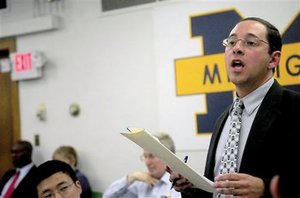
Andrew Shirvell's case has raised questions about U-M's use of its trespass policy.
“These fundamental rights deserve special protection in any community and especially our dynamic university community that is built on the free exchange of ideas,” the letter signed by U-M students Mallory Jones and Bennett Stein states.
Other civil rights experts also questioned the use of the policy, which is based on state law and also is used at other colleges and universities around the state.
“I’m not saying they’re acting in bad faith, but when they draft these policies, they’re not thinking of the free speech concerns and the possibility that someone could be excluded because of his views,” said Robert Sedler, a civil rights attorney and professor at Wayne State University.
Eastern Michigan University’s trespass policy is similar, except the warning expires after one year. It’s also problematic, Steinberg said.
“By limiting the banishment to a year, instead of a lifetime, the EMU policy is less egregious,” Steinberg said. “But it does contain many of the same problems as U-M’s policy."
U-M police officials maintain the warnings are always issued in good faith. They also point out they have an appeals process even though one is not required by state statute.
“If they are stealing, if they are threatening people or assaulting people, then we read them the trespass to keep them from coming back on campus and committing crimes on campus and victimizing our community,” U-M Deputy Police Chief Joe Piersante said.
Roughly 3,300 individuals are banned from U-M's Ann Arbor campus in whole or in part, and around 80 people are prohibited from EMU's campus.
Those who violate a trespass warning can face misdemeanor charges punishable by a maximum $250 fine and/or 30 days in jail, said Konrad Siller, an assistant prosecuting attorney for Washtenaw County. U-M police said they interview rather than arrest most trespassers they find on campus.
Steinberg said the ACLU received three calls after the AnnArbor.com report from individuals who felt U-M used the trespass policy to suppress protected speech. He said it shouldn’t be applied in the same way a business owner or private institution might use it.
“The University of Michigan is not a private institution,” Steinberg said. “There are certain parts of the that are generally open to the public for the free expression of ideas. The University of Michigan cannot use the trespass statute as if it was a private entity to bar individuals from participating in the public life and in the public exchange of ideas in places like the Diag."
U-M spokesman Rick Fitzgerald said the school received the letter from U-M's student ACLU group and it's being reviewed, but he didn't directly answer a question about whether the policy could be revised.
“(The trespass policy) will continue to be an option, as it always has been, to Department of Public Safety officers at the University of Michigan," he said, noting the trespass warning “Is a tool available to police officers throughout the state.”
Steinberg declined to say whether the ACLU has been working with Shirvell. Sedler said he thinks Shirvell has a good case.
“He certainly has a plausible claim that the policy of the violates the First Amendment because it can be applied to exclude someone from the campus for the person’s views, and it doesn’t contain narrow, objective and definite standards,” Sedler said.
Juliana Keeping is a health and environment reporter for AnnArbor.com. Reach her at julianakeeping@annarbor.com or 734-623-2528. Follow Juliana Keeping on Twitter
Comments
Anette
Sun, Nov 21, 2010 : 1:08 p.m.
Couldn't happen to a nicer organization. I'm no fan of the ACLU, but living in A2, I'm less of a fan of the UM and most of their "affiliates".
Mick52
Sat, Nov 20, 2010 : 11:05 p.m.
Roadman, your post does not move me. There is plenty of reason to believe that Shirvell's behavior extended beyond the boundaries of free speech, though I never agreed he should have been arrested or deserved a PPO filed against him. You cannot say the U of M is a public place. It is not that simple. There are places you simply cannot go, and in many other places you can go if you have standing. If you have any examples of the UM police using the trespass statute against people based only on our statement, "such as race, national origin, creed, etc. this clearly violates federal and states civil rights law." Please cite them. You are accusing them of discrimination and you need to have proof. False allegations of discrimination are as disgusting as real discrimination. Every time the UM police respond they do consider what the person is doing and take appropriate action. You cannot use freedom of speech to defend disturbances or infringing in areas you are not allowed to be in. You can be granted access, but it can also be revoked if your behavior is inappropriate. You simply cannot deem a place "public" whenever you want and go where ever you want and use the First Amendment to do so. It would be like an unregistered person sitting in a class. The police would be perfectly justified to use the trespass statute to order them to leave. The people who get trespassed get it because of their behavior, not for what they say. That is why the statute has stood for so long.
Wusedny
Fri, Nov 19, 2010 : 5:37 p.m.
What else can you expect from this scum bag organization?
Roadman
Fri, Nov 19, 2010 : 2:31 p.m.
@Mick52: While people affected by disruptions or bad behavior undoubtedly call the police, that does not necessarily mean there is a right to exclude the offending person from a public place. When members of the public are so excluded for invidious reasons, such as race, national origin, creed, etc. this clearly violates federal and states civil rights law. For a governmental unit to exclude someone due to unpopular free speech likewise can result legal action against that entity for abridgment of the right of First Amendment free speech. If Shirvell had been a law enforcement officer, insurance investigator, or reporter in front of Armstrong's fraternity house with audiovisual equipment at 1:30a.m. there would be no question that those hypothetical persons had a right to be there to ply their trade; likewise if Mr. Shirvell wishes to do so for unknown reasons and he does not trespass,burglarize, or make excessive noise he can do so. There has been much ado about if this had been Rick Snyder's or Mike Cox's home, this type of conduct would not have been tolerated. In reality, it has been all of the time with public figures. In Ann Arbor not long ago, anti-affirmative action protestors demonstrated at the home of Mr. Bernstein, the Michigan Department of Civil Rights Commissioner who supported affirmative action. Free Speech Clause protected activity. Bernstein even met with the protestors and catered in food for them. Former Detroit Office FBI Special Agent in Charge John Anthony had his Canton Township home demonstrated against by union picketers playing the Johnny Rivers' hit "Secret Agent Man" after he took employment with a Detroit newspaper during the strike in 1995. Anthony conceded the First Amendment rights of these picketers to do so. The U.S. Supreme Court has given vast application to the Free Speech Clause the last fifty or so years. That may or may not change with the Fred Phelps case pending before the Supreme Court and awaiting decision. Look at the background of the 1931 and 1970 trespass laws in Michigan. It was U-M who pushed for passage of the 1970 law and later wanted to enforce the 1931 statute. In the nationally-publicized Dearborn parks case I cited earlier, Judge Stempien initially upheld the right of the City of Dearborn to exclude non-residents from most city parks but did allow non-residents to use state-funded parks in Dearborn. After police later randomly began asking identification of park visitors to verify residency, Stempien held that these visitors' Fourth Amendment rights against unreasonable search and seizure were violated and held the entire prohibition against non-resident park visitors to be void. The case was a major victory for both the ACLU and NAACP. I believe that you will find that many of the 3,300 persons on the trespass list, like Shirvell, are persons being targeted largely because of their politics rather than posing a danger to anyone. Remember these facts: (A)Armstrong told a police detective not to comunicate to Shirvell that his conduct was unwanted when the detective volunteered to do so; (B)Armstrong is a public figure who worked for a public officeholder(Nancy Pelosi) and openly was gay; (C)Armstrong voluntarily dropped his PPO order request; (D)Armstrong is not currently being subject to any unwanted behavior from Shirvell. Shirvell is a bizarre character to be sure and if he used government resources to further his anti-Armstrong views, he should (and will)pay a price. Armstrong, I suspect is trying at this point to become a iconic martyr for the gay movement and may try to get some cash down the road in the way of a monetary damages suit by Debbie Gordon. Armstrong's "damages" are little different from what Congressmen Dingell and Levin have endured the last several months. They are not whining like Armstrong. I suspect that these cluster of Armstrong/Shirvell administrative and legal actions will take years to resolve.
UtrespassM
Fri, Nov 19, 2010 : 1:47 p.m.
Great Example for UM trespass trespass policy: 1.Officer A. said: "when the police said you trespass, you trespass." 2.Chief W. said: "Did you tell us that you had been physically assaulted by someone at work place? So you are not allowed be in the same area where he is. 3.Chief M. said: "Do you understand who you are?" 4.Chief P. said: "Sorry, This is Dr. M's decision to continue your trespass. I will lifted it for you as soon as you can get an overwrite from someone in a higher authority than Dr. M."
Mick52
Fri, Nov 19, 2010 : 10:58 a.m.
Some people are posting that the UM is public property and should be completely open to everyone. Not true. Like many public areas, you simply cannot be anywhere you wish. Prisons are the ultimate example. But you can't walk into many areas and wander about. Some areas are open to the public, like the Union, the League, the Museums, but even there, you have to conform to certain decorum and if you create a disturbance or do not comply with a lawful request the trespass law can be applied. Also, this is that same everywhere. Any private business/property owner can use the trespass law just like the UM does. Also, some posts seem to imply that the police are everywhere, following those of leftist opinion, see Roadman above. His statements are far from the truth. The UM is not a bastion of conservative thought. It is quite liberal and the police comply with that. What almost always happens in cases a la Shirvell, is that people affected by disruptions or poor behavior call the police. It is not the police initiating actions it is people who are fed up with the behavior. Each person on which the trespass law is used is asked first to leave. Only when they refuse are they arrested. It is the people in control of the building/dept that ask for enforcement. Let the ACLU sue, raise a stink, but they will find nothing other than behavior that is lawful and appropriate and really quite lenient. They will not find any unlawful application of the trespass statute and I hope they get charged with legal fees.
a2citizen
Fri, Nov 19, 2010 : 1:26 a.m.
If the ACLU had taken the case BEFORE Shirvell was fired, I might respect their cause.... Now, they just want to keep their name in the headlines. They don't mention trying to get Shirvell his job back.... By the way, libtards, i think Shirvell should have lost his job for using his government computer to email Armstrong. But, waiting for Shirvell to lose his job is a chickens way of operating.
Roadman
Thu, Nov 18, 2010 : 8:41 p.m.
@David Briegel: Yes, my critique of Prosecutor Brian Mackie's selective prosecution tactics are set forth as a post in the op-ed "Shrivell is a Bully" thread.
David Briegel
Thu, Nov 18, 2010 : 8:09 p.m.
As Roadman stated, Shirvell did not have his speech limited. He was told to stay away from Armstrong because of his stalking and harassing behavior. NOT his speech! Tom Lienert, A Public Law Enforcement Official! You are correct. trespass, I defy any of you dissenters to admit publicly that you would tolerate Shirvell's behavior if it were targeted at you! Publish your name and address! Mackie took the easy way out! Roadman explained that in another post.
Tom Lienert
Thu, Nov 18, 2010 : 7:41 p.m.
The ACLU is threatening a lawsuit because the U-M protected one of its students from harassment by a public official who was well beyond any reasonable limits of free speech. Nice. This is the same ACLU that claimed that Nazis harassing Holocaust survivors in Skokie, Illinois was somehow covered by the protection of the Bill of Rights. It wouldn't surprise me to find out they're also footing Fred Phelps' expenses in his attempt to have harassing mourners at a funeral declared protected speech. Like I said regarding Shirvell's threat, tell to sue and be damned!
Roadman
Thu, Nov 18, 2010 : 6:50 p.m.
I welcome the ACLU of Michigan's interest in seeking court review of this trespass policy, which I believe is overbroad and unduly chills free speech. I see a number of issues involving the Free Speech Clause of the First Amendment that are implicated in the trespass policy. One is that it gives unfettered discretion to a law enforcement official to ban any person from public property without any sufficient standards for determining exclusion. The potential for abuse is high as the official can surreptitiously use impermissible criteria for exclusion such as engaging in political favortism. He may decide not to exclude, for example, gun control advocate activists from protesting loudly since he may be sympathetic to their cause, but give trespass notices to demonstrators who denounce police brutality. In this vein, I would note that the few persons I am acquainted with who have received such notices from U-M have been activists of the left-wing persuasion. The second Free Speech Clause concern is that the remedy of exclusion is not narrowly tailored to advance a compelling government interest; this issue was apparent in the Shirvell case when the University of Michigan Public Safety initially banned Shirvell completely from campus but later, after hearing, limited Shirvell's access to areas where Armstrong was or reasonably likely to appear and potentially be unduly annoyed by Shirvell. There are also Fourteenth Amendment Due Process Clause concerns that I have. These include the Board of Regents delegating exclusionary power to a law enforcement offical. The Michigan Supreme Court in Crampton vs. Department of State held that having a state police official sit on a Driver's License Appeal Board in an adjudicative capacity where criminal law violations are alleged unconstitutionally violated due process since the potential risk of bias was impermissibly high; the court held that police officials are aligned with the enforcement powers of the state, hence the appearance of potential bias was great. Here, the U-M Public Safety Director is essentially making substantive decisions as to whether an individual is or has been engaged in unlawful behavior or is a danger to the public. Another due process argument is whether prior notice and opportunity to be heard should be afforded the citizen before a trespass notice issues. A person's interest to be free from taint of their name is something that has been recognized by the courts. Persons who have been placed on this list and who are barred from entry on campus would have a certain stigma attached to their name. I am assuming this trespass list is public record or at least publically available through the Freedom of Information Act and it is reasonable that publication of the identities of persons on the list have the reasonable potential to adversely affect the ability of such persons to hold public office, obtain professional licenses, employment, or security clearances, or impute social stigma that the person is a troublemaker. Before a person is placed on such a list they should have the opportunity for a meaningful hearing before an impartial decisionmaker. Even though Shirvell was granted a hearing, he already had a notice issue against him before that hearing occurred. I know of nothing that requires the University to grant an affected person any hearing at all, and to the extent that the granting of a hearing is in any way discretionary with the public safety official it is violative of due process since due process must be guaranteed in the procedure itself rather than at the whim of an official who has discretionary power to deprive the affected individual of a hearing. To the extent that the University is proceeding pursuant to trespass statutes enacted in 1931 and/or 1970 that establish purported rights to issue such notices, the ACLU may attack the constitutionality of these enactments themselves. A major concern I also have is whether the trespass notice procedures in their current form are being actually used to unfairly target "unpopular" Free Speech or groups. In other words, who does the onus of being on the list primarily fall upon? Is it left-wing political activists as opposed to conservative-minded groups. Does it target blacks or Arabs more heavily than others? In 1985, a lawsuit was filed against the City of Dearborn to test its "residents only" exclusion of persons from city parks. Black civil rights leaders claimed it was a thinly-veiled attempt to keep minorities from nearby Detroit from using the parks; the city claimed they could restrict the use of their recreational facilities to those city residents who actually contribute to the parks via payment of tax revenues received by the the City of Dearborn. Presiding Judge Marvin Stempien in Wayne County called the case the most important he heard during his career as a jurist. The concept of trespass notices and banning of citizens in public facilities in Ann Arbor is not limited to the University of Michigan. The same has been done in the County Building. The ACLU had previously been approached over a number of persons who had been restricted from the Washtenaw County Circuit Court. One of these persons was father's rights activist Dan Debolt, who was researching improprieties at the Court. Debolt, after uncovering information that arguably reflected adversely on the operation of the Court, was banned from entering the Court (with the exception of appearing on his own case) by court order. The story of Debolt's banishment is chronicled more fully by the political action committee People Against Corruption at www.a2buzz.org. A federal court lawsuit seeking review of the above and related matters would be for the public benefit and could create important legal precedent for all citizens.
Mick52
Thu, Nov 18, 2010 : 6:49 p.m.
Nonsense. I am sure the U is shaking in their boots over an ACLU lawsuit. Quick, anybody, name a lawsuit the ACLU ever won. When you finish at the bottom of your law school class, you go work for the ACLU. The trespass law is not abused. If they don't like it go to the legislature and change the law.
trespass
Thu, Nov 18, 2010 : 4:26 p.m.
@David Briegel- If he should have been charged with stalking then I am sure the County Prosecutor would have done so. The County Prosecutor prosecutes almost any case the UM asks him to, so he is not averse to pressing charges if he can. He just did not have a case. Why do you think that you know the law better than he does?
David Briegel
Thu, Nov 18, 2010 : 4:20 p.m.
The ACLU is always on the side of truth, justice and the American way. I just have a serious problem with turning this into a speech issue. Shirvell can say anything he darn well pleases. Obsessively stalking and harassing is what he did. That alone is what he should have been charged with. Imagine a law enforcement official with a badge stalking and harassing you at all hours of the day and night. Imagine?? All you anonymous posters, use your names and addresses. Then we will talk about right and wrong!
jj
Thu, Nov 18, 2010 : 2:34 p.m.
What's next, banishment from the Big House if you boo the football team?
YouWhine
Thu, Nov 18, 2010 : 2:13 p.m.
Speaking of Ken Magee... Where has he been lately? Nobody has seen him at work in weeks. Does he still work for the U?
trespass
Thu, Nov 18, 2010 : 2:02 p.m.
The root of the problem is that UM lobbied the state legislature and was given the authority to have their own police in 1990. Before that the Ann Arbor Police were responsible for criminal investigations at UM. The Ann Arbor Police did not always do the bidding of the Administration. Witness the "Hash Bash" where the Ann Arbor Police would not arrest students for marijuana possession but only gave them a ticket. Witness the "Naked Mile" which was largely ignored by Ann Arbor police as harmless. Witness also that the Ann Arbor Police said that they could not arrest Shirvell for picketting Armstrong's fraternity house. Witness also how the University Administration did not hold elections for the faculty or student members of DPS Oversight committee for more than 10 years. In the 19th century and the first half of the 20th century corporations hired the Pinkerton detectives to "crack heads" and even kill union organizers or others they deemed undesirable. The UM police act like these Pinkertons, doing exactly what they are told by the Administration rather than protecting the rights of all members of the community. It was a mistake in 1990 for the legislature to allow Universities to have independent police departments and the legislature should revisit this issue.
Karen St John
Thu, Nov 18, 2010 : 1:47 p.m.
A court order requiring Shirvell to stay away from Armstrong, to be administered by the Campus law enforcemnt, should have been more than sufficient, and not impinging on Shirvell's rights. I have no use for Shirvell's behavior, mind you. His vilification and subsequent termination from state office are more than appropriate. But now some can hold him to be a martyr, obscuring his misdeeds with the Universities. Lose-lose.
Bertha Venation
Thu, Nov 18, 2010 : 1:34 p.m.
I must say, while I think what Shervill did was not "freedom of speech," it was STALKING. I must agree with Speechless. Very well said. Sometimes it takes a jerk to bring awareness to an otherwise not well-thought out regulation.
5c0++ H4d13y
Thu, Nov 18, 2010 : 1:25 p.m.
I find it interesting that the trespass order includes the hospital. I'm not sure the university can deny someone medical care based on the decision of campus police.
Speechless
Thu, Nov 18, 2010 : 1:09 p.m.
..."Now that a light has been shined on the deficient process for banning individuals from campus for life, our hope is that the university will take a second look at this problem, and take action, without the need for a lawsuit," said Michael J. Steinberg, legal director for the ACLU of Michigan.... "The University of Michigan is not a private institution... [and] cannot use the trespass statute as if it was a private entity to bar individuals from participating in the public life and in the public exchange of ideas in places like the Diag...." Those quote excerpts sum up most of the bottom line here on civil liberties. At the outset, the university should have given Shirvell a limited trespass order similar in scope to their later, revised version, but one less restrictive still — and with an expiration date. Besides sporting events, Shirvell should have also been allowed access to outdoor areas on campus which the public regularly accesses, so long as he was not there to follow Armstrong. And, of course, he should have had a neutral appeals process available to him which has the power to overturn trespass "rulings" by campus police. Every once in a while, it takes someone who behaves like a complete jerk in order to effectively bring well-deserved attention to an absolutely terrible judicial process. During this months-long soap opera initiated by Shirvell, it has seemed as if he and the university's internal "legal" system were truly meant for one another. In practice, they both hold basic civil liberties and individual freedoms in high contempt. Two unpleasant birds of a feather.
bedrog
Thu, Nov 18, 2010 : 12:46 p.m.
ermg...Im a normally leftish liberal who is also no ACLU fan because of its willingness to facilitate those hellbent on eroding civility and responsible dissent/discourse in favor of what often seems like exhibitionism for its own sake. But i also see the irony in the shirvell /aclu alliance, although it cuts both left and right.
ACLUfan
Thu, Nov 18, 2010 : 12:12 p.m.
Great discussion! Seems like a few of you folks leaving comments have been personally impacted by U of Ms trespass warning policy. I encourage you to get in touch with the ACLU to share your stories: http://www.aclumich.org/contact
jondhall
Thu, Nov 18, 2010 : 11:18 a.m.
@ trespass or @ trespassM: As long as you permit the University Thugs to take advantge they will, those are the same thugs that protested in the 60's now they are in charge but they have one agenda, and that is THIERS. Next time vote for some Regents that might due more than merley monitor this situation, at least we have a govenor now that cares! who knows we might not always be state number 50 of 50, we are due some new Senators soon, ones that work for Michigan not the Establishment. As Always God Bless America, and for the Liberals as Reverend Wright said God loves Liberals, is that whey he said?
UtrespassM
Thu, Nov 18, 2010 : 10:57 a.m.
@jondhall, it is not only almost like china, it is much worse than in China. I think you will aggree with me if you had been in China and had read my previous post-notes at annarbor.com
jondhall
Thu, Nov 18, 2010 : 10:19 a.m.
Wow, Almost like China! To think I agree with ACLU,of course the Liberal so called Professors need protection from the Union thugs! All things in time. I can see it now, oh O can see the Light! God bless America.
mike from saline
Thu, Nov 18, 2010 : 10:15 a.m.
Sally, you're not that silly at all! You made some great points. I'm a free speech advocate. When in doubt, err on the side of free speech. Given UofM's history in regards to Free Speech rights [Code of Conduct], everything they do should be scuitinized.
ViSHa
Thu, Nov 18, 2010 : 10:08 a.m.
completely agree with you Silly Sally.
jns131
Thu, Nov 18, 2010 : 10 a.m.
I totally agree with ACLU on this one. I totally don't get how UM can get away with this on any level. Totally wrong on so many levels. This is just bullying on so many levels and a way to make everyone go away who bother them. You can ban an individual from a building because you own it. You don't own the property if it is public. So go figure how UM can get away with banning the public from public property. UM? I really hope ACLU puts you in your place because this trespass thing is so wrong on so many levels.
Silly Sally
Thu, Nov 18, 2010 : 9:41 a.m.
UM should have the right to ban certain people, but any such policy must have due process, not a police officer being the prosecutor, judge, and jury. It should be for convicted thieves, such as a person known to steal items while students are studying. It should not be to suppress free speech, unless someone is disruptive in a political forum, and then it should be for a limited time, and a limited scope. UM uses this policy to restrict only those who disagree with their PC mindset. If a group such as BAMN disrupts a speaker such as Supreme Court Justice Anton Scalia or UC Regent Ward Connerly, the police do nothing. This process needs: 1) due process (not some cop) 2) appealing methods 3) time limits 4) limited area.
Adrienne
Thu, Nov 18, 2010 : 9:36 a.m.
I'm a card-carrying member of the ACLU and not at all a fan of Mr. Shirvell. This analysis of the policy is long-overdue and necessary for several reasons, not the least of which being that Shirvell was granted an opportunity to be right about something and garner some sympathy. Good job, Bennett!
jcj
Thu, Nov 18, 2010 : 9:20 a.m.
This might be one of the only times I agree with the ACLU. And that in NO way means I agree with Andrew Shirvell.
clownfish
Thu, Nov 18, 2010 : 8:53 a.m.
hehe, ACLU defending Shirvells rights! He must be a commie!
zeeba
Thu, Nov 18, 2010 : 8:36 a.m.
I don't see how U-M, as a public institution, can ban anyone from any part of the campus that is open to the general public. They're a public institution and any non-restricted areas are public property. It's like a city trying to ban someone from the parks and library because they created a commotion at city hall. It's over-reaching and should be struck down.
ViSHa
Thu, Nov 18, 2010 : 6:58 a.m.
i guess one positive out of all of armstrong/shirvell legal back-and-forths is that this trespass policy has been made public and can be debated whether it is constitutional or not.
trespass
Thu, Nov 18, 2010 : 6:48 a.m.
The University administration also uses the trespass warning against faculty, students and staff, even though to do so violates their own departmental policies. They make up a false allegation that the person is dangerous and then read them a trespass warning. There is no investigation, the accused is not even told who they threatened, under what circumstances, or who accused them. They do not even require a written complaint. Thus, they routinely violate another constitutional right, that of due process. If you note my screen name, you will surmise that I know this tactic well.
trespass
Thu, Nov 18, 2010 : 6:42 a.m.
I attended a ceremony to sign another new joint research agreement with China, along with a friend. We stood outside the building with two picket signs before the ceremony. The UM Administration called the campus police and made sure they walked right up to us before entering the building so that we would know they were there. Then we put away our picket signs and went into the auditorium to listen to the speeches. Two police officers stood almost directly behind our seats and an Administration official read a portion of the University's policy on "freedom of speech" but they only read the part which said that protesters could be arrested and did not read the part that said we had the right to protest. I was well aware of the DPS's abuse of the trespass warning and I did not want to be banned from campus for life, so I sat quietly and did not ask the speakers any questions. This is just one example of how the Administration uses the trespass warning and its police department to suppress free speech.