

Ann Arbor City Council to decide on porch couch ban in two weeks, many students strongly opposed
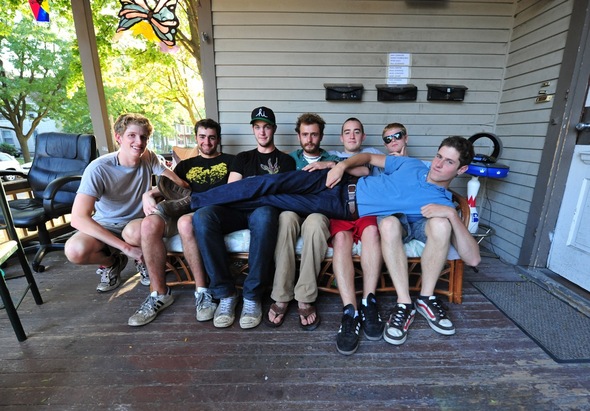
The University of Michigan students who live at "Woof Manor" on East Jefferson Street in Ann Arbor say hanging out on their front porch is a part of everyday college life. They're opposed to the city's proposed ban on having upholstered furniture outdoors, though they're unsure whether it would even apply to the cushioned couch they have now.
Ryan J. Stanton | AnnArbor.com
For the residents of "Woof Manor" on East Jefferson Street in Ann Arbor, hanging out on front-porch furniture is a part of everyday college life.
"Couches are just a great way to porch it up with the guys," says Marc Lecerf, a University of Michigan junior from Farmington Hills. "We spend a lot of time out here socializing."
But like many students returning to U-M for the fall semester, Lecerf and his roommates fear their way of life may be in jeopardy with a proposed ban on upholstered furniture on porches.
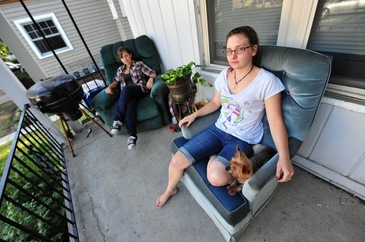
U-M juniors Shelby Roback and Sarah Parsons, who live in a rental home on South State Street, say they aren't convinced of the need for a ban on having upholstered furniture outdoors.
Ryan J. Stanton | AnnArbor.com
The Ann Arbor City Council delayed its decision on the so-called "couch ban" Tuesday night, citing the need to allow more input from the U-M student community.
Council Member Christopher Taylor, D-3rd Ward, who is sponsoring the ban, asked his council colleagues to postpone the vote until the Sept. 20 council meeting. A public hearing on the proposal will continue that night.
"It is in everybody's interest for students to have a fulsome understanding of the purpose and the effect of the ordinance, and to hopefully achieve their buy-in," Taylor said.
The delay comes after the Michigan Student Assembly, which is formally opposing the couch ban, criticized the City Council this week. MSA leaders said they were disappointed the council considered the ordinance over the summer and didn't attempt to seek student input.
"Students are the majority of the affected population by this," John Oltean, chairman of the MSA's external relations committee, told council members Tuesday night.
Oltean said if regulating furniture use is a matter of fire safety, there are other concerns for the city to address, including barbecue grills and fire pits, and the fact that much of the "ancient" off-campus student housing stock doesn't meet current building codes.
"We just wanted to make sure that the council was fully addressing this issue of fire safety, rather than just kind of taking a stab at just one point," Oltean said.
There are strong feelings in the student community on the couch ban, an idea that has been batted around for years but has lacked political support from council.
Taylor resurrected the proposal after a house fire near campus in April killed Renden LeMasters, a 22-year-old Eastern Michigan University student. Authorities believe a couch on the front porch helped spread the fire inside the South State Street rental home where LeMasters was staying.
U-M juniors Shelby Roback and Sarah Parsons, both from Rochester, now live in the house next door to the one gutted in the April blaze. Sitting on the upholstered furniture on their front porch early Tuesday evening, the two students said they aren't convinced of the need for the proposed ban.
"It's really nice to be able to sit outside on a summer night or a nice night like this with your friends and just enjoy the night," Parsons said. "The fire next door, I'm under the impression it was started by somebody actually trying to light the porch on fire. There might have been a couch involved, but I'm not sure that the couch was the source of the fire."
"They shouldn't take away part of our life because of that," Roback added. "It's like the culture of Ann Arbor — couches on porches."

City housing inspector Rita Fulton makes a case for a couch ban to the Ann Arbor City Council Tuesday night.
Ryan J. Stanton | AnnArbor.com
While students fear approval of the ban could bring an end to a time-honored tradition, city officials say it wouldn't prevent all types of furniture from being used on porches — it would apply only to those that are upholstered and not meant for outdoor use.
"This ordinance is not an attempt to stop occupants from using the exteriors of property, especially the porches. There is inexpensive furniture made for exteriors," said city housing inspector Rita Fulton, who gave a detailed presentation to council Tuesday night.
The language of the proposed ordinance reads, "No responsible person shall place, or permit to remain, upholstered furniture which is not intended or designed for outdoor use on exterior balconies, porches, decks, landings, or other areas exposed to the weather."
Violations of the ordinance would result in a fine up to $1,000 and an order to remove the furniture. The draft resolution also states if a violation remains uncorrected, the city may remove the furniture from the property with the cost for removal charged to the violator.
The proposed ordinance has been revised to include specific exemptions for furniture placed outside during a move or as part of a trash or recycling program. Furniture also would be allowed outside temporarily during yard sales between the hours of 8 a.m. and 6 p.m.
Several residents spoke for and against the ban at Tuesday's meeting.
An emotional Bob LeMasters, the father of Renden LeLasters, offered his support for the ban.
"They say losing a child is a parent's worst nightmare. I'm telling you, it's worse than that," he said. "I'm not asking for students to not enjoy the outdoors — just use appropriate furniture and not have another family go through what we've been through for the last five months."
City records obtained by AnnArbor.com through a Freedom of Information Act request show city staff has been working on bringing back the couch ban ordinance since last year. Fulton has done much of the research, which she presented at Tuesday's meeting.
Under the proposed ordinance, upholstered furniture would be considered a public nuisance. Fulton said there are concerns about fire safety, as well as aesthetics and health.
"I have to agree that some of them don't look good," Fulton said of porch couches. "Snow gets on them, the rain gets on them — they become insanitary."
Fulton said some have questioned why upholstered furniture is so much more of a risk outside than it is inside. She said it's because of the unlimited supply of oxygen and breezes that can fan flames, and a lack of devices and people outside to detect the fires when they start.
Fulton compared the amount of heat energy released in a couch fire to that of a small burning wastebasket or a pool of gasoline that is set on fire.
"As you can see, a sofa releases 173 to 780 times more heat energy than the wastebasket, and 7.8 times more than the gasoline," she told council members during her presentation.
Fulton said many of the off-campus rental houses in Ann Arbor were built using a now-outdated, balloon-frame style of construction that doesn't meet current building code standards. As a result, she said, a large number of houses have no fire-blocking between levels, allowing flames to rapidly spread upward and engulf a house in very little time.

Bob LeMasters, whose son died in a fire in April, speaks in support of the couch ban Tuesday night.
Ryan J. Stanton | AnnArbor.com
Of all the documented house fires that started indoors in Ann Arbor since 2000, Fulton said, there have been only three where the origin was upholstered furniture. From 2000 to 2003, there were 63 fires that started with upholstered furniture outdoors, Fulton said.
The numbers of fires that started with upholstered furniture outdoors have steadily declined ever since. There were 19 each in 2004 and 2005. In 2006, there were nine. In 2007, there were two. In 2008, there were five. In 2009, there were six. And in 2010, there have been four.
Fulton attributed the decline to landlords becoming more proactive and prohibiting tenants from having upholstered furniture on porches. Some who oppose the ban say that's where the issue should be addressed — not through legislation by the City Council.
Fulton said five major house fires have occurred in Ann Arbor since 2004 that involved porch couches, including the latest incident where Renden LeMasters was killed. She said Ann Arbor isn't unique in trying to pass a couch ban. In fact, several college towns in Michigan and across the United States already have such bans in place.
"When are you going to have the courage to pass this?" Ann Arbor resident Chris Crockett asked council members during Tuesday night's meeting. "It should not have come to the point of seeing a student die to get you to take this seriously."
Ann Arbor resident Mark Supanich offered a different take.
"In the presentation, I saw no real evidence that it was indeed a public nuisance," Supanich told council members. "I saw numbers for fires out of context. There was no context given to numbers. How many fires are started in kitchens? Is that a public nuisance? How many are started in people's garages with a pile of rags near an ashtray?
"I understand it's an emotional issue and I want to respect that, but I also believe that the City Council has certain powers and they should not exceed those. And I don't feel that it's been demonstrated that these couches represent a public nuisance any more than do, say, a deep-fryer for a Thanksgiving turkey or cars on the road."
Ryan J. Stanton covers government and politics for AnnArbor.com. Reach him at ryanstanton@annarbor.com or 734-623-2529.
Comments
Gfellow
Wed, Sep 22, 2010 : 8:43 a.m.
"Pursuit of Happiness..." I'd say that sitting on the front porch on a comfortable sofa fits into that category. It's a cultural institution. I doubt the proposed ordinance would stand up if challenged in court and may consequently be a waste of effort and tax payers money. According to sources, some 50-plus porch sofa fires occur ever year in Ann Arbor. Does the proposed ordinance exclude fire-proofed sofas? How many bed fires, I wonder? Frying pan grease fires? Auto collisions? Will we be banning these as well? That's what we have a fire department for, that's why we pay taxes. Could this decision have been the product of neatnicks - none of whom have a couch on their porch - and think the rest of us ought to be like them? Personally, I'd prefer a population encouraged to sit outside on the front porch, because it reflects a cohesive community, and if folks prefer to sit on couches - let 'em!...And no, I don't have a sofa on my porch, but you can bet I'll defend my neighbor's right to have one.
a2d3
Mon, Sep 20, 2010 : 11:50 p.m.
Kat: Pools are fun. Pools kill way more people a year than porch couches Ban pools too?
Kaytlyn
Mon, Sep 20, 2010 : 3:07 p.m.
i believe that after you have a fatality, people should understand that its not all about fun and games.Students can have their fun with OUTSIDE furniture, & keep the upholstered furniture inside.Just because they dont know the person who died, or just want to have fun, they should still take into consideration that someone is DEAD because of this.I think that trumphs over having fun.
David Cahill
Sat, Sep 11, 2010 : 11:10 a.m.
I don't care at all about esthetics in student neighborhoods. I do care about safety. I was impressed and grossed out by the City staff's presentation on couch fires last Tuesday at City Council. The staff is strongly pushing for the couch ban, not homeowners' groups. If you are sitting on a couch on a porch you are sitting on a bomb.
Speechless
Thu, Sep 9, 2010 : 5:10 p.m.
"... I cannot resist pointing out the "killer swimming pool" argument -- does not hold water." Oh yes, it holds water. A big cement pond out back can hold a whole lot. In fact, numerous small children drown in them accidentally every year. If we would only ban them, a good many lives would not needlessly be lost. Why don't we ban them, then? Well, it seems that homeowners with disposable income have become very fond of them over the years. No matter the danger, they've long been an integral part of suburban lifestyles. By the time consumer protectionism developed in the '60s and '70s. pools were "grandfathered" in as a form of recreation that couldn't be challenged. Couches on porches, in contrast, are far safer than outdoor swimming pools of any size. If you're blotto after a bender, you can't easily collapse onto your porch sofa and drown. Why, then, is there such urgency to prohibit them? Well, it seems that campus-area homeowner associations and merchant groups don't like to look at them. They consider living room furniture taken out to the porch or patio to be a pornographic assault on proper suburban and WASP sensibilities — bad social form for any self-respecting blueblood. They're fashion police who hold Ward & June Cleaver close to their hearts. That's all there is to it. As to what really drives this proposal, the safety issue being raised is total fiction. The only thing that actually counts at all is that a certain faction of movers & shakers in town thinks they look ugly. If one day Martha Stewart convinces the nation to haul their davenports outdoors, then rest assured indoor furniture on porches will take on sacramental meaning.
a2d3
Thu, Sep 9, 2010 : 1:07 p.m.
@Will "You do not seem to take issue with the information that I provided about the extreme flammability of upholstered furniture, instead you express your personal opinion that one type of exterior furniture material - wicker - is as big a hazard (based on?). And imply that new standards for newly manufactured, upholstered, indoor furniture will make it relatively safer than -- or equivalent to - outdoor furniture (without similar standards). The assumptive leaps in your argument are not supported or persuasive." Object A and Object B are similar items (both are cushioned couches) Object A has flame retardant added at beginning of it's life, object B has no flame retardant added at any point of it's life. Object A has flammability standards, Object B has no flammability standards. Object A support structure is made of heavy wood, Object B is supported by a material similar to twigs. Which object is more likely to be a fire hazard? "I checked to see if the the document you cite helps to support your points. It does not. To quote your NFPA source: "...upholstered furniture remains the leading item first ignited in home fire deaths." Your source continues, "On average, 7,630 home structure fires began with upholstered furniture each year... These fires caused an annual average of 600 civilian deaths, 920 civilian fire injuries, and $309 million in direct property damage....one of every 13 upholstered furniture fires resulted in death."" The numbers you are quoting represents all the upholstered furniture fires for the entire country...including indoors. The numbers for external porch fires and balconies is much smaller in the NFPA report; the annual average is less than.5 civilian deaths a year across the entire country which is more than a 1000 times smaller than he numbers you are quoting above. "The NFPA study raises an interesting question for me about fire alarms. Typically alarms are located inside a structure where the initial smoke might help to alert occupants if a smoldering fire were taking hold on a piece of furniture. If a fire starts accidentally or intentionally on a porch, it seems much more likely to become a full-fledged inferno before the smoke detector would be triggered." Fires on external porches from upholster furniture cause far fewer deaths per fire than if started indoors. Even so I am NOT opposed to requiring fire detectors on porches even though the risk is low. As you point out though the community itself serves as a fire detector because they tend to be visible outdoors. "You make an argument that there are many risky things in life and indoor, upholstered furniture on porches is not that big a deal. Sure, more people die in car crashes than in train wrecks. That doesn't mean that we don't work to improve the safety of railway travel. Thus, I cannot resist pointing out the "killer swimming pool" argument -- does not hold water. Right and i'm not opposed to improving train safety...But I would be opposed to banning all trains. As for not being a big deal.. I never said that.. I said the risk of death is very small compared to other risks around us and I don't think it's reasonable to ban everything because someone dies. For example many many more people die a year from candles or swimming pools.. but we are not banning those.
dtaa
Thu, Sep 9, 2010 : 12:24 p.m.
It's one issue to risk burning your own house down. It's a different issue if you live next to me, as it's not fair to risk my house too. Nice pic of them with their GRILL ON THE PORCH.
Ben Connor Barrie
Thu, Sep 9, 2010 : 12:06 p.m.
@drewk Renters, especially renting in an inflated market like Ann Arbor, have little incentive to fix up the properties they are renting. If you already feel as if you are plying an arm an a leg for your housing for a year, why would you want to invest in maintenance and improvements? After a year you (likely) be renting a different house and will have effectively lost the investment you made in the previous house. Perhaps rental companies could create language in their leases that provides incentives to tenants to maintain and even improve the properties they are renting. The debate over who and who is not a resident of Ann Arbor is interesting from an academic standpoint. Some seem to be trying to craft a definition of resident that excludes "students" but a clear distinction is difficult. Do most students pay property taxes? Aside from a few, no. But I am sure there are many non-students who are renters as well. Many students are employed in Ann Arbor. Does that make them residents? Is a resident someone who interacts with the community? It seems like some would consider the U of M community entirely separate from the "Ann Arbor Resident" community. Excluding one third of the cities population seems like a very narrow definition of resident, and ultimately fails to recognize the complex and multifaceted entity that the University is within the greater Ann Arbor community.
a2d3
Thu, Sep 9, 2010 : 10:41 a.m.
"@a2d3, why don't you research how colleges define being a permanent resident? Many of the students are NOT permanent residences, due to them not being fully employed, but students. Just because you change your license, doesnt mean that you are a permanent resident. " I never said anything about being a permeant residence. What I said was that most students live in ann arbor for all 3 months of the year they are and a large percentage stay for the full 365. I also said those that are in-state students, which makes up the majority of students, probably do change their address. "How about a property tax payer? Or someone who have invested interest where they live, beyond just going to college and partying?" Some of the largest personal property tax payers in ann arbor are the fraternities and the sorority. Furthermore some students buy houses in ann arbor because it's cheaper to pay a mortgage and property taxes than it is to rent. Also most of the property taxes from that come from property rentals are supported by the student population.. they wouldn't be there with out them. It's like saying that if someone lives in a apartment complex then they should have no say in the community..which is ridiculous. "Regards to your small research on material standards, there are standards for non-flammable materials, i.e. EN470-1 requirements on flame retardant." EN470-1 is for protective welding clothing. Again I'm not aware of any mandatory flammability or smoke production standards for external furniture Im not seeing your point. "Many ADULTS that do have outdoor cushions on their outdoor furniture bring them indoors after use." Many is different than most and I personally know of no-one who does that for porch furniture. Also most university students are adults. "This is because they are paying for these items themselves, versus budgeting what was received from parents and financial aid." And loans, which students pay back later. "So, they are valued differently. " Yes they are value differently.. the lowest priced cushioned outdoor couch on walmarts website that I can find is $474.00. "I dont think this applies to ALL students, but the small population of students that are not caring about the community or neighborhood, find it cool to have indoor furniture outdoors." It's all fun banning things until someone bans what you like. Personally I wouldn't put a couch on my property but I don't want people telling me I cant.
Will Hathaway
Thu, Sep 9, 2010 : 10:02 a.m.
a2d3: I read your comment on my earlier post. You do not seem to take issue with the information that I provided about the extreme flammability of upholstered furniture, instead you express your personal opinion that one type of exterior furniture material - wicker - is as big a hazard (based on...?). And imply that new standards for newly manufactured, upholstered, indoor furniture will make it relatively safer than -- or equivalent to - outdoor furniture (without similar standards). The assumptive leaps in your argument are not supported or persuasive. I checked to see if the the document you cite helps to support your points. It does not. To quote your NFPA source: "...upholstered furniture remains the leading item first ignited in home fire deaths." Your source continues, "On average, 7,630 home structure fires began with upholstered furniture each year... These fires caused an annual average of 600 civilian deaths, 920 civilian fire injuries, and $309 million in direct property damage....one of every 13 upholstered furniture fires resulted in death." Your argument that most indoor furniture fires begin indoors does not provide reassurance that indoor furniture is safer on porches. Yes, according to the NFPA data, only 250 of the fires began with upholstered furniture that was outdoors. This doesn't make it appropriate to have highly flammable chairs and sofas in vulnerable, exterior locations. The NFPA study raises an interesting question for me about fire alarms. Typically alarms are located inside a structure where the initial smoke might help to alert occupants if a smoldering fire were taking hold on a piece of furniture. If a fire starts accidentally or intentionally on a porch, it seems much more likely to become a full-fledged inferno before the smoke detector would be triggered. Indeed, unless a passerby happened to alert the occupants of the houses, more people could have died in the fires that were set last school year. Like some other commenters, you make an argument that there are many risky things in life and indoor, upholstered furniture on porches is not that big a deal. Sure, more people die in car crashes than in train wrecks. That doesn't mean that we don't work to improve the safety of railway travel. Thus, I cannot resist pointing out the "killer swimming pool" argument -- does not hold water.
HaeJee
Thu, Sep 9, 2010 : 9:49 a.m.
@a2d3, why don't you research how colleges define being a permanent resident? Many of the students are NOT permanent residences, due to them not being fully employed, but students. Just because you change your license, doesnt mean that you are a permanent resident. If they didnt have financial aid or their parents to pay for their education, would they still be able to afford housing in Ann Arbor? Highly doubtful it. How about a property tax payer? Or someone who have invested interest where they live, beyond just going to college and partying? Regards to your small research on material standards, there are standards for non-flammable materials, i.e. EN470-1 requirements on flame retardant. Many ADULTS that do have outdoor cushions on their outdoor furniture bring them indoors after use. This is because they are paying for these items themselves, versus budgeting what was received from parents and financial aid. So, they are valued differently. I dont think this applies to ALL students, but the small population of students that are not caring about the community or neighborhood, find it cool to have indoor furniture outdoors.
a2d3
Thu, Sep 9, 2010 : 7:02 a.m.
Will Hathaway: Furniture marketed for 'outdoor use only' have no mandatory flammability or smoke production standards (that I can find anyway) and in fact are frequently made with highly flammable materials. For example, a popular material for exterior furniture is wood wicker which has extreme flammability. The cushions for outdoor furniture likewise have no mandatory flammability or smoke production standards. Thus 'outdoor use' couches and other pieces are not necessarily any safer than indoor use types. Furthermore the United States Consumer Product Safety Commission is actively developing a national standard for flammability of upholstered furniture; it's one of their main goals for 2011 (see the CPSC government website 2011plan pdf on website) However the proposed standards excludes furniture made for outdoors. Therefore not only does the proposed ban actually allow (may even promote) highly flammable external furniture but will in-fact ban flame resistant furniture in the next few years. The National Fire Protection Association published a study in 2008 on upholstered furniture fires. The study took data from 2002-2005 from the National Fire Incident Reporting System as well as data from their own surveys. The study is fairly detailed and lengthy (about 60 pages) (search for os.upholstered.pdf in google) Page 32 of the pdf (page 20 of the study) shows data from upholstered furniture fires. The number of deaths from fires started by furniture on porches across the entire county is less than 1 death every 2 years. [The 0 deaths stated in the studys data chart indicates that the death rate must be below 1 person every 2 years since the number is rounded to near whole] Page 16 of the pdf (page 4 of the study) indicates that upholstered furniture fires anywhere exterior of the structure, as well as unclassified areas, cause an average of seven civilian deaths across the entire country annually. The death rate is many times lower compared to other sources. For example, it would be many times more effective to ban swimming pools because the number of deaths a year are many times greater. It would also be much more effective banning other fire potential sources such as candles or christmas decoration/trees since these also cause many more deaths a year than external upholstered furniture.
Duane Collicott
Wed, Sep 8, 2010 : 9:59 p.m.
"They shouldn't take away part of our life because of that." If an upholstered couch on a porch is "part of your life," you don't have one.
Speechless
Wed, Sep 8, 2010 : 9:52 p.m.
At least some proponents of a couch porch ban now become more honest about their reasons. Furniture on the porch is clearly a stand-in for the larger issue of neighborhoods not rigorously kept to suburban standards. What the merchant and neighborhood associations behind the proposed ban really want is to feel 'safe' from having to look any messiness on residential streets. Of course, campus-area slumlords have no responsibility for maintaining the outward appearance of the various properties they own. That would require they do some actual work in return for receiving princely rents on older homes frequently not up to code. That would be so unfair. As it is, student rents help cover the mortgage and buy the house for its owner, so what further social burden should self-sacrificing landlords be forced to endure? Should the cleanliness issue alone not be convincing enough, we also hear that students don't actually deserve local citizenship status. Apparently, it's unfortunate that voting laws and the constitution distract from the reality, so obvious to a few, that students aren't residents while living here as residents.
Will Hathaway
Wed, Sep 8, 2010 : 9:36 p.m.
Several posts ask for more information about why upholstered furniture is such a fire hazard. I did a quick search and found the following text from a National Association of State Fire Marshals document: A common consumer product application of polyurethane foam is its use in upholstered furniture. Upholstered furniture may be ignited by smoldering cigarettes, small open flames and large open flames when other household items are first ignited. Once ignited, non-fire resistant polyurethane foam burns rapidly, emitting large quantities of toxic gases such as carbon monoxide and cyanide. Polyurethane foams rapid rate of intense heat release typically raises the room temperature to the point of flashover that is, the point at which all contents of the room are ignited. Clearly, polyurethane foam poses a hazard, in effect making small fires very large, and very deadly, very quickly. http://www.cpsc.gov/library/foia/foia99/pubcom/fp991uph.pdf I learned other things in the search. That many communities are facing similar problems with indoor furniture in outdoor locations. In many cases, because such furniture is particularly flammable, it either accidentally burns and spreads fire much more quickly, or it is used to create intentional, celebratory bonfires. In either case, there is an unnecessary hazard. In Ann Arbor we have at least one serial arsonist roaming around who has already used porch furniture as a deadly accelerant. If the City Council did not act to prevent someone else from dying as a result of having old, indoor furniture on a porch, then I would view the Council as negligent.
MI-expatriate
Wed, Sep 8, 2010 : 8:11 p.m.
I didn't read through all 81 comments (so far) but will say that when I came to Ann Arbor and bought a property in 1998, never having lived in Michigan before but knowing that Ann Arbor was highly sought after, I was thoroughly discouraged on the way to closing on my property to view the student area properties in the heart of town. These areas reminded me of truly rundown neighborhoods in other cities I have lived in. Regarding budget, have the students never heard of garage sales, or the ReUse Center on Industrial? How about just picking the curb for other students' outdoor furniture when they leave. There is a fine line - some "indoor" furniture can pass as outdoor furniture - wooden frame with removable/replaceable cushions, but not fully upholstered sofas, chairs, recliners, etc. I just visited Cambridge, MA - granted, few porches there in student rental areas but I'm pretty sure the students still have social lives. It looks much cleaner and welcoming than Ann Arbor - student areas are far less obvious (ugly) and I don't think it is about the Boston area students. It is about the laws. Agreed, there are bigger issues but this has struck a local nerve.
Bubba
Wed, Sep 8, 2010 : 7:55 p.m.
It's really disheartening to see news about such silly and inane things. It seems like whoever is in charge here has horribly distorted ideas about what is and isn't important. It seems like those with the power to steer the city legislature in the right direction are completely ignorant of real issues, or more likely, would rather address things that will get them more attention. It's true, what many have been saying, that other things cause more deaths a year then couches on a porch, but logic and reason seem to have no place when it comes to this ban. At this point I sort of read this website's news because it just makes me straight up laugh at some of the things that people think are important. It's more of a written comic strip it seems. Seems more and more like that all over, actually.
Donna Roth
Wed, Sep 8, 2010 : 7:50 p.m.
How would we know where students live without this and other tells? Gets cleaned up by the management or owner. Then new semester and we start defining student living all over again. Note Bene: Not all student dwellings are so marked. Some sit inside, clean up and like a more orderly house. And? Must be other issues to get on the agenda for Council, eh?
a2d3
Wed, Sep 8, 2010 : 7:19 p.m.
Typo last line.. replace No with Yes :)
a2d3
Wed, Sep 8, 2010 : 7:17 p.m.
"Regarding the comments about the students being guests/visitors and not townies: Are they here 365 days a year?" All but 3 months of the year they are and a large percentage stay for the full 365. "Do they go to the Secretary of States office and file a change of address for their drivers license and voter registration? (Which, I believe, is suppose to be done within 90 days of them moving here.) Generally not." Those that are in-state students, which makes up the majority of students, probably do change there address. The student ID is used as voter identification "Do they change the address on their checking accounts to show that it is a local/Ann Arbor address?" The student ID also works as a bank card.. Also I would imagine one would want to see their bank statements. "So, I think that makes them visitors and guests, don't you." No "Sure, they spend a great deal of money here, but so do the movie companies that are here filming - and they are guests/visitors. Right?" No - These people usually dont meet your above requirements.. nor are there 41,000 movie crewmen/women in ann arbor.
amazonwarrior
Wed, Sep 8, 2010 : 6:36 p.m.
Regarding the comments about the students being guests/visitors and not townies: Are they here 365 days a year? No, probably not. Do they go to the Secretary of States office and file a change of address for their drivers license and voter registration? (Which, I believe, is suppose to be done within 90 days of them moving here.) Generally not. Do they change the address on their checking accounts to show that it is a local/Ann Arbor address? No to that one, too. So, I think that makes them visitors and guests, don't you. Sure, they spend a great deal of money here, but so do the movie companies that are here filming - and they are guests/visitors. Right?
Sandman
Wed, Sep 8, 2010 : 5:20 p.m.
Who, in their right mind, would think it should be "against the law" to have an unsightly piece of furniture on the front porch. Come on now people; this is the United States of America not some communist country. Our taxes do not pay for legislators to inact decorating laws. Ugly, unsightly, dirty, moldy, full of germs...if that is my choice and I pay rent for this property or own it, then that is my right as a U.S. resident; unless, of course, it is prohibited in the lease that I sign prior to occupying my house. Quick, Call 911, my neighbor is sitting in his Lazyboy, on the balcony, smoking a cigarette, grilling some hotdogs and drinking a beer...please give me a break. Accidental death is tragic and I pray that it does not happen to my family, anymore...but how I decide to decorate my porch or balcony or deck, should not be a concern of the government. Keep the man off my property...
drewk
Wed, Sep 8, 2010 : 5:13 p.m.
Maybe these houses wouldn't be considered such slums if the students would treat the house with a little bit of respect. I work on these houses and cannot believe what these kids will do. I'm sure they don't treat their parents homes with such disregard. If the thousands of dollars spent to re-repair these houses wasn't necessary, than other upgrades might be affordable. And when the couch burns, the first thing the students will do is demand that the landlord find a new home for them to live in until the burnt home is rebuilt.
a2d3
Wed, Sep 8, 2010 : 5:04 p.m.
TheAnnouncerMan007: You're right, the poll is statistically wacked out. The service they use (twiigs) states on the setup page that there is a bias towards the first question and they give an option to randomize the poll ordering to eliminate this... but for some reason it's not enabled. Also the wording puts a bias to the first answer.
a2d3
Wed, Sep 8, 2010 : 4:12 p.m.
"Do you go into work and tell your boss that you can't handle any immediate problems, only the SERIOUS ones affecting your employer? I didn't think so." If there are serious issues present.. then yes.
Lokalisierung
Wed, Sep 8, 2010 : 4:08 p.m.
"I've seen several comments here about students being guests in Ann Arbor. No, folks, they are not guests: they are paying customers." Totally agree with you and I'm so sick of people saying this. The live here 8-9 months a year, whcih is the same amount my grandmother lives here before she heads down south for the winter. I don't know if anyone would call her a "guest" in this town.
John Q
Wed, Sep 8, 2010 : 3:47 p.m.
"As many here have said, we have plenty of SERIOUS problems for the City Council to fix without the need to invent their own or overreact to isolated incidents." I would expect the City Council to address both the serious and the day-to-day issues that affect the city. That's their job. Do you go into work and tell your boss that you can't handle any immediate problems, only the SERIOUS ones affecting your employer? I didn't think so.
Stephen Landes
Wed, Sep 8, 2010 : 3:34 p.m.
I've seen several comments here about students being guests in Ann Arbor. No, folks, they are not guests: they are paying customers. Students move to Ann Arbor and bring something like $25,000 to $40,000 per year with them in tuition, room and board, fees, and spending money. They are here to buy a product - the University of Michigan degree and "experience" with all its trimmings. The citizens of this town and the administration, faculty and staff of the University are in the business of selling that degree and living experience. Whatever we decide to do on an ordinance, sign, policy, or other enactment, we need to remember that we need to serve the needs of our customer. I am not saying we need a "wide open town" with no rules and a couch on every porch, but we do need to keep in focus just what is the business and life blood of this town.
Donald
Wed, Sep 8, 2010 : 3:20 p.m.
people are complaining about newspapers piling up outside student houses? How about: AnnArbor.com refuses to NOT deliver the paper to MY house! I had a subscription, didn't renew, and have called them, and they just keep delivering it. Ann Arbor News did the same thing, every Sunday, with the localised editions to each house. I'd often see them stacked up at the end of driveways in student and NONStudent areas, when I was delivering other (non-A2) newspapers every morning. If local business really have a problem with the way students look, then they need to look at their books, and see if they can survive without the student population and the added business it brings them. If Football Season doesn't make the rest of the year worthwhile for them... then they have all the right to complain. But if their business model requires the students and associated money o be in town to keep them afloat... then they need to shut up and deal
liekkio
Wed, Sep 8, 2010 : 3:18 p.m.
@ amazonwarrior: That's an interesting line of argument - "the students who attend the universities in our area need to remember one very important thing....they are GUESTS when they are here". I do not think you can successfully combine charging someone an arm and a leg for coming to A2 to study with calling them a guest. It is either one or the other: the revenue this city lives off, or sour attitudes towards the students who bring it in. Can't have both, at least not for long. @ Stephenb1707: Looks like you answered your own question: "why not bring in the health department... AA would lose half the houses to shutdown". Bad for business. A porch couch ban, on the other hand, should bring in some money in fines and let both the City Council and the police look busy.
Kevin
Wed, Sep 8, 2010 : 3:08 p.m.
Why don't we ban couches in everyone's living room, I am sure more fires have been started there.
HaeJee
Wed, Sep 8, 2010 : 3:05 p.m.
@Zeeba, majority of undergraduate students are not residences of Ann Arbor. Their parents home is still their permanent residency. The employees that get transferred from work (like me) pay property tax and hope that our house value does not decrease when a coach lands on our neighbors porch. Also, you can buy plastic lawn chairs for less than $20 or the fold up chairs for less than $10. If the chairs are collapsing, then that is a whole difference issue. Part of being a college student is living a bohemian lifestyle for a few years is for some students trying to fit the image of a college student. If you chose to be this kind of student, then dont be surprised when people treat you like a child still. If the students main contingency is hanging outdoors with friends, then rent a house that has a deck or patio and buy either used lawn furniture off craigslist or plastic lawn furniture like the rest of us adults. If you are attending U of M, you can afford cheap used lawn chairs. A life was lost due to the love of the bohemian lifestyle because some people ruin it for all. This is how the real world works.
An
Wed, Sep 8, 2010 : 3:02 p.m.
1. Couches on porches...tacky. 2. Students are usually VISITING our town while they go to school. They do not pay taxes here (although I suppose a portion of their rent paid to slum lords pays some of the taxes). 3. Did I mention that they are VISITING our town? This is a college town...sitting on porches and socializing is fun but it should be done in those cheap plastic outdoor chairs ($10 -20 at Meijer or Walmart) rather than on couches.
Dylan
Wed, Sep 8, 2010 : 2:46 p.m.
You know, Reading some of these comments really has me amazed on how a person can sit here and can call this ban of keeping couches off porches "dumb". I know for a fact if it was SOMEONE in YOUR family you would NOT be calling this dumb! All we want to do is protect, so another family does not have to go what we have went threw. No one is asking any college student to stop having fun, just because you take your couch off your porch is going to stop the fun? No, don't think so... And well if it does.... Well there is seriously something wrong with your life. To me, some of you College kids wouldn't even think twice about this... It's your life... Sit here and think... What if your house caught on fire because you had a couch on the porch? Think about your life, and everyone around you... So sitting here and calling this "dumb" is pretty "DUMB" of you to say... Renden, We love you with all of our hearts and miss you so much. We are doing anything we can to make this right..... Love ya bud.... Dylan Lemasters (Cousin)
zeeba
Wed, Sep 8, 2010 : 2:35 p.m.
Amazon - students are residents here, same as anyone else. In fact, many of them live here longer than the employees who are transferred here by their companies for a year or two. Are they guests as well? And if so, how long do you have to live here to be considered a resident? Is my nine years long enough? As for everyone saying you can get basic outdoor furniture as cheaply as a couch - you can't. That's why they use couches in the first place. Often, you can get beater couches free or for about 25 bucks, whereas outdoor furniture simply collapses when it wears out. Also, cheap outdoor furniture is hard and uncomfortable - another reason they prefer couches. Part of being a college student is living a bohemian lifestyle for a few years. Quit trying to tidy them up and focus on things that matter, like faulty wiring and placement of outdoor grills.
Stephenb1707
Wed, Sep 8, 2010 : 2:32 p.m.
Forgot this part this morning. My daughter is a Senior at Michigan. Student housing is the pits to say the least. There are seven girls living in one small house who pay a kings ransom to live there. If they had a couch on the porch where it got fresh air all day, it would be the cleanest thing there. Instead of making it a council decision, why not bring in the health department. Let them check every house. AA would lose half the houses to shutdown. AA government must have something better to do than set porch decorating standards.
amazonwarrior
Wed, Sep 8, 2010 : 2:13 p.m.
I think the students who attend the universities in our area need to remember one very important thing....they are GUESTS when they are here and need to learn to act accordingly. The passing of ordinances such as this one, really are none of their business because once they finish college they are GONE. And I have read the excuse that it shouldn't be passed because they CAN'T AFFORD plastic lawn chairs?? Oh, PLEASE! And, would someone please explain to me WHAT the "attraction" is of sitting on a damp, moldy couch? Yuck!
Ben Connor Barrie
Wed, Sep 8, 2010 : 2:07 p.m.
I am a 20-something Ann Arbor native who has returned to town to attend a graduate program at U of M. This may be a little off topic, and I apologize for that. All too often though, I feel like some of the conversations in the comment section revert to townies versus students and both sides tend to paint with pretty broad brushes. Saying all students treat their houses terribly and lower property values is offensive and unproductive. As a townie and student, I think Ann Arbor is better than this. Why can't we use this forum to discuss the cost and benefits or costs and effectiveness of this piece of legislation? For my part I would like to see more data from the Housing Inspector. The article says there have been 5 major fires in the last 6 years involving outdoor couches. That hardly seems like an epidemic. Maybe there are other measures we could take that would prevent more fires. Also the creative use of "statistics" by Ms. Fulton to show couches contain more "heat energy" (why not use calories or BTU's?) than gasoline is manipulative and inappropriate. How many liters are in a "pool" of gasoline? Is there a standardized scientific couch they were burning in their experiments? As a side note @michiganpoorboy, your comment makes no sense and is inflammatory. What makes Michigan a "socialist school?" Is it because it's a state school? Or because of the left-leaning student body? What are the better and cheaper schools in the state? There many excellent universities in MI, but most of U of M's grad programs rank higher than the other universities. In terms of undergraduate programs, only Forbes recent ranking put's U of M below any other college in the state (Kalamazoo College).
Sandman
Wed, Sep 8, 2010 : 1:26 p.m.
Upholsered furniture can hold a lit cigarette, smoldering behind a cusion for quite some time without notice. Then, after everyone is passed out in the house, it will erupt into a fire of death. This is where the fear is located. It can happen just as easy in the house, but it doesn't because porch parties are more fun than living room parties. This is not a cause for legislation from City Council, this is why we should take personal responsibility to watch out for ourselves and our friends. The local government should stay off our porches and get back to major issues like: 1) Define the core services to be provided by the city. 2) Should we have more parks than we can afford to mow? 3) Stadium Bridge...oh yea, we're asking Big Brother to give us money for that project? 4) Let's put some brick and stone on that tin can you call City Hall...and straighten out those uneven windows. 5) 5-year vesting for a full retirement??? Holy Cow, no wonder we're in trouble. Leave the couches alone and educate the people...
Tom Dodd
Wed, Sep 8, 2010 : 1:01 p.m.
We drove over to Ann Arbor to see what all the fuss was about and got up close to one of those porches in the student ghetto that looked like a sale of damp, used living room furniture. We were surprised to see that they are not couches at all; they are sofas. Couches are made for lying back and talking to a psychiatrist on. We do not know of any Ann Arbor psychiatrists who hold their sessions on the front porch, but it might be a good idea. Local media and politicians refer to the offending furniture as couches knowing full well that similar seating in Saline is called a davenport after one of their founders, and most of the Midwest refers to this multi-seated living room amenity as a sofa. (Almost nobody says divan anymore. And loveseat? Lets not go there. Suffice to say its for two people.) Until A2 is able to get in touch with the rest of the culture, they may have to continue rewriting ordinances to keep late-night immolations from occurring in front of their residences. Perhaps they could demand sprinkler systems to soak down the old sofas in the dry season. Granted, damp and moldy furniture would not look too good and would probably smell really awful, but its only student rental property; A2 students are accustomed to that kind of abuse. Watch for still more legislation from Athens of the Midwest on the local level pertaining to overstuffed chairs, abandoned bar stools and hassock/ottoman offenses. Just watch where you sit.
Jody Durkacs
Wed, Sep 8, 2010 : 12:51 p.m.
First they came for the couch porches, and I didn't speak up because I had no couch on my porch... Seriously though, if this passes, Ann Arbor takes one more step towards having a city-wide Homeowner's Association. It's bad enough already. Don't make it worse. As many here have said, we have plenty of SERIOUS problems for the City Council to fix without the need to invent their own or overreact to isolated incidents.
Chris Heaton
Wed, Sep 8, 2010 : 12:41 p.m.
Responding to the idea that the landlord ought to mop up the problem when a ticket is issued. We need to punish the actual people who did the misdeed - that's how you change behavior. As a property manager, the police don't involve me when a tenant violates the local noise ordinance. In that case it's understood that the fine and court appearance belong to noise maker - not the landlord. People seem to think that a couch, placed on a porch by a student, is somehow different. I just don't see it!
pmaa
Wed, Sep 8, 2010 : 12:41 p.m.
The parents of the two girls pictured must be wondering why they already paid for 2 years tuition for their children to spend their time on the porch and then become involved in verbalizing their assumed self proclaimed right to sit in old, smelly, musty, dirty, potentially hazardous, upholstered furniture. Maybe they should head to the library and study up so they can understand the true "culture of Ann Arbor." Or better yet, go home. What an insult to the rest of the Ann Arbor community. Shame on you.
Forever27
Wed, Sep 8, 2010 : 12:34 p.m.
glad to see the students have so little to worry about in life that they can have the energy to get up in arms about putting couches on their porch. I'll tell you what; I'll support students being able to put ugly couches on their porch when they decide to stop littering all over town and destroying the neighborhoods that they inhabit with Solo cups and paper plates.
Jay Allen
Wed, Sep 8, 2010 : 12:32 p.m.
AA.Com. I know that polls are popular and folks want them, that is cool! But notice how the poll results do not align themselves with the comments. It is yet another case of clicking a button and running. Make folks be a poster (or at least a registered logged in user) and then vote. Popular or not, here goes. This is nothing more than an egregious act on the part of the council to "control" something. It is a huge game of tug-o-war and this is how the council is going to play trump. Allow me to say, that *IF* and I do mean *IF* this was pertaining to over flowing trash cans, paper everywhere, I could get behind that, to a point. But this proposed legislation does not cover that, it is "indoor furniture" that is being used out of doors. So people, please try and not confuse the two. When the subject came up about a month ago and one of AA.Com's posters tried to label this as a tempest in a teapot, I simply laughed. This is a debate that has come up before and it will again. The problem is you have people like this Fulton presenting facts she does not understand. Here is a quote: "As you can see, a sofa releases 173 to 780 times more heat energy than the wastebasket, and 7.8 times more than the gasoline,". Really? There is SO MUCH MORE to that quote, I am surprised that a science type guy has not ripped that to shreds. Perhaps we'll come back to that.......Energy in this case is stored and cannot be measured until some type of flame is introduced. Read that again. A FLAME. A couch sitting on a porch is not going to ignite. Physically impossible. So we have legislation to ban a couch because it will give off more heat energy than gasoline but we ignore grills, plastic chairs, lawn chairs, porch swings, plastic garbage cans, etc? What about the plastic siding, the soffit, the wood foundation the home is built on? Are we going to ban those item as well? It is nothing more than skewed remarks to steer people into thinking a certain way. Lastly on this before I move on, has anyone here ever thrown a match or a lit cigarette into a pail of gasoline? Hmmm....... The issue is there was and IS an arsonist. A fire was set ILLEGALLY and instead of finding this criminal we are wasting those funds on legislation. Yes, it is horrible someone died, it truly is. But a couch on a porch was NOT the cause and folks need to stop being so narrowed minded and being led around like cattle. Use your brain, do some research and see that the facts presented have nothing to do with the end goal. BTW, numbers lie and liars use numbers. When this mess came up before I needed some goods from Lowe's. While I was there I noticed the tag attached to outdoor furniture had the "flammable warning" label on them. I just looked under my couch and it has not tag on it. Food for thought....... Then again, maybe it will just simply ignite on its own! LOL
Cash
Wed, Sep 8, 2010 : 12:26 p.m.
Items to worry about: 1. The Afghan war 2. The economy 3. The moron in Fla about to ignite the Quran and a Holy war. 4. Joblessness 5. Urban violence killing children 30 miles from here 6. Cost of medical care 7. Condition of Michigan roads 8. Global warming 1000000. Ann Arbor porch couches
bedrog
Wed, Sep 8, 2010 : 12:26 p.m.
re bob martel's question about whether or not an outside couch is more combustible than and inside one: maybe, if its stuffed with corn or hay, since both of those materials can spontaneously combust if they've been wet. but that'd be a pretty odd, uncomfortable couch to begin with ( although 'non-odd'/'comfort' and 'student lifestyles' are not always synonymous).
townie
Wed, Sep 8, 2010 : 12:15 p.m.
The arguments against the ban seem to fall into three categories: 1. It is a basic human right of all citizens to put used interior furniture on their porch and parTAY. 2. Banning upholstered furniture on porches is just a slippery slope toward banning oxygen because it is one the essential elements for fire. 3. Property owners should not be responsible for anything that goes on in their rental houses. To me, this is a very specific and clearly defined hazard that has resulted in death (like electrical receptacles next to bathtubs). Maybe very few deaths, but one is too many for something so easily corrected. Other furniture that is resistant to fire can serve the same purpose as upholstered furniture, so no loss to anyone in terms of #1. In regard to #2, well, either you believe the government has a role to play in public safety or you don't. I believe it does and that legislation aimed at mitigating a very simple, identifiable and preventable hazard is not some socialist plan to take over every aspect of our lives. Your couch and porch fire can spread to other houses--so it's not just about your right to burn your house down and die in the fire if you choose to do so. As for #3, ticketing the property owner, who in turn passes the violation on to the responsible tenants is the only manageable way to handle this. An enforcement officer approaching a house with a couch on the porch will be told by tenants that either a., they don't live there, or b., that the couch was there when they moved in (which is very likely). Let the landlords figure it out. Most already have lease provisions to pass this on to tenants anyway. God forbid landlords having to pay attention to the goings-on in their rental properties.
InsideTheHall
Wed, Sep 8, 2010 : 12:14 p.m.
Good grief, fix the dang bridge!
treetowncartel
Wed, Sep 8, 2010 : 11:44 a.m.
We should ban, lakes, rivers, ponds, streams and other tributaries, as people can drown in them too.
a2d3
Wed, Sep 8, 2010 : 11:43 a.m.
[rasputin] "@ a2d3, your argument doesn't hold water. Pools are regulated by the city and have trained lifeguards present at all times, unless they're closed. If an accident does a occur at least attempts can be made on site to resuscitate the individual because trained personal are ALWAYS standing by." Except most pools are private pools and make up the vast majority of pools. I know no one personally who staffs a lifeguard for their personal pool. There is still the fact that many many more people die a year in the country from pools than porch house fires...so by your logic we should ban all private pools in ann arbor. " If can promise that certified firemen (and women) will be standing by every time a group of students decide drink, smoke, and party on porch sofas late into the evening, then by all means go ahead and keep your sofas." Actually we do most fire depts are staffed 24 hours Even if they weren't - things like candles and christmas trees/decorations statistically result in way way more deaths than porch couch fires. Therefore we should also ban candles and christmas trees/decorations in addition to swimming pools.
Speechless
Wed, Sep 8, 2010 : 11:37 a.m.
Following up on a few more good points found up above.... Too often the city inspection team goes out of its way to play nicey-nice with campus area slumlords. There have been far too many anecdotes over the years about turning a blind eye while walking through various hole-in-the-wall houses. Some on city council put on a show of concern for the "safety" of off-campus students by wishing to take away outside furniture, but they've cared little about, say, that partly missing floor plank on the aged wooden porch which the couch might be covering up. Safety really isn't a big priority. And swimming pools at home... talk about a serious outdoor danger! One of the fastest and most effective ways imaginable to dramatically increase our residential safety would be to impose an immediate and permanent ban on outdoor pools of any shape and size. This would represent a major step forward to enhance the protection of small children, especially. Numerous lives would be saved. What reason could there possibly be for city council not to take action right now to outlaw and remove all private pools in town? After eradicating home swimming pools, let's move on to outdoor cigarettes. And then ban all upholstered indoor furniture to fight bed bugs.
free form
Wed, Sep 8, 2010 : 11:31 a.m.
"They shouldn't take away part of our life because of that," Roback added. "It's like the culture of Ann Arbor couches on porches." No, it certainly is not! "Couches on porches" is the culture of poverty stricken Appalachia. This is not a culture those attending a world class university should aspire to. I'm sorry sitting in a recliner on your front porch is such an important aspect of your life, young lady... really it's almost sad. I don't know whether banning couches would help reduce the risk of house fires, but it certainly can't increase the risk. Plus, it helps decrease the risk that the student ghetto looks like a trailer park. This is a win-win in my book!
Jasperebow
Wed, Sep 8, 2010 : 11:04 a.m.
Have you heard about BED BUGS! Taking in that discarded furniture to promote the "porch couch" life may well lead to an infestation that will travel everywhere you go! Musty mildew, black mold, mice. Highly desireable additions to the ambience of student life. A community should not have to create ordinances but this issue has been presented and people are not paying attention. Any chance there is already an ordinance to cover such hazards on private property? If people had any common sense or decency we would not have to point out that talking and texting on a cell while driving is wrong.
81wolverine
Wed, Sep 8, 2010 : 11:03 a.m.
The "real" reason for this ban is to improve the aesthetics of the areas where the student housing is - nothing else. The argument that it will reduce the risk of house fires doesn't hold water. If you've every walked in many of these rental houses and buildings, they're often in terrible condition. How they're passing fire inspections I don't know. I was in a student co-op where there were wires running across the floor in a stairwell. If you're going to ban couches, like others said, start enforcing other rules and codes on the books that will REALLY reduce the risk of fires. Getting back to aesthetics, banning the couches will not get rid of the trash and garbage littering these porches all the time. If they can find a way to instill a stronger urge to NOT live like slobs in some of these students, THEN they'd be getting somewhere!
Chris Heaton
Wed, Sep 8, 2010 : 10:46 a.m.
Anybody look at the second picture in this article? A Weber Kettle right next to a Lazy Boy, unlimited oxygen and no smoke detector required on the porch ceiling - all within five feet of a building. Gang - it's not about lifestyle, it's about safety. I'm a local property manager, I want you to party on your porch (heck, I'll probably even come if you invite me), on furniture designed and intended for outdoor use and with combustibles at a safe distance so that you don't get hurt and my property doesn't get burned down as a result of your negligence. I've been at this for 25 years and have experienced 10 fires - all relatively minor luckily. One was caused by negligence on the part of an HVAC contractor - the other nine by tenant negligence. Those are all the stats I need to be sure that we need this ban. My leases require that you not use interior furniture on the exterior porches and patios and that grills not be used or stored within 10 feet of a building. Again, these details aren't about lifestyle - they're about some basic safety! I also have my own college student, an average kid in every way, and I can tell you with certainty that he thinks he's living forever. Like most people his age he lacks the experience to fully understand the risks associated with all of his behavior. That's why landlord experience and the experience of inspectors like Rita Fulton is so important in settling this issue properly - once and for all. A final note - I know many local landlords. None of them would ever place or endorse the placement of flammable interior furniture on an exterior porch or patio. Accordingly, they should never be at risk of fees or tickets associated with the misdeed. As one friendly competitor put it "when you speed in your leased Corvette they don't mail the ticket GMAC for payment" Let's make sure that the people who dragged mom's old couch out of her basement in Farmington Hills and brought it to Ann Arbor are the people who pay the ticket and removal/disposal fees. The property owner should have no involvement in this transaction.
townie
Wed, Sep 8, 2010 : 10:44 a.m.
@Bob Martel: The same couch is just as flammable indoors as out, but there are many reasons why upholstered furniture on a porch is much more likely to result in a dangerous, life-threatening fire than one located indoors. 1. In most houses these days, smoking is not allowed indoors--either because of a lease provision or roommate preference. Smokers therefore sit outdoors on the porch to smoke and their unsnuffed butts and ashtrays can lead to smoldering fires. These smoldering butts can be further encouraged by breezes that are not present on the interior. 2. As was likely the case of the recent fatality, a couch outdoors on a porch is much more vulnerable to arson--directly or indirectly. 3. BBQ grills are often placed on porches. Stupidly so, but I see it all the time. I've never seen a BBQ in a living room. A BBQ fire that spreads to porch elements or outdoor furniture will spread much more slowly than one that spreads to an upholstered chair or couch. 4. A smoldering fire in a couch indoors is likely to be detected much earlier--either by the odor or by a smoke detector. Porches do not have smoke detectors. I wonder how landlords and tenants would feel about an ordinance that required smoke or heat detectors on porches?
Useless
Wed, Sep 8, 2010 : 10:43 a.m.
Who would enforce this? If the police are stretched to thin to direct traffic when there is a traffic accident that knocks out a few stop lights (http://www.annarbor.com/neighborhoods/ann-arbor-west/car-falls-off-tow-truck-crashes-into-utility-pole-on-west-huron-street-near-downtown-ann-arbor/) then why should city council waste everyones time debating a new law. Lets spend our time getting more police back on the beat.
bedrog
Wed, Sep 8, 2010 : 10:40 a.m.
'couches don't kill people. careless slobs and smokers do'.... please send all t-shirt/bumper sticker royalties to a2.com and they'll know how to find me.
HaeJee
Wed, Sep 8, 2010 : 10:31 a.m.
"They shouldn't take away part of our life because of that," Roback added. "It's like the culture of Ann Arbor couches on porches." @Roback, couches on porches is NOT the culture of Ann Arbor. It is the culture of student housing in Ann Arbor. This may be where you go to college for 2-4 years, but there are many people who live in Ann Arbor that is raising a family and Ann Arbor is our permanent home. We are thinking about the long term future of our home, not just college town. I highly doubt when these students graduate and start a family that they will continue having indoor furniture on their porches of their permanent residence. This furniture was not designed to be outdoors. The material could be highly flammable with high temperatures and other natural outdoor elements. Regards to the cost of outdoor furniture. try craigslist. You can get outdoor furniture for cheap, less than the indoor couch.
zeeba
Wed, Sep 8, 2010 : 10:23 a.m.
Tom Joad - And how is that scenario any more risky than a cigarette left on an indoor couch? If anything, a fire in the living room will block off the stairwell even faster than a fire on the porch (which must first burn through the walls), not to mention filling the interior with smoke and triggering a flashover, which only occurs indoors.
treetowncartel
Wed, Sep 8, 2010 : 10:18 a.m.
@ ugottabekidding, I too am amazed that the new bridge over US 23 @ Geddesis merely a bike path. I thought for sure one bridge would be for west bound traffic and the other for east bound traffic, with a sidewalk/bike lane on one side of the road. What a waste of time and energy.
Bob Martel
Wed, Sep 8, 2010 : 10:18 a.m.
Setting aside the issue of appearance for a moment, is there something that happens to a couch outside that makes it more flammable than one that is left inside? If not, and safety is really driving this ordinance, what's the sense of banning them outside but not inside?
A2K
Wed, Sep 8, 2010 : 10:15 a.m.
It's not the furniture I've got a problem with...it's the rotting trash/garbage/filth filling the yards at 1/2 the student homes. Disgusting.
Tom Joad
Wed, Sep 8, 2010 : 10:09 a.m.
An outdoors couch is subject to repeated wet and dry cycles due to atmospheric humidity and wind-driven rain. They are either tinder boxes waiting to ignite or perfect conditions for mold to fester. A cigarette or dope smoker inadvertently leaves an ember or even a lit cigarette going (because perhaps they're too drunk/high to notice) They turn in for the night; the ember sets the combustible dried-out fabric afire and automatically one of the home's exits is rendered unusable. The fire engulfs the porch and smoke and flame rockets up the stairs of the home which are usually located near a front door, and you've got a fire or smoke situation that can kill in minutes. If students or homeowners want to enjoy the porch there are inflammable alternatives. Fire codes are written after-the-fact, usually when death is involved. viz Triangle Shirtwaist Factory fire NYC. As Nathanel Hawthorne says in A Rill From the Town Pump: "when the midnight bells make you tremble for your combustible town"
UgottaBkidding
Wed, Sep 8, 2010 : 9:57 a.m.
The Stadium Bridge is still in shambles and instead they're spending millions for a bicycle bridge overpass to US-23 and now they're concerned about passing a city ordinance about couches on porch? REALLY?!?! REALLY?!?! We've got to vote those pompous individuals out!!
Rasputin
Wed, Sep 8, 2010 : 9:35 a.m.
@ a2d3, your argument doesn't hold water. 1. Pools are regulated by the city and have trained lifeguards present at all times, unless they're closed. If an accident does a occur at least attempts can be made on site to resuscitate the individual because trained personal are ALWAYS standing by. 2. If can promise that certified firemen (and women) will be standing by every time a group of students decide drink, smoke, and party on porch sofas late into the evening, then by all means go ahead and keep your sofas.
B. Jean
Wed, Sep 8, 2010 : 9:15 a.m.
Here is a thought. How about someone consulting the fire department. Maybe the brave people that risk their lives every day to save our citizens might have an opinion on this. But why consult the experts when you can bend to the pressure of a vocal few that don't vote or pay taxes? After all, how dare anyone inconvenience a few students for something as trivial as saving lives.
Barb
Wed, Sep 8, 2010 : 9:03 a.m.
What a waste of time. And what a useless poll. Where's the "Let's spend time on more important things" option?
RobRoy
Wed, Sep 8, 2010 : 9:01 a.m.
I don't care if they are a fire hazard or not. They look ridiculous and make the property look like crap. I understand this is a college town, but the students turn a lot of these properties into slums and in turn it will likely devalue other properties. The landlords have a responsibility to maintain the properties but in the end, the renters also bear a large amount of responsibility in maintaining the properties. The couches are unsightly, filthy, and smelly. I've gone into a lot of student homes and they all treat them like crap and don't even get me started about the frat or sorority houses. I lived in a house during college with a bunch of other students and a porch couch does nothing for security. Lock your doors and be vigilant instead of leaving doors open for anyone to come in. If it was a security issue, everyone in town would have one on their porch. That's such a lame excuse.
Kaye Mears Garthwaite
Wed, Sep 8, 2010 : 8:43 a.m.
As a landlord I read all the comments and want to offer another point of view that no one has covered. We have a large population of street people in Ann Arbor, when we did allow couches on the porches we received numerous calls from young co-eds telling us that a strange man was sleeping on their porch! Please believe that our suport of the ban is for our residents protection. We have a firm no upholstered furniture clause and 99.9% of our tenants respect this clause and appreciate a well maintained beautiful home.
DagnyJ
Wed, Sep 8, 2010 : 8:20 a.m.
I'll support the couch ban if the city gets serious about requiring landlords to upgrade student housing. Many of the student houses are in serious disrepair, but the city looks the other way. I suspect that some of the landlords are buddies of the mayor and others.
alterego
Wed, Sep 8, 2010 : 7:57 a.m.
While they are banning couches, they should also ban unattended pots left on stoves. In the past year, there have been several incidents where fires were caused by these items.
a2d3
Wed, Sep 8, 2010 : 7:50 a.m.
Rasputin: People die from a lot of things.. but that doesn't necessarily mean we ban them. The death rate from swimming pools is many many times higher therefore the city should ban all swimming pools
Rasputin
Wed, Sep 8, 2010 : 7:43 a.m.
Clearly, if one student has already died because of a porch sofa providing the necessary accelerant to partially burn a house (on state street), then we need to ban couches from all porches. It is a shame, but we can't have students dying on central campus because of furniture!
InsideTheHall
Wed, Sep 8, 2010 : 7:39 a.m.
Now that the flower children of the 60's wear birkenstocks, hang out at Starbucks, and read the NYT they know what is right for the youngins. Idealism morphs in strange ways.
A2G
Wed, Sep 8, 2010 : 7:24 a.m.
One porch fire with a death. The city council needs to figure out whose interests they represent. The community of tax payers and voters or those of the students who do neither. It seems like the voters/tax payers of the city want the change for both safety and general appeacrance. If you walk through most of the student areas where the fire took place they look like trashed out slums with garbage and trash thrown all over the place.
zeeba
Wed, Sep 8, 2010 : 6:59 a.m.
Only three fires in 10 years attributed to indoor upholstered furniture, but 63 were blamed on porch couches? This is simply not credible. It seems that if a fire starts outside and spreads to the couch, the couch is blamed, but if the same thing happens indoors, the couch is absolved. If anything, an exterior fire presents less of a hazard because 1)it's immediately visible and generates a response from firefighters 2) easier to control and 3) presents a less immediate threat to occupants than an interior fire, which blocks escape routes, fills the inside of the building with far more toxic smoke and creates a risk of a flashover within four minutes. Leave the kids alone.
a2d3
Wed, Sep 8, 2010 : 6:51 a.m.
Furniture marketed for 'outdoor use only' have no mandatory flammability or smoke production standards (that I can find anyway) and in fact are frequently made with highly flammable materials. For example, a popular material for exterior furniture is wood wicker which has extreme flammability. Replacing a solid wood indoor chair with a wicker chair decreases fire safety; not increases it. The cushions for outdoor furniture likewise have no mandatory flammability or smoke production standards. Thus 'outdoor use' couches and other large pieces are not necessarily any safer than indoor use types. Furthermore the United States Consumer Product Safety Commission is actively developing a national standard for flammability of upholstered furniture; it's one of their main goals for 2011 (see the CPSC government website 2011plan pdf on website) However the proposed standards excludes furniture made for outdoors. Therefore not only does the proposed ban actually allow (may even promote) highly flammable external furniture but will in-fact ban flame resistant furniture in the next few years. The National Fire Protection Association published a study in 2008 on upholstered furniture fires. The study took data from 2002-2005 from the National Fire Incident Reporting System as well as data from their own surveys. The study is fairly detailed and lengthy (about 60 pages) (search for os.upholstered.pdf in google) Page 32 of the pdf (page 20 of the study) shows data from upholstered furniture fires. The number of deaths from fires started by furniture on porches across the entire county is less than 1 death every 2 years. [The 0 deaths stated in the studys data chart indicates that the death rate must be below 1 person every 2 years since the number is rounded to near whole] Page 16 of the pdf (page 4 of the study) indicates that upholstered furniture fires anywhere exterior of the structure, as well as unclassified areas, cause an average of seven civilian deaths across the entire country annually. The death rate is many times lower compared to other sources. For example, it would be many times more effective to ban swimming pools because the number of deaths a year are many times greater. It would also be much more effective banning other fire potential sources such as candles or christmas decoration/trees since these also cause many more deaths a year than external upholstered furniture.
City Confidential
Wed, Sep 8, 2010 : 6:46 a.m.
I went to MSU 10 years ago, when couches on porches were banned after a series of fires, and I still had a good time at college. Students adapt. It really is not that hard to find appropriate furniture and it is worth reducing the risk. There are reasons that society creates safety regulations - usually because too many people have died or been seriously hurt.
Stephenb1707
Wed, Sep 8, 2010 : 6:14 a.m.
I understand concerns but do not agree with government now saying what we can have on our porches. What about the off campus homes that have the same furniture. Is this aimed at campus housing without thought to the general population? Will this include screened in porches? If so, what about houses that have porches but cannot afford to enclose them? Now we have more laws. Lastly, we have too many laws that are made because of a few getting hurt or getting sick in a short period. It is time to take more time and make sure the law is just.
GoblueBeatOSU
Wed, Sep 8, 2010 : 6:11 a.m.
another ordinance..this time on Couches. I swear the purpose of the city's ordinances is so that some council member can attach his/her name to something. Lets get real. The city doesn't enforce the ordinances on the books now. If the city did enforce ordinances half the student rental homes would be shut. Please someone on city council explain to me why Couches on a porch are more dangerous than tiki torches strapped to the wood railings of a porch. The city doesn't enforce any rules against open flames on a 100+ year old porch..why would the city enforce a rule on a couch.
Cash
Wed, Sep 8, 2010 : 6:05 a.m.
Sad that this is become an interest of students. Ah for the 60s when students cared about issues like war and peace, police brutality, civil rights,...etc. Now it's their precious couch on the porch. Society regresses.
Alum
Wed, Sep 8, 2010 : 5:55 a.m.
Endangering a way of life, discriminating against the student population? When I was a student here, I realized I was a visitor in a town with rules and laws. When a fire on a porch with starts does the UM Fire Department respond? Of course not, it's the city that takes on that responsibility. You can't have it both ways. Students complain that there is a "financial" burden on them to buy outdoor furniture at Lowe's. Have you seen the cars parked on the streets of the student neighborhoods? Community input is vital but students are part of a larger community, not a separate part.
racerx
Wed, Sep 8, 2010 : 5:03 a.m.
Again, to quote the article, "...authorities believe a couch on the front porch helped spread the fire inside..." Believe. Are the facts not known? Un-upholstered furniture, i.e. plastic lawn chairs, can catch fire if someone is intent on starting a fire. Furniture not desiged for outside use, but can still catch fire. And how does the city's housing inspector have an unbiased opinion when she represents the city? City Council has other housing issues to worry about that would be much more worthy of their time as expressed by some in the article. Maybe they should listen to more than one or two opinions where the facts simply don't supported the proposed ordinance.
michiganpoorboy
Wed, Sep 8, 2010 : 3:02 a.m.
This only makes me wonder???? Why would any one go to a socialist school like the U of M???? There are far better schools all over Michigan that cost 50% of this place with far better results.
Typha
Wed, Sep 8, 2010 : 12:29 a.m.
I am entirely in agreement with those who are speaking out about the garbage and mess around some of the student houses, and have been even in the years when I was one of the students. Porch couches are a different issue entirely, and one of safety. They should not be banned because they make the student areas safer. As a student I would plan my route when walking after dark around the houses that most often had people on the porches. If I became uncomfortable about anyone nearby, I could always hop onto one of these porches until the coast cleared. When people spend time out on their porch they get to know the neighbors, notice when something is off, and an area where people are visible is less likely to be burgled. Yes, the couches aren't attractive, but students can't usually afford "appropriate outdoor furniture", much less the comfortable kinds, so why not let them have their granny's old couch and make the neighborhood a safer place?
Speechless
Tue, Sep 7, 2010 : 11:05 p.m.
This isn't about safety. It's yet one more classic round of Town vs. Gown. The driving force behind a proposed porch couch ban has always been the political desire to placate the merchant and neighborhood associations who sadly find themselves situated among the student 'riffraff.' Ideally, in the finest of all worlds, they'd like ordinances that require students to maintain their houses at standards comparable to what's seen on OWS homes tours. Christopher Taylor's Burns Park neighborhood has periodically been the scene of political firefights between townie professionals and student renters. I believe a demilitarized zone exists somewhere north of Wells St.
Tarlach
Tue, Sep 7, 2010 : 10:49 p.m.
The idea of a ban is dumb. When I was in college we didn't have the funds to run to Lowes to buy outdoor furniture and had a couch on our porch (under a overhang so it didn't get rained on). Good times. As long as things are reasonably maintained there's really nothing wrong with it. It's not like a ban is going to suddenly make student areas look like they aren't.
crayzee
Tue, Sep 7, 2010 : 9:55 p.m.
I managed to have a great time during my 4 years at U-M without doing any of the following: Littering plastic cups Urinating in public Burning furniture Letting wet newspapers stack up outside my apartment and rot Overstuffing garbage cans and letting the extra garbage blow away etc. I don't think it is too much to ask of today's students to do the same. I don't expect that they will keep their dwellings looking inside and out like the McMansions in the Uplands but they are obligated to follow community standards like any other resident.
sbbuilder
Tue, Sep 7, 2010 : 8:58 p.m.
Here we go plunging headlong in the race to the lowest common denominator. One porch fire, set by an arsonist, no less, and every cotton picken' couch, chair or other upholstered non exterior piece of furniture gets removed. Gee, that makes so much sense. That will put the curb on arsonist fires, I'm sure. And, as an added bennie, the City gets to fine the evil, money grabbing, licentious landlords. A true 'win win' (can't stand that phrase) for the citizens of our republic.