

Ann Arbor City Council tweaks rules regarding council emails again
Ann Arbor City Council members may have been a bit overzealous in their attempts to be transparent about emails exchanged during council meetings.
After tightening the rules around emailing during council meetings over the past two years, council members realized even third-party communications unrelated to city business were showing up as public record in the council's meeting minutes.
Council Member Christopher Taylor, D-3rd Ward, gave an overview of a new change in the council's rules this week, saying there's been "an overabundance of communication" included in the meeting minutes. He said that has included emails about social matters, constituent matters and other third-party matters entirely unrelated to the meetings.
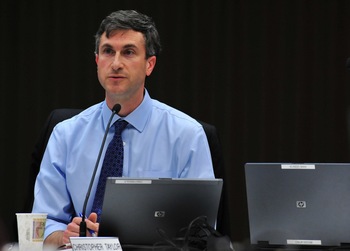
Council Member Christopher Taylor, D-3rd Ward, addresses his colleagues during Monday's council meeting.
Ryan J. Stanton | AnnArbor.com
The council voted unanimously at Monday's meeting to tweak its rules to state that electronic communication sent and received by a council member during a meeting will be included in the minutes, but the minutes won't include electronic communication received by a council member that clearly does not relate to the subject matter of the meeting.
"What will be different is if your spouse writes and says, 'What time will you be home?' it won't be included," said Mayor John Hieftje.
Before the changes approved Monday night, any email received by a council member during a meeting was included in the published meeting minutes. Taylor said that didn't seem fair to residents who might be emailing council members about sensitive matters unrelated to the meeting with no reasonable expectation that their email would be made public.
Council Member Sabra Briere, D-1st Ward, clarified for the benefit of the public that the change does not pertain to emails sent by council members.
"If a council member sends an email during the meeting, that and the email chain will still appear in the minutes," she said.
Following a City Council email scandal in 2009 that led to a lawsuit against the city and contributed to a council member being voted out of office, there was a flurry of debate in the community over the appropriateness of electronic deliberations during council meetings.
Council emails obtained through the Freedom of Information Act in 2009 revealed evidence that council members scripted votes, took cheap shots at each other and quietly reached decisions on controversial matters by discussing agenda items via email during meetings.
A new rule implemented by the City Council in 2009 effectively banned the exchange of emails during meetings with few exceptions.
The council tweaked its own rules again in 2010 and added language that council members must use the city's email system — not personal email accounts — for city business.
That was one of the requests made by Noah Hall, an attorney for the Great Lakes Environmental Law Center, which sued the city along with two businesses.
Ryan J. Stanton covers government and politics for AnnArbor.com. Reach him at ryanstanton@annarbor.com or 734-623-2529. You also can follow him on Twitter or subscribe to AnnArbor.com's email newsletters.
Comments
A2comments
Thu, Dec 8, 2011 : 12:05 p.m.
You can't make this stuff up...
BornNRaised
Thu, Dec 8, 2011 : 2:21 a.m.
Maybe if Taylor stopped emailing so much and focused on the meeting he wouldn't drop so many, "Uhh, umm, uh" .
moretothestory
Wed, Dec 7, 2011 : 6:57 p.m.
More covering up from the tax payers. Deceiving is how Julie Creal and others get away with covering the truth.
grye
Wed, Dec 7, 2011 : 4:13 p.m.
If the emails are occuring on a city owned computer, then the emails should be subject to disclosure. There should be no expectation to privacy using city owned assets. Having a "personal" conversation with someone? Use your personal cell phone or other personal communication device.
hut hut
Wed, Dec 7, 2011 : 4:05 p.m.
Why is it even necessary to FOIA communications and documents from elected officials and petite bureaucrats? It always gives the impression that someone is hiding something. There is no good reason for elected officials or bureaucrats to hide public information from the public and make people jump through hoops to get it. The primary purpose of every bureaucracy is to protect and perpetuate itself.
justcurious
Wed, Dec 7, 2011 : 3:54 p.m.
Maybe they should just stop emailing, tweeting, etc. during the meeting and pay attention instead?
Simon Green
Wed, Dec 7, 2011 : 3:53 p.m.
Maybe the city council should just ask the annarbor.com staff to moderate their emails.
debling
Wed, Dec 7, 2011 : 3:47 p.m.
Any and every correspondence using City property (computers, cell phones, Blackberry's, etc) should be available to the public always. Period.
hut hut
Wed, Dec 7, 2011 : 2:48 p.m.
Put this all to rest by writing and adopting a simple and coherent ethics policy for elected officials. Where's the ethics policy that Mr Taylor espoused after he was implicated in the email scandal? Where's the ethics policy City Council?
A Voice of Reason
Wed, Dec 7, 2011 : 2:37 p.m.
Wow, since when is talking and making fun of someone considered the skills we look for in our leaders? I think all emails and text messages during meetings should be shown on a live-feed monitor.
bedrog
Wed, Dec 7, 2011 : 3:41 p.m.
some of those who provoked such "fun making' well deserve it. ( see a related thread on the AATA/ACLU matter.) Leaders who would take them seriously ,in a private communication no less, should themselves be highly suspect.
Alan Goldsmith
Wed, Dec 7, 2011 : 2:34 p.m.
"What will be different is if your spouse writes and says, 'What time will you be home?' it won't be included," said Mayor John Hieftje." So will it include council members insulting others using their google accounts? You remember that don't you Mr. Mayor? Frankly when it comes to FOIA I really don't trust you to be a fair judge of what's relevant per some of the City's recent decisions. "Council emails obtained through the Freedom of Information Act in 2009 revealed evidence that council members scripted votes, took cheap shots at each other and quietly reached decisions on controversial matters by discussing agenda items via email during meetings." Ah, the good old days, eh Mr. Mayor.
xmo
Wed, Dec 7, 2011 : 1:59 p.m.
This is what happens when you have "ONE PARTY" rule. Ann Arbor voters are taught from a very young age that the "Other Party" is so evil that they continue to bury their heads in the sand and vote for these power hungry progressives no matter what they do or say! I like "DIVERSITY" in government!
hut hut
Wed, Dec 7, 2011 : 4:55 p.m.
Since when has "power hungry" been associated with one party and not the other?
Ryan J. Stanton
Wed, Dec 7, 2011 : 1:37 p.m.
In addition to the changes to council rules, the council approved 2012 committee appointments Monday night. If anyone is interested in seeing those, they can be found here: <a href="http://a2gov.legistar.com/LegislationDetail.aspx?ID=996921&GUID=43EFB081-983F-4FDE-AE12-F953B22A9F74&Options=&Search=" rel='nofollow'>http://a2gov.legistar.com/LegislationDetail.aspx?ID=996921&GUID=43EFB081-983F-4FDE-AE12-F953B22A9F74&Options=&Search=</a>
grye
Wed, Dec 7, 2011 : 4:33 p.m.
LDFA = Local Development Financing Authority Interesting that Steve, through the help of current city council members, is maintaining some connection and input into local political and city matters.
grye
Wed, Dec 7, 2011 : 4:28 p.m.
Oops, LDFA.
grye
Wed, Dec 7, 2011 : 4:27 p.m.
All right Mr. Acronym, what is LDEA?
justcurious
Wed, Dec 7, 2011 : 3:51 p.m.
Ryan, shouldn't these matters be posted in their own article?
Ryan J. Stanton
Wed, Dec 7, 2011 : 1:39 p.m.
Also note that Stephen Rapundalo, who was voted off council last month, has been appointed to the LDFA through June 30, 2015. <a href="http://a2gov.legistar.com/LegislationDetail.aspx?ID=1012127&GUID=9BF4D1F2-EEBA-43C4-9D51-52CAE12C1CAD&Options=&Search=" rel='nofollow'>http://a2gov.legistar.com/LegislationDetail.aspx?ID=1012127&GUID=9BF4D1F2-EEBA-43C4-9D51-52CAE12C1CAD&Options=&Search=</a>
bedrog
Wed, Dec 7, 2011 : 1:19 p.m.
Such discrimination and prioritization seems sensible in an era of garbage in/garbage out cyber overload , and FOIA zealots who range from the conscientious ( a minority?? ) to frivolous mischief -provoking cranks ( the majority..at least locally it often seems , given those who provoked some of the 'evil' e-mails).