

Ann Arbor council asks administrator for plan to trim employee costs
City Administrator Roger Fraser was given direction Monday night to come up with a budget plan that achieves a 3 percent reduction in compensation - at minimum - for Ann Arbor's non-union employees.
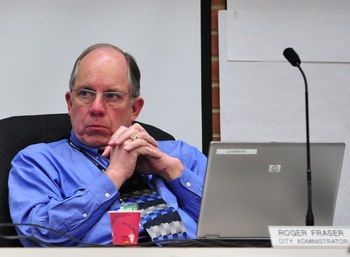
City Administrator Roger Fraser listens Monday night as council members give him direction to come up with a plan for trimming non-union employee compensation.
Ryan J. Stanton | AnnArbor.com
That directive came in the form of a resolution approved by an 8-3 vote of the Ann Arbor City Council. Fraser now must come back to the council in April with plans for trimming pay and benefits for the city's 180-plus non-union employees, including himself and the city attorney.
The approved resolution focuses on non-union employees because those are the costs city officials have direct control over. Officials hope reductions in wages and benefits for the city's unionized workers also can be negotiated at the bargaining table in the coming weeks.
Before reaching a decision on Monday, council members debated at length the semantics of the resolution sponsored by Council Members Marcia Higgins, D-4th Ward, and Stephen Rapundalo, D-2nd Ward.
Mayor John Hieftje at one point bemoaned the fact that it was taking so long to reach a decision and sarcastically opined it was going to be a "fun" budget year.
Most of the debate centered around whether each employee individually should take a 3 percent cut in pay and benefits, or whether the goal should be simply cutting the collective cost of all non-union employees by 3 percent - meaning some employees could see lesser cuts than others.
A successful amendment offered by Council Member Christopher Taylor, D-3rd Ward, preferred the latter, giving Fraser the discretion to determine how to reach a 3 percent total compensation reduction.
Taylor acknowledged there might be situations where a 3 percent pay cut to a low-income employee could be onerous, and other situations where a more highly compensated employee could stand to take a 5 percent cut. He said the administrator should be able to exercise those options.
The resolution specifically asks Fraser and other senior city management to show leadership by accepting a 3 percent reduction in compensation. In Fraser's case, not including changes in benefit levels, that means about a $4,361 pay cut.
Fraser previously declined to say whether he would be willing to take a cut when the issue arose last month.
Another revision made on the floor Monday night stripped the resolution of a clause that asked all council members to give up 3 percent of their pay. It also eliminated a sentence that asked the mayor to give up his $1,000 travel budget. A majority of council members thought the mayor should be able to travel around the state to represent Ann Arbor, despite the city's budget challenges.
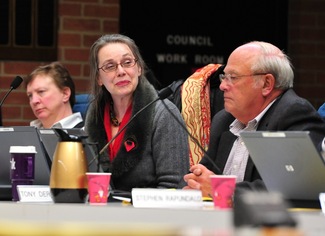
Council Member Sabra Briere, D-1st Ward, said Monday night she thinks the city's top management can stand to take higher pay cuts than 3 percent.
Ryan J. Stanton | AnnArbor.com
A majority of council members have already voluntarily agreed to give up 3 percent of their pay. The only two that haven't are Council Members Mike Anglin, D-5th Ward, and Stephen Kunselman, D-3rd Ward.
With their resolution reworded, Higgins and Rapundalo ended up voting against it. Higgins said she thought the intent of the resolution changed too much. Council Member Tony Derezinski, D-2nd Ward, cast the third no vote.
Council Member Sabra Briere, D-1st Ward, offered an amendment to the resolution that was turned down. She said 3 percent wasn't enough of a cut, and it should be 5 percent minimum.
"I felt very strongly that we really needed to be much more serious about the salary and compensation package," Briere said. "If we're not more serious than 3 percent, I didn't think we were going to make a big enough dent in the budget."
An analysis by AnnArbor.com showed it would take a 6.7 percent reduction in the base wages and benefits for all city employees to achieve a savings of $5.2 million. That's the additional amount of money the city must trim from its budget - on top of millions of dollars in cuts already scheduled to take effect July 1, including the elimination of 14 firefighters and the closure of Mack Pool and the Senior Center.
City officials say they're still trying to figure out how to avoid those cuts, but in the absence of concessions from employees, it's going to be difficult.Â
Personnel costs make up a large portion of the city's budget. The average city worker is expected to cost the city $103,769 in base salary and benefits next year.
Within the resolution approved Monday night was a directive to eliminate each council member's $560 travel budget, which will save $5,600 next year.
The budget directive resolution evolved from an earlier version that was tabled by the council last month. Rapundalo and Higgins worked with Fraser to revise its wording to focus on total compensation, instead of just pay.
Another clause was added to direct the city's administration to strive to establish equal health care benefits for all eligible employees by July. Currently, the city has five different plans and there are large discrepancies in the amounts that different labor groups pay for premiums and deductibles.
Fraser said the goal will be to get those unions that are enjoying a "free ride" on health care to start paying the same costs toward benefits as the city's non-union employees and Teamsters bargaining units.
Ryan J. Stanton covers government for AnnArbor.com. Reach him at ryanstanton@annarbor.com or 734-623-2529.
Comments
AlphaAlpha
Wed, Mar 3, 2010 : 8:46 p.m.
Just to be clear, could you please tell us which pages, columns, and lines from the Budget Book were used? Thanks.
AlphaAlpha
Wed, Mar 3, 2010 : 5:09 p.m.
Hello AnnArbor.com - Thank you for all your efforts. If you haven't already (I may have missed it), could you please post in meticulous detail just how you arrive at the 6.7% figure? Please? I'd really like to know why my 5.8% might be incorrect. Thanks very much for introducing more facts into the discussion.
snapshot
Tue, Mar 2, 2010 : 7:13 p.m.
It sounds like we only need the fire department to run the city and everything will be fine. What kind of hours do firefighters work? I think they would have the time.
snapshot
Tue, Mar 2, 2010 : 7 p.m.
It seems the unions just want all the money in the general fund dedicated to their financial whims. They keep bringing up all the other money the city is spending in other areas with no understanding of budget restrictions and allocations. They also forget the TAXPAYER is paying for these buildings too. The attitude of entitlement exhibited is amazing. The fact that the taxpayers have to pay for the new building projects doesn't seem to matter to them. Taxpayer should continue to fund inflated salaries and benefits in addition to the construction projects. And then they wonder why taxpayers are upset with unions.
bear
Tue, Mar 2, 2010 : 6:20 p.m.
Stun, Please tell me of the ridulous union demands that you speak of. If it were not for unions the council could change benefits and wages at thier whim, like they are about to do to the non-union employees. As a union rep I have never held the city hostage but have tried to work to achieve good labor relations with the employer while trying to help reduce labor costs. It does not do any union any good to bankrupt their employer. You however are so anti-union that it would make no difference what I tried to explain to you.
The Grinch
Tue, Mar 2, 2010 : 5:31 p.m.
"Your job as a 'union rep' should not even exist. What the heck does a union rep do? Waste my hard earned money to hold the city hostage to ridiculous union demands which raises my taxes." Yeah, you're anti-union, Stun. And, BTW, in my experience, someone who is a union rep does their job on their own time on their own dime, so quit fretting so about your tax dollars being wasted. Yet their not really your tax dollars, are they, since you don't live in A2?
The Grinch
Tue, Mar 2, 2010 : 5:18 p.m.
Stun: One does not vote somewhere where one has rental property. So what is it: Do you live and vote in Saline or in A2? And, whatever your answer, you have made conflicting claims as to your residence in different discussions. Why, then, should anyone in this discussion or any other believe a word you write?
stunhsif
Tue, Mar 2, 2010 : 4:26 p.m.
Bear, unions are not the entire problem but they are part of the problem. Your job as a "union rep" should not even exist. What the heck does a union rep do? Waste my hard earned money to hold the city hostage to ridiculous union demands which raises my taxes.
bear
Tue, Mar 2, 2010 : 3:04 p.m.
The unions are not the problem. From experience working with the city as a union rep. it is difficult to meet with the employer on good terms when the employer expects the union to follow the contract to the letter but the employer will spend more money on trying to fight a valid point by the union then it would have cost them to just ackowledge the union was correct and end the problem. As far as all of you that feel the front line work force is not dedicated to the citizens of this community you are wrong. It is the front like work force that keeps this city moving overcoming the policies established by management and the council that sometimes hinder the ability to get the job done. I have pointed this out before, it takes both sides to agree to a contract. When council approves a contract it knows all the financial ramifications of that contract, at least I hope they do. As far as the $100,000 pension average goes it is up that high because of adminstration being factored into the average. There is not one of my union brothers and sisters making that amount of money in retirement from city employment. The easiest thing to do is blame the union for the financial woes of the city but not one union member sits on the council or is invited to vote on the budget decisions made by the city administration.
Hot Sam
Tue, Mar 2, 2010 : 2:38 p.m.
What this and every other debate about local finance is missing, is the fact that if we didn't waste so much money in Washington, we would have enough for teachers, firefighters, police officers, good roads etc.
Steve Hendel
Tue, Mar 2, 2010 : 2:35 p.m.
Well. I am a former (30-year) City employee and current retiree, so I have (to an extent) benefitted from the pay and perks currently under discussion in the Council, the press and the blogosphere. I will tell you this-there IS waste in City government, although one person's wasteful extravagance is another's essential service. My own observation is that the vast majority of City employees, both the ones the public encounters every day (police officers, firefighters, trash collectors, etc.) and the ones the public doesn't even know about (accounting clerks, equipment operators and so forth)give the taxpayers value for money in terms of the quantity and the quality of their work. The General Fund, as we all know, has shed @ 200 jobs over the past several years; where do you think the work those people did went? Very largely, onto the shoulders of the people, the everyday workers, still employed. This phenomenon obviously occurs in the private sector as well, but a little recognition that City employees have striven to minimize the effects of these job cutbacks on the services we all take somewhat for granted might be in order.
BornNRaised
Tue, Mar 2, 2010 : 1:28 p.m.
@bellhelmet... you're right... the 4% (not 3) came after the original offer of 6% while asking the city promise to not close any MORE fire stations. The refused, so they threw away the original deal. Now, argue all you want about 4 vs 6, but if the city was that serious, why not work with folks? Instead, they take the 4% and then come back and say they're going to fire even MORE firefighters than before. Why would anyone want to offer anything to the city after a move like that? It only shows all the city workers that they can't trust the administration... which any resident could've figured out after reading about the Enron accouting that even Crawford admits to.
stunhsif
Tue, Mar 2, 2010 : 12:51 p.m.
@Grinch, Is it not ok for someone to have rental property?
RUKiddingMe
Tue, Mar 2, 2010 : 11:41 a.m.
Did anyone at the meeting suggest a small savings from ceasing all planning and discussion on new convention centers, transit stations, green belt purchases, public art, new city buildings and renovations, local currency and other candy-land fantasy ideas, etc. etc. unless it was vital to the operation of the city? That would save us a few hundred grand a pop. I mean, as long as they're all in there talking...
Vivienne Armentrout
Tue, Mar 2, 2010 : 11:08 a.m.
Please check - I'm pretty sure that Mike Anglin gives the money from the last salary raise to charity. Last I heard it was to the Michigan Theater. He voted against the last raise and has donated that amount since.
Moose
Tue, Mar 2, 2010 : 10:20 a.m.
Lee is right. There is no talk, not a peep, about finding ways to get the U to pony up, not a word about stopping unnecessary projects including the Driesetl Urinal. No proposals to revisit or put the crazy Greenbelt back on the ballot and let voters decide. No talk of revisiting the Google parking giveaway or the proposed Transit Center that is little more than a giveaway to the U for another parking structure. Not a word on getting rid of the DDA and putting those tax dollars back in the General Fund. Not a single word about reducing administrative overhead by cutting those jobs that pay more than $100,000. No serious talk of outsourcing IT or the Attorneys office. No plans to reduce the number of "buckets" that limit budget flexibility. No, it's all talk is about raising revenues by fees, fines and taxes and balancing the budget on the backs of working people. Spineless, clueless council. A scowling administrator sitting in his ivory tower.
Moose
Tue, Mar 2, 2010 : 9:25 a.m.
Hieftje should really enjoy his own "fun budget year" when he's out of a his mayors job come election time. Look John, you had a chance to stop some of this madness when you opposed the new city hall because you thought it cost too much money. Instead of leading, you put your tail between your legs and threw your lot in with the "buildings and money" bunch on council. Come August it will be time to pay the piper.
BornNRaised
Tue, Mar 2, 2010 : 9:24 a.m.
@stun... Great comments. Too bad you have none of your facts straight. "Unions digging in"? Hmmm... who was the first to offer pay cuts and benefit reduction? Oh yeah, the FD. How quickly did 'management' follow their own directive? That's right, they're still working out the, so called language. Funny FD could take a 4% across the board, but with it comes to them, oh wait! They have to have a ton of meetings, and just sit on their hands. But, in your mind, you somehow translate that into the unions 'digging in'. Reading what some people here post, is almost as good as reading the comics.
Pjohn3
Tue, Mar 2, 2010 : 9:22 a.m.
I recently found out that I will need to cover a greater percentage of my company health care expenses, elimination of 401K match (50% up to 6% of salary) and a cut of 7.5% to my salary. Then I read that the average city worker makes $103K and most of the union workers pay very little in monthly health care costs. But council proposes a city income tax to bridge the gap that cuts don't cover? THIS IS THE PROBLEM. There is a serious disconnect between the private sector and public. No more sacred cows. Open up the collective bargaining agreements and amend the charter to reduce the city's obligation regarding legacy costs. It is simply unsustainable.
The Grinch
Tue, Mar 2, 2010 : 9:19 a.m.
Stunshif: Thought your kids went to Saline Schools. If so, how do you plan on participating in an election on a tax increase in A2? So which is the truth?
stunhsif
Tue, Mar 2, 2010 : 9:13 a.m.
Rest assured that A2 Council will put to vote a 1% income tax. And if you believe that your property taxes would go down if it passed, I have some swamp land in the Sahara that I'll sell you for cheap! Really, if the city had dumped defined pension benefits years ago ( like almost all of us have in the private sector) our taxes would be much lower now than they are. Property tax rates in A2 are outrageous. Buy the same house in Jackson MI and your taxes are 1/4 what they are in A2. No wonder you see so many commuters heading east on I-94 from Jackson. This is going to get very interesting over the next 6 months as the unions dig in and show us taxpayers that they don't give a hoot about anyone but themselves. So much for calling them "civil servants". We will have to change that to "un-civil servants".
BornNRaised
Tue, Mar 2, 2010 : 9:12 a.m.
8 comments in, and already folks have fell into the cities smoke and mirrors game and totally lost focus of the issue. The salary reduction of 6.7% ALONG WITH the firing of 14 firefighters is all they're looking at to balance the budget. No talks about greenbelts, convention centers, parking garages, or pet projects. Notice they never said they won't stop with those. They're putting the budget deficit on the backs of the workers... well, the workers that will still have a job. But when it comes to them taking a pay cut, there's meeting after meeting and nothing gets done. Mayor asked for 3% MONTHS ago. The FD stepped up and took it quickly. Not forced... they volunteered. City leaders? Yeah, keep working on that. And they tell us is harder to get the unions to work with them on this. Hmmm... one union already did and they publicly spit in their faces. Sends a great message to the other rank and file, union or otherwise. FYI, did you know the city hall renovation, not the new structure, but the existing structure, cost and additional $5M to 'fix up'. That money wasn't budgeted for. That money came out of the worker's comp. fund (read: general fund). And that's direct from HR's mouth. The, almost $1M, accounting system IT purchased to 'dumb down' the current system that they claimed they 'saved up for'.??? Where did they 'save' that money? I don't remember any city wide bake sales going on. Oh, that's right! That's because IT milks money from each and every city department. You have no choice but to pay them the fee that THEY set, and you can't get your so called services from anywhere else. So now we have IT to thank for jacking up operating costs of other departments and creating false deficits. You can all write all the hate-blogs you want, point fingers at eachother, and look down at the city workers. Know your facts. If you believe everything that comes from Fraser and council and take it for face value, well... there's a word for that.
Moose
Tue, Mar 2, 2010 : 9:08 a.m.
Fraser's silence is stunning but no surprise. Here's the guy who took a $30,000 bonus, given to him by council as an incentive to live in the city. He took the money and bought some McMansion in a surrounding township, essentially thumbing his nose at council and the people he was hired to serve. He is given $4000 annually to drive his personal cars, BMW convertible and SUV. Obviously he's too good to drive a city motor pool Chevy provided by the people who pay his salary. Now he complains that some city employees, a few who actually qualify for public assistance and subsidized public housing are getting a free ride? Free ride? Wow. Who's literally getting the free ride here?
Really?
Tue, Mar 2, 2010 : 9 a.m.
So who's asking anyone to vote for a tax increase? I'm sure some self-educated 'person' is going to start talking about the income tax vote. Yeah, the one that lowers your overall taxes you pay to the city. But hey, don't argue the fact, just argue about your own personal opinions. That makes WAY more sense.
mmggttnn
Tue, Mar 2, 2010 : 8:46 a.m.
Now I'm really worried! It takes a 6.7% cut to balance the budget, but City Council is trying to do it with a 3% cut. All Councilpeople should be required to take a math course at WCC. Also, why are non-union workers taking the hit and not union workers? Bust the unions!
xmo
Tue, Mar 2, 2010 : 8:42 a.m.
Lets reduce the time city council meets and votes on stupid laws.
stunhsif
Tue, Mar 2, 2010 : 8:02 a.m.
A2.com did a study and it was determined that all city employees ( both union and non union) would need to take a 6.7% reduction to pay and benefits so what the heck is the City council doing dinking around with just a 3% cut to non union employees. First off, cut the non union's workers pay and benies 6.7% IMMEDIATELY and then demand the unions come to the table NOW and take the same cuts. I will never vote for any kind of tax increase until this happens.
BenWoodruff
Tue, Mar 2, 2010 : 7:59 a.m.
So, Since the Fire Department offered up a 4.5% reduction in wages, have they met the city's goal? I assume so.
A2westside
Tue, Mar 2, 2010 : 7:49 a.m.
The city needs to get back to the basic's - pick-up garbage, maintain streets, police/fire protection, sewer/water. The other things the bleeding hearts want ( homeless shelter, non-profits) their can write a personal check to surport. Also, the City should combine Park & Rec with the Public Schools Rec & Ed.
E
Tue, Mar 2, 2010 : 7:39 a.m.
"The average city worker is expected to cost the city $103,769 in base salary and benefits next year." How did this happen? By comparison a small business owner in AA earns $51,997 on average according to Payscale.com.