

Controlling employee costs may be Ann Arbor's biggest challenge
City Administrator Roger Fraser acknowledges Ann Arbor city employees enjoy more lucrative benefit packages than many others in the public and private sector.
"Looking across the organization, what we have consistently found is that wages tend to be close to the middle of the marketplace," Fraser said. "Where we're out of sync with the rest of the marketplace is in the amounts that the employees contribute to those non-wage costs, and we've been trying to focus on that."
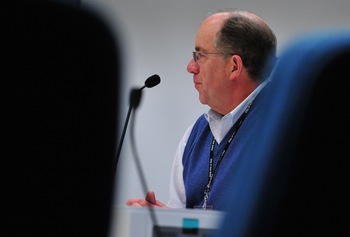
City Administrator Roger Fraser speaks about employee pay and benefits at the City Council's last budget session.
Ryan J. Stanton | AnnArbor.com
The city is paying more today to employ 766 people than it did earlier this decade when it had 959 workers. And it's those costs that are nagging city officials as they look to confront an additional $5.2 million general fund budget deficit - on top of millions already cut.
Despite efforts to slash personnel costs, pay and benefits in Ann Arbor city government - including retiree pensions - have risen to $114.9 million this year. In 2002, with a much larger staff, those costs totaled $86.7 million - or $104.4 million in today's dollars.
Employees are earning more, and their benefits are costing more. Annual expenses for benefits for city employees and retirees have nearly doubled from $32.7 million to $59.4 million since 2002.
The rising expenses are partly tied to the city being more aggressive about funding future liabilities for retiree health care and pensions. But officials also say the cost of health care has risen sharply, and employees aren't paying their fair share.
With wages and benefits for three-quarters of the city's workforce locked into union contracts, changing that could be difficult.
"Do we need improvements from employees? Absolutely," said Tom Crawford, the city's chief financial officer. "Are we working really hard at that? Absolutely. Are we having a hard time? Hell yeah."
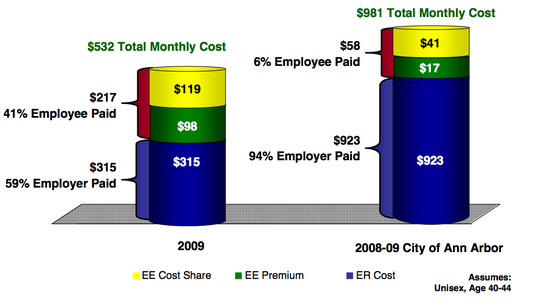
This graphic shows the average Ann Arbor employee last year paid only 6 percent of the $981 monthly cost of his or her health benefits. Across the marketplace, the average monthly cost was $532, and employees typically picked up 41 percent of that amount.
Courtesy of McGraw Wentworth
Greg Surmont, account director for McGraw Wentworth, the city's employee group benefits brokerage firm, said his firm surveyed more than 600 public and private organizations throughout the state. The survey found Ann Arbor employees enjoy top-dollar benefits at little cost to them.
According to the survey, the average Ann Arbor employee last year paid only 6 percent of the $981 monthly cost of his or her health benefits. Across the marketplace, the average monthly cost was $532, and employees typically picked up 41 percent of that amount.
A closer analysis of those figures suggests Ann Arbor paid $5.8 million more for health insurance last year than it would have if its benefit plans were in line with the rest of the marketplace.
"The city's costs in general are significantly higher than the prevailing costs out there," Surmont said. "In this case, it's a pretty big differential - nearly $400 more per month per employee - and the city is funding the majority of the expense. We've got employees who are paying little toward premium costs. In fact, just $17 a month."
Compared only with other municipalities in Michigan, Ann Arbor's employee benefit packages still are far more generous, the survey found.
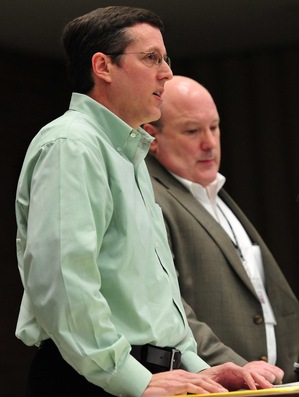
Tom Crawford, the city's CFO, addresses the City Council at its last budget session.
Ryan J. Stanton | AnnArbor.com
City officials say it's been a challenge getting the needed concessions from labor unions, specifically with the police and firefighters unions, whose members enjoy premium-free health insurance.
"We are still struggling with labor contracts that were heavily one-sided that were decided back in the '70s and '80s," said Mayor John Hieftje. "We've been working very hard to try to do more. Employees are contributing more to their health benefits, but not nearly what they need to be."
One of the challenges is Michigan Public Act 312, a 1969 law that provides for compulsory arbitration of labor disputes in municipal police and fire departments. Hieftje claims the law unfairly favors the unions and has led to situations in which a third-party arbitrator decides whether to dole out raises - even if the city can't afford them.
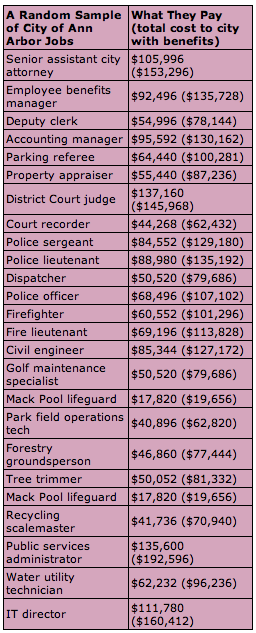
The average Ann Arbor city employee earns a base salary of $65,198 and receives $32,993 in benefits. By those calculations, the average active employee costs the city $98,191 per year, a figure slated to rise to $103,769 next year. And that's not including overtime, which is an expense of more than $2.76 million on its own.
According to U.S. Census Bureau statistics, the average per-capita income in Ann Arbor is $30,410 - less than half that of a city worker.
According to U.S. Bureau of Labor statistics, the average rate of pay for a government employee in the United States is $25.97 an hour, compared to $29.29 for a city of Ann Arbor employee. Total benefits for a typical government employee come at a cost of $13.54 per hour, while in Ann Arbor city government it's $18.82.
With personnel costs accounting for such a large portion of the city's budget, the jobs of city workers are on the chopping block. The latest proposals call for eliminating 17 positions in the police department and 20 in the fire department in July.
Hieftje has issued a call to the labor unions to take a 3 percent pay cut to help avoid layoffs. He said that would yield savings of $875,000 in the general fund and $1.5 million across all city funds.
So far, only the firefighters union has responded, agreeing to a 3 percent pay cut and a 1 percent increase in employee pension contributions. But even if every other labor group followed suit, it still would fall short of closing the budget gap.
An analysis by AnnArbor.com shows it would take a 6.7 percent across-the-board reduction in total compensation - pay and benefits combined - to achieve a savings equal to $5.2 million. That theoretically would balance the budget without layoffs or cuts to services, but would result in a $6,953 hit to each employee on average.
If the city went that route, the cuts could be achieved by implementing a 5.25 percent reduction in salaries and requiring each employee to contribute $290 a month more for health insurance.
But the City Council can't unilaterally impose that without consent from the unions.
"In the public sector, we don't have the same rules the private sector does to solve our personnel issues," Crawford said. "Public Act 312 is a huge issue for us and part of the reason why change is so hard and so delayed. The math may work. But is it practical? Not in any short time frame."
Robyn Wilkerson, the city's human resources and labor relations director, is currently attempting to negotiate with each of the city's eight collective bargaining units. She said it's difficult to ask employees to take deep cuts when the city's budget still hasn't hit bottom. City officials are predicting they'll need to cut an additional 8 percent from the budget in 2011-12.
As part of negotiations, Wilkerson said she's working to address what she considers a "tremendous disparity" between different labor groups when it comes to how much employees pay toward their health benefits.
"Our non-union employees and a couple of our Teamster groups pay 10 percent premiums now," she said. "Groups like the police, POA, COAM and AFSCME don't pay premiums at all and they have different levels of deductibles. One of our goals, quite honestly, is to get everyone on the same plan just in terms of equity from an administration standpoint."
AFSCME President Nicholas Nightwine, who heads up the city's largest labor union, acknowledged his bargaining unit historically has shared little of the cost of health benefits. For instance, AFSCME employees never paid deductibles for their health insurance until their last contract - and they still don't pay premiums.
"But when we negotiate a contract, both sides sign off on the agreement," Nightwine said. "So the city has not given us anything that they have not signed off on giving us. We don't make our own wages or benefits."
AFSCME has not yet responded to the city's request to open up its contract, which includes 3 percent raises next year.
"I'm not going to sit here and say we're going to absolutely say no to the city, but we feel we've already given back," Nightwine said. "Until last year, we went three years without taking a raise across-the-board."
According to year-end audits, expenses in the general fund - the city's chief operating budget - increased from $74.5 million to $83.9 million from 2003 to 2009. That's a 12.6 percent increase over six years.
All total, the city has a budget this year of about $351.7 million, which has grown by $132.8 million - or about 61 percent - in the last eight years, according to city records. Crawford claims comparing the city's overall budget today to past budgets is skewed because the city's accounting procedures have changed and capital projects weren't factored in before but now are.
Crawford also points out that the city's budget is about $25 million lighter this year than it would have been had not the city eliminated 239 jobs since 2001.
Council Member Carsten Hohnke, D-5th Ward, said city officials must closely examine every area of the city budget in the coming weeks, and that includes employee pay and benefits.
"Labor costs are a significant part of the organization," he said. "I don't think it's unusual. In an organization like ours, the people are going to be a big part of the expense, but compensation is definitely something that we have to look very hard at."
Ryan J. Stanton covers government for AnnArbor.com. Reach him at ryanstanton@annarbor.com or 734-623-2529.
Comments
AlphaAlpha
Sat, Mar 6, 2010 : 1:38 p.m.
"They are a meaningless set of numbers that add nothing to the discussion" On the contrary; they provide useful context. You likely know that, and are simply employing Debate 101 tactics. That's OK. What matters is: How will the customers, the voters, react to the fact that city workers earn twice what their private counterparts do? We both know the answer to that.
Sandman
Thu, Mar 4, 2010 : 9:44 p.m.
You guys have it right, but no one is putting it all together. Join the over $100K club: City administrator(Fraser), CFO(Crawford), Police Chief(Barnett), Fire Chief(?), Public Services Administrator(McCormick), Pirooz, Wheeler, Wilkerson, Bahl?, IT(what's his name?), any more chime in... These people are not the ones asking the employees to cut their wages, it is City Council and the Mayor, because they are also employees and realize we are not over paid. Management raised employee pay because they trained them to perform multiple tasks, widely skilled...no other city has employees trained as widely as Ann Arbor. All Ann Arbor employees are well worth their compensation; it's the bad press and public opinion that is the problem. Leave them alone and stop this negative greed and jealousy... This is a nice town with public influence over their talented, highly skilled "City Employees". Don't screw it up by taking out your financial troubles on them.
John Q
Thu, Mar 4, 2010 : 9:10 p.m.
"BLS numbers are what they are." They are a meaningless set of numbers that add nothing to the discussion other than to provide the false impression that Ann Arbor's city employees are overpaid and over compensated. Name one private employer that uses those numbers to determine a "fair wage" for their employees? Any company? I'm confident that no private employer in Ann Arbor uses those numbers to set pay and benefits for their employees. Why should the city be any different?
AlphaAlpha
Thu, Mar 4, 2010 : 8:32 p.m.
Hi John - "I believe that a simple test to the value of these numbers is to ask everyone here to apply the same standard that you insist should be imposed on Ann Arbor's employees." Regardless of what you believe, no "test to the value of these numbers" is required. The BLS numbers are what they are. No re-interpretation or 'value testing' is required. BLS numbers show city workers earn substantially more than their governmental peers, and over twice what civilian workers earn. BLS numbers are what they are.
Moose
Wed, Mar 3, 2010 : 11:03 p.m.
Jack asks "Why"? Because City Hall was an easy target and a fiscally conservative editorial policy sold papers by creating something over which readers to be outraged.
Jack
Wed, Mar 3, 2010 : 10:49 p.m.
I think readers need to realize that most, if not all, of the City's top executives are on contract; they are not "regular" employees, albeit they are employed by the City. None of them, to the best of my knowledge, including the ever-so concerned Mr. Crawford, have volunteered to have their wages cut. When they speak of wage reductions, they speak of other peoples' wage reductions, not their own. Those on contracts would not be affected. The Ann Arbor News has always worked hand-in-glove with City executives to pressure City employees to accept wage and benefit cuts and to incite public opinion against them. It seems to be a tradition. I say this because over the years I can think of no instance in which the News has supported City employees. I have no idea why the news appears to bear malice toward City employees. They have been blasting them for years about not paying their "fair" share (while never defining what that may be in their ever-so wise eyes), all the while offering their own employees basically free health insurance. Go figure.
John Q
Wed, Mar 3, 2010 : 10:04 p.m.
"Your ability to use diversionary tactics, distracting though predictable, is somewhat polished." You were the one who staked the claim that Ann Arbor's employees are overpaid because their pay and compensation exceeds some national average that you claim is a "fair wage". If anyone has created a diversion, it's you who created it by using these numbers which have no applicability to the discussion other than to create the false impression that Ann Arbor's employees are overpaid and over compensated as compared to people of similar skills, education and experience. I have consistently pointed out your abuse of these numbers. I believe that a simple test to the value of these numbers is to ask everyone here to apply the same standard that you insist should be imposed on Ann Arbor's employees. But given the opportunity to demonstrate the accuracy and value of this standard, you run away from it. I can only assume that your unwillingness to apply this standard to your own salary and benefits shows how meaningless and useless those numbers are to the discussion. The silence of the critics is deafening.
Moose
Wed, Mar 3, 2010 : 8:04 p.m.
From the human perspective, nothing is objective. Everything is political. It cannot be denied.
Moose
Wed, Mar 3, 2010 : 7:57 p.m.
Ax2 Man up.
AlphaAlpha
Wed, Mar 3, 2010 : 4:44 p.m.
Hi John - Your ability to use diversionary tactics, distracting though predictable, is somewhat polished. But, guess what? The issue at hand is about reducing the budget deficit, not you, me, him, or them. Discussing personalities instead of facts is an old trick. It's a useful debate tactic, but unbecoming when overused. So, no bait taken. You understand the pay issue, likely better than most. Those on or near the city payroll would likely advocate just as you do, and that's ok. What are your ideas for resolving the deficit? Scalable ideas preferred; indicators suggest the 2011 deficit situation will be worse than 2010's.
a2roots
Wed, Mar 3, 2010 : 11:38 a.m.
@ybecuz...nice attitude you have. Have yet to hear you say anything about paying your fair share toward benefits. Maybe because you think you are better than everyone else. You certainly think you are more brave.You blow your horn about being a firefighter and I respect your job but do not appreciate it being stuffed in my face all the time. Your job is no more dangerous than many. Get over it.If you do not like Ann Arbor, my guess is you do not live here, is then you should leave. There are many waiting in line for your job.
Moose
Wed, Mar 3, 2010 : 11 a.m.
I'm retired and my gross is $25,000 annually and my health care is part of my retirement. I also get a SS payment about $900 per month. Took a penalty to collect early. A couple of years away from Medicare. At the end of my professional career (24 years) I made less than $60,000 annual gross and paid about a third of my health costs about $1000 annually. I saved, invested also made contributions to my retirement fund. I own my home, in reasonable health, live in the city, pay city taxes. I believe that I was paid fair and competitive wages while I worked and my pension and SS is comfortable and plenty to get by on. I don't travel much and have never been on a Caribbean cruise. And you... Alphax2?
John Q
Wed, Mar 3, 2010 : 10:36 a.m.
"The fair wage concept is sound, is gaining recognition and acceptance, and is an important part of reconciling budget expectations with reality." I see that a "fair wage" is only those wages and benefits as they apply to others, not to oneself. Come AlphaAlpha, step up to the challenge. Do you make the national standard in wage and benefits? If you make more than that, do you consider yourself overpaid?
Moose
Wed, Mar 3, 2010 : 9:11 a.m.
City workers wages not competitive? I guess some won't be happy until there are no public workers, no public services and wages for everyone are on par with the Chinese. Don't worry, because as you drive down other working people's wages, your own jobs, wages and benefit cuts won't be far behind. It's only a natural progression and one that is encouraged by corporatists and CEO's worldwide. As you demand that other's wages and jobs are cut, so will be your own. And all this while those at the top quietly gloat as we at the bottom cut our own throats. Doesn't anyone see that we, working people, are being pitted against each other and used for those at the top's continued greed?
Moose
Wed, Mar 3, 2010 : 8:54 a.m.
John Q, Thanks for pointing out the hypocrisy of a few posters here. For those who's pay and benefits have been reduced or those who have lost their jobs, I am truly sympathetic. But just because it happens to you, doesn't make it right that you want everyone else to be in the same situation. All that is is a race to the bottom for working people while those at the very top, those who actually contributed to the global and local economic meltdown, continue to play us for fools as they make out like bandits.
AlphaAlpha
Wed, Mar 3, 2010 : 7:23 a.m.
Probably it's good to squabble over semantics instead of the real issue. It's a hint the wage normalization process has traction. Cuts, reforms, give backs, normalization, raiding, saving, pay reduction, competitive wages, take from the workers, give to the taxpayers, etc. Descriptives abound, like opinions. The fair wage concept is sound, is gaining recognition and acceptance, and is an important part of reconciling budget expectations with reality.
John Q
Wed, Mar 3, 2010 : 6:55 a.m.
"Because, as has been shown, city worker compensation is not competitive." I've asked anyone to post here that they make the national average in salary and compensation. Or, if they make more than that average, if they believe that they are overpaid and overcompensated. Not one person has stepped forward to the challenge. What that tells me is that no one who's here telling city employees that they are overpaid and overcompensated is willing to apply the same standard to themselves. Easy to tell someone us to take a cut in pay and benefits, isn't it?
John Q
Wed, Mar 3, 2010 : 6:51 a.m.
"I said reformed because I really meant reformed. In some cases it mean cuts (as in salaries), but in other cases it means increase co-pays or moving to a defined contribution or shared risk defined benefits approach to retirement." Reform = Cuts in salaries, cuts in benefits or taking away benefits from city employees. Is that better? That's what you're proposing. None of these reforms benefit the employees. Again, why hide behind the language?
AlphaAlpha
Wed, Mar 3, 2010 : 6:10 a.m.
Because, as has been shown, city worker compensation is not competitive.
AACity12
Tue, Mar 2, 2010 : 11:14 p.m.
361 million dollar budget and 114 million is employee costs. Why is the total 5 million deficit being placed on the employees shoulders? There aren't 5 million in cuts in the other 247 million? Staff has been cut by 31% and you then want a 7% pay cut? I understand "do more with less" but not "do more FOR less". Times are tight and all but I think its time for you to look within.
AlphaAlpha
Tue, Mar 2, 2010 : 9:57 p.m.
If a 5-7% total compensation reduction is effected, the city would not need to layoff anyone. Small consolation, but better than letting people go. If the reductions were larger, the city could hire again. A 14% reduction would allow the hiring of about 50 new workers, while keeping the budget balanced.
ybecuz
Tue, Mar 2, 2010 : 8:29 p.m.
For all of the accountants, union haters and general naysayers out here. Unless you are willing to strap on a pack, hump some hose into an IDLH, I'd appreciate it if you just said Thank You and went on your way.
Awakened
Tue, Mar 2, 2010 : 7:46 p.m.
No if th eCity Management will contribute. For example, they are adding 9 police officers to the cuts but adding no supervisory staff in the PD. 30%+ of the PD is command staff. If we eliminate 9 officers on the street, couldn't we demote 3 supervisors? That would only short us 6. Why isn't that considered. If it was 2 Sgt's and a Lt we'd save an additional $12,000. Not much, but better than nothing, and 3 more bodies to respond to emergencies.
snapshot
Tue, Mar 2, 2010 : 7:32 p.m.
Good for you Pragmatic. It'sgood to hear that there are city employees that understand the severity of the situation and are willing to contribute towards a solution willingly.
pragmatic
Tue, Mar 2, 2010 : 3:23 p.m.
I am a City employee and do believe that we employees could and should be paying more for our health care and should take a 3% pay cut to help the City in these difficult times. But I do think that staff reductions are also something that should be considered.
Hot Sam
Tue, Mar 2, 2010 : 1:57 p.m.
What this and every other debate about local finance is missing, is the fact that if we didn't waste so much money in Washington, we would have enough for teachers, firefighters, police officers, good roads etc.
BornNRaised
Tue, Mar 2, 2010 : 1:56 p.m.
@Moose... who does the Mayor work for again? There's your answer as to why he doesn't push it.
Moose
Tue, Mar 2, 2010 : 1:34 p.m.
"The mayor said he'd prefer a tax on tickets, but the city doesn't have that option under current state laws." Then get thee to Lansing and work with other cities in the same boat to change the law! For all the years that Hieftje and others have been talking about it, the law could very well have been changed by now.
a2roots
Tue, Mar 2, 2010 : 10:06 a.m.
The banter and finger pointing continues. One side blames it on the politicians, Fraser, and the Mayor for over spending and lining their pockets and the other side blames the unions and city employees. Bottom line is that at some point all parties need to be part of the solution and not the problem. There is plenty of blame to be passed around. Some, sorry @Moose, are beyond comprehending that the gravy train for ALL must end. I have said it numerous times and will again. A 3 or 4 percent pay cut is useless. All union and non-union employees need to pay a fair share toward their benefits or eliminate them altogether. This is not a health care agenda rather one of benefits and how they are paid and by whom. To some this will mean reducing their disposable income more than others. Sorry FD, but oh well join the crowd. Trust me, Fraser is no favorite of mine, but for all those blasting him for living in the township, please look in the mirror, because I bet most of you do not live in the city either. I would be curious to know how many of our city employees live in Ann Arbor? Don't tell me you cannot afford it, because based on the pay info most certainly can. Entitlements need to go away and all employees must pay their fair share.
Hot Sam
Tue, Mar 2, 2010 : 9:32 a.m.
"""The amount of money available to corporations and their CEO's is practically unlimited compared to unions who get their money from working class people.""" News flash!!! They ALL get the money from working class people...
Jack
Tue, Mar 2, 2010 : 2:06 a.m.
There are many, many City of Ann Arbor employees who make $20,000-$50,000. They would be tickled pink to be that average employee. But, somehow, you never read about them. It may be that those in the upper echelons of pay distort the picture and actually raise the average to what a2.com claims, (I would be interested to know what the median is, how many above and how many below), but I would actually have to sit down and add every salary and benefit myself before I would believe the figures presented. I would also like to know if the writer, when confronted with different employees with the same title, consistently chose the middle pay of those employees, or the highest. Likewise, to state that employees only pay 6% of their insurance is misleading. Non-union employees pay a monthly premium which varies depending on marital status and family size. They also pay deductibles and co-pays. Uncovered costs can come up to several thousand dollars a year for even a single person without catastrophic occurrences. Again, not mentioned in this article. Granted, there are union members who have it considerably easier. The City has been leveraging one group against the other (much as many of those who are writing in here are pitting themselves against City employees) for some time now in a desperate attempt to cut down on expenses. It may be that this tactic is necessary; it may be that this is the way the middle class disappears. To suggest that the Citys current situation is due to the Citys poor planning is imbecilic. No one foresaw the economic disaster that was forthcoming. Did anyone who assumed the City did no long-term planning ask them this question? In fact, they have done such planning. It is indeed some of the long-term plans that are now troublesome in this economy, such as the Greenbelt initiative. It is true that more could be done. It is true that Council is loath to reconsider some of its pet projects. Should the Greenbelt be revisited? Of course it should if it could be. [However, as I recall, it was the Ann Arbor voters who bought this proposal and voted to pass it. Many thought it would increase their property values. That didnt exactly come to pass, did it? Others pictured a ring of green around the City. Hardly. But it was the voters who wanted it, some of whom I suspect are now complaining about it here on these pages with no insight whatsoever.] Should the transmodal stations be delayed? Yes. [But there is always a flip side. If the City and others stop building, stop buying, even more jobs are lost, for without a demand for goods and services, suppliers have to lay off workers.] Should the City stop buying land? Most definitely. The City will say that many of these items are earmarked and funded from different sources, such as the Parks millage, and they are, but there are probably ways to backtrack that the City Council is disinclined to consider. There is nothing wrong with giving money back, an apparently untested concept. As an aside, lets hypothetically assume the worst case scenario, that, due to the current economic crisis, everyones benefits are eliminated, everywhere. Then, a few years later, the crisis is over. But no one has benefits any longer. How are you going to get them back? You have no one to compare yourself to. You cant say such and such company has such and such benefits. No one has any. Do you really want to go back to the 30s? You are doing a good job of arguing yourselves into it. I think the City and its employees are actually doing a very good job under extremely trying circumstances (taking on more work with a 30% staff decrease), exacerbated by constant criticism from the public, who wants their public servants to be just that, and who will abide no decrease in services. [Yet these same people do not appear to object to the yet higher salaries paid by the U, for which they also pay taxes.]
Ram
Mon, Mar 1, 2010 : 11:59 p.m.
NOTE: I had a few typos in my above post...here is an edited version. Moose: You are citing Federal Statistics. Most Unions donate to State Governments. Evidence: The MEA gave $53,672,972 to State Government yet only $2,676,297 to Federal. The SEIU gave $32,778,494 to State Government yet only $2,921,463 to Federal. The AFSCME gave $18,083,364 to State Government yet only $2,883,292 to Federal. As you stated, anyone can make a case based on "limited" statistics. You limited your data by using data strictly from the FEC, the Federal Election Commission. This provides Federal data only, excluding State Government. I would like to know how I limited my data? This all relates to our local government because "the average Ann Arbor employee last year paid only 6 percent of the $981 monthly cost of his or her health benefits. Across the marketplace, the average monthly cost was $532, and employees typically picked up 41 percent of that amount." We as taxpayers need to fix this broken system because it is one (of multiple) cause of the current insolvency.
Moose
Mon, Mar 1, 2010 : 11:39 p.m.
See any unions on this list? http://www.opensecrets.org/orgs/indivs.php AT&T tops this one. http://www.opensecrets.org/orgs/list.php And the fancy graphs on this page puts political donations from Business far ahead of Labor http://209.190.229.99/bigpicture/blio.php?cycle=2010 Don't you just love statistics? You know, anyone can try to make a case based on a limited set of them, can't they? Now what does any of this have to do with the price of parking structures or convention centers or fountains in front of public buildings?
Ram
Mon, Mar 1, 2010 : 11:08 p.m.
Moose: LOOK AT THE LINK HORNET POSTED. Its right here if you need it again http://www.followthemoney.org/database/top10000.phtml?&topnum=1000&so=a#sorttabl Who is the NUMBER ONE contributor to politicians and political committees? Teachers Union. Number 5, Public Sector Union. Number 11, Public Sector Union. How many of the top donors are corporations? Don't try to claim the political game is shifted towards "the right" because thats "where the money is." The Union has bought their way to the top of the game and its not wonder how governments are bankrupt. NOTE: The top unions are PUBLIC SECTOR not private sector. Check the link.
Moose
Mon, Mar 1, 2010 : 10:56 p.m.
I don't suppose that some folks have heard that the conservative US Supreme Court lifted the limits of corporate political donations. The amount of money available to corporations and their CEO's is practically unlimited compared to unions who get their money from working class people. The rules of political engagement are increasingly tilted to the right because that's where the money is.
Moose
Mon, Mar 1, 2010 : 10:45 p.m.
This issue is not complicated. That's just bureaucratic spin and talking points to make us think that only the big smart and expensive heads in city hall can figure it out. Well, they've literally done a bang up job to this point, why should we trust what they're telling us now? The problem is easy to understand if you know how to balance your own checkbook, pay your own bills on time and make an economic forecast based on known facts and a reality that is based on sustainability. I want my elected officials and administrators to be skeptical of the future and fast talking con men and always save for a rainy day. Once more with feeling. The problem is rooted in spending money we don't and will probably never have. It has been caused by basing financial forecasts on unfounded, but politically popular, rosy predictions. The problem has been caused by increasing public debt for building projects of dubious necessity then saddling taxpayers with long term debt. We need leaders who, rather than remake our government to their vision and values, need to know how to build systems and services that are tailored to OUR community values and ethics. We don't need or want a one size fits all business model that they learned at some business school or seminar. But the only solution that a few posters here have offered is to cut wages of the people who do the real, hard and sometimes dangerous work of public service. Then beat them around the head and neck with lies, and popular Fox News misconceptions of what public service workers really do and who they are. The real solution is a clean sweep of city council and the administration and that includes the so called "progressives" on council who have stood idly by and watched this mess unfold with hardly a squawk. Then maybe we can get a council comprised of pessimistic midwest realists who will hire someone with values of thrift, hard work, pay as you go and loyalty to the city instead of another corporatist CEO who attempted and failed to remake Ann Arbor and its government into something that it should never become.
AlphaAlpha
Mon, Mar 1, 2010 : 10:43 p.m.
Agreed. Recessions are the worst of all times to seek tax increases. The chance of an increase being approved here approaches zero. We need to acknowledge that, and begin saving money asap.
Hornet
Mon, Mar 1, 2010 : 10:43 p.m.
@Moose - check your facts, unions contribute far more to elections than corporations do. If you follow this link: http://www.followthemoney.org/database/top10000.phtml?&topnum=1000&so=a#sorttabl you will see unions all over this list, especially the NEA. How is this relevant? Because the politicians and legislators are in the pocket of the unions and are slowly but surely squeezing the life out of this economy. I can't argue with you about the AIG/Wall Street mess, those firms should have been left to fail like any business that does not wisely invest their resources (unfortunately, you could lump GM & Chrysler in that same boat). Wall Street & Washington (and the Federal Reserve) have a far too cozy relationship. However, the federal government's incessant meddling with the free market throughout the 20th century is a huge reason for our nation's economic problems. @nunya - Many studies have shown that minimum wage laws are bad for the economy as the laws of supply & demand (Economics 101) will result in reduced employment. Worse yet, unions get their friendly legislators to pass prevailing wage laws so that our government is forced to be wasteful when spending our tax dollars. Michigan has a strong prevailing wage law that results in government spending not being able to be as efficient as possible. The prevailing wage law was briefly inoperative in Michigan during the mid 1990's and employment grew faster during this period than it did prior to the law being invalidated. Right now it is back in place. Please point out any job in the private sector where you can retire at 50 with a full pension AND healthcare benefits. @TheGrinch - the union PACs are just a way around the unions giving money directly to the candidates. The Michigan Supreme Court ruling that outlawed dues to be taken via withholding was only settled last year - so we'll see if that has any impact in this year's elections.
stunhsif
Mon, Mar 1, 2010 : 10:20 p.m.
We can all sit here and bloviate our opinions. One thing is for certain at this point. Taxpayers will never vote for a tax increase knowing the disparity between the benefits government workers have and what private sector workers have. The pied piper is blowing his "cost reduction" flute and the flock have no choice but to follow his path.
AlphaAlpha
Mon, Mar 1, 2010 : 10:09 p.m.
From today's Chronicle: "In a budget white paper, circulated to residents, Briere has suggested specifically that for top management positions, the amount of the cut could be greater as much as 10%." Let's hope this resolution is adopted. Time will tell whether 10% enough to get management's attention...
AlphaAlpha
Mon, Mar 1, 2010 : 9:44 p.m.
It's a complicated issue. Many causes. A lot went wrong to get us here. It's very frustrating watching things deteriorate further. The resentment some feel will increase as conditions worsen. I hope it doesn't cloud their judgment...
Moose
Mon, Mar 1, 2010 : 9:37 p.m.
"The real issue here is a bad and worsening budget deficit." And most posters here want to blame municipal workers and cut their wages instead of solving the root problem which is a bunch of politicians who spend money they don't have and an administrator that enables them to do so while he plays fast and loose with the buckets.
AlphaAlpha
Mon, Mar 1, 2010 : 9:25 p.m.
Hi nunya - Just to be clear, Alpha Alpha has never blamed unions for anything. I know some others have; it's a big diverse world with opinions to match. Some union workers diss non union workers as well. No problem. It's human nature to act in one's own self interest; representation notwithstanding. Likewise for political affiliation, and other various defining characteristics. The real issue here is a bad and worsening budget deficit. State revenues are still dropping, property values have resumed their decline, wage deflation is becoming widespread, etc. If we don't resolve this soon, a judge will have to, and we'll lose some options if that happens. Thanks for caring. All - did they convene the Compensation Commission tonight? Any pay cuts should begin at the top...now, that would be leadership.
John Q
Mon, Mar 1, 2010 : 9:03 p.m.
"No tax increases of any type unless pensions, health benefits and public sector pay are reformed." Reformed? Don't you mean cut? Why hide behind the words? If you want people's pay and health benefits and pensions cut, why don't you come out and say it?
nunya
Mon, Mar 1, 2010 : 7:27 p.m.
To Alpha Alpha and all residents who want to blame the unions/city employees for the downfall in the economy and for the theft that takes place in the health care system SHAME ON YOU!!!! I am a home owner in the City of Ann Arbor and I have lived in many differnt cities in my lifetime and never have I seen the type of service that is given here in the City of Ann Arbor. You all want to complain and cry that the employees and unions aren't giving their part however how quickly you all forget that the agreements made were signed off by the City as well as the union. Some of you make it sound like the Unions hold the City at Gun Point or tie them up and hold them hostage until they give in. Come on!!!!! Really????? No one could have ever imagined the economy would take a dive like it did in such a short amount of time. However, the reality is that we are all paying for this downfall. Not just you but union memeber/city employees as well. It is easy to sit back and point the finger when someone is getting something you think you should have as well but that is life. I don't see you yelling and screaming about the insurance companies over charging because they can or Hospitals hiking the prices up on their meds, instruments, procedures, etc. because they can. These are the things we need to be looking at. You are foolish if you would believe Ann Arbor.com (Ann Arbor News) word for word on everything they print. It is known that they have, historically, twisted the stories when it comes to the City of Ann Arbor and their unions. It is also well known and I have it from very good sources that they have always been very non union. Keep in mind these are people trying to make a living and provide for their families just like you and me. You can't tell me that you are not going to do whatever you can to make the most of your situation and if you say otherwise I say your a liar. In my experience the employees of the City of Ann Arbor are some of the most dedicated and detail oriented people I have ever met. From what I have seen customer service has always priority one. I know you read the news and assume it is all fact. These employees pay. Maybe they don't pay in the way you feel they should or as much as you feel they should however they pay like everyone else. Again you can blame the unions all you want but I say good for the unions. The unions are not what has been breaking goverments or big business they are who has kept the playing field even for all. If it were up to the right to work people or big business they would be paying everyone at minimum wage and you would have lower class and upper class. If it weren't for the unions there would be no middle class. If it weren't for the unions we probably wouldn't have child labor laws and we would probably have sweat shops right here in the U.S. Again I think it is a shame that everyone immediately points the finger at the unions/employees but remember they are the people giving you the service you have become so accustome to. I am a taxpayer as well and am happy to support the City of Ann Arbor and it's unions/employees. KEEP UP THE GOOD WORK!!!!
The Grinch
Mon, Mar 1, 2010 : 6:39 p.m.
Hornet: The answer is that federal law forbids union dues from being used for political causes. Unions have created PACs to which members donate voluntarily (or not). State law goes further, and prevents those PAC donations from being collected via payroll deduction.
Moose
Mon, Mar 1, 2010 : 6:24 p.m.
When Roger Fraser uses the word "We", is he including himself as not only the city administrator but as a city employee, and a taxpaying resident, which he is most definitely not?
Moose
Mon, Mar 1, 2010 : 6:18 p.m.
Like good stewards do in the private sector... you mean like AIG? Like the bank execs that got huge bonuses after running their corporations into the ground, then getting taxpayers to bail them out? Come to think of it, that does sound like Roger Fraser and our city government.
Moose
Mon, Mar 1, 2010 : 5:13 p.m.
Yeah, we want Roger Fraser to treat taxpayers money like his own. Huge home in the township, a couple of Beemers. No wonder we got the Rog Mahal, he's caring for our money like his own.
Moose
Mon, Mar 1, 2010 : 5:01 p.m.
I fail to see the relevance to this conversation of how much money any union spends for political action work on behalf of it's members. In fact I'm glad they do, because it's used to defeat the forces corporate capitalism whose intent is to drive down wages and benefits of all working people, including the anti-union crowd. Did you know that ALL advertising done by Pharmaceutical companies is tax deductible by the corporations? Did you know that the US Supreme Court declared that Corporations can now make unlimited political campaign contributions? And that money from out of their share holders wallets? Even if they disagree with the corporate CEO's politics? Corporations have far more money to spend than working people's unions. That's a really tired argument. Most union members are glad to have someone fight for their interests in Washington and Lansing even if it costs a couple of dollars out of their paychecks.
yaah
Mon, Mar 1, 2010 : 4:49 p.m.
Thanks for writing and publishing this - this is a very important story and I am glad to see it getting attention. Good work!
Hornet
Mon, Mar 1, 2010 : 4:23 p.m.
@Moose - get an accounting from any union (if you can) and what percentage of their member dues are spent on collective bargaining versus political action. The NEA gave over $56 million in '07 & '08 while the AFSCME gave almost $21 million. Unions served a different purpose years ago, now they have bankrupt many companies in non Right To Work states and are rapidly bankrupting the governments at all levels. However, you are also right that the elected officials and administrators have also been party to these problems by agreeing to these contracts and we need to make sure we elect representatives who treat tax revenue as if it were their own money (like a good steward of capital does in private industry). My source for political action spending is: http://www.followthemoney.org/database/top10000.phtml?topl=0&topnum=1000
Awakened
Mon, Mar 1, 2010 : 1:43 p.m.
@ronaldduck. Only one Ann Arbor contract in at least a decade was decided by 312. I've posted the link before. The City asked for arbitration. The city won everything but first year wages. The only difference was that the city wanted a lump sum 2.5% and the Union wanted 2.5% wage increase. The arbitrator determined that the City could pay because the city didnt even argue it couldn't. The arbitrator gave the city the healthcare package the city asked for.... now they complain it isn't good enough. The problem isn't 312. It is the city administration. They didn't ask for the right things and want to blame 312 and the unions. Here is the link again. Really, folks. It only took me 20 seconds to find it online! http://turf.lib.msu.edu/awards/pdfs/awards/r2265.pdf
Moose
Mon, Mar 1, 2010 : 1:36 p.m.
AFSCME in Ann Arbor cannot strike and all grievances do NOT result in arbitration. Of Ann Arbor's public employee unions, only AAPD and AAFD grievances can result in binding arbitration if they are not settled through mediation and non binding arbitration. A State of MI appointed arbitrator may demand binding arbitration in any case, but that too is only after mediation and non binding arbitration does not result in a decision.br> To my knowledge and for at least the last two decades, the city has never settled a contract before it expired and union workers, who cannot strike, often worked for years under expired contracts with no increases in wages or benefits. In fact, under an expired contract, the City has the right to cancel the expired contract and impose any contract language or conditions it desires. The City holds all the cards during negotiations often forcing unions to file grievances for unfair labor practices. Even if the City loses a binding arbitration decision, the City can appeal and further delay the resolution and possible settlement. This is the current situation between AFSCME and the city over the City's loss in the so called "Me Too" grievance and arbitration. It has been going on for about four years and to my knowledge is still not completely settled. The City's attitude was and is, "File your grievance. Let's go to arbitration because we know you can't strike, you need the paycheck and we have the lawyers and the money (publicly paid city and private lawyers and your tax dollars) to fight you. We can invest the money that we would have to pay you if we settled before contract expiration and if it goes to arbitration, we have a good chance of winning and if we lose, we will have made some $$ off the wages we didn't pay you for the last couple of years. Of course. we'll also appeal the arbitrators decision and further delay the settlement" Like a previous poster wrote, public employee unions have far less power than the anti-union folks would lead us to believe.
John Q
Mon, Mar 1, 2010 : 1:06 p.m.
@Hornet - Is it "overly generous" when you're not the beneficiary of the pay and benefits? I think it's telling that the same people screaming about how city employees are overpaid based on some national average don't want to talk about how their pay compares to that same average. Afraid to hold yourself to the same standard that you want to slap onto city employees?
Really?
Mon, Mar 1, 2010 : 1:04 p.m.
I used to love all the comments from the high and mighty bloggers that went something like "Well they chose that line of work, no one forced them." That was when things were good in the private sector and unions asked for a raise. Funny how attitudes changed from "Too bad for them, they no one made them take that career path." to "They don't deserve any of that!" And when times pick back up again, all the union bashers will crawl back under their rock and once again look down upon the city workers.
ybecuz
Mon, Mar 1, 2010 : 12:15 p.m.
The public and private sectors are not operating on different economic rules. The difference between benefits and wages is due to the efficiency and correlation of the two to the overall economy. The private sector has always led the public sector in this regard. The lagging nature of the public employee to gain improvements leads to an inherent imbalance which takes longer to expunge from the system. So in 5-10 years when the economic recovery rewards those in the private sector, the public folks will be suffering from reduced wages and bennies that are currently working their way through the system, although I doubt that there will be as many bloggers to champion their cause when this occurs.
ronaldduck
Mon, Mar 1, 2010 : 11:59 a.m.
The comparison between the city workers pay and the average for residents is not fair. First off I saw a post that showed the difference between the city employee's whole package including benefits and the average wage on residents which does not include benefits. Second the resident average includes all the low skill, low wage jobs I.E. minimum wage and up. Also it has part time and temp workers factored in. There are no minimum wage jobs in city government. If you removed the unskilled low pay jobs from the resident list you would have a much more realistic comparison. I suspect that the wage scale would be much closer. I won't comment on the benefits because I don't know what they get. For those of you who think that the union's have forced the city to accept their terms on contracts I would only remind you that they can ask for anything they want but the city management is still in charge and can say no. The union has alot less power than you think. As for act 312 I can't say for sure but I don't believe that the Police or Fire Dept's have ever gone to binding arbitration on wage issues, so if that's true, you can't say that it caused the supposed wage disparity. Act 312 was enacted because police and firefighters are forbidden by law from striking. Before act 312 there were municipalities that just flat out refused to bargain with the employees. There were many instances of employees being treated unfairly and fired because management didn't like them for one reason or another. With act 312 the employees have a way to protect themselves. I also reiterate that a recent study shows that binding arbitration is split almost 50/50 in rulings so there is no great advantage for either party to request it. The city workers got the pay and benefits they have because over many years while other workers were getting sometimes huge annual bonuses and other perks they settled for 3 and 4 percent raises to keep up with inflation and asked for better benefits. They were the opposite of gready. Like the other poster stated they took the turtle route instead of the hare. Now people want to accuse them of someting nefarious when in reality it was just common sense.
Moose
Mon, Mar 1, 2010 : 11:58 a.m.
We also take a "pay cut" when politicians and administrators spend tax money they don't have and put the city into further debt when they pay non-union consultants for airport expansion and conference centers and parking structures and give more to exorbitantly paid and perked non-union administrators and managers. Where's your outrage for those millions? I always wonder about those who whine about unions, what they would say if they were the recipients of the benefits of collective bargaining. Every American deserves decent wages and health care benefits. In fact it was unions that worked for and in some cases gave their lives for, the 40 hour work week, better wages and benefits for everyone, Social Security, regardless of union or non union affiliation. Indeed, for many decades, the union "boat" raised every working persons boat. Those who gripe about unions, cutting wages and benefits for working people, those who support and vote for those politicians who give tax breaks to the wealthiest Americans, banks and corporations, they are voting against their own economic interests and are taking themselves down at the same time they take down their friends and neighbors.
ltpgb1998
Mon, Mar 1, 2010 : 11:56 a.m.
The tax payers of Ann Arbor are once again lied to - the employees give alot and the more they give, the more the uppermanagement takes. Fraser is quick to point fingers, but don't forget about his bonuses and salary - and Hefte - he works for the U OF M - so we know where his priorities are. Just think the kind of money the City of Ann Arbor could save if they didn't buy the wasteful things, such as that stupid statue - but instead blame it all on the employees - the employees are due monies from a greviance they won, but it isn't being handed out - so for you taxpayers that want to blame the employees - don't be quick to judge - the employees don't get paid as the article states, it is the top heavy people that make the lower people look like they get paid more than they do - $65,000 for the median is not correct - that is much higher than 80% of the employees make - it is the Chiefs and all their Assistant Chiefs that are being paid too much - we don't need all those managers and consultants. And now the city is hiring a designer for their building - that is wasteful - if I don't have money - I do without - the Top People at the city just do not want to give up and do without.
Hornet
Mon, Mar 1, 2010 : 11:20 a.m.
@John Q - I take a pay cut via higher taxes every time the unions (which control most levels of government today) get an overly generous deal for their members (not just pay but the insane retirement benefits that are unfunded and unsustainable). I am not criticizing the union members, many of them perform vital public services. The union members are not the extortionists, it is the union leadership who take money from the members to put politicians in place that will promote the union agenda. The winners are the unions and the politicians who are in the union's pocket. Throw in Public Act 312 and you now have a "judicial" system that is also biased in favor of the unions.
a2roots
Mon, Mar 1, 2010 : 11:18 a.m.
I do not advocate eliminating health, dental, vision and any other benefit. What I want is the union and non-union to pay a fair share. For family coverage I pay $300 per month. What do our city employees pay. If I want vision or dental it is additional. This may be only a fraction of what some pay. But it comes out of my paycheck and I would bet it is a significantly greater percentage of my paycheck than any city employee pays toward benefits. The gravy train has to end.
John Q
Mon, Mar 1, 2010 : 10:56 a.m.
"By your standard, I would expect that most Ann Arbor taxpayers are overpaid and get benefits that exceed the national standard. Anyone posting here that gets pay and benefits below the national standard? Anyone posting here who gets paid more than that think they are overpaid? Step on up!" What? No one up to the challenge? Easier to tell other people to take a cut in pay and benefits than yourself?
javajolt1
Mon, Mar 1, 2010 : 10:53 a.m.
The way this Mayor, Council, Administrator, CFO, etc., recklessly spend OUR money is a disgrace. We're talking about benefit packages while city services like snow plowing and pothole repair are ignored. Why? It's more important to keep an administrator in his cushy job with benefits than to hire THREE people to repair streets. This bunch of wildcats have concluded the administration of the city trumps the actual meeting of obligations to citizens. How many potholes would the new City Hall have repaired. Why do you think towns like Dexter, Saline, etc. are exploding? Former citizens are being driven out of Ann Arbor in droves by this bunch of keystone cops!!
Moose
Mon, Mar 1, 2010 : 9:50 a.m.
"City Administrator Roger Fraser acknowledges Ann Arbor city employees enjoy more lucrative benefit packages than many others in the public and private sector." I hope he includes himself in that statement. His silence on his his own pay and benefit package is stunning. C'mon Rog! We know that you're underwater on your McMansion in the township and city council is close to throwing you under the bus, so maybe it's a good time to downsize and move into a smaller home in the city, pay some taxes and get in the sinking ship with the rest of us! Don't worry, that nice pension and health care should make it easier. See you at the Washtenaw Dairy sometime. The first cup is on me!
AACity12
Mon, Mar 1, 2010 : 9:23 a.m.
Hostage? Stranglehold? Those are interesting ways to describe a contract negotiation with both sides signing off on the deal. I think the things left out of this article are studies that show staffing levels. I can only speak for the Fire Dept and that Ann Arbor FD is already below the national average of firefighters per capita. FAR BELOW the recommended levels from the National Fire Protection agency. This is before the 20 more the city is planning on cutting. The FD numbers is at 94 down from 126. So you cut large amounts of staff and then ask your people left to make up all the extra work. In return you pay them a little more. In the end the city comes out ahead. The other thing left out is a study on the cities finances. How much they have in the bank. How they compare financially to other similiar cities. @Snapshot. At what point should we consider what is best for ourselves and our families? They mayor sat on his throne and asked for a 3% pay cut. The FD gave 4.5%. 2 weeks later Fraser announces he is laying off 5 more then what was already planned. I would hate to speculate but I cant imagine that any union in the city would even think about taking a paycut.
Gill
Mon, Mar 1, 2010 : 9:12 a.m.
10 years ago, people laughed at public jobs. They were average pay with average benefits, but low risk. The private sector was high pay, fast money, with risky but profitable benefits. Now that the economy collapsed from the Bush years the private sector has very risky benefits with very little potential of benefits, so now it is time to attack those who took the path of the Tortoise over that of the Hare. We should be asking them politely, to take cuts to help out the City. Attacking the workers just makes things more difficult. We, the citizens, should be working with the City employees (workers, not politicians) to find a solution. Also, I believe the most dangerous job in the City is NOT in Police or Fire, but the guys who work in the Boom Lifts (cherry pickers) in the right-of-way: at least it seems the most deaths have occurred there from tipping or car collisions.
a2roots
Mon, Mar 1, 2010 : 8:49 a.m.
I am still waiting to hear from those so steadfast about pay and taking cuts why there should continue to be such a large disparity in what our union and non-union workers pay toward their benefits package. I may be wrong, but if memory serves me correctly a democratic council in the early 80's(Hunter, Peterson, Morris, Eaton, et al) were responsible for caving into union pressure to keep benefits as an entitlement. Over the years it has been an untouchable part of the negotiations. Time to suck it up and realize that just about everyone in the workforce pays a significant portion of their income, if they choose, for certain benefits of choice. Why is it that city of Ann Arbor employees, both union and non-union pay far less of the burden than other worker bees.
Moose
Mon, Mar 1, 2010 : 8:44 a.m.
On another thread I provided a link to a PDF of municipal employees wages and benefits. I was challenged to provide my own "facts" to support my position, which was the increase in the number of positions and salaries of top managers in city hall who make in excess of $100,000 in wages along, excluding benefits. When I posted that link I also asked that those who support cutting wages across the board including the lowest paid municipal workers to look at the list and tell us how many top managers and administrators make more than $100,000. Those doing the asking, those who advocate that a city wide cut in wages for all employees will solve all our budget problems, have not responded to my query. SInce Roger Fraser has been administrator, how many more city employees, and lets include consultants this time, those who make at least $100,000 annually have been added to the city payroll? Some posters here have gone to the trouble to "calculate" how overpaid the lowest paid city workers are, but have not told us how many top managers who make in excess of $100,000 there are and how many have been added while Fraser has been administrator. When he began his reign of budgetary legerdemain, there were two. The administrator and the City Attorney. The Administrator back then barely made $100,000. Eight years later it's twice that amount, without the bennies and "perks". For those who advocate across board cuts and who believe that the city budget should be balanced on the backs of those who actually do the real, difficult and often dangerous work (and trimming trees can be as dangerous as fighting a fire and occurs far more often), please tell all of us how many and how much these "workers" are paid. We have yet to hear anything from those who want to balance the budget on the backs of working people, how they feel about the city's wasteful spending on projects like new buildings, fountains, airport expansions, consultants, parking structures and conference centers. Have not these contributed to the budget problems as much if not more than workers wages? We don't need consultant driven airport expansions, but we do need workers who pick up our garbage. maintain streets and fight fires. We have yet to hear from those who harp on how overpaid and underworked city workers about the long term debt incurred by selling bonds at taxpayers risk while developers profit from projects of dubious necessity. Now this cudgel, used to bash public workers, has been picked up by Hieftje, Fraser and Crawford and is being used an argument and wedge issue to cover up their own shell game fiscal management. They sense that this sham argument is something that can use politically to protect their own hides and the hide of their enabler, the corporatist manger they hired. Greden was right. It is all about "buildings and money". Yeah, their buildings and the taxpayers money.
Really?
Mon, Mar 1, 2010 : 8:28 a.m.
@Awakened... I work for AAFD. You are correct. That's how it's figured. We get no social security. The people that belittle us are talking about a plan that was created years ago by the CITY ADMINISTRATOR! But folks don't want to talk about the present. Just living in the past I suppose. Hasn't been that way for a long time.
BornNRaised
Mon, Mar 1, 2010 : 8:24 a.m.
Ok, so does anyone else find it interesting that the city has been beating the drum for a long time that employee PAY needed to be reduced to fix this 'problem' they've created... but as soon as the firefighters take a larger pay cut than was asked of them, then look to 'leadership' to take the same... Well, now they say they're not going to take a pay cut, but then try to shift the attention off of pay and on to something else. Odd how that they want workers to make concessions, but when asked to do the same, they change the tune that now it's not a PAY issue, now it's something else. Let's get back to the pay. Firefighters took a voluntary pay cut. Now lets see the highest paid people in this city take one. But no, they're clearly too good for that. Funny how all the union bashers here say that unions only look out for themselves. It's the union that voted as a GROUP to take a pay cut as a GROUP. Whereas, the city leaders can simply say, "No, I'm not taking one." Now you tell me... who is the selfish one?
Awakened
Mon, Mar 1, 2010 : 8:21 a.m.
Reference the police officer making $70,000/yr and retiring with $100,000/yr could someone tell me where they get that figure. I was mad about this and spoke to a friend of mine in the same business. This friend (who works for another city) indicates that A2 employees get 2.75% per year worked. They retire at 25 years. This friend has a copy of their contract. 2.75% x 25 years = 68.75% 68.75 x $70,000 = $48,125 Fixed. No cost of living and no Social Security for cops or firefighters. Please let me know where you came up with these figures. Or maybe Ryan could confirm or correct this.
Moose
Mon, Mar 1, 2010 : 7:55 a.m.
Municipal employees ARE civilians. They are not in the military.
speerhawk
Mon, Mar 1, 2010 : 7:53 a.m.
Personally I do not mind taking a pay cut if it may save money and possibly someone elses Job. But take a look at what the city did to the Fire Fighters. They took a paycut to save jobs, then the city turned around and announced a layoff of almost twice as many as what they were initially threating too. Now they expect all the unions to take a paycut. As far as public act goes some would say it was created and hurt unions thus it has made it illegal for public employees to strike. So when you say it has made it harder for employers I would disagree. Now I wonder why one group of individuals has to give up their pay and benefits just becouse another group does not have them. Or becouse that other group thinks that they are overpaid.
AlphaAlpha
Mon, Mar 1, 2010 : 7:03 a.m.
Hey John - What part of "We could speak in terms of specific jobs and pay levels" makes you think I don't want to talk specifics?
John Q
Mon, Mar 1, 2010 : 6:38 a.m.
"It is indeed fair and appropriate to speak in terms of averages, even though some feel otherwise. We could speak in terms of specific jobs and pay levels, but it's not particularly necessary." You don't want to speak about specific jobs because you know if you had to talk about actual people with actual experience and actual education, your comparisons wouldn't hold up. The city workforce doesn't reflect the cross-section of the private sector anymore than comparing the people at UM or Google or any other workplace that requires people with specialized skills and education. By your standard, I would expect that most Ann Arbor taxpayers are overpaid and get benefits that exceed the national standard. Anyone posting here that gets pay and benefits below the national standard? Anyone posting here who gets paid more than that think they are overpaid? Step on up!
racerx
Mon, Mar 1, 2010 : 2:01 a.m.
So, when the golf courses are closed for the better part of the year, what does that maintenance work do? Does his other duties amount to the same pay? $64K for the Parking Referee to listen to people gripe about getting a parking ticket? Oh, and by the way, to those UM haters, the rank & file only got a 1% raise, we contribute to our benefit programs and any extra's outside what is provided we pay ourselves. Maybe the UM will give us anothe 1% if the income tax passes..hint, hint. And we're to believe Fraser/Crawford/Hieftje/Council who wants more money? To do what with? Give themselves more of it? It's just not health care cost that's gone up with less employees from previous years. Get a clue A2 you're being swindled, hoodwinkled, bamboozedled!
Tom Joad
Sun, Feb 28, 2010 : 11:46 p.m.
They are paying a tree trimmer $50,000 (REAL COST $80,000) a year for trimming trees. Government responded to the Go-Go spendthrift decade by generously providing salaries that are quite simply, unsustainable in the Obama Depression.
Dominick Lanza
Sun, Feb 28, 2010 : 11:29 p.m.
Why is Fraser and the Commision looking at more cuts for the Fire Department when they were the ONLY ones to agree to pay cuts and additional employee contribution for retirement? Now the Police Chief says he cant lose any officers well let the officers take the same cut as the firefighters as well all the other city union people should match the consessions given by our firefighters. Dont let us lose another fire station or any firefighters until all bear an equal share of the burden
Hornet
Sun, Feb 28, 2010 : 11:16 p.m.
We need to make Michigan a Right To Work state ASAP, end compulsory unionism and fight the corrupt AFSCME and NEA/MEA - they are bankrupting "we the taxpayers". Public Act 312 is a sham to allow mediators in the pocket of unions rule on arbitration - and the liberal agenda pushed in our public education system glorifying unions is BS - wake up people, this is OUR government paid by OUR tax dollars, we need to elect officials who are concerned about OUR well being instead of their being re-elected. This applies not only to the local level, but even more importantly to the state and federal level.
AlphaAlpha
Sun, Feb 28, 2010 : 10:21 p.m.
By the way, as I have said, I believe our AAFD deserves commendation for offering to reduce their compensation. I'm embarrassed our city leaders haven't yet likewise. Our leader should convene the compensation commission asap. This issue is not about union representation, nor political affiliation, nor the health care debate. The city has an urgent and worsening deficit which needs to be fixed. Competitive pay is only part of the solution. Competitive city leadership would be very helpful as well.
AlphaAlpha
Sun, Feb 28, 2010 : 10:13 p.m.
Hello John - "Based on what? I've yet to see you show that city workers are overpaid compared to those in private sector in Ann Arbor who do similar work with similar experience and education." Based on the fact that city workers earn over twice what civilians do. There are a wide variety of tasks performed by both groups (city & civilian). Fundamentally, the two groups are more similar than distinct. Especially when we look at averages, a valid tool. The city draws from the civilian workforce; retirees return to the civilian workforce. The city workforce is but a small and average subset of the much larger civilian workforce. So, yes, it's fair to compare the two as approximately equal in terms of skills, experience, education, etc. Since they are approximately equal and competitive in terms of skills, some would agree they should be approximately equal in terms of compensation as well. Most would agree one group would not deserve twice the other's pay. The city has an excellent, richly diversified workforce which is quite representative of our nation as a whole. It is indeed fair and appropriate to speak in terms of averages, even though some feel otherwise. We could speak in terms of specific jobs and pay levels, but it's not particularly necessary.
snapshot
Sun, Feb 28, 2010 : 10:02 p.m.
There's just no "reasoning" with these city/union employees becasuse they are so accustomed to "unreasonable" expectations. They consider themselves entitled to their taxpayer spoils. It is like trying to reason with children using logic beyond their comprehension. They will continue to dispute and distort the facts, make excuses, point fingers, inflate their importance, and deny responsibility in order to avoid accountability.
a2roots
Sun, Feb 28, 2010 : 9:58 p.m.
BornNRaised...that's window dressing. How about benefits??????When is the fd going to start paying?
javajolt1
Sun, Feb 28, 2010 : 9:55 p.m.
I think that's true. Seriously. This is about leadership and the lucky citizens of Ann Arbor have NO leadership. The Mayor, Council, the City Administrator, CFO, etc., This train wreck is at your doorstep and during a period where leadership is most critical what do you do? Recommend a city income tax. Apparently its OUR fault. Beautiful!!
BornNRaised
Sun, Feb 28, 2010 : 9:51 p.m.
The Fd did give wages back to the city. Remember that? Or just ignoring it? Council, mayor, Fraser... remember what they gave? Nothing.
a2roots
Sun, Feb 28, 2010 : 9:47 p.m.
John Q where have you been. Base pay is certainly an issue when a parking referee gets paid an absurd amount(just one example). Oh lest we not forget the benefit component. Please look at the numbers. As a taxpayer I am less concerned about the private sector where the market will dictate what an employer can pay and to whom.
javajolt1
Sun, Feb 28, 2010 : 9:44 p.m.
John Q.... Excellent point (???) Grinch, who's Kool Aid have you been drinking? There is no possible way you can spin this type of gift into something legitimate. Whom in the private sector receives lifetime pensions equal to 125% of their highest salary and lifetime healthcare. Other than U of M (and that ain't private sector), I would estimate.......zero.
snapshot
Sun, Feb 28, 2010 : 9:37 p.m.
600 applicants, the vetting process weeded out all but four? Were the relatives? I understand the union position. It's OK to take the money but never OK to give any of it up for the good of the community. Talk about biting the hand that feeds you.
The Grinch
Sun, Feb 28, 2010 : 9:36 p.m.
JohnQ: An EXCELLENT point. I raised this in another discussion in a slightly different manner at: http://www.annarbor.com/news/ann-arbor-police-chief-to-city-council-we-cant-afford-to-lose-a-police-officer/index.php#comment-68246
stunhsif
Sun, Feb 28, 2010 : 9:36 p.m.
@JohnQ, you are joking right about city workers not being overpaid? I suggest you read this article. It is not the pay we question, it is the pay plus the benefits. Benefits add an additional 30%. Did you even read the article? I think not, or perhaps you are just trying to pull a fast one on us!
javajolt1
Sun, Feb 28, 2010 : 9:34 p.m.
John Q - stealing from another poster above: "An Ann Arbor cop making $70,000/yr, and then retires with a $100,000/yr pension? Get Real! No wonder the city's broke!" You say...."compared to those in the private sector..." Those in the private sector must make a PROFIT or else they're unemployed. Those that are incompetent lose their jobs. 'Nuff said. This city government (especially the Mayor and council) are a complete and utter joke. Their incompetence is rewarded in perpetuity!
John Q
Sun, Feb 28, 2010 : 9:24 p.m.
"The indisputable bottom line is city workers are very overpaid." Bases on what? I've yet to see you show that city workers are overpaid compared to those in private sector in Ann Arbor who do similar work with similar experience and education.
michaywe
Sun, Feb 28, 2010 : 9:06 p.m.
Wow.....so much commentary directed against the unions representing "The Peoples Republic of Ann Arbor"! Couple of observations from a former A2 taxpayer with concern for the future of the "republic'" Replace the mayor and accompanying salary for an individual who appreciates the meaning of a city managed by a "strong administrator/weak mayor". Elect representatives who UNDERSTAND an endorsement from organized labor is window dressing! Council owes labor nothing for their endorsement - the MAJORITY OF A2 UNION MEMBERSHIP CAN NOT VOTE IN A CITY ELECTION, THEY DON"T MEET THE RESIDENCY RULE! An opposition party to oppose the Democrats is healthy. At least policy debate would probably take place among competiting brew pubs. Attributing a lack of progress nationally to solving exorbinant health costs locally is pretty far out considering the local issue is more about who pays. The reason health care hasn't been reformed by the current congress is simple - old fashioned, bipartisan opposition! Push hard for a new state constitution and assure A2 has convention delegates who can persuade out-state delegates of THE NEED FOR STATE INSTITUTIONS TO PAY PROPERTY TAX!
javajolt1
Sun, Feb 28, 2010 : 9:03 p.m.
Look, people need to stop saying things like, "The City agreed to this" as if we, the citizens are "the City". That's bull. These sweetheart benefit packages are the biggest conflict of interest of all time. Remember Neil Berlin? Roger Frazer's predecessor? I believe he is retired in beautiful Colorado after putting in, what, five whole years of dedicated service? Oh wait, he was the author of the most incredible sweet deal of the century. 90% of salary and full paid health benefits for life. We soon as he could cash out....he did. And we're still living with that legacy. The City of Ann Arbor need to realize the Citizens of Ann Arbor are coughing up their hard earned money for garbage like this. Meanwhile potholes remain unfilled, snow remains unplowed and garbage collectors seem hell-bent on putting little orange stickers on my garbage rather than taking it away. Time for "The City" to start living within its means like the rest of us. Can't make it? Start cutting YOUR salaries and benefits if you are really serious about public service for the citizens!
AlphaAlpha
Sun, Feb 28, 2010 : 7:02 p.m.
So, Moose, you have no facts to bring to the discussion. OK then. Attacking one's personality instead of their work is an old trick. As I said, I have been very clear about sources and methodologies. I have eagerly corrected any errors of fact I have made. If you wish to dispute my numbers, in a rational fashion, I invite your discourse. With numbers as well as words. Otherwise, the dissing is unbecoming, and detracts from the discussion.
bruno_uno
Sun, Feb 28, 2010 : 7:01 p.m.
roger- your statement below makes sense if you were a newbie to the job. but please come clean and know this is the most known fact for even us who do not work within city business environments across the nation. is this what we pay you for to make general and elementary statements such as: "Looking across the organization, what we have consistently found is that wages tend to be close to the middle of the marketplace," "Where we're out of sync with the rest of the marketplace is in the amounts that the employees contribute to those non-wage costs, and we've been trying to focus on that."
bruno_uno
Sun, Feb 28, 2010 : 6:57 p.m.
born n raised- i think you are trying to mislead the intent of tax payers trying to solve the issue at hand. we do not have anything against the lower paid employees of the city any more than those being paid top level salaries. this is a crisis, we do not have the money to pay the union at current contractual obligations. we need the union to work with city taxpayers and take cuts to make this work. please.
mmggttnn
Sun, Feb 28, 2010 : 6:54 p.m.
Hey Carston Hohnke, how long do you need to look at the problem? If you don't get it by now, you never will. PS: A 3percent cut isn't enough. Figure it out. The taxpayers have taken cuts of 10-15percent in home value loss, job loss, salary cuts, benefit cuts, and health insurance cuts. And we're over-taxed to boot. Bottom Line: Live within your means.
Moose
Sun, Feb 28, 2010 : 6:45 p.m.
Unlike some posters here, I'm not making claims that I cannot support or throwing around admittedly dubious numbers to fit a predetermined conclusion based on personal bias.
mmggttnn
Sun, Feb 28, 2010 : 6:40 p.m.
An Ann Arbor cop making $70,000/yr, and then retires with a $100,000/yr pension? Get Real! No wonder the city's broke!
AlphaAlpha
Sun, Feb 28, 2010 : 6:39 p.m.
Moose, can you do better? I've shown my ways and means. Can you bring any facts to the discussion? Or just your thoughts, feelings, assumptions, and accusations? The indisputable bottom line is city workers are very overpaid.
Moose
Sun, Feb 28, 2010 : 6:20 p.m.
Alphax2 says "Unless you know where there are more, and more accurate numbers, the median and the average are all we have for now, and even these numbers are better than none at all." So Alphax2 admits that his method of "figuring" mean/average/median employee costs leaves something to be desired, and that those dubious numbers that he continues to post are admittedly based on a murky budget and "apples vs oranges" comparisons, so we should continue to believe them because they're "better than none at all"? So let's just continue to make biased claims based on bad information. Good grief!
Chase Ingersoll
Sun, Feb 28, 2010 : 6:16 p.m.
R. Stanton: Good story. Is it just me, or does anyone else think the quality of the reporting on AnnArbor.com has really improved over the end of the Ann Arbor News print publication. I wonder if it was from the retirement of the old journalistic elites, who were not used to having their articles critiqued in real time, with younger and more respondent replacements who seem happy to post an article as a topic and then watch it develop through the comments. The new crowd of reporters seem happy to receive additional information on the subject and even some rather tough critiques of their reporting. They also seem happy to clarify, amend or retract, all in real time. When I read a print edition, I am left with a lot of questions. When I read the online and go down through the comments both question I had, or wish I had thought of are usually answered in the comments.
AlphaAlpha
Sun, Feb 28, 2010 : 6:14 p.m.
It seems clear that top city officials need to accept lower wages. If the compensation commission enables wage changes, what will it take to get the commission to meet? We need them to approve wage cuts immediately.
snapshot
Sun, Feb 28, 2010 : 6:07 p.m.
To Alan goldsmith, you're bashing of Democrats isn't going to help the city convince the unions to take a 7% overall compensation cut, now is it? For others blaming the economy and republicans is just as futile. It's the unions that have led to this economic travisty and management that has had no reason to play hardball like the unions have. There's been plenty of money to hide these inequities in the past and they are only becoming transparent now because there is no money to hide behind anymore. Now we're going to see what these union members really feel about the community they always said they care so much about when they were demanding more pay and benefits to protect us. Who protects us from them? It's supposed to be those administration negotiators. They obviously have failed, not the economy, Demecrats, or Republicans. The citizens have failed too because they weren't putting the pressure on the officials to hold them fiscally accountable for this fiasco. Nicholas Nightwine seems to be spinning a lot of "my union is not responsible" Rhetoric. By making comments like "we gave up a grievance" What does that mean? What did you give up in that grievance? What was the greivance? What did it save the taxpayer? He also makes comments like "both parties have to sign off on the contract" So that justifies the employee overpayment of wages and benefits? I'm sure the union would have agreed to far less without going to the state mandated arbitration. My question to Mr. Nightwine is "why don't I hear you stepping up to the plate to take some serious reductions to make up for your admission that your union "hasn't been paying its fair share". Ybecuz, If what you say is correct then you should have no problem with getting rid of 312, right. we don't need it. dgomg1, you've got to be kidding! You're hanging your hat on ONE employees comp plan? Yeah, that's going to fix everything. BornNRaised is asking for common sense? AIG comparisons? The securities and financial industries average 48% of revenue dedicated to employee TOTAL compensation plans, that includes the bonuses. Your union is getting close to 85% of revenues. How does that compare with your common sense strategy in which your STILL defending your union entitlement to excessive compensation and job protection? Unions, elected officials, administrators, and the citizens are all to blame. As a citizen, I'm now taking a stand demanding that the unions have to either make take and additional 7% total reduction or we need to work towards eliminating them from the equation. The ball is in the court of folks like you, union members. The question is, are union members going to do the right thing for the good of the community?
BornNRaised
Sun, Feb 28, 2010 : 5:54 p.m.
And the city game works! "Don't watch how much money my left hand is throwing away, just look at who my right hand it pointing at and rally against them. Then you'll be too busy to worry about what other 'projects' I spend your money on. Now let me get back to my Enron accounting." Heck, I should run for public office. All I need to do is take some entry level magic classes and I can have a free ticket to spend as much as I want and blame other people. I'm going to buy up tons of park land, then blame the city workers that I have to pay to mow and maintain those parks. I mean what resident wouldn't side with me? Just look at how many folks on this blog would vote for me!
stunhsif
Sun, Feb 28, 2010 : 5:48 p.m.
As GoBlueBeatOSU said in an earlier post, "Right here...this tells every voter all they need to know". Agree with that statement 1000%! Now when the facts come straight from the city of A2 that their benefit costs are way out of line, we see the number of postings from the union folks has dropped to almost nothing. The clothes have come off the King and we are all willing to say he is naked! The city should allow itself to go bancrupt and then they can cancel these ludicrous union contracts and start over.
a2roots
Sun, Feb 28, 2010 : 5:27 p.m.
@Really?...please do not try to tell me that only 4 of 600 are good enough for us. If 30 slots were available 30 would have been hired. Standards may be tough as they should be, but I would bet there is not much separating the top 50 and 600 is a good pool to select from. You are basically supporting my theory that they can all be replaced. I am still waiting to be told that it makes sense that the employee co-pay for benefits is minimal to non existant. Why is it you avoid this while finding fault with everything else? If I am not mistaken entitlements were supposed to have gone away.
AlphaAlpha
Sun, Feb 28, 2010 : 5:07 p.m.
glenn thompson - thank you. I agree. The lack of budget clarity makes it easier for the customers to be kept confused; confused sheep are easier to herd... Born N Raised - I agree with you as well. Perhaps I should have been more clear that I used a median and an average together than by my reference to mixing metaphors. Unless you know where there are more, and more accurate numbers, the median and the average are all we have for now, and even these numbers are better than none at all. I'll try to be more clear next time. Thank you for the reality checking.
Russ Miller
Sun, Feb 28, 2010 : 4:59 p.m.
The wiki and city numbers are apples to oranges - the outdated wiki numbers are linked to inflation adjusted 2000 census median _household_ data and do not include benefits, and may not include pretax income deductions (401, medical, etc). It's probably worth considering the student population as well when looking at these numbers. http://factfinder.census.gov/servlet/ACSSAFFFacts?_event=Search&geo_id=01000US&_geoContext=01000US&_street=&_county=ann+arbor&_cityTown=ann+arbor&_state=&_zip=&_lang=en&_sse=on&ActiveGeoDiv=geoSelect&_useEV=&pctxt=fph&pgsl=010&_submenuId=factsheet_1&ds_name=ACS_2008_3YR_SAFF
glenn thompson
Sun, Feb 28, 2010 : 4:51 p.m.
Alpha You miss my point entirely, but you demonstrate it very well. I am aware the city calls the 2010 budget a $350 million dollar budget. The point is, the city revenue will be much less, under $200 million. Look at the past audited financial statements. Mr. Crawford understands this. He calls it double counting. Others have called it Enron accounting. I do not mean to state that it is dishonest, but it is misleading. I believe your post demonstrates this, and I believe many of our Council are mislead. It also means that the budget can be changed by many millions without changing expenses or revenue. That makes it very difficult to compare budgets of different years.
Fred&Barney
Sun, Feb 28, 2010 : 4:48 p.m.
Fire the City Administrator and CFO NOW! Hieftje must be voted out! When corporations fail you do not blame the person who works on the factory floor, or the person who assembles a part. The blame lies with the company management. The same should hold true for the city. They are building a giant testimonial to themselves (Frasier Hall) and blaming everyone else for their failures.
Really?
Sun, Feb 28, 2010 : 4:42 p.m.
@a2roots. Clearly you have no idea what you're talking about. The last hiring of firefighters took in over 600 applications. Those applicants had to have the basic qualifications in order to even submit an application. After months of physical screenings, apptitude tests, psychological testing, oral interviews, only a select few were hired. I believe 4 to be exact. "They can be all replaced with an equally qualified applicant contrary to your thought that we already have all the best ones." You sure about that? Maybe you'd prefer the city hire from the bottom of that list instead of the top. Do you even know what it takes to be a firefighter in Ann Arbor since you seem so sure of yourself as to what "equally qualified" is. I love when people that have no understanding of how things work try to explain it to everyone else.
AlphaAlpha
Sun, Feb 28, 2010 : 4:14 p.m.
Amen regarding clarity. Thank you for the correction...
a2roots
Sun, Feb 28, 2010 : 4:11 p.m.
AAcity12...you must have skipped the segments that refer to the amount paid toward benefits by the employees. I have no problem paying for good people but I have a problem when those same people hold the city hostage by not paying their fair share. Look at any business and believe it or not even the feds and you will find that most everyone contributes significantly more to their benefit package than Ann Arbor employees. This started in the 70's when the city was flush and did the bendover for the unions. The unions know they have a good thing and will do anything to keep a firm hold. It has to stop and if it takes firing everyone then lets do it. They can be all replaced with an equally qualified applicant contrary to your thought that we already have all the best ones.
Ryan J. Stanton
Sun, Feb 28, 2010 : 4:05 p.m.
@glenn thompson You're exactly right to question the $351.7 million budget figure. There is some amount of double-counting that happens because of transactions between various funds within the organization and that inflates the total. Tom Crawford, the city's CFO, and I sat down together and looked at the FY 2001 budget and some of those "double counted" costs were shown subtracted out, which makes more sense. He says he plans to follow that method in future budgets. Unfortunately, for this story, I was unable to get a better comparison from the city for the "total budget." That's why I pointed out the change in audited general fund expenses, which is a more accurate reflection of actual budget growth but, again, does not provide us with the bigger picture. As you well know, accounting experts will tell you the city's budget is a bit of a riddle and, in some cases, cannot be figured out by the average citizen following common sense methods, which may be a problem in itself. Having a budget that the average citizen can understand would go a long way toward a better community dialogue about these issues.
AlphaAlpha
Sun, Feb 28, 2010 : 3:44 p.m.
It's worth noting that even using the perhaps-too-low annual average compensation value of $98,191, and wiki's Ann Arbor 2008 median income value (metaphor mix - best we have for now) value of $46,299, the average city employee earns over twice what the average resident earns. City workers earn twice -2.12 times- what the residents earn. That is remarkable.
AACity12
Sun, Feb 28, 2010 : 3:18 p.m.
Sorry A2roots. I read yours and the 50 other comments on here and mistook this as the place to blow my horn. But you are right, I am sure if you announce you are hiring firefighters for $10/hr you will get a few takers. But will they be the best, highest quality rescue technicians in the area? Thats what I want showing up at my door when I am in need.
AlphaAlpha
Sun, Feb 28, 2010 : 3:03 p.m.
Mr. Thompson - While the budget numbers are (needlessly?) confusing, take a look at the 2010 Budget Book page 86 (pdf page 97) Revenue Category By Fund, and you'll see that the total city revenues requested for FY 2010 are indeed ~ $350 million, in fact, the number is $369,438,038. And yes, many agree, the large revenue number is part of the problem.
BenWoodruff
Sun, Feb 28, 2010 : 2:50 p.m.
Mayor, You know Act 312 is NOT the issue. A study done in 2008 showed that from 1998-2008, awards were at the 50% employer, 50% employee wins in arbitration. Employers won more than Unions in 8 of the 10 years. 95% of all contracts and grievances are settled before arbitration. The POLC reported that in EVERY arbitration case since 2008, the arbitrator addressed the city's "ability to pay". Do you want to know why Unions only use arbitration as a last resort? Midland Firefighters spent over $250,000 in arbitration costs for TWO contratcs. The Union members spend their union dues and funds to try and improve their wages, benefits and working conditions, while the city uses funds from the fire department or police department to fight the union. Even when the Union wins, the members lose. Now, Act 312 was passed to even the playing field between public safety employees, who were barred by law from striking, and the cities, who would impose their wishes. For those who favor elimination of Act 312, will you advocate return the right to strike to fire and police? Also, arbitration happens when one side or the other doesn't bargain in good faith. Looking at the recent events in Ann Arbor, do you think the city has bargained in "good faith"?
a2roots
Sun, Feb 28, 2010 : 2:21 p.m.
Come on AAcity12, go blow your horn somewhere else. The firefighters have always had a stranglehold on Ann Arbor. My guess is there are plenty of well qualified, highly trained and willing to live in Ann Arbor firefighters out there. How do you justify paying nothing for a benefits package? Maybe if you did pay something like most other workers then you wouldn't have to be continually threatened with rifs.
glenn thompson
Sun, Feb 28, 2010 : 2:18 p.m.
It is very misleading to talk about a $351 million dollar budget. The total annual city revenue is between $150 and $200 million. Perhaps a $350 million budget is part of the problem. When Tom Crawford was asked to explain the difference he stated it was because of all the double counting. When money gets moved from one 'bucket' to another it gets counted twice. By shifting transfers or 'buckets' Council or the administration can change the budget by $10's of millions without a change in revenue or expenses. This makes accurate comparison of the budgets from different years very difficult.
a2roots
Sun, Feb 28, 2010 : 1:54 p.m.
Come on AAcity12, go blow your horn somewhere else. The firefighters have always had a stranglehold on Ann Arbor. My guess is there are plenty of well qualified, highly trained and willing to live in Ann Arbor firefighters out there. How do you justify paying nothing for a benefits package? Maybe if you did pay something like most other workers then you wouldn't have to be continually threatened with rifs.
limmy
Sun, Feb 28, 2010 : 1:53 p.m.
The problem I have with the city employees is that they have not viewed themselves as part of the solution. They are continuing to look out for themselves and take advantage of some very dysfuntional proceedures within the city. They won't get any sympathy from me.
AACity12
Sun, Feb 28, 2010 : 1:35 p.m.
Illegal to organize against the Taxpayer? Thats funny. As far as the Fire and police layoffs: What I think is a travesty is that the City recruits all these young people with good pay and benefits and then wants to turn around and tell them to take a cut or get fired. They attracted the best of the best from all over the state, many which had good jobs. If you want to pay your police and fire personnel minimum wage, you are going to get minimum wage quality employees. You want the best of the best that are highly skilled and highly educated in their field, then you have to pay for it. Just like if you want the best City administrator you have to pay $210,000 per year for him. If you want to pay $50,000 for a city leader you are going to get what you pay for.
bruno_uno
Sun, Feb 28, 2010 : 1:28 p.m.
buzz- your knowledge on the various acts is great news. however, lets focus on getting these unions to open up the contracts and move forward. its the direct solution to all our problems. unfortunately, the city taxpayers can only pay so much and the unions have to give in soon enough to our plight.
Buzz
Sun, Feb 28, 2010 : 1:14 p.m.
Collective bargaining does not always favor the unions. Act 312 is there because Police and Fire cannot go onstrike.
bruno_uno
Sun, Feb 28, 2010 : 1:11 p.m.
maybe the taxpayers should start having meetings on how to deal with the unions. the city leadership staff and elected officials are all in the same bed with them, its time for the city folk who pay their bills to take this into our own matter. perhaps have meetings on the same night as city council and get these unions back to reality.
AlphaAlpha
Sun, Feb 28, 2010 : 1:09 p.m.
Mr. Stanton - First, thank you for your efforts. A couple respectful questions: 1. Why subtract "temporary pay, overtime, comp time, severance pay, sick leave and accrued leave costs"? These are costs paid by the city to employees. Since they are real costs paid to real employees, I suggest they should be included. Why shouldn't they be included? 2. "Weeding out retiree medical insurance, pension payments and other costs..." I also believe the only labor costs which should be excluded from the 'average pay per employee' costs are the amounts spent on those already retired, shown as $25,432,710 in the 2010 Budget Book page 354, line 2, column FY2010. But, $59,426,234 - $25,432,710 = $33,993,524 for current benefits, different from the $25.3 million you cited. Did I misunderstand the budget numbers? These are important questions; I look forward to your responses. Again, thank you for fostering a fact based discussion.
John Galt
Sun, Feb 28, 2010 : 12:47 p.m.
The Unions are doing the same thing to the taxpayers that they did to the auto companies. It should be illegal to "organize" against the taxpayers.
mmggttnn
Sun, Feb 28, 2010 : 12:45 p.m.
TO Our Mayor and City Council: You've know for 2-3 years that union contracts are bankrupting the City and as a result are bankrupting us city taxpayers. You have not put enough pressure on them to give benefit concessions. If the unions continue to hold out, then do what Dave Bing, the mayor in Detroit is doing, and file for Chapter 9 Bankrupcy so you can terminate all union contracts. If you continue to be as soft as you've been, then you will never, ever get voter approval for any kind of a tax increase of any kind! I will vote NO until you cut these costs.
Ryan J. Stanton
Sun, Feb 28, 2010 : 12:40 p.m.
@AlphaAlpha Ann Arbor's accounting procedures make it difficult to calculate the average cost per employee. But if you follow the link in the story where the cost per employee is cited, you'll see how the city has computed that figure. For instance, the $55.5 million "personnel services" line item in this year's budget includes temporary pay, overtime, comp time, severance pay, sick leave and accrued leave costs. Subtracting those leaves $49.9 million, which averages out to a base salary of $65,198 for the average city employee. Calculating the total cost of benefits for active employees requires making a similar number of deductions from the $59.4 million figure listed in the city's budget. That includes weeding out retiree medical insurance, pension payments and other costs. That leaves $25.3 million, which averages out to $32,993 per active employee. By those calculations, the average active employee costs the city $98,191 a year in base salary and benefits, which will rise to $103,769 next year absent any changes.
braggslaw
Sun, Feb 28, 2010 : 12:39 p.m.
Duh! you think? Everyone who has a brain knows that cradle-grave govt. worker benefits paid for the taxpayers are no longer feasible.
Ryan J. Stanton
Sun, Feb 28, 2010 : 12:29 p.m.
Crain's Detroit Business had a story this past week that discussed the possibility that Ann Arbor officials may ask voters to approve a city income tax, which we also have reported on extensively here at AnnArbor.com. Kyle Mazurek, vice president of government affairs for Ann Arbor Area Chamber of Commerce, was quoted in the story saying the income tax proposal would be an easier sell if there had been more progress on some of the chamber's more historical concerns. Among the reforms sought by the chamber, Mazurek told Crain's, are transitioning city employee benefit packages from defined-benefit to defined-contribution and bringing health-care costs more in line with the private sector by increasing city employee co-pays and premium contributions. Click here to read the story.
AlphaAlpha
Sun, Feb 28, 2010 : 12:25 p.m.
From: http://www.annarbor.com/news/ann-arbor-city-offices-closed-this-morning-for-employee-meeting/index.php " "We can't reduce our own pay," Hieftje said. "That needs to go through a board. But we could recommend to them that they reduce our pay. And they don't meet this year, but as soon as we can get them to do that, I'm certainly willing to give that up." " "And they don't meet this year" Hello?? Statement of the year? The Compensation Commission should be convened immediately! Tomorrow would be soon enough. The deficit problem is growing worse, not better. We need action now, starting at the top.
AlphaAlpha
Sun, Feb 28, 2010 : 12:14 p.m.
Absent from the city-provided numbers above: $209,552 /year is what the city currently pays the Administrator in total compensation. Shown on page 3 of the City of Ann Arbor Position Summary by Fund".
AAresident
Sun, Feb 28, 2010 : 11:53 a.m.
In spite of serious economic problems, the City continues to go ahead with its plans build a conference center above the underground parking garage now being constructed on the Library Lot. This project has been heavily subsidized by Ann Arbor taxpayers. Our major loss so far has been the construction of the $59 million parking garage, funded by a general obligation bond. We didn't need a new parking garage and now we are all obligated to pay for it. One of the main motivations of City administrators in building this garage is to complete their long-planned and never made public agenda to build a conference center. At last week's meeting, the City Advisory Committee for the Library Lot made clear their intention to recommend that City Council approve their plan to build a conference center. It appears to make little difference to council member and Advisory Committee Committee Chairman Stephen Rapundalo that the conference center plan is almost certain to loose money for the City. He also willfully ignores the lack of public input on this project. It could be that Ann Arbor voters don't want another expensive and risky project. You can read a detailed report of the Advisory Committee Feb. 23 meeting here: http://localannarbor.wordpress.com/
AlphaAlpha
Sun, Feb 28, 2010 : 11:52 a.m.
Average A2 employee compensation using 2010 Budget Book: $116,858.34 for each employee for 2010 (calculations shown previously). Average compensation from numbers cited in article above: $101,794 ($65,198 wages + $32,993 benefits + $3603 average overtime = $101,794). Difference: $15,064 per employee in as yet unidentified costs. Did the city share all categories of labor costs with us?
RU4A2
Sun, Feb 28, 2010 : 11:42 a.m.
Why do we have Parking Referees at a total cost of $200,562. Yes that's for the two referees the city employs. If you are parked illegally or your meter expires, the rules are clear, you get a ticket. And what type of benifts do the Lifeguards receive? Aren't these just kids working part time jobs. When will Frazer and other top dogs take a pay cut and save Police and Fire dept jobs to protect our city.
Regular Voter
Sun, Feb 28, 2010 : 11:38 a.m.
Sickening Sunday morning fare. To find not only the mayor, who's been in there forever with his tax-raising buddy the administrator, but that also my 5th Ward Carsten Hoehnke, a relative newcomer, is grossly clueless and floundering like a puppy caught out in a blizzard. Where on earth do these people come from? Never in doubt and always going the wrong way. The Three Stooges run our city. No wonder the unions won't budge, there's no adult supervision. Time for the voter to clean house come November. Wake up Ann Arbor!
RUKiddingMe
Sun, Feb 28, 2010 : 11:17 a.m.
It's clear that health benefits and retirement packkages, etc. are a huge problem, but it seems to me not a huge amount of attention goes to the culture of spending in general with the city. Every time I see something about the costs of the IT, it makes me cringe. I've been involved in the IT department of several public and privately held companies, with what I'm confident are much greater IT needs in terms of manpower and hardware/software, and their costs, whether internal or outsourced, were microscopic compared to the city. Why do we keep seeing parking lots built and renovations of parking metering systems? And am I right that a water main and/or sewage renovation was executed in the Carpenter/Packard area, then completely torn up and redone again with Tarp money? Why was Fuller in front of the hospital torn up, repaved, then torn up and repaved again within a month? Did anyone get in trouble about that, or did we not pay for the second time? Why did the city pay 300 something thousand for the beginning planning phases of a transit station on Fuller? What was up with that huge over-priced purchase of the 1/2 acre in town for the green belt project? Why hasn't there been any kind of public statement by city government that we're going to freeze spending for a bit except for VITAL, CRITICAL operational items, like roads falling apart or bridges being unsafe? I see all this talk about this crisis, but we're tearing up parking lots to build new parking lots, and adding useless lawn space at exorbitant expense. And I get the whole "bucket" argument in terms of city funds, but perhaps it's not the only approach that every bucket be emptied for the sake of emptying it. Or maybe, with the way government works, there can be an emergency temporary allowance for loans or transitions from one bucket to another. If we can "temporarily" increase state income tax, can we not temporarily pool buckets? And can someone tell me how I can find out if the city paid for that complete de-sodding and re-sodding and fencing and compartmentalizing of the soccer fields by the Fuller pool?
a2roots
Sun, Feb 28, 2010 : 11:07 a.m.
Fairly apparent that getting employees to carry their fare share of the benefit burden would go a long way to resolving some problems. This is a problem that has plagued the City for decades. The unions have rolled over the administration regularly. It is about time they got a dose of reality and realize what the rest of the worker bees have been facing. How in the world can the firefighters justify not making any co-pays? Don't get me started with afscme...None of the unions have the best interest of Ann Arbor or the citizens in mind in any negotiation. Not to be slammer, but please, someone explain to me how the parking referee pay is justified??
scooter dog
Sun, Feb 28, 2010 : 11:07 a.m.
Wow 50k to trim trees,where do I apply.I have 40 yrs exp and own my own equiptment and have my own insurance.I can start monday1st of march.
dgomg1
Sun, Feb 28, 2010 : 11:05 a.m.
Funny that Fraser's benefit package is NEVER discussed in these articles, like his salary, life time paid health insurance after only FIVE YEARS of service, bonuses, car allowance, city paid million dollar life insurance policy.... blame the employees and the evil Act 312 when it really boils down to incompetent leaders who always have their hands in the cookie jar themselves. Shame on us, the A2 voters!!!
bruno_uno
Sun, Feb 28, 2010 : 11:01 a.m.
we waste years of time, money, and energy on how to solve the budget crisis. the solution everyone knows is dealing with the union contracts. lower wages and benefits to match the public funding through the tax base and the crisis is over. not really much else to discuss. we need to get this city moving forward but can not solve it without the unions help.
AlphaAlpha
Sun, Feb 28, 2010 : 10:52 a.m.
Thank you Mr. Stanton. While words have been plentiful, compensation numbers have been oddly absent from these discussions. Until now. We are now far better equipped to have rational discussions based on facts instead of thoughts and feelings. Though these numbers may yet not be completely representative of the compensation situation; they are extremely helpful. The $98,191 A2 total compensation cited ($65,198 + $32,993) is about $18,667 less than the average yielded but using the previously cited numbers from the 2010 Budget Book; I suspect there is additional compensation being distributed which falls outside the categories identified in the sources you cited in the story. There data here will be profoundly useful as we go forward. Total compensation is the key metric. Regardless of union representation. Regardless of political affiliation. Regardless of the health care debate. One fact is clear: labor costs are unusually high, and, as they represent a large portion of the total budget, they need to be reduced, throughout the organization. Let us hope the politicians and administrators can achieve this, otherwise the city will likely find itself in bankruptcy court. Again, thank you. Excellent work!
Griffen
Sun, Feb 28, 2010 : 10:45 a.m.
Golf Maintenance Specialist? Parking Referee? You've got to be kidding me??? However, the Mack Pool Lifeguard deserves a raise!
KJMClark
Sun, Feb 28, 2010 : 10:06 a.m.
VOR - "The economy does that from time to time." The last time the economy took a dive like this was in the 1930s. The last time health care took this much a portion of the economy was - never. The health care cost problems in this country are nationwide. It makes no sense to blame Ann Arbor's government for this country's messed up health care system.
walker101
Sun, Feb 28, 2010 : 10:06 a.m.
Just another reason to love A2, poor management within the City. Most other cities have a 5 year plan and in some case 10 years, they knew this 10 years ago and still decided on an ever ending spirling downfall on spending. Obvisouly poor planning on their part, as I mentioned months back only a sales tax increase will offset this downfall and even when that is passses it won't be enough, just lke many other cities around the country. Services are being reduced, police and fire personnel are being eliminated, but we can appreciate the Arts and useless projects that won't benefit the citizens fo A2 only the elite will rejoice and take pride in the waste of tax dollars at the expense of other priorities.
Jake C
Sun, Feb 28, 2010 : 9:55 a.m.
Anyone complaining that "This is what happens when you let Democrats run a city" doesn't know much about local politics. Party labels mean almost nothing at a local level, so anyone serious about running for city office knows they just need to register as a Democrat to even have a shot at winning. We've got people complaining about "RINO"s on the national stage, can we refer to "DINO"s at the local level too?
maccheese
Sun, Feb 28, 2010 : 9:55 a.m.
Amazing..when all else fails spin the story to make the employees look like the villians. Did you forget to mention that the city agreed to the contracts and the benefits that go along with it. Shouldn't the city's ability to pay have been determined then??? No raises for three years and the employees/ unions are portrayed as greedy. Then you go after the AAFD, they agreed to reduced benefits to avoid layoffs and as soon as their contract expires you will lay them off anyway... ah yes but maybe those unemployed city workers can camp out on that useless green space that the city seems to have money to keep buying up when they lose their jobs, homes and everything else.
voiceofreason
Sun, Feb 28, 2010 : 9:43 a.m.
The Grinch, Or, this is a reason to make necessary changes and not ask Ann Arbor residents for more money........
marzan
Sun, Feb 28, 2010 : 9:43 a.m.
Healthcare is so broken. It's ridiculous how expensive it is. Hopefully the unions will be willing to open up their contracts and negotiate.
voiceofreason
Sun, Feb 28, 2010 : 9:41 a.m.
KJMClark, The economy does that from time to time. Competent city government would have made reasonable future predictions. Considering the that Ann Arbor has been governed exclusively by Democrats for the past 30 years, your attempt to blame Republicans is patently delusional.
The Grinch
Sun, Feb 28, 2010 : 9:40 a.m.
Gee, it sounds to me that all of this is a reason to go to a single-payer health care system.
Grumpy
Sun, Feb 28, 2010 : 9:35 a.m.
Anyone know what Mr. Nightwine's "grievance" was?
Bridget Bly
Sun, Feb 28, 2010 : 9:24 a.m.
Craig Lounsbury: it does look at first pass as if the numbers don't line up, but there are a lot of ways to legitimately capture and express the same situation. One of your quoted figures is for "employee" cost and the other is "family" cost -- it's unclear whether these are the same or not. Also, what counts as "marketwide" matters a great deal, and it's hard to tell from this article. Are the organizations that don't offer employer-sponsored health insurance included or not? That makes a big difference. So it may not be so bad as anyone trying to deceive with these numbers, but readers do have to know what the numbers are based on. Maybe AA.com could find some kind of resolution?
KJMClark
Sun, Feb 28, 2010 : 9:11 a.m.
Wow, I wonder if the other commenters have ever run any organization before. Maybe people haven't noticed it, but the American health care system is bankrupting all of us. The benefit parts of these contracts made sense when they were set up. Health care costs have risen much further and faster than people thought was really possible. But every time the Democrats try to fix the system, Republicans kill the effort. And please educate yourselves on how the city works. The mayor and council don't do most of the contract negotiations. We have a city administrator and staff who do that. The mayor and council sometimes get involved, but their job is to deal with the final budgets, not micromanage the process along the way. Read about "strong mayor" vs. "city administrator" forms of government. The city has been trying to deal with benefit costs for years, with mixed success. But the city budgets were fine until the housing bubble crashed. The problem here is that the economy has gone downhill so quickly.
Ryan J. Stanton
Sun, Feb 28, 2010 : 9:10 a.m.
@Craig Lounsbury McGraw Wentworth's breakdown shown here looked at the median PPO cost ratio for individuals ages 40-44 (click the link in the story for the full report). So, they're different kinds of studies in that regard.
Craig Lounsbury
Sun, Feb 28, 2010 : 8:58 a.m.
according to a recent article in A2.com about teachers health insurance...."According to an analysis provided by the center, the average Michigan family premium in 2008 for all businesses and industries was $11,321, and employees contributed $2,522 - or 22 percent - of the cost." Now we have a different study that says the average annual cost is $6384 a year ($532 x 12). The employee contribution is 41% in this study and 22% in the other study. As someone once said about statistics (studies), there are 3 kinds of lies... lies, damned lies, and statistics. I'm just a knucklehead who regularly reads these things and I have absolutely no confidence that anybody is capable of intellectual honesty.
Ryan J. Stanton
Sun, Feb 28, 2010 : 8:55 a.m.
Here's further comment from AFSCME President Nicholas Nightwine: "We didn't have deductibles before this contract, and in these last negotiations, we do have deductibles now. When you say premiums no, we don't have anything coming out of every paycheck, but our co-pays did go up quite extensively for our hospital visits. And obviously it's cheaper under our insurance for a single person or a two-member family than people who have several members in their family, because you have to pay the co-payment or deductible for every member of the family. So our deductible right now, I believe, is $250 for the first visit you have to pay that for every single visit. This is something we presented to the city in our last negotiations and they were OK with it and signed off on it. In our last contract negotiations in 2007, we had given up a grievance to get this good contract and that grievance could have cost the city over $1 million easily, possibly $2 million. Plus it also could have caused us to have more pay scales, more steps in our pay raises. So with giving up that grievance, we did give up quite a bit, too."
belboz
Sun, Feb 28, 2010 : 8:15 a.m.
Whoa. That is one overpaid organization. It seems the government of Ann Arbor has developed an attitude that high taxes means high pay. Incredible. They should stop the talking and start acting. If people don't agree to reduced salary or benefits, then fire people. When contracts come up, then double the cut if people don't agree them now.
mobrightAA
Sun, Feb 28, 2010 : 8:14 a.m.
Ann Arbor is going to find itself in the same situation as the Big 3, where the retirees and current workforce fought amongst themselves over benefit packages.
xmo
Sun, Feb 28, 2010 : 8:10 a.m.
This is what happens when Democrats run a city. It's great for a while but some one has to pay for it.
stunhsif
Sun, Feb 28, 2010 : 8 a.m.
No suprise whatsoever, this is what many of us have been saying for months now on A2.com. Based on the facts above I think I will be ready to vote for a tax increase in about 50 years. Till then, leave me alone and live within your means. I look forward to the city of A2 and the state funded public schools finally looking in the mirror and realizing that the solution lies within their structures and not in picking the taxpayers pockets for more and more money.
ybecuz
Sun, Feb 28, 2010 : 7:58 a.m.
Once again, the blame for all of the financial problems of the world lies at the feet of Act 312. The spin that has this legislation in trouble is now gaining traction through the state, even though the assumptions are totally false. Act 312 provides for binding arbitration in case of a contractual impasse. It does not, has not, and probably will not favor one side over the other. If you look at the historical numbers you will find that only 5% of all contracts go to arbitration, with the outcomes decided 50/50 in favor of one side vs the other. If, like the governmental officials now proclaim, the results overwhelmingly favored the public employee, why would any union settle 95% of contracts without arbitration. The answer is because the results are inconsistently applied. The criteria for the decisions are based on three parameters. The comparables, both internal and external, and the ability to pay. The politicians would have you believe that the evil Act 312 is to blame when the negotiated contracts have been bargained in good faith by both sides. The problems that we are experiencing now exist because of the misperception of the never-ending growth of property values. This combined with the municipalities giving away the store to employees in lieu of hiring more personnel. After decades of the private sector leading municipal workers in pay and benefits, it proves that misery loves company.
Mark
Sun, Feb 28, 2010 : 7:38 a.m.
Responding to the Mayor's comment about Public Act 312, I don't recall hearing that the city ever argued in arbitration that it had an inability to pay. If the arguemnt isn't used then an arbitrator can't take it into account when making a ruling. Generally governments don't argue inability to pay because then they would have to open their books to prove the point and that's when the "skeletons in the closet" are found.
GoblueBeatOSU
Sun, Feb 28, 2010 : 6:27 a.m.
Right here...this tells every voter all they need to know.. "the average Ann Arbor employee last year paid only 6 percent of the $981 monthly cost of his or her health benefits. Across the marketplace, the average monthly cost was $532, and employees typically picked up 41 percent of that amount." Many employees in the corporate world are paying $700/month plus deductibles and copays. Small business owners can be paying $14,000 or more per year for their medical benefits. We can NOT vote for a tax increase. Any tax increase will just end up in the pockets of Fraser and other government employees who are already enjoying pay and benefits that far exceed what the everyday non-government worker is getting. When the city pays wages and benefits equal to a non-government worker for the same job...then lets talk about a tax increase.