

Ann Arbor tells University of Michigan: It's time to pay for traffic services on football Saturdays
The Ann Arbor City Council voted unanimously Monday night to send a strong message to the University of Michigan: Pay for city services on football Saturdays.
Now U-M has until Aug. 26 to strike a deal with the city to reimburse it for costs associated with providing traffic management services during Michigan football games and other special events at the Big House — in addition to the public safety services the city provides.
While the university and the city have a long-standing arrangement for police and fire services on game days, U-M has not reimbursed the city for its traffic management services — otherwise known as "signs and signals."
And that's been a sore point for the city.
Hoping to resolve the issue, five council members co-sponsored a resolution Monday that states the city no longer will provide signs and signals services unless the university agrees to a contract by Aug. 26 that provides for the full reimbursement of the city's costs.
The resolution was sponsored by Margie Teall, Stephen Rapundalo, Sandi Smith, Sabra Briere, and Christopher Taylor.
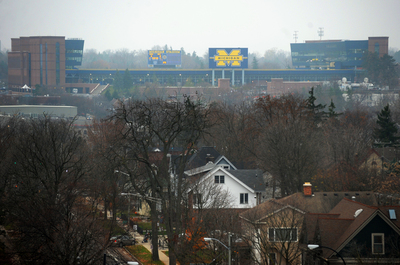
The city of Ann Arbor is asking the University of Michigan to finally agree to reimburse the city for traffic management costs it incurs during football game days and other major events that bring tens of thousands of people to town
City officials say the current practice of providing free signs and signals services for U-M football games and special events negatively impacts the city's already strapped budget, reducing the city's ability to perform traffic engineering, repair major streets, provide signage and maintain signal operations throughout the city.
Council Member Tony Derezinski, D-2nd Ward, said he was concerned with the timing of the resolution since football season is starting within weeks: The first home game is Sept. 3.
Taylor responded by saying the city and U-M have been in talks for some time and have made significant progress recently toward resolution of the issue, and acting City Administrator Tom Crawford just needed further policy direction from council.
"There is perhaps a lack of clarity as to where the city stands on this issue, whether the city will continue to provide those services to the university community in the absence of reimbursement," Taylor said, adding the resolution now provides that clarity.
Both Taylor and Crawford stressed that the city wants to have a continued positive relationship with the university that recognizes the value of collaboration and cooperation.
"We've already worked through agreements with the university for police and fire services on game days. This is specifically for signs and signals," Crawford told council members, noting that's not a service that can be readily provided by another party.
"This would be the city's work force working with city assets for the lights and signal boxes, etc., so that would be a city-only ability to execute this part of it."
Smith, D-1st Ward, asked if the city would be seeking reimbursement for costs it incurred in previous years. Crawford said he's in the middle of "fruitful discussions" with the university about possibly recouping costs for last year and then future costs going forward.
"The reason we're talking about this is because it's an issue that needs to be resolved," Crawford said. "This is an issue for the city and we've raised it with the U and they're working in good faith with the city at this point to meet our needs and their needs."
Mayor John Hieftje also chimed in on the issue, saying the fact that there are so many football games in a season now is a "real burden" on the city's staff.
"So it seems appropriate we would have a contract for this," he said. "It becomes more complicated and more intense each year, and now we have a nighttime game to deal with as well, which is a difficult time to get signs and signals people to work."
Ryan J. Stanton covers government and politics for AnnArbor.com. Reach him at ryanstanton@annarbor.com or 734-623-2529. You also can follow him on Twitter or subscribe to AnnArbor.com's e-mail newsletters.
Comments
Bill
Fri, Aug 19, 2011 : 2:28 p.m.
"City officials say the current practice of providing free signs and signals services for U-M football games and special events negatively impacts the city's already strapped budget, reducing the city's ability to perform traffic engineering, repair major streets, provide signage and maintain signal operations throughout the city." If the city is so cash strapped why it is spending public funds on artwork which is neither wanted or required? I agree U of M should pay it's fair share of the total cost but city officals constantly cry woof when it comes to the budget however, the mayor and city council continue to waste public funds on needless projects.
Mr Blue
Tue, Aug 16, 2011 : 10:33 p.m.
The politicians suggestion that the UM pay something to the city to offset costs of being their host is just political window dressing they trot out to placate the masses, make the taxpayers think that the politicians are actually doing something.
pbehjatnia
Tue, Aug 16, 2011 : 10:20 p.m.
$100k per annum for university/stadium related signs and signals? Well, let's do some comparison shopping here: Mayor Hieftje's 2010 salary as mayor of the City was $42k and Lecturer Hieftje's salary for an 8 month year at the U/M in 2010 was $101k. Hmmmm... I'm no numbers genius but something tells me nothing will happen here.
pbehjatnia
Wed, Aug 17, 2011 : 7:46 p.m.
@roadman: conflict is conflict. hieftje's interests long term cannot be on the side of this city.
Roadman
Tue, Aug 16, 2011 : 11:09 p.m.
It's a "one-third"appointment, so John Hieftje actually gets paid about $33,000 for his part-time services. This despite holding no graduate degree.
Candy
Tue, Aug 16, 2011 : 9:01 p.m.
Hopefully my comment won't be deleted, as I've heard that's a very common problem on this site. I'm not defending the U of M in any way, shape, or form, but I happen to know that the City of Ann Arbor "Signs and Signals" staff are paid way more than the "average Joe." These individuals make double per hour what most people make in the Ann Arbor area. Factor in that many of them don't possess any education beyond a high school diploma. I've always wondered why a city that claims to value education so much pays its own employees a wage much higher than even the most educated earn. But maybe that's just to be expected with government employees.
Laurel
Tue, Aug 16, 2011 : 10:57 p.m.
Please forgive me but I must laugh-my-___-off at your input here. I am curious to know just how much these individuals make. You said: "These individuals make double per hour what most people make in the Ann Arbor area. " According to CNN in 2010 the average household made $85,330. You're alleging that these city employees are making twice that?? Do your research before posting such boldly, ill researched statements... (<a href="http://apps.money.cnn.com/bestplaces_2011/compare_tool_2011.jsp?id=PL2603000" rel='nofollow'>http://apps.money.cnn.com/bestplaces_2011/compare_tool_2011.jsp?id=PL2603000</a>
einy
Tue, Aug 16, 2011 : 8:43 p.m.
Ah, heck, just raise the ticket price another $100! Joe Smoe will just pay it, right?! I cancelled my tickets years ago, Good riddance!!
Sallyxyz
Tue, Aug 16, 2011 : 8:04 p.m.
The UM should be paying a share of the cost for fire and police services throughout the year, not just on game days. Who responds when there is a fire in a UM building? Who responds when there is a serious crime or injury on campus? Or a toxic spill? A huge university that occupies 60% of the land in a relatively small city and pays no taxes is using city resources and services they are not paying for, while the rest of the residents pick up the tab through much higher property taxes than if the UM paid their fair share. This is unacceptable. The UM is sitting on a multi-billion$ endowment and is considered a "non-profit" enterprise? It's a large corporation and it needs to pay it's share of taxes to the city and state.
Stupid Hick
Wed, Aug 17, 2011 : 2:08 a.m.
Doesn't UM have its own police department to respond to crime on campus? Isn't UM essentially a branch of the State of Michigan? It would make as much sense for the Secretary of State office to pay property tax.
Laurel
Tue, Aug 16, 2011 : 10:59 p.m.
Who responds when women are assaulted on campus, attacked and raped?? Oh but wait, the Stadium needs more space/police/money/security/attention...
ML07
Tue, Aug 16, 2011 : 7:52 p.m.
1) I have no issue with Athletics with their $100M budget paying the $100,000 but why did this suddenly become an issue? 2) as others pointed out, i am not sure what signs we are talking about. Only a few lights are changed - which creates a problem as the corridor needs to change. 3) The real way to make money is have traffic officers stationed along main street up to 2 hours after the game and ticket all those drivers who block the cross intersections creating gridlock (since the lights are not timed). I have had serious issues getting across Main Street even 90 minutes after the game . Blocking the intersection should be fined
Mike
Tue, Aug 16, 2011 : 6:21 p.m.
Just make all roads leading to and from the football stadium into one lane roads like Stadium Blvd. and then you won't need any traffic control since all trafic will come to a standstill. You may have to deal with road rage but I think that falls under the normal duties of a police officer
Macabre Sunset
Tue, Aug 16, 2011 : 5:59 p.m.
It's a real burden for Ann Arbor's businesses to have to deal with all those customers on football weekends as well. Perhaps Council should consider outlawing sports altogether.
Mr Blue
Tue, Aug 16, 2011 : 10:30 p.m.
All well and good for the business owners that they get a buck or two, but as you suggested, without any verification, that the city should give back some of the revenue they take in on game weekends. Again, what is that revenue that the city gathers that they should return to the UM? Thought so, another made up "fact". I suppose you don't live in the city and would like to donate something to offset the costs of UM services on the city budget?
Roadman
Tue, Aug 16, 2011 : 5:20 p.m.
Check out <a href="http://www.umsalary.info" rel='nofollow'>www.umsalary.info</a> It is a website in which U-M employees salaries are public record. It discloses that Mayor Hieftje, his wife Kathryn Goodson (a voice teacher), and also Mayor Pro Tem Marcia Higgins as well one or two other City Council members have drawn salaries from U-M recently. The mayor does not even possess a graduate degree but is one of the highest paid lecturers at U-M. The mayor and his wife have earned together about $100,000 per annum. There are questions of potential conflicts of interest if these City Council members are voting on contracts or leases involving U-M - not to mention possible lawsuit settlements - when they are drawing pay from that entity. Someone needs to look into this.
PersonX
Wed, Aug 17, 2011 : 4:01 a.m.
I have no idea why the Mayor is lecturing and on what, and why anyone would want to listen, but I see no connection between the day job Ms Higgins (hardly my favorite council person) has and her votes on council. Most council members have day jobs and the way the university works, the top brass, who would care about council decisions, have no say in the appointment, promotion, or sacking of an administrative assistant (a rather important position) in one of the schools. This is all a red herring. There are enough problems with council not to introduce conspiracy theories.
Kai Petainen
Wed, Aug 17, 2011 : 12:21 a.m.
complain about whatever you like, but its not cool to bring ones spouse into the debate.
Roadman
Tue, Aug 16, 2011 : 11:06 p.m.
@Person X: John Hieftje earns about $33,000.00 per year (and has done so for several years) as an "intermittent lecturer" in the Gerald R. Ford School of Public Policy in what is known as a "one-third" appointment . Marcia Higgins is an "administrative assistant" in the School of Engineering earning about $42,000.00 per year. She previously worked for Borders before their financial woes caused massive layoffs and prior to that for Rick Snyder's Ardesta Corporation, a venture capital group.
PersonX
Tue, Aug 16, 2011 : 9:32 p.m.
Ms Goodson is a professional musician and has been working in town and teaching at UM for years; this has nothing to do with her marriage. I am surprised, however that both the Mayor and the Mayor Pro-Tem are also on the UM payroll. What do they do?
Sallyxyz
Tue, Aug 16, 2011 : 8:05 p.m.
I agree.
racerx
Tue, Aug 16, 2011 : 4:51 p.m.
Last year there were seven home games. This year there are eight. So, how does the mayor arrive at "...there are so many football games in a season now is a "real burden" on the city's staff." Where has he been? How is it "now" all of a sudden a burden? That $200 amount seems pretty steep. But, what can you expect from the cities accounting measures. The excuses that roads can't be repair because of staff's time is being eaten by facilatating football games is absurd. This conversation should have come from council during the "off-season" not three weeks before the first game. Oh, but cars idling was more important. I'm curisous. What would happen if the University doesn't pay, or agree to the amount? Would the city just not staff the signs and signals and have multiple accidents occur? What about other ogranizations that come to the city not related to the university, will they be charged? What if, and this is a big one, what if the library lot hotel is built and a major conference brings say, 30K people to the city, will the city charge that event also? How will this be perceived to other organizations that might want to hold an event in the city and have to pay for "signs and signals" related cost? Or, is this just for the university? Sorry, but this is just another attempt by the city to have the university contribute to their budget woes since they can't get property taxes from the university. You can bet that garbage pick-up will be next, lawn repair, pot hole maintenance, e.t.c. any other items that the city deems the university should pay. Take back the land where Pioneer is on along with the woods, build another parking lot and create a private walk way to the stadium and avoid the city streets altogether. This should solve this issue and could probably be done cheaper than that $200 quote.
RunsWithScissors
Tue, Aug 16, 2011 : 4:36 p.m.
If I'm reading this article accurately, it's not a question of whether the city should charge for services rendered but that the University has declined to pay for services rendered. When did the city start charging U of M for these services? Did U of M ever pay them? If so, why did they stop paying the bill? If not, why did U of M decide to not ever pay for this service? It puzzles me that any entity would completely disregard charges for services rendered. (Just imagine if I ignored my water bill!) And it puzzles me that the city would continue to offer services when they know full well that they won't be reimbursed. (The city would shut off my water supply in a heart beat if I didn't pay the bill.) What is the history (beyond Ryan's previous article) of this situation?
Kai Petainen
Tue, Aug 16, 2011 : 4:26 p.m.
One of the common complaints that I hear on the message boards, is that the Ann Arbor city council is linked to UofM, and as such they are a functioning pseudo-arm of UofM. For example, one criticism of the Fuller/Huron River parking lot, deals with this idea. This request (pay for traffic), seems to indicate that they are actually acting on behalf of the city/citizens and not the university. So for those of us who complain of the UofM ties in city council, this could be a counter-example of that complaint. And that city hall is concerned about Ann Arbor and of those who live in it.
leaguebus
Tue, Aug 16, 2011 : 4:18 p.m.
I can't really see why the U is making it so hard to collect this money. It would be nice to see what the U says about this.. Hint.
kilroy
Tue, Aug 16, 2011 : 4:14 p.m.
This is low hanging fruit that should have been picked long ago. Where has City Council been? Worse, where have the City Attorney and Police Chief been? The two of them are said to meet and pray every morning at City Hall. Didn't it occur to them that the Chief's budget was being depleted to provide traffic control for the U of M? They better start praying to keep their jobs as this is a PR disaster for both of them. If the University refuses to pay, as Sue McCormick says, let the University's police force do it all. After all, they famously boast that they are all deputized and can patrol city streets. God knows they have the money to do it.
ChunkyPastaSauce
Tue, Aug 16, 2011 : 3:50 p.m.
How about on game days raise parking by .15 cents near the stadium and/or increase fines a bit?
Jon Saalberg
Tue, Aug 16, 2011 : 3:41 p.m.
It's funny - it doesn't appear to be April 1 on my calendar, yet I am reading a story that says the city is telling the U that it must pay(!) for services. This completely flies in the face of that 12-page fence report. I'm confused. Which Ann Arbor city government is speaking here? I will believe it when I read that the U has actually ponied up the dollars to cover these services. Until, then it's just bluster. I don't recall the U-M generally being too amenable to being told that they will pay for anything not on the agenda, unless it's many millions to renovate sports facilities. Maybe, the city could convince the U to pay for the art in the new downtown building.
fishermon
Tue, Aug 16, 2011 : 2:56 p.m.
This is so silly. The only reason Ann Arbor is the vibrant city that we all love is the presence of the U of M. The money that comes to this city and surrounding area is the reason this city is an island of prosperity in this state. The U of M is a priceless pearl. City council needs to wake up and recognize that an expenditure of $100,000 a year for traffic control services for home football games is a very small investment for the return on the money that comes into this city for the whole home football game series. Go Blue! Walter Fisher
Laurel
Tue, Aug 16, 2011 : 10:46 p.m.
They already get tax breaks and let's face it, the U isn't going anywhere. Since they're here to stay, they can ante up and pay.
Sallyxyz
Tue, Aug 16, 2011 : 8:11 p.m.
"The U of M is a priceless pearl." Not exactly. It's a large, highly regarded midwestern university. Hardly a priceless pearl. "The only reason Ann Arbor is the vibrant city that we all love is the presence of the U of M." Not exactly. Plenty of A2's vibrancy comes from aspects of the city that are separate from UM. While there are certainly positives for the city by having a huge university in the middle of the city, there are also negatives. It's a mixed bag.
a2roots
Tue, Aug 16, 2011 : 2:24 p.m.
This must be making the U boil. It is about time they ponied up. Let us now see the U's attitude because they certainly do not like others to call the shots. If they can find a way they will do whatever they can to get back at the city.
a2roots
Tue, Aug 16, 2011 : 7:35 p.m.
@MS...There are several high ranking administrators in both the athletic dept and general admin that do not take kindly to not getting there own way. For example the UM opened a gate for football parking south of Ann Arbor Golf and Outing to siphon parking from AAGO. The gate had never been used before. They opened it in an attempt to hurt AAGO because AAGO ticked the U off about something. It was a spiteful attempt to harm AAGO because they were standing up to the UM.
Macabre Sunset
Tue, Aug 16, 2011 : 6:01 p.m.
Who is "they"? I remember assigning attitudes and feelings to my stuffed animals when I was a little kid. I grew out of it.
Angry Redneck
Tue, Aug 16, 2011 : 2:44 p.m.
Yeah, I'm sure the U is shaking in their boots at the big bad City Council.
Somewhat Concerned
Tue, Aug 16, 2011 : 2:23 p.m.
Sounds reasonable. Sounds like the usual Ann Arbor hypocrisy. If the city wants to block half its streets for an arts fair or turn over the city to pipe fitters or plumbers unions, it trots out figures about the tons of money pumped into the Ann Arbor economy (using some magic multiplier to make us believe each pipe fitter leaves 2 or 3 grand in town). If UM brings 60,000 people to town, many of whom eat or at least drink as much as any pipe fitter, the city forgets its theory of benefits to the local economy and whines. I suspect there are more cities than one that would love to put up signs and direct traffic to bring 60,000 people to town, even if they aren't booth-based artists or pipe fitters.
Laurel
Tue, Aug 16, 2011 : 10:15 p.m.
2004-2006 I worked for Weber's Restaurant and made hundreds each night the plumbers and pipe fitters were in town. It paid for my tuition for a semester and brought in more money when they were in town than any of the football weekends where the patrons were too drunk to tip or pay their tab after a whole day of tailgating.
Laurel
Tue, Aug 16, 2011 : 7:20 p.m.
If there were only 4 home games that would be one thing... However the number of home games far exceeds the number of art fair days by far. Simple math.
Edward R Murrow's Ghost
Tue, Aug 16, 2011 : 3:53 p.m.
I'm curious: 1) What are the traffic controls and extra expenses entailed by the annual visit of the UA ("pipe-fitters"). 2) Do you know for a fact that the Art Fairs do not pay the city of Ann Arbor a fee for service? Good Night and Good Luck
nowayjose
Tue, Aug 16, 2011 : 2:22 p.m.
That's less than the price for one UofM place chief. Sounds like a bargain
Jacob Bodnar
Tue, Aug 16, 2011 : 2:09 p.m.
You could certainly argue the city makes up those costs through increase economic activity during those 8 game day weekends...
Edward R Murrow's Ghost
Tue, Aug 16, 2011 : 3:51 p.m.
Sorry, but no. The vast majority of revenue into the city is in the form of property taxes. City businesses might profit from those football Saturdays, but they do not change by one penny the revenue collected by the city. Good Night and Good Luck
Joel A. Levitt
Tue, Aug 16, 2011 : 1:58 p.m.
This is an unusually stupid and self-defeating proposal.
Glockone
Tue, Aug 16, 2011 : 1:41 p.m.
The people drawn to Michigan football games spend a lot of money in Ann Arbor. This produces sales tax revenue, lodging tax revenue, business income tax revenue, and provides jobs that would not be there without the U. Ann Arbor would be a bedroom community to Detroit if the U were elsewhere. Perhaps the city should figure out how much it owes the U.
Laurel
Tue, Aug 16, 2011 : 10:43 p.m.
Except, let's be real a moment, shall we?? The University is rooted. She's not going anywhere, she's here to stay. Taxing her or charging her, she ain't gonna move. Get that Money!
David Cahill
Tue, Aug 16, 2011 : 1:28 p.m.
We may be a college town, but at least we're not a *company* town. The "Sovereign Nation of the U of M" should pay up.
Laurel
Tue, Aug 16, 2011 : 10:42 p.m.
Well said, Sir!
craigjjs
Tue, Aug 16, 2011 : 1:08 p.m.
I think it is reasonable for UM to pay the city for these services. Those of you who disagree, based upon business income on game days should also consider how much money UM is making from all of those ticket sales and parking fees. UM should not externalize these costs.
Ron Granger
Tue, Aug 16, 2011 : 1:06 p.m.
It is good to see the City formalize this request. If the University can spend hundreds of millions, they can easily cover this very real cost to the City and the taxpayers. This is simply a cost of doing business. I support the City playing hardball as necessary on this. One or two Saturdays with the streets running normal - not one way specials - will change their tune quickly.
Disco D
Tue, Aug 16, 2011 : 1 p.m.
From the sampling of responses I have read, it seems the majority believe the University should pay for these services. There have been rants on both sides. I simply believe it's a matter of fairness and the University should pay. If I were a business that had a major event which required special use of City services, I would have to pay for those services, wouldn't I? The University is no different. The fact that Tom Crawford indicated discussions have been ongoing with the University and the timing of this was to get the support of the Council was appropriate. As a City taxpayer, I would like to see the City get reimbursed for last year, but it's more important to correct it going forward.
Dee_AnnArbor
Tue, Aug 16, 2011 : 12:58 p.m.
This article implies that the city is considering a $100,000 per season price. Shouldn't that be a per game price, re-evaluated each year for the coming season, since there may not be the same number of home games each season?
timjbd
Tue, Aug 16, 2011 : 12:47 p.m.
Close the exit ramps from 94 to State St. and A2-Saline Rd, 14 to Main St. and from 23 to Geddes and Washtenaw. Let the alumni sit in 6-8 hours of game day traffic mayhem.
andys
Tue, Aug 16, 2011 : 2:02 p.m.
That's brilliant, and what do you tell you neighbor with a business downtown that you just sacrificed?
grye
Tue, Aug 16, 2011 : 12:39 p.m.
Did the city council come up with this idea all on their own or did they pay a consultant $100k to look into the matter?
Urban Sombrero
Tue, Aug 16, 2011 : 12:35 p.m.
FINALLY! Something I can actually get behind the City Council on.
Sasha9441
Tue, Aug 16, 2011 : 12:35 p.m.
Off topic, forgive me but I have a rant! I do not get the people who live in Ann Arbor and complain about football Saturday traffic! You knew well enough about the college itself and football games when you moved to downtown and surrounding Ann Arbor. Was it shocking to find out that 8 Saturdays a year, there are traffic issues in town? Come on, please.
Craig Lounsbury
Tue, Aug 16, 2011 : 10:44 p.m.
The point is, some folks could have been in their homes since the early 60's and they would be the ones who could "complain" in that when they moved to town the football Saturday experience was a bit different. 5-6 home games half the attendance.
Laurel
Tue, Aug 16, 2011 : 10:40 p.m.
Born and raised here and will not get pushed out or desert my home town because of the annoyance/inconvenience/cost the U poses to myself. I pay property taxes here, the U does not. I pay for signs and signals the U utilizes for game days, the U does not... Hmm, wonder why I have a problem?? Come on, please. I could understand where you were coming from if your rant was more rational... Your argument is like saying, "Humph, shoulda known Bush Jr. would mess up the country, if you don't like what he did make a national move." How practical is that?? Sorry, I love my hometown and that has nothing to do with the University.
Roadman
Tue, Aug 16, 2011 : 9 p.m.
@ Ed Murrow's Ghost: 1975 was Rick Leach's freshman season at quarterback. It was not a great season for U-M.
Edward R Murrow's Ghost
Tue, Aug 16, 2011 : 3:49 p.m.
" . . . add to that, attendance in years gone by was likely to be 50,000 -75,000 for most games." 1) 1975 was the last time that a UM home game drew <100,000 people. Anyone who bought a home after 1975 that is in an area affected by football day traffic has no room for complaint. 2) Given 50-70,000 people is still far beyond the capacity of the roads around the stadium,anyone who bought BEFORE 1975 has little room for complaint. Good Night and Good Luck
Sasha9441
Tue, Aug 16, 2011 : 2:37 p.m.
Scott, Someone dying is a little different than a traffic jam in my book!
Craig Lounsbury
Tue, Aug 16, 2011 : 1:55 p.m.
add to that, attendance in years gone by was likely to be 50,000 -75,000 for most games.
lumberg48108
Tue, Aug 16, 2011 : 12:49 p.m.
It used to be 5-6 home games a year like most schools and then they added a 12th game and bigger schools get 8 home games while most get 6 ... Not complainin - just sayin' ...
trespass
Tue, Aug 16, 2011 : 12:33 p.m.
Since the UM does not pay property taxes, they should pay fee for service for all city or county services. However, I am surprised that Hieftje and the other council members who are paid salaries by UM would vote to hold UM accountable for anything.
Roadman
Tue, Aug 16, 2011 : 8:55 p.m.
@PersonX: Check <a href="http://www.umsalary.info" rel='nofollow'>www.umsalary.info</a> That site makes salaries of U-M employees a matter of public record. Hieftje is an "intermittent lecturer" drawing $33,000.00 per year and his wife Kathryn Goodson, a voice teacher, draws $63,000 per annum. Mayor Pro Tempore Marcia Higgins earns over $42,000.00 per year as an administrative assistant in the School of Engineering. City Councilmen Tony Derezinski and Steve Kunselman have had past recent employment with U-M. It is all a matter of public record. And good business sense by U-M.
Epengar
Tue, Aug 16, 2011 : 3:18 p.m.
trespass is implying that the city council reps who are UM employees won't vote against their employers's interest. I bet trespass has no evidence to back up the implication.
PersonX
Tue, Aug 16, 2011 : 1:40 p.m.
Grow up--the UM has nothing to do with the salaries of anyone in city government.
Mr Blue
Tue, Aug 16, 2011 : 12:29 p.m.
Additionally, it's time for a city income tax to capture some taxpayers dollars that the UM pays to its commuting employees who use infrastructure but don't contribute to its maintenance and operation.
jeepinkev
Tue, Aug 16, 2011 : 12:23 p.m.
I like how the Mr. Heiftje calls it a "real burden". Its a real burden to have 100,000+ people come to your city? Really? With all those idling cars to ticket, you're going to make a fortune! I agree that the University should pay for city costs associated with events they hold...I'm more than positive they can afford $100,000 a year for "signs and signals". Then again, the Univeritiy's policy is to first deny everything and only hand over $ as a last resort.
deb
Tue, Aug 16, 2011 : 12:23 p.m.
. . . and now make the same demand regarding fire department service
PersonX
Tue, Aug 16, 2011 : 12:21 p.m.
The university is a non-profit institution because it is dedicated to education and scholarship. Football, fun though it may be and lucrative as well (for the u and the city), has absolutely nothing whatsoever to do with the central mission of the institution. Our society has way too much entertainment, and if the university wants to continue being part of the entertainment industry, and reap the financial rewards, it should pay the city. Perhaps the semi-pro sports programs should be exempt from non-profit status! (I know .... this is probably not legal etc. rant, rant, rant).
clownfish
Tue, Aug 16, 2011 : 12:20 p.m.
I can't wait for the line of people lining up outside City Hall to sign up to be the new "traffic light coordinator"! This line will probably only be matched in length by those lining up to run for City Council, the School Board and police and fire oversight committees. Oh, wait... everybody wants to complain, but nobody really wants to put their expertise to actual work.
Michael Smith
Tue, Aug 16, 2011 : 12:19 p.m.
Ok so the city wants revenue from the University for Traffic Signs and signals, no problem. Frankly the University should pay for it. But to listen to all the whining about how the University doesn't pay taxes, frankly you whiners need to stop and think what would be the fate of Ann Arbor without the University. It employs the majority of the City residence in one way or another. Why do you think the economy is doing well, because of our manufacturing?? Our research and development, oh wait that is connected to the university too.. So in short every person here is affected positively by the University supporting your and most of your neighbors income. So shut up and deal with the University not paying taxes and start looking to Phiser for ditching out and not meeting their commitment to the area, and thank the University for buying the behemoth instead of leaving it go abandoned. Leave the biggest employer in the city and all the business that profit from it's students, parents, and research done here alone and be thankful it is here. We could be experiencing the same fate as Detroit and thousands of other cities that don't have a thriving manufacturing base and a dying economy! We have it good here so quit complaining!
Laurel
Tue, Aug 16, 2011 : 10:34 p.m.
Lets be real here... The U should be thankful to us, not the other way around. At this point, the U of M is not going to relocate, tax em and bill em, they've got the $$$.
a2trader
Tue, Aug 16, 2011 : 8:18 p.m.
Um @Drewk, I think if you look a little more closely at Michael Smith's first two lines in his comment, he IS saying the UM should pay for these Traffic and Signs Services. He is just reminding us all that the UM has helped the area stay afloat while the rest of Michigan is sinking.
drewk
Tue, Aug 16, 2011 : 12:37 p.m.
Unfortunately, it's mentality like yours that put Ann Arbor in this predicament. Everyone here having a job with the University in some way in no way equates to them paying for all of these extra services. Why shouldn't they pay for "traffic and light services" when they admit to making millions of dollars on programs like football? Or not paying taxes on buildings they buy just to rent out at going commercial rates and pocketing the extra income?
clownfish
Tue, Aug 16, 2011 : 12:21 p.m.
Well said, Sir!
Carole
Tue, Aug 16, 2011 : 12:19 p.m.
It's about time the UM paid for some of the extra costs they incur with special events -- if the city is responsible for the extra services to provide safety for the events, the UM should pay.
Craig Lounsbury
Tue, Aug 16, 2011 : 12:17 p.m.
"U-M has not reimbursed the city for its traffic management services — otherwise known as "signs and signals." Can anyone clarify for me (and perhaps others) what exactly is included in this "traffic management services — otherwise known as "signs and signals." ? Other than reverting some stop lights to "blinker mode" what are we talking about?
Epengar
Tue, Aug 16, 2011 : 3:15 p.m.
Among other things, putting up signs and cones to convert a third lane on Main/Ann Arbor-Saline to northbound before each game, and southbound after, for a the mile and a half or so from Eisenhower to Stadium.
Stupid Hick
Tue, Aug 16, 2011 : 12:17 p.m.
Interesting. What if UM says they don't care whether the city provides sign and signal services on football saturdays? Who would suffer as a result? Would it be UM, or residents and potential customers of local businesses?
Guinea Pig in a Tophat
Tue, Aug 16, 2011 : 12:16 p.m.
I dug up this quote from this article: <a href="http://www.washtenawvoice.com/?p=11324" rel='nofollow'>http://www.washtenawvoice.com/?p=11324</a> "'According to a study done by Michigan State University, each home football game brings an estimated $10 million into the local economy,' said Marianne Gosz Klinker, communications director at the Ann Arbor Area Convention and Visitors Bureau." With that amount of money coming into the city, you would think the city would be more interested in encouraging people to come here instead of threatening to stop traffic management. How about the city fixes the crumbling roads around the stadium (the money for this is coming right?) and everyone calls it even?
racerx
Tue, Aug 16, 2011 : 4:58 p.m.
This is a great idea, since we're still waiting for the $3M from the sell of a city lot to help pay for the Raj Mahal!
Guinea Pig in a Tophat
Tue, Aug 16, 2011 : 12:54 p.m.
lumberg48108 - That's a good point. The City Council should have the city's best interest in mind, and this revenue is a great thing for the city. I have a hard time believing that $80 million coming into the city versus $100K/year hurts their budget, although like you say, it's not a direct payment to the city, so maybe this bucket of theirs is dry. Also the strong arming of giving them a little over a week to figure it out leaves a bad taste in my mouth.
lumberg48108
Tue, Aug 16, 2011 : 12:44 p.m.
Revenue generated for business is great - but that money is not a direct trickle down to the budgets of public service sectors and they have a budget to maintain.
Drew Paterson
Tue, Aug 16, 2011 : 12:13 p.m.
Fixing the timing on the city's traffic lights would jeopardize the city's annual OPEC award for being one of the state's best gas wasters. They are already risking the award with the proposed 'no idiling' ordinance. Let's keep the lousy traffic light timing and maintain our reputation for being a huge energy waster.
Craig Lounsbury
Tue, Aug 16, 2011 : 12:11 p.m.
Maybe we should set up toll booths and charge people to enter the city on game days. That would get a response out of Mary Sue and company pretty quick. ;)
andys
Tue, Aug 16, 2011 : 1:54 p.m.
Let's just ban those pesky football Saturdays altogether. Who needs all that bother. I want empty streets and sidewalks on weekends. Yeeesh!
Stupid Hick
Tue, Aug 16, 2011 : 1:37 p.m.
Yeah, and maybe we should have pay-as-you-go crosswalks all year round. Everyone who crosses the street should pay a quarter. The city should be run like a business, right? Why offer crosswalks, sidewalks, or any public amenity unless it makes a profit? Sheesh!
gofigure
Tue, Aug 16, 2011 : 12:58 p.m.
Love it!!!
Wolf's Bane
Tue, Aug 16, 2011 : 12:10 p.m.
Logic. It does a city good! This should have happened years ago!
Ryan J. Stanton
Tue, Aug 16, 2011 : 12:10 p.m.
I should note I wrote a story in March (linked in the story) where I quoted Sue McCormick, the city's public services administrator, as saying: "The university has made it clear they will not pay," she told council members, adding the city has given up on even sending the university a bill at this point. And from Monday's resolution: "The City's provision of free Signs and Signal services to UM for Special UM Event reduces the City's ability to perform traffic engineering, repair major streets, provide signage, and maintain signal operations throughout the City."
Ryan J. Stanton
Tue, Aug 16, 2011 : 2:29 p.m.
We were seeking comment from the university earlier and now that we have comment from a university spokesman we're posting a followup. Check the homepage.
lumberg48108
Tue, Aug 16, 2011 : 12:42 p.m.
Where is a reply from U-M regarding this story? Even a no-comment should be mentioned -- cause if you ran this story and did not get a comment from the most recent resolution, this is an unbalanced story.
gofigure
Tue, Aug 16, 2011 : 12:09 p.m.
H-m-m-m-m-m ....snd what will the fine folks at City Hall do when UM says "nope, not gonna pay"?
Laurel
Tue, Aug 16, 2011 : 10:30 p.m.
U of M has already agreed to pay, more than the city asked for... So this is kind of a moot point.
MIKE
Tue, Aug 16, 2011 : 6:44 p.m.
I hope they'll say, "sounds good, we'll do nothing special on game day".
Trouble
Tue, Aug 16, 2011 : 2:30 p.m.
U of M is Loaded. Ask two U of M Safety Chiefs.
snoopdog
Tue, Aug 16, 2011 : 12:05 p.m.
Seems to be a very reasonable request at first glance. On the other hand, what benefits does the city and business's located in the city enjoy from the influx of 100,000 fans, many of which do spend time before/during and after the games in A2. Good Day
WalkingJoe
Tue, Aug 16, 2011 : 12:03 p.m.
Let's not stop here, but also ticket all the cars idling as they stand in line going to and from from the game. After all we're trying to save the planet.
Laurel
Tue, Aug 16, 2011 : 10:29 p.m.
Or charge the U for the idling cars... Since they're responsible for why cars are stuck in game traffic.
racerx
Tue, Aug 16, 2011 : 4:55 p.m.
But (LOL!) we just want to educate the public on the affects that idling cars have on our environment!
Linda Peck
Tue, Aug 16, 2011 : 11:52 a.m.
It does seem that the city needs to be run like a business and if services are used they should be paid for, either through taxes or some other assessment.
Bill
Fri, Aug 19, 2011 : 2:33 p.m.
@StupidHick -- If you want Ann Arbor run like a government, then you have the wrong mayor and city council.Ann Arbor is run to their person whims, not to the public good.
Stupid Hick
Tue, Aug 16, 2011 : 1:38 p.m.
I disagree. The city should be run like a government. To benefit the public good, not to make a profit.
kathryn
Tue, Aug 16, 2011 : 11:35 a.m.
If it costs that much to manage the lights and signs for traffic for the games, then yes...the University should be helping to pay that cost since they are the ones causing the traffic. And yes, it makes sense that night games are going to further complicate the issue, so this is as good a time as any to bring it up.
Ignatz
Tue, Aug 16, 2011 : 11:31 a.m.
Seems fair to me. If the U uses city services, they ought to pay for them.
Laurel
Tue, Aug 16, 2011 : 10:27 p.m.
It actually IS happening, as the U has already agreed to pay more than the city has asked for. :P Seems like the U knows it's long overdue and is willing to pay up.
gofigure
Tue, Aug 16, 2011 : 12:19 p.m.
not gonna happen
jcj
Tue, Aug 16, 2011 : 11:20 a.m.
Long Overdue! And saying its too late never helps solve problems.
CB
Tue, Aug 16, 2011 : 11:04 a.m.
I totally agree - I live by the stadium and if you accidentally go somewhere during the game you can't get back home without taking a detour around Ann Arbor. My taxes are sky high even though I have proved that my place is not worth what it is assessed at. If you live near the stadium you cannot use your home for 6-7 saturdays per year, unless you stay put all day. The traffic lights on Stadium have always been timed by a moron. I avoid Stadium between 7th and Jackson even without the game, unless I have an extra 15 minutes to sit at lights. I resent having to pay these high taxes while U of M pays nothing, but rakes in the money. Same with Pioneer High School - what happens to all that money for parking? Did it go to build the school (Skyline) that we didn't need?
Laurel
Tue, Aug 16, 2011 : 10:26 p.m.
John B. While I have agreed with some of what you've said, I must disagree with this last comment here. On games where the U is being whooped you cannot predict the end of the game. Those are the days when stadium patrons (U of M supporters) leave early to hit the bars or go home rather than sticking around watching their team lose. There have been several games, just this past school year where traffic is backed up and crowds roam the streets because they left the stadium before the game ended, congesting our streets earlier. This problem is not so easily resolved. Maybe we should just settle this by charging the U property taxes and make some real money.
John B.
Tue, Aug 16, 2011 : 7:22 p.m.
It's quite easy to predict when the game will end. About 3.5 hours after it begins, on average. Allow maybe 20 minutes for a safety margin. Done. Next problem....
CB
Tue, Aug 16, 2011 : 4:42 p.m.
My home is not so close to the stadium that I "knew" this would happen. I am a lifelong Ann Arbor resident. I have left my home twice while the game was on, and since you cannot predict when it will end, I didn't make it back in time and was stuck driving almost 10 miles to get back home. I would have parked anywhere within a mile, but you can't even go down some roads that shouldn't be closed.
Stephen Landes
Tue, Aug 16, 2011 : 3:08 p.m.
Did you buy your house before 1969 (the big growth) or 1927 (when the stadium was built)? If not you could have known what you were letting yourself in for by moving to that neighborhood.
Craig Lounsbury
Tue, Aug 16, 2011 : 12:09 p.m.
"If you live near the stadium you cannot use your home for 6-7 saturdays per year, unless you stay put all day." Can you clarify that? I don't live near the Stadium but once the game starts we are free to move about the town freely till the game ends in my experience.
eone
Tue, Aug 16, 2011 : 10:58 a.m.
It"s about time! But don't stop there.
rs
Tue, Aug 16, 2011 : 10:57 a.m.
UM loves to pat themselves on the back every time they add another couple thousand seats, but the local road system never get expanded to handle the extra traffic. Maybe they should start paying for the extra stress they put on the road system every time they expand in the name of bragging rights.
Chip Reed
Tue, Aug 16, 2011 : 10:53 a.m.
does anybody pay any taxes on cash-only, no-paper-trail parking revenue. i know some people use that money to pay property taxes, but that's not the same thing...
John B.
Tue, Aug 16, 2011 : 7:19 p.m.
You couldn't pay me (enough) to live anywhere near the stadium...!
Trouble
Tue, Aug 16, 2011 : 2:29 p.m.
Flat Tax would change all this non-reporting... simple!
johnnya2
Tue, Aug 16, 2011 : 12:11 p.m.
The parking on property certainly inflates the value of a home on Pauline and many streets around the stadium. If a homeowner knows they can make $20 per car for say 10 cars, that is $200 per game. With a seven game season that is $1400 per year in revenue. For many of those homes that equates to a monthly mortgage payment. Would you be willing to pay more for a home that the bank said you get one month every year with no mortgage payment?
Basic Bob
Tue, Aug 16, 2011 : 11:09 a.m.
Do you think all that traffic in front of the house (and on the front lawn) helps property values? Just wondering.
observer
Tue, Aug 16, 2011 : 10:51 a.m.
I agree with dancinginginmysoul, it is way too late to worry about this now......the city of Ann Arbor is part of the University of Michigan, when it should be the other way around......But the city has it Green Belt and wait till the rise in public art brings in more tax dollars for the city, right Mr. Mayor. The Mayor and City Council need to take a business course on how to run a city.
johnnya2
Tue, Aug 16, 2011 : 12:06 p.m.
Cities are not and should not be run as businesses. If that is what you want, here is what businesses do: they can raise revenue (taxes), and they are designed to turn a profit. Cities are not. Government is not designed or there to turn a profit. Government is there to help the common good of its jurisdiction. Let's say UM says they will not pay a dime for this (they can act as a business as well). You will have amazingly long traffic delays before and after games (which hurts residents), they will also hurt local businesses. People will not have time to spend money at Frasers Pub, or Moe's or any other local business. Here would be the question to ask yourself from a BUSINESS standpoint. Does the city make 13 cents per person who attends the football games? In a 77 game season the games draw about 777,000 people. At a cost of $100k per year, that works out to about 13 cents per person.
KJMClark
Tue, Aug 16, 2011 : 10:40 a.m.
Excellent! Too bad we can't get the University to send out a flyer with their ticket books - "No special traffic light changes this year - expect long delays getting to the stadium." Ideally they'd point out that the buses are the best way to get to the stadium. But this will be ***MUCH*** better for those of us who live here. Traffic will be backed up onto the expressways, back from the first traffic light. But the rest of us won't have to put up with long stops at signals re-timed just for rude out-of-town drivers.
John B.
Tue, Aug 16, 2011 : 7:17 p.m.
Because they are. You'd have to ask them why....
scott
Tue, Aug 16, 2011 : 1:56 p.m.
Why rude?
prankstur
Tue, Aug 16, 2011 : 10:33 a.m.
Anybody know how much money the local busineeses take in on the game days. Does the city have a city tax? What about the money generated from parking. Seems like the money generated from the game days would more than pay for the traffic services.
dancinginmysoul
Tue, Aug 16, 2011 : 10:27 a.m.
Now the City decides it's time U of M pays? Now? Really? Property taxes are so high in Ann Arbor because U of M doesn't have to pay property taxes, and it keeps buying up more and more available property. Now the City decides it's time? Let's see, it's been 45 years (?) since U of M because a football "power house" (for lack of a better word) when Bo came on board. Now it's time for them to pay for services? While you keep nickle and dimeing small businesses downtown, raising parking rates, and garbage rates, and cutting police and not catching rapists? Now it's time? Sorry City, but you're a little late to this party.
John B.
Tue, Aug 16, 2011 : 7:16 p.m.
Um, that would be 'teat' aka mamilla.
Jojo B
Tue, Aug 16, 2011 : 11:49 a.m.
You bet they're a little late, but it is definitely time for them to join the party. The city needs to milk the UM football teet any way it can. It's the one true money-maker left in Ann Arbor and if it's costing the city rather than profiting the city, well, that doesn't sound right. I just wonder why this is coming up now. I guess the salad days are over and the other teets are gone.
Smart Logic
Tue, Aug 16, 2011 : 10:16 a.m.
I'm mixed over this. A large part of the issue are the terribly timed traffic lights in Ann Arbor, though games do admittedly need the extra traffic services. The optimal solution would be for UM to contribute but also for the city to fix their terrible traffic light timing.
a2roots
Tue, Aug 16, 2011 : 2:21 p.m.
This has absolutely nothing to do with signals.
Smart Logic
Tue, Aug 16, 2011 : 1:45 p.m.
KJMClark, the signals aren't timed well. Go drive around with and without traffic and see how easily you can get around. Just because it's multi-million dollar does not make it a good solution.
SurlyCommenter
Tue, Aug 16, 2011 : 1:35 p.m.
E. Huron is a more major through-way than S. Division, so of course you are more likely to catch the red light there. In my experience driving east on Huron every morning, the lights are timed perfectly. If I am stopped at the first light at Main, I'll make every single light all the way through my left turn at Division.
Buster W.
Tue, Aug 16, 2011 : 12:42 p.m.
KJM I don't care how much they paid for a new system. Whatever it was, it was a waste. Classic example driving down S. Division this morning...I drive thru E. Washington (green light) and I get to the very next intersection (2 seconds later) at E. Huron and it turns red. That should not happen, especially on a one-way street! Basic stuff.
KJMClark
Tue, Aug 16, 2011 : 12:28 p.m.
We put in a multi-million dollar traffic signal system - one of the best systems in the world. And people *still* say the signals aren't timed well. Some people are never satisfied.