

Ann Arbor officials hear budget proposals for forestry, utilities, dams and attorney's office
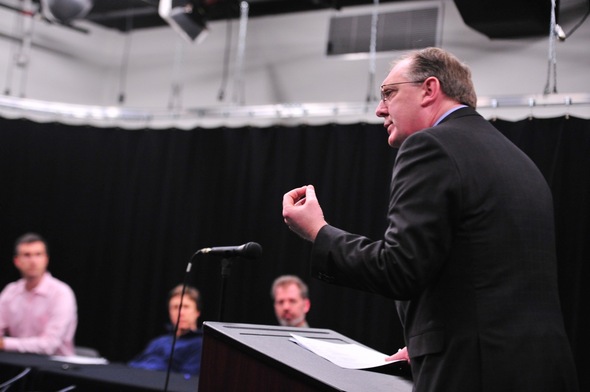
City Attorney Stephen Postema addresses the Ann Arbor City Council Monday night, outlining a plan to trim $47,000 from his office's budget.
Ryan J. Stanton | AnnArbor.com
Ann Arbor officials continued discussions Monday night on how to close a projected $2.4 million general fund budget shortfall for the fiscal year starting July 1.
Sue McCormick, the city's public services area administrator, presented Ann Arbor City Council members with a series of options aimed at trimming the budget down to size.
Among them was a proposal to reallocate expenses for forestry operations to the stormwater utility fund, a move that could save the general fund nearly $660,000.
The proposal involves eliminating two vacant full-time forestry positions and contracting out tree trimming, planting and stump removal services.

Sue McCormick, the city's public services area administrator, addresses members of the Ann Arbor City Council Monday night.
Ryan J. Stanton | AnnArbor.com
McCormick said she doesn't anticipate any service level reductions. Rather, she thinks it would result in more stable, long-term funding for the city's forestry program.
"The pressure in the general fund has been for reduction each year, and so that has taken its toll on the forestry operation to date," she said.
Council Member Mike Anglin, D-5th Ward, said he had concerns about the proposal, especially what looks to be a privatization of some forestry services.
"I don't think of that as privatization as much as logical use of contracted services to supplement our needs," McCormick said in response to Anglin's concern.
McCormick presented the council with more than $2 million in budget cutting options, mostly in the areas of field operations. Those cuts would be used partly to offset a $700,000 increase in spending within facilities over the next two years.
That includes projects like renovation and installation of new bathrooms inside city hall, along with more asbestos abatement and installation of new ceilings and lighting.
"All of us have experienced some of the issues with the bathrooms, the drains backing up," McCormick said. "The bathrooms are deplorable."
McCormick suggested the city spend an extra $77,235 a year to restore janitorial services inside city hall and the new police-courts building from three days a week to five days a week. She said the reduced frequency of service hasn't worked well.
"In fairly short order, we're going to be bringing a lot more people back to city hall, and we really need to acknowledge the fact that we have a facility that requires maintenance," she said. "We started out in the justice center with three-day service, and I think that is a recipe for decline."
McCormick proposed a reallocation of getDowntown go!passes to the alternative transportation fund, which would save $8,800 in the general fund.
She also highlighted $32,000 in expected savings from conversion of street lights to new energy efficient LEDs next year. The city could save another $158,000-plus from utilizing temporary labor for vacant positions in park operations, a budget analysis shows.
McCormick's plan reallocates more than $200,000 in costs from the city's general fund to the Metro Act Fund, including costs for graffiti removal, traffic island maintenance, and snow and ice control on sidewalks fronting city property. Those proposals go hand-in-hand with shifting $290,000 in sidewalk replacement expenses from the Metro Act Fund to the streets millage.
McCormick also laid out a plan for splitting up costs related to the city's four dams on the Huron River between the general fund, water fund and parks millage fund. Currently, about $240,195 is billed to the general fund and $88,938 to the water fund.
Next year, under McCormick's proposal, the general fund burden would fall to $215,819, the water fund burden would go down to $19,661 and the parks millage would pick up $90,101 in costs related to the Argo and Geddes dams, both of which create recreational impoundments.
McCormick also proposed rate increases for the city's water, sewer and stormwater utilities. A 3.36 percent increase is proposed for the water supply system starting July 1, along with a 4 percent increase for sewer and a 3.25 percent increase for stormwater.
McCormick told council members the city is expecting a $226,077 reduction in revenue from the city's solid waste millage next year, as well as $320,000 in waste contract cost increases. But the city expects to realize $597,452 in savings next year due to increased efficiencies for single-stream recycling at the city's Materials Recovery Facility.
Several other changes in solid waste are expected to save the city nearly $500,000 next year, including elimination of a full-time employee in tandem with a reduction of collection routes from seven to six, and implementation of an annual fee for downtown commercial trash carts.

Council Member Sabra Briere, D-1st Ward, listens as McCormick presents budget options Monday night.
Ryan J. Stanton | AnnArbor.com
The city also expects to see $618,000 in one-time revenue from the sale of compost equipment. The city has outsourced compost operations to New York-based WeCare Organics.
McCormick said none of the changes in solid waste should impact service levels.
Toward the end of the meeting, McCormick highlighted more than $230,000 in costs the city expects to incur related to staffing provided for eight University of Michigan football games next season. That factors in the closure of Main Street at a cost of $8,900 per game.
If the university was willing to reimburse the city for those costs, McCormick said, the city would be able to direct those dollars to snow plowing, pothole repair and other street projects.
"The university has made it clear they will not pay," she told council members, adding the city has given up on even sending the university a bill at this point.
Several council members chimed in and said they want the city to make it a standard practice from now on to send the university a bill for those expenses.
"As least it's there on the record," said Council Member Stephen Rapundalo, D-2nd Ward.
"I would like to see it on the record. Absolutely," added Margie Teall, D-4th Ward.
City Attorney Stephen Postema addressed council members Monday night with his plans to trim about $47,000 from the city attorney's office next year.
That includes about $12,000 in equipment and supplies and $35,000 in savings that would be achieved by reallocating costs for an easement paralegal's time to the budgets of capital improvement projects that benefit from the work.
City Administrator Roger Fraser is expected to deliver his executive budget recommendations to council in April, followed by a vote to adopt the budget in May.
Fraser announced Monday night he'll be resigning in about two months.
Ryan J. Stanton covers government and politics for AnnArbor.com. Reach him at ryanstanton@annarbor.com or 734-623-2529.
Comments
BornNRaised
Wed, Mar 2, 2011 : 3:30 p.m.
So if she found how to cut $2 Millon out of $2.4 Millon, why is it we are looking to layoff police officers (for the first time), and layoff 12 firefighters? The city wants departments to take a 4% hit. The FD already gave 4%, plus lost 4 employees, plus 2 more due to retirement that aren't being replaced. People alone, that's a savings of $600,000 using Fraser-math of $100k per employee. Does that strike anyone else as odd?
DonBee
Wed, Mar 2, 2011 : 2:31 p.m.
If you want to get the University to pay for closing the streets for the games, just tell them the streets will not be closed until the money is in hand. After the first game the streets are not closed and traffic is not redirected, the University will fork over the money. Lousy answer, but it may be the only way to break the log jam with the university using extraordinary city services and then not paying. Services that would not be required if the university was not holding a special event. After all the money for the street closing is what 1 or 2 seat licenses in the stadium (or so it seems).
glacialerratic
Wed, Mar 2, 2011 : 12:09 a.m.
This story is barely comprehensible. If I'm deciphering it correctly, McCormick proposes raising water utility rates in order to pay the forestry operations costs that will be moved from the general fund to this part of the city's budget, which is under McCormick's management. The only way the city has to increase revenues, apart from taxes, is to raise water utility rates. Pump up the rates and siphon off the overflow. That sucks.
average joe
Tue, Mar 1, 2011 : 10:15 p.m.
When you think about it, one could argue in court that the cost to the city for these home games is outside the realms of tax exemptions from being a university/school/public institution, and we all know the athletic dept. is not a non-profit. So since these sporting events don't appear to be classroom, research, or medically related, the U/M needs to pay the bill.
JSA
Tue, Mar 1, 2011 : 9:06 p.m.
If the University is unwilling to pay for security or closing main street. The answer is simple. No sercurity and main street stays open.
tmo
Tue, Mar 1, 2011 : 5:31 p.m.
Why is there no mention in AA.com of the additional budgetary holes caused by the loss of Federal Tiger II grant funds for the Stadium bridge repairs?
bugjuice
Tue, Mar 1, 2011 : 5:01 p.m.
47 g's is a drop in the bucket in the City Attorneys office. The cuts will come at the expense of service and will most likely be an unfilled position with no real change to the bottom line. Now Mr Postema, do the real work and make serious cuts to your bloated budget, like your own excessive pay.
grye
Tue, Mar 1, 2011 : 4:01 p.m.
If the university is not willing to pay for the closure of Main Street for security during the football games, then let it stay open. The university is so flush with money, they can help by paying for services beyond normal, reasonable, and expected services. In addition, why hasn't the city been looking at streamlining its operations in the past? Why wait until there is a budget crunch before implimenting changes to ensure my tax dollars are spent wisely?
bugjuice
Tue, Mar 1, 2011 : 2:51 p.m.
If you liked Fraser's way of doing business, you'll positively love Sue McCormick as administrator.
Bogie
Tue, Mar 1, 2011 : 2:10 p.m.
Right on Joe! I guess the only thing, that made me "raise an eyebrow" was that a New York based company is taking over the compost operation. Is there not any local business, willing to take that contract?
Tom Whitaker
Tue, Mar 1, 2011 : 1:13 p.m.
The City Attorney's office could be cut substantially if there wasn't such a culture of secrecy and backroom dealing in the current administration. Citizens should not have to submit Freedom of Information Act requests for nearly every bit of public information they may need. If our City operated with more transparency and openness, if City leaders were willing to speak openly about their personal goals, ambitions and plans, then we wouldn't need so many attorneys helping them hide their true intentions or defending them when their scheming runs afoul of the Open Meetings Act and other requirements.
cinnabar7071
Tue, Mar 1, 2011 : 12:57 p.m.
Hall I would bet they are also the biggest burden.
InsideTheHall
Tue, Mar 1, 2011 : 12:32 p.m.
Atta boy Joe, kick the largest employer in A2 in the teeth. Brilliant!
average joe
Tue, Mar 1, 2011 : 1:34 p.m.
With the U/M 's budget, it would hardly be a kick in the teeth, but merely a extremely small scratch. Also, if the city had incured these expenses because of a resident or small business on a regular basis, then what would happen then? It would be applied to their property tax bill, but since the U/M doesn't get one....
average joe
Tue, Mar 1, 2011 : 12:18 p.m.
"...McCormick highlighted more than $230,000 in costs the city expects to incur related to staffing provided for eight University of Michigan football games next season." "The university has made it clear they will not pay," Perhaps the city look into imposing a .30 cent surcharge for each of these 800,000+ tickets, or, have a sudden & un-explained significant drop in water supply on game days. Who supplies services to whom?