

Ann Arbor mayor releases five-page letter explaining reasons for Fuller Road Station project
Ann Arbor Mayor John Hieftje today released a five-page missive on the Fuller Road Station project city officials are considering on a portion of Fuller Park, calling it a "one-time opportunity for our community to advance into the modern age of rail."
The letter touches on how the project could be funded and what impact it could have on general fund activities like police and fire protection.
The big-picture concept for Fuller Road Station, Hieftje writes, is a multimodal transit hub that includes accommodations for automobiles, trains and buses, as well as walking and biking facilities. It's proposed for the south side of Fuller Road in front of the University of Michigan medical campus, where a paved parking lot sits close by the east-west rail line.
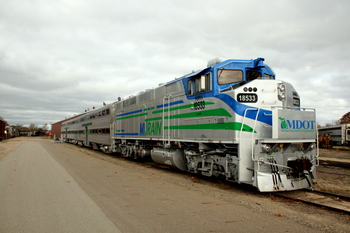
Mayor John Hieftje says the Southeast Michigan commuter rail project is farther along than most people realize. He says MDOT already has a train, shown above, for a commuter rail line running from Ann Arbor to Ypsilanti, Metro Airport, Dearborn and Detroit, where it would link with the new Woodward Line.
Photo courtesy of Mayor John Hieftje
Hieftje goes on to say the entire project — both the first and second phases — can be built without any significant upfront cost to the city.
Though U-M and the city would share usage of the parking structure and bus station, Hieftje writes, the university would pay almost all upfront costs to construct the first phase. Under the plan that is still being worked out, he adds, the city would own the station and the city’s portion of the costs would be made up over time from funds generated by parking spaces.
"The financing plan will not impact the city’s ability to pay salaries in police and fire or fund parks, etc.," Hieftje writes.
A big advantage of the financing plan, Hieftje writes, is that U-M's upfront contributions can meet the required local match for federal funding for the entire rail station. The first stage of federal funding for construction of Phase 2 — the actual rail station — recently was secured, he adds, referencing a $2.8 million federal grant announced in May.
Hieftje notes that on July 8 he received a letter reaffirming Amtrak's support of the Fuller Road Station project. He references a portion of the letter, which states the station would replace the exiting Amtrak station in Ann Arbor and "would represent a significant improvement for the high-speed corridor" and complement other track and station improvements.
"The new train station on Fuller is part of the Federal Rail Administration’s overall upgrade of stations, tracks and trains for better service and faster Amtrak trains (110 mph) along the Detroit to Chicago High Speed Corridor," Hieftje writes. "The new station in Dearborn is about to begin construction and Battle Creek’s station is being significantly upgraded along with the stations in Pontiac and Grand Rapids (all receiving federal funds). Amtrak will be buying new cars and engines (made in the U.S.) for its Midwestern routes."
If not for Fuller Road Station, Hieftje writes, U-M would be pushing forward with a plan for two new parking structures on Wall Street along with a new bus terminal.
Some Ann Arbor residents and even some City Council members continue to have doubts about the project and the city's ability to afford it.
The $43 million first phase, as approved by the Planning Commission in September, includes a five-level parking structure with five built-in bus bays and 103 bicycle parking spaces. City officials say they're tweaking those plans to possibly include commuter rail platforms in the first phase now — but that's if the project is even done in phases.
The university has committed to paying for 78 percent of the Phase I costs and would have access to 78 percent of the parking spaces in the structure. The long-term vision for Fuller Road is estimated to cost $121 million, inclusive of planning and engineering costs, and city officials are hopeful federal funding will be forthcoming to cover those bills.
Joel Batterman, a member of the University of Michigan Bicycle Coalition, continues to question the thinking behind building a 1,000-car parking garage that will primarily serve U-M. He believes current U-M parking facilities are underutilized.
Batterman served on the transportation analysis team last year for the U-M Integrated Assessment of Campus Sustainability, which concluded that smarter parking management and enhanced support for transportation alternatives — as opposed to new parking capacity —would allow the university to meet its transportation needs in a more cost-effective and environmentally beneficial manner (download the report here).
Ryan J. Stanton covers government and politics for AnnArbor.com. Reach him at ryanstanton@annarbor.com or 734-623-2529. You also can follow him on Twitter or subscribe to AnnArbor.com's e-mail newsletters.
Comments
Sean McAde
Thu, Aug 4, 2011 : 8:37 a.m.
umich07 This comment is hidden because you have chosen to ignore umich07 . Show DetailsHide Details I agree that Ann Arbor does not need a LRT system. shat it needs is a PRT system. Now getting on to a Howell to Ann Arbor run is different. Yes it is LRT and it only goes about 55 miles per hour, (40 on the run), but then the line between Hammond an Ann arbor can run at 110 miles and hour (90 on the run). It can't do that between Ann Arbor and Detroit/Pontiac. At about 45 to maybe 65 mile per hour with shared freight. At any rate the run into residential areas by running a line to Canton from Ann Arbor an into the city of Detroit passing by Metro Airport. Eighty five miles an hour (60 on the run) that's faster than the average low speed of about 45 miles per hour, which is the speed at which you will reach the city at. At any rate a switching station at Fulller Road is a good idea if and only if it is used right. LRT from Howell, HSR from Hammond, and PRT with auto shuttle to Novi, Pontiac, Mount Clemens, Flat Rock and Ypsilanti. Along the routes are various other routes such as the Fairlane route or the Novi Mall route, I hope you get the picture. It's about a 110 mile per hour train from Hammond and a 55 mile per hour from Howell, an Ann Arbor PRT, a PRT (high speed, 55 miles per hour) to Detroit in a personal pod (4 or two bikes), a nine person transport (one stop possible), or the ability to take a car. Now if you take a car and your befuddled by it maybe you should purchase a "mobility" car. One that let's you decide to run a cable with this this or a circular track. But that is another story.
lester88
Fri, Jul 29, 2011 : 2:45 p.m.
It's quite obvious that Ryan Stanton and AA.com are the Mayor's propoganda machine. Like it or not, this project will be done. The emperor has decided what is best for you.
lester88
Sat, Jul 30, 2011 : 9:19 p.m.
Updated with facts? He seems to defend a position if you ask me.
Vivienne Armentrout
Sat, Jul 30, 2011 : 2:24 a.m.
I thought Ryan's coverage of this letter was factual and even-handed. He updated it a couple of times to reflect additional information.
blahblahblah
Fri, Jul 29, 2011 : 2:34 p.m.
Facts missing from the mayor's letter (part 3): 8.) "The AATA is currently governed by a board appointed by the mayor of Ann Arbor." 9.) The mayor's appointed AATA governing board voted unanimously (with one member absent) to move forward with the "Smart Growth" expansion plan which has an estimated price tag of $465 million in capital costs and $52 million in annual operating costs (on top of current $27 million annual operating costs). 11.) $132 million of the $465 million in capital costs is earmarked for an aiport shuttle and commuter rail. It is not clear to me how much of the $52 million additional annual operating costs are dedicated to commuter rail or if the plan is banking mostly on federal monies as suggested above by "aaudubon". 12.) The mayor's appointed AATA governing board will need voters to pass a county-wide millage vote (planned possibly in February 2012) to fund this expansion of county services. 13.) The mayor so far has refused to allow the citizens of Ann Arbor to have a similar vote on using our parkland for Fuller Station. At the very least, City Council should wait to see if the "Smart Plan" is approved by county voters before moving any further.
mtlaurel
Fri, Jul 29, 2011 : 2:19 p.m.
don't need a new center for marginal service: went to the Amtrak station 2weeks ago to get service to Chi: station was empty/attendant couldn't guarantee any train without a delay of 45 to 90 min..had to drive to W Mich and have someone drive me to Bangor Mi station and travel to Chi so I'd make my time window. As far as travelling East into Det and suburbs..Who and for what? get off the train in Det..and walk around? The people out here from Canton/Livonia to work are not going to hassle with driving to a station..park car...get on train...get off train...take a bus or cab to their work...GIMMEE a break...FIX and BEEF UP the service that exists...meanwhile for the cost of a ticket, while Detroit is tooling up high fuel economy in smaller autos, people WILL drive. AND people coming to Univ Hosp means they have a more complicated problems..and have one or two family members..you think 2 or 3 people are going to buy Amtrak tix as opposed to driving in their car...which also gives them flexibility of getting out to a motel they can afford if they need to stay...GIMMEE a 2nd break...CALL it what it is:MED CENTER PARKING.
aaudubon
Fri, Jul 29, 2011 : 12:40 p.m.
to: Umich07 - to discount mass public transit because our town is a mere 117,000 discounts the HUGE numbers of people who are not part of the counted population of the city but travel in and out for for and for treatment. Also, rail serves the region - not just the City, so again, your criticisms are short sighted and narrow minded. to: blahblahblah - the AATA's Smart Growth Master Plan estimated price tag DOES include both Ann Arbor to Detroit Rail costs and the North-South rail costs. Furthermore, it includes the cost of expanding this rail into Livingston and Wayne Counties. This estimate does not suggest Ann Arbor citizens will pay for those costs. A majority of this actually would come from Federal money for light rail and commuter rail.
Mike D.
Fri, Jul 29, 2011 : 12:34 p.m.
This is an investment in our future. Over time, more people will commute into the city (sorry anti-development types, it's a fact you can't change) and they can do so in cars or on a train. Have you seen the rush hour traffic on 23 and 275? They weren't busy a decade ago. You don't think think 94 and 14 are going to be the same in 10 years? Have you noticed that over the past decade downtown Ann Arbor has turned into gridlock at rush hour? Complaining about the fact that a large rail station needs parking spots is insane; if the people parking those cars didn't do so, they instead would be driving those cars much farther. That's what you'd prefer? And complaining that a parking lot (the "park land") is going to be turned into a structure is the most blatant head-in-the-sand anti-development nonsense I've heard in a while. But the most ridiculous part of this is the assessment by the bicycle hippies that we'd need less parking if more people rode bicycles. Yes, and if evil space aliens vaporized half the population, we'd also need less parking, but that probably won't happen, either.
lester88
Fri, Jul 29, 2011 : 2:53 p.m.
Downtown has turned to gridlock during rush hour because of the addition of bike lanes and construction projects like the big hole on S. Fifth Ave that have choked traffic down or closed a lane increasing A2's carbon footprint.
blahblahblah
Fri, Jul 29, 2011 : 1:19 p.m.
"Complaining about the fact that a large rail station needs parking spots is insane; if the people parking those cars didn't do so, they instead would be driving those cars much farther." What's insane is that there is no "large rail station" and no guarantee that one will ever exist. So building a large parking structure and calling it a train station does not fly for most Ann Arbor residents. As for the 78% of the structure being used by U of M commuters, they actually would not "be driving those cars much further" if they choose to use a park and ride lot located at the edge of town.
belboz
Fri, Jul 29, 2011 : 11:08 a.m.
Who gets the money from selling and developing the old Amtrak? Perhaps that should be given to the city since the city to offset the costs..... I fail to see how a new station will increase the speed of the train and help support a 100mph rail system. The speed in and out of the city will not change, nor will the fact that Ann Arbor has a train station. Didn't anyone notice the government does not HAVE the money? Waste O Cash.
Stephen Landes
Fri, Jul 29, 2011 : 5:22 a.m.
I would like to see the traffic studies on how all the traffic is going to be managed. I don't know if Wall Street and Fuller Road are capable of handling the load. Fuller beyond North Campus is a pretty narrow road. Wall Street is narrow its whole length. This traffic snarl should be interesting. I have a feeling that the cost of the parking structure is just the beginning of this project.
Rita Mitchell
Fri, Jul 29, 2011 : 1:44 a.m.
There's an error in my last post, citing the example of the May 17, 2011 meeting, which was for the Parks Advisory Commission. The agenda lacked reference to Fuller Road Station, as did all attachments. If the FRS topic was discussed, then the public was not adequately notified in order to participate. Public hearings are different from public meetings, which are, at least in my experience with the FRS proposal, tightly controlled. The FRS proposal is an example of a costly, high profile proposal that deserves the "robust public discussion" that has been more recently recommended for other projects under consideration by the city. We have yet to have such discussion on the FRS proposal.
lefty48197
Fri, Jul 29, 2011 : 1:01 a.m.
This sounds like a great idea to me. Southeast Michigan has long been stuck in the early 20th century when it comes to public transportation. Today, we see wiser heads coming up with ideas like the bus terminal at the US23/Plymouth Rd. highway interchange. What a brilliant idea! A rail/bus hub near the hospital is another 21st century idea. I can't wait to see it happen!
blahblahblah
Fri, Jul 29, 2011 : 1:04 p.m.
I totally agree about the park and ride lots sprouting up along the freeways such as at US23/Plymouth Rd. Those lots mean less commuter traffic driving through the center of town and are supported by an existing network of buses. Unfortunately, Fuller Station is nothing more than a giant park and ride lot located in the center of town, therefore totally defeating the idea of leaving commuter cars at the edge of the city. As for a potential phase 2/rail component, there is no existing "commuter service" in place and there is no money to build and/or operate it. So these "wiser heads" are leaving out some important details.
Halter
Thu, Jul 28, 2011 : 11:45 p.m.
It seems to me that if the Mayor has to rationalize why we need this project in 5 pages, then we don't need it.
MyOpinion
Thu, Jul 28, 2011 : 10:40 p.m.
One minor detail about the proposed new parking structure is that currently if you take the train you can park for free in the old Edison?? parking lot. That's pretty much the same thing that happens if you take an Amtrak train from Toledo - free parking. I'm not sure train riders deserve free parking, but I sure wouldn't park at a city lot for 5-6 days. That would be kind of pricey. So, this parking lot really isn't for train customers.
Rita Mitchell
Thu, Jul 28, 2011 : 8:36 p.m.
City officials know that there was only one true public hearing at the Planning Commission. The other meetings were either: -Presentations which showed essentially completed plans, followed by questions submitted in writing by the public attendees, from which questions were selected for response by staff. The "process" was one in which the presenters attempted to get responses to options for brick or rock color, and art for what has been designated by the someone as a "gateway to the city, OR -Meetings at which the Fuller Road Station was on the agenda, and if the public was checking the agenda, had an opportunity to comment on the topic prior to the full meeting. As one example from Ryan's list of meetings, May 17, 2011, go to this site: <a href="http://a2gov.legistar.com/Calendar.aspx" rel='nofollow'>http://a2gov.legistar.com/Calendar.aspx</a> and search on Planning Commission meetings for 2011. The agenda indicates no information on the topic of Fuller Road Station. How is the public supposed to participate when agendas are posted with no clear topic? Was the item added last minute? Where are the minutes from that meeting? What issues were presented to the public for their input? The public has never been asked whether we want a new train station, whether we want to give up park land, or whether we want to participate with the University on building a parking structure in one of our parks. We have been allowed opportunities to comment on plans that clearly show that decisions were made, and those decisions have not included the public in the discussion process.
deb
Thu, Jul 28, 2011 : 7:54 p.m.
Couldn't we do a nice new train station with everything, while not having to include 800 extra parking spots for the U? If we were to do something like that, could we not save a lot of the parkland?
cjenkins
Thu, Jul 28, 2011 : 7:33 p.m.
@ Tony Dearing I am tired of annarbor.com allowing the anti-everything political group to use bullying and intimidation against other commentors under articles pertaining to city issues. They indirectly accuse me and others of not having legitimate opinions on issues just because....shock...we might actually like a policy the mayor, council or the city comes up with. I am strongly in favvor of the train station and others are too, but why should anyone ever comment when others are allowed to instantly dismiss them as illegitimate. Sometimes they directly say that other times they insinuate it. It is disgusting that is allowed to happen time and time again. You should really think about getting rid of comments all together.
lester88
Fri, Jul 29, 2011 : 3 p.m.
AA.com should go one step further cjenkins. They should only post items that are positive for the Mayor. Wait..........that's what they do! Maybe they should only post comments that support the Mayor to make you happy.
CynicA2
Thu, Jul 28, 2011 : 10:13 p.m.
There is no "anti-everything political group". Just a variety of locals expressing their opinions on a variety of local issues, not all of whom agree with each other, so arguments occur. Big deal - that's just part of the whole democratic process. If anything, this blog is TOO restrictive on comments. If you can't stand the heat, get out of the kitchen, which is barely even WARM, to begin with.
Mr Blue
Thu, Jul 28, 2011 : 9:23 p.m.
Oh, those pesky comments! The nerve of some people who have different opinions based on real facts instead of repeating the same tired council majority talking points without addressing any of the opposing facts of the situation. It's a park giveaway to UM for a parking lot. The pie in the sky train station is a straw man cover for what is really going on. Get ALL rail out of the Huron Valley and put it out on the freeway zones where current transportation infrastructure exists. If the UM wants a parking structure, let them pay for it. Pass a local income tax to capture just a tiny bit of what we pay (thru the UM) their commuting employees.
SonnyDog09
Thu, Jul 28, 2011 : 7:08 p.m.
"the modern age of rail" is an oxymoron. Hizzoner is smitten by his beloved choo-choos. However, there is nothing "modern" about 19th century technology. Additionally, Michigan lacks the population density to support rail.
deb
Thu, Jul 28, 2011 : 6:20 p.m.
This story needs to be re-posted on the front page. It is a very important issue to the community. It was only on the main web page for a small amount of time yesterday, warranting a re-posting so all members of the community can see and discuss it.
lester88
Fri, Jul 29, 2011 : 3:02 p.m.
Deb, there is nothing to discuss. The train station decision has been made. Like it or not.
cjenkins
Thu, Jul 28, 2011 : 7:35 p.m.
Yes it is, especially for the people in favor of the project.
deb
Thu, Jul 28, 2011 : 6:44 p.m.
Thank you. I think we all agree it is a very large and contentious issue for the citizenry.
Tony Dearing
Thu, Jul 28, 2011 : 6:36 p.m.
We've moved this to the "Top story'' module on the homepage so that it continues to appear on the homepage.
blahblahblah
Thu, Jul 28, 2011 : 6:20 p.m.
For all those homeowners along the Allen Creek floodway with a leaky basement or flooded street today, be rest assured the city's sewer fund is going to good use providing Fuller Park and Fuller Pool with brand new sewer lines. Basements are one thing, but we sure don't want our parkland to flood.
Ryan J. Stanton
Thu, Jul 28, 2011 : 6:19 p.m.
City officials say there have been 15 public meetings on the Fuller Road Station project to date and they are as follows: January 27, 2009 Wall Street Neighbors Community Meeting June 16, 2009 Park Advisory Commission Meeting September 10, 2009 City Planning Commission Work Session Meeting September 15, 2009 Park Advisory Commission Meeting September 17, 2009 Public Workshop/Open House October 12, 2009 City Council Work Session Meeting November 5, 2009 City Council Meeting February 10, 2010 Citizen Participation/Community Meeting March 9, 2010 Planning Commission Work Session Meeting March 16, 2010 Park Advisory Commission Meeting April 21, 2010 Ann Arbor Transportation Authority Board Meeting May 6, 2010 Citizen Participation/Community Meeting July 8, 2010 Citizen Participation/Community Meeting January 10, 2011 City Council Work session May 17, 2011 Parks Advisory Commission
Kai Petainen
Sat, Jul 30, 2011 : 2:25 p.m.
when is the next public hearing?
djj
Thu, Jul 28, 2011 : 5:41 p.m.
Obviously many of you do work at the hospital. Joel Batterman I welcome your bicylces, but when a doctor who pays $2000 a year to be able to park at the hospital to care for patients and do research, and cannot find parking, something has to be done. "not utilizing present parking...." while others wait in a parking garge for a shift to end, "stalkng" the employee just to find a parking spot. That's the reality of parking near the hospital. 24,000 employees, and MANY of them use the communter resources because they cannot not afford the 660 a year to stalk trying to find a parking near the hospital. (the outer parking lots cost $60.00) Bringing REAL Trains to Michigan and bringing Michigan into the 21st century has been beaten down and brusied for years. It's time for A2 and SE Michigan to become People Movers. Finaly someone has taken the lead, strapped on their coconuts and are becoming forward thinking......mmmm, sounds like UofM -- look around. It's time A2 started catching up. Population 115,000 living in the bubble, count your blessings.
deb
Thu, Jul 28, 2011 : 6:22 p.m.
So the U, with over 7 billion in its coffers, should be paying for its own parking structure.
Rita Mitchell
Thu, Jul 28, 2011 : 3:54 p.m.
Please ask the mayor for details on the parking revenue. The U plans to pay less for its use of Fuller Park, after the structure is built. The U will collect parking revenues as it does currently for 700 new parking spaces in the structure, and that specific revenue will go to the U, not to the city. The city will retain about 200 parking spaces, that the article indicates will be available to soccer players, park and pool users. Will the 200 spaces instead become pay-for-parking spaces? Is that the revenue alluded to by the mayor? The spaces remaining under city control will in no way make up for the expense of moving sewer lines, installing storm drains, water lines, creating a new roundabout, all of which are expenses in addition to the $10 million that is expected of the city as its "contribution" to the parking deck.
deb
Thu, Jul 28, 2011 : 6:24 p.m.
Additionally, there are about 150 spaces near the current amtrack station, so with these additional uses, the city wont have added any additional parking spots then they currently have. So why is that not in the letter Mr. Mayor??
racerx
Thu, Jul 28, 2011 : 3:22 p.m.
To continue, Batterman, how do you suppose these 24K employees of the Health Center arrive to work each day? By bike? Again, most of the UM employees don't live in the city. How much more clearer does one have to be to understand this? What? You suggest those employees bike from say Howell? Chelsea? Detroit? Wayne? Will there be maintained bike paths from these areas in the winter? Until there is a sustainable light rail system, people will continue to use their mode of choice, and this is the automobile. Granted we could all use more efficient cars (Prius, hybrids, diesels), but until then, a 1K car parking garage is the way to go. Look at the problems Wayne county is having just getting a light rail system running from Woodward Ave from downtown Detroit to the suburbs. How long has this debate been going on? Get over it. Car is king.
deb
Thu, Jul 28, 2011 : 6:25 p.m.
So the u can build its 1k parking structure, but the city should not be a part of it.
Rita Mitchell
Thu, Jul 28, 2011 : 3:56 p.m.
If the med workers are going to work by train, why the need for a parking structure? They won't have cars with them on the train.
nemo
Thu, Jul 28, 2011 : 3:31 p.m.
If it's all about transporting med workers, the train is pointed in the wrong direction. Folks in Michigan are hooked on "up north" for the weekend, and have been for generations. Anyone who expects them to move from Brighton to Canton so they can ride a train to work, doesn't understand Michiganders.
Adam Jaskiewicz
Thu, Jul 28, 2011 : 3:15 p.m.
I don't care about the station, but that train is pretty. I hope I can start riding it to work soon.
racerx
Thu, Jul 28, 2011 : 3:15 p.m.
Maybe I'm not that interested and it was mentioned in the article. But the parking revenue will go to the city and not the DDA? Is this clearly stated in the contract? Or, will the DDA amass these funds once the parking structure portion of the city is built?
Ryan J. Stanton
Thu, Jul 28, 2011 : 3:09 p.m.
I've added a link in the story to the letter signed by Amtrak Assistant Vice President Michael Franke. The letter says Amtrak looks forward to working with the city to bring the Fuller Road Station project to fruition.
Ryan J. Stanton
Fri, Jul 29, 2011 : 3:19 p.m.
The mayor says there's no basis for the claim. This is his explanation: "When a letter is requested from me, I ask the recipient if they would look at a draft, especially if it is about something outside of town so I can be sure local knowledge is not missed or mistaken and the letter hits the pertinent points. The suggested changes usually amount to a word or two, maybe a sentence to clarify something that improves my letter. I might not take their advice but it's good to have. I told Eli that I would be happy to look at a draft and he passed it along. To the best of my knowledge, Mr. Franke never responded to Eli's email. Anyway, I never saw a draft. He simply sent the letter. No problem. I do not believe an Assistant Vice President for our nation's passenger rail operator would sign a letter written by someone else on an important matter like this."
Kai Petainen
Fri, Jul 29, 2011 : 12:07 a.m.
thanks for adding that link
deb
Thu, Jul 28, 2011 : 7:53 p.m.
Really, I am quite interested in this. Please confirm or dispel that the mayor wrote the letter singed by Amtrac officials.
deb
Thu, Jul 28, 2011 : 6:28 p.m.
I would really like you to address what Ms. Lesko has said about the mayor writing the letter for Amtrack (and other points she has made). I see your words above 'singed by . . .' which makes me believe that he didn't write it. Please do clarify
Ryan J. Stanton
Thu, Jul 28, 2011 : 2:58 p.m.
@Kai — I asked Eli Cooper from the city for a more detailed explanation of the $2.8 million federal grant. He confirmed what I have heard before, that only $150,000 of that is for the environmental study. Here's what he told me via e-mail: "Our grant application was for the environmental and preliminary engineering phases as outlined by the Federal Rail Administration (FRA). The FRA's Notice of Funding Availability (NOFA) outlined funding available and an application process for these phases of work. We applied for and received an award under the terms and conditions of the FRA's NOFA. The first element of our work is as you have identified, the environmental analysis. Our grant application identified a budget of $150,000 for that effort. The remainder of the grant request was outlined as activities and resources needed for Preliminary Engineering associated with a new intercity passenger rail station. The application described a more complete set of project elements including the station, drop-off area as well as rail platforms and improvements to rail systems associated with the proposed new station. Also note, our application anticipates appropriate public involvement associated with these phases of work."
Kai Petainen
Thu, Jul 28, 2011 : 4:08 p.m.
so, from my understanding, the $2.8 million was marketed for environmental stuff. but only 5.4% of that is used for environmental matters. does this not sound like clever marketing? what we should have heard earlier, was that they received a grant of $150,000 for environmental matters and $2.6+ million for other stuff.
deb
Thu, Jul 28, 2011 : 2:02 p.m.
I actually dont mind the idea of a light rail or new station. The part that angers me is the fact that the train is being used to cover the fact we are going to build a gigantic parking garage for the U. I do not think the mayor merely overlooked mentioning the number of parking spots created one time created by this new structure. I could continue about the misinformation that this letter
Ron Granger
Thu, Jul 28, 2011 : 1:37 p.m.
It is a fact proven time and again in other cities - connecting low crime areas to high crime areas brings in crime. People will ride that train to opportunity - gangs, crime, drug sales, etc. It is a concern that must be considered.
Mike D.
Fri, Jul 29, 2011 : 12:43 p.m.
The only thing factual about your statement is the fact that only racists believe that public transportation from Detroit brings in criminals.
Ron Granger
Thu, Jul 28, 2011 : 1:34 p.m.
"Under the plan that is still being worked out, he adds, the city would own the station and the city's portion of the costs would be made up over time from funds generated by parking spaces." -- Whatever. Other cities have incurred *huge* losses in "sure deals" like that. Why are local taxpayers funding UM expansion? Why are we converting parks to parking for UM? There are far too many unanswered questions about this. It all needs to slow down.
EyeHeartA2
Thu, Jul 28, 2011 : 1:19 p.m.
So, does anyone believe this parking structure will ever be anything other than parking for the University (that happens to employ mayor Leftie?)
Plubius
Thu, Jul 28, 2011 : 1:14 p.m.
The single, most important factor in this discussion has been completely over-looked. NS, the owner of the rail line, has place excessively restrictive speed limits on Amtrak's trains. Thus, the trip from Chicago to Ann Arbor is regularly taking 7-8 hours these days. At this rate, ridership will plummet to zero and all of the money spent will be wasted.
Mike D.
Fri, Jul 29, 2011 : 12:45 p.m.
The current situation is just a ploy by NS to get more money from Amtrak to maintain its tracks. Eventually, they will get it and the lines will support higher speeds.
Kai Petainen
Thu, Jul 28, 2011 : 9:54 p.m.
with respect to NS... they are not involved in the process. this is what they told me: "I don't know why you insist on drawing NS into this, but to be clear we have absolutely no involvement with the construction of a new passenger station in Ann Arbor, nor do we have any involvement with local government decisions pertaining to emergency responders." — NSC Media Relations
Silly Sally
Thu, Jul 28, 2011 : 1:14 p.m.
"City officials say they're tweaking those plans to possibly include commuter rail platforms in the first phase now" What, they are only now considering commuter rail? If it is not commuter rail, then it is Amtrak and we should upgrade the parking at the existing station by buying the abandoned DTE lot on the other side of the tracks. "78% of the parking structure will be for UM..." What is in it for the city? Presently, I do not need to pay some high fee to use the Amtrak station. under King John, soon I will, adding to the cost and making a drive seem less costly.
Patricia Lesko
Thu, Jul 28, 2011 : 1:11 p.m.
Ryan, You write, "Hieftje notes that on July 8 he received a letter reaffirming Amtrak's support of the Fuller Road Station project. He references a portion of the letter, which states the station would replace the exiting Amtrak station in Ann Arbor and "would represent a significant improvement for the high-speed corridor" and complement other track and station improvements." A FOIA filed by A2Politico showed that Hieftje wrote the "letter of reaffirming Amtrak's support." Eli Cooper sent an email to the Amtrak official saying that Hieftje wanted to write the letter because he was "sensitive to issues." Like the truth? I wrote this is February 2011: (<a href="http://www.a2politico.com/?p=5627)" rel='nofollow'>http://www.a2politico.com/?p=5627)</a>: "In 2009, Hieftje spearheaded the creation of an Economic Development Fund. Alas, there was no money to put in the fund, so Hieftje took money from the city's General Fund. That resulted in the layoffs of firefighters, and a multi-million dollar early retirement pay-out to about two dozen police officers, who are paid for by money in, yes, the General Fund. There were other service cuts, as well, including to summer programs for children. Oh, and fees for services were hiked, including fees for sewer and water. Money from the Economic Development Fund has already been used for the Fuller Road Parking Garage being built for U of M." This letter is filled with deceptions, distortions and outright whoppers. It's right up there with the one you ran from Christopher Taylor in which he understated the city's debt by $215,000,000 while explaining how manageable the debt really is—Taylor didn't include the $215,000,000 unfunded pension and health care liability (and you neglected to fact check him). He and AnnArbor.com got a Weekly Whopper for that one (<a href="http://www.a2politico.com/?p=6276)" rel='nofollow'>http://www.a2politico.com/?p=6276)</a>. Hieftje will earn a Weekly Whopper for this one. Hieftje tries to call a parking garage a train station. You want to call what you posted reporting. It's a matc
deb
Thu, Jul 28, 2011 : 9:01 p.m.
will you provide a link to the documents that show Hieftje wrote the letter please?
Mr Blue
Thu, Jul 28, 2011 : 12:40 p.m.
Get ALL rail out of the Huron River valley in Ann Arbor. The Huron River and the valley should be considered a natural asset more beneficial for people's health and well being than a route for trains and commuters. The Huron River has more value as a natural asset than it does as a declining transportation route that primarily serves Amtrak, some private freight companies and the UM hospital. Place ALL rail, high speed or light along the existing I-94 and 1-96 transportation corridors. These routes already serve car commuters and connect major cities. Use these locations for transfers to upgraded urban bus systems that serve communities along the route. Car commuters could park along the highway routes and use rail and transfer points. Using the transportation infrastructure that has already grown along these routes will save money and serve more people in the long run that using the old tracks and building new infrastructure like a parking structure and modal terminal.
Mr Blue
Thu, Jul 28, 2011 : 7:32 p.m.
All the more reason to get rid of those rail lines along the Huron. People, jobs, transportation and technology have moved beyond 100 year old transportations routes. Following your way of thinking we should still use covered wagons and follow the buffalo herds because it was good enough for great great grandpa.
Charlie Brown's Ghost
Thu, Jul 28, 2011 : 3:10 p.m.
On the other hand, that railroad in particular was a big part of the opening of this part of the country, this city, regional immigration, the automobile industry, and transporting of soldiers and materials as far back as the Civil War. Some of us don't mind it being there. I understand the Norfolk Southern is looking to sell it, so you may go ahead and buy it, rip it up, and donate the land it to the city or county for use as a natural asset.
Charlie Brown's Ghost
Thu, Jul 28, 2011 : 12:36 p.m.
After looking at the picture, I think I now know why there are a couple dozen commuter rail cars sitting in the yard up at Cadillac.
thorj97
Thu, Jul 28, 2011 : 10:01 a.m.
" ... the university would pay almost all upfront costs to construct the first phase. " Wait a minute, didn't I just read an article about the need to cut spending on nursing? I wonder where that nursing money is going ...
Technojunkie
Thu, Jul 28, 2011 : 3:52 a.m.
I'm just not seeing how trains make more sense than buses like Greyhound and Megabus run. Buses give you far more flexibility, go exactly where you need them to, use existing roads, cost a whole lot less, don't have to pull over and stop while a bus travelling in the opposite direction passes as you'll have to do with this single track commuter line, take about as much time to complete a trip as trains in the real world, and you can even get WiFi on buses now. About the only downside is that Uncle Sugar is less likely to whip out the federal taxpayer credit card to buy the toys. Trains make no sense for passenger use anymore outside of the NYC-DC corridor and a few densely populated cities. That's why private industry abandoned them decades ago. They got squeezed out of business between buses and planes.
Kai Petainen
Thu, Jul 28, 2011 : 3:46 a.m.
I'm not great at politics, but should this sort of thing be put up for election? Whether or not I agree or disagree with it, the majority vote wins, and I respect that.
Rita Mitchell
Thu, Jul 28, 2011 : 2:51 a.m.
I read the mayor's letter. I have walked from Fuller Road up the hill to Huron Street. I would not call the distance a "hop and a skip". It's more of a slog and a drag. Once at the top of the hill, the distance to Main Street is at least another six blocks, not conveniently located to downtown business use. As for bicycling in the area, 1) the Border to Border Trail is not addressed by any of the planning documents, a status that has not been altered, 2) riding a bicycle to a parking lot and taking a bus to another destination makes no sense whatever. Use of our city resources for this project, in capital outlay, and ongoing operations is highly questionable, and does not pass the test of a high priority project. Our city staff have spent far too much time on this project, further adding to the costs covered by our tax dollars for consultants and design, and for what gain?
Kai Petainen
Thu, Jul 28, 2011 : 2:21 a.m.
I feel bad posting more than one comment... but there might be some truth to the 'build it and they will come'... but it's not the reason that folks are talking about. here's my prediction. In the past, train stations would go to train hotels. Some of the Fairmonts in Canada were great train hotels. Travellers would travel and stay at train hotels. Now, we have a different situation -- baby boomers. The baby boomers are aging and within 10-20 years a large amount of people will die, or age quite well. This will put stress on all areas of society -- including the stock market and hospitals. They have the money, and they need to be taken care of. They will want closer parking lots and mass transit to get to the hospital. In some manner, they will not be able to drive, but they will be able to take the train to the hospital. UofM will continue to be at the forefront, as times change and the Train Hotels turn into Train Hospitals. This transportation advantage, the UofM will have over other hospitals in the area. It will keep sophisticated talent/doctors in the area as parking will be less of a complaint. There will be other side effects to the Ann Arbor area. Although it is illegal to cross the train track into the Arb, as the trains speed up, so too might the injuries and the policing of the train tracks. Putting on my public safety hat, this particular area could become high concern from a security standpoint, as it will be near a hospital, with mass transit and near a large amount of people. But, the train will serve the needs of the many, and so the desires of some (for it not to be built)... doesn't seem to matter, as construction has already started.
Rita Mitchell
Thu, Jul 28, 2011 : 2:20 a.m.
For another perspective on use of our public park property for a parking structure, go to: <a href="http://www.protecta2parks.org/" rel='nofollow'>http://www.protecta2parks.org/</a> To propose to build a parking structure and call it supportive of alternative transportation fails the logic test.
Ruth Kraut
Thu, Jul 28, 2011 : 2:17 a.m.
Why would it be a problem to put the parking garages on Wall Street instead of parkland? From my point of view it would be preferable. And I think an intermodal station is a great idea, but let's start with the other modes--trains and buses. Where I grew up in a NY suburb, the train station came first and the bus and parking pieces came after...
Kai Petainen
Thu, Jul 28, 2011 : 1:57 a.m.
Amtrak has commented on the train station: July 8th they send a letter to the mayor and on May 15th I posted this from Amtrak... "First, the location of stations starts as a local decision. In this case, we have outgrown the current building and the amount of parking is insufficient on our side of the tracks, inconvenient on the other side. We are supportive of the city's efforts to improve our facilities, especially as an intermodal station where passengers can be exchanged among modes." — Amtrak Media Relations reference here: <a href="http://blogs.forbes.com/kaipetainen/2011/05/15/lets-move-beyond-this-incident-pollution-local-news-and-responsible-investing/" rel='nofollow'>http://blogs.forbes.com/kaipetainen/2011/05/15/lets-move-beyond-this-incident-pollution-local-news-and-responsible-investing/</a>
Kai Petainen
Thu, Jul 28, 2011 : 1:52 a.m.
"If not for Fuller Road Station, Hieftje writes, U-M would be pushing forward with a plan for two new parking structures on Wall Street along with a new bus terminal. " That sounds like a good plan... does it not?
1bit
Thu, Jul 28, 2011 : 2:21 a.m.
Kai: The University already has their master plan for Wall St. I guarantee you they will build the structures irrespective of what happens at Fuller Rd. The purpose of the structures are to service the Kellogg Eye Center and other new centers that will be blocking the sun further on Wall St. Although the mayor may be using this as an excuse in his epistle, I'm sure if one asked U of M they would tell you that the two issues are unrelated.
Kai Petainen
Thu, Jul 28, 2011 : 1:49 a.m.
I'm confused: "the actual rail station — recently was secured, he adds, referencing a $2.8 million federal grant announced in May." I thought that was for an environmental study?
Ryan J. Stanton
Thu, Jul 28, 2011 : 3 p.m.
I've provided a response to your question below.
blahblahblah
Thu, Jul 28, 2011 : 1:46 a.m.
Facts missing from the mayor's letter (part 2): 4.) SEMCOG is no longer listed in the "partnership" and included in the ".. excellent example of intergovernmental cooperation." How much did SEMCOG spend on the commuter line, only to get nowhere? Who is going to run it? MDOT?AATA? Is this where the "smart" regional plan is headed? City Council is allowing the AATA to essentially dissolve itself and morph into a regional transportation authority without any say from the elected City Council officials? The $450 million smart plan vote does not even include running a commuter line. 5.) Amtrak has not publicly shown support for this project. 6.) The current Amtrak station is adjacent (across the tracks) from a significant chunk of open land/brownfield site, so the site is not as landlocked and "cramped" as described. There are many environmentalists who would like to see this site cleaned up. 7.) This is not "a one time opportunity for our community.." Building a parking structure based on an assumed train station to follow still does not solve the fact that no commuter train service exists today and may never exist.
Maxwell
Thu, Jul 28, 2011 : 1:55 a.m.
I gotta agree - I'd like to support this as part of a true mass transit system but not on a "build it and they will come" basis.
blahblahblah
Thu, Jul 28, 2011 : 1:42 a.m.
Facts missing from the mayor's letter (part 1): 1.) The city has spent somewhere around $3 million (environmental studies, consultants, sewers, road engineering, etc.) on a project that has yet to be approved by city council. Nowhere in the letter is there any mention of the $10 million in funding the city would need to borrow (with interest) in order to build yet another parking structure. The letter states, ".. the city's portion of the costs will be made up over time.." from parking revenues, yet no mention is made to how much money the city will lose in current parking lease payments from U of M on the current lot. 2.) As mentioned, above, Federal funding was not "..for construction of Phase 2, the rail station..." but for an environmental impact study. Anyone keeping an eye on Washington knows that future rail funding can not and should not be assumed. You know the old saying about when you assume something....... 3.) The "most significant hurdle for this project" is not just the infrastructure improvements but the complete lack of any operating entity or annual funding to support a commuter line. A picture of a train does not mean the service exists or "..is farther along than most people realize." A picture of a train without any supporting statements of any other developments should not persuade the average Ann Arbor voter.
Kai Petainen
Thu, Jul 28, 2011 : 9:52 p.m.
with respect to number 2. $150,000 of the $2.8 million is for environmental work. the rest is for engineering work.
CynicA2
Thu, Jul 28, 2011 : 1:29 a.m.
I suspect that the current debate over what to cut to reduce our national debt will result in considerable reductions in the funds available for many, if not all of these rail projects, at the federal level. Without this funding, they are going nowhere. Considering that we still don't have the money in hand to repair the Stadium bridges, and all the acrimony in Washington, projects like rail are easy to cut. After all, it's not like they're taking away something we already have, like Medicare or Social Security. If the politicians are considering modifying (read "reducing") the mortgage interest deduction, which has been something of a sacred cow until recently, you better believe they will chop, chop, chop, at all this overblown rail stuff. So much the better...!
cjenkins
Thu, Jul 28, 2011 : 12:16 a.m.
This is a great project and I look forward to its completion. I encourage all to actually download and read the Mayor's letter. It is informative and spells out the reasoning and justification for the project. All of us who like to plan for the future, who believe in investing in infrastructure and who think that our country needs to grow in a direction that is less dependent on big oil should be in favor of this project. True environmentalists would be people who are interested in decreasing the amount of traffic congestion and fuel emissions. Although some of our so-called local environmental groups like to pretend otherwise, fighting for a strip of parkland that has been a parking lot for twenty years, vs. supporting a train station that has the opportunity to actually decrease traffic and congestion in Ann Arbor is completely political and speaks to nothing environmental. This strip of parkland was so inconsequential to these same environmentalists and our own parks commission twenty years ago that they traded it to save a couple of trees. If this piece of land was that important it would never have been traded. I fully support trading the current parking lot parking lot for the opportunity to build something that one day might actually be a great benefit to the environment and our community. Although we can't predict what happens in the future and there will be no guarantee that all will go as planned, I believe the risk is one we should take.
thecompound
Thu, Jul 28, 2011 : 9:38 p.m.
It's a comment board not high tea at the country club, people are going to disagree. And throwing out the "bully" word du jour really does a disservice to those who have truly been bullied.
cjenkins
Thu, Jul 28, 2011 : 8:13 p.m.
Why should anyone bother commenting when annarbor.com just allows people like you to call people's integrity into question. I can't control the vote totals. People like my comment, plain and simple. I am allowed an opinion even if a bully like you doesn't like it. That does not make the comment wrong or inconsistent. Why should anyone even bother to comment when there are people like you who ready to pounce on any idea that don't share.
deb
Thu, Jul 28, 2011 : 7:58 p.m.
who cj? who? look at the comment board. Very few support the parking structure? The shock is that you say there is support with no back up The inconsistency in vote totals??? Then I point out the inconsistency between cutting spending on services, you also agreed with, and a large spending expenditure on this.
cjenkins
Thu, Jul 28, 2011 : 7:53 p.m.
Ha! I posted under an article, not your article. Exactly what am I supposed to reply to? Your insinuation that since I agree with the mayor that my opinion is not real? What inconsistency did you point out? That I like the proposal? How is that inconsistent? Shock!....people are actually for this project eventhough you can't see the forest through the trees.
deb
Thu, Jul 28, 2011 : 7:44 p.m.
Who is using what for a political agenda? If this was simply a train station, I would support it. But the fact that it is being used to shoe horn a 1000 spot parking garage is what I find appalling. Notice how the mayors letter dosent mention how many parking spots there will be? In one of your earlier post you defend the mayors police cuts saying we need to cut spending, then you come here and advocate a gigantic expenditure. Again, It is amazing that you are lock in step with the mayors decisions. Bullying?? by pointing out your inconsistency, and other questions about your post? But i must admit that you have done a good job attacking me instead of responding to the substance of my or others comments
cjenkins
Thu, Jul 28, 2011 : 7:24 p.m.
And exactly what is so wrong with agreeing with the mayor.? He is logical and actually completely correct on this. Deb, I find your attitude insulting and a form of bullying. Just because I have an opinion that you don't like, that does not give you the right to try and intimidate me into not posting a comment. That does not give you the right to chase people off the comment board so you can use it for your own political agenda.
deb
Thu, Jul 28, 2011 : 6:34 p.m.
I also find it funny that trepang, the second poster who also showed great support for the project, has 8 votes and this post has near 150. Apparently people liked the longer post better, because thats what people usually do, vote for the longer more complicated post, not the short sweet one . . .
deb
Thu, Jul 28, 2011 : 2:08 p.m.
I read the letter, and I agree with tom, cjenkins comments fall entirely inline with the mayors, and this is not the first post that he has done this
Tom Whitaker
Thu, Jul 28, 2011 : 2 a.m.
"I'm betting that you are the only one on this board who actually took the time to read the Mayor's letter. " And I'm betting he's the one who wrote it.
Bear
Thu, Jul 28, 2011 : 1:01 a.m.
Amen! Here's to progress. One of the reasons Michigan is in such poor shape is because of our lack of initiative in building mass transit infrastructure. I'm betting that you are the only one on this board who actually took the time to read the Mayor's letter. Half of these jokers don't even know the rules regarding procedure, nor do they actually care about the parkland parking lot. They just love to bury their head in the sand and cry out, "the sky is falling"!
umich07
Thu, Jul 28, 2011 : 12:06 a.m.
Ann Arbor is a town of 115,000 or so people. Any light rail installation in Ann Arbor is a hilarious waste of money.
deb
Thu, Jul 28, 2011 : 1:59 p.m.
Train traffic has only increased by about 1% a year for 15 yrs. It serves close to the same amount of passengers it did in 1997 as it does now. Why did we not need a station then?
CynicA2
Thu, Jul 28, 2011 : 1:49 a.m.
Bear, Ann Arbor is small potatoes, any way you cut it. Michigan is depopulating... Ann Arbor's pop. is stagnant, at best, and is growing nowhere fast. Now that Borders is going, it'll soon have a few hundred less. All we have is the Big U and a handful of tech companies who promise the sun and the moon (like Google did), and then one day vanish like gypsies in the night 'cause they found a better deal somewhere else. In any case, the money for all this rail silliness is likely to vanish in the budget-cutting process, as the politicians look for things less contentious than Social Security and Medicare to cut.
Bear
Thu, Jul 28, 2011 : 12:56 a.m.
Apparently you don't have all of the information at hand or are intentionally ignoring it. Ann Arbor happens to be one of the major users of Amtrak passenger rail service between Chicago & Detroit. Do your research, then criticize. Be factual, not just opinionated.
a2grateful
Thu, Jul 28, 2011 : 12:01 a.m.
It's not about a garage. . . It's about illegally transferring a public asset without permission, or just compensation. . . We don't need five pages to understand this. . . We don't even need five sentences. . .
EyeHeartA2
Wed, Jul 27, 2011 : 11:48 p.m.
I was wondering why he wasn't at the AAPD sexual assault news conference today. Turns out, he had better things to do with his time.
nemo
Wed, Jul 27, 2011 : 11:41 p.m.
Mr. Mayor: If this project is all you say, and such a laudable endeavor, why are you persisting in trying a back door end-run around the voters? Put the sale of the parkland up to a vote as you are required by law, and as mandated by the citizens of this town. There has been no community engagement in this process, none—just planning by regal fiat, and now you are trying to influence an election occurring in a week with bully words and ballyhoo. Put this up to a vote, you win, I'll abide by it; you lose, crow's not necessary, pigeon will do.
thorj97
Thu, Jul 28, 2011 : 9:57 a.m.
Sounds like a replay of the downtown conference center fiasco. Community input ignored, community resources to be turned over to developers, the back door end-run, etc., etc.,...
xmo
Wed, Jul 27, 2011 : 11:31 p.m.
The city is run by people who were elected by you the voter and they have a (D) next to their name. They will tax and spend as they please because they are part of the ruling class and know so much more than you. Go back to to your fields and plant your crops! Remember August 3rd, you don't have to vote for this kind of ruling class unless you want to!
leaguebus
Fri, Jul 29, 2011 : 1:57 p.m.
Surely you jest! The Republicans are the ones that refuse to tax the ruling class and want to balance the budget on the backs of the poor and middle class. Does the Snyder budget ring any bells here?
nickcarraweigh
Wed, Jul 27, 2011 : 11:23 p.m.
There's plenty still to learn about this project, but I frequently travel by train and it sounds to me like it might be a good idea. Kalamazoo used the intermodal strategy to federally-fund a nice rehab of its historic train station while moving the municipal and the inter-city bus lines under the same roof (be nice to not have Greyhound blocking Huron St. several times daily). Strange, though, that some city council members are troubled about the potential cost, since they're still bent over for a $50 million Fifth St. underground parking "structure" that is completely useless (the Fourth St. structure's LED signage typically displays hundreds of vacant spots daily) unless the city also shells out for a white elephant of a convention center. By the way, large stretches of the Ann Arbor-Chicago train right-of-way were rated at up to 90 mph until earlier this year,. when the track owner geared down the speeds to as low as 40 mph in what Amtrak employees still regard as blatant arm-twisting to force the public purchase of what has become an unprofitable line. Then, too, the University's sterling reputation as partner to Ann Arbor and its residents means if UM is all for the project then the fine print should be gone over very carefully, indeed. Could be we will all be trespassed eternally from our own train station.
Tom Whitaker
Wed, Jul 27, 2011 : 11:22 p.m.
This enormous parking structure on parkland completely negates any purported benefits from future rail service and provides a built-in disincentive for hospital workers to bother with public transportation of any kind. It is expandable up to 1600+ spaces, so it will be far too easy to build more parking rather than encourage alternatives. Considering what's going on in Washington D.C. as I write this, federal funding for just about anything is questionable, so expansion of this parking structure by UM seems far more likely than any major commuter or high-speed rail system being maintained. The $2.8 million grant from the FRA was to perform an environmental impact study PRIOR to starting work. Federal law prohibits proceeding with any work on a federally-funded project until this study is completed, yet City Council just authorized, and work has started on the REAL Phase One--a $1.2 million sewer relocation project--just a few weeks ago. Trees in Fuller Park have been cut down and the digging to move a 60-inch diameter sewer pipe out of the way of the parking structure foundations will completely disrupt the site. The existing storm water detention system is also being modified to serve the future structure. In another questionable move, it is our sewer millage and rate-payer revenue that is being used to fund this parking structure's related sewer work. So much for those impenetrable buckets! In his haste to get this project built, it appears the Mayor has already jeopardized federal funding, and the show put on by him and staff at the Council meeting, fumbling to come up with any justification for the sewer project (other than the parking structure) was just embarrassing to watch. The Council and Mayor, except for Mike Anglin, didn't seem to care if federal funding might be at risk, and joyfully pledged their support for this oxymoronic project.
Kai Petainen
Thu, Jul 28, 2011 : 2:34 a.m.
"The $2.8 million grant from the FRA was to perform an environmental impact study PRIOR to starting work. Federal law prohibits proceeding with any work on a federally-funded project until this study is completed," The "latest" environmental study is many years old and does not include the unsolved environmental matter that happened close to the area. To borrow a line from another comment... "true environmentalists" would want mass transit, but "true environmentalists" also want the spills that flow in our rivers... solved.
Trepang674
Wed, Jul 27, 2011 : 11 p.m.
This is a great step in the right direction. The North/South line and its stations should be soon on it's heals. Next big job is to give the railroad union some people skill training...a haircut and some spiffy uniforms.
InsideTheHall
Wed, Jul 27, 2011 : 10:39 p.m.
Hold your wallets King John has spoken.