

Ann Arbor officials moving quickly on drafting regulations for medical marijuana dispensaries
The subtle smell of cannabis emanated from a sixth-floor conference room inside city hall Tuesday night, where Ann Arbor officials met to discuss a draft medical marijuana ordinance.
The faint odor came from a corner of the room where a handful of marijuana advocates sat and watched attentively as members of the Planning Commission and city planning staff pored over a four-page proposal outlining new regulations for medical marijuana dispensaries.
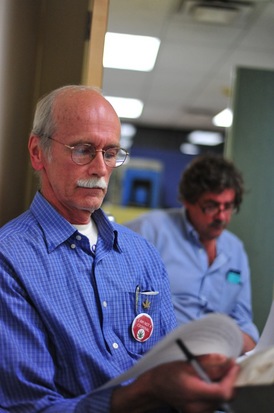
Medical marijuana advocate Chuck Ream, who opened a dispensary on Packard Road last month, looks over a draft ordinance Tuesday night regulating medical marijuana dispensaries in Ann Arbor.
Ryan J. Stanton | AnnArbor.com
"I hope that the Planning Commission is going to put together regulations that reflect the will of the voters, which was made very clear with a 74.28 percent victory for medical marijuana in 2004," said Chuck Ream, a longtime medical marijuana advocate who last month opened a dispensary on Packard Road near Iroquois Place.
"We need regulations specific to Ann Arbor that really reflect the wishes of our people," added Ream, who wore a button that featured a pot leaf and read: "I am not a criminal."
What the pro-reefer crowd learned Tuesday night is that it soon could be a violation of city ordinance for even the smell of marijuana to leave the boundaries of their property.
One of the many bullet points in the draft ordinance handed out during Tuesday's Planning Commission working session states: "No equipment or process shall be used in any medical marijuana dispensary which creates noise, dust, vibration, glare, fumes, odors or electrical interference detectable to the normal senses beyond the property boundary."
The draft ordinance also states all activity in a medical marijuana dispensary, including growing and dispensing, must be done indoors. Also, no dispensaries would be allowed within 500 feet of one another, within 1,000 feet of a school, or within 200 feet of a residential district.
A public hearing on the new ordinance is set for 7 p.m. next Tuesday before the Planning Commission inside city hall. The commission is expected to take a vote on the issue either at that meeting or at the following meeting on Oct. 5.
The ordinance is expected to go before the Ann Arbor City Council for a first reading by its meeting on Oct. 18, with final approval expected to follow in November.
The City Council approved a four-month moratorium on new medical marijuana dispensaries last month in an effort to give city staff time to come up with zoning regulations. The moratorium expires Dec. 3, and city officials are moving quickly to get an ordinance in place.
"The Planning Commission is looking for appropriate locations for medical marijuana dispensaries that are not in conflict with other uses," said City Planner Jill Thacher. "What's being considered right now, which is in early draft form, is allowing medical marijuana dispensaries in seven or eight of the city's zoning districts, and also allowing it as a home occupation."
The four-page document handed out Tuesday spells out allowable locations for medical marijuana dispensaries, allowable uses for them, and regulations for "home occupation" situations where residents want to act as home-based caregivers.
The draft ordinance states all operators of medical marijuana dispensaries must be registered as caregivers with the state of Michigan. Likewise, all patients must be diagnosed by a physician as having a debilitating medical condition and have been issued a registry identification card by the Michigan Department of Community Health.
Medical marijuana dispensaries would be allowed only in zoning districts D1, D2, C2, C3, M1, M2, RE or ORL. (Click here to view the city's zoning maps).
The different districts come with different regulations. For instance, in C2 and C3, dispensaries must meet minimum parking requirements spelled out in the city's existing codes.
In D1 and D2 districts, dispensaries would be limited to selling or otherwise providing marijuana and related drug paraphernalia to patients. Growing would not be allowed in those districts.
Drive-in marijuana dispensaries would be prohibited at all locations. And in all cases, no actual smoking, inhalation or consumption of medical marijuana would be allowed on the premises.
An annual zoning permit also would be required for all dispensaries.
In the case of home occupations, the draft ordinance sets a limit of one registered caregiver per single-family home, and limits that person to providing medical marijuana to no more than five patients. It also states that patients may not pick up marijuana at home occupations. Rather, the caregiver must personally deliver the medicine to his or her patients.
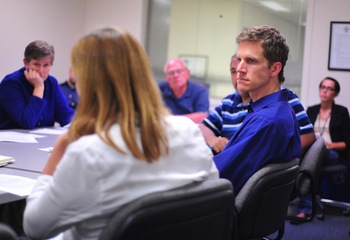
Planning Commissioner Kirk Westphal and other city officials discuss medical marijuana dispensary regulations Tuesday night.
Ryan J. Stanton | AnnArbor.com
Planning Commissioner Kirk Westphal acknowledged Tuesday night he has personal experience with a medical marijuana dispensary that moved in next to his downtown office this year.
"There is a dispensary in my building on Main Street, and I was surprised at the odor issue that's transpiring, and so were many of my fellow tenants," he said. "So, from that perspective, I'm hopeful that some awareness of best practices can be distributed, so that these new facilities don't cause a burden on landlords or the tenants who are already established."
Westphal said city code already regulates odor transfer in residential areas, and it looks as though the new ordinance would add that restriction for the downtown.
"But again, it leaves landlords and tenants to fend for themselves when it involves intra-parcel — or between units within the same parcel — transmission," he said.
As more and more dispensaries have cropped up throughout Ann Arbor in the last several months, city officials have been trying to get a handle on the situation.
They say there now are about eight or nine medical marijuana dispensaries in Ann Arbor — some downtown, some in residential neighborhoods and some in industrial zones.
"We have received complaints about some, not all, of the existing medical marijuana dispensaries that we know about," Thacher said. "And some of those things are a lot of traffic, and also odors emanating from the businesses, and the ordinance will seek to address questions like these."
T.J. Rice, owner of the Ann Arbor Patient-to-Patient Compassion Club, a medical marijuana dispensary at Fourth and Washington, attended Tuesday's meeting and said his dispensary opened in February.
A cancer survivor who lives on Social Security disability and uses medical marijuana himself, he said he works "on a private basis, more or less," and his clientele is small right now compared to others in Ann Arbor.
Rice and Ream agreed after Tuesday's meeting that the city may be overstepping its bounds with what it has proposed in terms of regulations for dispensaries.
Ream told planning officials he admired their work, but he said it's apparent they're "really new to this" and offered some constructive criticism regarding the regulation of home occupations. He said every facet of home occupation is already dealt with in state law.
"Anything that you add to this will just be (subject to litigation)," he said. "You can't add to the state law. You can't make things worse or harder than they are in the state law."
Ream also questioned the city's proposed limit of one caregiver per household.
"I'm going to be married soon to my true love and she is going to become a caregiver, I hope," he said. "I'm certainly going to be a caregiver. And isn't it clear that people who share common interests might love each other and be together, and might both want to be caregivers?"
Ream noted his dispensary, Med Mar Compassionate Healthcare of Ann Arbor, is within 200 feet of a residential district on Packard, which is prohibited in the draft ordinance. He said he hopes he can be grandfathered in since he opened a few days before the moratorium.
"The part about making everything happen indoors — that's another extension of the state law," he added. "You're saying something that the state law doesn't say."
Thacher noted that when Michigan voters legalized medical marijuana in 2008, 79 percent of the voters of Ann Arbor approved the proposal on the ballot.
"Statewide, different communities are doing vastly different things to address where to locate medical marijuana operations of different sorts because the state act gives virtually no guidance to municipalities," she said. "The different approaches range from banning medical marijuana use outright on federal grounds to permitting it in select zoning districts like any other use."
Officials said Tuesday night that City Attorney Stephen Postema is taking a lead role and working with the Michigan Association of Municipal Attorneys on a statewide approach.
City Council Member Sabra Briere, D-1st Ward, attended Tuesday's meeting as a casual observer. She offered her feedback to planning commissioners at the end, saying she was concerned about the issues related to zoning of caregivers.
"I'm not certain you're properly addressing this issue with this language, and it caused me to wonder a little bit about the goals here," she said.
Dennis Hayes, an Ann Arbor attorney long involved with the medical marijuana industry, encouraged planning officials to put patients first when drafting the ordinance.
"Check in with some of the existing places and see what they actually do," he said. "So you can see what happens in real life with people trying to accommodate the needs of the patients. The patient numbers vis-Ã -vis the accessibility of caregivers are growing out of whack. There's just a lot of patients who can't find good caregivers, and a lot of patients who can't find where to get medical marijuana that's suitable for them."
Ryan J. Stanton covers government and politics for AnnArbor.com. Reach him at ryanstanton@annarbor.com or 734-623-2529.
Comments
tommysnell
Sat, Sep 18, 2010 : 1:06 p.m.
Keith: As a registered Patient, Registered Caregiver, B.S in Horticulture from MSU and now a Nursing student I have seen first hand the benefits of MM for myself and others. Nitrogen, Phosphorus ect are Elemental Fertilizers...regardless of their source. Kinda like Oxygen is, well, Oxygen. There is little difference in growing Cannabis like there is little difference in growing Farmers Market produce (no regulation there).The subtle variances in culture practices are more evident in over-all yields and plant development and not at all similar to formulating a prescription pharmaceutical. It IS a weed and by nature a very simple-to-grow plant folks. Not rocket science, no need for regulated grows. There are actually Senior citizens in California who deliver meds on bikes to patients. It's called a job and compassion.
Keith
Fri, Sep 17, 2010 : 8:03 p.m.
I have been thinking about this for awhile now and have determined that its not the use of Medical marijuana that bothers me. Its how it will dispensed. When you receive a script from a doctor you take it to CVS and they fill it with proper medicine with instruction on how to use it. It comes with dosage amount 800 mg taken orally once every 6 hours. The drug is manufactured in a regulated industry. A doctor cannot prescribe MMJ and it's dosage. Its not regulated on how its grown. There are different THC levels. How about the damage it causes to your mental state,or the effects it will have on the patients lungs. Maybe we shouldn't care because there dying anyway. Ya know what i forgot this product can be baked into brownies. So, if its baked and sold wouldn't the same dept that inspects food service companies need to inspect the facilities. I mean these are people who have an immune system that is compromised because of chemo therapy. Right? Is the State regulate the type of environment it will be grown in, or will it just be grown in what ever fashion the so called caregiver in his/her "educated" opinion see's fit.
jhcer
Fri, Sep 17, 2010 : 3:26 p.m.
@JAM, You really said it perfectly. To me, this is not an issue of whether or not marijuana should be legal. That's already been decided and I'm not opposed to it. My issue is specifically 1818 Packard and the affect is has on the homes around it. If 1818 Packard opens, it will affect the neighboring homes. If anyone says otherwise, they are not being realistic to the truth. Ream absolutely should have done his homework. @Rusty: You can't compare 1818 Packard to Morgan & York, which is EXACTLY why they are zoned differently. Please see JAM's description and visit the area. Take a walk in that area. It's not even close to the same thing.
tracyann
Fri, Sep 17, 2010 : 2:13 p.m.
@Cash - my thoughts exactly. Also, as a caregiver and nursing student, I say to those who oppose it, don't delude yourselves. Stopping it will not stop the people who need it from aquiring it. And not from some back-alley thug, but from well-respected individuals in the medical community and other caregivers. There are many people who do benefit from MM and would rather use that than manufactured chemicals from a lab.
Cash
Fri, Sep 17, 2010 : 6:38 a.m.
They should be located wherever drug stores can be located. If a dr can prescribe chemical drugs with known life-altering side affects, and also prescribe a natural substance, what's the difference? Really do we think no one abuses prescription drugs? LOL Really do we think no one abuses alcohol? And as always people fear what they do not understand. Abuse chemical drugs and as long as drs prescribe them, no problem with the law. Grow a plant in your backyard and get raided. Go figure. You'd almost think multi-billion dollar drug corporations were controlling this country.
herbal_tea
Thu, Sep 16, 2010 : 9:13 a.m.
Whoever is supplying the dispensaries needs to grow better ish.
JAM
Thu, Sep 16, 2010 : 8:34 a.m.
Rusty: Here's the difference between Morgan and York and 1818 Packard: Morgan and York IS 200 feet away from the nearest residence; it's surrounded by other businesses; and there is a considerable parking lot AND a very tall fence (which qualifies as a conditional land use buffer) between that parking lot and the nearest home. 1818 Packard is a few feet from the surrounding homes, and the home closest to it is separated by a 4-foot chain link fence. (If I read the zoning right, it would be illegal to have a tall fence due to proximity to the corner and the sidewalk.) The plot is zoned C-1; every other business location in the area is zoned C-2. According to what the city already has on the books, that business location has probably ALWAYS been in violation of the land-use buffer code. There is more buffer between Dairy Queen and its neighbors than between 1818 Packard and its neighbors. This reminds me of the backyard chicken dispute...... the people who opposed backyard chickens aren't egg-hating vegetarians; they didn't want the nuisance of a farm in their backyard. This is an inappropriate location for any type of a business that could be considered an "attractive nuisance".... thus the C-1 zoning. Maybe if they'd bothered to do their homework first, they could have found a more appropriate location.
a2d3
Wed, Sep 15, 2010 : 10 p.m.
Reading the ordinance... looks way overly restrictive.. and way to many things going on. Looks like (to me) its breaking the parts of the spirit of the state law, it has rules in it that already exists in other parts of ann arbor ordinance, and it seems to be more restrictive in certain areas than if they were a registered pharmacy.
AlphaAlpha
Wed, Sep 15, 2010 : 9:18 p.m.
The people spoke, with unusual clarity: 79% is phenomenal. Yet so much fuss. More tax dollars wasted in debates. The war on drugs? Lost. 50 years ago. The status quo: fail. In caps. Time to legalize, tax, move on. And get relief to those in need.
bugjuice
Wed, Sep 15, 2010 : 6:21 p.m.
It's shameful that publicly paid bureaucrats and elected officials are working to overturn the will of the 75% of the voters who approved this law just because those bureaucrats and politicians suffer from their own twisted version of Reefer Madness. There is far too much paranoid hyperbole being tossed around on this issue by people who have a personal or political axe to grind, like law enforcement and public attorneys who would have fewer people to prosecute and might be out of a job if they can't put pot heads in jail The facts are that Marijuana is less harmful than mothers milk and it was made illegal so law enforcement and bureaucrats could justify their existence. The money spent on enforcement and prisons, the hundred billion dollar, decades long politically motivated "Drug War", could be better used to to provide therapy for those with serious addictions and fix real social problems like teen pregnancy and homelessness. Legalizing recreational drugs will remove the profit motive and thus take organized and street thug crime completely out of the picture. Jean Carlberg should worry more about the folks with big cash in their pockets who might get mugged after a dinner at the Chop House or the drunk students who cause problems at local clubs than some pot heads who want to get high and go home to snooze. Stop the paranoid lies and ridiculous hyperbole! Legalize it!
John Davis
Wed, Sep 15, 2010 : 5:19 p.m.
Cannabis was used as medicine for 2000 years before the politicians got hold of it. Most modern drugs take 10 to 20 years of evaluation before hitting the shelves. Depending more on how much money is put behind them How many more thousands of years will it take to overcome 70 years of political prohibition.
Ryan J. Stanton
Wed, Sep 15, 2010 : 5:02 p.m.
Breaking news on the medical marijuana front in Michigan today: http://www.annarbor.com/news/michigans-medical-marijuana-statute-needs-clarification-appeals-court-judge-says/
Christopher Lock
Wed, Sep 15, 2010 : 3:11 p.m.
My point above is basically that new attitudes (and subsequent policies) are coming, ready or not, and in California, much of it is here. But we're still figuring this out too. For instance, as a friend took a drag in my open convertible on Sunday (licensed and allowed to partake as often as he deems necessary for his arthritis), we passed out-of-state families shocked to see this open use in front of them (it's still technically not legal, though that may change in November). Walk around on any day and the scent wafts here and there in tony shopping districts or nice neighborhood, and any music concert can grow heavy with the scent. While I celebrate this as the "smell of California", it's preposterous that tobacco friends would be rightly shouted out of any bar for the last fifteen years while this is blown with abandon. I look forward to more sensible decorum once the novelty has faded, and though the near total lack of police anywhere in our sprawling city allows open use (though probably not legal), it probably does belong for use at home or in special clubs or bars, like tobacco or alcohol. As a public school teacher, I personally will have nothing to do with pot as long as it incarcerates young people or kills them in gangs -- and there ARE health effects to watch, though probably not as severe as tobacco or alcohol. What Ann Arbor has to keep in mind, which thousands of miles of let-live West Coast doesn't, is that if the surrounding region remains somewhat repressive, the town attracts a disproportionate number of "visitors", many causing more trouble since they see this as a visit of wild abandon. As some have said, Ann Arbor doesn't need to be known as an "anything goes" Amsterdam. I think of the well-intentioned park in Switzerland that humanely permitted all drug use, with medical help nearby, and being the only such place, attracted users from all over Europe and eventually closed after being overwhelmed. In other words, even a tolerant community should proceed carefully if it outlying regions would only give them their troubles. Better for the whole state to proceed, with caution and regular refinement, perhaps Ann Arbor and a few other towns taking the lead in sensible innovation, and bring a Midwestern-style competition to what will otherwise become another California-led industry.
rusty shackelford
Wed, Sep 15, 2010 : 3:08 p.m.
I was mistaken in the original location of 1818 Packard, however I believe my point still stands. It is less than 2 blocks from M&Y, and the same distance from both another liquor store and a cigar store.
Ricebrnr
Wed, Sep 15, 2010 : 3:03 p.m.
Yes please shut this down! Let them get their MJ behind Dairy Queen across the street or in the ally from Main to the Hands on Museum when I'm with my family. SO much more wholesome. Stop being ostriches and sheep!
a2d3
Wed, Sep 15, 2010 : 2:49 p.m.
@abby: "but the emphasis on my initial comment is while we allow use of medicinal marijuana without fully evaluating the impact." In all due respect.. no it wasnt... "I don't agree with this medical marijuana, its a bunch of BS." "Its just to get marijuana legal and more on the street. " " I don't care what anyone says people will do what they want just to get what they want even if it is at someone elses expense. Its the American way! Thats why its pure BS." [BTW: Im pretty sure if I abbreviated swear words through out my comments I would have been modded out.... ] "The younger generation and absent-minded (drug users) had and/or used a dieing elderly parent, grandparent, etc. to convince medical science that smoking marijuana makes them feel better" Actually if you read research papers on clinical trials on marijuana from the last 15 years it's pretty well established that it has positive effects on various disorders and diseases. So while people gave anecdotal evidence that initiated research in the area... it was science convinced science... ( a lot of medical drugs get their start this way.) "they passed it as law now they are going to make it common "practice"" It was already common practice. "next thing you know ANYONE will be able to purchase marijuana." Anyone can purchase it now. "Cops won't be able to keep up with it and a few of them may end up buying there too!" They cant keep up with it right now. There wouldn't be anything to keep up with if it was legal.. And some cops do smoke pot.
Lokalisierung
Wed, Sep 15, 2010 : 2:23 p.m.
"but the emphasis on my initial comment is while we allow use of medicinal marijuana without fully evaluating the impact." how much do you really need to "evaluate" reefer. I'm not Someone who thinks that anything that is natural is great, because thousands of things natural can kill you. But anyway, Weed has been around forever and we all pretty much know the effects. You get high, you eat a lot, some pain goes away, maybe some paranoia, You can get addicted to it etc. Big whoop. How long do you think people chomped on viagra before they "legalized" it? Not as long as people have been smoking weed. people who are sick and feel better by smoking weed let them. Is it really worse that oxycontin that just turns into Herion when it's in your system?
Abby
Wed, Sep 15, 2010 : 2:09 p.m.
@Hans Masing, I am sorry to hear all the suffering your mother went through while under going treat, but the emphasis on my initial comment is while we allow use of medicinal marijuana without fully evaluating the impact. @Christopher Lock, well said. One could only wish that someone within Washtenaw County or the State of Michigan is open-minded enough and with a little common sense will look into your suggestion, instead of walking around here with a "Big House" attitude that you see well too often around.
Urban Sombrero
Wed, Sep 15, 2010 : 1:51 p.m.
@Edward Vielmetti: Does annarbor.com ever plan on introducing an "edit" function/button into the site"?
Abby
Wed, Sep 15, 2010 : 1:48 p.m.
You all need a little more humor in your life, because when I said..."I is a graduate.....", it was intentional. Maybe I should have put...LOL.
Woman in Ypsilanti
Wed, Sep 15, 2010 : 1:47 p.m.
FWIW, I don't find the argument that medical marijuana laws will result in the substance being legalized to be very valid. I do agree that we are headed in the direction of legalization for recreational use. I just don't see why that is a problem. Why is it any business of the state if someone wants to unwind with a joint once in a while? Most of the social problems associated with marijuana are related to its prohibited use and not to the drug itself.
Urban Sombrero
Wed, Sep 15, 2010 : 1:46 p.m.
As long as I live, I will never get why people are so damned afraid of marijuana. Safer than alcohol. Safer than tobacco. Non-addictive (at least not physically addictive). Yet still, it's verboten to test it. It's verboten to use it. Ridiculous! I say, legalize it! Tax it! This country would be in the black within 5 years. I hope Prop 19 passes in California. If it does, I expect (barring Federal intervention, that is) that it will be a humongous success. And, if so, will be adopted in many more states in the future. Legalize it. Tax it. Solve the budget deficit in one fell swoop! Bada-bing, Bada-bang, Bada-boom! Fiscal solvency!
Craig Lounsbury
Wed, Sep 15, 2010 : 1:21 p.m.
@Bear @ craig lounsbury, in all fairness, you should probably follow your own advice. The proper term is 'ought', not 'aught', which is an archaic word, similar in meaning, but not the same, nor universally interchangeable with the term, 'ought'. >>. Bear, with all due respect I offered no "advice". I was pointing out that none of us have the ability to edit our mistakes. At least I don't see an edit button on my computer screen. I wasn't meaning to pick on Abby, nor did i mean to suggest I never make mistakes. To the contrary I was suggesting an edit button would be nice feature for any of us to fix our errors.
Hans Masing
Wed, Sep 15, 2010 : 1:12 p.m.
@abby - I sure do wish you'd been able to give your rant to my mother a couple years ago. When she was still alive, of course. That would have been while she was dying of ovarian and anal cancer, undergoing chemo and radiation, and the *only* way the doctors could get her to have an appetite was with medicinal marijuana. It relieved her pain, let her relax, and she would get the nutrition she needed due to the medicinal effects of marijuana. I am sure you would have maintained your strict non-tolerance policy in the face of a 65-year old woman who was half her weight, ravaged by disease, and unable to take full breaths before she would be wracked by coughing fits due to the pain. But, of course, you see the drug as the media and DEA want you to see it - and that's really unfortunate.
Bear
Wed, Sep 15, 2010 : 1:11 p.m.
@abby. So, by EVERYDAY people, you must mean people like you. Because I am wondering who is excluded from the term EVERYDAY people. I am also wondering just what that term actually means, since it appears to be nonsensical. Also, Reefer Madness is a well-known propaganda movie filmed in 1938. Rediscovered in the 1970's, it has found new life as unintentional comedy, mainly because of the exaggerations and fabrications attributed to marihuana smoking. It is common knowledge, even amongst the uninitiated. And I am sorry, but your references to Amsterdam show your bias, which, in my opinion and using your own terminology, is "pure BS". You appear to be totally ignorant of the situation as it stands; which is what your term "EVERYDAY" people must allude to. @ craig lounsbury, in all fairness, you should probably follow your own advice. The proper term is 'ought', not 'aught', which is an archaic word, similar in meaning, but not the same, nor universally interchangeable with the term, 'ought'.. That given, the statement offered by Abby, "I is a college graduate..." although probably unintentional due to a lack of patient proofreading before hitting the 'submit' button, is HILARIOUS! But seriously folks, keep your clucking tongues in check; marijuana isn't the boogie man it has been made out to be for political purposes. No need to jump on the NIMBY bandwagon out of fear and so-called 'righteous indignation'. Get off the bandwagon, calmer heads should prevail, the sky is NOT falling, and whether you will admit it or not, marijuana has been easy to obtain, despite legal persecution for many decades. It is everywhere, it is in common use by both liberals and conservatives, rich and poor, the ignorant and highly educated. THAT IS WHY IT'S LEGALIZATION FOR MEDICAL USE WAS FAVORED BY TWO THIRDS OF THE VOTERS IN MICHIGAN!!!!! Clue up people, not everyone has your hardheaded neanderthal way of reasoning on this issue.
Christopher Lock
Wed, Sep 15, 2010 : 1:05 p.m.
Some A2 decision-makers may want to make a quick trip out here to Los Angeles to see how it's handled with little fuss after a time of free-market experimentation. California basically legalized this a few years ago -- maybe not technically, but anyone who wants the stuff can get it and it's not only not a big deal but use continues to decline in the younger population, losing its intrigue quickly except for a fraction who'd be into it for personal or medical reasons anyway. There was an initial flurry of competition, unregulated, and even "pot-heads" thought things were getting out of hand. After about a year, the majority of fly-by-nights were cleared out, but shops that met new criteria were allowed to stay: not being close to schools, housing, or too concentrated, nor allowing use on premises, looking more like high-end beauty counters and each with a security guard that tolerates no loitering anywhere near the facility. You want the security requirement because these places had a spell where they tended to get robbed. Several friends obtained their license-to-carry cards after short doctor visits and can buy it at near the same street-cost (which seems terribly expensive to me -- but then, I haven't smoked in fifteen years). The dispensers want this to work more than anyone, so they are meticulously clean, silent, smoke-free neighbors, shoo anyone from use nearby and market sleek, long factory-rolled cigarettes in futuristic boxes (7 per pack at $30), loose-leaf, buds, pills, brownies, pizza, even ice cream (I do not lie). What's happening here is recognition that for generations California's major crop has been cannabis. The state is de-funding drug gangs and perfecting its own market niche, none of my friends having to do anything with "underground" sources relating to crime gangs, and nobody going "crazy" since it costs about the same but is now taxed like crazy. Ann Arbor's reasonable tolerance could launch similar competitors in the Midwest. The expense of imprisoning pot dealers and drug users is shifting toward spending the money on intervention and taxing it as recreation. The "Drug War" failed, a better model is coming. The question is, will Ann Arbor study how it's done in other places and open a niche industry, or watch California perfect the market?
5c0++ H4d13y
Wed, Sep 15, 2010 : 12:22 p.m.
When did medical marijuana get FDA approval for marketing? Every other drug for sale does.
other
Wed, Sep 15, 2010 : 11:16 a.m.
Rusty: you have the wrong location - it's where the Aquatec place used to be, on the same side of the street as Morgan an York. you can't miss it. the address (1818 Packard) is HUGE. It's right next to the house on the corner of Iroquois and Packard.
Craig Lounsbury
Wed, Sep 15, 2010 : 10:54 a.m.
"I is a college graduate at the top 5% of my graduating class," In fairness we all aught to have some minor ability to edit our posts IMO. Nothing major mind you, just things that slip past the spell check.
Abby
Wed, Sep 15, 2010 : 10:46 a.m.
@John Davis, do u have a medical degree? @Forever27, I don't know what show or magazine you are even talking about, my comments are based on what how EVERYDAY people are responding to this law. My comments are based on observation even though I do have a professional medical background, with a little bit of law enforcement AND I is a college graduate at the top 5% of my graduating class, not that I have to substantiate myself here.
rusty shackelford
Wed, Sep 15, 2010 : 10:38 a.m.
Ann Arbor has a long history of tolerance of marijuana. I hope that both zoning officials and pitchfork-wielding commenters will remember that according to the city of Ann Arbor, possession of marijuana for personal use, for any purpose, is considered only about as bad as overstaying your parking meter. That is the town's longstanding attitude (overblown outrage on the Internet notwithstanding) and any zoning issues ought to be considered within the context the city's history with the substance.
rusty shackelford
Wed, Sep 15, 2010 : 10:35 a.m.
Um, Ream's store is on a commercial strip of Packard, right across from Morgan and York. I don't see any kind of ignorant outrage over them selling potentially intoxicating chemicals "only 200 feet from homes with families."
jhcer
Wed, Sep 15, 2010 : 10:19 a.m.
Shame on Chuck Ream for even TRYING to open a Medical Marijuana facility in such a residential neighborhood. He should NOT be grandfathered in. The fact is this type of facility does NOT BELONG in a residential neighborhood. Do not get me wrong, I am not against medical marijuana, I am against plopping a facility smack dab in the middle of an area full of homes with families. There are other locations in Ann Arbor available that are not so residential. A complete lack of regard on Ream's part for the residents that inhabit this area is frankly upsetting. Our economy is already struggling and his facility with make the value of those homes around it plummet. I don't care what anyone says it will NOT be safe to put a facility in a residential area. And the person who wants to be reactive vs. proactive clearly doesn't have children that play near this area. Are we going to wait for something bad to happen before we act? And what does the city owe Ream that would warrant a grandfathered clause on an issue that should have been plain common sense in the first place? I really hope City Council does what it's supposed to do and thinks about what is best for the citizens of A2. Just because we voted to allow people to be treated does not mean it should be in anyone's back yard when there are other, more commercial areas, available. Noone should be grandfathered in. It's because of his poor judgement that this is even being looked at, let's be honest.
Forever27
Wed, Sep 15, 2010 : 9:49 a.m.
@Abby, you should stop watching the movie Reefer Madness. Your paranoia is sad. The only reason Marijuana is illegal is because of the paper/alcohol/tobacco lobbies. Not to mention the racist propaganda used during the 1940's and on.
John Davis
Wed, Sep 15, 2010 : 9:35 a.m.
Ok one more before I go. Doctors can not "prescribe" cannabis, they have to recomend a patient use it. To prescibe it would vilate Fedral law and they would be arrested imeditately. The law was written in this manner because to many people fear complete legalization. So enough restrictions had to be in place that those fears were put to rest. Otherwise to many on the fence voters would have rejected the measure for fear they were supporting a legalization bill. Caregivers are not hard to find. And growing your own is simple and cost effective, any one with a sick family member can be their caregiver. Check out the Michiganmedicalmarijuanassociation.org website and you will find no shortage of avalible caregivers.
Craig Lounsbury
Wed, Sep 15, 2010 : 9:12 a.m.
@xmo "Since this is a prescription drug, why don't they sell it at Rite-aide, CVS or Walgreens? Why do they need a special store?" Which is exactly why the law is poorly written. It allows for a prescription drug to be used but with no way to get your prescription filled short of farming it yourself. Or finding a farmer who is limited to 5 customers by law. With due respect to Mr. Davis who I initially agreed with in his first post, the law IS poorly written.
John Davis
Wed, Sep 15, 2010 : 9:08 a.m.
Abby, Cannabis was used as medicine for 2000 years before becoming a political issue. If you have a Medical degree then your opinion on what counts as medication is valid. If you are not a medical professional then your opinion is not based in fact or science and is just BS. All any of the medical marijuana patients are asking is for Doctors to be ones deciding what works for treatment of a patient. If you feel that you are better qualified to do that than a medical Doctor then by all means, explains your qualifications so that we may better understand your position. There are several groups working toward changing the marijuana laws in this country. Most believe that the top priority is to help stop legitimate patients from have to continue suffering at the hands of people who have no stake in this. I have a Mother dying of cancer who won't use the cannabis her Doctors are begging her to try. She is not dying painfully from the cancer, she is dying painfully because people like you who have no medical background and have done no medical research (or any research at all) are making political decisions based on ignorance and fear. Medicine should be regulated by science not politics. Some groups have the complete legalization of cannabis as there hopeful end result. Some feel this is the only way to protect patients and Doctors from further pain and prosecution. Other just want prohibition ended because of the huge cost it has taken from us as a Country. Yes others still just want to get high. But all agree the first priority is to get the patients off the front lines before continuing to try and end the war being fought against the American people by its own Government. Now if you will excuse me I was just call to Karmonos, My Mom won't be coming home this time. She likely won't survive the night. I sincerely hope your health never degrades to the point you need the medicine you feel so comfortable deigning others.
treetowncartel
Wed, Sep 15, 2010 : 9 a.m.
Their product is already ending up in the hands of people with out cards. I hear they are charging exorbiant prices as well. this will only make the black market more attractive as with any thing that is regulated by government. yes you can get it legally, but you can get it illegally for cheaper. Mooonshine and cigarettes come to mind offhand.
xmo
Wed, Sep 15, 2010 : 8:50 a.m.
Since this is a prescription drug, why don't they sell it at Rite-aide, CVS or Walgreens? Why do they need a special store?
John Davis
Wed, Sep 15, 2010 : 8:36 a.m.
There is nothing wrong with the way the Law is written. It HAS NO GREY AREAS! It was written very clearly and very simply. The only people who think there are "grey areas" are those people who want to change the law to their own benefit. People like Oakland County Sheriff Bouchard who uses the public's fear to try and convince people the law has something that needs to be changed. He proclaims the marijuana is being guarded by alligators but does not tell you that the alligator was 8 inches long and in an aquarium. Sheriff Bouchard fought hard against this law before it was passed and now that he lost his election bid and is out of a job, he grabs as much press as he can. He wants the Law changed and hopes to get a private sector job because of the press he gets in shouting about it on the TV. The dispensary owner wants the law changed too. They want it changed so that they can legitimize their business operations. They Law as written does not permit for profit businesses. Care giving is meant to be a compassionate service, similar to nursing and other caregivers for the sick. When was the last time you saw a well to do nurse? Most nurses I know have trouble making ends meet just like the rest of the working class. They do their work for the benefit of the patients, not for the money. There are no GREY AREAS in the Law! It DOES NOT need to be changed at this time. People need to give the Law a little time to work the way it was intended. The Law is not even 2 years old, we have Laws that are 70 years old and we are still trying to get the kinks worked out. Are for profit dispensaries a good idea? Yes they are. Do we need them? Yes, there is a need. Should we allow them? Yes we should allow dispensaries in communities that want them. That is what local government is for, to determine how to regulate commerce locally. Does Lansing need to step in and make changes in the Law? NO, let the local governments do their job and regulate their own communities. Just like the Federal government needs to stay out of States rights issues (like the medical use of cannabis), the State needs to stay out of Local issues (like the regulation of Commerce). If the voters of Michigan want to change the Law then so be it. Lansing needs to stay out of the way and let the voters speak. In 2008 63% of voters said this is the Law we want for Michigan. Give the voters time to have the Law they voted for work without political or business greed getting in the way! And for God sake quit hurting patients to further your own personal gain. Sheriff Bouchard this means you! It is not ok to pull patients out of wheelchairs, throw them to the ground, but a knee on their neck and a gun to their head, take whatever cash they have (with no evidence of a crime and no charges filed) and the medicine their Doctors recommended. You ARE NOT A MEDICAL PROFESSIONAL! YOU DO NOT HAVE A MEDICAL DEGREE! YOU DO NOT GET TO FORCE YOUR MEDICAL OPINION ON OTHERS! If the voters need or want a change to benefit the patients it is not the Law that needs changed. It is the actions of those who were meant and are paid to protect us. Tell me, is it OK for YOUR tax dollars to go toward State employees breaking State Law to further the career of a failed politician, Mike Bouchard? Is it OK for SWAT teams to use patient information protected by HIPPA and State laws to break into a dying man's home, and finding no marijuana or anything illegal, to then take all of his cash and TVs with no crimes even charged against the patient. Sounds like robbery to me. If you did not commit a crime, and just being a patient is NOT a crime, and someone took your stuff what would you do? Let's put it another way, police are now trying to get a list of patients who buy prescription pain killer from pharmacies. Do you or have you ever had to take a pain killer? Prescription painkillers are a controlled substance. The police can take that list of patients, target them like they do Cannabis patients, and come into your home take whatever they find of value and then leave you broke and beaten on the floor in handcuffs. Why? Because you have a prescription for a drug and drivers licenses, so you must be a druggie driving illegally. You have just forfeited your cash, car, home, and anything they can sell at auction. Sound farfetched? This is exactly what happens to Medical Marijuana Patients all the time, in Oakland County it just happens more often with a press conference afterward. If you want to be pissed off about something, be pissed off about the violent way our States patients are being treated by the people we pay to protect us.
JAM
Wed, Sep 15, 2010 : 8:13 a.m.
So the name of the place on Packard is actually "Med Mar Compassionate Healthcare of Ann Arbor"? Then why don't they have THAT on their great big sign, instead of "1818 Packard" with marijuana leaves wrapped around it? If they want to be taken seriously as medical business people, maybe they should conduct themselves that way.
a2cents
Wed, Sep 15, 2010 : 8:04 a.m.
Always curious about the term care-giver, now I understand (?): Care has nothing to do with the patient... it's all about the plants. Unrelated, but my sensitivity to the complications of being a neighbor to a drug house increased when the one down the block was closed and a number of neighborhood issues evaporated. Also: Fried food would all but disappear if the odor rule was applied to restaurants.
Abby
Wed, Sep 15, 2010 : 7:54 a.m.
I don't agree with this medical marijuana, its a bunch of BS. I didn't agree with it then & I still don't agree with it now. If I wanted to live in Amsterdam, I'd move to Amsterdam. Its just to get marijuana legal and more on the street. Believe me that is were its headed. I don't care what anyone says people will do what they want just to get what they want even if it is at someone elses expense. Its the American way! Thats why its pure BS. The younger generation and absent-minded (drug users) had and/or used a dieing elderly parent, grandparent, etc. to convince medical science that smoking marijuana makes them feel better, so they passed it as law now they are going to make it common "practice" and next thing you know ANYONE will be able to purchase marijuana. Cops won't be able to keep up with it and a few of them may end up buying there too! I agree with the guidelines/regulations here, sometimes you have to put the cart before the horse, ALphaAlpha. That natural thing don't happen when you dealing with the general population of this country unless you are holding a crystal ball....LOL
Craig Lounsbury
Wed, Sep 15, 2010 : 7:42 a.m.
I might add that there needs to be a better way for the folks who legitimately benefit to get their "medicine". If I want an aspirin I don't have to plant an aspirin bush and wait several weeks for the bush to grow bid enough to spit out a couple pills.
Craig Lounsbury
Wed, Sep 15, 2010 : 7:19 a.m.
John Davis makes an excellent point. As I understand the law a care giver/provider can have a maximum of 5 patients/customers. How can one possibly operate a store front with a maximum of 5 customers? The law was poorly written from the beginning.
dextermom
Wed, Sep 15, 2010 : 6:52 a.m.
What a novel idea!
John Davis
Wed, Sep 15, 2010 : 6:27 a.m.
State law allows caregivers to grow the patients plants for resonable compensation. The plant and all medicine from those plants belongs to the patient. The caregiver is just growing it for the patient. So what are these guys selling and to who. If they are just using a storefront for a convenient place for thier five patients to pick up there meds then fine. But the minute they sell to someone who is not one of their five patients they are committing a crime. They are selling meds that belong to their patients. Unless the patients are receiving all profits, but if that is the case how do you afford to keep a store open?
AlphaAlpha
Wed, Sep 15, 2010 : 5:48 a.m.
Alternately, the city could suspend implementation of regulatory efforts, let things evolve naturally, and react as needed to whatever actual problems arise, if they even arise.