

Ann Arbor officials talk about need for cuts to police and fire
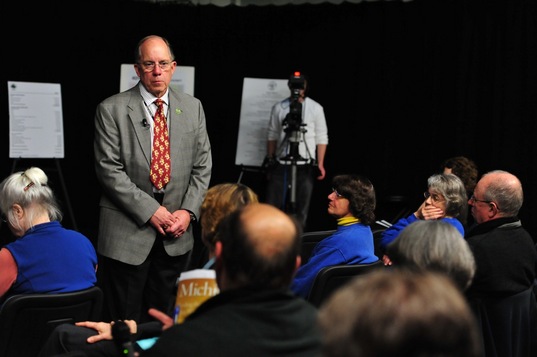
City Administrator Roger Fraser takes questions from the audience at Wednesday's town hall forum on the budget at CTN's television studios.
Ryan J. Stanton | AnnArbor.com
Ann Arbor City Administrator Roger Fraser recalls better times — just a year ago — when the city had a balanced two-year fiscal plan that included spending $83.25 million in 2010-11.
But with the economy sinking further, and after slashing general fund spending to $77.88 million, the city still has about $1.53 million in red ink to worry about as it heads into the new fiscal year in July.
The Ann Arbor City Council ultimately will approve a balanced budget, but the cuts will be felt this year, Fraser said.
Fraser laid out the details of his 2010-11 budget plan at a town hall forum Wednesday night attended by about two dozen residents and taped for rebroadcast to the entire city on CTN.
As the size of city government shrinks, Fraser said city officials continue to pursue opportunities for regional collaboration and explore privatization of operations. He spoke of efforts under way to consolidate services with Washtenaw County and other surrounding municipalities and reminded the crowd of successful efforts to form a joint city-county office of community development in recent years.
"Many of you will remember that several years ago there was a countywide millage that authorized the overhaul of public safety radio systems," he said. "That is the 800-megahertz initiative. We are in the process this summer of establishing a joint dispatch operation with the county for police services, and again, the experiment here is to have county employees and city employees working side-by-side."
Talks of regional cooperation on fire services also are ongoing, Fraser said, announcing plans for increased cooperation this summer.
"We've recently reached an agreement with the city of Ypsilanti and Ypsilanti Township where we have a functional fire district," he said. "And what that means is that, rather than assigning people to fires based on political boundaries, we're taking a look at where the equipment is, where the stations are, and where the fire is. And the closest equipment, the closest people — whether they're in Ypsi city, Yspi Township or the city of Ann Arbor — respond to that fire," he said. "We've developed a set of protocols around that that we're in the process of formalizing."
Fraser's budget contemplates reducing the city's full-time employee count from 766 to 706. That includes eliminating 20 positions in police and 20 in fire.
On the minds of residents Wednesday night was how those cuts would play out in terms of the city's ability to protect and serve.

Mayor John Hieftje joined Fraser on Wednesday to talk with residents about the city's budget problems. "Every year we work harder on the budget," Hieftje said.
Ryan J. Stanton | AnnArbor.com
"We're not proposing in this budget that we can provide the same level of services in 2011 that we did in 2010 or 2009," Fraser said. "We will do everything we can to minimize those impacts. But it's going to take a whole lot of creative work on the part of our people — both managers and folks on the line — to try to optimize what happens. You'll see some changes."
With police and fire making up half the general fund budget, Fraser said they couldn't be protected from cuts in this year's budget.
"As we talked with council about this, it was their belief and it's my belief that we didn't want a community that was strictly police and fire — that we cherish our parks and we cherish a lot of things that we do," Fraser said. "We need still to do code enforcement, we still need to do good planning — we need to do a lot of those things — and so this is an effort in some ways to catch up, because safety services now represents about 52 percent of our total budget. It used to be closer to 40 percent."
Mayor John Hieftje said the City Council isn't necessarily going to agree with all of Fraser's recommendations, but his comments at Wednesday's forum supported many of Fraser's notions.
"One of the things that we have been fortunate of in Ann Arbor is that our crime rate has been going down," Hieftje said. "Now it doesn't go down steadily every year ... but it's down 15 percent from 2002 and 2003."
Hieftje said it's important to have four firefighters on the scene of a fire as soon as possible and, despite cuts, the city will do everything it can to make that happen.
Fraser said the new fire chief believes that even with 20 fewer firefighters, all five stations can be kept open — though there may be "rolling closures" where a station may be closed on a given day.
"One of the strategies that we believe may very well work is we have two stations where we have more than one engine company," Fraser said. "And if we distribute all of those trucks to the five stations, we can keep them all open, and that's what we're hoping to do. We're also at the same time planning to reduce the number of supervisory and managerial ranks in the service and push down the number of people out of the administration and onto the street."
Fraser addressed how city leaders came to achieve a 3 percent reduction in compensation for all nonunion employees — a budget directive handed down by the City Council.
Fraser revealed the reduction, which affects him, doesn't actually involve any decrease in pay. He and the city's budget team worked to achieve the savings by increasing employee costs for health insurance, among other changes to benefits.
"We have a longevity program that allows people who have a certain number of years to get a flat-rate amount just for longevity — it starts at the end of five years and it increases in five-year increments after that," Fraser said. "That goes away. There are a number of things like that that, in total, wind up to a 3 percent reduction in total compensation for nonunion employees."
Fraser said the city has been able to make those kinds of changes unilaterally with its nonunion employees. The city has not had luck, however, trying to wrest concessions from the city's labor unions.
"Because of the state laws related to collective bargaining — particularly for emergency services personnel — we have had very little success," Fraser said. "For police, particularly, they still have fully paid health care. Their contributions to retirement have not changed. They still have virtually all the benefits that they had in 2005. We're negotiating at that, but they can be as obstreperous as they want to be and our recourse is to go to 312 arbitration."
One resident at Wednesday's forum asked Fraser why the number of traffic citations is down and whether it corresponds to a decrease in police officers.
"It's sort of an interesting trend," Fraser said. "It's not just in Ann Arbor, but it's around the state that it's down. The other thing that was also part of our revenue shortfall that I mentioned (is that) the district court is down several hundred thousand dollars in revenue compared to their forecast. Their actual caseload has fallen off. The number of filings in the district court has dropped dramatically, and that also then directly relates to the amount of money they collect."
Fraser said he was at a loss to explain the trends as one would typically expect the numbers to increase in a tough economy.
As further cost-cutting is considered, Fraser said the city owes it to citizens to explore privatizing operations like the Huron Hills Golf Course. He also plans to explore outsourcing building inspections, plan review and other planning functions.
"The Chamber of Commerce has complained and complained and complained that we have not made adequate use of the private sector to provide services ... and that the private sector can do it more cheaply than we can," Fraser said, adding those arguments could very well prove true.
Fraser said the city also will be evaluating over the next year whether it makes sense to get out of the solid waste business. He noted that between now and June 2011, between 40 and 60 people in the city's AFSCME union — many of whom work in solid waste, street repairs, etc. — are expected to retire.
"Their contract expires a year from now," Fraser said. "We believe that there are reasons why a number of them will want to go on before we start seriously sitting down and talking about a new contract. And with that in mind, we're also trying not to hire replacements for those folks."
Ryan J. Stanton covers government for AnnArbor.com. Reach him at ryanstanton@annarbor.com or 734-623-2529.
Comments
anti-thug
Sat, Apr 24, 2010 : 12:04 a.m.
I see what they are doing, cut fire service and police then the police will have more jobs.
Awakened
Sat, Apr 10, 2010 : 9:18 a.m.
@bornNraised Thank you for the information. Too often people miss the concept that free speech and free exchange of ideas includes correction of misinformation. You are correct that I only have the word of the individual who identified himself as an AA firefighter. I do not know his name. He was in his cups but I wondered if it were a case of 'In vino veritas.' You have eased my mind on the subject.
ronaldduck
Sat, Apr 10, 2010 : 6:18 a.m.
The last link states, "... in February 2009, an arbitrator ruled that the city of Ann Arbor must pay its largest police unions retroactive raises dating back to 2006. Some of the raises were as high as 3 percent. Yet in December, the city learned it was facing an $8 million deficit over the next two years not including the $1.5 million the retroactive raises would cost the city." Someting else that just dawned on me. This states that the arbitrater ruled in Feb on the raises and that in Dec the city learned about the deficit. I don't know how the arbitrater is supposed to know about a deficit that will be announced 10 months later that the city apparently didn't even know about yet.
ronaldduck
Sat, Apr 10, 2010 : 6:09 a.m.
aataxpayer All three links you listed are for organisations that are not neutral on this issue, but are in fact very anti union. They will not show any of the rulings that go in favor of the municipality because they advocate that the municipality should always get its way irregardless of the inpact on employees. Therefore any "facts" from these groups need to be taken with a grain of salt. The last link states, "... in February 2009, an arbitrator ruled that the city of Ann Arbor must pay its largest police unions retroactive raises dating back to 2006. Some of the raises were as high as 3 percent. Yet in December, the city learned it was facing an $8 million deficit over the next two years not including the $1.5 million the retroactive raises would cost the city." I'm not familiar with this ruling but it appears that either the city refused to honor the contract and give raises that were in it or the PD was operating without a contract for three years in which case they needed someone outside to help settle it. I repeat what Ben Woodruff said. 95% of contracts are settled without arbitration and of the reamaining 5% half go in favor of the municipality. When police and firefighters are given the same rights as everybody else then we can talk about getting ride of act 312
Awakened
Fri, Apr 9, 2010 : 7:37 p.m.
@Ben Woodruff You are correct. I have no experience in the field. I heard an Ann Arbor firefighter say that they would not hire a townshop paid on call firefighter because they were scabs. Also that they would not work a fire in the townships that was under the control of the township department. The combination does not feel like the kumbayah togetherness you intimate. Perhaps, since you seem more in the know, you could tell me how many times AAFD has fought a fire under the command of a township departmenr or township paid on call officers have been hired? This AA firefighter said never. Ever. Please prove him wrong.
BenWoodruff
Fri, Apr 9, 2010 : 6:43 p.m.
aataxpayer, once again...how about some proof? i've told you what the stats are, and you make the same argument without back up...how about this, you remove act 312 and allow firefighters and cops to strike...whaddya say?
Mick52
Fri, Apr 9, 2010 : 3:52 p.m.
Seems like the PD and FD are the primary targets. Does anyone know how much the city spends on its social agenda programs? Are they funded by grants? Are they self sustaining? I would prefer cuts in non essential services rather than essential services. I know the YMCA fiasco cost in the millions to relocate the residents, is this common in city housing? I guess what is essential vs non essential is determined by ones political leanings...
Lokalisierung
Fri, Apr 9, 2010 : 1:30 p.m.
Ben, I hear what you're saying and in a perfect world I would love as many FF as possible, of course. I think they do an amzing job and when you're butt is in the ringer you need as many of them as possible. But of course, in reality, your average AAFD isn't "running into a fire and saving lives" that much. We all know that is true, we've all talked about it a billion times. There is only so much money to go around. Residents have elected officials to oversee the budgeting of that money by the City Administrator that they hired. If it were up to ME, I would cut the parks budget to shreads and not lay off any AAFD/PD. But I'm in the minority so there you go. My "Tough Work" is not as tough as there's a freely admit. Then again my "not tough work" isn't as "not tough" as theirs is. It's a balance. I'm not saying I'm as important as a FF that can save people's lives, but then I don't make as much money as they do.
BenWoodruff
Fri, Apr 9, 2010 : 1:14 p.m.
Loka...yeah, but your "tough work" probably isn't running into a fire, trying to save lives and property...let us all know when you decide to volunteer...
Lokalisierung
Fri, Apr 9, 2010 : 12:16 p.m.
"when there is a fire, every fire department, union and nonunion is GLAD to have extra hands on deck..." Well of course they are, when we have tough work to do at any job we'd love more hands. Doesn't mean we can afford it or should pay it.
BenWoodruff
Fri, Apr 9, 2010 : 9:29 a.m.
Awakened, you know not of which you write...when there is a fire, every fire department, union and nonunion is GLAD to have extra hands on deck...if you worked in this field you would know that...
BenWoodruff
Fri, Apr 9, 2010 : 9:26 a.m.
aataxpayer, why would the city avoid arbitration when they can bust the union's pocketbook by driving them to act 312 on every issue? maybe they don't want to have to "show the books" to an independent arbiter and show that they do have ability to pay...what does the city have to lose? once again, i challenge you to look at the arbitrations that have occurred and check the facts...unless they don't fit your preconceived notions...
ronaldduck
Fri, Apr 9, 2010 : 8:03 a.m.
Sorry Awakened but Pittsfield Twp has 18 full time union firefighters that handle all the daily calls. When they have a working fire they call out their paid on call FF's. And you are absolutely wrong when you say the full time departments won't work with the payed on call departments. They work together all the time with no problems.
Awakened
Fri, Apr 9, 2010 : 7:54 a.m.
@Bornnraised. Sorry, I was basing this on comments I heard made to a friend of mine by one of your co-workers. My friend is a township firefighter. How many former AATFD, PTFD, Scio Twp figherfighters work for AAFD?
Awakened
Fri, Apr 9, 2010 : 7:10 a.m.
@Ben Woodruff. The other townships are paid on call departments with only a small full time staff. The Union departments (AA, Ypsi, Ypsi Twp) won't work with them.
BenWoodruff
Fri, Apr 9, 2010 : 6:08 a.m.
bruno uno, sorry...both you and Fraser are wrong. Fire depsrtments have had and used mutual aid agreements for many years. The question in this case is, how effective is an agreement that has the "automatic" departments crossing through a jurisdiction (Pittsfield township) that does not participate "automatically"? Why would the closest department to Ann Arbor not be involved? Another question to ask is why they don't. Do they know something we don't about the effectiveness of this "agreement or lack therof?
detroit29
Thu, Apr 8, 2010 : 10:43 p.m.
The way the city of ann arbor is conducting business is really starting to irritate me. Cutting police and fire will end up causing problems. I wonder if they even care.
bruno_uno
Thu, Apr 8, 2010 : 10:04 p.m.
We've recently reached an agreement with the city of Ypsilanti and Ypsilanti Township where we have a functional fire district," he said. "And what that means is that, rather than assigning people to fires based on political boundaries, we're taking a look at where the equipment is, where the stations are, and where the fire is. And the closest equipment, the closest people whether they're in Ypsi city, Yspi Township or the city of Ann Arbor respond to that fire," -Roger Thanks for the commentary Roger, does your statement mean another way or nice way of saying it took until the year 2010 for the union to allow fires to be fought based on common knowledge and not jurisdictional boundaries? if so, thank you unions, you cease to amaze me!
Workin for A2
Thu, Apr 8, 2010 : 7:17 p.m.
PA 312 is not the problem the Mayor makes it out to be...the Police Officers union had not been to 312 (arbitration) since the 1980's. Then during the 2006-2009 contract negotiations, the City is the one who filed for arbitration. The reason, the City refused to consider giving the police officers a % raise for the contract year starting July 1, 2006, even though the city's salaried employee were seeing an average of 3% and some of the administrators were receiving 4% and above raises...At arbitration, the officers won a % raise, but lost on healthcare and are now contributing more...despite what the mayor or Mr. Fraser states in the paper. So let's be clear on this...the City of Ann Arbor is the one who filed for arbitration, not the union. And in fact, in the arbitrators decision he stated in considering the awards...if the city could lock out the police, what would cause the lockout...it was clear the city's issues was healthcare and if the police could strike, what would cause them to strike...the issue was a % increase in the contract year which started July 1, 2006. Seems fair to me...by the way MSU has an on-line library of all arbitration rulings. One last item...the city never claimed an inability to pay.
Dominick Lanza
Thu, Apr 8, 2010 : 6:53 p.m.
Firefighters are tired and demoralized only one week if yet another tragic fire (remember the three deaths last year) and they look at loosing a quarter of the department. I saw in some news reports that some cities in the nation are funding shortfalls in police and fire with an additional one penny sales tax. MMMMMMMMMMM now that would mean all those UM students would help pay for the services we provide and the university enjoys FOR FREE Can we do this? Is it legal in Michigan?? Lets find out then everbody including those who come to town to work and vist pay for these vital services
Hunterjim
Thu, Apr 8, 2010 : 5:23 p.m.
I am not 100% on this but I do not think the city has claimed their "Ability/inability to pay" when they have gone to arbitration. If they did it would require them to "Open their Books" to the arbitrator, which they do not want to do...I wonder why?
pragmatic
Thu, Apr 8, 2010 : 4:47 p.m.
At $103,000 for the wages and benefits of the average City employee, staff cuts are the best way to cut expenses. Rarely do I agree with Republicans on most issues, but their call for greater privatization of government services should be seriously explored. Without competition, waste and inefficiency is often the result. The threat of losing one's job to a private company may wake up Department heads and supervisors to the need to do more with less.
rossianroulette
Thu, Apr 8, 2010 : 4:14 p.m.
Stop attacking Fraser and the Mayor and Council, they need more citizen support in going after these absurdly high Union salary/benefit/pension contracts that are bleeding our city budget dry. We need to do what Toledo just did and what LA has begun to do -- declare a financial emergency and void these old Union contracts. Why these Union guys think they can get by paying much less than anyone else for their health care, and retire so early with jacked-up last salary calculations for their pensions, is beyond me. And no one else gets defined benefit pensions but they do! Let's get a citizen refereundum on the upcoming ballot to require that the city pay all its workers no more than average equivalent private sector wages, benefits, pensions. Maybe that'll give our officials the bargaining clout they need.
BenWoodruff
Thu, Apr 8, 2010 : 2:43 p.m.
Ryan, how about researching the Act 312 results over the past few years and find out whether the Mayor is telling the truth...I'll bet you will find most, if not all arbitrators have included "ability to pay" in their decisions.
BenWoodruff
Thu, Apr 8, 2010 : 2:40 p.m.
aataxpayer, don't you get tired of beating the same dead horse...Act 312 prevents public safety strikes, and levels the playing field between employee and employer. 95% of contracts are settled before arbitration and of the 5% that go, half benefit the employer and half the union. It costs a lot of money, over $100,000 for a Union to go to arbitration and in fact, Midland spent $278,000 in their contract arbitrations, while the city uses Fire and Police budget dollars to fight the arbitration case. Please know what you are writing about before you make such statements. Of course, if you want to go back to the "bad old days" of Fire and Police strikes, be my guest.
Lokalisierung
Thu, Apr 8, 2010 : 2:38 p.m.
Blah blah city council take a pay cut....everyone listen to my internet sound byte.
Ryan J. Stanton
Thu, Apr 8, 2010 : 2:36 p.m.
Hieftje said one of the city's biggest hurdles in realizing savings with the unions is Michigan Public Act 312, a 1969 law that provides for compulsory arbitration of labor disputes in municipal police and fire departments. "One of the things that mayors across the state are lobbying for and the Michigan Municipal League is lobbying for is a change in Act 312 at the state level because it is extremely difficult to work with the police and fire unions to get anything back. Sometimes they'll get a wage increase and the arbitrator does not have to take into account the ability of a community to pay and that's one of the key points. So we're pushing on that in Lansing. I don't know if there's going to be any change, but it would help communities across the state to sort of level the playing field when it comes to union negotiations."
Griffen
Thu, Apr 8, 2010 : 2:17 p.m.
Do not cut Fire or Police. This will send the wrong message to criminals. We just had a four suspicious fires in and around downtown Ann Arbor, one killing a EMU student. We need all the departments on high alert nad get to the bottom of these fires, not lay them off. I suggest City Council take another pay cut.
Mike
Thu, Apr 8, 2010 : 1:48 p.m.
Gee how about a Public Safety millage rather than another park millage?
annarbor
Thu, Apr 8, 2010 : 1:32 p.m.
"How much would they save if they quit offering domestic partner benefits". About twenty-five dollars.... How pathetic...
speerhawk
Thu, Apr 8, 2010 : 1:25 p.m.
How much would they save if they quit offering domestic partner benefits.
Lokalisierung
Thu, Apr 8, 2010 : 12:58 p.m.
Sorry though i didn't see it, what is the number of layoffs in the FD in this budget if it's changed?
Fat Bill
Thu, Apr 8, 2010 : 12:41 p.m.
I sure hope the city is truly removing the extra "fluff" from the budget. I know first-hand that a supervisor in the parks department has a take-home vehicle, which he drives to Fenton! While I can understand a take-home vehicle for emergency responders who live in the area and must respond at a moments notice, I can't see how this individual qualifies. Maybe someone should file a FOIA request to determine which city employees are utilizing a take-home vehicle so we can see if there are any other opportunities for savings...
Lokalisierung
Thu, Apr 8, 2010 : 12:37 p.m.
I am aware that the city has eliminated some 200-300 jobs since 2001ish (Sorry I don't have the exact figures). I am also under the impression that their unions are the strongest and have more benifits and price per employee.
nowayjose
Thu, Apr 8, 2010 : 12:03 p.m.
The money from ticket revenue is put into the general fund of Ann Arbor. This money is in no way given back to the police or part of their budget. Why would the average street officer writing a ticket care about the money, when they don't see a dime.
Lokalisierung
Thu, Apr 8, 2010 : noon
"And didn't the city turn around and thank them by announcing MORE layoffs then originally planned?" I'm not certian but I don't think so...were there more? Yes the FF took a 3% cut that the Non-Union already had, and I blieve more than that. These unions gotta give up some goodies if they want to keep their numbers. Of course "giving up" 3% will probably just mean not taking their yearly increase.
qwertykey
Thu, Apr 8, 2010 : 11:48 a.m.
Didn't the firefighters just negotiate a pay REDUCTION with the city to save money and prevent layoffs? And didn't the city turn around and thank them by announcing MORE layoffs then originally planned?
Lokalisierung
Thu, Apr 8, 2010 : 11:21 a.m.
"In recent months I've seen several instances where they are financially motivated to give traffic tickets." Ok so a bunch of people complaining about the monies for citations have gone down, and the opther half complaining there are too many tickets given...typical AnnArbor.com fair. As for the police and fire taking the brunt of everything they've been getting by untouched as other areas of the city have been taking cuts, eliminating positions etc.... It's their time.
GoblueBeatOSU
Thu, Apr 8, 2010 : 11:08 a.m.
adarper...you are right..." In recent months I've seen several instances where they are financially motivated to give traffic tickets."...I've seen this as well. Clearly they are writing tickets for the smallest infraction. It is just a money grab. I suspect they believe the more tickets they write...the more revenue they will bring in and the more of their own jobs they will save. Of course this plan isn't going to work. When you start writing trivial tickets you start to turn the voters against you. Worse, they seem to be writing these small infraction tickets against the voters while at the same time ignoring the people that come from out of town for the sporting events...why go after the local voters and not the people from out of town? Maybe some job cuts would remind them who they work for....
friend12
Thu, Apr 8, 2010 : 10:30 a.m.
The layoffs are short term fixes. I don't pay much attention to AA government, but, has anyone looked at a 10% pay cut across the board. That would require negotiations when it comes to union positions, but, that might be palatable than lost jobs. AA also seems top heavy, I haven't seen much on administrative cuts.
try your best
Thu, Apr 8, 2010 : 10:13 a.m.
I don't understand the city of Ann Arbor officals and certain residents. I thought property taxes were for Police and Fire. Don't scream when First responders are slow getting to Your emergency, they can't be at two places at once. Maybe now those lazy Police and Firefighters will earn their pay and benefits!
Moose
Thu, Apr 8, 2010 : 9:53 a.m.
I should add that after coercing employees to retire with his open hostility towards them, we'll find out that pensions will need to be cut as well. There's a method to his anti public employee madness. Roger Fraser, the suburban sprawler, hired by the allegedly anti sprawl Mayor and council.
Moose
Thu, Apr 8, 2010 : 9:46 a.m.
Ask why there are so many employees seeking retirement, giving up a steady job, in these economic hard times. I wouldn't suppose it has anything to do with Frasers hostility towards all front line employees regardless of union affiliation. Remember the Denison Survey.
Jody Durkacs
Thu, Apr 8, 2010 : 9:29 a.m.
I echo the "fire Fraser" comments. His priorities have always seemed misplaced.
pragmatic
Thu, Apr 8, 2010 : 9:14 a.m.
It's unfortunate that the police and firefighters are bearing the brunt of the layoffs in order to reduce the deficit. I work for the City in one of the enterprise funds and it is very obvious to me that we are also overstaffed and should have our staffing levels reduced. The City Administrator and Council need to make all Departments more accountable not just those financed by the general fund. We owe to the taxpayers of this fine community who pay our generous wages and benefits.
gibby76
Thu, Apr 8, 2010 : 8:25 a.m.
@Alan Dailey totally agree. They should learn a lesson from our Ypsi neighbors and watch their spending for projects that will put them further into debt. Water Street development project was a nice idea, but to revitalize that area for human habitation basically has put them in a tight financial situation. Just because we want to do certain things for the city, doesn't mean we should, especially when money is limited. Would think automation and digital record keeping could alleviate some manpower issues that fire and police and EMS services require, but when it doesn't exist cutting that manpower undermines their service. I fear giving more responsibility to the larger county wide entity (for which A2 is the seat) would just stretch what they are responsible for. Things can change real fast if we're not careful. Heck we get limited police coverage here on the outskirts of the city, but not that far from major thoroughfares and highways. Will it come a time that my security will be determined on having lethal home defense options? Some would argue yes.
Kelly
Thu, Apr 8, 2010 : 8:14 a.m.
I recall reading an article on this news service in the past 7 days citing an intercepted plan to take over Washtenaw County. These terrorists are now in jail waiting for court to resume in their cases. If extremist militias are on the rise, why are local officials cutting first responders? They should absolutely be the last cuts made to any budget. Along with the FBI, our state and county police officers prevented the death of numerous Michiganders. Stop cutting our first line of defense. Terrorists come from within just as easily as they come from abroad.
Alan Dailey
Thu, Apr 8, 2010 : 8:05 a.m.
You will find this same story repeated in cities and towns all over the country. As soon as a budget will not support all the bloated programs and ridiculous wage and benefit packages, Administrators will invoke the "its for the kids" or "its for our public safety", while ignoring dozens of ways to reduce operating budgets without constantly increasing the burden on taxpayers. Taxpayers, it is time for action to overcome apathy. Career politics has yet to work and the fear tactic shines the light on incompetence.
Steve Pepple
Thu, Apr 8, 2010 : 8:04 a.m.
A comment was removed because it violated our conversation guidelines. Please do not comment in all caps, it is the online equivalent of shouting and is considered rude.
Fred&Barney
Thu, Apr 8, 2010 : 7:40 a.m.
City Hall will be built completed with the savings from laying off police and firefighters. This despite the fact the four people have died from fires in the last 6 months. Fire Fraser!
gibby76
Thu, Apr 8, 2010 : 7:39 a.m.
@Awakened I agree with your perspective on consolidation. However, others may disagree on putting that much authority and responsibility behind the services, but perhaps that's a learning curve... It does not give me comfort in thinking as Ann Arbor as a "Safe Community" as justification for doing away with those protections. We still have a certain population that needs policing and reducing that force or changing it before certain systems are put in place could change that "safe" status in a heartbeat.
belboz
Thu, Apr 8, 2010 : 7:24 a.m.
The Fire Department is overstaffed compared to the number of fire related calls. I certainly don't feel less safe with these cuts. As for Police - it is always nice to have more, but if we can't afford them, I have no problem eliminating positions. Ann Arbor is a safe community because of its citizens, not the police. I'm not saying they don't provide quality service, but the best way to create a safe community is to have one the is economically viable. And forget about transferring money. Quit the cycle of "if we have it, we must spend it." This is a great time for government to become more efficient.
gibby76
Thu, Apr 8, 2010 : 7:06 a.m.
well if the city is having this much trouble they should be making across the board cuts not just undermining the police and fire. strange they bring this up shortly after that horrible house fire we had in Ann Arbor. Ypsi can't cover they have their old ancient historical houses from the 19th century that still need watch guarding after being grandfathered in under poor fire codes :P (ok ok gross generalizations there, i'm exaggerating.) the services should put more dough being digital notification and information retrieval like GIS so they can more easily keep attuned to problems. And sorry, IT people trained in such tech don't need more then 50k. City work should be conceived as a service not a koosh job imo.
Steve Pepple
Thu, Apr 8, 2010 : 6:57 a.m.
A comment was removed because it contained a personal attack against another commenter.
adarper
Thu, Apr 8, 2010 : 6:19 a.m.
I think we should cut the Ann Arbor Police Dept staff. In recent months I've seen several instances where they are financially motivated to give traffic tickets. I got one when I was trying to change the lane with 3 seconds of speeding. They are simply amazing. They are desperate, but if AA doesn't need that many police officers, we should just let them go.
Domey
Thu, Apr 8, 2010 : 5:48 a.m.
Not only is it an interesting trend, that traffic citations are down after cutting police officers. It is PREDICTABLE! It has not only happened in Ann Arbor, where there have been personnel cuts, but around the state, where there have also been personnel cuts. In fact, if you cut all POLICE positions then traffic citations will be ZERO. Cut all the FIREFIGHTERS and most fires will result in buildings burning to the ground and accident victims will die more frequently. Cut all the POLITICIANS...will anything BAD happen? I guess one bad thing that might happen is that the politicians may lose their homes. But they can join "Camp Take Notice". There's my 3% budget cut solution.
Ryan J. Stanton
Thu, Apr 8, 2010 : 5:41 a.m.
Ann Arbor resident Brad Mikus, a management accountant, asked Fraser on Wednesday about line items in the city's budget for the current fiscal year that are nowhere near spent as the year draws to an end. "Instead of eliminating positions, are there things in the administration, in the overhead, that could be eliminated on the budget side?" Mikus said. "For example, I was looking at the fiscal year 2010 budget versus actual expenses and, in the general fund, there's a line item 'postage.' It's budgeted for $250,000 but the actual expense is only $95,000. If you annualize it, it's going to be under by $100,000. "Another line item 'travel,' also in the general fund it's budgeted at $230,000," Mikus said. "Actual expense is $75,000. If you annualize it, it's $113,000, so that's another $118,000. If you add both of those two together, it's about $200,000 that you could eliminate from the budget, which I'm not sure how many FTEs that is, but that's an option." Fraser said it was fair for Mikus to point out those savings. He said early on in the execution of the 2009-10 budget it was clear the city was going to have trouble getting through the year and department heads were asked to find ways to cut expenses in areas where possible. "To the extent that we've been able... that will be reflected in the 2011 budget," Fraser said. "It will show up in part of the savings that we're counting on to get us through this year without having to eat into fund balance very much. But that is not surprising to me at all that we would have those kinds of variances."
a2grateful
Thu, Apr 8, 2010 : 5:23 a.m.
Well, there will likely be slow response times to emergencies, and City risk management says that certain levels of loss are acceptable... but isn't the City website great? And we're carefully studying density, and zoning... while "helping" developers devise site plans that take five years to develop, are shot down in moments of political folly, all while the mayor says, "Isn't this process great?" And the mayor's folly fountain is getting ready to "fire up"... in time to ask the question, "What, we have to spend how much to winterize and maintain this?" The bridges and roads crumble... while the City donates public park land to U of M for hospital parking garages... and no citizens ask, "Who, does the mayor really work for... the City... or U of M? While the mayor giddily talks about his multiple trolly-folly choo-choo train projects... does anyone care about the future path of a once-cool City? All aboard?
AlphaAlpha
Thu, Apr 8, 2010 : 5:19 a.m.
The average yearly compensation for city workers is over $103,000. A 7% reduction could stop all layoffs and all cutbacks.