

Ann Arbor rejects proposal for Huron Hills Golf Course, citing financial risks and threat to parkland
The city of Ann Arbor has decided not to proceed with a proposal to privatize management of the city-owned Huron Hills Golf Course.
Sumedh Bahl, the city's community services area administrator, sent a letter to Pittsfield Township-based Miles of Golf today, thanking the company for presenting its proposal for Huron Hills three weeks ago. But it's not going to work out, Bahl said.
"I appreciate the time and effort that you and your team invested in developing the proposal," Bahl wrote. "However, the selection committee has recommended to me, and I am in agreement with their recommendation, that the city not pursue your proposal as presented."
The Miles of Golf proposal had caused concerns among residents who feared the city could be jeopardizing valuable natural areas space while putting the city at financial risk. In his letter, Bahl cited similar concerns about the proposal, which called for building a new golf center and driving range and converting Huron Hills to a 9-hole course.
The new facility would have come with an estimated price tag of $3.25 million. Miles of Golf proposed putting up $250,000, while the city would have had to issue $3 million in bonds to cover the rest. Miles of Golf proposed paying the city back over 20 years.
Doug Davis, co-founder and vice president of Miles of Golf, told AnnArbor.com he met with Bahl today and discussed the city's stance. He said it's his understanding that Miles of Golf still has a chance to rework its proposal and resubmit it to the city.
"They want us to rework the proposal so they have a better understanding of it," he said. "They want us to put it in a different context. Basically they just need some of the wording to be clarified to understand what it is we're trying to do."
Davis said the substance of the proposal wouldn't change, but it would go into deeper detail on the financial projections. He said the city still has a choice of losing about $250,000 a year operating the golf course itself, or realizing a $6 million swing over 20 years.
"We're just trying to make something work for both parties," Davis said. "They've got to get out of the business. They've got enough on their plate other than running a golf course."
But Bahl said the Miles of Golf proposal is "dead." And the request for proposals process that Miles of Golf went through is now over, he said.
"What we said is that the proposal that was submitted, that's rejected. Now if they want to do something different, they can do that," he said. "That's where we left it."
Bahl said the city doesn't think the financial risk of the Miles of Golf proposal is balanced by the potential reward. Nor does the city see the use of city parkland for a business heavily focused on retail revenue as appropriate.
Bahl said if there's a different financial proposal, the city might take another look at what Miles of Golf has to offer.
But, he said, "The proposal they presented, the return is not there."
Considering the city is losing nearly $250,000 a year subsidizing Huron Hills, Miles of Golf estimated the city could save $5 million over 20 years, plus profit another $1 million under the proposed public-private partnership arrangement.
Bahl said in his letter that after further review, the city feels the risk of issuing $3 million in bonds is "not commensurate with potential financial benefits."
"Fixed costs for the city such as personnel and retiree health care are not factored in your projected savings, hence the actual savings, if any, would be very minimal," Bahl wrote.
Bahl also said the core focus of the Miles of Golf proposal appears to be retail, with the golf course playing a minor role — which doesn't meet the RFP guidelines.
He pointed out that part of the company's proposal shows total revenues growing from $4.2 million to $5.8 million from 2011 to 2020 — 75 percent of which is from retail sales, and only 7 percent to 10 percent of which is from golf course operations.
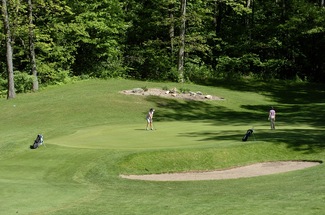
The city has rejected a proposal to privatize management of the 18-hole Huron Hills Golf Course.
File photo
"Such a disparity between projected retail and golf revenues suggests that the focus of your proposal is expanding your retail at the city parkland rather than golf," Bahl said. "Such a use of the city parkland is unacceptable."
Bahl also called the company's revenue projections for the golf course "overly aggressive," noting the proposal states 10 percent of revenues in excess of $575,000 would be paid to the city. "However, your projected revenues do not reach the threshold of $575,000 ever. Hence, the city would never receive any revenues," he said.
Though the city has been losing money on both of its golf courses — Huron Hills and Leslie Park — the financial picture is improving.
Records obtained by AnnArbor.com this week show rounds of golf played at both courses have gone up in each of the last three years. Rounds played at Huron Hills went from 13,913 to 21,216 from 2007 to 2010, while rounds at Leslie went from 21,857 to 31,042 during that time.
Revenue continues to go up year after year as well. Revenue at Huron has gone from $242,677 in fiscal year 2006-07 to an estimated $353,215 for 2010-11. Revenue at Leslie has gone from $615,448 to an estimated $865,000 during that time.
Colin Smith, the city's parks and recreation services manager, said rounds of golf and revenue have increased since the City Council directed staff three seasons ago to implement improvements recommended by a golf consultant, city staff, the Golf Advisory Task Force and the city's Park Advisory Commission.
The National Golf Foundation collects data for courses across the country. It shows a decrease of roughly 3 percent each of the last four seasons for golf courses in the state of Michigan, while Ann Arbor has seen an increase, Smith pointed out.
Now halfway through the 2010-11 fiscal year, the projected total loss for the city's golf fund is $420,191, Smith said this week. That's about $70,764 less than the $490,955 originally projected in a six-year forecast provided at the time of the improvements in 2008.
"The amount of subsidy that we had planned in the budget for golf is not going to be required to the same extent we had planned, simply because of the good performance of the courses," City Administrator Roger Fraser told AnnArbor.com this week. "Clearly the revenues are up higher than what we had forecasted, so we're delighted with that."
But the city still will be considering its options.
"Golf operations still cost the city several hundred thousand dollars a year, and so hard choices remain," said Council Member Christopher Taylor, D-3rd Ward and ex-officio PAC member.
Ryan J. Stanton covers government and politics for AnnArbor.com. Reach him at ryanstanton@annarbor.com or 734-623-2529.
Comments
mike from saline
Fri, Dec 24, 2010 : 9:04 a.m.
Lon Horwedel wrote: "But most golfers are a fickle bunch, They'll go anywhwere, as long as the rounds are cheap and they can ride in a cart and drink their beer." Thank God there are still some groups out there that you can smear with offensive steryotypes, like the one above.
Peter
Thu, Dec 23, 2010 : 12:47 p.m.
Oh NO! Balancing costs and benefits scares me!
Speechless
Thu, Dec 23, 2010 : 12:46 p.m.
"... Thank you for serving the wealthiest citizens in Ann Arbor by preserving their beloved open space using all of our tax dollars...." If you've been reading the comments, Huron Hills could one day become a low-overhead natural park should interest levels in golf continue to decline over time. Or, as a few suggest, it could also evolve into a disc golf course and/or a place for trail bicycles. As for "all of our tax dollars" — who knew! The problem with attempting to rhetorically conflate "open space" with "wealthy citizens" is twofold. First, open spaces occur near neighborhoods ranging across the economic spectrum. Does this conflation intend to suggest that we're morally obliged to tear up all open spaces located in higher income areas? Must open fields or stands of trees within view of someone's mansion necessarily die? Or, might they be painstakingly replanted, roots and all, in a less tony part of town? Second, there's an unstated implication here as to what happens when open space is no longer preserved in the sole interests — allegedly — of nearby wealthy neighbors. Why, we'll hand it over, naturally, to even wealthier developers! Miles of Golf would represent the initial stage in that kind of development process. ------------ "... it is hilarious that we are spending money to buy farmland in the middle of nowhere and letting our city parks decay...." The greenbelt program doesn't "buy" farmland; it purchases development rights. Program funding comes from a dedicated tax stream approved by a large majority of city voters. By definition, then, financing for city parks and for greenbelt rights purchases draw from separate 'buckets' of tax money.
poohbah
Thu, Dec 23, 2010 : 12:21 p.m.
Some considerations regarding golf course finances... Fiscal year data (6/08-6/09) show on a cash/operating basis (revenues less expenses) that both courses lost just $60K. However, the City allocates non-cash costs to these "enterprise operations" (only the golf courses are in this category) and for the same fiscal year, these allocated non-cash costs were $410K. These costs include: 1) general city overhead costs, 2) pension fund for retired city employees (NOT just golf course staff), 3) depreciation and amortization. 4) information technology surcharge. Understand that these allocated costs are a percentage of the city-wide total costs associated with each of these categories and are not specific costs associated with golf course operations. As a result of this allocation, the two golf courses then "lost" about $470K. But on a cash/operating basis, they almost broke even! Are these allocated costs fair? Looking back at the city overhead charge, you find that it has increased by 54% in the last two years. Total golf course revenue for the fiscal year was about $1M; the allocated costs then amount to 41% of revenue. How can you ever show a profit with such a high percentage of non-cash costs? You can't! And, finally, these are "allocated non-cash costs" based on total city operating expenses. If you get rid of the golf, these costs do not go away. They just have to be allocated somewhere else.
et-tu-brute
Thu, Dec 23, 2010 : 11:46 a.m.
There seems to be many comments about letting Huron Hills go and being a park Specifically, Firebiker: "A natural, self-sustaining park seems much more logical, both financially and environmentally." Hate to tell you but there is no such thing as "A natural, self-sustaining park", the city has already explained to us the costs of parkland. If this course was to go "natural" there would still be a cost of $100 K to $300 K a year to "maintain it" depending on how much detail and usage there will be. To let it go natural and incure these costs on top of the inherited costs that Huron Hills still owes is what really doesn't make sense. The land is beautiful. The course is doing better and provides a wonderful service to the people of this city, just like the pools, the ice rinks and the river. The City asked for ideas on how to run it better, no one had any ideas that didn't entail a 3 million dollar investment on the taxpayers behalf, so lets see if the city can take what they've learned, listen to the opinion of the people and merge these ideas into a better asset and a better course and land usage for all of us. It's Christmas people and yes, I still believe!
zeeba
Thu, Dec 23, 2010 : 11:39 a.m.
If the city is "losing" $250k a year on HH, how much is it losing on the operation of the adjacent Gallup and Furstenburg parks, which encompass about the same area? I'll wager the city spends at least $250k on these two and gets nothing in return. Huron Hills primary value is that it is the only "beginner" golf course readily accessible to young people in and around Ann Arbor. It's where average kids can come to learn the game and offers a venue for Parks and Recreation golf programs, which the difficult Leslie golf course is not suited for.
Hmm
Thu, Dec 23, 2010 : 11:02 a.m.
Excellent news! I will be there the first day HH is open again for the year.
David Cahill
Thu, Dec 23, 2010 : 10:55 a.m.
What a nice holiday present from the City! Let's hope that the same caution and fiscal prudence are used to reject the deficit-ridden and money-sucking proposal for building a hotel/conference center on the Library Lot.
LBH
Thu, Dec 23, 2010 : 10:25 a.m.
I wonder how many of the people who want to "save Huron Hills" are the same people who complain bitterly about the evil empire in the form of UM squatting on taxable property? Huron Hills is losing money, doesn't contribute to the property tax base, and costs money to maintain. Lose, lose, lose. It's nice that the people who live above it will still have a protected view sponsored by all Ann Arbor property tax payers. Perhaps those folks would like to band together buy it, (putting it back on the taxable roles) and run it as a business? Or A2 could take a page from various golf communities. If you want to live "on" the course, you will pay to maintain it through fees, and I'm not talking about property taxes. You love the view from your living room, buy it, because if you don't own it you may lose it.
Pam Wilson
Thu, Dec 23, 2010 : 10:14 a.m.
If Huron Hills cannot be sustained as a golf course, I agree that keeping and maintaining as a park is the way to go. Specifically, I agree with Firebiker: "A natural, self-sustaining park seems much more logical, both financially and environmentally."
Soothslayer
Thu, Dec 23, 2010 : 9:57 a.m.
I want to thank the A2 City for making the right decision that allows me to keep my expansive back yard golf view maintained at all the other tax payers expense. What a great holiday gift!
Terry
Thu, Dec 23, 2010 : 9:53 a.m.
Disc golf courses require no more maintenance and work than do walking trails. And, while ball golf has been steadily declining across the US, disc golf has increased by 12-15% a year, or more, for more than the last 10 years. That means going from ~900 courses in 1999 to more than 4,000 at this moment. It also means that out of every 100 rounds of golf played in the US in 2010, more than 25 of those rounds were disc golf. If the course is eventually pulled and the park eventually turned into something a little wilder, I volunteer my services, pro bono, to design a disc golf course (I have designed several.) on the property, in a way which would fit in well with the other uses.
aanative
Thu, Dec 23, 2010 : 9:52 a.m.
If memory serves, the Open Space preservation was a millage enacted by the citizenry, and is wholly distinct from City parks funding. Can't badmouth elected officials for every initiative approved by the electorate.
Brad
Thu, Dec 23, 2010 : 9:38 a.m.
"Curious that someone on staff chose to include the picture one of the beautiful holes on the back 9 for this article, which would not have been affected by the proposal, rather than one of the flat stretches on the front 9. Rather deceptive don't you think?" Since there are 11 holes on one side and 7 on the other, I don't see how a photo from the side with 11 would be "deceptive". I might use "representative", though.
DagnyJ
Thu, Dec 23, 2010 : 8:54 a.m.
Thank you for serving the wealthiest citizens in Ann Arbor by preserving their beloved open space using all of our tax dollars. When I see the "No Golf Strip Mall!" signs in front of $1 million homes, I know something is wrong. The Miles of Golf proposal might not have been optimal, but the city has to face the fact that we cannot afford two money-losing golf courses funded by taxpayers. Leslie Park clearly has the edge in terms of revenue, popularity, reputation. Also, it is hilarious that we are spending money to buy farmland in the middle of nowhere and letting our city parks decay. How stupid is that? Congrats to the mayor and council for pushing through proposals that led to this mess.
Bill Sloan
Thu, Dec 23, 2010 : 8:25 a.m.
Curious that someone on staff chose to include the picture one of the beautiful holes on the back 9 for this article, which would not have been affected by the proposal, rather than one of the flat stretches on the front 9. Rather deceptive don't you think?
golfer
Thu, Dec 23, 2010 : 8:24 a.m.
lon hit it on the nose. golfers are a funny breed. what i do not understand is why keeping it like it is. any business that keeps loosing 250k a year has to change. take away leaves, turn off street lights etc. but keep loosing 250k a year is stupid. i say work with miles of golf. i am sure you can find a way in the middle. knowing miles like i do. they will do what is best for both of you. sit down and come up with a plan that both are happy with. i think if you want to keep giving away 250k a year give it to me. i say phase two is sit down in a off site location for a couple of days. then see what you can work out. letting it die is not a good option. keeping it for birds and just a park you need to still make money for the city. this way you can make something out of nothing. TALK AGAIN
Brad
Thu, Dec 23, 2010 : 8:14 a.m.
So do we close all money-losing parks, or just the ones where they have activities you don't participate in - like golf. Good decision, city. And thanks to Miles of Golf for giving it a go.
Firebiker
Thu, Dec 23, 2010 : 7:28 a.m.
Easy solution- let it grow wild and open it up as a mountain biking/hiking/skiing area. If you have ever been to the local state and county parks on weekdays and weekends, you will see the parking lots full of users, year round Very small amounts of fossil fuels are used in trail maintenance, no pesticides and fertilizers are required, precious water is not wasted on irrigation, and trail building is usually done by volunteers and national trail building organizations. A small user fee or trail pass, similar to any park fee, would offset the minimal trail maintenance fees. A natural, self-sustaining park seems much more logical, both financially and environmentally.
Pamela Staton
Thu, Dec 23, 2010 : 7:11 a.m.
Yay. Kudos for making the right decision. We don't need commercial development in one of the beautiful natural areas left. It should be protected as a golf course - many kids play there. They have to have an affordable course on which to learn. I pay lots of taxes and I'm quite willing to subsidize parks, pools, and golf courses for our citizens.
Steve Hendel
Thu, Dec 23, 2010 : 7:07 a.m.
Good work Sumedh. Although I must say, those NIMBY signs everywhere along Huron River Drive were inflammatory and inactivate. "No Golf Strip Mall"? Nonsense! That was never proposed, and it invokes an image of Georgetown Mall transplanted to the lush verdant green pastures of a bucolic golf course.
5c0++ H4d13y
Thu, Dec 23, 2010 : 6:18 a.m.
A golf course is not a "natural space". It's a manufactured environment that has no resemblance to what it replaced.
InsideTheHall
Thu, Dec 23, 2010 : 5:13 a.m.
Score one for the good ol boy network. The course will likely be shut down and converted to a "nature area" aka gay hang out.
sueperry
Thu, Dec 23, 2010 : 2:41 a.m.
Speechless: You are spot on, as are many of the other commenters. - - though your humor and sarcasm has more truth to it than you may know. The city has apparetly been trying to derive as much income as possible from other city parks for many years. I've lived across from Virginia Park, a small 5 acre neighborhood park for 25 years. It has a kids play area, one baseball diamond, a basketball court, and several areas of open space. (1) Going back a number of years, the city rented a portion of the park to a private contractor for use as a "staging area" for many months while the contractor performed work on adjacent private property. This entailed dozens of 16-wheeler semi-trucks jumping the curb and depositing (and later removing) good-sized mountains of sand and gravel. The contractor never restored the park to it's original state, as they were required to do - despite neighborhood complaints. (2) More recently, perhaps 5 years ago, the Parks Department, in conjunction with AA Rec and Ed, began scheduling soccer games in the open space - - every day - all week - - much of the week-end - - a hundred or more players and their families there at any given time since games were scheduled back to back. This is a pay-to-play sport, with many kids from out of the area. Lots of trash - -parking problems - - neighborhood residents unable to use park - - big portion of open space turf turned into a muddy mess. Was discontinued after neighborhood complaints. No attempt to repair huge areas of mud. (3) Two years ago, the entire park was leased to Rob Reiner for filming of his movie for most of the summer. All ball games cancelled. Basketball court torn out and removed.Most of the park off-limits to residents. Major construction work from early morning to 10 PM at night. Rows and rows of semi-trucks parked in and moving about the park. Trees trimmed unnecessarily. Cost to Rob Reiner? $100 per day and a $5,000 donation to the Parks Fund. Again, the park was not restored to full use for many months after the movie folks left - - though it was promised to have occurred within two weeks. (4) Lastly, this past summer, the Parks Department, again in conjunction with Rec and Ed, scheduled more baseball games at our single ball diamond more than ever before - most every day - often starting at 3 PM and lasting until 8PM or later - - exactly the times that area residents most often use this park in summer. Sometimes all day on week-ends. Had to have a handicapped accessible porta-potty brought in too - - quite lovely. Again, these are pay-to-play folks, many from out of the area (Plymouth-Canton-Dexter-Chelsea). The ball diamond is situated in such a way that most or all of the open space is off limits to residents during a ball game. And trash - - parking problems - - games lasting until 9 PM or later with noise reaching nearby homes where folks have small children sleeping. And just last year the city wanted to park cars at Frisinger and Allmendinger Parks on football Saturdays. All to make $30,000 for the season? Perhaps one could divide that amount by the number of area residents that pay taxes to have and maintain this NEIGHBORHOOD park and that would be denied park use during those days, - - and you can see what per capita value the city places on upholding the rights of residents to enjoy their parks. ( Not to mention trash, gas-oil contamination, soil compaction, turf damage, etc.). I don't know what experience other residents have had with their neighborhood parks. And then Huron Hills. Perhaps city council and staff could define what they perceive as the original and intended use for our parks? It has evidently changed.
15crown00
Thu, Dec 23, 2010 : 1:20 a.m.
Be completely totally fair about.Close EVERY golf course
Speechless
Thu, Dec 23, 2010 : 12:09 a.m.
Kudos to Brian Kuehn, above, for helping cut throught the oft-repeated b.s. surrounding the supposed "loss" of $250,000 per annum. This fantasy financial hemorrhage derives from arbitrary city accounting procedures. That works here as propaganda to promote a privatization proposal. The courses actually run a lot better than that. To extend the city administration's strange internal logic, each neighborhood park is a damaging "loss center" which cries out for immediate privatization. We've just got to let private contractors demonstrate for us how to profit from swing sets, picnic tables, trash bins, and walking paths. Open spaces, apparently, are untapped cash cows waiting to happen. Bring on the frisbee green fees! Can't expect to toss that disc around for free.... So, my carefully considered response to this current golf 'round' is... Yay! And kudos to the mayor: "The look and feel of Huron Hills — it's a park," he said. "And I wouldn't want to do something where, if it didn't work out as golf, it would be difficult to go back... we could make it into a natural area park and have minimal responsibilities as far as maintenance...." This isn't downtown. Park space in outlying areas should remain as that.
John Roos
Wed, Dec 22, 2010 : 11:04 p.m.
I love that course. Soft driver, red fox and Pileated woodpeckers. It's really beautiful out there.
zeeba
Wed, Dec 22, 2010 : 10:46 p.m.
There is nothing this course needs the city can't provide itself. First, it needs to bring in a designer to utilize the current wasted space and land features to turn it into an interesting 18-hole course, with 9 holes on each side of the road. Second, add a liquor license and golf carts. Third, hire staff who treat customers with respect, rather bringing in a bunch of minimum-wage kids who'd rather be somewhere else. Problems solved!
ShadowManager
Wed, Dec 22, 2010 : 10:31 p.m.
Great news. It's nice to see not every civic government and organizaiton is cowed by the bad economy into making disasterously bad decisions for shortterm gain.
treetowncartel
Wed, Dec 22, 2010 : 9:58 p.m.
I think in the long run this is the right decision. ( hole courses don't fare to well. Keeping it 18, even with its quirks, is the best thing going. Ann Arbor should look to the agriculture school in East Lansing and its turf management program for some assistance. It would definitely come at a cheaper cost than using a private compay. Reshaping the course a bit and adding some well placed bunkersd and hazards could put a fresh face on the course.
sbbuilder
Wed, Dec 22, 2010 : 9:17 p.m.
Yeah, the financial stuff presented by Miles of Golf is a 'financial risk'. Maybe. Why bother hiring somebody elso to manage one of the City's rescources when the City can botch the job all on their own. Year after year. To the tune of $250K.
LiberalNIMBY
Wed, Dec 22, 2010 : 9:15 p.m.
Ha! I love how this was framed as a "staff decision." I'm sure it didn't have anything to do with phone calls from certain council members to Fraser (and Fraser to Bahl). Yes folks, when it comes to budget cuts, it looks like the council will have to pick on a less moneyed neighborhood next time, or better yet, spread the pain across the city. This lesson should've been learned in the second ward years ago: when you're this afraid of losing your precious council seat, you really shouldn't tick off the people who have thousands to spend on yard signs.
shepard145
Wed, Dec 22, 2010 : 8:38 p.m.
HEADLINE: "City of Ann Arbor adopts California Style Fiscal Incompetence As City Hall Rushes Toward Bankruptcy"
Sallyxyz
Wed, Dec 22, 2010 : 8:30 p.m.
I agree with bedrog. This is a good decision.
Lon Horwedel
Wed, Dec 22, 2010 : 8:30 p.m.
@DonBee As an avid golfer myself, I can assure you that raising greens fees at Leslie and Huron by $5 will not raise an extra $250,000 at all, and, in fact, may cost the courses money by forcing local golfers elsewhere. One of the reasons Leslie and Huron have seen a spike in rounds the past few years is the fact they've made themselves competitive in a golf market that has taken a huge hit from the recession. They've done this by giving deals to seniors, lowering their fees in the spring and fall, and offering several different pass options. Other reasons include Leslie getting a liquor license, marketing, and the fact that Leslie is nationally ranked as one of the top municipal courses in the country. But most golfers are a fickle bunch, they'll go anywhere, as long as the rounds are cheap and they can ride in a cart and drink their beer.
DonBee
Wed, Dec 22, 2010 : 7:57 p.m.
Seems raising the price of a round of golf by $5.00 would solve the $250,000.00 hole in the budget. Seems like a no brainer to me.
Brian Kuehn
Wed, Dec 22, 2010 : 7:47 p.m.
First, let me say that I am a golfer and thus my view point is influenced by that fact. Maybe we should divide up the Parks & Recreation budget by park/facility. Every park or natural area can become an Enterprise Fund. Starting with the tennis courts (I play tennis, too), we can assign an MSC and depreciation to all the tennis facilities. Cost of maintenance would also be added in. I suspect there are no employees assigned to tennis so charges for retirement funding would not be included. Offsetting these expenses would be the revenue (my estimate is -0- but perhaps there is a better number available). Wow, tennis requires a subsidy from the City!! Let's issue an RFP to privitize the courts. Next we move on to the swimming pools. They have some revenue but my guess is that using the formula developed by Parks & Recreation, the pools will require a subsidy. Better issue an RFP on the pools. Natural areas should be next. Few of the areas are left completely alone. There seem to be environmental burns frequently along with the removal of invasive species. Trails and foot bridges need to be maintained. Of course, offsetting any costs are the revenues from natural areas (-0- I think is about right). Maybe a company can propose a toll system for the use of the natural areas. Playgrounds and parks need garbage pickup and mowing. Equipment needs to be maintained and replaced. All those costs probably won't be offset by the revenue (-0-) but an enterprising firm might be willing to respond to an RFP. The cost of fencing in the parks to prevent entry by casual non-paying users can be covered by a City-backed bond, payable from revenue generated by attendence fees. Once we have privatized all the parkland, we can pretty much layoff all the dedicated and hard working employees in the Parks Department, saving the City even more money. These newly unemployed professionals can apply to the concessionaires selected by through the RFP process. They may be able to make a "living wage" unless we decide to suspend the "living wage" ordinance.
margaret
Wed, Dec 22, 2010 : 7:24 p.m.
Keep Miles of GOlf where it is We need that business on Carpenter road A Plus for the Township NO Police cars visit there and WE don't apartment complex or shopping center there either Let the golf course stay
Ryan J. Stanton
Wed, Dec 22, 2010 : 7 p.m.
Also, for those tracking the finances, specifically how the accounting is done in the golf course budgets, here's info I got from Colin Smith this week: "The golf courses operate in an Enterprise fund and that is how their performance is measured. As a result, retiree health care, depreciation, and the Municipal Service Charge are part of their annual operating budget. If one were to remove the golf courses from the Enterprise Fund these costs would not simply disappear. Retiree health care would continue to be a budget obligation. While depreciation is not charged in the General Fund, a way to fund capital replacement of equipment would still remain as a budget obligation. The MSC is charged to Enterprise Funds relative to their use of City Administrative Services provided (e.g. Human Resources, Parks Administration, Payroll)and reflects the cost of doing business. Lastly, if the courses moved to the General Fund at least one expense would increase in operating costs - long-term bonded debt would not be recorded as a liability, but as a annual cash expenditure. For FY2011 that amounts to a $110,000."
Ryan J. Stanton
Wed, Dec 22, 2010 : 6:52 p.m.
Quote from the mayor in my last story: Hieftje said there are other options for Huron Hills beyond the Miles of Golf proposal, but the city must remember at every stage that it's a park. "The look and feel of Huron Hills it's a park," he said. "And I wouldn't want to do something where, if it didn't work out as golf, it would be difficult to go back. Because one of the options here I think is if it's found that golf can't work out there, we could make it into a natural area park and have minimal responsibilities as far as maintenance."
Ace Ventura
Wed, Dec 22, 2010 : 6:45 p.m.
Once again the city council proves to be kittens with out fur.
bedrog
Wed, Dec 22, 2010 : 6:44 p.m.
Good call. Whatever winds up being done,the privatization was not the right thing.
LRP
Wed, Dec 22, 2010 : 6:40 p.m.
OK, if the city is losing $250K per year, stop the golf course operation and make it a park. We're using the taxpayer's milage money to purchase farmland "outside" of the city highway loop. It's a no brainer to save this parkland first. Come on A2 City Council, GET WITH IT!