

Ann Arbor school district fund balance shrinking; this year's budget deficit estimated at $8M
The Ann Arbor school district keeps sliding toward the day it may need to borrow money to meet payroll during the eight weeks a year the state doesn’t provide aid payments, its chief financial officer said Thursday night.
That’s because the district has been spending its fund balance, also known as the rainy day account, to help make up for budget shortfalls.
The district expects to be $8 million short at the end of this school year. That’s up from $6 million projections earlier in the year.
When the board passed its budget for this school year at the end of last school year, it contained provisions to take $2.5 million from the rainy day fund to balance the books.
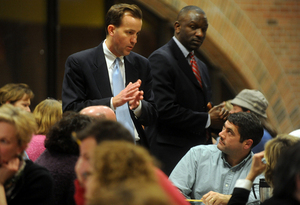
Ann Arbor Superintendent Todd Roberts and Robert Allen (right), deputy superintendent for operations, discuss a draft plan for possible cuts in the district in January.
But due in large part to nearly $400 in per-pupil funding cuts from the state, the district has added to that deficit.
Superintendent Todd Roberts has instituted a series of cost-savings measures for the second half of the year, including limits on overtime and an 8 percent cut to his own salary and a 4 percent cut for his cabinet staff.
If cost savings result from those changes, especially the overtime and some heating and cooling cost reductions, the district would shave about $2.5 million off the total shortfall.
Even with those cuts, the district will likely have to use nearly $8 million from the savings fund. That would leave about $20 million in the fund.
While that may sound like a lot of money, it isn’t, Robert Allen, the district’s chief financial officer, told the board’s planning committee Wednesday.
That’s because the district needs to have about $16 million in the fund to cover payroll and other bills during the weeks it doesn't get state aid checks.
If the district doesn't have the money in that account, it would have to borrow from the state.Â
Several other Washtenaw County school districts already do that. But while the money comes at a reduced interest rate, a district still has to pay interest, Allen said.
Allen said when he worked in the Flint school district, it was paying about $400,000 in interest costs each year when it borrowed state money.
“That’s four teachers,” he said.
The school board’s policy says the district shall maintain 15 percent of its budget in the fund balance. This year, that would be between $25 million and $26 million, Allen said.
“We’re really close to having nothing there,” he said.
The district’s financial situation doesn’t appear to be improving anytime soon. District officials are projecting a nearly $20 million deficit for the 2010-11 school year. Projections estimate a per-pupil cut of up to $400 that year.
School board Trustee Glenn Nelson said he was at a Michigan Association of School Boards event on Wednesday, and an official from the House Fiscal Agency told the group to expect an additional $165 per-pupil cut in 2011-12.
“It’s not going to get sunny until after fiscal 2012 at the soonest,” he said.
David Jesse covers K-12 education for AnnArbor.com. He can be reached at davidjesse@annarbor.com or at 734-623-2534.
Comments
owlnight
Tue, Mar 16, 2010 : 9:47 p.m.
@AlphaAlpha Thank you for hearing my side. But any worker that has less than ten years does not get a retirement. Most will not be able to afford to buy retirement that is why we stayed here for years.
AlphaAlpha
Tue, Mar 16, 2010 : 9:16 p.m.
Hi Owlnight - It's a bad situation for all involved. Sadly, these issues are common nationwide, worse in many areas. A lot went wrong to get us here. Hopefully, the AAPS will keep all its employees. Perhaps you can affect the outcome, especially since proposals are likely still being formulated. By the way, any vested retirement benefits you have are yours to keep, regardless of an employer change. Also, the new employer scenario often includes a 401k match to help establish a new, additional retirement account, one you can control. Good luck.
scooter dog
Tue, Mar 16, 2010 : 8:01 p.m.
The time to do something has passed,where were all you complainers when the milleages were passed by in some cases less than 5% of the registered voters.You had your chance to vote yet everyone was too busy to get involved,so now your stuck with a administration that is hell bent on a business as usual attitude. It'll be a cold day in hell when the teachers give back any type of worthwhile cuts in pay and benefits. I hate to say it but in this town the only way to solve the school problem is to hire a guy like Mr Bobb because the people running it now don't know what the word cut means
owlnight
Tue, Mar 16, 2010 : 5:56 p.m.
@ AlphaAlpha "in that scenario, usully the same friendly crew gets rebadged as private, but at a reduced pay and benefit level." We will be fired "pink-slipped", the other company will hire us. We will lose our retirement, maybe less wage and benefits we now have. Do you have any idea how this is making us feel about this. It looks like ours will be decided before the teachers have to do their part.
AlphaAlpha
Tue, Mar 16, 2010 : 4:06 p.m.
Privatization is a viable option, protestations notwithstanding. In that scenario, usually the same freindly crew gets rebadged as private, but at a reduced pay and benefit level. It does work, but it doesn't need to be the central issue. Public, private, represented, or not, degreed, or not, experienced, or not, these are all secondary to the finances. The district has inadequate funds for the status quo, and many customers sense the risk reward ratio for higher taxes isn't there. New taxes are unlikely to be approved. The district will spend less; hopefully they won't choose to get rid of their good people in lieu of small pay cuts. Many would prefer a small pay cut to outing an unlucky few. Seems rude to let a coworker lose it all instead of all pitching in a bit...
AlphaAlpha
Tue, Mar 16, 2010 : 3:48 p.m.
Good point; how about 'truth in compensation'... One's salary ('gross pay') is only a part of total compensation, and total compensation is the key metric we should be using. An extreme example: If an employer put 90% of one's $100K total compensation into their 401k instead of their weekly paycheck, could we say the person earns $10K per year? Not accurately. In reality, benefits comprise a very significant (~40% typ.) portion of total compensation, and must be defined and accounted for as such. Otherwise, there would currently be a large AAPS surplus instead of a large deficit.
owlnight
Tue, Mar 16, 2010 : 10:26 a.m.
@ AlphaaAlpha What about the privatization of our jobs, bus, maintanence and custodians.
owlnight
Tue, Mar 16, 2010 : 10:22 a.m.
@ AlphaAlpha That about the privatization of our jobs, bus, maintanence and custonians.
AlphaAlpha
Tue, Mar 16, 2010 : 4:37 a.m.
School data is at: http://a2schools.org/budget/files/0910userfriendlybudget.pdf page 45 (pdf p. 49) has the summary data; page 85 (89) has teacher salary rates which exclude benefit pay; page 89 & 90 (93& 94) shows the predominant AAPS cost is labor for teacher salaries. BLS data is at: http://www.bls.gov/news.release/ecec.toc.htm Employer Costs for Employee Compensation September 2009 So, to recap: Average total annual compensation for three groups: All private workers: $57,179.20 All state and local government workers: $82,846.40 Ann Arbor teachers: $101,227.92 AAPS teachers earn 22% more than their government peers, and an astounding 77% more than the average private worker. All avenues for savings should be investigated; investigations will likely conclude labor costs must be reduced.
AlphaAlpha
Mon, Mar 15, 2010 : 10:04 p.m.
To reiterate the comments of several others: Does anyone have a better idea? Thank you.
AlphaAlpha
Mon, Mar 15, 2010 : 9:53 p.m.
Whoa - a pay cut already. Should have said: Ann Arbor teachers: $101,227.92 per year total annual compensation.
AlphaAlpha
Mon, Mar 15, 2010 : 9:47 p.m.
Hello Jen Eyer - $100,107.54 per teacher total average annual compensation. "Could you please provide a source for your numbers regarding compensation? That would help the discussion" Certainly. Per the AAPS user friendly budget, (teacher compensation divided by number of teachers), and BLS data. "Also, I agree with Lisa that it seems comparing the compensation of teachers to the general population is a bit of an apples to oranges comparison, as one is not comparing the same set of jobs, skills, required levels of education, etc." While at first glance it may seem a bit of an apples to oranges comparison, upon reflection, it is not. No two people have the same anything. This is why averages are used. Unfortunately, extraordinary economic events suggest most teachers will see lower compensation, because they earn far above average, and tax increases will be difficult. Hopefully the reductions can be gradual sooner, instead of substantial later.
tmo
Mon, Mar 15, 2010 : 6:16 p.m.
If we borrow that much money this year, options like closing CHS better be on the table to recover from this desperate move next year. This option would impact the fewest students in the face of the capacity of that now exists at the high school level.
motheroffour
Mon, Mar 15, 2010 : 12:54 p.m.
Cut programs and those that are responsible for those failing programs. Not only are we spending a lot on education, the quality for everyone is severly lacking We have spent to reduce the acheivement gap and it is failing. The administrators blame the teachers-the administrators should pack their bags-it doesn't work. Question is why doesn't work? We spend to have consultants advise and they don't know what to do. The people responsible for installing programs don't have a clue what goes on in our schools. They don't know what to do and it ultimately destroys every students future and the ability to compete and contribute in a competitive world. Cut the little gimmicks and experimentation. Lets try this and lets try that people need to realize that when things they try don't work, then kid become damaged goods. Become accountable. If a person is responsible for a failed program, fire that person because in the real world that is what happens. The biggest problem with the money we are spending on acheivement gap progrms is that we still have segregation in the schools. I can name many instances where we listen to parents select their teacher for the children, the parents get advice "ask for this teacher" so our neighborhood can play together, the students that don't know this build-you-neighborhood classroom routine get dumped on. The chld that lives in one neighborhood maybe doesn't have a parent that is even aware of this benefit and the adminitrators certainly don't go out offering advice and promoting it. Dr. Roberts needs to address this phenomena that results in very blantant form of discrimination. Look at the demographics. There should not be one classroom in our schools that is segrated, even if parents what it that way. You have discrimination and money spending on acheivement gap programs becomes worthless because we all know and take owenership that discrimination is fatal to every plan to reduce the acheivement gap. A simple plan of assuring "No Segregated Classrooms/Events/School Groups" in our schools will do much more and at very little cost to reduce the acheivement gap. Dr. Roberts needs to get involved. Simple and very less costly method to reduce the acheivement gap. You will never reduce the acheivement gap if your let the schools decide to become segregated. It has and will always fail if you segregate.
PhillyCheeseSteak
Mon, Mar 15, 2010 : 10:40 a.m.
krc, According to my child's school principal, the number of students in each class will rise, but these are "ideas" and nothing is finalized. Here's what was communicated to parents: "class sizes rise to an average of 20 for Kindergarten, 24 for grades 1 & 2 and 27 for grades 3 to 8." I don't think AAPS has the ability to fund smaller class sizes anymore, regardless of whether or not "it's all the rage" (and whether outcomes prove that lower class sizes benefit student achievement and learning).
krc
Mon, Mar 15, 2010 : 10:28 a.m.
And if they choose to close Elementary schools, thus making class size larger in the ones remaining, does that mean that the district would recall all the teacher's assistants to help the teachers manage? I was still working when the big push to lower class size was all the rage and was laid off every year after the 2 week'startup' was finished.
PhillyCheeseSteak
Mon, Mar 15, 2010 : 9:57 a.m.
We are in a harsh new reality here in Michigan, and because of our system of state funding for eduction, also here in Ann Arbor. Michigan is now a "poor" state and the compensation of our state employees, legislators, and taxpayer-funded educators must now be brought in-line with that reality. Ann Arbor Public Schools must make some drastic changes such as closing elementary and middle schools at the end of THIS educational year. We must be efficient with our school building and the way our grades are configured at each school. We do not have the luxury of debating this issue for several years. We, Michigan taxpayers, need to let our representatives in Lansing know that we want education to be funded, as best we are able to fund it. If that means adding the Michigan sales tax to certain services, I'm all for it. But educator's compensation must be addressed too.
DagnyJ
Sun, Mar 14, 2010 : 10:08 p.m.
I have to agree with Basic Bob. The budget must be balanced today, regardless of the wisdom of the state funding formula. Even if we all marched on Lansing, called the legislature, and went on hunger strikes to protest school funding cuts, we STILL must make cuts to the budget now. So Lisa, what would you do to cut spending? (Hiding behind complaints about the state doesn't balance the budget. Nor does talking about a millage some time in the future. We have to cut something NOW.)
Basic Bob
Sun, Mar 14, 2010 : 9:02 p.m.
Lisa, I disagree that the state is responsible to provide personalized education options for one of the wealthiest districts in the state. Aside from getting more money (unlikely), how would *you* balance the budget?
Lisa Starrfield
Sun, Mar 14, 2010 : 8:32 p.m.
aataxpayer, I disagree with your analysis that those are the only options.
Lisa Starrfield
Sun, Mar 14, 2010 : 4:31 p.m.
aataxpayer, Is your goal to cut teacher pay or balance the budget? Because they do NOT necessarily mean the same thing.
Lisa Starrfield
Sun, Mar 14, 2010 : 8:34 a.m.
Basic Bob, CHS isn't the cause of the problem. The state's failure to properly fund schools is.
Lisa Starrfield
Sun, Mar 14, 2010 : 8:28 a.m.
aataxpayer, I don't wish to speak for the union but I suspect the union feels that all avenues should be explored first. Is the purpose to cut costs or to slash our paychecks? Because they do not necessarily have to be the same thing. Further, with the state making all kinds of noises about attacking teachers' pay and benefits, it would be unwise of us to agree to anything until we know more about what the state will actually be doing. Do you really expect us to agree to a 4% cut of benefits and salary with the district, with the possibility of an additional 5 to 10% cut looming over us from the state?
Basic Bob
Sun, Mar 14, 2010 : 4:17 a.m.
We're bleeding money and still have six high schools. The CHS supporters should be proud they are driving us into bankruptcy at such an exceptional pace.
sh1
Sat, Mar 13, 2010 : 4:53 p.m.
@Dagny: Teachers do not need to have a master's degree to be hired, but they are require to take 18 credits toward a "planned program" (master's degree) during their first five years in order to renew their certificates. They are required to continue to take credits beyond that to keep their certification. So, new teachers may not have their master's degree YET, but they will.
DagnyJ
Sat, Mar 13, 2010 : 4:46 p.m.
@sh1: teachers are NOT required to get a masters degree. To teach in Michigan one needs a bachelor's degree only. True, there are licensing requirements dictating the coursework included in the BA, but if you look at programs at EMU and UM you'll see that teachers are certified and licensed in this state with a 4-year undergraduate degree. IF teachers choose to get a masters or beyond, then they bump up in the salary scale. But it is not required.
sh1
Sat, Mar 13, 2010 : 3:37 p.m.
@DonBee: I took a good look at the list and saw the professions that require the most schooling/certification pay more. So why do you think out of all of those listed, teachers should be singled out? Are you posting somewhere else about those overpaid CPA's or attorneys?
Ram
Sat, Mar 13, 2010 : 2:40 p.m.
Andrew Thomas: I disagree with your belief that we can't compare 5th grade percentages to 8th grade percentages. Of course the 8th grade test is going to be harder, shouldn't they be getting more intelligent in 3 years? I believe we can, and must, directly compare achievement at one grade level with achievement at another. At the beginning of each school year, teachers have a list of goals which they plan to accomplish with the students in their classroom. The MEAP is intended to measure what percent of that year's goals are accomplished. If we look at it from that standpoint, how much of that year's material was each student able to comprehend, it is entirely possible to compare the same students at different stages in their education. If use the approach of comparing this year's 8th graders to last year's 8th graders, as is typically the approach when the press reports gains in test scores, what is the conclusion we can draw from that analysis? Some may say that this year's 8th grade teachers did a better job than they did the previous year. But what if that class was already performing better at the 3rd grade level? Who gets the credit? Some may say its a waste of time trying to "give credit" to certain teachers, but I disagree. I think one of the most important tasks administration has is to continually evaluate teacher performance. I have always believed that the most important factor in a child's education is parenting. Data shows the most important factor in education is the teachers (http://www.nytimes.com/2010/03/07/magazine/07Teachers-t.html). We need to make sure that the instructors in our schools are the best we can get. I agree with your statement that having a 10% failure rate in 3rd grade only set the 8th grade teachers up for extreme difficulty. Students can't learn 4th grade material if they don't even know 3rd grade material, etc. Thanks for the civil debate, I really appreciate it.
Andrew Thomas
Sat, Mar 13, 2010 : 2:21 p.m.
Does anyone seriously believe that $67K a year is typical of what an attorney makes?
DonBee
Sat, Mar 13, 2010 : 1:50 p.m.
@sh1 - I suggest you take a good look at the list, an Attorney needs more than a 4 year degree, all the engineers need PE's and others also have requirements beyond a 4 year degree. Please look at the State of Michigan web site for specifics for these jobs. I think you will be surprised that professions other than Teachers require more than just a simple degree. (-:
sh1
Sat, Mar 13, 2010 : 1:36 p.m.
@Dagny: and those are the ones with the highest salaries on the list, leading me to believe teachers' salaries are not out of line.
DagnyJ
Sat, Mar 13, 2010 : 1:32 p.m.
@sh1, you said "DonBee, on your list of professions, teachers are the only ones I know who are required to get master's degrees (at their own expense) AND state certification, so you are incorrectly comparing them to professions that only require a bachelor's degree or less." Attorneys are required to get the equivalent of a masters' degree and are required to pass the bar to practice. Psychologists also need to be licensed and get an advanced degree in clinical practice. Architects must do a five year undergraduate program and be licensed. CPAs are licensed too.
Andrew Thomas
Sat, Mar 13, 2010 : 1:25 p.m.
@ Ram: Interesting analysis, and I commend you for actually looking at the data, rather than engage in knee-jerk posturing as so many posters (on both sides of the issue) are doing. That said, I must disagree with your approach. The general trend, which can be observed over time, is that MEAP scores for ANY cadre of students decline as they progress through the grades. This does not mean that the teachers at the elementary level are doing a "good" job and teachers at the middle school level are doing a "bad" job. The MEAP that 8th graders take is very different from what 3rd graders take: questions are harder and cover more material. Also, the standards are different for each grade, so knowledge that would fully meet the standards at 3rd grade would be insufficient at 8th grade. This seems pretty obvious, but the implication is that you cannot directly compare achievement at one grade level with achievement at another because you are measuring two different things. The other reason for the decline in MEAP scores as you move up through the grades is that it is much easier to slip behind than it is to catch up. Someone who meets the 3rd grade standard (but just barely) is in danger of falling behind in subsequent grades where the work is more demanding. On the other hand, someone who does not meet the standard at 3rd grade will have to try extra hard just to catch up to where he or she should have been last year, let alone trying to master the new material at the next grade level. My takeaway from this is that even a small percentage of students who do not meet the standard for one of the early grades is likely to baloon into a much larger percentage down the line. So while having a "meets or exceeds" rate in the low 90s for 3rd grade may sound good, but it isn't good enough.
Lisa Starrfield
Sat, Mar 13, 2010 : 12:39 p.m.
aataxpayer, The AAEA has been at the negotiating table for several weeks now.
owlnight
Sat, Mar 13, 2010 : 10:47 a.m.
@DonBee You like to play with a calculator try this one. Maintanence and custodian workers have sick time that can be saved after each year it would be paid allready, if it is in with the benefits it is not as much as they think that privation can save. By the way I think the cuatodian $55,084 wagw and benefits is a bit high.
Ram
Sat, Mar 13, 2010 : 10:46 a.m.
Talk of Merit Pay based off of standardized tests doesn't compare this year's sixth graders to the sixth graders of last year, it compares them to the fifth graders of last year. If we compare the current sixth graders to the sixth graders of the previous year, we leave room for confounding variables to distort our data. Taking this into account, the 8th graders of 2009 were the 5th graders of 2006. Knowing that, lets take a look at the data from Andrew Thomas' post... Percentages who meet or exceed state expecations... For 5th grade math: 2006 91% For 8th grade math: 2009 88% For 5th grade reading: 2006 89% For 8th grade reading: 2009 90% (Andrew Thomas cited the following source: AAPS presentation to BOE 5/6/2009) As we can see, there was a 3% decrease in MEAP scores in Math and there was a 1% increase in MEAP scores in Reading. First off, we should not make bold claims off of the data from one class. That is not a large enough sample size. I went looking for further data on MEAP scores in AAPS, but the link to MEAP data on the AAPS website is down (http://www.aaps.k12.mi.us/aaps.about/meap_data). My goal was to show how claims that "MEAP scores are increasing" isn't exactly true. I can't claim to have proved that statement to be false, but it certainly isn't true based off of the available data. While data for AAPS MEAP scores was not available, I was able to get some data about the state of Michigan as a whole. Lets take a look at the previous two 8th grade classes. Percentages who meet or exceed state expectations... For 5th grade math: 2006 76% 2005 64% For 8th grade math: 2009 71% 2008 75% For 5th grade reading: 2006 84% 2005 80% For 8th grade reading: 2009 84% 2008 76% (Source: http://www.michigan.gov/mde/0,1607,7-140-22709_31168_40135---,00.html) I can't find any clear statement in the above data. One class performed 5% worse in math as time went on, and one class performed 11% better in math as time went on. One class saw no change in performance in reading as time went on, and one class performed 4% worse in reading as time went on. Conclusion: I'm all for Merit Based Pay, and I think it is an entirely feasible possibility (http://www.educationreport.org/9598). However, most people misinterpret the MEAP data. We shouldn't be comparing the class of 2008 to the class of 2007, we should be comparing the same kids at different levels of their education. This helps diminish the influence of any confounding variables resulting from the differences between two classes. If we are going to be serious about using statistics in our evaluation of our education system, we need to make sure we know what we are talking about. I hope I have been of help to the other community members posting here.
sh1
Sat, Mar 13, 2010 : 9:51 a.m.
DonBee, on your list of professions, teachers are the only ones I know who are required to get master's degrees (at their own expense) AND state certification, so you are incorrectly comparing them to professions that only require a bachelor's degree or less.
DonBee
Sat, Mar 13, 2010 : 9:28 a.m.
According to http://archive.aft.org/salary/2009/PubEmpsCompSurvey09.pdf Which is a survey of State Government Jobs and Salary (not including retirement and health care)...The Michigan State Government pays at the average for the following for jobs that required degrees to enter (I left off a number of jobs for which a degree is usually required, but is not always required). As always do your own research, make your own conclusions. Note that the survey has minimum, maximum and average salaries. I took the Average column. CategorySalary Accountant....................54,789 Financial Examiner........48,525 Tax Auditor...................49,214 Biologist........................56,313 Chemist.........................57,409 CSI................................45,952 Geologist......................54,142 Economist.....................42,282 Librarian.......................55,374 Bridge Inspector...........45,494 Civil Engineer...............57,558 Environmental Engineer.69,932 Social Worker...............48,379 Teacher.......................63,893 Registered Nurse.........54,460 Psychologist................66,021 Architect.....................61,199 Attorney......................67,484 According to http://teacherportal.com/teacher-salaries-by-state Michigan is the 4 best state to be a teacher in based on cost of living vs salary. Better than Michigan are: Illinois, Delaware, and Georgia in that order. Teacher Portal Gives the average salary for a Teacher as $54,739 as a pure average salary vs other states for Teachers, Michigan ranks 7th, Behind California, Connecticut, Illinois, New Jersey, New York, and Massachusetts. If I take the state filing that AAPS did (The Michigan Financial Information Database -FID) AAPS in 2007-8 (last year available on line) - Salaries for Teachers were $75,026,778.51 and benefits were $31,454,593.63. So if total compensation was $1 for a teacher - Salary would be $0.704. I am doing this because I can not get the average salary directly from AAPS, and the number of actual teachers is also not available. Anyone who has these numbers, please correct me. So if Salary is $0.704 of $1 and we go back to the "User Friendly Budget" that AAPS released. The average total compensation of a teacher based on the building by building numbers in the AAPS released document is $101,227.92. If we use the ratio from the above calculation - than the average teacher salary in AAPS is roughly $71,260. I am providing this so that the discussion, I hope, will be based in facts.
Carole
Sat, Mar 13, 2010 : 8:26 a.m.
Exactly what is the balance remaining in the AAPS savings fund. It is mentioned that $8M would have to be used leaving a balance of $20M. Still enough to cover the remainder of the year I do believe. Utilities could be cut a good deal - people could take care in turning off lights, unplugging electrical appliances when not in use, and just turning off the computers with a power surge unit would cut that expense a good deal. Lights in the hallway - do we need a light every three feet - can everyone other one be turned off. Closing the doors instead of heating the outdoors. Will this solve all - no but helps with cost and helps the environment. Mr. Roberts, thank you for cutting your salary and the others in top position.
Lisa Starrfield
Sat, Mar 13, 2010 : 7:49 a.m.
alphaalpha, Most state and government workers are not required to hold college degrees and certifications. It is unreasonable to compare teachers who must by law carry those qualifications to a group whose qualifications are much less.
Lisa Starrfield
Sat, Mar 13, 2010 : 7:39 a.m.
Stunshlf, I have a masters degree and I make NOWHERE near 125 even including benefits. Furthermore, the school district does not pay for master degrees. Your source of information is really bad.
Lisa Starrfield
Sat, Mar 13, 2010 : 7:31 a.m.
Mr. Olsen, MEAP scores represent the work from the previous year. What do you do for those teachers who retired over the summer but whose work led to better test scores? Of course, one of many issues I have with merit pay has yet to be addressed by anyone here and that is that I think it is a trap. It is an attempt to lower our base pay and then the merit portion will be cut or removed altogether during the next budget crisis never to be reinstated leaving us with much lower salaries.
snapshot
Sat, Mar 13, 2010 : 12:39 a.m.
I can't believe how these folks deal with a fund shortage, and they call themselves educators. It is they who need an education and they'll get it when the district is in a receivership due to bankruptcy. Ann Arbor is getting ripped off.
AlphaAlpha
Fri, Mar 12, 2010 : 11:29 p.m.
Average total annual compensation for three groups: All private workers: $57,179.20 All state and local government workers: $82,846.40 Ann Arbor teachers: $101,227.92 AAPS teachers earn 22% more than their government peers, and an astounding 77% more than the average private worker. Regardless of MEAP score improvements, with tax revenue in short supply, not only are pay raises inappropriate, pay reductions are appropriate.
Andrew Thomas
Fri, Mar 12, 2010 : 11:25 p.m.
@ Stunhsif: Your statement that MEAP scores have been going down is factually incorrect. Here are some examples: For 8th grade math, here are the number of students who meet or exceed state standards: 2006 82% 2007 86% 2008 88% 2009 88% For 8th grade reading: 2006 88% 2007 90% 2008 90% 2009 90% For 5th grade math: 2006 91% 2007 92% 2008 91% 2009 91% For 5th grade reading: 2006 89% 2007 93% 2008 90% 2009 90% (Source: AAPS presentation to BOE 5/6/2009) You will note that all of these showed an improvement from 2006 to 2009, with the exception of 5th grade math, which held steady. @ Grinch: A little civility, please. Let's answer comments such as this with facts, not insults.
stunhsif
Fri, Mar 12, 2010 : 10:12 p.m.
Grinch, MEAP scores had been going down for the past 10 years so one year of MEAP scores going up by a tidbit does not merit a raise. If "pay for results" had been implemented 10 years ago ( Unions would never agree to this) the teachers would be making half of what they do now, and that is about what they are worth in the marketplace across most of the USA if you look at their wages in Michigan. Factor in the actual hours they work ( forget homework and evenings--we all bring our laptops home and work at night) 7-2:30 with an hour of prep time and three months off a year. Yes three months, you get more than 2 months in the summer, plus two weeks at Christmas, plus a week's break for spring plus Martin Luther, plus this day and that day. Figure with all the time off an A2 teacher with a school funded master's degree is really making around 125 bones a year plus benies. Not too bad!!! And then you can retire at the age of 53 and live off the taxpayer for another 40 years if you are healthy, not a bad gig at all.
The Grinch
Fri, Mar 12, 2010 : 9:18 p.m.
No, actually I think merit pay based on MEAP scores a terrible idea, but just wanted to see if all of the teacher bashers who so often cite falling test scores as proof of teacher incompetence want to own the logical corollary of their argument. Likely not. Teacher bashing is more fun and it's a fact-free activity.
Jimmy Olsen
Fri, Mar 12, 2010 : 9:07 p.m.
@the grinch Glad to see you are finally on board with merit based pay increases. MEAP up...salaries up...
The Grinch
Fri, Mar 12, 2010 : 8:58 p.m.
MEAP test scores in the county have gone up: http://www.annarbor.com/news/statewide-meap-scores-increase/ So all you "results-oriented" teacher bashers--do you now support a pay increase? Or do results really have little or nothing to do with your opinions? Didn't think so!
emu2009
Fri, Mar 12, 2010 : 1:42 p.m.
Well at least the kids will have a brand new skate park to use.
Andrew Thomas
Fri, Mar 12, 2010 : 1:23 p.m.
Dagny, the structural changes you are talking about are being considered, but are not necessarily in the limelight at this time. We are facing an approx. $18 - $20 M deficit for the upcoming fiscal year, which starts in only a few months. The process of closing schools, reconfiguring grades and the associated redistricting is very contentious and needs to play out over a significant period of time in order to build consensus and allow sufficient input from parents and other stakeholders. As I recall, the estimated net savings from closing a building are around $600K, so even if five or six buildings are closed, this doesn't begin to cover the projected deficit. As for the contracts, virtually all union contracts are up for renewal this year (including the largest with AAEA) so that piece will be addressed.
DagnyJ
Fri, Mar 12, 2010 : 12:17 p.m.
Andrew Thomas, pinching people's salaries, asking for cuts in "discretionary" accounts, upping fees. These are not structural changes. These are short term fixes. Closing schools, reconfiguring grades, renegotiating contracts for years to come...these are structural. The current board continues to dance around the edges, rather than do the hard work.
AlphaAlpha
Fri, Mar 12, 2010 : 10:50 a.m.
DonBee - I agree that Mr. Nelson is being too optimistic. This is nearly the worst possible time for AAPS (or AA) to borrow money. Evidence suggests we are in the early stages of a credit collapse induced deflation. Historically, these events resolve over a multi year to multi decade period. Short bounces notwithstanding, it is likely tax revenues will decline for several years; tax increases are very difficult to implement during recessions. Since the size of the budget will decline, and labor cost is a large portion of the total budget, it is inevitable that labor costs will decline. It would be easier on the employees if small reductions begins at once, with further reductions implemented incrementally over the years, rather than to delay reductions until the situation worsens to a point where options become limited.
DonBee
Fri, Mar 12, 2010 : 10:04 a.m.
I would love to agree with Glenn Nelson, but I think he is being too optimistic. Given the fall in home values, I suspect that there will be a 10 percent or larger drop in the ISD, County and District taxes that are based on property taxes in 2010-2011 and it will not come back in one year. For instance the Special Education tax brings roughly $18 million for AAPS, and with the drop in home values and equalized valuations, that will probably drop by $1.8 million in 2010-2011 school year. The sinking fund, the bond fund and all the other special funds that are based on property tax will also probably drop. The $165 drop in Operating fund revenue will be the least of the problem. It is the drop in all the other revenues that will be the real killer. I hope the school board is getting realistic updates on the Equalized Valuation in the district and the county and have built these drops into the budget. The problem with these drops is there is a limit in how fast the Equalized Valuation can be raised again, so a 10 percent drop will take several years under the law to come back again for existing property (you can always build new taxable property) and that is a long term hole that will mean structural changes to the district. Short term fixes and tricks will not solve the problem. In Plymouth-Canton they engaged a large number of people in working groups (not the 2 to 3 hour meetings that AAPS did) where the working groups included community experts to look at savings. The end result of working groups is posted on the PCPS web site. I would love to see AAPS take a similar approach. We have lots of smart people in the private sector who run or work with many activities the school system does (e.g. purchasing, transportation, maintenance, energy consumption, etc). I wish the school board well, it will be a very tough year. The question is, will they and the administration do the long-term fixes and take as much pain as possible at one time, or will they just whiddle away at the problem and have to return to it again and again. As I have posted elsewhere - on a per student basis there are areas where we have large differences between AAPS, and Plymouth-Canton, I for one would love to see the district dig in and figure out why these exist. Maybe there is money that can be saved in areas that would have less impact on employees and students.
Andrew Thomas
Fri, Mar 12, 2010 : 8:51 a.m.
@ DagnyJ and AATaxpayer: Well, it's not as though the District isn't doing anything. They have put forth an aggressive cost reduction plan that goes way beyond "pay to play" for athletes. A big part of this is a $5 M reduction in compensation for district employees, primarily teachers. Another part is the privatization of transportation, custodial and maintenance services, which is experiencing a lot of push-back from the unions. We'll soon see whether the BOE has the backbone to do what is necessary on this front, or if they cave in to political pressure. As for the AAEA, their position all along has been not to say anything publicly until the rest of the District's plan is on the table, and has been approved by the BOE. Negotiations with AAEA will begin soon, and because of the nature of labor negotiations, most of the action will take place behind closed doors. Frustrating to the average taxpayer, but that's just the way it is. My expectation is that AAEA will, in the end, recognize they face a choice between a pay cut and massive layoffs and will ultimately do the right thing. But don't expect them to tip their hand in advance. It's time to show a little patience and trust in our BOE and our superintendent. Yeah, I know; there's a lot of cynicism out there about government in general, but I do believe our school leaders have their priorities straight and the best interest of the students at heart.
stunhsif
Fri, Mar 12, 2010 : 8:36 a.m.
Aw shucks, lets just stick our head in the sand and pretend nothing is wrong. With all this stress I am certain the teachers and other union folks ( Principals,janitorial,bus drivers) cannot do their jobs as effectively as they used to so I propose giving them all a big raise and fund their pensions with a 20% increase. This will help them get back on track and be 100% effective in teaching our kids. Let's roll back the Headlee amendmemt, implement a 1% A2 city tax, let's raise alcohol and tobacco taxes too! Don't forget, we can raise auto registration fees even more. Let's leave no stone unturned because right now we can probably get a few more drops of blood out of that stone if we squeeze it hard enough.
James
Fri, Mar 12, 2010 : 7:35 a.m.
Drastic times require drastic measures
AlphaAlpha
Fri, Mar 12, 2010 : 6:34 a.m.
Average compensation rates for our teachers is substantially greater than average compensation rates for their customers the taxpayers. A compensation reduction of 7% or so would eliminate the deficit, while allowing AAPS employees to continue earning at a rate much greater than the average citizen.
DagnyJ
Fri, Mar 12, 2010 : 6:34 a.m.
It's time to DO something. You have to cut costs. And that means something structural...beyond asking HS athletes to cough up more money to play. Look around at what other districts are doing.