

Ann Arbor considers tunnel under railroad tracks behind Depot Street to access MichCon site
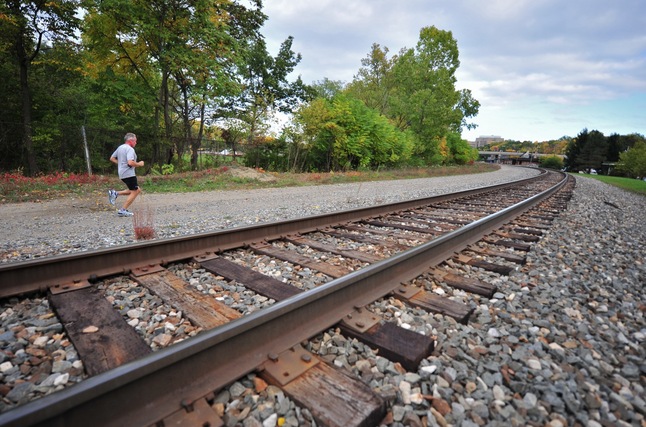
A jogger runs along the Norfolk Southern Railroad tracks just north of Depot Street, with the MichCon site that's being cleaned up visible in the background behind a chain-link fence. Ann Arbor officials are considering options for creating access down to the site for both people and stormwater, possibly by digging a pedestrian tunnel under the tracks.
Ryan J. Stanton | AnnArbor.com
But how exactly will pedestrians and bicyclists access it?
One way that's being discussed involves driving a pedestrian tunnel underneath the railroad tracks that act as a barrier between Depot Street and the Huron River. That could serve a dual purpose, creating a new path for people, as well as a path for stormwater to flow down to the river.
"It's not going to be something that happens immediately. Permissions from the railroad, even if we approve something, will still take time to negotiate," said City Council Member Sabra Briere, D-1st Ward, who is excited about the long-term prospects.
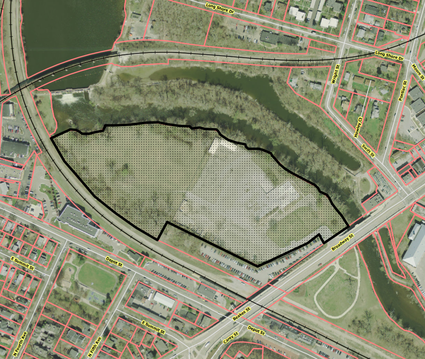
The footprint of the MichCon site, which Ann Arbor officials hope will become a city park someday after DTE Energy completes environmental remediation on the site.
Courtesy of city of Ann Arbor
"And while it's not going to be a great place to hang out," Briere added, "it will be a great place to go safely underneath the railroad tracks, and that's what I'm really excited about."
The Ann Arbor City Council voted 9-0 Monday night to approve a $50,000 contract with engineering firm Orchard, Hiltz & McCliment Inc. to undertake what's being called the Allen Creek Railroad Berm Opening Feasibility Study. Funds are coming from the city's stormwater capital budget.
Council Members Tony Derezinski and Marcia Higgins were absent.
The study is being conducted in conjunction with the city's North Main-Huron River Corridor Vision Task Force, which is examining ways to improve the North Main corridor and open up access to the city's recreational amenities along the Huron River near Argo Dam and Argo Cascades.
Part of the task force's mandate is to determine the best possible route from the south to the north side of the railroad tracks, connecting with the Border-to-Border Trail.
"There's lots of discussion about how to do this safely," Briere said, noting both tunnels and bridges have been discussed.
"If we can drive a tunnel, it's a lot less expensive than a pedestrian bridge," she said. "However we choose, we have this enormous task of figuring out how to get safely from the south side of the tracks to the north side of the tracks."
OHM will analyze the feasibility of a shared-use, non-motorized path through the railroad berm from the Main Street/Depot Street area to the Huron River/MichCon site area. Where exactly that passage might go and whether it's actually feasible is yet to be determined.
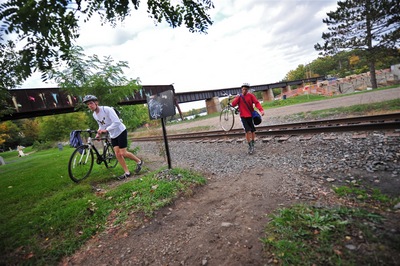
A pair of avid cyclists do as they said they've done for years and go past a "no trespassing" sign and cut through private property to carry their bicycles over the Norfolk Southern Railroad tracks that act as a barrier between the Main Street/Depot Street area and the Border-to-Border Trail and Argo Park.
Ryan J. Stanton | AnnArbor.com
"It takes potentially years of negotiation and it still has to be budgeted."
Jerry Hancock, the city's stormwater and floodplain programs coordinator, gave an overview of the upcoming study in a memo to council members.
He noted that in March 2007 the city adopted a flood mitigation plan that specifies 56 mitigation objectives or recommendations, including a study of the Allen Creek railroad berm.
That includes examining ways to remove the railroad berm located between Depot Street and the Huron River, as well as other portions of the railroad berm in the Allen Creek corridor, to allow floodwater to travel to the river without a major barrier impeding the flow, acting like a dam.
The mitigation plan also recommended examining the costs of creating a "terraced rail system." The full plan can be viewed online at www.a2gov.org/floodplains.
The Allen Creek runs through Ann Arbor's west side but hasn't been seen above ground in decades — it's now a system of pipes that run roughly parallel to the Ann Arbor Railroad tracks, starting at Pioneer High and spilling into the Huron River just below Argo Dam.
"The railroad berm near the outlet of Allen Creek is oriented perpendicular to the overland flow of the creek and causes the floodplain depth to be as deep as 10 feet," Hancock said. "In addition, the area upstream of the berm experiences flood depths typically in the three- to five-foot range."
Hancock said there are "numerous structures within the influence of the railroad berm" located near the mouth of Allen Creek. If the berm could be opened up enough to restore the floodplain to its more typical depth, he said, some structures might not be in the resulting smaller floodplain.
Structures that would remain in the floodplain would experience reduced flood depth and a reduced flood risk, Hancock added.
OHM has been selected to complete both a study and design recommendations for opening the railroad berm near the mouth of Allen Creek. Hancock said the recommendations will address the feasibility, costs and potential reduced flood risk benefits of such a project.
Ryan J. Stanton covers government and politics for AnnArbor.com. Reach him at ryanstanton@annarbor.com or 734-623-2529. You also can follow him on Twitter or subscribe to AnnArbor.com's email newsletters.
Comments
nickcarraweigh
Sat, Oct 6, 2012 : 1:40 a.m.
There's bound to be some unemployed erstwhile East Germans with plenty of experience and time on their hands.
NUXI
Thu, Oct 4, 2012 : 8:57 p.m.
Those no tresspassing signs are the biggest joke in Ann Arbor. I doubt the photographer had to wait more than 5 minutes to get a picture of people using it.
NUXI
Thu, Oct 4, 2012 : 9:09 p.m.
They should just install a level crossing there. It can't possibly be any more dangerous than the rampant illegal crossing. Same with all the other open and notorious illegal crossings. Gallup park has a level crossing for the pedestrian trail at the railroad tracks and I don't think I've heard of any problems there.
demistify
Thu, Oct 4, 2012 : 3:31 p.m.
"Ann Arbor officials are considering options for creating access down to the site for both people and stormwater, possibly by digging a pedestrian tunnel under the tracks." I can just see the trial lawyers salivating.
CynicA2
Thu, Oct 4, 2012 : 3:15 p.m.
If a new train station were ever to be built, this would be the perfect place for it. Lots of space for parking, and it could be built on the same side of the tracks as the parking, so users wouldn't have to worry about crossing the tracks.
Ron Granger
Fri, Oct 5, 2012 : 1:22 p.m.
It is prime river front property. Hardly appropriate for a train station. The noisy train station does not need to be on the edge of the downtown core. Put it outside the city. Oh right - then the city can't control it and the federal dollars flow through the county instead of the city.
CynicA2
Thu, Oct 4, 2012 : 8:14 p.m.
And the current train station isn't?!? Both sites are about the same elevation, are they not - floods don't seem to affect the current station and parking area, so why would the other side of the tracks be a problem?
Epengar
Thu, Oct 4, 2012 : 4:54 p.m.
Nearly the entire site is in the floodway and floodplain. How is that a perfect place to put a train and bus station, and park hundreds of cars?
kremlach
Thu, Oct 4, 2012 : 2:27 p.m.
This, and a similar tunnel by the Arb, were "promised" before one of the last park millages. Once the millage passed, they said the tunnels were not feasible (but kept the money).
Top Cat
Thu, Oct 4, 2012 : 1:38 p.m.
How about a zip line over the tracks ?
sbbuilder
Thu, Oct 4, 2012 : 1:26 p.m.
The periodic flooding could serve a dual purpose in that it would wash away the pee and other detritus that is surely to accumulate. A brilliant win-win (I hate that phrase) situation. For just a little extra money, we could have solar panel or wind generated lighting installed. Oh, and for a little bit more money we could also make the surface out of that new fangled permeable material so that small amounts of water don't pool up. Please hurry up with the new millage proposal so that we can get this thing off the ground, or under the ground, or whatever.
zags
Thu, Oct 4, 2012 : 1:02 p.m.
The goal for many years has been grade separation between railroads and any type of crossing. With high speed rail, it becomes even more important and extremely unlikely that any new at grade crossing would ever be built. That being said, there is a chance for an at grade crossing due to the potential crossings' proximity to the Amtrak station. Trains will always stop in AA so their speed acceleration/ decelerating will always be low. As much as I hate to admit, spending money to properly study all the alternatives is actually a good idea.
jcj
Thu, Oct 4, 2012 : 7:01 p.m.
When exactly do you expect high speed freight trains to happen?
a2cents
Thu, Oct 4, 2012 : 1:56 p.m.
Freight trains don't stop there.
lynel
Thu, Oct 4, 2012 : 1:02 p.m.
Instead of always telling us that Marcia Higgins was absent, how about reporting real news? Like when Marcia Higgins ATTENDS a meeting.
AlwaysLate
Thu, Oct 4, 2012 : 3:02 p.m.
Yeah, what's up with Ms. Higgins anyway? Ever since Borders closed and she lost her job, she also appears to have lost her interest in being a Counsil Member.
ordmad
Thu, Oct 4, 2012 : 12:29 p.m.
This area is designated for high speed rail. The City can't choose to have an at-grade crossing and initial indications are those that do exist may well be removed, let alone adding any. Thus, this study. Remember, facts 1st (of course, not nearly enough in the story), mouth in gear second.
jcj
Thu, Oct 4, 2012 : 6:59 p.m.
ordmad "This area is designated for high speed rail." BIG DEAL! When the high speed rail gets to the point that it might actually happen, put a culvert under and move on, Until then council would better serve the people by concentrating on what is needed NOW!
CynicA2
Thu, Oct 4, 2012 : 3:06 p.m.
Don't hold your breath for "high speed rail"... all kinds of ways that may get "derailed".
Brad
Thu, Oct 4, 2012 : 12:24 p.m.
And of course we already have like 30,000 people crossing the RR tracks willy nilly on every football Saturday, and as far as I know we haven't had one hit by a train yet.
Unusual Suspect
Thu, Oct 4, 2012 : 2:28 p.m.
That's on a railroad that has a maximum of one train per day in each direction.
Brad
Thu, Oct 4, 2012 : 12:22 p.m.
Leslie Park golf course has a tunnel under the tracks between the 3rd and 4th holes. It's a large corrugated metal pipe and it works just fine for people and golf carts. Very simple and all you really need. Just keep the DDA out of it.
Craig Lounsbury
Thu, Oct 4, 2012 : noon
will there be lighting in the tunnel so I can view the requisite artwork?
Gbob
Thu, Oct 4, 2012 : 11:59 a.m.
There have been deaths along the NS tracks through Ann Arbor over the last 30 years. Check out the tunnel crossing at the Toledo Zoo which is pretty nice. The NS railroad has not allowed on grade crossings in the past .
Gbob
Thu, Oct 4, 2012 : 6:23 p.m.
Norfolk and Southern owns the ROW and would like to remove all the on grade crossings including the one in Bandemer Park. We lost the on grade crossing at Dixboro Rd with the bridge construction. Any high speed rail must include improved pedestrian crossings. Look at a map of Ann Arbor and envision and new freeway dividing the city along the river. The tunnel between Gallup and the Arb was opposed by UofM by the way.
Unusual Suspect
Thu, Oct 4, 2012 : 2:27 p.m.
The Gallup Park one was actually a downgrade from a road crossing to a pedestrian crossing. I'm guessing that's a lot easier to accomplish than a new crossing of any kind.
mw
Thu, Oct 4, 2012 : 12:46 p.m.
There is also an existing grade-level pedestrian/bike crossing of the tracks going into Gallup Park from Geddes Road.
mw
Thu, Oct 4, 2012 : 12:43 p.m.
But how many of those deaths have been suicides? Keep in mind that there is already a grade-level crossing of the track in that area used by cyclists and pedestrians -- the dirt road/path into Bandemeer Park. Put in another like it to enter the new MichCon site.
Homeland Conspiracy
Thu, Oct 4, 2012 : 11:59 a.m.
"They" could put some "art" in the tunnel
jns131
Thu, Oct 4, 2012 : 5:29 p.m.
What? Replica the one on Liberty and at City Hall? Not a bad idea.
Common Sense
Thu, Oct 4, 2012 : 11:49 a.m.
I support the concept of a track grade crossing as mentioned by Jim Osborn. I have experienced these crossings many times in Switzerland. They are set with a lighted grade crossing, pedestrian gates, and flashing warning lights. A tunnel is too costly and presents too many problems as mentioned in other posts. We have too few trains per day.
jcj
Thu, Oct 4, 2012 : 6:55 p.m.
"Bicyclists won't stop for traffic lights, and they won't stop for crossing gates and flashing lights." In that case we should have fewer cyclist!
Unusual Suspect
Thu, Oct 4, 2012 : 2:26 p.m.
Bicyclists won't stop for traffic lights, and they won't stop for crossing gates and flashing lights.
Jim Osborn
Thu, Oct 4, 2012 : 12:06 p.m.
The European trains are electric and quiet. American trains are not, they are LOUD and therefore easy to notice unless one is deaf. As all trains, freight and Amtrak, seem to only go 40 MPH or less at this location, I much rather cross on foot this single track than Washtenaw or State Street, or even Main St near M-14.
Kai Petainen
Thu, Oct 4, 2012 : 11:46 a.m.
YAY! this was an idea i had mentioned earlier....
Kai Petainen
Fri, Oct 5, 2012 : 1:32 a.m.
HA! I can appreciate a good jab when I see one. That was a good/funny jab. Ya... I probably lost my credibility with that one.
jcj
Thu, Oct 4, 2012 : 6:54 p.m.
There went your credibility!
Jim Osborn
Thu, Oct 4, 2012 : 11:08 a.m.
Allow surface crossing and open up the MichCon parking lot to AmTrak station users. THe lot is there, we see it being used for special events such as the Art Fairs, and I see cars illegally parking along the driveway to the station since there is no other place to park. Where is the "leadership" Has anyone ever been struck by a train while crossing the tracks? Do not count those who wear headphones and walk on the tracks.Just crossng the tracks as seen in this article's phnoto. I doubt it, as I could have done it as a 6 year old.
Jim Osborn
Thu, Oct 4, 2012 : 11 a.m.
As President Reagan would say, "There they go again". I watched yesterday's debates. Crossing railroad tracks should be a simple endeavor. A train comes by only once an hour or less, it is very loud, and there are good line-of-sight for visibility. The only difficulty is the fact that the tracks are raised up by 8 to 12 inches, which is easily solved. It should be made level, just as they are at any street crossing. It is easier and safer to cross these tracks than to cross most down town streets. For added safety, though it is not really necessary, Ann arbor can duplicate what Glendale, California did at its railroad station that has a double set of tracks. They installed a pedestrian crossing gate with lights, a miniature form of a road crossing. This crossing has several freight trains, Amtrak, and Metrolink trains daily, about 5 times the traffic that Ann Arbor has and there is no problem, even though trains speed along at up to 79 MPH. But unlike Ann Arbor, not everyone desires to just spend, spend, and spend. If drainage is a concern, I have seen many times where water flows parallel with the ties and under the rails. This is easy to do. Much of this could be done for less than the $50,000 study. If the railroad were to balk and not give "permission", laws can and should be changed so that tracks do not impede the flow of people. Certainly this was not the intent when we the people gave permission to railroads to have tracks. Find a less expensive way than a tunnel that will only attract homeless and be unsafe.
G. Orwell
Thu, Oct 4, 2012 : 12:18 p.m.
They won't do it. It makes too much sense. Look at what they want to do with the ATAA. Spend millions to pick up a few more people.
Jim Osborn
Thu, Oct 4, 2012 : 11:14 a.m.
People cross these same tracks in Depot Town , and elsewhere, in Ypsilanti. Are the folks in Ypsi just smarter, since they do not seem to need a tunnel to cross the tracks? Put the money into making the crossings safer for motor vehicles, who's drivers may not see the 1940s era warnings with dim lighting. Update them with modern LEDs and quad gates with skirts.
Let me be Frank
Thu, Oct 4, 2012 : 10:54 a.m.
The tunnels could end up being nice places for homeless and would be criminals.
jns131
Thu, Oct 4, 2012 : 5:28 p.m.
Tent City perhaps?
Ross
Thu, Oct 4, 2012 : 1:09 p.m.
And stagnant water, since it'll nearly be below the river level.
ChrisW
Thu, Oct 4, 2012 : 11 a.m.
And rats. Don't forget rats.