

Ann Arbor voters couldn't provide enough margin to get countywide schools enhancement millage passed
Buoyed by a stronger than expected showing in the city of Ann Arbor, opponents of a countywide enhancement millage easily defeated the 2-mill tax Tuesday.
Going into Election Day, both sides agreed the balance of the election likely swung on the voters in the city of Ann Arbor.
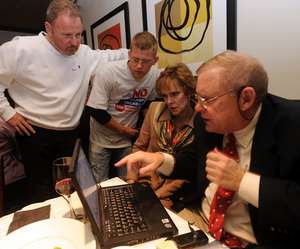
They were thought to be a stronghold for proponents who felt the millage was necessary to keep the 10 traditional school districts in the county solvent and strong.
But that didn’t turn out to be the case.
City of Ann Arbor voters did endorse the millage, but only by a margin of 2,355 votes. The city was 56.2 percent yes and 43.8 percent no.
“The margin in favor wasn’t what we were hoping for,” said Steve Norton, the campaign manager for the Ann Arbor citizens' pro-millage group.
The margin wasn’t enough to make up for the heavy losses in the other areas in the county.
- In the city of Saline, 61.4 percent of voters cast no votes.
- In the city of Ypsilanti, 52.4 percent of voters said no.
- In the city of Milan, 71.8 percent of voters rejected the millage.
- In the city of Chelsea, 50.9 percent of voters rejected the proposal.
- In Ypsilanti Township, 66.5 percent of voters cast no votes.
- In Pittsfield Township, 54.7 percent of voters said no.
Voter turnout was around 20 percent countywide.
For many who said no, the economy was a major factor.
“I took a big pay cut,” said Mary O’Neil, 56, of Ypsilanti. “I just couldn’t afford to pay more, as much as I would have liked to.”
Both sides also said a strong factor was the a message by opponents that school boards and school administrators aren't doing a good job with the money they already had.
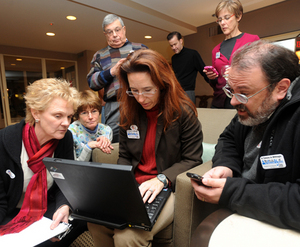
Lon Horwedel | AnnArbor.com
“People are more suspicious of how money is being spent,” Norton said. “I think (the opponents) ended up confirming people’s worse fears.
“For a lot of people, the reality of what was at stake hadn’t set in. They didn’t realize how close we were to the edge.”
Opponents of the millage were able to drive home their message, thanks to funding from McKinley and its CEO, Albert Berriz.
Supporters of the millage said they didn’t have a chance of competing against Berriz’ $75,000 in donations to a campaign group set up to fight the millage.
Berriz deflected concerns his money bought an outcome he wanted.
“Our coalition is broad and wide,” he said. “At the end of the day, it doesn’t matter the number of endorsements or the money that is spent. At the end of the day, the voters get to go into the booth and vote.”
Norton said the pro-millage folks didn't expect to have as “well-funded” of an opposition group when they started the push for the millage.
If the millage had passed, $30 million would have been raised each year for the next five years. It would have been split among the 10 districts on a per-pupil basis. Ann Arbor, the county’s largest school district, would have received about $11 million.
Individual districts are barred by state law from asking voters directly for general operating funds. The only way operating funds can be raised is through a countywide enhancement millage.
Washtenaw County voters already support one countywide schools tax, which is targeted for special education.
This millage would have gone directly into each district’s general operating fund. It was not targeted for any individual item.
Districts said they needed the money because of continued state cuts to funding. The state pays each district a set amount per student. That money - often called the foundation grant - comprises the bulk of a district’s revenue for its general operating funds.
During the run up to the election, Gov. Jennifer Granholm and the state Legislature cut hundreds of dollars per pupil from that foundation grant, leaving many districts scrambling to find more revenue.
Superintendents have said if the millage failed, deep cuts would take place at each district.
The millage campaign drew a lot of attention to school funding.
Norton said that’s a good thing.
“We really opened up a conversation with this,” he said. “Unfortunately, that conversation is about to get much more difficult. I think it’s going to be more painful than people realize.”
Opponents of the millage request said they're ready to begin working on making changes at the state level in school funding.
Kathy Griswold, one of the opposing group’s leaders and a former Ann Arbor school board member, said the group planned to have conversations with state legislators as soon as Wednesday morning about the issues.
By 1 a.m. Wednesday morning, the Web site for the main opposition group, Citizens for Responsible School Spending, had been updated to be the home page of a new group, Coalition for Responsible Schools for All Students. The Web site says the political action group will advocate for “developing an educational model that is student-centered, sustainable and transferable to other communities.”
• Read entire coverage of Election '09 in Washtenaw County.
David Jesse covers K-12 education for AnnArbor.com. He can be reached at davidjesse@annarbor.com or at 734-623-2534.
Comments
stunhsif
Mon, Nov 9, 2009 : 11:48 p.m.
Hot Sam, very well said, could not agree with you more. I am in sales and my bonus pay and income has dropped drastically since I am paid on commission. On top of that is a 10% paycut on my base salary. Perhaps teachers should be paid for what they deliver to their classroom??
Hot Sam
Thu, Nov 5, 2009 : 8:05 a.m.
I can find no evidence of any one in education ever getting a pay cut in my lifetime. Yes, they make "sacrifices" which means not getting a raise, and they have had their co-pays increased, and lost home value like the rest of us...but an actual cut? Hasn't happened. These same educators have a guaranteed pension plan and health care for life. Meanwhile our meager retirement savings have been dramatically reduced. My sales, and subsequently my income, are down 40%. My wife is in sales, and her income is down 40%. And some on this blog want to call us selfish for voting no on this "temporary" tax???? How about an across the board "temporary" pay cut???
Andrew Thomas
Wed, Nov 4, 2009 : 11:40 p.m.
Designated Conservative: Sorry, I didn't find this link particularly informative or insightful. Just more blathering conservative rhetoric. I'm sure I could waste your time by providing you with links spewing equally uninformative, equally uninsightful blathering liberal rhetoric. Personally, I've had enough of both over the past few weeks. What we need are concrete, constructive ideas.
Designated Conservative
Wed, Nov 4, 2009 : 10:41 p.m.
I just came across an excellent insider's perspective on the reasons why the public schools have so successfully resisted real reform up until now, and also why we need it so badly. Check it out at http://dcon2012.wordpress.com/2009/11/04/these-are-not-your-parents-public-schools/. It's a quick read from a local public school teacher.
djahner
Wed, Nov 4, 2009 : 8:31 p.m.
Charter & parochial school parents pay taxes too! Remember that the next time you draft a millage request.
march
Wed, Nov 4, 2009 : 6:21 p.m.
Do you think when things improve and the state increases funding again, and they will, that taxes will go down? Yeh, sure.......
rosewater
Wed, Nov 4, 2009 : 4:35 p.m.
Ill continue to vote "NO" on any new school millage until I see some fiscal responsibility and accountability from the MEA and WISD.
eldegee
Wed, Nov 4, 2009 : 4:02 p.m.
Throwing millions more dollars into our schools is no guarantee they'll turn out students who can read and write their own name. A poorly funded district can still graduate well-educated students who contribute to society. IF the parents are actively involved in their children's education, AND the teachers are dedicated. My wife and I know this from personal experience. Folks - Money is NOT the problem that Johnny can't read.
An
Wed, Nov 4, 2009 : 3:53 p.m.
@Ed - You said asking in the form of a question would get more answers, but...I asked the following earlier today (around 9 am) and not one person answered or told me where *I* could find the answer, etc. Some questions... How many students in Ann Arbor live in University of Michigan housing with their parents? No taxes get paid by those families, not even through rent, because U of M doesn't pay taxes (correct me if I am wrong). How many of those students who live in U of M housing have English as a Second Language issue, thus costing more $ per student to educate?
lumberg48108
Wed, Nov 4, 2009 : 3:06 p.m.
Attention: Jeremy Lazare "THE SINGLE MOST IMPORTANT THING WE CAN DO" is too tax people more? ARE YOU SERIOUS? The only way out of economic blight is responsible spending while allowing for entrepreneurs and business to excell and innovation to prosper! No one ever spent their way out of bad times!
YpsiLivin
Wed, Nov 4, 2009 : 2:27 p.m.
Andrew Thomas, Thanks. I also appreciate and respect your opinions, though I probably don't share many of them. :) There are actually many school districts in Michigan that have fewer than 100 students - the consummate example of wasting the taxpayers' dollars. For the record, WashCo districts have the following enrollments: Ann Arbor - 16, 400 Saline - 5,504 Lincoln - 4.790 Ypsilanti - 3,875 Dexter - 3,640 Chelsea - 2.640 Milan - 2,554 Willow Run - 1,975 Manchester - 1,262 Whitmore Lake - 1,217 South Arbor Charter -737 Fortis Academy 717 Central Academy - 482 WTMC - 355 Ann Arbor Learning Community - 272 Eastern Washtenaw Multicultural Academy - 201 New Beginnings Academy - 192 Honey Creek - 189 Victory Academy - 110
David Jesse
Wed, Nov 4, 2009 : 1:57 p.m.
Ed: Here's a previous story that includes the data you refer to. Scroll down for the spreadsheet. http://www.annarbor.com/news/local-schools-districts-spending-on-instruction-takes-slight-dip/index.php
JSA
Wed, Nov 4, 2009 : 1:32 p.m.
I am amused by the griping of the supporters of the millage. First and foremost this was an attempt by AAPS to use WISD to get this rip off attempt on the ballot. I am appalled that the superintendents of the other school districts gave their assent knowing that their residents would reject this out of hand. The numbers prove this and I would hope that they are all looking for a job shortly. As usual in Washtenaw County the purpose of this millage was to allow Ann Arbor residents, bureaucrats, and politicians to use the democratic process to extort funds from the rest of the county's residents to pay for things that Ann Arbor Schools wanted but couldn't get on their own. Don't try to paint this as something it is not. It was a money grab by AAPS pure and simple.
Blue Eyes
Wed, Nov 4, 2009 : 1:11 p.m.
I have two comments: The 1st is the inference that it was expected that the "yes" margin in AA would push the millage through over the "no" votes outside of AA. AA wants it so the rest of the county is stuck with it? How nice for everyone outside of AA! Second, as others have pointed out, a lot of us know people who have already lost their jobs or are about to, and those "few extra dollars" that would go toward the millage make the difference between whether those people eat, have heat or even a place to live. I don't think any of us want to go back to the days of the Depression when it was common to send your children to live with relatives or friends because you couldn't afford to feed them. Whether we like it or not, we have to make the attempt to live within our current means.
Andrew Thomas
Wed, Nov 4, 2009 : 12:53 p.m.
Ypsilivin' Thanks for the clarification, I stand corrected on the size ranking of the Ann Arbor district. There are a LOT of very small school districts in Michigan (less than 1,000 students) and these are certainly targets for consolidation. Also, I wanted to say that I have enjoyed your comments and the lively debate they have generated. Even though we seem to disagree on many points, I respect and appreciate your position.
Jimmy Olsen
Wed, Nov 4, 2009 : 12:29 p.m.
Supporters of the millage said they didnt have a chance of competing against Berriz $75,000 in donations to a campaign group set up to fight the millage. Didn't have a chance? It's not all about money. What about the captive audience the teachers have had since this was announced. I couldn't believe some of the stuff they have been telling the kids in the classrooms, let alone the signs, etc. Could it be many people finally found out where all their money goes to support a school district? Maybe they found out a little something about teachers and administrators? The dialog here has been good - eyes wide opened on both sides. So lets not stop the debate and move on to Lansing and let your elected officials know how you feel.
xyz
Wed, Nov 4, 2009 : 12:22 p.m.
Public education in my school district (AAPS) is actually on top of my donation list now.
YpsiLivin
Wed, Nov 4, 2009 : 12:21 p.m.
Andrew Thomas, I am advocating the consolidation of school districts. There are many administrative/service functions that could be consolidated without consolidating the districts themselves. The goal of consolidation should be to eliminate "over-administration." As for the size of Ann Arbor's school district, it isn't as big as you think. The list goes something like: Detroit Utica Grand Rapids Flint Livonia Lansing Dearborn Ann Arbor Plymouth-Canton Warren,
Designated Conservative
Wed, Nov 4, 2009 : 12:06 p.m.
If all 24,114 yes voters each donated just the $200 per year that they said the tax would cost the average county homeowner, they alone would provide over 80% of the $30,000,000 that this new tax was projected to provide to the schools. Considering that this voluntary method would minimize collection/administration costs associated with the tax process, I suspect that their voluntary contributions would actually provide MORE funds to the schools than any tax. Come on yes voters its time to get your checkbooks out and support the schools! More at http://dcon2012.wordpress.com.
treetowncartel
Wed, Nov 4, 2009 : 11:51 a.m.
The aspect of the county voting as a whole is a little troubling, kind of goes back to that basic theory in civics class concerning taxation without represntation when you look at how the money would have been distributed. Really, this is the kind of thing that each individual school district should decide for themselves. If Dexter want it, Dexter can have it, if Manchester doesn't, then manchester doesn't. Perhaps the now that the legislture has gotten a budget done they could look into amending the statute. Certainly, one would think our local reps in Lansing could put this in order. Was there ever any commentary from our reps in Lansing about their position on the countywide school millage? or did they hide their head in the sand so it couldn't be used against them in the next election.Also, where are the voters, the outcome is over and it is what it is, but the low voter turnout is embarassing.
Andrew Thomas
Wed, Nov 4, 2009 : 11:50 a.m.
Unless I completely misread the post, YL seems to be advocating a single county-wide curriculum, set of text books, etc. I could certainly live with five, maybe even three consolidated districts based on geographical proximity and common values.
Andrew Thomas
Wed, Nov 4, 2009 : 11:31 a.m.
Ypsilivin' To echo another post, be careful what you ask for. Do you REALLY want a county-wide school district? Consolidation dilutes local control. If there is one thing that this election clearly demonstrated, it is that there is a very wide gap between what voters in Ann Arbor expect from their schools (and are willing to pay for) and what smaller out-county areas want. A consolidated, county-wide district would, in all likelihood, be dominated by Ann Arbor -- largest population center, most students, highest tax base. That means that we Treetown tree-huggers will be selecting the texts, the curriculum, etc. for Manchester and the other more conservative out-county areas. You didn't want the millige crammed down your throats by Ann Arbor liberals (like me) and you were successful -- in no small part, because many Ann Arbor residents objected to being a "donor district" supporting the rest of the county. Given this dynamic, how do you think outcounty areas would be treated in a consolidated district? I do think some consolidation is in order -- there's just no way to justify the continuation of the Willow Run District, for example -- but a county-wide district is just too big. Besides, Ann Arbor is already one of the largest districts in the state -- I think third or fourth behind Detroit and Utica, maybe someone else -- so it isn't clear to me there would be additional economies of scale.
treetowncartel
Wed, Nov 4, 2009 : 11:20 a.m.
Top Cat, I boughtt $200 in Michigan lottery tickets this morning. Done and done.
belboz
Wed, Nov 4, 2009 : 11:18 a.m.
I hope everyone complaining about the "no" vote, talking about how this is going to destroy our economy and future, are not driving around in a Toyota, Hyundai, or some other foreign car. The parking lot of my kids schools are filled with these. Many teachers don't seem to realize they are dependent on the economy of the state as a whole. Or, they choose to ignore it. Either way, these are not the people I want teaching my kids.
dotdash
Wed, Nov 4, 2009 : 11:18 a.m.
dadcss: Michigan schools are funded at about the national median per-pupil level. They are *not* expensive. Sure, Mississippi is educating their kids for less, as is Arkansas, but do we want to be Mississippi? Aren't we aiming for something better? I saw a lot of "no" vote signs on huge lawns, so I can't really agree that the no votes were motivated exclusively by hardship. I wish I could, because I would feel better about it.
treetowncartel
Wed, Nov 4, 2009 : 11:08 a.m.
Top Cat, I boughtt $200 in Michigan lottery tickets this morning. Done and done.
TXteacher
Wed, Nov 4, 2009 : 11:05 a.m.
As the unions fall, so will the wages of all workers. I've seen it here in Texas. Be careful what you wish for all you union haters. You just might be getting it!
TruBlue
Wed, Nov 4, 2009 : 10:51 a.m.
@Rob I work more than a 40 hour week with no extra pay. Get over it. It's called the real world. @YesVoters feel free to pony up a $200 donation today to your school.
glacialerratic
Wed, Nov 4, 2009 : 10:49 a.m.
Dave Martel is an employee of Annarbor.com. Readers should also know that he is a board member of the AA Public Schools Educational Foundation, and that he is quoting from the Foundation website without attribution. Annarbor.com opposed the millage. In the interest of ethics and good journalistic practice, how about full disclosure? Why should voters write a check to a non-profit foundation (whose board includes mortgage bankers and realtors with a stake in opposing the millage) which is not accountable to the public for the decisions it makes about how funds are spent? Public schools are a public responsibility.
AAJoker
Wed, Nov 4, 2009 : 10:46 a.m.
Well said DonBee, a great list of savings ideas.
dadcss
Wed, Nov 4, 2009 : 10:43 a.m.
Look this is not about "I support education vs I do not support education". So lets take that off the table, this is about money or lack there of. No money in households because of the economy and no money in schools because schools have to pay real wages and real utility bills. If you have an extra $200 per year, then go down to your local school and give it to them. Let us now begin to look at changing the funding model, let us look first at the funding models in the other 49 states.
YpsiLivin
Wed, Nov 4, 2009 : 10:36 a.m.
mpeterse, You can have my school district lock, stock and barrel. All ten WashCo school districts should strongly consider striking a deal with Washtenaw Community College to provide vocational education courses. WCC has devoted significant (taxpayer-funded) resources to vocational education and can deliver it better than the local school districts can. While they're talking with WCC, they should consider using that facility to replace AP courses. Guess what, the outcome is the same - students who pass get college credit because it's a REAL college course. The only difference is the price. The reason we have ten local school districts is because the school district administrators fight so hard to keep their little fiefdoms intact. That's administrative job security, and I assure you that's Job #1 for school administrators. We could do well with five, or three or dare I say even one school district in Washtenaw County? The school districts should work together to form ONE curriculum; use ONE set of text books; have ONE calendar; ONE bus maintenance facility; ONE central administration; ONE purchasing department; ONE Information Technology department, etc. The list of potential savings is nearly endless. This won't happen NOT because the taxpayers don't want that, but because the 10 school district administrations don't want that. The taxpayers are just in charge of producing the money; administrators rely on obfuscation to prevent the taxpayers from knowing how their money is being spent.
David Jesse
Wed, Nov 4, 2009 : 10:29 a.m.
you can find full results here: http://electionresults.ewashtenaw.org/nov2009/canvassreport30.html
Mibroker
Wed, Nov 4, 2009 : 10:26 a.m.
Still no reporting of results in Lincoln, Manchester, or Dexter?
Tom Bower
Wed, Nov 4, 2009 : 10:20 a.m.
WISD superintendent and board of trustees are not accountable to the public. When's the last time you voted for one of the WISD trustee positions? See Revised School Code, section 380.614. URL:http://www.legislature.mi.gov/(S(sbxtie55zjfq32jd32m4f4mr))/documents/mcl/pdf/mcl-Act-451-of-1976.pdf People wanting fundamental changes should consider that increasing public accountability of those making the decisions is a necessary first step. With greater public accountability would this election have occurred? Particularly if consolidation of services is to occur and WISD is to become more powerful. In that case, greater transparency and accountability are necessary. The WISD board voted to place this issue before voters at its meeting on August 4, 2009 at 8:30 a.m. There were two members of the public in attendance -- me and A2.com reporter David Jesse. This is transparency?
An
Wed, Nov 4, 2009 : 10:13 a.m.
Kate said: "I too, am disgusted by people in Washtenaw county. Congratulations on taking your anger and frustration of our economy out on our teachers.... now they too can suffer and have 300 jobs cut. Chances are, someone you know will now lose their job. And of those that are lucky enough to keep their job, they will all be shifted to new buildings and most likely teaching a new subject in which they have never taught before and may not be their strongest area- which in turn means that your child will not get that really great English teacher they were hoping for, because that teacher now teaches history, or math- and maybe only in the mornings at your child's school, because in the afternoon they have to go to another school where they are needed. And do you really think they are going to cut an admin over a teaacher that was hired 5 years ago? Not likely. This will do far more harm than the few dollars you would have paid per week. Seriously, people who voted "no" were not educated enough on this millage, and if they do come up with another I don't think they are going to try to be sneaky about passing it like one blogger suggested, maybe just separating the facts from the rumors. GREAT JOB ANN ARBOR.... I am extremely disappointed. " I already LOST my job. I am already SCRAPING BY. You are awfully judgmental. Perhaps you have not yet lost your job. If so, good for you, but don't you dare put the guilt trips and scare tactics on those of us who ALREADY LOST OUR JOBS.
An
Wed, Nov 4, 2009 : 10:10 a.m.
"For heaven's sake, you can save $200 a year by lowering your thermostat a few degrees. This will cost us all dearly in the end." My thermostat is already set at 67 degrees during the day and 62 degrees at night. How much lower should I go with it? And for the record, I couldn't decide "Yes" or "No" yesterday, so in a move that is highly uncharacteristic of me, I chose to NOT vote at all. I am not worried about teacher's salaries, but why all the administrators? A principal in each high school, plus one grade level principal per grade, all making 100k or more. So that's about 20-24 "principals" all making 100k or more a year? That's 2,400,000 per year (and that's a low estimate) just on principals for high schools. Really? They can't make it wit 2 o4 3 principals for each high school? Like I said, I was torn, so I didn't even vote (and thus don't have a right to say anything, I know this.) I am surprised and saddened by the nastiness going back and forth. We had a choice to make. It went to the polls. The people spoke. Now can anyone answer my question about how many kids in our school system live in U of M housing? How about Public Housing (also not paying any kind of taxes).
DagnyJ
Wed, Nov 4, 2009 : 10:09 a.m.
Jon, catfishrisin, and others: You should read and think more carefully before you react. IN this comment thread and others are many suggestions on how to design a millage that would pass. It would include: transparency in budgets and spending, an alignment of teacher contracts in the WISD districts so that AA isn't subsidizing another district's overly generous contract, demonstration of restructuring in all districts, which means pay-to-play, consolidation, transportation redesign, coordination by the WISD for these things to happen, and by that I mean, the WISD helps districts purchase as a group, etc. efforts by the unions to remove themselves from MESSA, etc., and that would mean all unions in all districts. If those things were done, I could support the millage.
Barry
Wed, Nov 4, 2009 : 10:06 a.m.
I supported the millage, and watching it fail has given me some great ideas. Watching the voting patterns have given me some great ideas - let's find some other great ways to lower our taxes: 1) Let's have Ann Arbor stop paying for the townships roads through the Road Commission. Why should we subsidize those fat cat homeowner living on five acres in the countryside? 2) Let's get rid of all subsidies to the state parks. Hunters should cover their own costs. 3) Let's have the townships pay their own costs for police support. 4) If you're retired and have no kids, let's get rid of Medicare / Medicaid. It's really unfair that I have to support you - shouldn't you be transparent about your own health care costs? 5) Kathy Griswold supported building Skyline. How about she get support from McKinley to pay for the cost of that building? Taxes are for public goods - things that benefit all of us. Gutting the school system will have irreparable consequences - but thank goodness that you'll be able to save $.50 per day.
mpeterse
Wed, Nov 4, 2009 : 10:05 a.m.
Over the last few weeks I've seen a number of comments regarding consolidating some of the 10 Washtenaw County school districts. Okay... Now that the millage did not pass, who among you is willing to consolidate your school district? Hmmm? Any practical suggestions here? Traditionally we end up with individual school districts b/c no one wants their community to give up its own directed education. Is this financially smart? Of course not. Now that it's on the table due to financial issues in the County (and beyond), what is the next practical step to pursue this? And, again, who among you is willing to merge your school district with one or more of your neighboring districts AND go on the record as willing to do so AND work NICELY with said neighboring school districts to accomplish this?
dadcss
Wed, Nov 4, 2009 : 9:59 a.m.
Households in general are barely scraping by with no extra cash. If you have money for the schools then by all means donate it. But do not judge me - I'm trying to get 2 kids through college.
Jon Saalberg
Wed, Nov 4, 2009 : 9:58 a.m.
Ugh. Why do the anti folks rant about the "nastiness" of those who support our schools? Calling anti folks out for not understanding the difference between a teacher's salary and living within your means, or that setting our schools on a path towards lower standards is not being nasty - it's the truth. And please, anti crowd, can you provide some documentation of the rampant waste that you complained about? Saying there's waste doesn't make it so. However, spending $75K can apparently make people believe anything.
Andrew Thomas
Wed, Nov 4, 2009 : 9:57 a.m.
Catfishrisin We really don't need this kind of comment. One of the very important things we seem to have lost in this country is the idea that two intelligent, well-informed people of good will can look at the same facts and come to very different conclusions about what is best. Although I supported the millage, I have the utmost respect for Kathy Griswold and others who have been on the opposite side of this issue. We need positive solutions and productive discussion, not insults.
catfishrisin
Wed, Nov 4, 2009 : 9:45 a.m.
I suggest voters be required to demonstrate a respectable IQ score on the WAIS as a prerequisite to vote. Maybe that would prevent this type of collective poor judgment from affecting important issues in the future.
DagnyJ
Wed, Nov 4, 2009 : 9:31 a.m.
Dave, exactly right! And if the WISD and districts had said, here are some of our plans for restructuring...and then showed us the plans, that would have been quite persuasive. I would have supported that millage.
dogface
Wed, Nov 4, 2009 : 9:25 a.m.
My grandkids attend Eberwhite elementary school. They have 20 kids in each class. One teacher, no parapros, no assistants, no helpers. My grandkids love their teachers! So each classroom generates over $200k in revenue. The teacher gets about $75k including benefits. Who gets the rest of the $125k??????
Dave
Wed, Nov 4, 2009 : 9:23 a.m.
Let's face it, the school districts got greedy -- they asked for more than was reasonable or responsible. A more appropriate approach would have been to come to the voters and say "The state unexpectedly pulled back funding and we are asking you (the voters and taxpayers) to help offset those cuts on a temporary basis. Give us 2 mills for 2010 and 1 mill for 2011 while we restructure the county school districts and drive out waste that exists in the system -- just like many companies and families have done." I believe something similar to this approach would have easily received approval as voters would have seen it as a reasonable and responsible approach. Rather the districts requested 2 mills for 5 year. Everyone knows that meant in 5 years they would be back asking for the 2 mills to be renewed and at that time they would state "this is not an increase in taxes, but rather a replacement millage that is required to support the schools operating funds." If schools truly want to teach our kids, they should lead by example and look at ways to change their operating models -- they should be leaders of new paradigms and be innovative in solving issues and problems that they face. They should be efficient educators. Instead we see the same approach and threats -- "we need more money or we are going to cut teacher positions and increase classroom size." The message has gotten stale and the messenger no longer has credibility! By the way, I was in favor of the increase (only because I have 3 kids in the system) but I fully understand those who voted against it!
braggslaw
Wed, Nov 4, 2009 : 9:20 a.m.
The democratic process worked. The voters have spoken. If somebody wants to donate their own money to the schools feel free, this is America you can do what you want with your own money.
jbens
Wed, Nov 4, 2009 : 9:19 a.m.
It's great how adults who benefited from adequately funded schools in their youth can now say that this millage is too much and vote against it. The message is that our generation deserved good schools, but our children and grandchildren do not, they're not worth the money (which I'd rather spend on Michigan football). For heaven's sake, you can save $200 a year by lowering your thermostat a few degrees. This will cost us all dearly in the end.
Audrey L. Jackson
Wed, Nov 4, 2009 : 9:14 a.m.
I am one of those Ann Arbor voters who did not support a county millage. Rather than debating the merits of a so-called "anti-teacher" vote, I choose to see the outcome as a pro-classroom vote. Ann Arbor has consistently served around 17,000 students over the past 10 years, yet personnel costs have exceeded that number of students for a while. One school is essentially a boot camp for troubled kids who also attend one of the main high schools. Another high school is a prized site for extremely low teacher to student ratio, and serves mainly future IVY leaguers, another high school is a dumping ground for GED students who don't "fit in" (who does fit in at the HS level)? And Skyline, that technoedubuilding where not even all grade levels of students are attending? And we wonder why the district comes up short on money whether Lansing cuts per pupil spending or not? Parents should remember "when is the last time you were able to easily arrange a meeting with your school principal?" Parents should question why administrative decisions handed out during staff meetings often never reach the eyes or ears of parents. Everyone should question why we pay six figure salaries to principals who no one seems to have access to and who always seem to be off in another state receiving education training to bring back to this school district. Not least of all, why isn't AAEA donating its teacher union dues to buildings or classroom programs that are so "endangered?" There's not a lot of mystery to why this millage proposal failed. Sadly, there is a lot of arrogance behind the thinking to suggest that such a millage should have emerged without first addressing internal system budget problems in the district, first. Ann Arbor Public Schools haven't even begun to remove the layers of waste in this district.
Terrin
Wed, Nov 4, 2009 : 9:06 a.m.
Jeremy: Perhaps you are unaware, but many folks in Michigan have already lost their jobs, and many of those folks are trying to just to keep food in their mouths and a roof over their head. Asking them to pay more for a problem they didn't create seems a little selfish. Further, you should be grateful you live in a place where you have public education. Ask your parents to pay for a private school for you. See how that goes.
Andrew Thomas
Wed, Nov 4, 2009 : 9:06 a.m.
I supported the millage, but the voters have spoken and it's time to move on. My hopes for the future are the following: 1. The District will engage the citizens of Ann Arbor in a thoughtful discussion of where and how cuts will be made. 2. The MEA will consider accepting at least a token wage reduction in order to mitigate the effect of budget cuts on classrooms. I realize this would be a bitter pill, especially considering some of the extreme anti-teacher rhetoric we have seen from some millage opponents. But based on my very "quick and dirty" analysis, 1% pay cut could save 20 teacher positions. We need to have this discussion. 3. Ann Arbor parents -- it's time to step up and support our schools with private funds. As noted by David Martel and others, the Ann Arbor Public Schools Educational Foundation is a potential source of support for vulnerable programs, particularly in the arts. If you are not already a supporter of AAPSEF, please consider donating an amount at least equal to what you would have paid under the millage. Like many of you, I am disappointed in the election results, but there are many ways to support our schools, and ensure their continued excellence. Instead of wringing our hands, we need to figure out a better way.
An
Wed, Nov 4, 2009 : 8:44 a.m.
Some questions... How many students in Ann Arbor live in University of Michigan housing with their parents? No taxes get paid by those families, not even through rent, because U of M doesn't pay taxes (correct me if I am wrong). How many of those students who live in U of M housing have English as a Second Language issue, thus costing more $ per student to educate? I've been laid off for 18 months. I have a part time job and some other funds that I saved that I am living on. I own a home in Ann Arbor. I truly cannot afford more taxes. I want my kids to get a good education, but I want to feed them too.
DonBee
Wed, Nov 4, 2009 : 8:38 a.m.
As I have advocated (and I am not a shill for anyone - no one has handed me a dime) there are lots of ways to cut the costs in the school systems - most do not require a vote beyond the school boards: 1) consolidate services with WISD - one team to service all the schools purchasing, busing, cleaning, food services, and other non-classroom services. Pick the people who do the best job today from the 10 districts and move them to WISD. Based on VA, the savings for larger districts is about 20% 2) AAPS - bite the bullet and implement the busing study - that is a $1 million dollar savings and a huge carbon reduction 3) AAPS - consolidate Stone, Roberto Clemente and Community at Skyline, close and sell the 3 buildings that those schools are in. Not only does it allow consolidation of services staff, it puts three tracts of land back on the tax rolls. 4) Look at consolidation of benefits - move (as Rep Dillion - a Democrat suggested) To a single benefit plan for all the employees - bid it competitively. 5) Sit down with the unions and open the contracts, this will be painful. Maybe it is time to break the step model in the schools, maybe it is time to pay teachers more for excellent performance, maybe it is time to...The first place i would look is at the Plymouth-Canton contracts, they are very different and the students there perform well on less money in the school budget. 6) Look closely at fringe activities, those that service a very small number of students (e.g. independent studies, very small special classes for people with an interest) and ask - is there a way that we can continue to provide these with less cost (e.g. Michigan Virtual High School, Volunteer instructors, co-op options). Don't just cut them, look at how you can do them differently. We need to Think Different about how we run the schools, not how to yell and point fingers. I challenge the students who have posted here - you are inside the schools, what kinds of cost savings can you see that don't directly impact your education? One complex answer is to move all homework to Power School - we already pay for it. Let the students get their assignments from homework there and stop printing reams of homework sheets that get lost or eaten by the dog on the way home. If we are willing to dig in, we can do this without cutting music and other programs. I fear the "leadership" of the schools will choose teacher pink slips because it is easy. The teachers should also be getting engaged in pointing up savings, it should be job one as Ford used to say for everyone.
jondhall
Wed, Nov 4, 2009 : 8:37 a.m.
Is it not about time that someone else pays other than the land owners? How about the MEA taking a pay cut? What a novel idea! They could agree to work an additional year, sort of like the years that got added to Social Security (one can not retire as early), no not the MEA! They are a UNION, and the do not give a S ___T about our children. Spread the pain!
Tom Bower
Wed, Nov 4, 2009 : 8:36 a.m.
I hope A2CRSS will engage policy makers and advocate changing current law that denies public school academies from being eligible to receive regional enhancement millage money. This is section 380.705 of the Revised School Code. In addition, I hope A2CRSS will advocate for needed changes to section 380.614 of the Revise School Code which concerns the election of members to intermediate school district boards. The current law effectively excludes representation of public school academy advocates on intermediate school district boards and denies popular election by school district (general powers districts as well as public school academy districts) thereby insulating intermediate school district boards from public accountability of county voters. The current method of electing intermediate school district board members amounts to a de facto closed club approach which discourages transparency and accountability.
MjC
Wed, Nov 4, 2009 : 8:34 a.m.
Im not a rich taxpayer. Im not connected to the Vote No folks. Im a parent volunteer and strong supporter of Ann Arbor Public Schools. So the voters have spoken - whether you're relieved or disappointed in the outcome it's time for all of us to take action. Make a difference now by writing to your State Reps and Granholm to demand school funding levels be restored. Its our state government that is failing our school systems (colleges included). Contact your State Representatives and School Board Members today - http://house.michigan.gov/find_a_rep.asp
shawnsbrain
Wed, Nov 4, 2009 : 8:32 a.m.
The inflamatory statements made toward to "NO" voters on this thread are what is ludicrous and uneducated. If the upcoming cuts hit the classroom the responsibility lies directly with the administration and not the voters. The anger of the students needs to be focused at those who control the money and not those who give it. This election was not bought. I, for one, could not care less what some A2 real estate guy has to say. My decision to vote "NO" was based squarely in personal observation of excess. While there are many hard working public school employees and motivated parent volunteers, there are also lazy ones and disinterested parents as well. I would be all in favor of requiring families with kids in school to volunteer 40 hours a year to the schools. If they chose not to, add it to their tax bill. Yes, I do have a kid in school and I volunteer well in excess of that. Trying to get additional help is like pulling teeth. Finally, the threat of eliminating sports and the arts is just that; A THREAT. It is just one more attempt at not dealing with the big issues and attempting to either shame or strongarm the public into perpetuating the status quo. This type of attitude motivates the "NO" side all the more. I'll see you all fundraising activities for our schools. Well, maybe I won't if you don't show up. Same goes for school board meetings. Let's get the operating budget on the table.
Rob
Wed, Nov 4, 2009 : 8:16 a.m.
@No-voters: I understand your point, I really do. I for one plan on supporting my kid's school with whatever taxes may have come out. And at this point, I'll agree with Kathy and mygirlfriday - I hope that all other "yes" voters will be storming the castle with me if the AAPS administration tries to touch anything to do with teachers actually teaching. Finally, @Yeggi - Good lord, man - how many teachers do you actually know? I can't think of a single one that I do that says they're happy with their pay. Do you think their day stops when the kids go home? My BIL is up for HOURS grading, making class plans, tests, dealing with administrative crap - almost EVERY NIGHT. It's way more than a 40-hour week. And I'm sorry, but it's a ludicrous suggestion to quit a job - any job - in this economy. How about you go back and find some serious suggestions rather than just being inflammatory, 'k?
Basic Bob
Wed, Nov 4, 2009 : 8:06 a.m.
Millage supporters, I was opposed to this before it went on the ballot, long before McKinley funded the opposition. This was an obvious money-grab through a loophole in state school funding. Don't blame Mr. Berriz for anything other than thinking critically and supporting a cause he believes in. Teachers, your Jedi mind tricks won't work on my kids. We taught them to read at home, and took them to many of the places that are in their history and government books. They went to two inaugurations (Clinton 1996 & Bush 2000). One ignorant Ann Arbor Huron teacher punished my kids because they took 3 days away from school, not to go to Disneyland or Traverse City, but to go to museums and castles in Europe. Both money and education are more valuable to me because I don't take them for granted, but have to make choices.
texorama
Wed, Nov 4, 2009 : 8:03 a.m.
The angry responses by the pro-millage crowd are uncalled-for. I have voted for many, even most millages in the past, and I'm sure I'll support others in the future. But this one was a stinker. School spending has increased at twice the rate of inflation, and Kathy Griswold, a former school board member, has said she couldn't get hard figures as to where the money was going. The defeat of this millage is a call for responsible spending, not an attack on the value of education.
needed perspective
Wed, Nov 4, 2009 : 8:01 a.m.
Wow...I am all for those who voted yes to open their check book and make a donation to their district today. This vote was not a slap in the face to anyone...if is a reflection of the economic crisis faced by all who are not paid with public funds--income decline/loss, job losses, business closures and the housing and foreclosure crisis. These are not good times.
YpsiLivin
Wed, Nov 4, 2009 : 8:01 a.m.
Jeremy, You persist in giving credence to the assumption that the only place the schools can cut is classroom operations. Far from true. Classroom operations may be the only part of the school system you see, but a little investigation will turn up plenty of waste, fraud and abuse in your local school system. There are many administrators in the school systems who contribute nothing to the overall well-being of the students, yet still collect a paycheck. School districts can and should be consolidated. This county doesn't need 10 duplicate administrations and taxpayers are simply tired of people who come at us with their hands out, looking for more money. For me, however, the most shocking thing about your post is your sense of entitlement. Get one thing straight, kid: life doesn't owe you a living. Now put on your Big Boy pants and go to school.
susan
Wed, Nov 4, 2009 : 7:54 a.m.
You did not report Dexter or Manchester?
Mary H
Wed, Nov 4, 2009 : 7:40 a.m.
I'm not surprised that the millage didn't pass in this economy, even though I voted for it. I sympathize with the people who feel they can't afford it. But something is wrong when one person/entity with an interest in the real estate business can give $75,000 to an issue. Sounds more like buying an outcome than free speech.
spaceman
Wed, Nov 4, 2009 : 7:31 a.m.
Thank you David Martel for pointing out how all the YES voters can contribute to the cause of local education; I wonder how many will do so. Most of the cry babies commenting this morning are using emotional and irrational arguments. They want something, but they want you to pay for it. And the comment that the outcome was "bought" by some funding from Al Berriz is ludicrous. It was in fact the proponents' signs that had the biggest impact. Rational people know that it does NOT "Take a millage to educate a child". While many people simply rejected higher property taxes in these difficult economic times, others voted no as a rejection of the collectivist/socialist inspired philosophy behind this latest effort to push confiscatory taxes for public usage even higher.
kraken1165
Wed, Nov 4, 2009 : 7:18 a.m.
I think the way certain areas have voted shows a level of frustration as to the way money is distributed thoughout the district. A2 students seem to be worth more than everyone else. All students should recieve an equal funding. Until that happens I have a hard time increaseing funding to this district and wont until this is corrected.
Barry
Wed, Nov 4, 2009 : 7:09 a.m.
Jeremy is correct - McKinley's sponsored voters have moved to gut the school system. Kathy Griswold, congratulations to you and your team for ensuring that Ann Arbor joins the rest of Michigan's race towards the bottom. And to MCC - "now is the time to hold the AAPS accountable." No, now is the time for the actions of the voters of this county to gut the schools. Here's my recommendation - let's eliminate football, basketball, and wrestling. That would be an accountable action. And for all of you crying about taxes - look at prosperous states like North Carolina, where you'd face far higher taxes. Businesses don't want to move to Michigan just because of the SBT - they don't want to move here due to miserable roads, miserable schools, and short-sighted voters who refuse to invest in their state.
David Martel
Wed, Nov 4, 2009 : 7:08 a.m.
The Ann Arbor Public Schools Educational Foundation is a non-profit organization separate from the Ann Arbor Public Schools that serves as the one true vehicle for private giving to public schools in Ann Arbor. The Educational Foundation is fiscally sound and transparent. Dollars are stewarded responsibly. Dollars do not go into teacher compensation or district administrative compensation. Dollars stay 100% in Ann Arbor. The Foundation has a 17 year history raising private donations for the Ann Arbor Public Schools. And don't forget, donations are not only not a "tax" but they are tax deductible. Approximately 54% of voters in the Ann Arbor Public Schools district voted yes. If each of the approximate 12,971 "yes" votes were to donate an average of $250 annually (based on an average home value of $250,000 and a taxable value of 50%), we would instantly raise $3,242,750 annually to support public education in the Ann Arbor Public School District. FIND OUT MORE at http://www.supportannarborschools.org and spread the word.
tink
Wed, Nov 4, 2009 : 7:04 a.m.
Kate, in some ways you make our point when you say they will not cut an administrator over a teacher. That's the problem. There are plenty of ways to reduce spending rather than just saying "we need more money". We don't need 10 districts with 10 superintendents and support staff. There is far too much overhead in this county, too thick a middle layer. Put the money back in the classroom. Also, the teachers and their powerful union need to make concessions on health care and retirement as the rest of us have done, the sooner the better. Even the UAW has seen the need to do so. Some may lose their jobs? Look at the rest of the economy! The reality is that these schools need to be able to responsibly educate a child for the $10K plus they currently receive per pupil. I don't understand why this one group of professionals EXPECTS to receive special consideration. They have come across as so arrogant. Those of us who voted against this measure are not misinformed, angry, taking it out on the children. We just live in the real world. I doubt that the predicted doom and gloom, i.e., teachers will be shifted from one school to the next each school day, will come to pass. For those who wanted this measure to pass, take the amount your taxes would have risen and donate it to your schools. But until the necessary spending cuts are made, the teachers benefits are more in line with the rest of the professional work force, and strategic plans for how to spend tax dollars are transparently in place, please don't expect the rest of us to subsidize wastefulness.
Basic Bob
Wed, Nov 4, 2009 : 6:56 a.m.
I'm appalled at the sore losers in this thread. All the shame about how hard it is to teach and how the kids will suffer. Sometimes life is hard and we have to say NO. Please don't sulk, but learn to accept the outcome and move on.
Jon Saalberg
Wed, Nov 4, 2009 : 6:55 a.m.
Opponents of the millage were able to drive home their message, thanks to funding from McKinley and its CEO, Albert Berriz. Congratulations. We have allowed a rich person to "buy" our school system.
Yeggi
Wed, Nov 4, 2009 : 6:44 a.m.
From Jeremy: 'Teachers have one of the hardest, most thankless and unsung jobs on this planet, and this is a shameless slap in the face to all of them. "I don't need you. I like how things are going." ' If this is the case then they can quit. In this country worth is equated with pay. Public school teachers are well paid. I'm weary of chatter, 'teachers are not paid enough.' The fact is Michigan public school teachers are well paid.
mygirlfriday
Wed, Nov 4, 2009 : 6:37 a.m.
"City of Ann Arbor voters did endorse the millage, but only by a margin of 2,355 votes. The city was 56.2 percent yes and 43.8 percent no". I believe the comments towards Ann Arbor are a little uncalled for. It would appear that many of the Ann Arbor voters were for this milllage. As for the teachers cuts, stop shaming the voters and place the blame where it really belongs. If teachers positions are cut, and the students are punished for this short fall, then wouldn't it be time to start aiming your opinions and judgements at the people who can fix it? Look to your school board and the administrators to take a serious look at all of the areas in their budget. There are many more places that these cuts can take place and teachers (the most important people in the entire education system), do not have to be sacrificed. If you all placed as much energy in making the right decisions at the administrative level. The scare tactics that have been brought out here never need to happen.
TruBlue
Wed, Nov 4, 2009 : 6:21 a.m.
Jeremy- I have 2 comments for you: 1. Schools don't DESERVE anything. It's taxpayer money and taxpayers decide when to give. I honestly would have voted for it if there were clear restrictions on how the money would have been spent. The entitlement mentality in this state appalls me. 2. You will do just fine without the funding. I went to school 1 year on only half days because the school didn't have funding to go a full day. I have since got a BS and MS from UM. Don't sweat it. To everyone else- The people have spoken and they have said: "No more blank checks to government!"
Ice Cream
Wed, Nov 4, 2009 : 6:20 a.m.
David, how did Dexter vote? Last time I checked, we were part of Washtenaw County:-)
Kate
Wed, Nov 4, 2009 : 6:17 a.m.
I too, am disgusted by people in Washtenaw county. Congratulations on taking your anger and frustration of our economy out on our teachers.... now they too can suffer and have 300 jobs cut. Chances are, someone you know will now lose their job. And of those that are lucky enough to keep their job, they will all be shifted to new buildings and most likely teaching a new subject in which they have never taught before and may not be their strongest area- which in turn means that your child will not get that really great English teacher they were hoping for, because that teacher now teaches history, or math- and maybe only in the mornings at your child's school, because in the afternoon they have to go to another school where they are needed. And do you really think they are going to cut an admin over a teaacher that was hired 5 years ago? Not likely. This will do far more harm than the few dollars you would have paid per week. Seriously, people who voted "no" were not educated enough on this millage, and if they do come up with another I don't think they are going to try to be sneaky about passing it like one blogger suggested, maybe just separating the facts from the rumors. GREAT JOB ANN ARBOR.... I am extremely disappointed.
AAJoker
Wed, Nov 4, 2009 : 6:05 a.m.
Jeremy Lazare and Rob, Don't give into the brain washing, there are many areas for cost savings and consolidations that won't hit the classroom. It is time the school system realized they are running a business that provides education and thus the need to manage their costs. There will be some potential adjustments to some programs, if parents want to keep small initiatives around they can fund them directly. Consolidate, negotiate and eliminate!
Rob
Wed, Nov 4, 2009 : 5:47 a.m.
I'm disgusted at the selfishness and short sightedness of the people in my county. Perhaps THE SINGLE MOST IMPORTANT THING WE CAN DO to pull out of a recession, to make the world a better place at all, is to educate our children. Make them into intelligent, informed citizens who are capable of dealing with the many burdens our generation is creating, and whatever comes next. The next time you pass someone on the street begging for money or a bite of food, think about your or your neighbor's child in that position - and congratulate yourself on moving our society in that direction. Teachers have one of the hardest, most thankless and unsung jobs on this planet, and this is a shameless slap in the face to all of them. "I don't need you. I like how things are going."
Jeremy Lazare
Wed, Nov 4, 2009 : 3:27 a.m.
I'm sorry, by Kathy I meant MCC. I'm sorry for the misunderstanding it may have caused.
Jeremy Lazare
Wed, Nov 4, 2009 : 3:25 a.m.
This is horrible. Being a student of the Ann Arbor Public Schools, I cannot be more disappointed in voters throughout the county. This millage meant the ability to keep our schools running in the excellent shape they have been running. Our generation is the future of America, and simply saying "I don't want to pay more taxes" is hardly an excuse for denying the funding our district, and all districts deserve. The students and faculty of the public schools in this county, whether directly or not, are the ones who are most influenced by this vote. Now, I am obviously against changing the minimum age to vote, but putting such an influential millage in the hands of people who are not the most affected by this is ludicrous. Taxpayers would have to pay more money, absolutely, but the margin of increase in the amount they would pay is not nearly as dramatic the "no" supporters say it is. However, the margin by which this vote will change our district is unknown so far. What we do know is that support for the schools in our county will be cut dramatically. Kathy, I don't care who you are, or what you do. I defy you to look at the faces of people who will possibly lose their jobs because of the judgment you have passed on the importance of their teaching positions and feel no remorse about what all of you have done. Shame on all of the no voters in the county.
MCC
Wed, Nov 4, 2009 : 2:26 a.m.
Now is the time to hold the AAPS accountable for every decision they make. It frightens me when Steve Norton says "I think its going to be more painful than people realize". Does he know something we don't. The AAPS claim that they will "do no harm", and "keep the cuts away from the classroom". Let's see if they will do that. For every administrator they cut, that's 2-3 teachers they save. So instead of 200 teachers, let's see 65 administrators go. 65 out of the 700 AAPS employ is only 10%. All away from the classroom. Sounds realistic to me. Let's competitively bid out our health insurance. Let's consolidate services with the other 10 districts. Actually let's just consolidate some of the districts. Can we fancially support 10 districts in Washtenaw County? Many with less that 2000 students. Let's hope the AAPS doesn't use the next 6 months to make the classrooms, the children, and the parents so miserable that when they bring back the millage in May, and my guess is that they will with a slicker campaign, they can convince people to vote for it. LET'S HOPE THE AAPS DOES THE HONORABLE THING!
Kathy Griswold
Wed, Nov 4, 2009 : 2:07 a.m.
Please visit the Coalition for Responsible Schools for All Students website at www.A2CRSS.org.