

Ann Arbor's dilemma: Spend money on public art or help the needy?
In these tough economic times, should Ann Arbor continue to spend hundreds of thousands of dollars on public art while some city residents are struggling to find food and shelter?
"I'm wrestling with it," said City Council Member Christopher Taylor, D-3rd Ward. "The juxtaposition of a proposed material spend on art in these difficult times raises questions in the community as to whether this is a proper allocation of our resources."
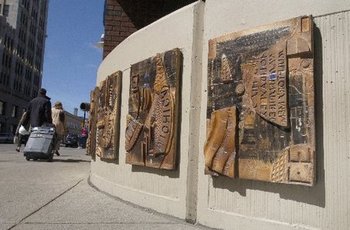
The art installations on the city parking structure at Fourth Avenue and Washington Street were part of an earlier version of Ann Arbor's public art effort. In 2002, donors rounded up more than $100,000 for three works, including "Untitled" by Barron Naegel and Yiu-Keung.
File photo
Taylor sought feedback on the city's dilemma in an e-mail sent out to his constituents Monday night.
"Should Ann Arbor spend money that it has been saving in its Public Art Fund on public art, or should it spend that money instead on human services?" he asked
Taylor said he's gotten close to 100 responses so far, and a majority of them are pro-art.
The City Council passed a public art ordinance in 2007 that ensures 1 percent of monies budgeted for city developments and some other infrastructure projects be set aside to fund public art projects. By the end of this fiscal year, the Art Fund will have accumulated about $1.5 million.
The Ann Arbor Public Art Commission has recommended the City Council allocate $850,000 of that money toward an integrated water-based art installation in the lobby and courtyard of the new police-courts building on Huron and Fifth Avenue. That proposal is scheduled to come before the City Council on Dec. 7.
Taylor said some people have suggested instead of spending the money on art, the City Council ought to amend the public art ordinance and spend the money this winter on human services such as food and shelter for the homeless.
"A supporter of this position might argue simply that in desperate times such as these, it is irresponsible to fund art when people are suffering," Taylor wrote in his e-mail. "If we amend the public art ordinance to reallocate the art monies to human services, we will be able to provide comfort and security to scores, if not hundreds, of persons during the dead of winter in bleak economic times."
|
|
Mayor John Hieftje said today he's aware the issue is being discussed, but said it's not yet clear whether the City Council would be able to raid the Art Fund even if it wanted to. Even if it could take action to end the public art program, he said, each dollar most likely would have to return from the fund it came from, and only a small portion comes from the city's general fund.
"Government money is in all these buckets, and some of the buckets are locked up," Hieftje said. "It's not cut and dried."
In the current fiscal year, Taylor said, Ann Arbor will spend $1.27 million general fund dollars on human services in the areas of housing stability, health and well-being, economic stability, and youth success. Ann Arbor's total general fund budget is about $85 million, which includes police, fire, parks and other funds.
Just last week, the City Council approved spending an additional $159,000 from the Ann Arbor Housing Trust Fund to expand warm-bed shelters at the Delonis Center and through the Interfaith Hospitality Network this winter. In addition, the county will spend another $850,000 this year on human services.
Totaled, Taylor said, the amount spent on human services by the city and county this year will be about $2.28 million.
Taylor said if the city decides to raid the Art Fund to spend more money on human services, opponents might ask, "Should we sell parkland to pay for another homeless shelter? Should we cut the hundreds of thousands of dollars a year we spend to mow park grass to feed the hungry? Should we eliminate leaf pickup in favor of foreclosure prevention?"
Ryan J. Stanton covers government for AnnArbor.com. Reach him at ryanstanton@annarbor.com or 734-623-2529.
Comments
fatih
Wed, Jan 5, 2011 : 7:07 p.m.
Cities can be more beautifull as become spending so much money on art. thanks to read me.
dprice
Sat, Nov 14, 2009 : 9:23 a.m.
I see the "vote" on how the public art fund shoyld be spent is skewed. Why is there not a check for not spent at all? Why is there not a check spot for "return the money back to the people from whom you took it by force"? Those people could then determine for themselves how best to spend their money. I ask the city officials, "what is art"? Can they even explain what "art" is to them, or how this is related to the residents' ideas of what is art? Likely not. In the end, they spend our money, which they took from us by force, on their subjective ideas of what they want, feeding our money to those who they think deserving. I vote the city discontinue the art fund and give the money back to the rightful owners who earned it with their work and productivity.
thoag75
Thu, Nov 12, 2009 : 4:45 p.m.
I can't believe that the City Council of A2 would prefer to spend 1.5 million dollars on art instead of making an easy decision to change the ordinance so the money can be spent on A2's needy. That money could by so many blankets, coats, hats, gloves, and food for the less fortunate. Is art really more important than a hungry child or a homeless family? I think not. Get with it people. Times have changed and more people need help. Let's help them now and deal with art later.
yadabuster
Thu, Nov 12, 2009 : 1:43 p.m.
LOL. Now that is the hypocrite liberal Ann Arbor I know. Steal as much from the people who create jobs to fund all of your grand projects but when reality brings you to a choice between your self centered grandiose foolishness and life, your twisted value system has you questioning which to choose. Why not just silence and abort the needy.
a2roots
Thu, Nov 12, 2009 : 11:20 a.m.
Seems insane to spend large sums on art when other more community based services are in financial need. I am not advocating we spend another dime toward public services or the homeless. The glorification of the street bum last week should open some eyes about misplaced priorities and the lack of fiduciary responsibility of our elected officials. We need to focus on issues that benefit the community. I would prefer to see a fully staffed police and fire department than art work. However, I also believe our sacred cows out there, one being the fire dept. be scrutinized to the max regarding pay and benefits. Why is it that Ann Arbor has to be the haven and protector for the less fortunate? I would bet that if we allocated less there would be a decline in those seeking the free handout. Residents that pay huge tax bills seem to continue te get the short end.
snacks
Thu, Nov 12, 2009 : 8:20 a.m.
Come on people are you kidding me this is a no brainer, police man are being cut back. homeless are on the raise can't plow the roads when there snow out. schools are forced to make cut backs. we need to get are priorities right.
American Family
Wed, Nov 11, 2009 : 7:07 p.m.
to treecity, I agree. Read my post about middle way up this blog.
treecity
Wed, Nov 11, 2009 : 2:54 p.m.
There is plenty of help for homeless in Ann Arbor. I'm tired of hearing about why we should help them. More handouts for bums just attracts more criminals and mentally ill people here. Already I can't walk downtown in the evening without being accosted by multiple bums. I realize this isn't the "touchy-feely" liberal opinion, but I don't work 70 hours a week so that I can hear about how my hard earned money should be spent on someone who isn't working. For all of you who want to help the homeless, why don't you go find a bum and invite them into your home. Problem solved.
Bill
Wed, Nov 11, 2009 : 2:02 p.m.
I am in favor of public art by local yokels and One, Two, Many 70-foot my-first-painting murals on parking structures and other smaller works. The One Percent Art project should be suspended for five years, then reconsidered. A volunteer board to meet as needed in the interim. No more money in. All salaried people let go after money disbursed. Money already there to be spent on many small art works or returned to original sources.
anonymous
Wed, Nov 11, 2009 : 1:52 p.m.
The fact that people are actually debating this makes me feel sick to my stomach. Yes, art is certainly important in communities, but not as important as making sure people's basic needs are met. If people are sick and homeless, do you really think they'll care about public art? I know that an "art installation", regardless of its beauty, would be of little comfort to me if I were in that situation. I'm so glad to see that at least some people agree that helping the needy is more important at this time.
Jon Saalberg
Wed, Nov 11, 2009 : 1:16 p.m.
The city should take the money and put unemployed people to work tearing down the dam. Then the debris could be used to make a rock sculpture. Thus, you've taken care of three issues at once: employing people who need work, removing the dam, and, creating installation art, albeit not downtown, but nearby.
pegret
Wed, Nov 11, 2009 : 1 p.m.
If the $$ is to be spent on art, cook1888, redeye, and suswhit all make excellent points about providing work for LOCAL ARTISTS. There may still be a few outside of the A2AM who have not starved to death yet. And I have a feeing they would be a lot more likely to spend there earnings in the area than the artist from Germany. Also, A2phiggy's suggestion to use some of the earmarked money for art education in the schools is brilliant.
Tom Teague
Wed, Nov 11, 2009 : 12:45 p.m.
Following the links in the story will take you to the AAPAC's site where you can also access the City's site with information on how the Public Art Fund is funded and selected. The commenters who say that this is not a binary decision (buy art vs feeding the hungry) appear to be correct since the funds are earmarked and would have to be returned to various budgets before they could be re-purposed. While there may be valid reasons not to proceed with Herbert Dreiseitl's work at this time, it is worth noting that the AAPAC holds public meetings and invited public input on this project from its inception.
Mel
Wed, Nov 11, 2009 : 11:32 a.m.
They can make it work for both. Use the art to raise funds and increase traffic to local causes; not necessarily in the art itself but the events around the art. Give everything a higher purpose and it will how exponentially more meaning within the community. And both efforts will probably even benefit more than if they stand alone and w/o the added values attached.
Arboriginal
Wed, Nov 11, 2009 : 10:56 a.m.
World Class Art for a World Class City!!! How many tourists do our homeless bring in? Just asking!!!
Dalouie
Wed, Nov 11, 2009 : 10:51 a.m.
This article is just off base, they are being sensationalist. It hearkens back to the old A2 News. The fact is even if they ended the art program at the next meeting the city could only spend a very small portion of the money on the poor and they are already spending a bunch to help them. Art is supported this way in cities and some states around the world. I agree that some cut back in the program may be called for in this economic environment but don't end it. Art is a major part of what Ann Arbor is and building and maintaining the artsy, green image of the city is essential to economic development.
RhondaM
Wed, Nov 11, 2009 : 10:46 a.m.
I am sick to my stomach that anyone would even consider spending this much on Art when the city is making budget cuts, and people are starving....what has this world come to...
walker101
Wed, Nov 11, 2009 : 10:07 a.m.
Art really needs to take a step back and we as a human being should consider those less fortunate and help during these times.
LDR
Wed, Nov 11, 2009 : 10:01 a.m.
I am not opposed to publc art per se, but doesn't anyone else think a water based project of this scale and expense in a climate that will be frozen 4-5 months of the year is utterly stupid? That, and the lack of support for a local artist(s) project really annoys me. And the fact that the artist can't get his proposals in on time (and,yes, I know who he is, I just don't care..you're going to do art of this magnatude, that only big business or governments can pay for, you have to have more business sense or hire someone who does). I feel like the city employees who are supporting this are doing so just because they've already wasted so much money on the "consultation" they must now justify...I don't think the artist actually WANTS his work here...it's ugly, late, and expensive! I've seen Dreiseitl's other works, this is not up to par. Who's got the guts in city to just say NO? A sculpture garden of local and state artists' works would have been beautiful, educational, and supportive, ALL YEAR round. More art, less expense, less maintenance, more meaningful locally.
Kristine
Wed, Nov 11, 2009 : 9:25 a.m.
I assume an $850,000 "water-based art installation" is in fact a fountain. If that's the case, has anyone determined what it will cost annually (water, electricity & general maintenance) to run such a monster? I believe that the initial expenditure $850K will be just a drop in the bucket (no pun intended).
Awakened
Wed, Nov 11, 2009 : 9:11 a.m.
Why not do both? The fire department works 24 hour shifts. Half their time is spent shopping, cooking and napping. Then they get a couple days off in exchange. Put them on shifts like cops and nurses. And cut out all the traffic enforcment on the highway. We pay for State Police to do that. AAPD is just padding their numbers on the freeway with easy tickets instead of patroling the neighborhoods where crime is occurring. Both of those fat, sacred cows, can be cut to fund programs to help the needy and art.
Go Blue
Wed, Nov 11, 2009 : 9 a.m.
Well of course the 100 or so comments are pro art! Those that would veto such a frivolous luxury aren't sitting around in front of their computers or even online reading the news! We are in a depression - no bones about it - and yet our government still doesn't get it - business as usual, spend, spend, spend - raise the taxes, find a work around to raise the taxes and squander the money they do have! C'mon - a big reality check is needed here. Just because there are those that have the luxury and security of a paycheck, health insurance and a roof over their heads, does not mean you have to wear blinders. The situation is dire - incomes are down or gone. House equity is down or gone. Health insurance is something many cannot afford to pay for. The average person has or could easily have to give up their home. And the question is should we use the funds for ART??????? Good grief - where are the priorities? Where is the logic? Our government needs to get real, get it right and cut to the bone and start taking (like the rest of the country) some big pay cuts and stop spending taxpayer money on nonessentials. When faced with declining revenues, what do you spend your money on? Movies, art, CDs, clothing, fancy shoes or do you stick to the essentials like food and a roof over your head? Same logic applies to our government - stop squandering tax dollars on luxuries. Long gone are those days where everyone was flush with revenues and all the extras became a priority. Oh, and for that "the money is locked up" comment - seems a backdoor was found to use in doing a workaround to put up that big building now under construction in Ann Arbor..............so it is obvious that there are ways to make things happen. And would it not be possible to do some major overhauling of the "bucket" system? This is akin to what's his name fiddling while his city burned around him. Oh, and the art work in question - how few people would actually go into the building to see it? Certainly not something that would benefit all taxpayers, rather a few that would see it. Hmmmmm, preferential? It is long past the time to tighten the governmental belt - cut taxes, quit spending on all that is not relevant and stop trying to bleed the taxpayers dry for dollars that are spent on luxuries.
Tom
Wed, Nov 11, 2009 : 8:57 a.m.
How about "NEITHER"??? How about you spend your money the way you see fit and I'll spend my money the way I see fit? Being unemployed I take some solice in the fact that I will probably not make enough this year for my income to be abused/misused by any government agency.
HappySenior
Wed, Nov 11, 2009 : 8:50 a.m.
The notion that the money can only be spent on art is ridiculous. The City set up the buckets. The City can change the buckets, add buckets, delete buckets. The comment "Just because a few of the people starving at this moment were bourgeois a decade ago doesn't make them any more special" is so cold and cynical, it makes me worry about the future of this country. Sounds like this very liberal, award-winning city needs some housecleaning.
a2taxpayer
Wed, Nov 11, 2009 : 8:25 a.m.
This is unbelievable. Council needs to think before they start moving or allocating our money for their own wants. I say put all the money back into the funds where it came from. Then stick to the basics that the city needs to function and keep the taxpayers safe.
Ed Verhamme
Wed, Nov 11, 2009 : 8:16 a.m.
Why not pay the poor/ unemployed folks to cut the grass instead? or pay them to BE the ART? This year Ann Arbor should designate the underprivileged as art.
Angela Smith
Wed, Nov 11, 2009 : 8:11 a.m.
Mr Taylor is seeking the opinions of the folks in his ward, but the comments here are so very thoughful as well. Though I stand by my opinion, which differs from the majority of feedback he received, I know his stance will be a reflection of our opinions. If nothing more, his communications have increased my support for him as a council member and representative of our ward!
Mike D.
Wed, Nov 11, 2009 : 8:08 a.m.
In the grand scheme of things, we are not in desperate times. There are people starving in our world today just as there have been for as long as there have been humans. Just because a few of the people starving at this moment were bourgeois a decade ago doesn't make them any more special. I am in favor of public art (and not cheap school projects by local yokels or 70-foot my-first-painting murals on parking structures), especially when money has specifically been set aside for public art. I'd like to see all the people posting on here about how public art is less important than human services cough up a few grand each of their own money. Hey, all they have to do is eat out less, right? People before luxuries, right?
Steve Hendel
Wed, Nov 11, 2009 : 7:01 a.m.
The mayor is essentially saying that because "Government money is in all these buckets..." it isn't always possible to shuffle funds around between, say, public art and affordable housing. Well, true up to a point; but he should also have pointed out that in a lot of cases these sacrosanct little buckets were created and promoted by he and his Council colleagues-often, IMHO, in response to the urging of one or another special interest. There are also a number of these buckets scattered around the City's budget in the form of voter- approved millages for roads, parks, etc; each with it's own constituency which considers THOSE monies inviolable. So when tough times come, and people question the use of monies from Bucket # 0055(a) for it's intended purpose rather than some currently pressing need, remember the words of Pogo: "We have met the enemy, and he is us."
a2phiggy
Wed, Nov 11, 2009 : 1:21 a.m.
Perhaps the money should go toward hiring art teachers in the schools, they can also spend some time teaching in homeless shelters, and we can enjoy beautiful pieces of creative artwork of all ages, races and backgrounds?
logo
Wed, Nov 11, 2009 : 12:04 a.m.
The mayor is right about the buckets, sorry Townie. We just got an informational email from our Council Member complete with a chart that shows where the money in the Art Fund came from. Only $12,500 was from the General Fund. That is all that could be spent on human services or safety services or whatever. As he said even if the the money could be spent on something else, it would have to go back to the funds it came from. Utilities would get the most. If the money can only be spent on art, spend it on art. A big part of what makes this city attractive to the Googles of the world and other high tech firms is the artsy, green image. Keep it up, build the job base. No other city in Michigan and only a few in the Midwest can match it.
A2D2
Tue, Nov 10, 2009 : 10:51 p.m.
Judith, you make my heart hurt.
theseeker
Tue, Nov 10, 2009 : 10:47 p.m.
This is a dilemma? If the funds are discretionary, there should be NO debate. Human services are struggling all over the country, and especially here in Michigan. Which of this council person's constituents that is being surveyed is among the people hurting? I'll wager none are.
braggslaw
Tue, Nov 10, 2009 : 10:09 p.m.
At this time in history, art is an indulgence. Let's take care of people. When the economy recovers people can indulge themselves again.
eagleman
Tue, Nov 10, 2009 : 10:07 p.m.
Art is a luxury. That's all it is. If Ann Arbor wants to be decorated by mediocre works of art than they should either seek donated pieces or request the citizens who are so desiring of such accoutrements of decadence, to provide the funds to acquire art. That people are even arguing that tax dollars should be spend on this in a time like this simply boggles the mind. No progressive city that is governed by humanist principles would even consider such a debate.
tredd
Tue, Nov 10, 2009 : 9:13 p.m.
With all due respect, the solution is obvious...let's vote to raise our taxes! Remember, it takes a village to fund and artist, it takes humanity to feed the hungry. Apparently we are a village without humanity.
townie
Tue, Nov 10, 2009 : 9:08 p.m.
The problem with this debate is that we currently have an extreme boondoggle of a public art project on the table. This $1 million water feature to decorate the already wasteful City Hall expansion perverts the whole discussion. How can we possibly consider spending this kind of money on a high-maintenance water and light do-hickey that only operates 6-8 months per year? And to add insult to injury, it's being promoted as a monument to sustainability and environmentalism! Art is important, but I believe that we need to scale back the art expenditures during hard times and look to the private sector to pick up the slack--as has been done historically. Anyone out there willing to fund a giant, lighted urinal for the new City Hall? I didn't think so. If not, why would our City Council want to do it? Because it's not THEIR money, that's why. As a government, I say feed and house the hungry and cold, or provide basic government services before spending money on art. If Council decides art is more important, then please, at least don't waste it on this ridiculous, over-priced, high-maintenance water feature. I am so tired of Hieftje's "bucket" metaphor. Where there is a will, there is a way.
strunny
Tue, Nov 10, 2009 : 9:06 p.m.
I read this and think it's a no-brainer, people over art. If you were walking down a street by yourself and had some water and saw a thirsty child, would you give it to him/her or stare at the sunset and reflect? I see all the different ideas and opinions though and if there's this much debate about something that *seems* simple, I can't imagine how easy it would be to be actually part of the City Council or the Mayor, working through everything knowing all the details and laws. It's sad that it has to be so complicated.
suswhit
Tue, Nov 10, 2009 : 9:05 p.m.
reposting this because it's a great idea..... from Redeye Alternate proposal: For the next two years, all art spending must be: a) Local b) For projects costing less than $25,000 So instead of a $850,000 "integrated water based" civic ego bomb in the courts building (my favorite place to appreciate art), Ann Arbor would get at least 34 new points of civic enjoyment and pride, *and* put much of the money back into the local economy. (34!!!! 34 art installations for 25,000 each (to local artists!!) instead of one giant urinal. AMAZING!!)
usteveu
Tue, Nov 10, 2009 : 8:58 p.m.
we have new sidewalk sections, handicapped curbs, bike lanes, roundabouts but NO STADIUM BLVD BRIDGE. now we need more art, yea right.
suswhit
Tue, Nov 10, 2009 : 8:53 p.m.
I'm all for public art. Within reason. $850,000 mortgaged over 30 years for a total of at least 1.6MILLION for a giant urinal -- that will only "perform" in good weather? That I'm not so supportive of -- particularly when it's not even a local artist. Plant a beautiful rain garden in that "courtyard" and spend the rest on something a lot more meaningful. Or pay down the debt on that monstrously large building. PLEASE.
bunnyabbot
Tue, Nov 10, 2009 : 8:34 p.m.
weren't many of us pointing out that spending over 3/4 a million books was a bit excessive while the police force was reduced? I certainly was. AND I AM AN ARTIST. then you have the artsy farsty crowd, they want art art art everywhere, fancy bike racks, recycled water things and they want all the poor homeless people to be given food and shelter, but NOT at their expense.
American Family
Tue, Nov 10, 2009 : 8:16 p.m.
Spend money on public art or help the needy? Well lets see: People who work and pay taxes might like to see nice works of art, now and again. Help the "needy" find a job, so they can pay taxes and then enjoy the art work also. Sitting on duffs and complaining, while waiting for a handout is silly and degrading to all involved. If there is still a dilemma as to how Ann Arbor should spend its "surplus money", put it up to a city wide vote. Let the LEGAL, REGISTERED voters decide. But here is an idea; PAY DOWN SOME OF THE CITY DEBT before spending MORE money on works of art, or giving it away to people that seem to be forever standing at the soup line with their hands open looking for a hand out, and not looking for a job.
CLX
Tue, Nov 10, 2009 : 8:04 p.m.
aaman, the Catholic church could feed millions if it ever sold its art collection. most organized religions have similar, vast holdings, and none have ever liquidated their assets to feed anyone. the same could be said for any of us - how could any of us possible buy any luxury good, or eat out, when there are people losing their homes and going without food. there is a place for art, and there should be consideration given to keeping ann arbor a vibrant place for businesses. people want jobs, not handouts, and sometimes that means taking a more long-term look at what it takes to make ann arbor attractive. i'm not justifying any particular project - I just don't think we should so quickly disqualify any art project as meaningless.
aaman
Tue, Nov 10, 2009 : 7:43 p.m.
Apparently the vast majority of this nation and I suspect Ann Arbor professes to be religious. Is there a leader in any religion who would opt for letting people go hungry so others could gaze at art? Anyone willing to step forward and say my religion says that art is more important than people??
ChildeJake
Tue, Nov 10, 2009 : 7:31 p.m.
It seems like a clear-cut choice, but it isn't. A cut to arts funding is a cut to jobs. Does that mean no cut should ever be made? No. BUT, neither does it mean we should cease allocating money for art until there are no homeless, sick, or unemployed. It obviously isn't being said enough. Art is industry.
Vivienne Armentrout
Tue, Nov 10, 2009 : 7:25 p.m.
The art that you picture (on the Fourth & Washington parking structure) was paid for with private donations, including a substantial donation from Barbara Bergman in memory of her husband Reuben Bergman. Reuben got the Ann Arbor parking system working after decades of neglect. His portrait is part of this moving and beautiful public art (it does not have a label).
The Picker
Tue, Nov 10, 2009 : 7:13 p.m.
The best of this situation is to hire local starving artists, a twofer!!!
dlb
Tue, Nov 10, 2009 : 7:09 p.m.
While I am a strong advocate for human services. Ann Arbor already offers much more in services than other cities our size. Public Art is the type of program cities should be paying for. Food/shelter/mental health care should be a State and Fed issue. Art is important for continuing to make Ann Arbor a place for people and businesses want to come to. The more people and businesses who come, the better for city funding
jcj
Tue, Nov 10, 2009 : 7:08 p.m.
While I would never have supported the Public Art Ordinance. I do not think it is good policy to change something in midstream and use that money to fund something else no matter how noble the cause. I would prefer to leave the existing art funds alone and use them sparingly ( not on an out of towners art)I would stop putting money into the art fund and from here forward put the money raised into a human services fund. After amending the ordinance.
Eric64
Tue, Nov 10, 2009 : 6:46 p.m.
BornNRaised thank you. I agree 100%. At least someone has the nerve to say it,face it people the city is so off base with spending money on stupid crap when so many other things need to be addressed throughout the city.Eric
BornNRaised
Tue, Nov 10, 2009 : 6:35 p.m.
The article says that most of the letters were pro-art. But when I take the survey (at 54 people right now) the VAST majority is pro-people. Someone lying here? A politician maybe? Go figure. Ok, for those of you that don't want to support the homeless. Think about all the public services (read: JOBS) this city is getting rid of to fund these things. This city cares more about the crap they put on the streets than the employees that maintain this city. I can't believe that the residents are so self-centered, that this is even an issue. Those individuals must sleep well at night knowing they are ending the lives of hundreds of city employees for this garbage, but will be the first to complain when a leaf is left on their street, their home is broken into, or their house burns down. Sleep well with that.
Eric64
Tue, Nov 10, 2009 : 6:29 p.m.
A holiday wish for Residents of ann arbor. We need a new carrying Mayor and City council.
Eric64
Tue, Nov 10, 2009 : 6:23 p.m.
Wow the city can spend this kind of money when the city is deep in debt over 2 milloion last time I checked high unemployment and all the homeless and hungry and this is what the city is focused on really nice.
liftpoint31
Tue, Nov 10, 2009 : 6:22 p.m.
I know that this may seem a little harsh, but I go with art. When I go downtown I would rather see a piece of art vs having a bum ask me for spare change. The homeless are like stray cats if you feed them they keep coming back. Now lets be honest sevices for the homeless allow liberals to stroke their conscience without getting their hands dirty. If you care so much take them home. by the way, do you think it might be the starving artists who are responsible for all the west side home invasions?!?
redeye
Tue, Nov 10, 2009 : 6:04 p.m.
Alternate proposal: For the next two years, all art spending must be: a) Local b) For projects costing less than $25,000 So instead of a $850,000 "integrated water based" civic ego bomb in the courts building (my favorite place to appreciate art), Ann Arbor would get at least 34 new points of civic enjoyment and pride, *and* put much of the money back into the local economy.
AAW
Tue, Nov 10, 2009 : 5:54 p.m.
Kinda seems like a no brianer to me. Lets feed the hungry like Jesus did.
voiceofreason
Tue, Nov 10, 2009 : 5:54 p.m.
It seems to me that this is a choice between two relatively frivolous endeavors. However, if this money is already allocated to a fund for public art, it seems like police protection would be higher on the list than homelessness if it were used for another purpose. To answer the proposed question though, I would choose public art. Using the money for public art would at least have some lasting benefit to the community as a whole. If funding is increased to homeless shelters, it will simply attract more homeless from other areas.
Cash
Tue, Nov 10, 2009 : 5:49 p.m.
I guess the answer depends on if you are a wealthy person throwing around money.... or the hungry, cold person hoping for food or shelter.
Think!
Tue, Nov 10, 2009 : 5:48 p.m.
In the film "Sicko" when an older woman in poor health is dropped off near a homeless shelter disoriented and still in her hospital gown, Michael Moore asks "Who are we?". Indeed. Who are we when we choose mowing, parkland, and public art over feeding, clothing, and housing those who are in need. Shame on us for even having to question where our public funds are best spent.
John of Saline
Tue, Nov 10, 2009 : 5:44 p.m.
The city could seek corporate or individual donors for art projects. The donor could be recognized on the plaque next to the object that is alleged to be art.
chosen1
Tue, Nov 10, 2009 : 5:32 p.m.
judith on the grand scale of life and death what is more important to you? human life or art? If for some unfortunate event some economic hardship should befall you or someone dear to you and they lost their house to the bank would you even consider stating that art is needed in ann arbor. Why not use some of the university of michigan's students projects around town? or even some of the many talented art students in our high schools? I do think that there should be some sort of accountability if money is used on those who are needy. Some sort of volunteer work or something along the lines where they give back to the community that is giving to them. Certainly art can wait til after americans recover from this economic crisis
nuseph
Tue, Nov 10, 2009 : 5:28 p.m.
I believe in public art. I just wonder if $850K for a water feature is the right way to spend it. Couldn't such funds be used for one or more arts events--which would allow for more active engagement with the public, plus potentially bring additional dollars to A2 businesses?
StephinA2
Tue, Nov 10, 2009 : 5:27 p.m.
That's actually not a bad idea, Otto. There is a gallery in Lausanne, Switzerland (the Brut Collection, http://switzerland.isyours.com/e/guide/lausanne/artbrut.html) that displays art created by persons whom society had deemed to be "outsiders" and is quite beautiful.
Otto Mobeal
Tue, Nov 10, 2009 : 5:21 p.m.
How about funding the "needy" to create art? I don't think the average quality would suffer, but we would be killing two turnips (for you Vegans) with one stone.
John Galt
Tue, Nov 10, 2009 : 5:16 p.m.
Many of the "nice to have" projects that have been implemented need to be curtailed to put funding into the needs. Police, fire and education as well as infrastructure are higher on the list than art, greenbelt and other projects.
John of Saline
Tue, Nov 10, 2009 : 5:12 p.m.
Judith, do you know the difference between "needs" and "wants"?
StephinA2
Tue, Nov 10, 2009 : 5:11 p.m.
With all due respect to your personal opinion, Judith, how "civilized" is a society that lets fellow human beings starve or live on the streets? Frankly, I believe that compassion for others is more sacrosanct/holy. Art has its place but it is a luxury. What about the art of human kindness? I realize some may believe that they need art to live, but art does not physically or technically sustain biological life.
Macabre Sunset
Tue, Nov 10, 2009 : 5:05 p.m.
Should they require that people receiving services do some work for the city? Perhaps they could help prepare sites for artwork. I agree we should provide the basics, a safety net. But where we go wrong is in not giving those in the most economic trouble any responsibility for their community. They are citizens, too, and that goes both ways.
Judith
Tue, Nov 10, 2009 : 5:04 p.m.
I received Christopher Taylor's email asking his constituents whether public art funds should be spent elsewhere. Here is my reply. In it I refer to the "con" argument he poses. Dear Chris, As a strong supporter of the Public Art Ordinance, I say it is a disastrous idea to use its funds for anything other than public art, at any time. If this is done once, in "desperate times," the money will never again be allocated for public art. I do not believe public art is frivolous. It is never "irresponsible" to support it. The Ordinance is a jewel and firmly establishes Ann Arbor as one of the most cultured, civilized small cities in the country. My heart goes out to the growing numbers of people who will be homeless and wanting in the next year, but I firmly believe the money to help them must be taken from some fund other than the Public Art Ordinance, which is sacrosanct. In so many parts of our society, especially schools, art is the first thing that is sacrificed in hard times. Ann Arbor should be better than that. I'm alarmed that this proposal is even being considered. Judith
Bill
Tue, Nov 10, 2009 : 5:04 p.m.
If the police and fire depts are warning of reduced service because of budget cuts, why is public art even on the table?
John of Saline
Tue, Nov 10, 2009 : 4:58 p.m.
As long as they spend cash on art, they can't complain they don't have enough cash for services. It's that simple.
cook1888
Tue, Nov 10, 2009 : 4:56 p.m.
If it must be used for art, it should be spent on local artists. There have been any number of articles concerning the downtown and merchants asking people to buy locally. Lots of articles about the local food movement. Why not spend those big art bucks on local artists?