

Ann Arbor's new ban on porch couches doesn't sit well with University of Michigan students
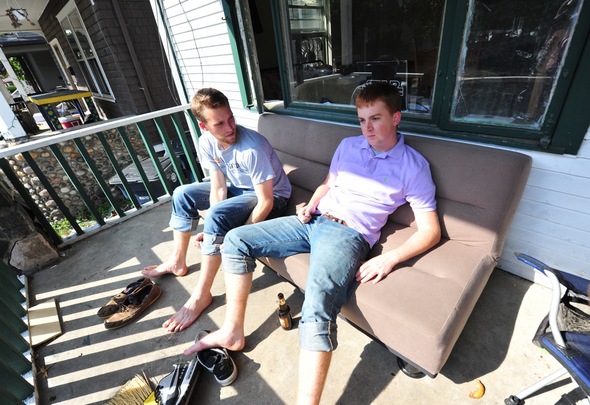
University of Michigan seniors Max Kubitz, left, and John Mickley mourn on their front porch on Tuesday, the day after the Ann Arbor City Council passed a couch ban.
Ryan J. Stanton | AnnArbor.com
University of Michigan seniors Max Kubitz and John Mickley tipped back beers on Tuesday as they contemplated the fate of two upholstered couches on their front porch.
The East Jefferson Street residents say they "completely disagree" with the Ann Arbor City Council's decision this week to outlaw the use of indoor furniture outdoors. And they say their couches are too gross and weather-beaten to move inside the house.
"We were talking about putting it on the porch of somebody we don't like and getting them a $1,000 ticket," Kubitz joked of the couch he was sitting on.
The City Council's unanimous vote in favor of a so-called "couch ban" Monday night leaves many residents, including a large number of U-M students in off-campus rental housing, scrambling to figure out what to do with the old furniture on their porches.
Residents with upholstered furniture on their porches have until Oct. 2 to remove the items or risk facing up to a $1,000 fine for violating a new city ordinance.
"To me, it's just so inconvenient for students only," Kubitz said. "Students are the only population that have upholstered couches on their porches, and it's taking away one of our freedoms and just giving us another problem. I mean, like none of us have trucks here to get rid of stuff like this or deal with this. What are we supposed to do with this couch now?"
City officials estimate the number of upholstered furniture items that need to be removed from porches — and find new homes either indoors or in landfills — is in the hundreds.
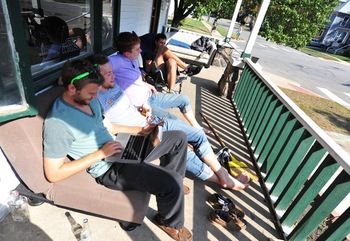
U-M seniors Oliver Honderd, left, and Sam Wolson, right, join Kubitz and Mickley on their front porch on Tuesday.
Ryan J. Stanton | AnnArbor.com
"We understand that the ordinance goes into effect soon and will work with students and student leaders to assist as best we can with the efficient, low-cost removal of porch couches," said City Council Member Christopher Taylor, D-3rd Ward, who sponsored the couch ban.
The couch ban proposal has been discussed and shelved more than once in recent years, but support for it grew earlier this year following an April fire that started on the porch of a South State Street home and killed a 22-year-old Eastern Michigan University student.
The parents of that student, Renden LeMasters, have been lobbying the City Council ever since to pass the couch ban, which some are now calling "Renden's Law."
The fire that led to Renden LeMasters' death is believed to have spread inside the house with the aid of an upholstered couch on the front porch. City officials say a growing body of evidence shows porch couches are a fire hazard, and getting rid of them will save lives and property.
"We understand that disposal of upholstered furniture is a complicated affair," Taylor said. "But the undeniable safety benefits of removing upholstered furniture, at least in my estimation, outweigh that upfront burden."
Taylor said the city is planning to set up a drop-off center soon in a place convenient for students. Anyone with a couch to get rid of will be able to drop it off free of charge.
Another option if the couches are still usable, city officials say, is to simply bring them indoors or use websites like craigslist and Freecycle to find new homes for them.
The Michigan Student Assembly Executive Board issued a statement this week condemning the passage of the couch ban, saying the City Council failed to genuinely consult students, and the proposal will do little to address comprehensive fire safety reform.
"Only after MSA asked for a postponement did the City Council consult students on this issue," the statement reads. "However, a one-week delay allowed little time for students to express their concerns and sidestepped the much larger issue — the City Council acted unilaterally and offered no opportunities for students to review and discuss the proposal during the legislative process. With consideration largely during the summer months, the couch ban never had an opportunity to receive reasonable oversight and criticism from the student body."
MSA leaders say the couch ban fails to address larger issues of fire safety around campus, including infrequent fire safety inspections, smoke detector maintenance, fire escape readiness, and fire safety education. However, at least some council members have said they agree with the students on that point, and they intend to further examine those issues.
Despite the couch ban’s passage, MSA leaders say they hope to build a strong working relationship with the City Council over fire safety reform and other issues.
The language of the couch ban ordinance specifically reads, "No responsible person shall place, or permit to remain, upholstered furniture which is not intended or designed for outdoor use on exterior balconies, porches, decks, landings, or other areas exposed to the weather."
Though residents still will be able to use furniture intended for outdoor use on their porches — such as patio-style furniture — some students said it won't be as comfortable. Mickley said he doesn't see couches as the problem, but rather human behavior.
"If someone were to burn the inside of the house, then should we take couches out of the inside of the house, too?" he said. "My dad's house burned down when he was a kid and his mattress burned, so should we ban mattresses? It doesn't make any sense."
Tina Tam, a U-M graduate student who lives next to the house on State Street where LeMasters died, agrees with the council's decision to ban upholstered furniture on porches.
"I support it because I think it's just a risk to people in the house, and we've seen it happen," she said, referring to the fire she witnessed. "I mean, it was kind of scary — it was an accident and someone died from the accident that was right next door."
Gerardo Rodriguez, another U-M grad student, opposes the ban.
"I mean, people have other things on the porch, so it's like they're saying they're going to ban porches one day just because it started on a porch," he said. "It just makes no sense. If they found it were a dinner table, they would be banning dinner tables or something."
Information disseminated to council members shows Ann Arbor joins a long list of other college towns that have couch bans in place, including East Lansing, Detroit, Allendale, Kalamazoo, Mount Pleasant, Ypsilanti, Marquette, Houghton, Columbus, Madison and many others.
Ryan J. Stanton covers government and politics for AnnArbor.com. Reach him at ryanstanton@annarbor.com or 734-623-2529.
Comments
shittaco
Wed, Oct 13, 2010 : 10:58 p.m.
I got a ticket today for a couch on the curb. I took it off the porch on the first of October when the couch ban was set, had it trapped in my backyard and put an add on craigslist. Two days ago a person got back to me about the couch that wanted it and i put it on the curb. today i got ticket for the couch (not on the porch). And two beer bottles and one singular water drinking container that were on my porch (not trash). I'm not one to complain, but ruthless finger pointing and ticketing is not going to solve anything. Take in mind that not everyone with stuff on their front yards are drunk collage kids that don't think about his or her property. Grow up and leave the innocent alone, if your going to ticket people go to the houses with all the red cups in their yard, on the street, the gutters and everywhere but the trash. Sorry for wasting your time if you don't agree with me, and thank you for giving me your time and hopefully standing by me if you do. - Anonymous Annoyed AnnArborite
johnnya2
Sat, Sep 25, 2010 : 10:22 a.m.
@ Jeff Crockett Based on yoru argument, we should ban automobiles and INDOOR couches as well. More people have died from these than the TWO per year in outside couch fires. The number of people affected by it, is unimportant. Yes, when people die others are affected. SO? In the last 20 years, the same number of people who died from couch house fires died from falling out dorm room windows. I guess the logical thing to do is to ban windows in dorm rooms now?
johnnya2
Sat, Sep 25, 2010 : 10:09 a.m.
@racerrx You said, " It is not known if the couch on the porch of the house on State St. was the actual cause of the fire." I am 100% sure the couch did not cause the fire. Couches do not suddenly become engulfed in flames. The illogic of the city council is astounding. If a fire starts in a home, should we then ban couches INSIDE a house? I mean lets face it, it will cause the fire to spread faster inside.
Jay Allen
Fri, Sep 24, 2010 : 4:18 p.m.
@jeff crocket: "Further, reflect that it is much easier to use the low incidence argument against the porch ban when you have not been personally affected by the death of a loved one in a house fire." Then if it is "easier" (in YOUR words) to use the low incident rate to NOT ban couches, then it MUST BE "harder" for your side to use it right? That is dead wrong as that is EXACTLY your side's position. That is YOUR argument. And BTW, it is far harder on this side of the fence as it is a land mine as we are being "PC". So.......Lots of deer in and around Gallup this year. I know, I am there 4-5 days per week. Carrying on, so ONE deer runs across Fuller road and hits a car. An unfortunate death occurs. Our city is going to pass an ordinance against driving on Fuller road during the gun and bow season? All of you, READ that again, ALL of you on that side are arguing the EFFECT and NOT the cause. You cannot debate against that. The couch did not combust on its own. A flame did not magically appear. The fire was set and the fire was set deliberately. Want to argue that? So if you are going to ban couches and get everyone all up in arms, then also ban: -Grills -Propane -Charcoal -Matches -Lighters -Cigarettes -Trash cans -Indoor outdoor carpeting -Out door furniture -Vinyl siding -Porch swings -Tables -Paper -Clothing Need to continue? @Some Guy in 734: Still waiting for the agent's name who will under value a home because of a couch or the agent's name who'll say a house is worth more money because of a nicer couch. How was Santa? @townie: How was the drive through the student area today?
Woman in Ypsilanti
Fri, Sep 24, 2010 : 11:03 a.m.
@Jeff Crocket. I am not still not convinced that porch couches represent enough of a hazard to ban them. I am sure that it is a great tragedy for all involved. But using your logic, it would make more sense ban cars because 40,000 people a year are killed annually in automobile accidents. Which I am sure you will agree is also a great tragedy for those involved.
Milton Shift
Fri, Sep 24, 2010 : 9:09 a.m.
MrBeasly: "I will care about what the students think about city issues, when they start paying taxes." They do - a big chunk of their rent goes to property taxes, and their tuition to UM, which is the only reason Ann Arbor isn't the site of economic holocaust like Detroit.
Milton Shift
Fri, Sep 24, 2010 : 9:06 a.m.
The real issue that causes these porch fires to be deadly is the lack of smoke detectors on the porches wired to an interior alarm system. Won't be long before some smart*** law students find ways to sidestep the wording of the legislation. Here come the folded porch mattresses!
Jeff Crockett
Fri, Sep 24, 2010 : 5:50 a.m.
In response to an earlier post supporting the couch ordinance, Lokalisierung writes: "So we should pass laws to "save" and average of 2 victims a year out of 300,000,000 people?" I would encourage the writer to consider that the true loss goes far beyond the statistics, affecting not only those who died, but their relatives, their friends, the other residents in house fires (who may have survived but suffer front long lasting emotional trauma), potential friends and acquaintances who could have later benefited from contact with the individuals who died, and those who were injured in house fires. Also, consider that the statistics underestimate the actual numbers since they are based only on fires that are reported to Campus Fire Watch (see http://www.campus-firewatch.com/resources/couch%20fire%20compilation042010.pdf.) Further, reflect that it is much easier to use the low incidence argument against the porch ban when you have not been personally affected by the death of a loved one in a house fire. At the City Council meeting on Monday where the ordinance was passed, the testimonials of the friends and family of Renden LeMasters were compelling. When tragedy strikes someone else, the tragedy becomes a statistic. When tragedy strikes us, the tragedy becomes real. Hearing the testimonials convinced me not only that the proposed couch ordinance should be enacted ASAP, but they also caused me to regret that the ordinance was not passed when it was first considered six years ago.
jcj
Thu, Sep 23, 2010 : 8:48 p.m.
@Jeff Crocket Well I have expressed my feelings about the ban and I am not in favor of calling it a safety issue when it is clear that so many posters here are more interested in the aesthetics. So while I am not in favor of the ban I will have you know that I end up raking most of my neighbors leaves because they blow into my yard! I challenge you to meet our standard as far as how WE keep our yard! WE do take the time to pick up trash up and down our street! "I would consider these comments more seriously if there was some evidence that these same people demonstrated personal responsibility for keeping their neighborhoods clean and safe." So don't be so easy about painting anyone against this ban as lazy slobs which is what you are insinuating! "Or, this fall, volunteer to help rake leaves onto the streets" Maybe you get special treatment but I can't rake the leaves into my street any more!
Jay Allen
Thu, Sep 23, 2010 : 8:18 p.m.
@townie: So you are "ashamed" to take people into the "student" section of town? Right? That is the nuts and bolts to your post. So now that ALL couches are to be removed, this 100% CHANGES your opinion? You will NOW take out of town guest into the student area? Your opinion comes back to the core issue. It IS NOT about "couches" per se`. It is about cleaning up the town. Paper and trash were also mentioned by YOU. Just another attempt to mask the real issue. While does this mentality all walk around like a herd of cattle? One does it so they all fall in line.......Monkey see, monkey do.
Jay Allen
Thu, Sep 23, 2010 : 8:13 p.m.
@some guy in the 734: I held a real estate license for 3 years. When the market began to go to pot, I let my license lapse. There is NOT ( 1 ) reputable agent that is going to say a "couch" makes the house worth more. Especially at a rental on Campus. Roof, windows, carpet, paint, furnace. Those increase value. Siding, gutters and landscaping can as well. But a couch? Ever had an appraiser out and the appraisal comes in low? Happens all the time now. Ask the appraiser why? Because of a "couch" will be at the bottom of the list. If you truly believe this, then get to bed early as Santa Claus comes tonight too.
Townie
Thu, Sep 23, 2010 : 7:11 p.m.
Thank you Jeff Crocket for saying what you said. I doubt many students will get the message but thanks for trying. I've lived here a long time and I'm ashamed to take visitors (US and foreign) into some of the student 'streets' -- UM is supposed to be the elite of US universities but these streets look like slums. Broken glass, trash everywhere and a clear 'we don't care' attitude. It doesn't have to be that way. I am proud of being an A2er and my community. If you want to trash a town please do it elsewhere.
Lokalisierung
Thu, Sep 23, 2010 : 6 p.m.
"I see missing from their comments a lack of concern for the rights and personal freedom of the over 20 students who died during the past 10 years nationally in porch fires that started in couches,..." So we should pass laws to "save" and average of 2 victims a year out of 300,000,000 people? "While people who have been complaining about the ordinance seem impassioned about their loss of personal freedom, I would consider these comments more seriously if there was some evidence that these same people demonstrated personal responsibility for keeping their neighborhoods clean and safe." What does this have to do in relation to personal freedom?
Jeff Crockett
Thu, Sep 23, 2010 : 5:54 p.m.
We live in an older home and have both a wooden porch swing and a piece of iron furniture. This furniture is quite comfortable, and we do not feel our "freedom" has been impacted by the couch ordinance. We feel that there are just as many opportunities to socialize as there would be with a couch. In fact, a porch swing seems to improve opportunities to connect with neighbors since it invites a lot of positive comments from people who walk by. So, my suggestion to those who feel disappointed by the ordinance, consider this as an opportunity to get a porch swing. You will enjoy it far more than couch. But, if the goal is to be neighborly, please consider volunteering to be a Neighborhood Watch Captain for the Neighborhood Watch program by calling Deborah Caulfield at 794-6930 Ext.49346. Or, please pick up trash in your area to create a cleaner environment. Or, if you see trash cans staying on the curb several days after pickup, move the trash cans to the appropriate place. Or, this fall, volunteer to help rake leaves onto the streets. Or, this winter, shovel the sidewalks in front of your house and your neighbor's house so that everyone that walks by can be safer. While people who have been complaining about the ordinance seem impassioned about their loss of personal freedom, I would consider these comments more seriously if there was some evidence that these same people demonstrated personal responsibility for keeping their neighborhoods clean and safe. More importantly, I see missing from their comments a lack of concern for the rights and personal freedom of the over 20 students who died during the past 10 years nationally in porch fires that started in couches, the rights of the extended families to see their loved ones grow into adulthood, or the rights of the children of these young adults who could have been born but will not have that opportunity. Where is their concern for these rights? The right of the public at large to live in a clean and safe community trumps the right of a few individuals to have a couch on their porch. The same individuals who have spent time protesting this ordinance could better serve their communities by volunteering to help keep their neighborhoods clean and safe.
Stephen Lange Ranzini
Thu, Sep 23, 2010 : 5:18 p.m.
"The Michigan Student Assembly Executive Board issued a statement this week condemning the passage of the couch ban, saying the City Council failed to genuinely consult students..." Amen! Guilty as charged. As I noted during the first discussion on this proposal, city council should never pass legislation that directly impacts students during the summer months when they are away. There is no reason to rush through non-emergency quality of life items such as this in the middle of the summer or the middle of the night without full consultation.
Lokalisierung
Thu, Sep 23, 2010 : 4:57 p.m.
"I just hope their stupidity isn't contagious and infects other communities." "Information disseminated to council members shows Ann Arbor joins a long list of other college towns that have couch bans in place, including East Lansing, Detroit, Allendale, Kalamazoo, Mount Pleasant, Ypsilanti, Marquette, Houghton, Columbus, Madison and many others."
C. S. Gass
Thu, Sep 23, 2010 : 4:45 p.m.
People in Ann Arbor's city government have made another law limiting people's freedom unnecessarilly. This is the hallmark of government which has lost direction. They make laws such as this because they think more is better. The more laws they make the better off everyone will be? This attitude is killing the land of the free and the home of the brave. I'm glad I don't live in Ann Arbor City limits. I just hope their stupidity isn't contagious and infects other communities.
jcj
Thu, Sep 23, 2010 : 4:31 p.m.
BTW There are too many politicians local and otherwise that do not have the back bone to call it like they see it. So they take the easy way out.
jcj
Thu, Sep 23, 2010 : 4:29 p.m.
@atticus My main problem is not the ban as much as what I see as dishonest. I don't think the majority felt it was a "safety" issue as much as an eyesore issue.
Atticus F.
Thu, Sep 23, 2010 : 3:59 p.m.
jcj, I disagree somewhat with what. Anybody who pays rent in the city of Ann Arbor IS helping to pay property taxes that go towards services, roads ect.. They are also entitled to vote under some circumstances...But it's important to remind people that the people who we elected for city council made this decision on our behalf. weather you agree or not.
Subroutine
Thu, Sep 23, 2010 : 3:35 p.m.
Stupid. That is All.
jcj
Thu, Sep 23, 2010 : 3:21 p.m.
@Elaine "Sorry kids. You are guests in the community, not taxpayers. You have to play by the local rules." Does that mean they have no right to question the rules? Seems to me that's what the older generation has been telling the younger generation forever! I expect you did not like it when you were the younger generation. But as we get older we in some cases get wiser and in some cases just get harder!
zeeba
Thu, Sep 23, 2010 : 3:14 p.m.
Elaine - So are you proposing that we go back to allowing only property owners to vote? That seems to be your stance here. And student renters DO pay property taxes through a share of their rent - that's why it's deductible from state taxes. They're residents, the same as anyone else. And if the neighbors are that concerned about property values, they ought to push for limits on the number of unrelated persons who can rent a single property together. It's the sheer fact that they're poorly maintained, high-occupancy, cheap rentals that drives down property values, not anything the students do. And I'm not a student. I'm 54, and a homeowner. But I chose not to buy in the student areas rather than blame them for ruining the neighborhood.
Some Guy in 734
Thu, Sep 23, 2010 : 2:52 p.m.
Elaine: of course they have to play by the rules, but tax has nowt to do with it. And although they may not do it directly, students absolutely do pay tax. The landlord has to kick up his share, and who do you suppose gives him the money to pay that tax? Announcer Man: Realtors will definitely tell you that your furniture can affect selling price and how long your house stays on the market. (At least that's the case in so-called "normal" housing markets, such as we may have again someday.) It's called "home staging". Google it sometime.
Lokalisierung
Thu, Sep 23, 2010 : 2:51 p.m.
Sure because we only see them as "kid's porches," as far as i know this isn't an ordinance that deals with age is it? Nor does it state an area that this ordinance is active in, meaning it's city wide. So what about my grandparents that love to have their morning cup of joe in their screened in linai? It's on the side of the house not the back, so that's a porch, so that's illegal.
libertyordeath
Thu, Sep 23, 2010 : 2:46 p.m.
When buying a good or a service, one is subject to sales tax. Students buy goods and/or services in our community. Those that pay sales tax are taxpayers. Hence, students that purchase goods pay sales tax, and by extension, are also taxpayers. (Furthermore, some students live and work here, they pay income tax just like the rest of us.) But that isn't really the point here. Taxpayers don't make the rules, voters indirectly make the rules (via their elected representatives). Students and full-time residents are voters, therefore they make the rules, albeit indirectly. Taxes have nothing to do with it.
Megarz
Thu, Sep 23, 2010 : 2:44 p.m.
I don't really care about these kids' couches, but I do think that they should have banned them before the school year started instead of in the middle of the semester. A lot (despite popular belief) of these kids are working and taking 15+ credits and just don't have time to deal with this. That being said, whatever...
Lokalisierung
Thu, Sep 23, 2010 : 2:32 p.m.
"You are guests in the community, not taxpayers." Can we discuss your comments here for a moment? Or should I say, back them up a little? Do you really think college students don't pay any tax? Are theyt all just guests and none of them end up living here? How lonmg is one considered a guest for? What if they come here and do 4 years of undergrad and then 4 -8 years of medical school...are they still guests? Let's say i'm a townie, and I have a child. This child just got out of highschool and decides to get a part time job around town. They are renting, but they don't own land...are they guests? Let's discuss this.
Elaine F. Owsley
Thu, Sep 23, 2010 : 2:24 p.m.
Sorry kids. You are guests in the community, not taxpayers. You have to play by the local rules.
5c0++ H4d13y
Thu, Sep 23, 2010 : 1:38 p.m.
What are they going to do about the porsche couch? http://media.nextautos.com/wp-content/uploads/2006/10/917-couch.JPG
djm12652
Thu, Sep 23, 2010 : 1:32 p.m.
All of these anti-couch on the porch comments amaze me...rather than spewing the disdain for the people that actually enacted this ban...quit your whining like 4 year olds, get off your cans and run for City Council so you can change things...and for ThosewhostayUofM, perhaps in your pursuit of happiness, you could enlighten the mature, wisened students to quit puking all over the sidewalks on weekends so I may pursue my own happiness taking a leisurely walk on the sidewalks! Maybe they could puke on the porch sofas.
Jay Allen
Thu, Sep 23, 2010 : 1:30 p.m.
A few of you (no names as I do not want my post pulled) have such a narrow approach to stuff it is amazing that you function in this world. One of you in particular runs around shooting your mouth off and when asked for PROOF, you leave the subject and never come back. You have done this forever, well at least 3 times in the last 9 days. To say that couches lowers the property value is more than absurd. Please, find me ONE real estate agent that will come into YOUR HOME and say "your house would be worth more if you had different furniture". To carry on about property values lowered because of this is ludicrous. It is an excuse and nothing more. In the next sentence you say "trash" and then "clean up the area". There we get to the root of the problem. Your mentality is such that you are using a couch ban to clean up your property which is the effect and NOT the cause. 1. If you do not like the students, then do not rent to them. No one is forcing you into anything. 2. If you do not like the University, then move. It was here long before you. It is obvious you types love the BENEFITS from the University but when you have to compromise with it, you become belligerent. 3. I researched this on my own. When you have a "rental contract" it would be within your right as a property owner to list "conditions" in which the renter has to comply with. You can put in there "no couches on porch", "keep trash picked up", etc, etc. But no, it is YOU as the property owner that wishes to be naive and pass the buck elsewhere. The city did not need to pass this ban, the city should have turned it on you. YOU own the property, not the kids. If you do not like what they are doing then YOU handle your business don't expect someone else to do it for you. Yes the death is unfortunate. We are beating the horse. But the death got emotions all riled up and folks were feeling pressure to pass the ban. The couch did not combust on its own, a fire was set. Then miles of worthless rhetoric disguised as data was presented that did nothing but convolute the subject. Remember, the mayor said: "Mayor John Hieftje cautioned Monday night the city needs to make sure it is reacting to actual problems and not perceptions" City council needs to stop with the "do as I say and not as I do" mentality.
jcj
Thu, Sep 23, 2010 : 1:30 p.m.
Like eyeheart has said and like I said on an earlier story. Council should not be passing this under the guise of safety!! If the law is intended to keep property values up then CALL it that! Don't hide behind "safety" just because it's more appealing than saying some people in this town are slobs! This city administration is more concerned about telling people what they can't do than they are about doing what they( city administration ) should do!
Speechless
Thu, Sep 23, 2010 : 1:17 p.m.
Wait... what is it that we were talking about? Porch couches again? Oh never mind.... www.annarbor.com/news/ann-arbor-city-council-passes-ordinance-banning-couches-on-porches/index.php#comment-145649 Hey, it's a nice day. Why not go outside and paint a big rock in a park? Couches and Rocks: --- Acorn fuel for page-hit gold! --- Two keys to current affairs in the city administration
paul wiener
Thu, Sep 23, 2010 : 12:42 p.m.
This is one of the most ridiculous laws I've ever heard of, and probably unconstitutional as well. I hope there's widespread non-compliance. Obviously, a rider to this law should exempt anyone who has a non-flammable "couch." I don't really see how this law protects people, unless a whole host of other bans and behaviors are outlawed. A2 is the last place I would have expected to see the government control people's lives, with their approval. Why not ban porches too, or ones made of wood, or houses made of wood. Can one put mattresses on the front porch? Pillows, sleeping bags?
donderop
Thu, Sep 23, 2010 : 12:22 p.m.
@WomaninYpsi: I'm not dictating anything to anyone. And if that's the way you feel, would it be all right if someone blasted music all day and night next door to you? After all, they have a right to entertain themselves, don't they? And who are you to dictate the decibel level of their music? Oh -- it's a law? Hmmm.
Lokalisierung
Thu, Sep 23, 2010 : 12:15 p.m.
"And who are you to dictate the decibel level of their music?" Loud music can bother you when you're inside your home. A couch on your neighbor's porch cannot.
Macabre Sunset
Thu, Sep 23, 2010 : 12:12 p.m.
Building houses out of wood is proven to be dangerous and bad for the environment. We can't just stop at the couch ban. We must demand, as citizens who deserve a completely safe and aseptic world, that all wooden houses be torn down and replaced with steel fireproof structures. One more accidental death is one too many. We must act now to ban wood-framed houses.
Woman in Ypsilanti
Thu, Sep 23, 2010 : 12:01 p.m.
@donderop Excellent. Then you don't really believe that people have right to dictate aesthetics to their neighbors in the interest of "property values'
Lokalisierung
Thu, Sep 23, 2010 : 11:59 a.m.
"Upholstered indoor furniture left in the elements can harbor vermin and mold." Your home has more more of a chance of that then a couch on your neighbors porch.
donderop
Thu, Sep 23, 2010 : 11:54 a.m.
@Ypsiwoman: It's not just about aesthetics, is it? It's about health and safety as well. Upholstered indoor furniture left in the elements can harbor vermin and mold. Happy picnicking!
Woman in Ypsilanti
Thu, Sep 23, 2010 : 11:43 a.m.
@donderop Why do you think that you have a right to any say at all about the aesthetics of your neighbors houses? Your right to keep your property value up is not greater than your neighbor's right to own outdoor furniture that is not to your taste.
debling
Thu, Sep 23, 2010 : 11:42 a.m.
If the ordinance made any sense it would ban all furniture whether inside or outside that did not meet specific fire codes and have sufficient fire retardancy. What does it matter if the couch is on the porch or inside of the house? Maybe someone should find out what kind of furniture Christopher Taylor has in his house and get an ordinance passed to ban that. The new ordinance should also provide city funds for removing the couches and compensating the residents for their losses (min $50 per couch no matter how terrible the condition is).
libertyordeath
Thu, Sep 23, 2010 : 11:34 a.m.
From the article: "The language of the couch ban ordinance specifically reads, "No responsible person shall place, or permit to remain, upholstered furniture which is not intended or designed for outdoor use on exterior balconies, porches, decks, landings, or other areas exposed to the weather."" I am an irresponsible person, therefore, I can place upholstered furniture on my porch if I so desire.
Lokalisierung
Thu, Sep 23, 2010 : 11:21 a.m.
Oh I love these threads. My favorite typical post goes something like; "Oh my god I decided to live in a huge college town and I can't believe there are college kids having parties and making a mess like college kids do.
donderop
Thu, Sep 23, 2010 : 11:15 a.m.
@Thosewhostay: If having a raggedy old couch on your porch is your pursuit of happiness, then perhaps you can understand that your neighbors' pursuit of happiness, i.e., a clean, pleasant environment, is also important. And indeed home values ARE in part based on appearance of surrounding homes.
jjc155
Thu, Sep 23, 2010 : 11:08 a.m.
Man I wish my only concern was that I was no longer allowed to have a couch on my front porch. I love the use of Mourn with regard to this story, classic!
Woman in Ypsilanti
Thu, Sep 23, 2010 : 11:04 a.m.
I have long disagreed with Ypsilanti's porch couch ban. I've been considering learning how to work with fiberglass because I want to make an outdoor couch which *LOOKs* like a ratty old porch couch but doesn't actually violate the ordinance. Fiberglass seems like something that would work.
ThoseWhoStayUofM
Thu, Sep 23, 2010 : 11:04 a.m.
Oh... and before somebody says it, the constitution was written to protect the rights outlined in the declaration of independence. I know that the pursuit of happiness is in the declaration of independence and not the constitution. The constitution is a list of negative liberties (things the government CAN'T do) whereas the declaration of independence lists the rights we, as human-beings, are endowed by our creator to have. The constitution is a means to ensure our rights are protected. Therefore, it is our constitutional right to the pursuit of happiness, whether it be through free speech, bear arms, etc... assuming it doesn't infringe upon another man's rights. Most importantly, we have a right to our property, and no government should take that away, including our right to put a couch on our porch if we want to. Just because the social elite thinks it looks bad, doesn't mean they have the right to take away the rights of the peons they have the misfortune of living near.
ThoseWhoStayUofM
Thu, Sep 23, 2010 : 10:54 a.m.
Last I checked, it is my constitutional right to furnish my house on my property the way I like. It's called the pursuit of happiness. What is wrong with society? Why are we paying our elected officials, with our tax dollars, to write laws to keep students from having couches on their porches? Oh I forgot, it's for our own good. We are too stupid to make those decisions for ourselves, INDIVIDUALLY. While they're at it, why don't they ban driving cars in Ann Arbor, right? I mean, cars account for way more deaths than couch fires.... am I right? When exactly did social-liberalism's definition change to mean the EXACT OPPOSITE of what it traditionally was known to mean? We are socially liberal, which means we should ban any and all things we, the social elite, believe to be socially deviant... nice...
RoboLogic
Thu, Sep 23, 2010 : 10:47 a.m.
They find a way to place a couch on the porch, so I contend they are smart enough to find a way to properly dispose of it. Or is cleaning up after yourself not in the student playbook? If it is too nasty to take inside, then it is probably too nasty to have on your porch. Get rid of it. Thats what they make outside furniture for. Read the law and find a way to deal... or a loophole. Put out an approved piece of outside furniture with a heavily padded sleeping bag on top for comfort. Then, when it (the pad or pillow, or bag)gets nasty, you can wash it. Listen up students... when you wash something... it stops being nasty for while. I like arbormike's post quoting "Maybe we should call the waaambulance for all the students that somehow managed to get the couch on their porch, but now somehow can't figure out a way to clean up after themselves." If you boys and girls could figure out a way to clean up after yourselves now that you are on your own (without mommy and daddy telling you to) your neighbors might not get so uppity.
John
Thu, Sep 23, 2010 : 10:43 a.m.
If a reporter approached you, would you not tell him your opinion? We were asked questions and gave serious answers. "Adults," who I assume is the majority of people complaining about out words, voice similar grievances about minutiae all the time. Look no further than the multiple comments on this very story about how they would be most upset with the filth of the college houses.
Forever27
Thu, Sep 23, 2010 : 10:35 a.m.
@atown, I have a house in this area and it did not cost $300,000. But I would like to keep the value that it does have. It's a proven fact, blight (be it burnt out houses or trashed neighborhoods) lowers home values.
Forever27
Thu, Sep 23, 2010 : 10:33 a.m.
thank you donderop. Not everyone who lives in ann arbor is the stereotypical "latte-sipping, prius-driving" yuppy that people think.
Some Guy in 734
Thu, Sep 23, 2010 : 10:27 a.m.
To Messrs. Kublitz and Mickley: Spend an hour talking to Renden LeMasters' parents, or his friends. Those aren't too hard to find--there are a lot of them around. THEN you can tell me what "mourning" is.
atown
Thu, Sep 23, 2010 : 10:23 a.m.
Oh please, the condition of these houses in the student ghetto is hurting your property values?? Try buying a house anywhere near this area and it's gonna cost you at least 300k
walker101
Thu, Sep 23, 2010 : 10:08 a.m.
Like removing the couches will make Ann Arbor more appealing. The area around the school is an eyesore to anyone driving through, many students couldn't care less and have no pride when it comes to living in a rented room, it's a reflection of their upbringing.
donderop
Thu, Sep 23, 2010 : 10:04 a.m.
@EyeHeartA2: I don't drive a BMW. And I can't afford Starbucks, much less even a bleacher seat at any stadium. But I do care that entire neighborhoods in this city look like crap because a bunch of whiny, spoiled slobs can't be bothered to clean up after themselves.
zeeba
Thu, Sep 23, 2010 : 9:51 a.m.
What a crock. A couch on the porch is less dangerous that a couch inside. I'd rather have a couch ablaze on the front porch than in my living room. The real problems is that these tend to be ancient couches that were built before fire retardant manufacture became common.
InsideTheHall
Thu, Sep 23, 2010 : 9:18 a.m.
Fix the dang bridge for crying out loud!
A2G
Thu, Sep 23, 2010 : 9:09 a.m.
Unfortunately, the students responses seem to be that of spoiled children rather than of responsible adults. I wonder what their peers serving overseas in the military and Peace Corps or those working and volunteering in blighted urban areas would think.
Forever27
Thu, Sep 23, 2010 : 9:01 a.m.
@jcj, what about the right to the rest of the community to not have neighborhood blight lower their home values? This isn't a constitutional issue here. This is a city passing an ordinance that is backed by a majority of the local population. Some students are up in arms about their "right" to place a couch on their porch. My point was that they have far more important rights being violated every day, but this is the one that they seem to care about. My original comment was directed more at the priorities of the student body.
jcj
Thu, Sep 23, 2010 : 8:50 a.m.
@fjord To quote you recently. "In this case, it seems that the squeaky wheel (in the form of NIMBY neighbors) may have been louder than the dogs." I say In this case, it seems that the squeaky wheel (in the form of campus neighbors) may have been louder than reason.
jcj
Thu, Sep 23, 2010 : 8:35 a.m.
@Hot Dice You called it! If this is the hot item at council meetings then we might as well give up on taking care of any real issues in this city. I suggest that as students get "approved" furniture they paint it florescent orange. And install Christmas lights and leave them up all year like some of the other yokels in this town! Now there is a REAL eyesore!
Brad
Thu, Sep 23, 2010 : 8:32 a.m.
The student in the first photo really does a good "mournful". He has obviously lost a "way of life". Now he just needs to "get a life".
metoo
Thu, Sep 23, 2010 : 8:24 a.m.
This is deja vu all over again for me. When I was in college some 20 years ago the city did the same and banned couches on front porches. I cared a lot then as a student but I do not give a rip about it now... unless that mess of a porch is next door to me and bringing the value of my home down. I agree with donderop in the 3rd post to this article. Talk to these kids in 10 years when they are home owners and their tunes will change.
Hot Dice
Thu, Sep 23, 2010 : 8:07 a.m.
The aesthetic standard of the NIMBY (or whatever you'd like to call this recurring crowd of complaint) is always looking for a vehicle for broader imposition and enforcement. Grief and fear worked well this time. This was never about porch fires, it was about angry townies trying to "clean up the behavior" of college kids while forgetting the culture of their own youth. We have much bigger fish to fry than couches on porches -- this is embarrassing. For example: Are we ever going to have a meaningful conversation about the fate of Georgetown Mall? Maybe if I put a few upholstered couches in front of the old Kroger we can get things moving.
jcj
Thu, Sep 23, 2010 : 8:03 a.m.
@Forever27 "Remember the days when students got up in arms about things that actually mattered in the world?" Well after looking at past comments it would seem that to some sports is what really matters! When taking away someones right big or small it should matter to everyone! Nobody is 27 forever!
Brad
Thu, Sep 23, 2010 : 8:03 a.m.
And these are the same people that become the "leaders and the best"? When does that start?
arbormike
Thu, Sep 23, 2010 : 7:59 a.m.
This isn't news. Maybe we should call the waaambulance for all the students that somehow managed to get the couch on their porch, but now somehow can figure out a way to clean up after themselves. Maybe their parents will pay for the removal. UM undergrads are third graders who drink.
Brad
Thu, Sep 23, 2010 : 7:58 a.m.
"We understand that disposal of upholstered furniture is a complicated affair," Really? What are the complications? Picking up the phone to call someone to pick it up? Paying $20 to have that done? That is a toughie to be sure.
xmo
Thu, Sep 23, 2010 : 7:52 a.m.
Who votes for these small minded Democrat city council people? We have high unemployement, bad roads etc and they chose to waste their time on banning couches from porches?
bruceae
Thu, Sep 23, 2010 : 7:51 a.m.
Obviously the Ann Arbor City Council could care less about the students. If someone could post the names of the council members and list the real companies they work for maybe we could start a boycott of those businesses? If students stop spending money where these people work it will get their attention.
RUKiddingMe
Thu, Sep 23, 2010 : 7:43 a.m.
Mr. Stanton: This is the 2nd time you've said "the parents of" (plural) and then named one parent. "The parents of that student, Renden LeMasters, have been lobbying..."
Forever27
Thu, Sep 23, 2010 : 7:30 a.m.
Remember the days when students got up in arms about things that actually mattered in the world? I can't believe that these kids are getting so upset over something so trivial. The locals don't like the couches on the porch, deal with it. There are far worse threats to their civil liberties than porch couches.
jcj
Thu, Sep 23, 2010 : 7:28 a.m.
Lets see how many tickets are issued this winter when residents don't shovel their walks. How many tickets were issued this summer to residents that didn't mow their lawn? How many tickets were issued to residents that have dogs barking day and night? @Mr Beasley While I don't agree with the typical students views on most things. (if there is a "typical" student view) To say "I will care about what the students think about city issues, when they start paying taxes." is an antiquated and uninformed statement. It would be like them saying I will care about what the old folks think about city issues, when they start changing their own depends.
C6
Thu, Sep 23, 2010 : 7:20 a.m.
Disposing of an old sofa isn't really all that hard. I had one last year that I dragged outside, and using only a claw hammer, a pair of pliers, and a big screwdriver I disassembled most of the beast into pieces small enough to fit into the household trash cart. The city truck emptied the cart and hauled those fabric, foam, plastic and wood parts away on the next week's pickup. What wouldn't fit into the cart was the heavy metal framework, which a scrap man came and hauled away along with some other household recyclable junk, after I'd called him. I think the dog is still wondering where his sofa disappered to...
Soothslayer
Thu, Sep 23, 2010 : 7:16 a.m.
OrSpell Check Your Text Language: English (change) RE yards looking like crap aren't there already blight ordinances within the city limits that could be enforced? What about outdoor patio "couches" and other similar furniture that are all the rave now, are those ok? Do police have to check the tags/mfg to make sure its an outdoor approved/designed seating or whats the deal? I want to under this ordinance what exactly constitutes an offending "couch"? Just like the ban on texting and driving ("I wasn't texting officer, I was surfing the web!", "looking for a friends phone number", "checking my gps", etc) this law is a waste of time, ill conceived, impossible to enforce and little/no value to anyone but "teh man". While we're at it let's ban airplanes too because they sometimes crash. Outdoor (patio) seating (couches) for everyone! With all of these goofy ideas and uses of time the City Council must have no work to do, lets disband them and save some resources.
Killroy
Thu, Sep 23, 2010 : 7:13 a.m.
I loved front porch culture when I was a student, but no one was ever killed by a fire back then who's primary accelerant was a ratty old sofa either! What else is A2 supposed to do, let this tragedy happen again?
C6
Thu, Sep 23, 2010 : 7:05 a.m.
Chuck Early: I'm from Ann Arbor - what's a newspaper?
Chuck
Thu, Sep 23, 2010 : 6:50 a.m.
Good thing we have big brother to make sure we don't start houses on fire by setting an old couch on the porch on fire. The couch is definitely the cause of that. Now I guess people will have to roll up newspapers. Until they ban them.
Steve Pepple
Thu, Sep 23, 2010 : 6:33 a.m.
A comment was removed because it contained a personal attack.
5c0++ H4d13y
Thu, Sep 23, 2010 : 6:33 a.m.
@MrBeasley the students pay taxes via the rents they pay to landlords that use that money to pay taxes.
racerx
Thu, Sep 23, 2010 : 6:27 a.m.
@Monica Milla-the actual determination as to what caused the fire is still under investigation. It is not known if the couch on the porch of the house on State St. was the actual cause of the fire. During the same night there were other suspected fires on campus. These seemingly related events ceased once the school year ended this past spring, which could lead one to believe that there is/was a student arsonist. But I defer since this is not known to be true.
Somewhat Concerned
Thu, Sep 23, 2010 : 6:26 a.m.
What's the next infringement on student freedom? A ban on empty beer cans and soda bottles being strewn over the front yard for more than a week? No cars blocking half the sidewalk? No keg of beer on the porch, open to cute high school girls if you can get them to come over and play beer pong in the front yard? This assumes the police actually do something other than cruise by in their cars with the windows up and one ear glued to their cell phone. Really, what are the chances the police will do anything more about couches than they do about everything else, including obvious underage drunkeness on front lawns?
MrBeasley
Thu, Sep 23, 2010 : 6:25 a.m.
I will care about what the students think about city issues, when they start paying taxes.
InsideTheHall
Thu, Sep 23, 2010 : 6:18 a.m.
The good ol A2 Council: The building is on fire and they are looking for marshmallows.
SillyTree
Thu, Sep 23, 2010 : 6:11 a.m.
I can't believe there is a new article about this. I guess people quit blogging on the old ones after a while and the whole thing needs to be started fresh with the same old arguments. I guess it's good that there is a place to vent, but sometimes it seems like too much attention is paid to inflammatory issues (no double entendre intended.) Please try not to pander.
GoblueBeatOSU
Thu, Sep 23, 2010 : 6:09 a.m.
Does the city enforce the current ordinances that are on the books? No Look at the student rental homes. Many of the homes are not close to being up to code. I asked the City Council how they planned to find the resources to enforce this ordinance. No reply. I asked why are couches so bad but the open flame from a tiki torch is ok? A charcoal grill is ok? Does the city do anything to keep people from using grills on porches? No. The city doesn't care about fire safety. If the City did care they would do something about the real fire hazards. Like everything, this City Council is all talk. The just like to see their name in the news. The more they are in the news the more votes they'll get in the next election.
donderop
Thu, Sep 23, 2010 : 6:03 a.m.
Talk to these kids 10 years from now, when they're paying the bills and unhappy about a house in their neighborhood with a trashy old couch on the porch and beer cans and pizza boxes littering the yard.
Jimmy McNulty
Thu, Sep 23, 2010 : 5:49 a.m.
Yes, more legislation to protect us from ourselves.
Monica Milla
Thu, Sep 23, 2010 : 5:30 a.m.
Something I'm not clear on, even after having read all the stories on the fire, is how it actually started. As far as I know, couches don't self combust. What caused the flame?