

Mother of 22-year-old fire victim urges Ann Arbor officials to support couch ban
Kimberly Lemasters fought back tears this week as she stood before the Ann Arbor City Council to talk about her son's death.
As she gained composure, Lemasters called for a citywide ban on porch couches in Ann Arbor, an idea that has been debated for several years but never has gained enough political support to get past the City Council.

Kimberly Lemasters, the mother of 22-year-old Renden LeMasters, who died in a fire in April, addresses the Ann Arbor City Council on Monday.
Ryan J. Stanton | AnnArbor.com
In April, 22-year-old Renden Lemasters suffered fatal injuries in an early morning fire that gutted a rental home on South State Street. The cause of the fire still hasn't been determined, but is considered suspicious and was one of four fires that night.
"I know there have been previous but unsuccessful attempts to pass this ordinance banning upholstered furniture from the front and rear porches of city houses," Lemasters said. "My understanding is that a major cause of the past failure to pass this ordinance has been due to the student opposition. Well, Renden was a student, and I know that if he was here today and it had been one of his roommates, he would have been here to be an advocate to this new ordinance."
Investigators believe the fire that killed Renden Lemasters started in a trash container on the front porch, spread to an upholstered sofa nearby, and eventually set fire to the whole house. It's a scenario the city's top fire officials have been warning about for years.
"We are going to have a fatality," now retired Assistant Fire Chief Chris Brenner said in an interview in November 2005, calling for a couch ban.
Former City Council Member Leigh Greden, D-3rd Ward, was the lead supporter of a couch ban ordinance six years ago. But the controversial proposal was tabled by the council in August 2004 due to lack of political support and significant pushback by the student community. The proposal never came back for a vote.
The case for the ban at the time included a 13-page report from the fire department that showed there were 74 reports of fires involving upholstered furniture on the streets or sidewalks and three couch fires on porches since April 2000.
But that didn't sway some on council.
"If I look back 20 years from now on important things I did on council, I don't think passing an ordinance to modify the behavior of 20-year-old college students will rank real high, " said then-Council Member Mike Reid, R-2nd Ward.
Two specific incidents led the city's top fire officials to publicly state in the fall of 2005 that it was only a matter of time before someone died.
In June 2004, U-M football players and friends kicked out an air conditioning unit, jumped out of windows and broke down doors to flee a fast-moving fire that started in a couch on a porch on 924 Oakland Ave. The house was leased by nine U-M football players. Two firefighters were injured in the blaze, according to reports.
In September 2005, a house at 730 Arbor St. was destroyed by a fire that was linked to a couch on a porch. One man was critically injured by the fire and from jumping from a second-story window. Six other men who lived there weren't hurt, but lost all of their belongings.
Five years later, the idea of a couch ban is gaining support following the fire that claimed Lemasters' life.
City Council Member Christopher Taylor, D-3rd Ward, has been working on a couch ban proposal for the last several weeks.
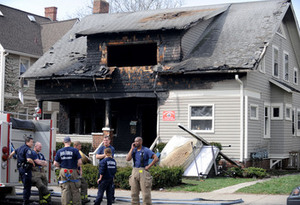
This house was gutted by fire on State Street in April.
Taylor is crafting draft language for the new ordinance, which would prohibit responsible persons from placing furniture that is not intended or designed for outdoor use on exterior balconies, porches, decks or landings.
Violating the ordinance would be a civil infraction punishable by a fine, which must be paid within 45 days. The draft ordinance states if any violation remains uncorrected, the city may remove the furniture from the property, with the cost for removal charged to the owner.
"After the fatal fire, it obviously highlighted the importance of addressing this problem," Taylor said. "I got into contact with the city attorney's office and the fire chief to resurrect a language that was previously being considered, and that is essentially working its way through the process."
Taylor said he understands porch couches are a traditional aspect of student life that many University of Michigan students value.
"All of that is perfectly understandable," he said. "And when I was in college I enjoyed that, too, and did not consider the safety issues. But the safety issues are obviously present and, at this point, sadly irrefutable."
Council Member Margie Teall, D-4th Ward, said she's expecting the ordinance to come before council at the second meeting in July. She'll be supporting it.
"I supported the ban in the previous iteration," she said. "To me, it just makes sense for a number of reasons. For the safety reason, certainly. The fire department has supported this for a long time, and we couldn't muster the support from the general public previously."
No opposition has yet been voiced. But some of the same supporters who championed the cause in 2004 are back at it. That includes Bob Snyder, president of the South University Neighborhood Association.
"We supported it when it came up originally back in August 2004," Snyder said. "At that time, everybody said, 'Oh, it's just aesthetics only.' It was aesthetics perhaps, but we said, 'One of these days somebody's going to die.'"
Snyder recalls it was tough opposition from the Michigan Student Assembly that shot down the ban the last time. He said Greden's proposal was "laughed off the council floor" with only about four or five supporters.
Snyder has advice for the current City Council: "Act now. Don't sit on your hands. Don't sit and talk it to death, and don't table it to death. Act now."
Greden, who was voted out of office last year, still supports the ban.
"It's indisputable that indoor couches kept on an outside porch serve as a giant fuel tank for fires that start on the couch or elsewhere," he said. "There's no doubt we'd be better off without them."
Fire Chief Dominick Lanza, who joined the city's staff in March, also is pushing for the couch ban. He said there's a good trail of evidence to suggest the couch played a role in the State Street fire that killed Lemasters in April.
According to a report by Fire Marshal Kathleen Chamberlain, a 911 call came in from a passerby at 5:16 a.m. The caller reported a garbage bag burning on the front porch of 928 S. State St.
By 5:18 a.m., the nearby couch was burning. By 5:19 a.m. the deck of the porch was burning, audible interior smoke alarms were sounding, and the fire was spreading upward and into the roof. The report states all attempts were made to alert and evacuate the interior occupants, but by 5:21 a.m., the whole front of the house was burning and the fire was spreading quickly.
"At 5 o'clock in the morning, a gentleman leaves work and starts to drive home and sees a small fire flickering on the front porch, decides to get involved — thank goodness he did or it could have been worse," Lanza said. "He stops his vehicle, gets out, goes to the front door, sees a small fire next to a couch in a trash receptacle, knocks on the door — not knowing what else to do to get the attention of the occupants and try to get something to put the fire out."
Everyone was sleeping, but someone finally came to the door, Lanza said. They went to get a pot of water.
"When they get back, the fire has multiplied so quickly that a couch is totally involved and the walls on the porch have started to burn," Lanza said. "I actually haven't heard it but I'm told they kept him on the phone for the majority of the first few minutes of the fire on 911, and he keeps referring to how bad it's getting, and you can actually attach a time to how fast the fire multiplies."
Lanza said eliminating porch couches is about safety.
"The problem we're having is that young folks in the colleges like to use their porch as a gathering place," he said. "It's like an entertainment center, and sometimes people get careless — they barbecue and it's like putting the fuel there. It's like putting a can of gasoline there."
Ryan J. Stanton covers government for AnnArbor.com. Reach him at ryanstanton@annarbor.com or 734-623-2529.
Comments
A. Ben
Sat, Jul 31, 2010 : 7:57 p.m.
Way to interview a student about the issue, aa.com. Great journalism. Also, why didn't a roommate show up with the mother?
Jean
Thu, Jun 10, 2010 : 9:43 a.m.
Very sorry about the loss of your son. However, whether the couch is in or out of the house, it is a personal choice. Please do not consider limiting freedom to furnish your home with a standard item as a fire hazard. Would you ban all baseballs when one hit a person and killed them? No. Just as baseballs and couches are part of life, you cannot ban them. It is what an INDIVIDUAL CHOOSES to do with them that is a variable out of anyone's control.
JRD
Thu, Jun 10, 2010 : 2:16 a.m.
I must say that I do understand both sides. I was in college once as well and understand why the students would not want this ordinance passed. However, I also know that at that point in my life I was not always making the best decisions and still needed guidance on some topics. I still needed speed limit signs to tell me not to drive to fast or all of the things that have been discussed previously. If this saves 1 life isnt it worth it? Renden happened to be just 1 of the individuals in the home at the time of the fire, but what if next time the house full of people are not able to make it out safely? If it is something that we can do to help prevent future tragedies, why would it not be worth it? I agree we cant save everyone, but if we can just save 1 person? What if that 1 person was your family member would you feel differently?
JRD
Thu, Jun 10, 2010 : 2:14 a.m.
I must say that I do understand both sides. I was in college once as well and understand why the students would not want this ordinance passed. However, I also know that at that point in my life I was not always making the best decisions and still needed guidance on some topics. I still needed speed limit signs to tell me not to drive to fast or all of the things that have been discussed previously. If this saves 1 life isnt it worth it? Renden happened to be just 1 of the individuals in the home at the time of the fire, but what if next time the house full of people are not able to make it out safely? If it is something that we can do to help prevent future tragedies, why would it not be worth it? I agree we cant save everyone, but if we can just save 1 person? What if that 1 person was your family member would you feel differently?
Pete Thirtytwo
Wed, Jun 9, 2010 : 11:44 p.m.
If couches are such "fuel tanks" for fire, why not prohibit them indoors as well? I don't understand how a couch becomes more flammable once it's on a porch.
Pete san
Wed, Jun 9, 2010 : 10:48 p.m.
The loss of this young man, and the pain to his family are tragic. My condolences to them. I would caution those thinking that a ban is the answer. You should consider that each time we pass a law, it chips away at more of your freedom. You can't legislate safety, you can't legislate morality and you can't legislate intelligence. Oh, you can pass laws, but that doesn't mean it will have the intended affect. We have speed laws, drunk driving laws, seatbelt laws, helmet laws, etc, yet we manage to have higher and higher numbers of deaths on our roads each day. I am all for laws that will make our lives better, but until we look at how to better get compliance to the laws we currently have, making another will only give you a feeling of having done something until the next "porch fire". Maybe we should pass a law that says the insurance companies limit of liability is capped if their is a couch on the porch, and it is the cause of a fire. Then see how fast landlords will purge this scurge!
Stephen Landes
Wed, Jun 9, 2010 : 10:37 p.m.
I voted "no" on this one. I know what it is to lose someone in my own family (in my case my brother to a drinking driver) so I am not insensitive to the Lemasters family and their pain. However, an outright ban on one type of furniture on a porch has not been shown to be likely to have an affect on this problem. I am much more concerned that the Ann Arbor Police don't seem to be treating this death as a murder, i.e.: loss of life in the commission of a felony. Arson is certainly a felony and the death of this young man should, in my opinion, be considered murder. We should expect that our police force is treating this issue with the seriousness that it deserves. I believe a conviction for murder in this case would send a very strong message to the idiots in our community who think this was just for fun or revenge or whatever their motive was. We changed drinking and driving laws in this state and country to make sure people take seriously their responsibility to others on the road. Let's make sure the people that killed Rendon Lemasters get the same message.
ChunkyPastaSauce
Wed, Jun 9, 2010 : 10:25 p.m.
"three couch fires on porches since April 2000." So 3 couch fires in a 4 year span. There are about 300 fires a year in Ann Arbor. So about 1200 fires in 4 years. Thus roughly 3/1200*100% = 0.25% of all fires in Ann Arbor involve couches on porches. Therefor the "problem" of couch porch fires in the city is really vanishing small relative to other causes of fire.
Chase Ingersoll
Wed, Jun 9, 2010 : 8:01 p.m.
You don't need an ordinance for the fire marshall, or any peace officer for that matter, to walk down the street and write a ticket up in the name of all of the leaseholders in possession of the property, for maintaining an unsafe condition. Let them show up in court and sort out their relative responsibilities with the judge and/or pay a fine. Very quickly the problem will be solved and after a couple of years couches on the porches will not be part of the Wolverine culture that is taught to incoming freshman. Shall we try this with beer?
Ryan J. Stanton
Wed, Jun 9, 2010 : 7:58 p.m.
Michigan Radio picked up on the story today. http://www.publicbroadcasting.net/michigan/news.newsmain/article/1/0/1661159/Michigan.News/Fatal.Fire.Leads.to.New.Effort.to.Ban.Couches.on.Porches Note that its report states other college towns in Michigan do have bans, including East Lansing and Grand Rapids.
JD
Wed, Jun 9, 2010 : 7:14 p.m.
Please, please, please do not tell me that you are crying at a city council meeting, asking the government to make it against the law for me to sit on my front porch in a couch. Please do not tell me that you are asking the government to make it against the law to talk on the phone while Im driving when the phone isnt making me a bad driver, I am already a bad driver, do not blame the phone. Please do not tell me that you are asking the government to make it against the law to eat and drive (worse than talking on the phone and driving) when drive thru fast food is perfectly acceptable. Please do not tell me that you are asking the government to make it against the law for me to drive my own car while not wearing a seatbelt when it is actually safer for you, if I do not (seatbelt is very uncomfortable for me and restricting). Please do not tell me that you are asking the government to make it against the law for me to drive my motorcycle without a helmet when it actually hinders my ability to see clearly and certainly does not make the road a safer place for the other drivers. Please do not tell me that you are asking the government to make it against the law for my children to bully other kids at school(Pam Byrnes) a silly waste of your final few months in office. This is the definition of way too much government; its not the over spending, its the over controllingget over yourself and start taking responsibility for your own actionsor lack there of
annarbortownie
Wed, Jun 9, 2010 : 7:12 p.m.
"If I look back 20 years from now on important things I did on council, I don't think passing an ordinance to modify the behavior of 20-year-old college students will rank real high, " said then-Council Member Mike Reid, R-2nd Ward. Mike Ward, you do not deserve to represent Ann Arbor citizens! Quite frankly, you don't deserve to represent a flea. What a heartless, uncaring person you must be to make the statement you made. 20 years from now I will still remember the person ( Mike Reid) that made me ashamed to call myself an Ann Arborite. If this council passes this ban it would be years in the making and LONG overdue. I just read other comments and most of you make me sorry to be from Ann Arbor. Being 5th generation Ann Arbor, it makes me ask "What have you done to my town??" This is not the way people that cared about others and the betterment of Ann Arbor would talk. Ann Arbor down the tube.
Subroutine
Wed, Jun 9, 2010 : 7 p.m.
Thousands of people are killed in car accidents. I think we should ban cars. In fact, every time someone is hurt or killed, I think we should ban whatever may have caused it. On that same note, I think anytime any one of us who is annoyed by the activity of someone else, or disagrees with their point of view, it should be banned. Or in this case, maybe we could have the private sector handle it. Have the landlords or the insurance company decide what should be on the porch. But that's crazy right? My government should keep me and you safe. I don't think we should rest until all potentially dangerous acts are banned.
tidge
Wed, Jun 9, 2010 : 5:34 p.m.
The fire is a sad story, but no matter what the outcome of a "couch ban", the real pro-active approach would be to schedule some basic fire-safety classes for students. Start with the High Schools and try to get the Universities to buy-in as well. It's extremely easy to start a fire by dumping old coals from a grill into a garbage container like a trash bag. I've seen coals from a kettle grill that wasn't warm to the touch start fires in dumpsters hours after being dumped. It's scary, but it happens. Allowing indoor fabric furniture on outdoor porches is probably not defensible without appealing to non-scientific arguments.
a2phiggy
Wed, Jun 9, 2010 : 5:12 p.m.
My heart goes out to Ms. Lemasters and their entire family and group of friends. It takes a lot of courage to try to turn a tragedy into something that can improve the lives of those left behind - if this saves one life, even through the debate of the issue and not necessarily some type of policy change, it is worth it. I do hope that the Michigan Daily continues to cover this story, but in the fall when students are back in session - they need to see this as not a crime, but a possibly preventable tragedy. Discussing this in June won't help. In my time as an A2 resident, I have seen very little enforcement of any type of ordinance that is in place, so this seems like a waste of time and energy in terms of policy - but I pray that in some fashion, it helps the family find peace.
SemperFi
Wed, Jun 9, 2010 : 2:51 p.m.
The good and reasoned posts here are nearly drowned out by babbling of "don't tread on my freedom to be an idiot." It sounds like many of you posters are ready to allow the nihilists and anarchists make the rules (or not make any) and run city hall. Heaven forbid, there would be any laws of governance regarding public safety. To listen to the self-professed, freedom riders, everyone should be allowed to rent a room and have absolute right to defile their temporary neighborhood and not be held to any accountibility for their actions. Face it, our society is a matrix of imperfect laws. That doesn't mean that we stop trying to make it better.
pragmatic
Wed, Jun 9, 2010 : 1:37 p.m.
So why don't we just ban all porches? Therefore there will be no more couches, nor barbeque grills, smokers, trash cans or anything flammable on these wooden structures. I would also ban indoor stoves and candles which are the cause of numerous house fires. You can never be too safe.
Lokalisierung
Wed, Jun 9, 2010 : 1:35 p.m.
"Obviously if you look at the results of the poll at the end of the article you can see MOST people favor the law." Obviously 77% of the 809 people taking this poll thought so. There just MIGHT be some more ditricts out there not fully reported yet. "Shouldn't furniture industry regulations call for far less flammable materials..." The furniture being outside and exposed to the elements "damages" or removes the flame retardant treatment put on it. Especially when you think many of these pieces have moved around for years and been outside, found on the street corner etc. "They are ugly and residents who try to keep up their homes have a right to an attractive neighborhood." I can't even believe someone would type this.
Cash
Wed, Jun 9, 2010 : 1:27 p.m.
I'm pretty sure that the fire chief has more knowledge of fire hazards than I do...thus I accept his assessment. Ban them.
Speechless
Wed, Jun 9, 2010 : 12:38 p.m.
A few tangental questions & comments related to a proposed porch couch ban: One question little addressed is the inherent safety of the commodity in question. Given its incendiary potential if moved to the porch, is my living room couch essentially a large block of solid fuel that also happens to provide personal comfort? Am I one dropped cigarette away from creating a household inferno? Shouldn't furniture industry regulations call for far less flammable materials (assuming the flame retardant construction does not pose a cancer risk)? My understanding is that California law requires furniture to resist open flames. Clearly, there is a nationwide student market for cushy sofas designed to function poorly as devices to enhance incineration. Such items, if they exist, would address concerns raised by the Fire Dept. and Kimberly LeMasters. If it does make sense to remove outdoor couches, shouldn't the ban also extend to cooking grills located on or near porches? Should wooden swings & chairs disappear as well? An arsonist could pour fuel on wooden furniture before tossing a match, and thick, sturdy models offer strong blaze material. How many other items might the city potentially include in a more general, more encompassing ban on flammable porch objects? When would we want to stop adding items to such a list — and why?
Macabre Sunset
Wed, Jun 9, 2010 : 12:23 p.m.
We've banned fires on front porches, right?
Larry Baitch
Wed, Jun 9, 2010 : 11:57 a.m.
No other city's fire marshalls would put up with the dangers and problems caused by indoor furniture kept outside, and Ann Arbor should finally ban this dangerous and fatal practice. Resident Ann Arbor homeowners are tired of the arguments posed by students and landlords about "freedoms" and disparaging "homeowner culture". Couches and other upholstered furniture which are not meant for outdoors are a fire hazard, vermin attractor and establishes any street having such furniture as "student ghetto". They are ugly and residents who try to keep up their homes have a right to an attractive neighborhood. We well know that students' parents would never have couches on their lawn, roof or porch and would never allow their kids to park cars on their lawns or have Budweiser signs hanging up. Dangerous, fatal and ugly: a responsible City Council needs to impose a ban now before another cigarette, grill or other ember kills somebody's child.
retskips
Wed, Jun 9, 2010 : 11:18 a.m.
I guess I'd ask anyone commenting on this - do any of you walk down to football games on Saturday's - these houses as well as so many in the area are filled to the brim with students on these days, you cant even see the lawn because of tables full of drinks, drinking students having a good time and the garbage there after. If you think eliminating all sofa's on front porchs will somehow change the image of the area you are simply wrong and ignorant. If there were to be some law would it affect newer sofa's? The ammount of "good" chemicals poured into sofa's and bedding these days to make sure furniture doesnt burn should scare you.
bill
Wed, Jun 9, 2010 : 11:04 a.m.
icommented in capital letters to wake up this bunch of old people who are still living in the sixties and think a2 looks cool with junk on lawns and porches. also to wake up city council to vote in favor of modern safe clean attractive student housing. keep voting down change,stay cool junked up,slum housing. wait until there is another fire. help keep our city looking like a dump and stopping change, keep the current mayor and city council and listen to all of the people who want to keep historical slums around. hope this makes it to the comment section without capitals. makes it much easier to read. the city isn't reading anyway
retskips
Wed, Jun 9, 2010 : 11:01 a.m.
Uh oh, here we go again by eliminating freedoms like the freedom to sit outside on your front deck and relax or read in a comfy piece of furniture because of an unsolved arson case? Wasn't this started or believed to have been arson? I have heard that there were no smoke alarms? Is this true? Why start punishing the people because of arsonists, unenforced firecodes, and the inability to solve criminal acts. Just more knee jerk reaction. I guess having known Renden thru the class we shared, would Renden have supported this? He lived near the UM campus because he enjoyed the life, sights and sounds around the UM campus as opposed to living elsewhere or near EMU. Is this something just to make us feel better.
zeeba
Wed, Jun 9, 2010 : 10:52 a.m.
Old, upholstered furniture is a fire hazard either indoors or out. In fact, it's probably less of a hazard outdoors because the fire originates on the exterior of the structure. Outdoor furniture is designed differently, it's true, but that's so it can be weather-resistant. It's not because fire is a greater hazard in an outdoor setting. The real problem is that many students smoke and drink at the same time and are careless with how they dispose of lit cigarette butts (beer cans, bottle caps, empty chip dip containers, etc.) or accidentally drop burning embers from joints, bongs and hash pipes. But this is a hazard either indoors or out. Candles are often present indoors as well, adding a hazard that usually doesn't exist outside. This strikes me as an aesthetics issue, not a safety one. And I've been out of college for 30 years now.
uawisok
Wed, Jun 9, 2010 : 10:45 a.m.
This unfortunate incident should not be the stimulus to pass more "cider house rules" on owners of private property. I personnally would not have upholstered furniture on my front porch, but if a homeowner wishes to do so no problem here...IMO...I believe the police force and city officials with their limited resources have bigger fish to fry than becoming porch furniture police.What ever happened to life,liberty and pursuit of happiness??
Graz
Wed, Jun 9, 2010 : 10:42 a.m.
And while I'm on a rant, saying behavior is the only issue that should be addressed is short-sighted. Behavior could be said to be the issue in deaths caused by speeding. Yes, there is someone acting in an unsafe manner by speeding, but the people who survive a resulting crash because of present auto design safety regulations, selt belt laws, truck weight limits, etc. is someone not killed due to another's actions. Many laws are designed to not only save the person who is not being safe, but also the innocent bystander. And, as for changing behaviors, everyone knows that speeding is dangerous and that if stopped, the ticket is expensive. But my daily commute on HWY 14 and 23 shows there are many folks that drive like maniacs anyhow. Due to laws, my vehicle was built in such a way that should one of these folks lose control and hit me, my chances of surviving are greatly enhanced. A couch ban is a law along these same lines. It won't stop porch fires, but it will greatly increase the chances of the fire not spreading so rapidly that there is little chance of people not having time to get out of the burning structure.
WLD1
Wed, Jun 9, 2010 : 10:34 a.m.
One person dying in the city in the 100+ years people have been putting couches on the front porches does not justify a ban. In that case we should ban houses from being rented out to college students. They should all live in dorms or apartment complexes with small balconies. College students in general are fire hazzards. They smoke and throw cigarette butts everywhere. Not to mention weed and Hooka's, Bong's. We need to stop this socialist mentality when something we don't like happens government needs to control it, to protect everyone. That is socialism.
Graz
Wed, Jun 9, 2010 : 10:19 a.m.
Saying that a couch ban will not bring anyone back is kinda silly and is not a valid argument against passing the law. Unless someone knows something that everyone else doesn't know, NOTHING will bring anyone back from the dead. The debate should be whether this will prevent future deaths is the debate to have. The fire chief supports this ban and there is evidence that the upholstery on furniture designed to be used indoors is more of a fire hazard when placed outdoors and that such materials increased the speed of the spread of fire is pretty compelling. Students can and will find furniture designed for outdoor use to have porch gatherings. Bemoaning the loss of liberty isn't valid either. Certain laws are designed to promote public safety. Banning the ability to have Grandma's old pasley print sofa on your front porch is not an infringement on liberty by any stretch of the imagination.
DaLast word
Wed, Jun 9, 2010 : 10:06 a.m.
This tragedy may or maynot have been avoided given the circumstances. This fact is true, many of the homes that students rent in that area are fire traps and pig styies with grabage and rats. The city needs to inforce a basic code of living standards. It doesn't matter if the students push back, most 19 and 20 year olds don't even know what's in there best interest. At that age I thought I was invincible and did plenty of very risky things...I got luckey more than once. There is a reason adults are in charge in this world, most, I say most of the time they have the benifit of experience and better judgement. City council should also use some of knowledge before someone else gets hurt.
grodon
Wed, Jun 9, 2010 : 10:04 a.m.
Another attempt to protect us from ourselves. Where does it end? Every time someone dies, we want to pass laws so that it will never happen again. Deaths do suck but we can't live our lives in fear and pass laws all the time restricting our freedoms.
Rasputin
Wed, Jun 9, 2010 : 9:57 a.m.
While my heart goes out to Kimberly LeMasters for the loss of her son, I am sure that banning sofas on the front porches of houses will do very little in preventing possible fires or deaths. As the article states, the cause of the fire was NOT determined. In other words, the sofa ban probably would not have prevented this fire. What I think would prevent these type of accidents is better education regarding fire safety and training of not just renters, but landlords as well. This just my two cents, but it seems more logical and less knee jerk. I'd ban sofas on front porches simply because their ugly.
HaeJee
Wed, Jun 9, 2010 : 9:48 a.m.
Edward I completely disagree. There is a huge difference of indoor and outdoor furniture. They are made from different materials to able to sustain different environments. These couches that this article is talking about is furniture that was designed to be indoors. Often times, these cushions that you mention are not kept outdoors. There are other ways to reduce this hazard. The leasing agents could add this in the leasing contract. If the ordinance does not pass, I would put pressure on the people that are renting these homes out.
SemperFi
Wed, Jun 9, 2010 : 9:42 a.m.
Ghost, your observation about behavior being the issue is valid. Behavior is always the issue and that's why we pass laws to set standards for behavior. Fire Safety is a public issue and there are standards in place to deal with it. We don't mandate that cars not be able to exceed 70 mph, but we do set limits on how fast people are allowed to operate their vehicles. So, we have set limits on acceptable behavior by enacting speed limits and enforcing them for the sake of public safety. Furniture manufacturers have prescribed standards that apply to outdoor and indoor furniture. We can use those standards to pass a cogent law that will allow for reasonable public safety. Yes, this is a tragedy and we should address the real issue, Fire Safety. There is nothing cosmetic about insuring reasonable public safety.
Whirlybird
Wed, Jun 9, 2010 : 9:30 a.m.
Obviously if you look at the results of the poll at the end of the article you can see MOST people favor the law. If inappropriate couches on porches, ugly or otherwise cause danger to people being responsible or irresponsible, they should be banned. That's why there are seatbelt laws, helmet laws, car seat laws; ALL laws protect ALL people...stupid, ignorant, intelligent, young, old... Yes, accidents happen and that's a shame but if accidents can be minimized because of a law, then that just makes sense.
jns131
Wed, Jun 9, 2010 : 9:26 a.m.
Silly things become a ban when stupidity is involved. This was a senseless tragedy and I believe someone said arson was the cause but no one has been brought to justice? Sad day for the mother but this will not bring her son back. Most who mourn feel they have to do something to feel like they are doing something to keep the memory alive. Time to move on, ignore the couches on the porches and remember in another way.
earthchick
Wed, Jun 9, 2010 : 9:18 a.m.
I supported the ban when it was proposed in 2004 and I support it now. I have never understood why student opposition was allowed to be such an obstacle to passing the proposal. It is unfathomable to me that student desire to party on their porches (something that could obviously be done without couches) should trump safety concerns. My heart goes out to the LeMasters family.
Edward R Murrow's Ghost
Wed, Jun 9, 2010 : 8:35 a.m.
You are correct--a garbage bag was burning. My mistake. And that happens... how? Behavior, perhaps criminal, remains the issue. Good Night and Good Luck
Veggie Burrito
Wed, Jun 9, 2010 : 8:29 a.m.
@Edward R Murrow's Ghost: As there was absolutely no mention of a grill anywhere in this article, the analogy you make is invalid. Behavior of the house's occupants is not the issue here; rather, the behavior that led to the placement and ignition of a garbage can which led to the tragic fire. A ban on upholstered furniture on porches may have slowed the progress of the fire from garbage can to couch to house (thus allowing longer evacuation time), which is not a behavioral issue but rather a safety measure.
Edward R Murrow's Ghost
Wed, Jun 9, 2010 : 7:48 a.m.
I seldom agree with "Do not taunt" but I do here. Renden LeMasters' death was a tragedy, but couches on porches is not the issue. Behavior is the issue. There are many homes in A2 with big front porches with nice patio couches on them. There are homes in the student slums with ugly indoor couches on their porches. When "couch porches" are mentioned, people think of the latter, not the former, but this likely will impact all types of couches. This seems an extreme reaction, one akin to mandating that new cars not have be able to exceed 70 mph because someone was killed when doing 75 mph. It was the behavior that was dangerous, not the car. The article appears to imply the fire spread from the grill, to a garbage can, to the couch. Was the problem, then, not the location of the couch, but having a grill near flammable items on the porch? And, if so, is this not a behavior issue rather than a "couch" issue? Again, this is a tragedy, but let's insure we are addressing the real issue, not cosmetic ones. Good Night and Good Luck
Do not taunt Happy Fun Ball
Wed, Jun 9, 2010 : 7:26 a.m.
We are all sorry for the loss this family has experienced. This type of law will not bring anyone back. A fire hazard is a fire hazard inside or out - all types of fires occur in AA - if the Fire Chief wants this - the city should listen.