

Are we next? Possibility of fracking in Washtenaw County drums up fear
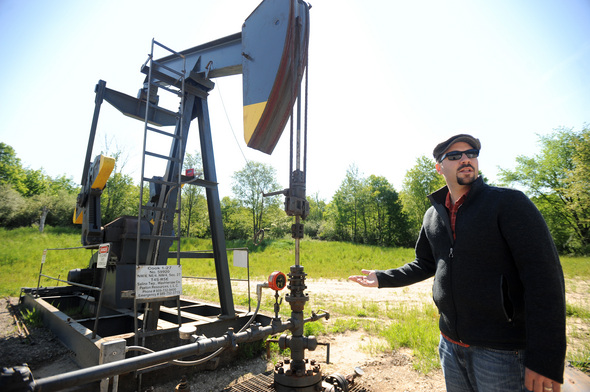
Greg Vadnais Jr., a leasing agent for Paxton Resources, stands next to a pump jack at an oil well near corner of Willow and Macon in Saline Township. The company has obtained mineral rights to about 28,000 acres of property in Washtenaw County.
Angela J. Cesere | AnnArbor.com
In the driveway, a traffic cone marks the spot where a killdeer has decided to lay her eggs among the gravel. From the window of their custom-built home they can watch their three horses, which they bred and raised, graze in the pasture.
Just beyond the pasture, however, is an oil well - the pump jack rising and falling, drawing oil out of the ground from 3,000 feet below.
“You have to have an exploration budget to do that, one that only ‘big companies’ can afford.”
- Greg Vadnais, land lease agent for Paxton Resources, on the use of fracking to find gas in Washtenaw County.
The well has been producing oil for about 18 months now, but it wasn’t until recently that anyone seemed to notice or care.
Controversy arose last November when Paxton began approaching other landowners in Saline Township and neighboring communities about leasing the rights to the minerals below the ground.
The move came just as a fierce national debate over the environmental safety of oil and gas exploration using a controversial practice called fracking was reaching a crescendo.
Suddenly, concerned residents were showing up at local township halls and Board of Trustee meetings worried about water table contamination.
In April, about 125 people packed the auditorium at Liberty School in Saline for a town hall meeting organized by state Rep. Mark Ouimet.
No, the audience was told, fracking isn’t being used locally, but there is no guarantee it won’t be in the future.
County and township officials say their hands are tied - oil and gas exploration is regulated by the state and federal governments: The Michigan Zoning Enabling Act prevents them from making any laws concerning oil and gas activity within their jurisdictions.
Meanwhile, dozens of Washtenaw County landowners have seen representatives from oil companies knock at their door with a sales pitch, a land lease and a pen in hand.
Local oil wells in action
Cost vs. demand
Michigan’s natural gas boom hit its peak about 30 years ago, and prices have fallen ever since -- a fact that has discouraged many companies from undertaking the more expensive practice of fracking for gas.
“We’ve got such a prolific production of (natural) gas it’s depressed the prices,” said Hal Fitch, the state’s geologist and lead oil and gas regulator.
He said the costs to drill large-scale horizontal natural gas wells and hydraulically fracture them with may not garner enough revenue to recoup the cost.
Natural gas sells for about $2 per 1,000 cubic feet. Crude oil is going for about $100 per barrel.
A traditional vertical oil well - the type currently used by Paxton in Washtenaw County -- costs about $2 million to drill.
As a small, family-run operation, Paxton doesn’t have the financial clout it would need to invest $10 million to $12 million in fracking a well, said Greg Vadnais, land lease agent for Paxton.
“You have to have an exploration budget to do that, one that only ‘big companies’ can afford,” Vadnais said. “We’re in the oil game now.”
Besides the four wells operated by Paxton, there are at least two other working oil wells in Washtenaw County. The wells -- in Salem Township, in the northeast corner of the county -- were drilled in the mid-1980s and continue to produce oil.
Fracking: Old and new
Fracking, short for hydraulic fracturing, involves injecting chemical brine water deep into the earth to break loose oil or gas that was previously hard to get.
Experts say fracking has been used for nearly 60 years to find oil and gas in Michigan.
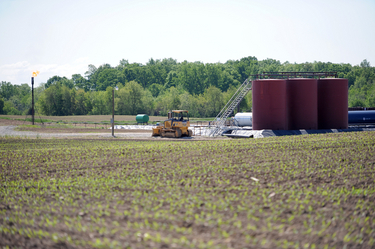
Paxton Resources' crude oil tanks and a flare stack, left, which burns off excess natural gas, stand in the middle of farmland owned by the Luckhardt family in Saline Township.
Angela J. Cesere | AnnArbor.com
There are nine long horizontal wells in Michigan that have been completed and hydraulically fractured, Fitch said. Two of the wells are producing natural gas into a pipeline.
Nine permit applications for the activity are also pending with the state currently, Fitch said.
In Hillsdale County, there’s an “experimental” long horizontal well. The company doing the work is drilling in a field where hundreds of traditional, vertical oil wells were drilled in the 1950s, Fitch said.
By utilizing horizontal fracking, the company may be able to extract left over oil.
“There’s still a lot of oil left in there that you can’t get out with a vertical job,” Fitch said, noting he’s not sure if the move will work.
The Trenton/Black River geologic formation that runs under Saline Township is known for holding oil in naturally occurring underground “lakes” of oil, Fitch said.
“The Trenton/Black River wells generally don’t require hydraulic fracturing,” Fitch said. “You drill a vertical well, run casing through it, perforate it, and it flows. It’s counter-productive to hydraulically fracture them.”
The geologic formation in which Paxton’s oil wells are located in Washtenaw County is the same formation the West Bay Exploration Company has tapped into in neighboring Jackson County.
West Bay has drilled more than 40 oil wells amongst the small lakes, fens and wetlands of the Irish Hills. Another 40 are planned for the next two years.
Contamination fears
Recent incidents in other states have drawn national attention about environmental concerns related to fracking.
In March, Ohio oil and gas regulators said a dozen earthquakes in northeastern Ohio were caused by injecting gas-drilling wastewater into the earth.
Officials in Ohio, Pennsylvania and Colorado Officials in Ohio, Pennsylvania and Colorado have pinpointed methane contamination of drinking water supplies to nearby gas drilling operations.
“The real story on hydraulic fracturing is that there have been some issues in other states. However, despite what’s said in other stories out there, there has been no direct contamination of groundwater from hydraulic fracturing,” Fitch said.
Fitch said the contamination issues that have arisen from surface spills and wastewater disposal associated with hydraulic fracturing - which is human error, not that of the process itself.
The millions of gallons of water required to hydraulically frack a well become contaminated in the process and must be disposed of.
Trace amounts of powerful chemicals are added to the water that make the water more viscous and suspend sand particles in the water. Some of the additives are also friction reducers, Fitch said.
Companies are not required to disclose the chemicals in the water - a “trade secret” akin to the formulas for Coca-Cola and Dr. Pepper, Fitch said.
“There’s legitimate concern over those chemicals and they do have to be managed properly,” Fitch said.
A recently proposed federal bill would require companies to reveal the chemical makeup of the solution they use to frack wells drilled on public lands - which would come as a relief to some after the recent auction of public land in northern Michigan.
Oil and gas companies are responsible for conducting their own environmental impact statements and for testing water around the wells they drill - a fact that has garnered scrutiny from environmentalists.
Disposal of the wastewater from the activity has many people worried about their drinking water.
In Jackson County, West Bay wants to add a couple of injection waste wells to dispose of waste brought to the surface in oil drilling. Mostly, the waste is salt-water brine, but according to the EPA, it could also include toxic metals and radioactive substances.
The waste wells would be drilled in the northeast corner of Norvell Township - just feet from the Washtenaw County line.
The hunt for mineral rights
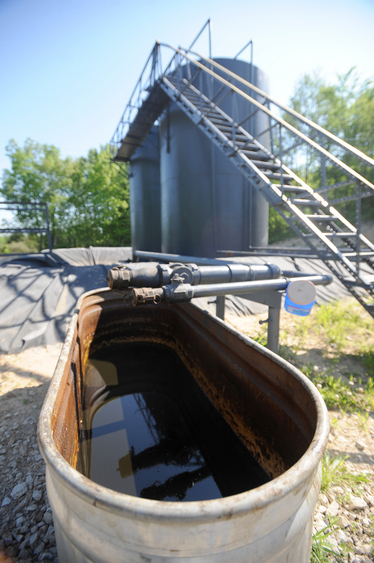
A crude oil catch basin stands next to holding tanks at Paxton Resources' oil well near the corner of Willow and Macon in Saline Township.
Angela J. Cesere | AnnArbor.com
In Saline Township where the oil is flowing from the ground, the vast majority of the lease agreements were acquired by Phillips Resources of Pittsburgh several years ago.
After Phillips only hit oil twice, they sold their Washtenaw holdings to Paxton Resources LLC - the company that has since become the focus of many local conversations.
Initially, the Dwyers said, they were apprehensive about signing a lease with Phillips. The company said it was looking for oil.
“We started reading things, talking to people,” Wendy Dwyer said. “We were concerned. We wanted to know if it was going to be safe.”
After doing their research, the Dwyers decided allowing an oil well to be drilled on their property was akin to buying a lottery ticket.
The risks seemed minimal - a well more than 3,000 feet deep had to be drilled into the earth to see if the oil was there. Their water well is several hundred feet below ground, and they didn’t see the harm with it happening on the back side of their property in their hay field.
The money the couple gets from the lease agreement - about one-eighth of the sale of the oil - isn’t “life-changing,” Tim Dwyer said.
“To me, I can’t see the cause for concern,” Wendy Dwyer said.
A company representative checks two 300-barrel holding tanks every day at each site, and the pump jack that runs on a small motor. The holding tanks are in a lined well built to hold twice the amount of oil than the capacity of the tank - a feature mandated by the state.
At some sites, a flare burns off the excess natural gas that comes out of the well.
Paxton
Since taking over Phillips’ operations in Washtenaw County, Paxton has drilled two wells - and hit oil both times.
The company bought about 24,000 acres in leases from Phillips - and have added about 4,000 acres on their own volition - bringing the company’s Washtenaw County holdings to 28,000 acres in Saline, Lodi, Freedom, Lima and Bridgewater townships.
Out of the leases the company acquired, Paxton claims it’s only signed three to four leases of its own in the year and a half it’s been working in the area.
Paxton has claimed that they’re not out for a huge resource play: “We’ll be specific to places where the stars align,” Vadnais said.
Vadnais said they company has signed all the leases for mineral rights that it needs to for the operations it plans on doing in Washtenaw County, and plans on drilling two more wells in the next year. Seismic tests are being conducted in Lodi Township, Vadnais said.
Though he understands the opposition, Vadnais said Paxton has had no complaints about their activities or the way they do business in Washtenaw County - a claim validated by several of the landowners with a Paxton-owned and operated oil well on their property.
“We have not had a problem other than people’s emotional reactions to the industry,” Vadnais said. “You’re going to have to try really hard to hate us.”
New resistance
Though Paxton is clear about the small scale of its current activities in the Washtenaw County, the underlying fear is that oil and gas exploration could easily multiply with a change in the market.
Many Lodi Township residents there have signed over their mineral rights to Paxton, but some have declined - and started attending meetings to speak out to regulators and to inform their neighbors of what’s going on.
Mitch Rohde, Lodi Township resident and founder of the site nopaxton.com - said he was approached last fall by Paxton with a land lease agreement and denied it.
“The fear is that we’re next,” Rohde said, referring to deep horizontal fracking.
Lodi Township resident Clive Wotton said he’s been approached by land lease agents from Paxton and Petro Vest Incorporated of Houston, both of which touted the financial benefits of the agreement without giving specific numbers or fully explaining the environmental ramifications.
Realtors have reported home sales falling through in Lodi Township because of the speculation of oil development, Wotton said.
“I think there’s a lot of fears out there because it’s new to a lot of people,” Fitch said. “Frankly, there’s a lot of misinformation out there. I don’t blame people for being concerned.”
Lack of local control
A Michigan zoning ordinance prevents counties and townships from passing their own regulations on oil and gas activity - effectively leaving the state in control of the industry.
So far, local municipalities can only take a limited approach to regulating what happens - like in Saline, where the city council has passed a moratorium on selling water outside of city limits.
“We were selling the water to people that were doing activities outside the city limits,” said Saline Mayor Gretchen Driskell. “I don’t see why we need to facilitate it.”
Driskell said there’s a lot of speculation flying around about the issue and she is concerned about the lack of local control over where companies can drill wells.
However in Saline Township, the officials haven’t said no to oil exploration companies.
One local official -- Gary Luckhardt, a member of the Saline Township Board and the zoning administrator -- has two producing oil wells operated by Paxton on his property.
Saline Township signed a non-developmental mineral lease agreement in 2010 -- now owned by Paxton -- for township owned property that would garner it income from an oil well if it should ever start producing.
The township board did deny a request for a non-developmental mineral rights lease agreement for the cemetery property, said Saline Township Supervisor Jim Marion.
“It’s all state regulated,” Marion said. “We don’t have any comment one way or another.”
An amendment to the state’s constitution has been proposed to ban horizontal hydraulic fracturing in Michigan.
LuAnne Kozma, campaign director for the Committee to Ban Fracking in Michigan, has written an amendment to the state’s constitution and is circulating petitions to get the amendment before state voters on the November ballot.
“What I really can’t stand is the very accommodating and tolerant response by other elected officials to regulate and tolerate,” Kozma said. “People should be really outraged.”
Amy Biolchini covers Washtenaw County, health and environmental issues for AnnArbor.com. Reach her at (734) 623-2552, amybiolchini@annarbor.com or on Twitter.
Comments
Dan Timmons
Fri, Jun 8, 2012 : 6:26 p.m.
I noticed that the article provided a convenient link to the activist group which is committed to ban hydraulic fracking in Michigan, even on private lands. Anyone wanna bet that the next article on this site which discusses this topic will likewise have the same link? I'd say those odds are much better than the likelihood of a link being provided to an organization which supports the use of the most efficient form of energy we have, which are fossil fuels. Media bias, thy name is annarbor.com
Peter Baker
Fri, Jun 8, 2012 : 1:34 p.m.
Lenawee, my home county, shut down installation of windmills around Palmyra, Riga and Ogden, because a hysterical minority were concerned about shadows and noise and cronyism. And that was for wind power. Why can't we get the same level of scrutiny from "concerned citizens" over pumping chemicals in to the ground and causing a million tiny earthquakes?
E. Manuel Goldstein
Fri, Jun 8, 2012 : 4:49 p.m.
Probably because you have politicians like Mark Ouimet who act in the interests of his corporate sponsors. You are forgetting this is the oil and gas industry, which has tons of money to spread around to influence the ignorant through propaganda.
Mike
Fri, Jun 8, 2012 : 11:43 a.m.
The EPA has never documented an instance of groudwater contamination caused by fracking. The ground water you're so worried about is around 200 feet down and the gas and oil wellsare at about 3000 feet. The Wall Street journal just wrote a piece in March about it and the EPA says it may cause contamination but they have not documeted that in over 60 years. Where does all of this fear come from? So much misinformation out there, and peopel just such it up and hit the panic button. Our country is in deep trouble when people stop thinking and run their lives on emotion and fear.
Hemenway
Fri, Jun 8, 2012 : 10:12 a.m.
The oil industry and the MDEQ cannot be trusted on these matters. These Fracking operations should be stopped until such time the risks are fully understood. Most folks in Washtenaw County reply on well water. We have a shared concern.
michael Limmer
Fri, Jun 8, 2012 : 2:19 a.m.
i would suggest that people read the article that was in the New York Times about fracking in Ohio. The landowners were smart, banded together, hired a good attorney, and got a deal that increased their financial yield by hundreds of times what the gas company was offering, a complete disclosure of any and all chemicals used in the process, and most importantly, a very good if not ironclad agreement that the gas producer would financially liable for any contamination issues. Now they are enjoying royalty checks that amount to hundreds of thousands of dollars and legal protections that go way beyond what any government would offer.
martini man
Fri, Jun 8, 2012 : 1:12 a.m.
The liberals are against anything that will help America . They can all get fracked !!!
Dave Bass
Fri, Jun 8, 2012 : 12:45 a.m.
What right does our dear government have in nixing local controls in zoning? Sounds like a "line my pocket" deal to me.
Floyd
Fri, Jun 8, 2012 : 12:20 a.m.
We need to change our fracking zoning laws!
steve
Thu, Jun 7, 2012 : 11:54 p.m.
Is there a reason why we need this fracking? Seems like we got an entire university of students who could work to experiment with ideas on making a safer energy production process uniquely meant for our community, the way it should be.
JRW
Thu, Jun 7, 2012 : 8:32 p.m.
Fracking is a disastrous process that permanently damages the water and environment. If in doubt, see link below. http://earthjustice.org/features/campaigns/fracking-across-the-united-states And we can thank Dick Cheney, who was VP when the fracking industry was allowed to be exempt from the Clean Air Act and Clean Water Act. And, the fracking industry does not have to make public the chemicals they are injecting into the ground water. If it's so safe, what are they hiding? Fracking has already been banned in Vermont, and is being banned in several European countries due to the disasters in this country. The fracking process has also been implicated in causing earthquakes. http://www.scientificamerican.com/article.cfm?id=ohio-earthquake-likely-caused-by-fracking
Hayduke
Thu, Jun 7, 2012 : 9:01 p.m.
Vermont is the least likely place to frack anyway. Take a look at the ways some of these problems are being handled. Frack water is often now recycled (like sewage water). Banning is often temporary to better understand the issue. Fracking did not cause the earthquakes, water disposal is thought to have, it is still uncertain.
gawaters
Thu, Jun 7, 2012 : 5:33 p.m.
For those of us who are facing the real possiblity that the drilling equipment, huge tanks, open holding ponds, and flares will be directly outside our front windows operating and making noise 24/7, and that this activity will be taking place in close proximity to our family's drinking water wells, this is a frightening development. I will venture to guess that those who are saying there will be no problems with this type of development have not researched what has happened with existing wells, and most importantly, are not facing the possiblity of having this development occur right across the street from their house, as I am. It is easy to support risky development that is happening somewhere else!
Mi resident
Thu, Jun 7, 2012 : 5:31 p.m.
What if....what if... what if..... What if I get into a car accident.. maybe I shouldn't drive...
steve
Thu, Jun 7, 2012 : 11:54 p.m.
You getting into a car accident doesn't effect an entire community. If fracking goes wrong, it does effect our community.
Michigan Man
Thu, Jun 7, 2012 : 5:28 p.m.
Fracking has been going on in Washtenaw County for decades! I am little surprised that the "smartest people in the nation" in Ann Arbor have not yet figured this out.
kmgeb2000
Fri, Jun 8, 2012 : 12:28 p.m.
From the all the availabe DEQ records for oil and gas exploration/production in Washtenaw County only 1 gas well and 6 oil wells are in production in WC, as such is the case hydraulic fracking has not been going on in WC for decades. It is more likely that it has never been used in WC or at most once since the method is typically applied to gas wells. One more well exists but it is a gas storage well that would not likely be fracked. The total number of wells drilled in WC is only 224, and if only 7 have resulted in producing wells (gas or oil) that leave 217 dry holes and no large scale hydraulic fracking (LSF). From article, Hal Fitch indicated only 9 well in the state have been large scale fracked and 9 more have permits. That's a total of 18 in the whole state that have applied LSF.
Nancy Shiffler
Thu, Jun 7, 2012 : 5:17 p.m.
Here are a few examples of what has gone wrong in the past (based on work by Chris Grobbel of Grobbel Environmental & Planning Associates of Leelanau, and former MDEQ employee): In 2007 reported that the MDEQ, Office of OGM maintains an internal list of ~700 O&G contamination sites known since 1986. Example A: Hayes 22 Central in Gaylord -- Nearly 60 releases of crude oil, brine and condensate since July 30, 1985. Groundwater contamination plume 3,500 ft long, 1,000 ft wide, 30 feet thick (200 feet below ground surface) or 10.5 million cubic feet. Impacted 3 private drinking water wells, located 233 and 298 feet from the facility (chloride, benzene, etc.). Clean up stalled despite 35 years of MDEQ oversight, 3 private lawsuits filed in 2007. Example B: Gladwin County Dairy Farm -- 9/11/2003 release of brine and crude oil of an unknown quantity reported from "a hole in a flow line…overtime" reported to MDEQ. Second spill reported on 6/22/2004 to MDEQ from a "second leak in the flow line..." October of 2007 – soil and water sampling by Chris Grobbel indicated free phase crude oil, benzene at 61,200 ppb; toluene at 87,800 ppb; ethylbenzene at 32,900 ppb; xylene isomers at 107,000 ppb; 1,2,4-TMB at 236,700 ppb; 1,3,5-TMB at 9,020 ppb; Naphthalene at 4,900 ppb; lithium 14 ppm; chloride at 24,400 ppm in soils all dramatically above standards.
E. Manuel Goldstein
Thu, Jun 7, 2012 : 5:09 p.m.
The good citizens of Washtenaw County should propose a ballot referendum to ban fracking in the county.
E. Manuel Goldstein
Thu, Jun 7, 2012 : 5:08 p.m.
AnnArbor.com should investigate to see if Mark Ouimet receives any money from the fracking industry.
Michigan Man
Thu, Jun 7, 2012 : 5:30 p.m.
EMG - Mark is a millioinaire and in the 1% camp. Same as me! He has more money that the fracking industry. I, however, would be happy to be on the receiving end of some fracking industry money!
Tru2Blu76
Thu, Jun 7, 2012 : 4:07 p.m.
Addendum: I should have written: The county or the state should have the figures on the number of already naturally contaminated wells...
tf049
Thu, Jun 7, 2012 : 4:29 p.m.
good point. Many areas of northern Lenawee county have unusable wells due to the sulfide problem. re-drilling at $1000 minimum "may not" result in a patent well.
Tru2Blu76
Thu, Jun 7, 2012 : 4:05 p.m.
Pretty good journalism on the part of Amy Biolchini. My one criticism is that, in an effort to cover all the bases, this article strays from the central question: just how risky is oil industry fracking? Of the many fracking operations around the country (which are yet to be started in Washtenaw County), how many of them resulted in contaminated ground water so far? Another aspect not covered: there are pockets of briny water already in the Washtenaw water table - resulting from natural contamination caused by salt deposits impinged by the water table. Also, around Milan, there's some amount of hydrogen sulfide (H2S) gas contamination - another case of the water table impinging on naturally occurring deposits of that gas. In both situations: those water wells in the contaminated zones are either unusable (briny deposits) or require processing (usually done with in-home installations to remove the hydrogen sulfide gas - which is both poisonous and corrosive. The county should have the figures on the number of already naturally contaminated wells - something which should play into the calculations when thinking about potential future contamination by "fracking water" used and later stored under ground.
JRW
Thu, Jun 7, 2012 : 8:34 p.m.
http://earthjustice.org/features/campaigns/fracking-across-the-united-states This will answer your question about how risky fracking is across the country. It's a disaster.
tf049
Thu, Jun 7, 2012 : 4:30 p.m.
Yes; why do you think they call the city Saline?
tf049
Thu, Jun 7, 2012 : 3:46 p.m.
It's very nice to talk about this issue of "fracking" as it applies to state of Michigan residents. However a larger ground water pollution issue exists within your fair city's and suburbs. the massive amounts of herbicides, pesticides and fertilizers dumped onto your yards to obtain that niece green appearance far overshadows the oil productions within the state. When was the last time you walked through one of Ann Arbors downtown parking garages? dodging oil spills and coolant leaks is more common than you may think. When you have one finger pointing outward there is usually three of the fingers pointing back.
Hayduke
Thu, Jun 7, 2012 : 8:55 p.m.
Exactly. One of the biggest polluters is run off from a parking lot, with the general public's automobiles doing the brunt of the damage.
Chase Ingersoll
Thu, Jun 7, 2012 : 3:21 p.m.
We are paying $2.65 per GGE or gallon equivalent of Natural Gas at the pumps in Ann Arbor. At $2 per 1000 cubic feet. That is a wholesale cost of $.25 Nice spread for everyone involved in that supply chain. Chase Ingersoll
Joe Hood
Thu, Jun 7, 2012 : 6:12 p.m.
Aren't natural gas prices regulated by the state? Utah has had prices of $.64 per GGE. Ontario is at $.88 per GGE.
rick
Thu, Jun 7, 2012 : 2:23 p.m.
Just Frack baby..... Fracking is here to stay people so get over it...
steve
Thu, Jun 7, 2012 : 11:50 p.m.
It may be here to stay, but it doesn't have to be here to stay in our community.
ddjames
Thu, Jun 7, 2012 : 1:28 p.m.
My father lives in Monroe County. He is an elderly widower. The company that came through in last 2 months told him he would "win the lottery" by signing away his mineral rights. His memory and judgement not being what it used to be, he fell prey to their slick tactics. Warn your elderly parents to keep their hands in their pockets when these people come along. They did NOT suggest he seek an attorney. My father told us afterwards and by then IT WAS TOO LATE. The agreement is TOTALLY written in the leasing company's favor and there is not a thing we can do about. The law is on their side. (very short explanation of several weeks of negotiations with attorneys and the company's executive to get this contract voided).
jns131
Fri, Jun 8, 2012 : 12:07 a.m.
Now it comes out to finger pointing the elderly. I know a few elderly that are very sharp in their wisdom. Sorry but what they did to yours was wrong, but he should have known better.
JRW
Thu, Jun 7, 2012 : 9:20 p.m.
I'm very glad to hear that you were able to get the contract voided. These slippery companies are doing this all over the country. Someone needs to sue them for deceptive tactics. Please tell us the name of this company so others can be make aware.
Hayduke
Thu, Jun 7, 2012 : 8:53 p.m.
Until he gets a chuck of a nice well (12.5% at no cost to him), and/or the term runs out on the lease and he can cash another lease bonus check.
Goober
Thu, Jun 7, 2012 : 3:51 p.m.
and your point is?
Robert Hughes
Thu, Jun 7, 2012 : 3:25 p.m.
This is the real story.
Jeffersonian Liberal
Thu, Jun 7, 2012 : 1:25 p.m.
Wow, a well written article minus the usual liberal fear mongering and hysteria. But beware of the fanatical mental midgets like Michael Moore and his progressive friends who live to trample on property owners rights. They will not stop until they have taken away our liberties and cut off the use of our natural resources.
Joe Hood
Thu, Jun 7, 2012 : 6:10 p.m.
Funny about those that complain, they drive their gas eating cars but don't want to pay the piper. Any drilling that takes place here will be far more safer for the environment than anywhere else in the world.
mixmaster
Thu, Jun 7, 2012 : 1:58 p.m.
Your property rights end at my drinking water, wherever it comes from.
Ron Granger
Thu, Jun 7, 2012 : 1:24 p.m.
This is so wrong! We routinely hire corporations to exploit other nations for their natural resources with no regard for the health and well being of the native populations. But it isn't supposed to happen here! We're supposed to do it to them, not do it to ourselves.
mixmaster
Thu, Jun 7, 2012 : 1:24 p.m.
Have we already forgotten the gigantic BP oil leak that continue to pollute the Gulf of Mexico? Now just imagine that happening in Lake Michigan. But that's impossible because the oil companies tell us that everything is safe and we need the gas... AND they need the profits.
Unusual Suspect
Thu, Jun 7, 2012 : 1:20 p.m.
Quick! Start the fearmongering!
mtlaurel
Fri, Jun 8, 2012 : 12:42 a.m.
there's plenty of information attesting to the deeper drilling and its risks/the secrecy/the anecdotals about people and ill effects. what is your basis for demeaning people who are paying attention...do you get your info from the cute pictures on Tarot cards or something like that?Just tell people what information to use then....The drilling industry isn't going to tell you the truth,by the way.
Unusual Suspect
Thu, Jun 7, 2012 : 2:23 p.m.
No. But I also don't reject things outright just because groupthink says I should.
TC
Thu, Jun 7, 2012 : 1:51 p.m.
I take it that you have complete trust in the oil business to protect us and our waters. I wish that I did too.
Unusual Suspect
Thu, Jun 7, 2012 : 1:29 p.m.
See what I mean?
mixmaster
Thu, Jun 7, 2012 : 1:26 p.m.
And defending an industry that pollutes the Gulf of Mexico. But no, it can't happen here.
xmo
Thu, Jun 7, 2012 : 1:07 p.m.
It would be wonderful to be part of "No Blood for Oil" crowd by producing our own oil in Michigan! I fear the government regulations more than any Fracking issues!
TC
Thu, Jun 7, 2012 : 1:48 p.m.
Regulations are only protections.
mixmaster
Thu, Jun 7, 2012 : 1:25 p.m.
If only you knew what you were talking about.
Diagenes
Thu, Jun 7, 2012 : 1:07 p.m.
Looks like Mark Ouimet is doing his job on this issue. Since it is a Federal issue as well as a state issue where is Congressman Dingell? He is on the Eneregy and Commerce committee. Does he have an opinion on oil and gas development development in Washtenaw County? Oil and gas development can mean a boost to the local economy. Lots of union truck drivers delivering supplies to the well drillers. Many spin off jobs will be created, not to mention the tax revenue that will be paid to local government. Unless you can prove a substantial danger to the environment, I say go for it.
Diagenes
Fri, Jun 8, 2012 : 1:15 p.m.
All those southern democrats like Al Gore protected the tobacco industry for decades. Drilling for oil and gas on land is much safer than a mile deep in the gulf. If there is very little danger to the environment than we should develop local energy supplies. Let the experts in this area inform the property owners and make a decision. I find the absence of Rep. Dingell interesting. I thought he was hard at work on the issues confronting our area.
TC
Thu, Jun 7, 2012 : 1:47 p.m.
I'm only asking for protection.
mixmaster
Thu, Jun 7, 2012 : 1:30 p.m.
It took a long time, many lives lost to cancer and billions of dollars to get the tobacco industry to stop killing us. How long will it take to bring the Fossil fuel industry to clean up their messes? Strip coal mines, cancer causing oil pollution in the Gulf and around the world and you want to add fresh water contaminated with an unknown chemical soup right next to the largest body of fresh water on the planet?
fjord
Thu, Jun 7, 2012 : 12:53 p.m.
Fracking is an enormously inefficient way to extract energy from the ground. It simply is not a sustainable practice. Add to that the enormous risk of groundwater contamination, which has happened again and again near fracking operations, and it simply doesn't make sense to pursue this means of energy production. Fresh water is a far more precious resource than fossil fuels. We are developing alternatives to fossil fuels, but there is no alternative to fresh water.
Hayduke
Thu, Jun 7, 2012 : 8:50 p.m.
How is it inefficient? Is it economic? How is it an enormous risk? What about the 60 years of hydro-fracking in northern Michigan? I still see flocks of cars traveling north for vacation in polluted waters? Do some research before writing what seems incredible naive and uninformed.
mixmaster
Thu, Jun 7, 2012 : 2:07 p.m.
I guess you're not concerned with the continuing pollution in the Gulf from the BP oil leak and the potential for more. Out of sight, out of mind is a strategy... until it's too late.
Basic Bob
Thu, Jun 7, 2012 : 1:58 p.m.
Fracking is not practical in Washtenaw County. If you read the article, you will find that producers like Paxton Resources will not spend huge amounts of money on fracking here. What they do in Wyoming is not important to me. We are far more likely to experience an outbreak of flesh-eating bacteria.
garrisondyer
Thu, Jun 7, 2012 : 1:18 p.m.
hear, hear. Why is this such a hard concept for people to grasp? Is it because MI is surrounded by the Great Lakes? Don't people understand that contaminated water in most of Michigan will simply start making its way toward those same Great Lakes?
Mike
Thu, Jun 7, 2012 : 12:51 p.m.
We live in a area that is afraid of the hazard of the month. They have been fracking for over 60 years and drilling for oil longer than that. It's safer than driving your car or flying in an airplane and people still somehow overcome that fear and go to work everyday. Life has risk, you do the best you can to control risk and then life throws a curve ball at you anyhow. If you want to live in a modern society you deal with risk. If you want to go back to the 1800's you deal with even more risks............get over it and quit being so scared, life is too short to live it in bubble wrap.
Hemenway
Fri, Jun 8, 2012 : 10:16 a.m.
Who are " they"?
mixmaster
Thu, Jun 7, 2012 : 1:34 p.m.
The difference now is that drillers use horizontal drilling techniques to extract gas and oil many miles away from the wellhead. Vertical single wells are very different from horizontal drilling with many inlets drilled into an area. We know very little about our planet and to think that we know what will or won;t happen based on old technology is sheer lunacy.
Goober
Thu, Jun 7, 2012 : 12:45 p.m.
My guess, some feared the light bulb, automobiles and PC's.
Robert Hughes
Thu, Jun 7, 2012 : 3:18 p.m.
That's right. And some still fear them, rightly so, too. Pity we don't use our resources for the betterment of human society and the environment; it's a choice that we've failed to make time and again over the centuries.
brb11
Thu, Jun 7, 2012 : 1:01 p.m.
And my guess is that some feared Thalidomide. What is your point?
fjord
Thu, Jun 7, 2012 : 12:57 p.m.
This is different. Once you contaminate the groundwater, it's enormously difficult — maybe even impossible — to reverse it. How's that whole Gelman/Pall thing going? Groundwater contamination due to fracking is a very real fear — it has already happened elsewhere. It's simply not worth the risk.
TC
Thu, Jun 7, 2012 : 12:26 p.m.
Well, what if there is a problem someday? What if drinking water does get contaminated? What if a lake or river becomes unusable and the surrounding property needs to be abandoned. What happens if "human error" creates a problem, large or small? How would those affected by these potential problems be made whole? Is there a plan for that? Do those doing the drilling have adequate insurance or other funds to compensate for the loss of the use of a lakeside home? Is there enough money set aside by the oil companies to supply families with drinkable water if that becomes necessary? If I can no longer fish or swim with my children or grandchildren on the lake that is just across the road, would there be compensation for that loss? What if it becomes necessary for a family to abandon a home? Who would pay for that? None of these scenarios are far fetched. They could happen and nobody can guarantee that they won't. Where is our protection if they do happen? It's disturbing to read that local officials claim that "their hands are tied". Sorry, They don't get to wash their hands of the problem so easily. It's the locals that help folks like Rep. Mark Ouimet get elected. If Rep. Omimet and others can't protect us then they need to be replaced by those who can. Replaced by those who don't give up so easily. I admit to being afraid of the fracking process. It seems very extreme to me, risky. However, I realize that the power and the clout lie with the oil companies and the "drill baby drill" crowd. They will get what they want. If they can't be stopped, maybe we should at least demand that the rest of us are protected.
JRW
Thu, Jun 7, 2012 : 9:17 p.m.
"What if drinking water does get contaminated?" The drilling company pays a small fine and it's business as usual. The water does not get cleaned up, the damage has been done and the fracking company walks away to pollute in a new spot.
mixmaster
Thu, Jun 7, 2012 : 1:55 p.m.
Don't worry, Be happy is a song and has nothing to do with reality. Burying your head in the sand, putting your fingers in your ears and screaming alalalala is a no way to deal with reality, Mike.
kmgeb2000
Thu, Jun 7, 2012 : 1:55 p.m.
@Mike: Your tornado example is prefect since we just did that, so local emergencey personel secure the area, aid the effected and insurance rebuilds you home - end of story (assuming no loss of life). Now the alternative: so your groundwater becomes contaminated. First you have to convince someone a problem with your groundwater exists, then it must be investigated (which will require years and $$$$). Any cleanup if done, will require decades to achieve a minimal level of cleanup. During this time, you have to live with your contaminated water supply. You may or may not receive water delivered by trucks for all your needs like those effected in Pennsylvania (likely only after litigation). In another comment, you indicated fracking has been conducted for over 60 years, which is true. Just not the large-scale hydraulic fracking (LSF) that has only been done for about 10 years, starting in Texas. The fracking prior to this period used from 50,000 to 100,000 gallons of fracking fluids, the current implementation often use 5,000,000 gallons for each LSF procedure. Now multiple fracking procedures are conducted on an individual well so the volume maybe more likely 10,000,000 to 15,000,000 gallons of fracking fluids. Let's continue. So you've fracked the well - now the return fluid must be addressed and disposed in some way. Like you said 60 years ago NBD, it's only a few thousand gallons. Now it's several million gallons on fluids with few options for disposal. Depending on the area it may be radioactive and either way it's definitely not fit for a WWTP. I don't think it's simply being "scared" but people expressing real concerns that at the moment don't have answers. Yes the technology works but the real cost has not been determined.
ruminator
Thu, Jun 7, 2012 : 1:24 p.m.
Thank you for the comments about our local officials. Most of the Saline Township elected officials are large land owners. Many already have named producing wells on their property or are in the permitting process for new wells. Except for the recent token vote against mineral rights leasing for the cemetery, you likely won't find another negative vote by the board in matters concerning the production or oil and gas in Saline Township. Even more disturbing, none have abstained from any vote because of their financial interests in the exploration or production of oil and gas in the township. When the elected body that represents us is personally involved in the oil business, who can we take our concerns to?
amlive
Thu, Jun 7, 2012 : 1:23 p.m.
@ Mike - If any of your scenarios happen to me, I have home, health, auto, and life insurance to take care of repairs, medical bills, and my family. I don't however, have any insurance to cover property devaluation if anything goes wrong which can be traced as residual effects of fracking on a neighbor's property. I don't believe most municipalities have insurance to find a new water supply should theirs end up with contamination. I don't believe that any individual or municipality should have to pay for this type of insurance either, but rather the person / business with potential to be at fault or cause these problems should be required to carry suitable insurance before they are permitted to engage in such activities. If the risk of anything going wrong is indeed low and can be objectively appraised as such, than the insurance rates should not be prohibitive. If there seems to be a fair risk to the process however, with consequences of possibly having to buy out properties and pay for relocation and possible health problems of an entire community, then the insurance rates may prove cost-prohibitive. There you go all you oil-drinking hold-to-conservative-values-only-when-it-suits-me folk. Regulate no further than requiring insurance to make sure companies are held fully accountable for all damages they may cause to others and their property, and let the free market decide. If fracking is proven beyond a doubt to be as safe as they say, then insurance should be a drop in the bucket in overall cost of drilling.
garrisondyer
Thu, Jun 7, 2012 : 1:15 p.m.
@Mike, You're comparing, for the most part, apples to oranges. Natural risks of living in our world vs. man-made/unnecessary risks. I'm with you on enjoying life. I'd also like to continue to enjoy life, free of this fracking idea and all the unnecessary environmental (water supply) risks that come with it.
Mike
Thu, Jun 7, 2012 : 12:54 p.m.
What if a tornado hits your home? What if you get hit by lightning? injured in an auto accident? fall off your bike? have a heard attack? Just relax and understand that things will work out, you can't control everything. Enjoy life and don't be so scared...........
kmgeb2000
Thu, Jun 7, 2012 : 12:14 p.m.
For a additional detail on the concerns please see: http://www.psehealthyenergy.org/data/Howarth_statement_to_Congress.pdf No its does not speak of zombies, just about our surface water, groundwater, and the air we breath. It also is not that the sky is falling but realities related to the practices.
Epengar
Thu, Jun 7, 2012 : 9:21 p.m.
The link worked for me too.
Robert Hughes
Thu, Jun 7, 2012 : 3:14 p.m.
Worked for me on my mac.
DonBee
Thu, Jun 7, 2012 : 1:47 p.m.
Your link ends up in a 404 error.
A2Realilty
Thu, Jun 7, 2012 : 11:59 a.m.
This is perfectly safe. What could possibly go wrong? Signed, Gelman and Pall
Wguru
Thu, Jun 7, 2012 : 6:53 p.m.
In 1998-1999, Pall/Gelman used horizontal drilling similar to that used in fracking to install horizontal purge wells and a 4000-foot pipeline to transport 1,4-dioxane extracted from its northern contamination plume back to its core treatment facility at its property on Wagner Road. That plan was approved by the DEQ even though an industry expert hired by the City of Ann Arbor called it a "back of the napkin plan." In July 2005, the northern section of the transmission pipeline began to leak. Without any prior contingency plan in place, Pall/Gelman had to rush to replace the transmission capacity by relining the northern horizontal purge well piping in the same borehole thus eliminating the extra purging that was capturing dioxane heading northeast 90-100 feet underground. By the time it was replaced in December 2005, the original pipeline was leaking 154 gpm of its 190 gpm flow back to an aquifer near where that aquifer is connected to the deeper E aquifer. The original pipeline failed. Apparently, the only contingency plan if the replacement pipeline fails is to drill another, shallower pipeline. The purge wells are not capable of capturing all of the dioxane heading north and east. Pall/Gelman claims that the dioxane will eventually vent to the Huron River. Much of it may, but where is the question... somewhere between Ann Arbor and Ypsilanti? Some dioxane may vent through the artesian springs in the Allen Creek watershed close to the river. Some dioxane may find its way to Barton Pond where Ann Arbor gets 80% of its water. For more info, visit the SRSW/C.A.R.D booth at the Ann Arbor Green Fair, Friday, June 8, and click on the links at www.srsw.org.
Unusual Suspect
Thu, Jun 7, 2012 : 1:23 p.m.
Get educated. What Gelman did what they did intentionally.
garrisondyer
Thu, Jun 7, 2012 : 1:11 p.m.
The possibility of a wrecked supply of fresh water, one of the largest such supplies in the world. Any contamination from this will be making its way toward the Great Lakes.
Real Life
Thu, Jun 7, 2012 : 11:12 a.m.
I'm more afraid of paying higher gas bills and freezing to death in the dark. Fracking means cheap and nearly limitless energy for now and into the future for hundreds of years. And it's here in America. Let's see - jobs, energy, national security, and the end to all that annoying global warming claptrap.
mixmaster
Thu, Jun 7, 2012 : 1:20 p.m.
You could burn the gas that comes from the contaminated tap water to keep warm.
bedrog
Thu, Jun 7, 2012 : 12:33 p.m.
When one calls man- made climate change " annoying claptrap" your judgement about anything else becomes dubious. I'm an agnostic on fracking so far , but the more climate change deniers support it, the more opposed to it i'll become.
Brad
Thu, Jun 7, 2012 : 11:36 a.m.
Are you fracking serious?
greenstriper
Thu, Jun 7, 2012 : 11:28 a.m.
I call nonsense: The method used to extract oil does nothing to settle the argument over climate change/global warming. The oil is still being extracted and used.
Basic Bob
Thu, Jun 7, 2012 : 10:27 a.m.
Up next: Possibility of zombies in Washtenaw County drums up fear. Walmart unable to keep machetes on the shelf.
5c0++ H4d13y
Thu, Jun 7, 2012 : 12:09 p.m.
We'll just make some lobos.