

Art installation in front of Ann Arbor police-courts building to move forward with council approval
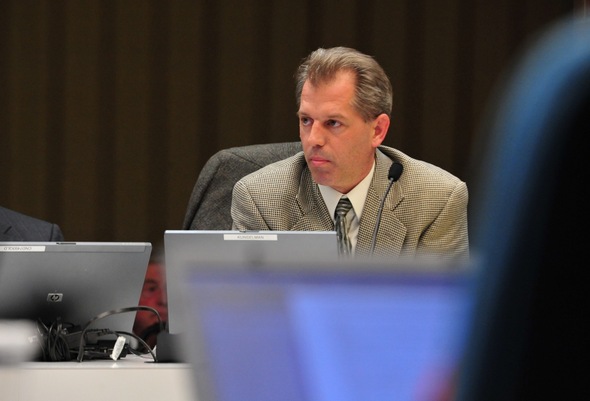
Ann Arbor City Council Member Stephen Kunselman, D-3rd Ward, continued to raise concerns about the legality of the city's Percent for Art Program Monday night.
Ryan J. Stanton | AnnArbor.com
Two of the final pieces of the new Ann Arbor police-courts building were approved by the Ann Arbor City Council Monday night: interior furniture and exterior artwork.
The council agreed in an 8-3 vote to spend $553,320 from the city's public art fund under a contract with Quinn Evans Architects to complete the fabrication and installation of the Herbert Dreiseitl water-based sculpture in front of the new city hall addition. That follows a $111,400 contract the city approved last December with QEA for design on the project.
Council members who voted against going forward with construction were Sabra Briere, D-1st Ward, Stephen Kunselman, D-3rd Ward, and Marcia Higgins, D-4th Ward.
In a separate resolution, the council voted unanimously to approve a $36,000 purchase order to ISCG Inc. for furnishings and equipment for the 15th District Court, which will be housed in the new building at the corner of Fifth at Huron streets adjacent to city hall. The city still plans to spend an additional $39,000 in another forthcoming resolution.
City officials noted the potential total cost for furnishings and equipment has been reduced from $160,000 to $75,000 through "increased use of adapted existing inventory combined with refurbished and new goods." The court administrator was criticized by council members at a recent meeting for the unexpected $160,000 price tag for furnishings.
But it was the public art installation that was the subject of scrutiny from council members at Monday night's meeting.
Under the contract, QEA will continue to oversee the final design and construction of the art installation. Conservation Design Forum will be a sub-consultant to QEA.
The proposal calls for a tall, tilted sculpture that incorporates metal, water, concrete and a series of LED lights intended to draw attention. The money to pay for the artwork is coming from the city's Percent For Art Program, which has been debated.
Briere said she thinks the council made a mistake three years ago in agreeing to dedicate 1 percent of capital project costs to public art. She said she thinks that should be reduced to 0.5 percent.
Kunselman said to this date, there has been no written opinion from the city attorney regarding the legality of the public art program. He questions taking money from dedicated funds like water, sewer, parks and streets and redirecting it to a purpose not originally intended.
"If it's so good, how come others aren't emulating it?" Kunselman said of the program, adding he thinks the sculpture being funded is "too extravagant." He said he'd rather have the city spread out its public art money rather than put so much of it into one project.
Sue McCormick, the city's public services area administrator, said the public art fund still will have $1.7 million left in it after spending money on the sculpture project.
Mayor John Hieftje said an insignificant amount of the money is coming out of the general fund, so it's a faulty premise to say the program has played a part in general fund budget cuts.
"There are cities that have 2 percent programs," Council Member Margie Teall, D-4th Ward, said Monday night in defense of Ann Arbor's 1 percent program. "This is a landmark project, and it's one that will hopefully draw people downtown."
Kunselman said he's still worried about the maintenance and repair costs the city will have to take on once the water-based installation is up and running. A representative from QEA said there have been no projections on what those costs might be.
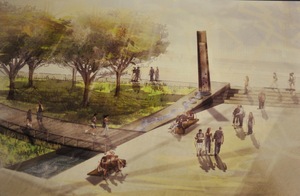
An artist rendering of the proposed sculpture.
The cost to complete the design, fabrication and installation of the exterior artwork is $553,320, inclusive of all artistic, professional design and engineering fees, permits, fabrication and installation costs and reimbursable expenses, city officials said.
In June, QEA — with assistance from CDF and the artist — prepared and publicly issued a request for statements of qualifications to potential fabricators/installers. Two companies were considered, and the Future Fence/Future Fab Co. of Warren was selected.
The project will be delivered as it was presented to the city in June 2009, with the exception that the exposed metal will be bronze in lieu of weathering steel, city officials said.
While community concerns were expressed about hiring an artist from Germany, city officials said Future Fence has committed to including Michigan organizations on its fabrication team, including Leprecon Inc. (lighting and water technology) of Hamburg, the Center for Creative Studies (glass globes) of Detroit and the Fine Arts Sculpture Center (bronze) of Clarkston.
The installation is expected to be completed in the spring.
Ryan J. Stanton covers government and politics for AnnArbor.com. Reach him at ryanstanton@annarbor.com or 734-623-2529.
Comments
CincoDeMayo
Sun, Nov 28, 2010 : 9:47 a.m.
Thanks for the info John. Where can I see the other Kamrowski pieces?
John Tucker
Thu, Nov 25, 2010 : 9:07 a.m.
In front of City Hall there was a series of mosaic panels by Gerome Kamrowski, internationally renowned Surrealist and Abstract Expressionist. He lived and worked in Ann Arbor from 1946 until his death in 2004. I understand that these panels were put in storage during the remodeling of City Hall. There are many Kamrowski pieces throughout the University and there is another Kamrowski installation planned for the new Mott Hospital. Before purchasing new works for Ann Arbor it would make sense to get these panels and any other stored works back on public display.
CincoDeMayo
Fri, Nov 19, 2010 : 12:42 a.m.
I'll put a vote in for Zeke Mallory. Also, what about the tile mural that was already on the outside wall of city hall - one of the few pieces of public art that Ann Arbor had, and one I enjoyed greatly - will it still be visible? Duane, Duane, Duane, the Colonade has so grown on me. And, I mean that literally. So much food, so little time....
pegret
Wed, Nov 17, 2010 : 1:43 p.m.
Since the continually rising cost of this "landmark project" is making it even more unpopular amoung residents/taxpayers than it was originally, I have a suggestion. Let's get local (wow) artist/muralist, Zeke Mallory (whose lovely Tios mural was torn down by the city at considerable expense to make way for 8 parking spaces) to paint something beautiful on the ugly monolith. I'll bet he wouldn't charge anything close to what Dreiseitl does, and who knows, maybe then people will flock downtown to see the area's first "Murinal"!
OverTaxed
Wed, Nov 17, 2010 : 1:35 p.m.
I agree with Mr. Clarkson. This city has done nothing but raise my taxes and reduce my services. It is the typical Democrat agenda. For the Middle Class they say, I say rubbish. Spending 1/2 Mil+ on one piece of so-called art in front of their elitist monument to themselves is criminal. Bernie Madoff went to jail for such scams, here they run the government. They think we adore what they do when really we mock them. The entire A2 government is made up of people who should be sitting at home watching Oprah. If this city was not being overtaken by blood sucking U of M, they wouldn't even be there. A real community wouldn't stand for such lousy leadership and wasteful (like Bush) spending. You are just Bush session Republicans with an Obama mask!
Killroy
Wed, Nov 17, 2010 : 1:19 p.m.
Every great society has supported the Arts in one way or another since the beginning of time. It is what identifies us collectively as civilized. The very idea of the Arts, is to celebrate our accomplishments with laurels. This project, I believe, had good intentions, but as Mr. Duane Collicot has pointed out is incredibly ugly. However, it seems very appropriate that it resemble a phallus given that it costs 500k and comes from the EU.
bedrog
Wed, Nov 17, 2010 : 12:47 p.m.
Many civilizations have monumental public art combined with economically strapped populations: the assyrians,the aztecs, the maya, n.korea, baathist baghdad,soviet russia..... oh, right! But seriously, so did florence, imperial rome etc and we're all the better for it...although this particular project does not seem 'medici worthy' from the sketches,and michelangelo, giambologna and cellini are probably safe in their reputations.
Jim Clarkson
Wed, Nov 17, 2010 : 11:29 a.m.
How about instead of a 1% art fund we have a 1% city services fund so the city can pick up my leaves and actually plow the streets when it snows.
deb
Wed, Nov 17, 2010 : 10:41 a.m.
other things draw people to downtown areas in other cities, like hookers and drugs, and just like the water fountain they are a waste of money. I am glad we are building this with Michigan labor. I also understand why the city council wanted to use a well known artist. I would guess their thinking is in the long run, people may think that the guy who designed this may become well known and world renown. However, they could have taken a chance on a michigan born talent, or for that matter anyone with ties to the area, or even the country
arborani
Wed, Nov 17, 2010 : 9:46 a.m.
Looks to me like a highlighter upended on a TV remote. Must try this for my coffee table.
Arboriginal
Wed, Nov 17, 2010 : 8:09 a.m.
C'mon folks! Think about all of the videos and pics of people whizzin' in the fountain! It will be a rite of passage. When the first one goes viral we will understand the concept! Is there a Facebook page yet? "I'm a fan of Pissing in the Fountain"
Cash
Wed, Nov 17, 2010 : 5:35 a.m.
The saddest part of this is the "Let them eat cake" attitude of the Ann Arbor City Council, representing the citizens of Ann Arbor. While our own local artists suffer in this economy, I mean really suffer....there own tax money is given to an artist from out of the US. As some local artists I know live on social security and struggle to pay their taxes....this is a disgrace for any city claiming to be "caring". You...city council...have slapped the face of every local artist in the area.
Cash
Wed, Nov 17, 2010 : 5:28 a.m.
Ypsilanti is planning a lawsuit. Seems A2 is trying to steal the fame generated by the Ypsilanti Water Tower.
Kevin S. Devine
Tue, Nov 16, 2010 : 11:35 p.m.
Thank you Councilor Kunselman for expressing your concerns about maintenance and repairs for the project. Don't let up! Not being well-versed in the language and aesthetics of visual art, I'm afraid I lack the vocabulary to properly express my distaste for this particular piece, however, as a taxpayer the terms "hornswoggled" and "boondoggle" come to mind when I think of paying for maintenance and repairs on this over time. I viewed photos of some of Mr. Dreiseitl's other water sculptures and found them interesting and perhaps provocative. What is proposed for Ann Arbor, to me, is neither. We can do better.
Duane Collicott
Tue, Nov 16, 2010 : 11:12 p.m.
I agree with the comments about the ugliness of the new building. Even my kids know it. This new building takes the ugly award from the Colonnade shopping center, which is not an easy thing to do.
MorKor
Tue, Nov 16, 2010 : 10:52 p.m.
There should be a stipulation to use American artists, not German. Keep it local. What are the qualifications of the judges of the "art?" Couldn't they have found something more interesting than this sterile grouping of rectangles?
lester88
Tue, Nov 16, 2010 : 10:28 p.m.
"Mayor John Hieftje said an insignificant amount of the money is coming out of the general fund, so it's a faulty premise to say the program has played a part in general fund budget cuts." Really? All these "insignificant amounts" add up to a significant amount Mr Mayor. Let's see, if I give away 10 dimes (insignificant amounts) from the general fund, is that any different than giving away the whole dollar at once? I guess this is the type of faulty premise he is referring to. Council members who voted against going forward with construction were Sabra Briere, Stephen Kunselman, and Marcia Higgins. Good for the three of you. Earth to the others: This is the way you lose the ability to pay argument. This has to be frustrating for the Administrator and a setback in convincing employees that wage concessions are needed.
calmic
Tue, Nov 16, 2010 : 10:18 p.m.
Thank you, Councilman Kunselman,for pointing out the missing information about maintenance costs for this 'art'. Don't forget the operating costs as well -- the energy to run the pumps and the LED lights.
Roadman
Tue, Nov 16, 2010 : 9:13 p.m.
I think opposition to this water art expenditure is one of the few things that Alan Goldsmith and Marcia Higgins have agreed upon. Ironically, the District Court entrance will be behind the artwork so all the people being evicted from their homes will get an opportunity to see how their tax dollars had being wasted. What is humorous is that the One Per Cent for Art ordinance requires that the theme of the art project proposed has to relate to the subject of the capital expenditure that produced the funding. In this case that was the $55 million dollar sewer upgrade and refurbishing that was deemed necessary by the powers that be. That is why the Art Commission had to find an artist that specialized in water art. In this case the motif of the artwork was, specifically, waste water. Absolute absurdity!
Stephen Landes
Tue, Nov 16, 2010 : 8:44 p.m.
PS: if you want public art that will bring people downtown take a look at what Grand Rapids is doing with their annual art show competition. We could actually take money from our art fund and use it to buy, you know, ART from artists that come for Art Fair. Could be the ultimate prize.
Stephen Landes
Tue, Nov 16, 2010 : 8:26 p.m.
I like public art: Well designed, attractive buildings are a great start. I like the comment about our new tin shed city hall. That is a generous description of the mess being built on Huron Street. The building is ugly -- no fig leaf fountain is going to hide the blemish we've allowed to be constructed in our city. As for drawing people downtown, well, Ms. Teale just has no idea what attracts people downtown. I worked for many years in the Rouge complex in Dearborn. Well before my time in the days when entertainment wasn't so easy to come by people would drive to Miller Road on Friday nights to watch coke being pushed red hot from the coke ovens into rail cars and then quenched -- lots of flames, sparks, smoke, and geysers of steam. Great cheap entertainment. I somehow cannot see this lame fountain having any noticeable affect on the entertainment preferences of Ann Arborites or our visitors. Now, if we build a comedy castle right next to the fountain we might have a real winning attraction. Or maybe Homer Simpson will pipe it up to the Duff Brewery............
GoblueBeatOSU
Tue, Nov 16, 2010 : 8:22 p.m.
hard to believe that "we" as a majority voted these people into office. The fault rest with us. Complete waste of money. The comments hear are clear. The people don't want this. But Hieftje and company will spend our money anyway and then cry that their isn't enough money to cover their benefits. For me, what is most sad, is that their are so many talented artists in and around AA. Yet this council doesn't believe any artist in the area is deserving of "our" tax dollars. If Council cared just a little they would amend their rules so that the 1% would have to go to local artists. Clearly Council doesn't care about anyone but themselves.
st.julian
Tue, Nov 16, 2010 : 8:17 p.m.
This is one of the dumbest expenditures, I've witnessed in a long time. This proposed monstrosity lends nothing to hide the blatant meatal building engineering look of the new building, lacking any architectural interest or meaning. Second, the award to an out of state,let alone out of county artist, is assinine ocnsidering the amount of artistic apital that resides in Michigan. But then again, why does the council have to make sense. For Democrats they sure know how to outsource work that could be done here whetheer it be art or composting. You need not worry about losing sleep with a bad conscious, there is an absence of one.
ArgoC
Tue, Nov 16, 2010 : 7:56 p.m.
A boring piece of public art, and certainly overpriced.
81wolverine
Tue, Nov 16, 2010 : 7:46 p.m.
I think in these tough economic times, it's a very bad use of money to spend this much on a fountain. It's bad enough to be building a huge new police/city building right now. Where is the common sense within the City Council? I say do away with the 1% program.
A2JetGuy
Tue, Nov 16, 2010 : 7:23 p.m.
Perhaps the Arizona legislature will adopt a resolution opposing Ann Arbor City Council's controversial new art proposal. It's payback time for Arizonans! http://www.annarbor.com/news/ann-arbor-city-council-adopts-resolution-opposing-arizonas-controversial-new-immigration-law/
Tim Darton
Tue, Nov 16, 2010 : 7:21 p.m.
Something like 66% of the $$ for this project are going to local fabricators, plumbers, electricians, etc. Haven't heard anyone complaining about all the "foreign" art in the UM Art museum or at the DIA. How about when the Vienna Philharmonic comes to town and leaves with a bag full of UM cash? Art has borders? As for this program, as someone said above, it is no different than what exists in other states and many progressive cities. Art brings a ton of money to Ann Arbor every year, it is part of the city's reputation. This is appropriate and good for business in our community.
CincoDeMayo
Tue, Nov 16, 2010 : 6:45 p.m.
This artist's rendering is very confusing. The sculpture looks like it is placed in a sculpture GARDEN, not at City Hall. I love public art and I love being in cities that have a lot of public art. I've also always wanted more public art in Ann Arbor. However, I agree completely with Macabre Sunset: "There's "Art", which is approved by people in ivory towers, and makes millionaires out of the lucky few who have the right political connections....And then there's art, which comes from endless hours of work from creative people who don't necessarily have any political connection to people in ivory towers." I prefer art. And, I prefer to help our local artists' economy.
Dog Guy
Tue, Nov 16, 2010 : 6:40 p.m.
If I'm "drawn to downtown" by anything it will be by my out-of-town guests wanting to see the new corrugated tin shed city hall.
townie54
Tue, Nov 16, 2010 : 6:37 p.m.
I can almost guarantee that no one will come to town for the sole purpose of seeing art on the city hall
Mick52
Tue, Nov 16, 2010 : 5:55 p.m.
Won't draw me downtown. No matter how artsy this goofball idea is, the high cost of parking trumps it. Great to hear the public art program might be illegal too. Thanks to Mr. Kunselman, Ms. Briere and Ms. Higgins for opposing this. Ann Arbor is a city for rich people. Here is a great example. I read before this thing cost about one million dollars, is this the final payment? Pony up a million dollars for a "renowned" artist rather than spread it around to local artists. Classic A2.
Brad
Tue, Nov 16, 2010 : 5:39 p.m.
Just the latest installment of "Ann Arbor As A Product". We have to show everyone how incredibly cultured we are, and the cost is immaterial. How else will all the children continue to be above average?
Huron74
Tue, Nov 16, 2010 : 5:18 p.m.
We should put Mayor Hieftje's name on this art. For the benefit of future generations.
bunnyabbot
Tue, Nov 16, 2010 : 5:05 p.m.
will there be tadpoles in the water too?
Macabre Sunset
Tue, Nov 16, 2010 : 4:58 p.m.
It does seem the Council members have fallen in love with the concept, but prefer pretense over substance. There's "Art", which is approved by people in ivory towers, and makes millionaires out of the lucky few who have the right political connections. This is expensive, and requires little to no effort from the artist - his reputation is what you're paying to produce. And then there's art, which comes from endless hours of work from creative people who don't necessarily have any political connection to people in ivory towers. This is just an expensive and modern version of the parable, The Emperor's New Clothes. Only instead of a naked emperor wandering the streets, we'll have a giant urinal on the outside of a public building. The joke's on us.
ViSHa
Tue, Nov 16, 2010 : 4:48 p.m.
on the plus side, 3 people voted against it.....baby steps, people, baby steps.....
Urban Sombrero
Tue, Nov 16, 2010 : 4:44 p.m.
That thing reminds me of the giant monolith in 2001:A Space Odyssey. Or, rather, it's pretty darned ugly. (At least the artists drawing is.)
SillyTree
Tue, Nov 16, 2010 : 4:33 p.m.
I like the idea that we should have art downtown. I am a bit surprised at the comments here. I know that liberals seem to get a bad name, but they are an economic force. I mean there are plenty of them. If they love art and they love to hug trees, what better way is there for the Rick Snyder's et al to get their hands on a few of those liberal dollars than to bait these liberals with trees and art? Kubrick may or may not be responsible for the monolith in 2001: A Space Odyssey. Arthur C. Clarke wrote the screenplay and the stories from which it came. In his earlier stories the monolith was tetrahedral rather than the rectangular prism that appeared on film. The sculpture depicted here does not appear to be either. I'm not sure I like it. I have to admit that the artist rendering does not include the surrounding features such as the new building. It is confusing as to how it will look when finished. Are there other drawings that add these features? Oh! Wait! There is a tree crying outside and I have to go hug it.
Marvin Face
Tue, Nov 16, 2010 : 4:14 p.m.
Percent for Art is a good idea. Most States and many cities have similar programs. New Haven and Spokane, among others, have had theirs in place since the early 1980's. My only complaint is that the Percent for Art should be used to showcase the local and regional artistic talent rather than providing an already well-known, and clearly disinterested entity (Dreiseitl) with another opportunity.
AACity12
Tue, Nov 16, 2010 : 4:12 p.m.
Ok so they aren't using general fund money for the sculpture. But the 1% they used for the water fountain could have been used to buy things that instead had to be bought with general fund money. Like furniture and security systems. It's all a shell game and Heiftje is playing you all.
Brian Bundesen
Tue, Nov 16, 2010 : 4:06 p.m.
This really does appear as another example of priorities that are way out of whack. It is very sad that this has such a high priority in today's economic climate. In reviewing the cities needs, this should be quite low on the list.
bunnyabbot
Tue, Nov 16, 2010 : 4:05 p.m.
what a waste of money, that could feed a lot of people :( I for one will probably spit a wad of gum in it if I happen to walk by it someday.
B. Jean
Tue, Nov 16, 2010 : 3:44 p.m.
Hmmm.... more police and firemen or basic need services, OR how about an over half a million dollar "art fountain"? Yep, saving lives, helping the needy, or a fountain, it's a puzzler alright. Another stellar example of great leadership and impressive decision making by city council.
amazonwarrior
Tue, Nov 16, 2010 : 3:43 p.m.
"Mayor John Hieftje said an insignificant amount of the money is coming out of the general fund, so it's a faulty premise to say the program has played a part in general fund budget cuts." Just how "insignificant" is the amount of money coming out of the general fund? No one knows how much it's going to cost to maintain, that doesn't sound encouraging. Looks like more waste and abuse of taxpayer money the city shouldn't be throwing around, as if there are buckets of it laying around. Ugly piece of "artwork"; it looks more like a memorial to the dead.
yourdad
Tue, Nov 16, 2010 : 3:40 p.m.
Why does this look so Phallic?? I bet the local artist talent pool could/would have come up with something more appropriate and far less costly that all you artsy fartsy liberal tree hugging hippies could really take pride in.
Duane Collicott
Tue, Nov 16, 2010 : 3:30 p.m.
"Many public works of art require fabrication and professorial installation services, it not a paint by numbers painting being thumbtacked to the wall." It's also not the Statue of Liberty or the Eiffel Tower. It's a simple rectangular prism laid on top of a sloped base with a few water pumps. When I build a commissioned piece out of LEGO, I don't charge money to draw it up and then expect others to build it for me. According to this, it doesn't look like maintenance is included: "Kunselman said he's still worried about the maintenance and repair costs the city will have to take on once the water-based installation is up and running. A representative from QEA said there have been no projections on what those costs might be." But it's OK. In a few years when it's falling apart, we'll just ask John Dingell for some bailout money to it. I once read, "It's not art if a monkey could do it." This isn't far from it.
jameslucas
Tue, Nov 16, 2010 : 3:30 p.m.
Whats the over under on when a spray painting artist tags it with relevant street art, at no cost to the city?
Tee
Tue, Nov 16, 2010 : 3:19 p.m.
I'm fairly certain the draw to the "landmark project" will not produce the feel good sentiment Ms.Teall is claiming it will when residents stroll past a $500,000 water feature made by a non-local artist on their way to pay their property tax bill.
Marshall Applewhite
Tue, Nov 16, 2010 : 3:12 p.m.
I can understand wanting to add little touches to make the city unique, but this is absurd. The artist rendering makes it seem like this will be placed on a picturesque lakeshore. At least give the public a realistic view of the project. I'm not usually a naysayer, but there is no way this ends well.
Killroy
Tue, Nov 16, 2010 : 3:12 p.m.
Now at least the homeless will be able to take a bath 24/7 in A2. Always a silver lining to all this whining about money.
Randy
Tue, Nov 16, 2010 : 3:02 p.m.
Many public works of art require fabrication and professorial installation services, it not a paint by numbers painting being thumbtacked to the wall. IDK but it probably also covers the cost of future maintenance too. Art that enriches the local cultural experience is not wasted, it's and investment in our community.
Top Cat
Tue, Nov 16, 2010 : 3 p.m.
Perhaps they will let the Cub Scouts use it for the Raingutter Regata. Or maybe it will become a public wishing well and so lucrative that it will pay for itself. It might work as a water slide in the summer once the bars close. It there is a local terrorist attack, it might be useable for public waterboarding. They possibilities are endless.
treetowncartel
Tue, Nov 16, 2010 : 2:59 p.m.
I think following the ground breaking of the public urinal the City council should pass a referendrum decriminalizing urniating in public, or at least pass a 60 day moratorium regarding same.
RDanzer
Tue, Nov 16, 2010 : 2:37 p.m.
"This is a landmark project, and it's one that will hopefully draw people downtown." Hey honey, pack up the kids and let's go downtown to look at the new cop shop......Right, that scene will play out over and over again. Why do we keep voting for these clowns?
Speechless
Tue, Nov 16, 2010 : 2:35 p.m.
Maybe I would have been willing to do a flip-flop and come out in support of this expensive installation if its high cost had also underwritten a whitewater amenity. Without that, it doesn't really seem like true public 'art.' Plus, why does the surreal rendering up above make it seem like a Kubrick-ian 2011 monolith is resting high on a cliff edge at Pictured Rocks National Lakeshore? Does the Planning office have something untoward in the works for Huron Ave. at Fifth?
Ace Ventura
Tue, Nov 16, 2010 : 2:21 p.m.
What a waste of taxpayer dollars.
Duane Collicott
Tue, Nov 16, 2010 : 2:15 p.m.
"The council agreed in an 8-3 vote to spend $553,320 from the city's public art fund under a contract with Quinn Evans Architects to complete the fabrication and installation of the Herbert Dreiseitl water-based sculpture" For that kind of money the artist isn't fabricating the art himself? What did we pay him for?