

Gov. Jennifer Granholm: Without big change, massive higher education cuts on horizon
At a student rally meant to build momentum for the recently slashed Michigan Promise scholarship program, Gov. Jennifer Granholm touched on a less-discussed issue - the state's decades-long divestment in higher education.
Years ago, the state gave a bigger slice of funding to its public universities. Today, Michigan ranks near the bottom of all states in terms of how much it offers up to those schools, Granholm said. She linked the decline to the state's once-robust, but now dwindling, manufacturing tax base.
Consider:
• In 1960 at the University of Michigan, the state appropriation made up 77 percent of the general fund budget, which pays for teaching and academic programming.
• Today, it comprises 22 percent of that budget, according to the U-M Office of Budget and Planning.
• Tuition weight has flip-flopped accordingly. Tuition made up only 21 percent of the general fund budget in 1960.
• Now, students are footing more of the bill, paying 65 percent of the general fund budget.
Granholm said without a massive tax re-structuring, things will only get worse. But she offered up few details.
"Long term, the way we have funded higher education and K-12 is based on an antiquated tax structure," she said. "The tax structure we have is based upon a 20th century economy and not a 21st century economy.
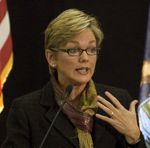
Gov. Jennifer Granholm appeared at EMU earlier this week.
Tom Perkins | For AnnArbor.com
"I'm asking the Legislature to come back to Lansing and work with me on a grand bargain that would restructure taxes in a way that allows us to invest in the priorities of education, both K-12 and higher education," she said.
Stimulus dollars will be going away next year, which doesn't bode well for schools' 2011 fiscal year.
"If we allow that cliff to occur, we will see massive cuts to higher education and K-12," she said. "It just cannot continue to happen that way if we want a growing economy."
University leaders say less money from the state leads to tuition hikes. At Eastern Michigan University, President Susan Martin kept the tuition hike the lowest of the state's 15 public universities by looking for savings elsewhere, she said.Â
For instance, by paying for natural gas a year in advance, EMU saved $1 million. But fiscal year 2011 isn't so far away, and she says the school is "very concerned."
"The governor mentioned states that have a higher number of college graduates are doing much better," Martin said. "We need to restore funds to all of our education programs - K-12, community college and higher education - because higher education is a great asset of the state."
So, what's a state to do? Who should foot the bill for higher education? Tell us what you think in the comments section below.
Comments
Mr Rice
Mon, Nov 30, 2009 : 3:45 p.m.
I believe Governor Granholm is correct in looking at state appropriations given to our state universities. Here is a good example why. With Michigans public schools facing an economic crisis because of state funding issues, there are sure to be cuts that will be painful to our communities. Our tax dollars need to be carefully targeted but that message is not connecting with Central Michigan University. The Universitys Board of Trustees decided to approve the acquisition of WFUM-TV located in Flint, Michigan, for $1 million of CMUs reserve funds. My understanding is that University reserve funds are made up of appropriated state dollars, leftover tuition and university earnings. The purchase of this station represents poor judgment at a time when Michigan is fighting for its future. I believe this for the following: 1. The Flint area is currently served by 4 public television stations, WDCQ, WFUM, WKAR and WTVS. According to the FCC and Consumer Electronics Association, approximately 85% of television viewers in the Flint area get their television by cable and satellite providers such as Comcast, Charter, Direct TV, Echostar, and AT&T. Comcast, the largest of these providers, carries three PBS stations: WDCQ, WKAR, and WFUM. The remaining 15% of the population watches with home antennas, and can receive PBS programming from the stations mentioned. As the University of Michigan has learned, there is no community need for a redundant PBS station in Flint. 2. The initial cost for CMUs new station is high enough, but there are significant ongoing costs involved with broadcast transmission. Is this use of taxpayer money a wise investment? Consider that CMU has increased tuition by 21% in 2007, 6.6% in 2008, and 4.63 for 2009. Perhaps with better fiscal control of tuition costs, this university might have seen a Freshman enrollment increase this year, as it did for most of the higher education schools in our region. 3. CMU has stated that one of their purposes for acquiring WFUM is to market CMU in Oakland County, where the University can get access to some of the dollars in Oakland County. Operating a television station is an expensive way to market a University when more traditional marketing tools such as advertising can be used with greater effectiveness and less money. How does running a redundant public television station in Flint meet the mission of Central Michigan University? It doesnt. Nor is it the mission of Public Broadcasting to act as an advertising outlet for CMU. Keep in mind that the FCC licenses for Public Broadcasting are non-commercial FCC licenses.
Ralph
Sun, Nov 29, 2009 : 3:49 p.m.
We can raise tuition 30-40%. That ought to do it. If you want nice stuff, you've got to pay for it. So many of you seem to have committed suicide without pulling the trigger.
Basic Bob
Sat, Nov 28, 2009 : 5:44 p.m.
The Republican approach would be to incarcerate them. That's been working really well. $2 BILLION spent each year for prisons.
The Picker
Sat, Nov 28, 2009 : 2:40 p.m.
Is it my imagination or are most of the large caseload states, blue states? Go figure!
Macabre Sunset
Sat, Nov 28, 2009 : 1:34 a.m.
I checked some data based on total caseloads rather than new cases. Illinois is an outlier, not by as much as the new caseloads indicate. According to the Federal ACF, 2.01% of Michigan is on welfare while 1.69% of America is on welfare. Michigan has among the highest percentages, mainly because it has less limitations than any other state. We get what we pay for.
Been There
Fri, Nov 27, 2009 : 11:18 p.m.
@clara, @macabre sunset -- The welfare caseload chart shows that Michigan is typical in its welfare caseload. I spot checked several other states, and in most of them, including Michigan, the case load is a little over 0.7% of the population. Illinois is the outlier, not Michigan.
Basic Bob
Fri, Nov 27, 2009 : 9:08 p.m.
I don't believe anything a politician calls a 'Promise'. I saved the state $4000 by sending my daughter out of state. And there's no reason for her to come back here. There are no jobs.
FreedomLover
Fri, Nov 27, 2009 : 5:44 p.m.
Our education system is also based on a 20th century economy. Jenny never talks about restructuring it into a 21st century education system. The state Democrats really want a graduated income tax so they can tax the wealthy into leaving the state. The Democrats answer to success is to tax the successful until they are as poor as those who have no interest in success. I would rather encourage the unsuccessful to raise there standard of living by being more successful. Welfare doesn't encourage success. Its just a bandaid on a problem that will not get better.
clara
Fri, Nov 27, 2009 : 2:52 p.m.
Interesting link. @Macabre Sunset Michigan does not have twice the welfare cases as Illinois but almost three times (73,512 to 27,911)!
Macabre Sunset
Fri, Nov 27, 2009 : 1:41 p.m.
As long as Jenny protects Michigan's best-in-the-nation welfare program and best-in-the-nation union benefits program, we won't be able to afford anything else. You get what you invest in. Michigan has more than twice the welfare caseload as Illinois, which has a much larger population. That's because benefits are so generous here. And raising taxes to "21st Century" levels will not necessarily increase revenue. It will just cause independent companies to hire less and independent people with a lot of money to move out of state. Jenny's leadership is a major reason we will remain in a one-state recession long after the rest of the country recovers.
MikeMartin
Fri, Nov 27, 2009 : 1:35 p.m.
Jennifer Granholm is a complete failure as a governor. As noted here her only solution is to run around screaming that we are in trouble and push more and more and more taxes. She just doesn't get it, more corporate taxes drive businesses from Michigan. More personal taxes drive people to move to places where the employment outlook is better, taxes are lower, and the weather is nicer. It's pretty simple. But, as people run for the doors she figures raising taxes on those who are left is a good solution. For those voters who consider republicans the enemy and only vote democrat- thank god we have some republicans in the state house to balance this wacko, tax crazed governor who has lost touch with reality. If her party controlled the state house, they'd just raise taxes and wait on her signature. We are state in desperate need of spending realignment with the understanding that we have almost killed off the auto companies- the goose that laid the golden egg. Lay off the taxes lady! And implement some real cutting or lay off some of the state employees while you are at it. That's what I have to do in my life.
Basic Bob
Fri, Nov 27, 2009 : 11:34 a.m.
This state won't have a higher number of college graduates unless there are also jobs for them. One employer I worked for did not want to hire an engineer with a college degree because it just meant he would have to pay more in salary. Instead he got a high-school educated worker with experience but little knowledge. Michigan lost one more college graduate to an out of state job.
Cal
Fri, Nov 27, 2009 : 11:02 a.m.
I basically agree with Larry. There are a number of things that can and should be cut, at the state and local levels. At the local level, for example, police pay could be cut 25 percent if they are making $60,000 or more. There are many people who would like to become a police officer and make $45,000 a year. At U. of M. tuition has been going up around 10 percent a year for the last 30 years. Many professors, including LS&A, are probably now making six figures. It isn't justified. Cut their pay--a lot. Cut the president's pay by about 3/4; if she doesn't like it have her go elsewhere. Someone should be hired who knows something about a budget, anyways. Professors should have their pay slashed. If they don't like it have them get a job elsewhere. There are plenty of smart, talented people around Ann Arbor who would love to make between $50-75K a year teaching intelligent students and doing research. Also, at one community college I know of, faculty start out making $49k a year, and a PhD isn't even required. It's just too high. Their pay should be cut 25 percent. If they don't like it they can always try and find something better elsewhere. There are plenty of qualified people available to take their places. In one community I know of they are talking about cutting student aid by $300/student. I'm no expert on this, but that sounds to me like $30k for each 100 students, or approximately one teacher laid off. That's a sacrifice, sure, but not the sky falling. At the state level they are talking about halting any increase in the personal exemption so the education establishment doesn't have to sacrifice, and getting rid of the state's new EIC; and some Democrats are already talking about "reforming" Prop. A. That shows that they don't get it. Maybe there should be a graduated income tax, but it should go for relief, not to keep the status quo for these interests. Yes, everyone should have to sacrifice.
Technojunkie
Fri, Nov 27, 2009 : 10:18 a.m.
Universities could raise admissions standards back to realistic levels instead of lowering them until they fill all available admissions slots. This isn't a problem for the UofM but it's a huge problem down the line. Even greatly increased foreign student attendance hasn't been enough to fill in for the lack of qualified Michigan students. Several hundred thousand Michigan residents fleeing Granholm's "leadership" is enough to shrink the qualified applicant pool quite a bit, before considering that most of those refugees were probably among our best and brightest. Pass the Michigan Fair Tax mifairtax dot org so we'll have more small business startups for our graduates to work in!
larry
Fri, Nov 27, 2009 : 10:16 a.m.
"Granholm said without a massive tax re-structuring, things will only get worse. But she offered up few details." Why is it always TAX restructuring? Isn't there any other type in her arsenal? Here are some suggestions: 1. Reduce pension contributions. 2. Reduce or eliminate 401k matching funds. 3. Reduce pay. 4. Cut or reduce non-core programs & facilities. 5. Reduce health benefits. There are probably many more.... We cannot continue to support a State system that pays lucrative pension and health benefits to it's retirees for many years, and some of who retire in their 50's and "double-dip" back into the system. Increasing taxes on the rest of us is not the solution. It will only serve to drive productive businesses out of the state and further reduce the tax base.
stunhsif
Fri, Nov 27, 2009 : 9:57 a.m.
" the tax structure we have is based uponon a 20th century economy and not a 21st century economy'. So Jenny, your way to "restore funds to higher education" is to what, raise taxes on Michigan residents? You folks in government just don't get it! It is obvious that Jenny has not been reading the comments here at A2.com. We the people have no money to pay higher taxes and neither do the corporations. Raising taxes will only drive more companies to resource jobs to the south or Mexico. It is time that we demand change to the pay and benefits that all state employees receive. That is the single best and fastest way to reduce costs. If the state employees don't like it they can get a job somewhere else. Everyone else has taken pay cuts and pay more for health care and benefits. Shared pain for all folks, not just those in the private sector. Again, the kids should be insulated if at all possible. Don't cut sports, don't cut music programs. Cut the benefits and pay to the unions!!
DonBee
Fri, Nov 27, 2009 : 9:52 a.m.
I wish the Governor would put some real proposals on the table, rather than just running around telling us the sky is falling. We all know that. What does she propose? Why these changes to taxes? What further consolidation of services does the state propose? How do we make the roughly 200,000 people who work for local schools, local, county and state government, etc more efficient and effective? No matter what happens it is going to be painful, we might as well learn what the pain is going to be.
M
Fri, Nov 27, 2009 : 9 a.m.
Perhaps the three-year degree concept should be employed to save money and attract students. The European standard is to complete a bachelors degree in 3 years. In fact, a three year high school should be considered as well. I'm sure there are significant obstacles, such as getting faculty to go along with the concept. However, the inability or refusal to see beyond the current models of thinking will surely exacerbate the problem.