

Campaign to discourage downtown Ann Arbor visitors from giving money to panhandlers to kick off in June
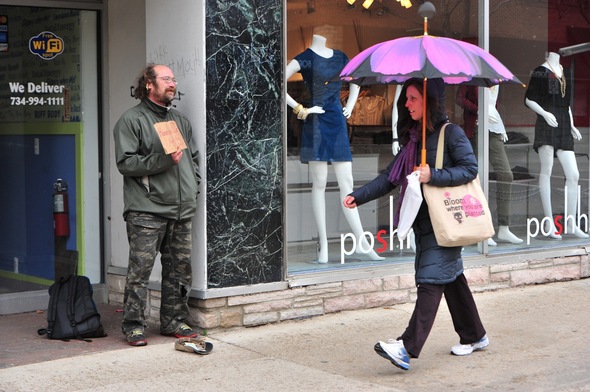
Gwyddion Storm, who is homeless and suffers from mental illness, solicits money from passersby on Liberty Street. A native of Columbus, Ohio, he says he has hitchhiked all over the country but has been panhandling on the streets of downtown Ann Arbor since last summer.
Ryan J. Stanton | AnnArbor.com
As general manager of the Espresso Royale coffee shop on South State Street, Peter Ludt has a keen perspective on downtown Ann Arbor and its panhandling culture.
There's no doubt that downtown has a panhandling problem, Ludt says, and many people seem to think it's slowly getting worse.
Ludt addressed the Ann Arbor City Council Tuesday night, offering what he and others who recently served on the Mayor's Street Outreach Task Force hope are solutions.
The task force is recommending the launch of an awareness campaign called "Have a Heart, Give Smart," an effort to address what it found are often the root causes of panhandling and homelessness: substance abuse and mental illness.
Expected to launch in mid-June, the campaign will encourage people to stop giving money to individuals on the street, potentially feeding drug and alcohol addictions, and to instead make donations to local human service agencies that provide help for those in need.
"We established from Day 1 that the act of panhandling is legal and supported under the First Amendment of the Constitution, and we are by no means looking to rid this city of it," stressed Ludt, also a board member of the State Street Area Association.
"What we were trying to accomplish is an attempt to better meet the needs of those who actually panhandle and the community members who feel uncomfortable and unsafe walking our streets," he said. "We as a city need to provide a safe and supportive atmosphere, not only to the residents and the visitors, but to the panhandlers who call Ann Arbor home."
The City Council voted unanimously Tuesday night on changes to the city's solicitation ordinance to prohibit panhandling in more areas of the city, including in front of the downtown library and within 12 feet of a public alley. The changes were sponsored by Council Member Sabra Briere, D-1st Ward, who chaired the Street Outreach Task Force.
Briere said everyone in Ann Arbor knows the value of giving, and the goal is to increase that, which she acknowledged may not be easy.
The task force is requesting the city's Downtown Marketing Task Force undertake an expanded role that includes working with residents, merchants, service providers and the city to provide a safe and clean downtown. It believes the outreach campaign planned and ready to implement complements the Downtown Marketing Task Force’s mission.

A panhandler named J.J. juggles balls on Liberty Street in September. He and some friends had been squatting in an abandoned house where they invested a small sum of money to make minor repairs. "On a good day, I can make $40 to $50 out here," he said. "Some days, I just get mean looks." His sign reads, "Home Sweet Homeless: I'm ugly, I smell bad, but doggonit people like me."
Ryan J. Stanton | AnnArbor.com
Ludt said he personally wasn't aware of the many safety net services provided by organizations like Dawn Farm, the Delonis Center, Home of New Vision, and the Engagement Center until he became a part of the Street Outreach Task Force last fall.
"I'm sure there are others in this city that are also not aware of these services," he said. "That is the sole purpose of the 'Have a Heart, Give Smart' campaign, to provide an alternative to giving money on the street. Especially in these times of heavy budget cuts — not only from the state level, but from the county level and obviously the city level as well — these social services need our support to continue helping those in need."
The task force announced over a month ago it would be setting up a website called a2cares.org to serve as a portal to local nonprofit human service agencies. But it doesn't appear the site has launched yet.
The task force also plans to distribute small cards that provide information on free services available to those in need, including food, shelter and sobriety help. The cards will stress that panhandling is typically a symptom of a greater need. Other promotional materials, such as bumper stickers and posters, will be printed and distributed with financial support from the Downtown Development Authority and downtown merchant associations.
The Street Outreach Task Force also is recommending the police chief and city administrator refocus police attention in the downtown area, with targeted foot patrols during busy hours. But task force members acknowledge the city's financial limitations.
"With these budget cuts, we also understand we are not going to get our beat cops back, which is what so many people want," Ludt said.
After six months of work, the task force recently presented a 42-page report to the City Council on the subject of panhandling.
Ray Detter, another task force member and chairman of the Downtown Area Citizens Advisory Council, addressed the City Council Tuesday night on what the task force discovered through its research, which included interviews with panhandlers and service providers.
"Panhandlers generally are not homeless, we found," Detter told council members. "Almost universally, they are not homeless."
Detter said people who regularly spend time downtown became aware last summer that the panhandling situation in Ann Arbor was worsening. He said people have reported being accosted by aggressive panhandlers and being scared for their personal safety.
In addition to the changes made this week, the city's solicitation ordinance will continue to ban panhandling on public buses, inside or near parking structures, from a person in a vehicle, from customers in outdoor seating areas, within 12 feet of a bank or ATM, or within 12 feet of Nickels Arcade, the Galleria and the Pratt Building on Main Street.
The ordinance also will continue to prohibit aggressive panhandling, which is described as moving within 2 feet of a person solicited; following and continuing to solicit a person who walks away; knowingly making a false or misleading representation when soliciting; soliciting in a manner that is intimidating or threatening; or obstructing the free passage of traffic.
Ryan J. Stanton covers government and politics for AnnArbor.com. Reach him at ryanstanton@annarbor.com or 734-623-2529. You also can follow him on Twitter or subscribe to AnnArbor.com's e-mail newsletters.
Comments
Joseph Jay Sherwood
Mon, Aug 27, 2012 : 7:24 a.m.
In having turned my situation almost completely around even today I will seldom give a homeless person money... why would this having been there myself? I'm not cold hearted but I can read many signs when I see a derelict on the street... His eyes, his hands, watch for signs of a lie, teeth are a giveaway often, current hygeine, telltale signs of a user, the way he may speak to you tells if he's drunk or high or actually handicapped mentally... don't be too quick to judge a man you yourself can end up in those shoe's yourself no matter who you are. all in all I learned from that horrible lifestyle ( because thats what it is for most) is that Karma is real and it can hurt you like nothing other, and a little respect to your fellow man goes a long way... I can see myself going pretty far in life and I know for a fact my heart has always been in the right place, reading the truth about me now would you have given that young man in the picture up there juggling a dollar or just told me off like i was some scumbag loser who had no ambition in life? Wheres your life going thats so great?
Joseph Jay Sherwood
Mon, Aug 27, 2012 : 7:15 a.m.
But anyways back on track Even I will agree it was a big problem/completely unnacceptible and i'm being used as a poster boy for blame?! no no no, the town needs to make some arrests ( and news reports it has!) and give help to those that utilize it for self betterment... I knew it was bad when a handful of these loopy bums would aggressively badger me for money!!! like I can or will fund your bad habit I can barely get a bag of tobbaco to enjoy with my slice of pizza and narsty soft drink i like to have before I do a 3 mile walk to my "house" Which I had to completely sterilize a room just to have somewhere to sleep... black mold and old booze bottles full of mold and poisonous spiders throw in a little fire damage and the occasional break in from a junkie and you have quite a setting for many an interesting tale. I wanted to experience the world before I learn what I want to do in it and I sure did from all sides that year... from eating an expensive dinner with that seemingly mythical woman in a red dress completely randomly, to that feeling i get standing on top of a mountain overlooking all of pheeonix, to that feeling Of holding my best freind dead in my arms taken from me too soon by some irresponsible teenage driver ( he may have been just a dog, but to me was way more than that). All i ask is people take in the same consideration I did... you are no one to judge on stereotypes if thats how you think then you don't belong in ann arbor silly. Try to remember no matter how smelly, rotten, seemingly worthless, addicted, or just flat out evil a person is they are still a person and weather you help them by incarcerating them ( some NEED it) or by throwing them some change to a couple bucks... want a tip from an expert on this??? ask the bum in question to turn his pockets inside out before you give him anything, the contents say it all...he may in fact have more cash on hand than you, they can eat and (god forbid) find comfort in under a 10 budget for
Joseph Jay Sherwood
Mon, Aug 27, 2012 : 6:57 a.m.
I'm now back in my hometown in northern michigan where all my family is Last summer I was a nanny for a family of 4 people and every weekend I was a registered street performer ( licensed to panhandle MwaHaHaaa!!!) on the side, It's a part of me I'm addicted to being the center of attention sometimes and In my opinion it's good for me, i'm not hurting anyone. Me and my performance partner have went our seperate ways our last performance togather was in mackinac city crossings as a juggling duo (contact,toss,bounce,clubs, My human blockhead act)... It may be a leisure time activity to me and turned into a naughty habit at one point but I'm not some free loading drug addict and I'm offended to be portrayed as one. You try chewing and swallowing a glass lightbulb with a 6 inch nail in your sinus cavity for a 20$ bill from some overprivelaged loadmouth drunken fratboy and tell me to my face that I didn't earn my money. I'm obviously not even close to perfect but thanks to this town and it's at least temporary acceptance of me I feel like a more well rounded person... right now i'm stuck working some mcdonalds gig while in and out of the hospital due to my left testicle contorsioning and due in two months for another ultrasound and a biopsy on the testicular tumors... I got more help frrom strangers on the street in small change donations than I get from most things. I've currently taken in an abused mother of two and her children and she's been accepted into my family, we are engaged because it gives us hope that I can get thrrough all of this and live to be married and have a happy life where I can manage ( juggle) my responsibilitys and again rise above my peers on whatever i put my mind into.
Joseph Jay Sherwood
Mon, Aug 27, 2012 : 6:42 a.m.
(this will go on a while I have alot to say) I was in ann arbor last year for about 3 and a half months. During That time I became very well aquainted with virtually all of the Travelling and Local Homeless... Bra Man ( Crack Addict), Gwideon ( pot head, Legitimately mentally handicapped), Crutch (severe alcoholic, Possible sex offender), Hollywood ( licensed pot head), The "vets" ( con artists, crack addicts, alcoholics), The real vets ( alcoholism, mental handicaps), The Black Gentleman with the expensive watch/clothes who is literally posing himself off as mentally handicapped and insulting you to your face when he approaches you) ( he IS calling you MotherF****R!), then the youngsters an assortmant of heroin users, pot users, alcoholics, cocaine addicts, some generally just bored and lost in todays world, some on a fixed downward slope that will eventually result in a very sad story for them and all the lives that where somehow touched by them... regardless they all need help, I needed help and honestly I still do too, we all do and how people get it varys from person to person. But one thing is evident this can't go on... I foresaw the crime rate rising ( and it did) as soon as me and my preferred company left there where rapes! ( reported and unreported) there where attacks, there were overdoses! It seems things got way out of hand but by that time i unplucked my head from my butt and realized I can barely take care of myself I can't help these people. I moved on and looked back at a huge mess i felt for some reason partially responshible for...I love ann arbor and it isn't the kind of love as in Fun Fun Fun, no it's way more personal than that Its always gunna hold a special place in my heart. Hear was my best educational opportunity, first love, first experience at learning thet there is places on earth that can be diverse and multiculturally acceptable! Ann Arbor is where I even had my first kiss at 16 years old! I was a waldorf student for hecks s
Joseph Jay Sherwood
Mon, Aug 27, 2012 : 6:24 a.m.
Greetings I am the "panhandling" Juggler some of you Know as J.J. I'd like to personally let all of you know(waether you read this or not) that many of you are right and many of you are kind of unfortunately sheltered, maybe stupid, definantly ignorant. Firstly i'll state that I myself only once was even remotely regarded as aggressive mainly because There wwas a morning when the heroin addicts decided to seat next to me responding in all of us receiving tickets. I was never in truth aggressive. I made humor out of my situation and was Thankful and responsible with my "Personal cash Donations" In my entire stay in Ann arbor I had purchased 1 alcoholic drink for my own use and thats when I arrived frrom mt pleasant and was with money a freind had made gambling ( which I do not condone). I baught a cheap forty ounce bottle of Actual dark ale Beer ( not stinky malt liquer). I only asked people for ciggarettes if they where displaying their bad habit in front of me... (if you're going to puff poison gasses into the air the least you can do is just give me my own ciggarette I can manage on my own, Plus I may very well be saving your life). I treid to make my stay Entertaining, Relatively Wholesome and while I was on a block you won't find the toothless Crackhead Who I can assure you is up to absolutely no good... I maintained respect for everyone and their opinions weather or not they directly involved me and always kept in mind that yes I am a beggar and that means I can't be choosy... I thankfully accepted any food offerings and would 75% of the time buy food with my Earnings ( because face it I Earned the money in my Cup, Do you Honestly think I really wanna be out there every day 8-12 p.m. having to look many of your ugly judgmental mugs face to face trying to come up with new and somewhat clever ways to say " I'm in a bit of a bind and lost in life could you possibly stick a crowbar into that pocket and flip me a quarter because they add up
Joseph Jay Sherwood
Mon, Aug 27, 2012 : 6:08 a.m.
If this actually can post i'm stoked for a chance to explain myself!
djm12652
Fri, Apr 22, 2011 : 6:51 p.m.
@javajolt...exactly. There have been times when I have been able to tell when someone was truly hungry and offered to buy them something to eat...each time they said yes, I have been rewarded with the sight of a person gratefully devouring the food in front of them, without having to wonder if I was truly doing anything helpful or supplying that next rock of crack....on the other hand, the "pros" know who lives downtown [I do, a block from Main St. and Liberty] and who doesn't. If you are in town on a daily basis, the panhandlers won't even bother asking you...but offer to buy a pro food or give a pro some food and they will not so politely tell you where to go and what to do with yourself...or throw it down in front of you...done to me only a couple of times before I learned my lesson...or tell you what to do, which is anatomically impossible , with it. And for those that bring up "Crutch", as some have referred to Arthur, ....ask him, he'll tell you he has 18 years seniority on Main Street.
Sallyxyz
Thu, Apr 21, 2011 : 11:28 p.m.
I for one am pretty tired of all the hands extended out these days, from downtown panhandlers, to the groups that hover by all entrances to Kroger stores, to the husslers that work the parking lots in Arborland and at the Meijer gas station, to the scammers that populate the exit and entrance ramps to freeways. Times are tough all around, but enough is enough! I give to none of these, however worthy or unworthy. I choose to make my philanthropic contributions privately and to organizations directly that I believe in, and not to individuals with their hands out or buckets extended. I am sick and tired of being hassled at every turn throughout the day when walking down Main or Liberty in A2, exiting my parked car in Arborland, while pumping gas at Meijer on Carpenter, or trying to enter a Kroger or Busch's store without running a gauntlet of organizations with their hands out, some using kids to ask for $$. I don't care if it's the Girl Scouts, a school car wash, or the Knights of Columbus. I'm tired of it. Citizens should be able to walk around in a commercial district and conduct their business WITHOUT being constantly asked for $$. This is like 3rd world countries with hoards of poor hassling everyone else for a handout. This is not about sympathy, it's about being able to walk and shop without being constantly hassled. How did we get to this point of allowing all of this obnoxious behavior in our town?
Joe
Thu, Apr 21, 2011 : 8:10 p.m.
One more thought (my posts seem to come in two's): I would LOVE to see a statistic that would show how much revenue downtown businesses are losing due to people not wanting to come downtown due to being harassed by beggars. I know for a fact that several of my friends have made decisions to go elsewhere, stay in, order pizza, or whatever just because they don't want to go downtown after dark and have all these people hitting them up for money, smokes or the leftovers as they leave the restaurant. There are revenue dollars being lost....no doubt about it. So when you give a buck, that buck encourages beggars, and beggars are costing your downtown vendors revenue. May not be a huge factor, but in this new economy, you cannot afford to ignore any factor that could affect downtown businesses. One of the things I love the most about downtown AA is the diversity of vendors....let's keep it that way.
Sandy Castle
Sat, Apr 23, 2011 : midnight
Hey treetowncartel, that is SO true. While I've been approached too many times to count in downtown Ann Arbor AND downtown Ypsilanti, I have NEVER been approached in Depot Town!
ViSHa
Fri, Apr 22, 2011 : 7:06 p.m.
agree joe. i know many families who don't go downtown for that very reason. and although i've been aggressively harassed and other people have been aggressively harassed, some people wont let go of the "down-on-their-luck hobo with a heart of gold" stereotype.
Atticus F.
Thu, Apr 21, 2011 : 8:58 p.m.
Joe, the homeless have been in Ann Arbor for longer than I've lived here. Any merchant doing business were well aware of the homeless population long before they decided to do business here. And if they are apposed to the doing business where there are homeless people, maybe they could sell their wares in downtown Milan. I here they dont have much of a homeless population. And if any of your intolerant friends don't want to come to A2 because they cant stand to look at or listen to the homeless, good. we don't want them here anyway.
treetowncartel
Thu, Apr 21, 2011 : 8:34 p.m.
Try Depot Town in Ypsi, never have issues like this there.
Joe
Thu, Apr 21, 2011 : 7:59 p.m.
It's definitely getting worse and more aggressive. I read an article a few months ago about AA becoming the homeless capital of the midwest. Cops from other cities are directing homeless people to AA. Which reminds me, while panhandling may not be illegal, I thought loitering was???? Why are cops in Inkster busting people for "loitering" and suggesting they head to good 'ole Ann Arbor? Don't try to tell me that the rise in petty crimes and robberies that we see are not related to this problem. Is anyone naive enough to actually think that 4,000 jobless/homeless people in Ann Arbor is not going to affect crime. PULLEEASE. Give someone on the street a buck is NOT helping them....it's NOT solving ANY problem other than the next fix/high/buzz/whatever. Every time I've offered to buy food, they turn it down. Every person with a "will work for food" sign has declined my offer to actually do work. It's a joke. We live in a great city in a great country. McDonalds is hiring....money and free food. What else do you need to save up enough money to put a deposit on a modest apartment? Seriously, I'm not saying that all homeless people are lazy, but very few actually do not have the capability to work their way out of it. There are opportunities for those who want them and are willing to make it happen. I don't give a thing to beggars. Period. I've been burned too many times. Stop giving on the street and start donating to a legitimate homeless shelter (bonus: tax deductible) and guess what? The problem will self correct. Rocket science this is not.
katie
Thu, Apr 21, 2011 : 7:01 p.m.
Remember, that there are shelters for families, too. For me, it's a matter of priorities. I would rather give money to a well-run local shelter like Alpha House for families who are homeless than to someone on the street who may or may not use it for drugs or alcohol. Kids are doubly victims of homelessness. They can't panhandle to get money. My heart does go out to those who are homeless, single people and families both. I really hate it that my tax dollars go to tax breaks for big businesses while people are going homeless. Although you can't force people to mental hospitals, some of them would have a different route if they could get the help they need, and sometimes that's inpatient mental health to get to a better place mentally.
a2why
Thu, Apr 21, 2011 : 7 p.m.
Outlaw panhandling. Give the panhandlers a clean uniform, a broom/mop/snowshovel/window squeegee and a tip jar. We'll have squeaky clean downtown storefronts, people will be less intimidated by their presence, and commenters will stop complaning about the money they receive. Problem solved.
treetowncartel
Thu, Apr 21, 2011 : 6:53 p.m.
The other week i was approached by a gentleman who said he was just short of a couple bucks to get his car fixed. I said "great, i am here to help, I am a mechanic, take me to your car and lets see if we can fix it." He turned around and left for the next "mark" getting out of their car in the parking lot.
Sandy Castle
Fri, Apr 22, 2011 : 11:57 p.m.
I think these people use the bus system, because I was approached in downtown Ypsi with this story!
treetowncartel
Thu, Apr 21, 2011 : 6:49 p.m.
Just bring a couple airplane bottles with you and hand those out instead. As John Coltrane put it, Straight no chaser.
Jay Thomas
Thu, Apr 21, 2011 : 6:20 p.m.
Most panhandlers are not homeless. I think most people are unaware of this fact. Jennifer Granholm (and many others on the political left) criticized John Engler on mental health cuts and then did some of the same cutting herself -- with nothing but crickets from the left in response. That's Michigan politics for you --> hypocrisy. We couldn't put the mentally ill back in hospitals if we had all the money in the world... because they have rights (thank the ACLU) and unless they are deemed a danger to themselves or others there is nothing you can do.
klac1977
Thu, Apr 21, 2011 : 4:52 p.m.
I completely agree that it would be better for everyone if people showed their compassion by giving to funds that are established to help the homeless and less fortunate. Just handing someone money on the street doesn't do anything positive for anyone. It will just bring more panhandlers to the area and the things they are typically using our money for are not helpful things. I know that recently I've found I would rather avoid downtown Ann Arbor, a place I used to love going. I just can't handle getting out of my car and immediately being bombarded by someone yelling "Miss, Miss, do you have a cigarette...or 50 cents??"...I would like to enjoy myself when I'm walking downtown - not have to be looking ahead of me trying to figure out how I'm going to avoid being accosted. And I'm not a heartless person - I'd love to help someone who's actually in need - I just feel that many of the people asking me for money have no desire to actually make an effort to better their situation, they are just happy to let me work hard everyday to give them a few bucks for drugs or alcohol and that is not okay with me.
klac1977
Fri, Apr 22, 2011 : 6:43 p.m.
Well, what I said was "just handing someone money on the street doesn't do anything positive for anyone"...and I honestly believe that to be true. Giving to an organization that has more positive ways to use our money to help those in need makes much more sense to me. Handing someone a dollar that will, let's be honest here, most likely be used for liquor or drugs isn't helpful. I'm sure there are a handful of people out there, downtown A2, asking for money that really are trying to save that money to put to a good use but the majority of the people I see - the same couple of them everytime I'm downtown- aren't doing that, I've watched it with my own eyes.
Atticus F.
Thu, Apr 21, 2011 : 5:08 p.m.
Saying that giving to the homeless cant do anything posative, is a pretty broad statement.
Goofus
Thu, Apr 21, 2011 : 4:50 p.m.
Can we get some regulation of the largely non-homeless populaton that is now stationed on nearly every street corner selling that meaningless "newspaper" "The Ground Cover"? They are more annoying than the old give us change artists (who they largely are...just now with yellow vests...)
Atticus F.
Thu, Apr 21, 2011 : 4:40 p.m.
Essentially, they want to take money out of the pockets of our poorest, most volnurable people, and put it into the pockets of administrators who work for non profits. Sickening.
javajolt1
Thu, Apr 21, 2011 : 4:58 p.m.
That would be bad if it were true. ...but it isn't.
smokeblwr
Thu, Apr 21, 2011 : 4:24 p.m.
I'm not going to let The Man tell me what to do. I'm going to give MORE money to panhandlers!!!
Pizza Man
Thu, Apr 21, 2011 : 4:24 p.m.
All these things that the City has come out with sounds well and good. But what if someone asks me for money when I am sitting outside at Starbucks on Main st.? Should I call the Police? When the police show up what are they going to do? What are the penalties for panhandling? I can just see the police not showing up for about 45 because it is not a high priority call. Then telling the panhandler not to do it. So what! What is that going to do? They will just ask me for money the next time I am sitting outside. I am downtown a lot in the summer and I see the same guys everyday asking me for money everyday! It makes me not want to go downtown at all, and it gets really tiring to say no to the same people everyday. As for the people that are afraid to go downtown because of the panhandlers, that is just crazy talk.
djm12652
Fri, Apr 22, 2011 : 7:13 p.m.
45 mins? Please, an armed robbery in the middle of the afternoon last Aug is still an open case...you can expect a response time of maybe 45 days for something like this...we no longer have our regular beat or bike cops downtown...plain and simple.
pseudo
Thu, Apr 21, 2011 : 3:36 p.m.
I think the testimony from the panhandlers themselves is telling and I think an educational campaign is a good idea. I don't think that is the extent of what the city should be doing. I think Javaholt is right on and with that I offer this bit of advice: Decide on a yearly, monthly, weekly, and daily basis how much money you want to toss out your car window and give that to the panhandlers. Its the same thing. Now if you want to contribute to helping the mentally ill, the homeless, addicts trying to recover, etc. Set up a budget and donate to an organization that is doing that work. That will make difference.
cinnabar7071
Thu, Apr 21, 2011 : 4:22 p.m.
Most that give money don't really care about the person, they just want to feel good about themselves. IMO
dlb
Thu, Apr 21, 2011 : 3:08 p.m.
We are seeing the shredding of our social fabric. We are seeing the consequences of cuts in our societal safety nets over the past 20 years. We long since stopped providing adequate services for the mentally ill and marginally employed. Our current governor wants to cut things even further in favor of money to corporations. And, no, I do not support panhandling - we need to improve our income support and mental health programs!
djm12652
Fri, Apr 22, 2011 : 7:10 p.m.
if businesses are given opportunities to re-invest "breaks" by creating jobs, why is this such a bad thing? Income support? Sounds like welfare to me...
cinnabar7071
Thu, Apr 21, 2011 : 4:25 p.m.
Safety nets? More like hammochs.
LiberalNIMBY
Thu, Apr 21, 2011 : 2:47 p.m.
Very little of this discussion matters if people continue to *not* report aggressive panhandling. They will *not* go away because of your nasty looks. I can personally vouch for the fact that the police are *very* responsive and appreciative when you report an aggressive panhandler (for example, they're not allowed to come within 2 feet of you, be near the ATM, or bug you when you're eating outside). Do yourself and all of us a favor and call the non-emergency police number when you encounter aggressive dudes: 994-2911. (If you can't remember this number, just call 911. You don't have to give your name.) Would you expect any type of crime to improve if nobody called to report incidents? C'mon, folks! Put in a call or stop complaining.
nickcarraweigh
Thu, Apr 21, 2011 : 2:45 p.m.
In my younger and more vulnerable years, I figured out that when I woke up in the morning I owed about $150. Some of this money went to things I wanted (food, shelter, caring for family) and some for things I didn't want (aircraft carriers, George W. Bush's personal grudge against Hussein, subsidizing ethanol) but it was money I pretty much had to pay either way. With panhandlers, I have a choice. I can, as the advocates in this story suggest, donate to charitable organizations and thus subsidize the Master in Social Work racket, or I can donate directly to the the poor. If I choose to give directly, my control ends when the money leaves my hand. If I choose to give indirectly, my control ends when the money leaves my hand. History is littered with best laid plans that uniformly failed to alter one fact: The poor will always be with us. Whether I like it or not matters not a whit.
djm12652
Fri, Apr 22, 2011 : 7:08 p.m.
Good thing Bush isn't there anymore and we don't have to worry about owing money for things we don't want, like the conflict in Afghanistan, socialistic medical care, big bail-outs to large political contributors....
smokeblwr
Thu, Apr 21, 2011 : 4:27 p.m.
What...the...heck...does this mean? Brain hurts.
dlb
Thu, Apr 21, 2011 : 3:10 p.m.
masters of social work racket? what in the heck is that?
Brian Kleinschmidt
Thu, Apr 21, 2011 : 2:21 p.m.
This is getting ridiculous. Tuesday I was getting a cup of coffee from 711 at 6:00am and a pan handler followed me in to the store and aggressively harassed me. I cannot take a walk around the block from Liberty down State St and back William without getting harassed by a minimum of two panhandlers every day. As an alcoholic myself and totally agree that if you want to help don't enable people by giving them money. If they want help Ann Arbor is a great place to get it; if you want to help, volunteer or donate to organization that is trying to help these people. As far as enforcement, if I ever see a cop on foot I will personally thank them for the services they provide. I don't believe you can help by driving by. I look forward to the day I can take a walk downtown and don't get harassed.
Atticus F.
Thu, Apr 21, 2011 : 5:15 p.m.
Being "harrassed" and being annoyed are 2 completely seperate issues... The problem is that people who are annoyed by simply having to look at the homeless, are now claiming that they are being harrassed. As stated before, I've lived in this city for over 30 years, and I have never been bothered, as this person claims to be on a daily basis. Sure, people have asked me for change, but most panhandlers have nothing to gain by following after someone who has refused to give them money, and they know it. I jsut think this issue is being greatly overstated by a few angry intolerant people.
klac1977
Thu, Apr 21, 2011 : 5:06 p.m.
I respectfully disagree with you, Atticus. I think Brian makes a very valid point. EVERYONE should be welcome to roam the streets of downtown Ann Arbor, but no one should have to deal with being harrassed. I want people who need help to get help but begging, especially in an aggressive manner, is not the solution. Giving our money to local charities and getting people the right kind of help while allowing everyone to enjoy the streets of Ann Arbor again is the right solution.
Atticus F.
Thu, Apr 21, 2011 : 4:45 p.m.
Then why dont you stay home. As far as I'm concerned, the homeless are more welcome in this town than you. I've lived, and worked in this city for over 30 years, and have never found the homeless to be a problem. So please quit making a mountain out of a mole hill.
tonuab
Thu, Apr 21, 2011 : 2:16 p.m.
I used to be part a of a church group that [still] hands out food and clothing to the homeless on Friday nights at Liberty Plaza. What they really provide, however, is care and relationship. It is true that many of the homeless are suffering from mental illness and addiction, but there are also those that have just had an unfortunate series of events that led to them to the street. Having listened to many stories, I learned that many are trying to turn their lives around, get jobs, and get off the street. Unfortunately, there's a big gap that is created once you are classified as "homeless," making it much harder to get out of than to get into. One of the things stressed by the church group is that volunteers don't hand out money. My husband and I got in the habit of carrying McDonald's or Subway gift cards in our cars, with a card from the church group that listed local sources for hot meals, food, clothing, etc. When we see a panhandler, we give them the gift cards and the church card. This way, we can still show caring and kindness without enabling addiction. Sometimes it's forgotten that behind the labels of "homeless," "addicted", and "mentally ill" there stands a person in need of caring, love, and kindness. It is possible to provide those things without enabling addiction. I heard a great story by Dr. Wayne Dyer once. He had come out of a restaurant where he was dining with some business colleagues and was met by a homeless person. The smallest bill he had on him was a $100 bill, but he gave it to the homeless man. As they walked away, his colleagues peppered him with questions and concerns about why he gave this homeless man $100 as he was likely to go spend it on drugs. Dr. Dyer replied that God had put this man on his path and $100 in his pocket for a reason. It was only his responsibility to give what he had been given, it was God's responsibility to help guide the homeless man's response to the gift.
javajolt1
Thu, Apr 21, 2011 : 2:12 p.m.
There's no doubt some panhandlers have mental health issues or cannot find a job. But the recent hearings about the matter (see task force report linked above) produced testimony by panhandlers themselves that confirmed by and large: 1. This is a preferred choice - their choice 2. They make more money panhandling (tax free) than they would in a job 3. Many don't want a 'real' job 4. Panhandling and homelessness are NOT the same 5. Panhandling and poverty are NOT the same 6. Panhandlers work in groups protecting turf Employment is regulated. Employers have rules. You and I are bound by rules. If panhandling is a tax-free 'job' for many involving aggressively shaking down unsuspecting innocent shoppers going about THEIR business as they protect their turf........it seems some rules about their conduct is not at all unreasonable. For those that see panhandling as their CHOICE, nobody is to 'blame' but themselves. So how about laying down some rules of conduct for that group that has made the choice to get in your face on a street corner to separate you from your hard earned money? I have worked downtown for years. I and my fellow downtowners have gotten pretty good at making the distinction between "career panhandlers" and truly needy. "career panhandlers" refuse food (I've seen it numerous times), want only cash (they are vocal about this) and have no problem being observed as they walk to the liquor store to get a bottle of vodka when they collect enough money. My business has offered numerous jobs to panhandlers on State Street, only to be refused because "panhandling is easier". Look folks....there's compassion and there's being a sucker.
bruceae
Thu, Apr 21, 2011 : 1:40 p.m.
Why not use these guys as a training tool? My daughter and I are usually downtown at least 2 nights a week and we always run into these guys asking for money. This world is full of people and organizations that have their hand out for cash. Ann Arbor City Council, local schools, churches, girl scouts and yes, the pan handlers. What makes any one group better than the other? These guys are just looking for a little cash to buy smokes and a beer. Your city council is trying to build more million dollar fountains. Who should be banned? If you can't as a adult tell them "No" and teach your kids to say "No" then you deserve to be broke.
Linda Peck
Thu, Apr 21, 2011 : 1:37 p.m.
From the article and comments here, there seems to me to be no good solution to this eternal problem. I do feel intimated by some panhandlers and I don't enjoy the feeling. I don't like having to pay up or else, especially over and over and over. We have a lot of panhandlers! I think there should be a clear law that says either yea or nay to panhandling.
potwitically incorrect
Thu, Apr 21, 2011 : 1:35 p.m.
"The cards will stress that panhandling is typically a symptom of a greater need." That greater need more times than not being: A crack rock A pack of heroin A pint of liquor Ann Arbor - The Great Enabler I myself was a waste of life for 20 plus years until the enablers stopped enabling. Not one time ever was anyone doing me a favor by prolonging my addiction. Please,please, puhhhhleeeaaassse believe me when I say that the vast, vast, vast majority of these panhandlers use your hard earned money to prolong their addiction. You are not doing them any favors- in fact you are hurting them. Between the shelter and the local churches I assure you that no one in Ann Arbor goes hungry if they want to eat. While this is not a word for word quote, Mr. Storm (in the video above) stated he is not an alcoholic but chooses to stay on the streets so he can drink after a hard day of begging because in order to stay at the Delonis Center a person must stay sober. This sounds like some serious denial going on. I could go on for hours with this but I have to go to work now so I can feed my family and not my addiction.
Tailgate Jim
Thu, Apr 21, 2011 : 1:21 p.m.
I both feel sorry for these people on the one hand and on the other, they drive me nuts. I love going downtown with my wife and kids and to constantly molested by these people...it just doesn't look good for our city. Then you have "Crutch" hobbling around, changing which leg he limps on each block and ducking down an alley, while putting his crutch under his arm, to count his take for the night. I truly support banning any and all panhandling...just hope it can be inforced.
klac1977
Thu, Apr 21, 2011 : 4:55 p.m.
I know exactly who you are referencing and he is the main reason I don't like to go anywhere in the Washington/Main area anymore...everytime I have plans for dinner at BD's I'm immediately stressed out about him approaching me. I just want to walk from the lot to the restaurant and enjoy the view, not be concerned with where he's at and when he's going to stop me.
81wolverine
Thu, Apr 21, 2011 : 1:21 p.m.
I agree that the problem is getting worse. I don't go downtown all that much. But, pretty much every time I do nowadays, I get at least one panhandler asking me for money. I don't know whether the city is doing less enforcement, or there's simply more homeless people, or both. But, I agree that the city needs to deal with the problem by enforcing the ordinance in a lot more areas if not everywhere. If it continues, less people will want to spend time downtown which is something no one wants. I'll continue to donate to the organizations that help the homeless like the breakfast program at St. Andrews. Also, I think the suggestion to start some sort of work program so those homeless people who are capable of helping out can do so. Lord knows, there's lots of improvements that can be made in this community that aren't happening under the reduced budget days we're in.
loves_fall
Thu, Apr 21, 2011 : 1:20 p.m.
If they want to make it easy for people to give smart, they should put collections boxes where people can get to them... or even set up a txt to donate. Even a few visible options would probably help redirect people's donations to legitimate outreach organizations that are being hit hard by gas prices and rising food costs.
loves_fall
Sun, Apr 24, 2011 : 4:46 p.m.
It depends on how secure they are -- and like I said, if they wanted to they could set up a txt to donate. Text a number, nothing to steal.
djm12652
Fri, Apr 22, 2011 : 7:03 p.m.
great idea, and they need to make the collection boxes highly visible, so they can be readily stolen...and stolen they would be, after generous people put their donations in them!
xmo
Thu, Apr 21, 2011 : 1:17 p.m.
It seem strange that in a city that has only one political party (The party of Peace ,Love and Understanding) that homelessness exist! Maybe we need to take those homeless panhandlers into our homes so that they will not be homeless anymore! My solution is to give them a bus ticket to some place warm, after all, if you are going to be homeless, why not enjoy it!
dotdash
Thu, Apr 21, 2011 : 12:59 p.m.
I have serious reservations about this. It cannot work to simply redirect mentally ill panhandlers to a social services agency -- those places are hard enough to negotiate with all of ones faculties intact. And what is the goal we are trying to accomplish? Not to be confronted by the poor who have a legitimate claim on our charity? Yes, outlaw aggressive panhandling, okay, fine. But mentally ill people don't respond to a changing economic environment by getting better. They just suffer more or somewhere else. And what kind of solution is that, really?
loves_fall
Sun, Apr 24, 2011 : 4:45 p.m.
They can eat at a LOT of places... not to mention there are weekly food supplies available at various resource centers around the county. Most of what you give a panhandler to 'eat' goes to supporting substance abuse. Psychological problems or not, I don't think that kind of self-medication is good for them or the community.
dotdash
Thu, Apr 21, 2011 : 8:11 p.m.
If they ask openly for money, and someone gives it, how is that a scam? And frankly, if I am ever so down on my luck as to be begging on the street, I hope someone will give me money. Golden Rule.
EyeHeartA2
Thu, Apr 21, 2011 : 7:21 p.m.
...or (more likely) drink. BTW, they CAN already eat in numrous places. the CHOOSE to scam you for money.
dotdash
Thu, Apr 21, 2011 : 1:41 p.m.
They can eat.
loves_fall
Thu, Apr 21, 2011 : 1:21 p.m.
How does handing them cash on the street help?
tim
Thu, Apr 21, 2011 : 12:30 p.m.
I agree with Quince that panhandling should not be allowed in Ann Arbor. If you want to be compassionate give your money to the shelter and let them help the people ( they have more experience with this population ). Allowing panhandling will just encourage more panhandling and soon many will avoid Ann Arbor all together (I certainly avoid Greek town for that very reason).
Top Cat
Thu, Apr 21, 2011 : 12:28 p.m.
I'm not understanding this. First there is a quote, "We established from Day 1 that the act of panhandling is legal and supported under the First Amendment of the Constitution..." However, then it states "the city's solicitation ordinance will continue to ban panhandling on public buses, inside or near parking structures, from a person in a vehicle, from customers in outdoor seating areas, within 12 feet of a bank or ATM, or within 12 feet of Nickels Arcade, the Galleria and the Pratt Building on Main Street." Assuming panhandling is "free speech" how can so many exceptions be created and why are some businesses favored and others not ?
Sandy Castle
Fri, Apr 22, 2011 : 11:48 p.m.
Free speech can be allowed in some areas and not allowed in others. Just ask Pastor Terry Jones about that one ;o)
Teresa
Thu, Apr 21, 2011 : 1:11 p.m.
It seems like the exceptions are for safety reasons.
Quincesol313
Thu, Apr 21, 2011 : 12:15 p.m.
These seem like some of the most stupid rules I have ever read. Do they give the panhandlers a checklist so that they know where they can beg for money. I like crown's idea of putting the to work but then they would have a union job which pays more than many people that are under employed. There is one real solution to this issue, just outlaw panhandling in the city. With the current laws beggers would have to have a chart and a tape measure with them at all times. The reason the problem is becoming worse is because the city allows it. I do like the fact that they have to be at least 12 feet away from Nickles Arcade, at least one business gets preferential treatment.
15crown00
Thu, Apr 21, 2011 : noon
Good luck with that.what do you propose to do with all the do gooders. Make these beggars (and that's what they are)part of the migrant(as long as they r legal)workforce. If not that put them to work on the roads.it doesn't take a genius to throw cold patch in a hole.how to pay them?in this case i would agree on some form of welfare paying them.it's a win/win.you get them off the streets and our roads become at least decent.pay would be minimum wage if not slightly less.
InsideTheHall
Thu, Apr 21, 2011 : 10:40 a.m.
How can we blame Engler for this one? Closing of mental health facilities leads to increased street people with mental illness???? Heck good ol John hasn't been the Gov for over 8 years now. Ann Arbor should follow the model used by Mayor Gulliano when he clleaned up the streets of NYC.