

Could proposed 5-cent fee on plastic and paper bags reduce waste?
A Chelsea official says he’s taking another swing at reducing the amount of plastic and paper bags in the city by introducing a proposal that would tag a 5-cent fee for their use.
Chelsea Council Member and Chairman of the Western Washtenaw Recycling Authority (WWRA) Board Frank Hammer says he plans to introduce another discussion on the issue at a City Council meeting in the next few months. Hammer approached the issue in 2008, but it went nowhere with elected officials.

Council Member Frank Hammer
Lisa Allmendinger | AnnArbor.com
“It would be the first step in banning (plastic and paper) bags of all kinds in the city,” he said.
The preliminary plan includes a 5-cent charge for either type of bag used at the check-out line, and it would be collected by the city’s merchants who hand them out. However, Hammer’s proposal does not include a charge for the small plastic bags that people use to double wrap meat, fruit or vegetables.
Details about how this would be handled at the city's two farmers markets, for instance, would need to be worked out, he says.
The money would go to the city, Hammer says, and it would be used by WWRA to offset the costs that the recycling authority charges businesses to recycle their cardboard.
“WWRA charges business between $150 and $350 per year to recycle their cardboard and the businesses pay it because it saves them money in the long run," he said. "But small businesses are saying in this economy, it’s tough to come up with this money.”
WWRA then sells the cardboard and other materials.
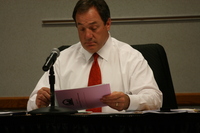
Chelsea Mayor Jason Lindauer
Lisa Allmendinger | AnnArbor.com
Lindauer says he’s in favor of having “a proactive dialogue about it, but I want to hear from the retail sector and the businesses with their thoughts as well.”
Council Member Rod Anderson said that if retail stores thought there was a cost benefit to banning plastic bags, they could implement it on their own without government interference.
From his research into the topic, plastic bags have less impact on the environment than paper ones do, he said, and specially designed reusable plastic or cotton bags need to be reused a lot to “reach a break-even point.”
Anderson says one British study concluded that the cotton bags in consideration needed to be used more than 109 times to be superior to throwaway plastic bags.
“Unfortunately,” he said, “The study found the average number of uses to be only 51 times.”
In addition, Anderson said, “To be sanitary, the bags must be washed between uses. Adding the cost and inconvenience of the washing processes wipes out much of the advantage of reused bags, because washing lessens the number of times they can be reused.”
Failure to wash the bags, he says, can lead to exposure to dangerous bacteria such as coliform and E. Coli.
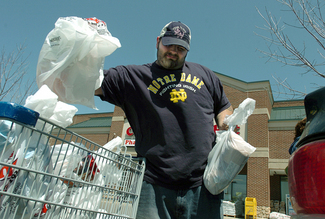
A man unloads groceries in plastic bags into the trunk of his car while shopping at Polly's Country Market in Chelsea in this file photo.
Ann Arbor News file photo
“I’m extremely careful to reuse plastic bags,” says Council Member Ann Feeney, who also brings her bags back to the grocery store for recycling.
She says, “A nickel is a lot of money to some people and we already have enough rules to live by.”
“Government can’t legislate bad behavior,” she says, referring to people who aren’t careful with the bags and litter the environment with them.
Both she and Anderson agree that there are a lot of ramifications to an ordinance of this nature.
“We’re not in the grocery business,” Anderson said. “It’s up to them to decide if there are benefits and what the costs are.”
Chelsea would not be alone in its quest to reduce the use of these bags. The Ann Arbor City Council considered a plastic shopping bag ban for the city's largest retailers in 2009.
Hammer says some countries, as well as a number of cities, most recently Seattle, have outright bans on the use of plastic bags.
In 2008, about 380 billion plastic bags were used in the United States, according to Hammer's research - and 100 billion are plastic shopping bags. It takes about 12 million barrels of oil each year to make these bags, he said.
Getting rid of them takes resources, too. In 2008, plastic bags cost the Western Washtenaw Recycling Authority about $9,000, Hammer said.
"Although the volume of landfill space taken up by these plastic bags is minimal," he wrote in a report to the City Council in 2008, "The resources they use and the blight on the landscape is significant."
Anderson, Feeney and Lindauer said the financial implications for retail stores in the city are an unknown, and this is just one aspect of this idea that needs further exploration.
Although council members say they are willing to have the discussion, they say Hammer must be able to convince them of the overriding merits of his proposal. They expressed apprehension about adding another fee on consumers as well as additional local government regulations on consumers and retailers.
Lisa Allmendinger is a regional reporter for AnnArbor.com. She can be reached at lisaallmendinger@annarbor.com. For more Chelsea stories, visit our Chelsea page.
Comments
Cici
Tue, Feb 14, 2012 : 10:06 p.m.
This would save me a LOT of money! I'd certainly do a lot less impulse buying, since I wouldn't have much bag room except for the items I came for. No more browsing and picking up items I don't need. No more going into additional stores in the mall or where-ever as I'd limit my shopping to the amount of bag room, or bags I brought with me!! It would save me money, but I don't think merchants would be too happy about my limiting my shopping to my bring-your-own-bag space. They would also be forced to wrap their styrofoam meat packages (with plastic) much more securely - they leak! But now I really am thinking about all the $$ I would save. I wouldn't be able to buy extra pillows at Target or blankets at Macy's. Don't have a big enough bag to bring for those things that isn't plastic.... And I am not about to pay MORE for a bag to put them in.
Arborcomment
Tue, Feb 14, 2012 : 9:34 p.m.
Sorry, several localities on the east coast have this "tax" - and that's what it is. Receipts collected go into general spending - not environmental purposes. And yes, plastic grocery bags are accepted as part of recycling in many locales.
Cody Robbins
Tue, Feb 14, 2012 : 8:15 p.m.
We are so worried about plastic and paper bags that we need to fine users. Paper is a natural resource that will breakdown in the landfills and be returned as a nutrient to the soil. Plastic is a different story. Why don't we focus efforts on more hazardous materials like ANTIFREEZE and METH LAB DUMP SITES, included in those efforts can be for computers, fluorescent light that contain MERCURY, and other more harmful chemicals. Also Chelsea is a tourist town. The many parks and lakes in the Waterloo and Pinkney Rec. areas are frequented by those form outside this area. Family camping trip goers need to be able to manage food from the stores as well as kids running around. These people will not want to deal with the hassles of carrying food by hand since city council BANNED PAPER AND PLASTIC!!
Cici
Tue, Feb 14, 2012 : 10:12 p.m.
What about those little alkaline batteries? Who drives out to the landfill to dispose of those? They are certainly a pollutant! I would suggest that ANY merchant or store that sells them should have to recycle them - much like our pop bottles and cans. Then we could dispose of them in most stores and not be tempted to throw them in with the trash in our plastic bags.
Lac Court Orilles
Tue, Feb 14, 2012 : 2:19 a.m.
I complain to Walmart cashiers every time I shop there about their plastic bags effect on the environment. Most don't understand the reason for my pleasant suggestion and some say, "I never listen to the news." Customer communication about plastic bag damage cannot seem to break through the front line at Walmart to get to the decision makers. Unfortunately our Republican State Legislators would rather tax senior citizen pensions instead of placing a tax on stupid plastic bags and plastic bottles that litter our roads. The power to tax is the power to destroy. And I am one who wants to destroy the use of this plastic litter.
15crown00
Tue, Feb 14, 2012 : 1:24 a.m.
if you can't use paper or plastic what kind of bags are left/
Jack
Tue, Feb 14, 2012 : 1:17 a.m.
What Mr. Hammer fails to mention is that these reuseable bags are disease ridden. Public health officials have tried to warn people about the risks of using the bags. In the late 90s 96 people in Scotland died from ecoli riding aloing in the bags. Several children have died in the the US due to contaminated shoping bags. Additionally, bags manufactured in China may be contanimated with lead. Not to mention all the people who use these bags to pick up pet doo doo. What will they do now? Go out an buy more plastic bags so they can pick it up? Or simply decide to not pick it up at all? This sounds to me like another politician trying to make a name/career for himself. I cannot help but think that he realizes there is a public health issue but simply ignores it.
Joe Kidd
Tue, Feb 14, 2012 : 1:01 a.m.
I have the solution. Just burn them in your burning barrel. You can get a burning barrel at Ace Hardware in Dexter.
Mick52
Tue, Feb 14, 2012 : 12:45 a.m.
Hammer belongs in Ann Arbor. So make customers pay so business can save the fees they have to pay for recycling. And this comes right after we approved a tax to improve recycling.
Ron Granger
Tue, Feb 14, 2012 : 12:14 a.m.
How dare anyone force me to stop polluting! The plastic grocery bag industry makes Billions off of these. They have a history of being rather ruthless at fighting these types of measures, including suing people who get in the way of their profits.
cheryl grace
Mon, Feb 13, 2012 : 10:48 p.m.
Many grocery stores in Ontario do charge 5 cents per bag. That extra charge, however small, definitely motivates me to remember my reusable bags. I've observed that most other shoppers do the same.
Mike
Mon, Feb 13, 2012 : 9:54 p.m.
Pick another time for more rules and regulations, I'm getting sick of them...........Let's focus on getting people back to work insted of more governemnt schemes to seperate them from their hard earned money. Does this guy sell the re-usable bags or have a family member that does? One step at a time you give up rights and have more interference and intrusion into your life...........How's Obama care working out for you? The cost curve isn't exactly bending down and religious organizations are being trampled in the process. Maybe Mr. Hammer should move to Seattle..........it would be a much better fit.
Fatkitty
Mon, Feb 13, 2012 : 9:22 p.m.
Amazing isn't it, how these plastic bags were the next best thing since buttered bread 10 or 20 years ago, when they came on the scene as the answer to "save the trees". 50 years ago, we laundered diapers, washed dishes, carried a lunch pail, put milk bottles out to be picked up recycled and returned, etc.. And most of the time, whatever we purchased was made in the USA. What happened?
Ann English
Mon, Feb 13, 2012 : 11:22 p.m.
One thing that came along within the last 30 years or so is the store brand INSULATED reusable bag, so cold food and drinks can stay colder in the bags than they could 50 years ago. These bags can be CLOSED at the top, too, so the cold temperatures from the contents can't escape in any direction. Plain paper and plastic bags are better made for INEDIBLE purchases.
Joe_Citizen
Mon, Feb 13, 2012 : 8:59 p.m.
Does Hammer have interest paper or plastic? How does he make out in all this mumble jumble. I say there should be a deposite on bags at the grocer, 1cent plastic 2cent paper, per bag deposit. Save a tree today!
tim
Mon, Feb 13, 2012 : 7:50 p.m.
Any plastic we can get rid of is probably a good thing. We use to go on canoeing trips when I was a kid ( pre pop bottle deposit era ) and there were soda/beer cans all up and down beautiful northern Michigan rivers. The bottle deposit law quickly cleaned up these rivers (and that law should be applied to all non carbonated drinks as well). I know it would be a hassle to bring your own bags to the store ( I can hear myself complain), but I would soon get in the habit of keeping bags in my car. Well worth it in the long run.
Ming Bucibei
Mon, Feb 13, 2012 : 7:17 p.m.
The EPA website indicates that paper and cloth bags are more harmful to the environmnet than plasticbags last time i checked their website Ming Bucibei
bunnyabbot
Mon, Feb 13, 2012 : 7:57 p.m.
maybe if they end up in the landfill but I have reused the same cloth bags for several years now. I just throw them in the wash with a load of towels and hang dry them as needed. I no longer use paper grocery bags and rarely ever get a paper "shopper" bag from a retail store, if I do I reuse it until it falls apart and then but it in the recycle bin.
David
Mon, Feb 13, 2012 : 7:12 p.m.
Would not want to patronize businesses in a city that would enact such a fee
Chicagobob
Mon, Feb 13, 2012 : 5:37 p.m.
It's too bad to see see the many negative and bone-headed comments about a subject that ought to be explored. My view is that the State ought to take leadership here and not rely on cities and towns to do it.
golfer
Mon, Feb 13, 2012 : 5:02 p.m.
watch out this will come to ann arbor after the idle law.
bunnyabbot
Mon, Feb 13, 2012 : 4:04 p.m.
there really isn't a good way that merchants would be able to track how many bags were used or how much was collected from them. Short of putting a button on a register, but even that would only work for computerized stores, which a lot of small businesses are not. (so that leaves collecting money to be on the honor system). This is about Chelsea, but I find a lot of people in Ann Arbor (as a small business owner) pass on a bag for thier purchases quite often, either they can fit them in thier purses or pocket or they carry a reusable tote bag around. A lot more out of towners are also forgoing shopping bags. At the grocery I see more people using reusable totes. Also the collection bins a lot of grocers have for plastic bags are being utilized and filled. Some grocers offer cents off your bill if you bring in a reusable bag. The best push to do would be to encourage businesses to do that, more people would get in the habit of having totes with them then.
Lynn Glazewski
Mon, Feb 13, 2012 : 3:54 p.m.
I'd have to buy plastic bags for dispossing of dog poop, taking out daily small amounts of trash to my trash can. Doesn't seem like a reduction of plaatic to me.
Doug
Mon, Feb 13, 2012 : 3:49 p.m.
I can see that Hammer will be a 1 term council member.
easy123
Mon, Feb 13, 2012 : 3:48 p.m.
I still am in favor of this, I hate the plastic bags flying around like kites because someone did not bother to clean up. Hey, cigarette use was legislated, and that could be considered bad behavior!
Ann English
Mon, Feb 13, 2012 : 11:15 p.m.
Some of those plastic bags seen flying around are from our car trunks on a windy day. Packing groceries or taking out reusable, even insulated bags from our trunks has to be done with a watchful eye on the much lighter plastic bags used for returnable cans and bottles, on any windy day, so they don't fly out, up, up, and away.
cgerben
Mon, Feb 13, 2012 : 3:37 p.m.
I'm largely apolitical, but I've never been more convinced of the need for government intervention than after reading the comments to this story.
Frustrated in A2
Mon, Feb 13, 2012 : 3:21 p.m.
As someone who uses plastic bags but reuses them around the house and recycles them I would be upset if Ann Arbor tried to pass something like this. I would be sure to shop at a store in a community that does not have this tax or fine or however they want to word it.
obviouscomment
Mon, Feb 13, 2012 : 3:13 p.m.
I can see charging for plastic bags but what's so wrong with paper? It's much easier to recycle. I don't like to use reusable bags for things like raw meat.
Ann English
Mon, Feb 13, 2012 : 11:10 p.m.
I didn't think about raw meat, but you're right. Often the raw packaged meat has blood in it, which can leak out of the package. Paper can absorb some blood, like other fluids, and then dry. Paper with lots of ink on it can be recycled, it's the glossy feature of some paper and ink that isn't accepted by many recyclers.
Mary
Mon, Feb 13, 2012 : 2:55 p.m.
Meijers plastic bags are recyclable. Why would WWRA charge to collect cardboard when they just turn around and sell it? Do they need to get paid twice? They could do what they do in Germany...sell the plastic bags at the check out. They used to cost .25 euro. There are NO free plastic shopping bags in Germany.
Jack
Tue, Feb 14, 2012 : 1:18 a.m.
Reuseable bags are unhealthy unless constantly sterilized.
Go Blue
Mon, Feb 13, 2012 : 2:43 p.m.
Oh for pity's sake, would everyone stop whining! We are a lazy, selfish society with a sense of entitlement that is beyond all. There is an easier way to accomplish this, maybe not as quickly, but surely worth a try. Sugar attracts more bees. Start offering an incentive when a buyer brings their own bags, when they bring a shopping cart back to the store, etc.. There are many ways to offer the option to participate and with enough publicity, a program just may catch on. Rewards work, penalties do not induce anyone to participate in a program. You have to admit, there IS validity to reducing all those plastic bags.
Sallyxyz
Mon, Feb 13, 2012 : 2:40 p.m.
This will only work if shoppers get a 5-10 cent rebate per bag for bringing in their own bags, like Whole Foods and Busch's offer. Charging people a nickel for a cheesy thin plastic bag (like those at Kroger's) is ludicrous. Kroger also stopped offering the bag rebate, so I would suspect fewer people bring their own these days. You have to reward people for good behavior rather than punish them for bad behavior. Stop dinging people every time they turn around. There are fees constantly being added to all of our bills (electric, cable, internet, etc) as well as banks that keep adding fees, and people are sick of it.
Fatkitty
Mon, Feb 13, 2012 : 2:40 p.m.
This is totally nutz. For this idea to work, I mean REALLY work, it will have to be enforced at least county-wide. Otherwise, me and lots of my neighbors will be shopping elsewhere OUTSIDE of Chelsea/Polly's, which leaves much to be desired anyway. So, bye-bye Polly's. Paper bags - what's the big deal? They're recyclable, as opposed to those nasty plastic things that end up in MY yard every time we get a northwestern breeze.
grimmk
Mon, Feb 13, 2012 : 5:44 p.m.
Plastic bags are recyclable too.
Fatkitty
Mon, Feb 13, 2012 : 2:48 p.m.
Maybe they could charge everyone a 0.35% bag tax; and the people who "bring their own" would have to line up for a 50 cent refund. Still a dumb idea.
Ricardo Queso
Mon, Feb 13, 2012 : 2:34 p.m.
Have any of the Greenies done an analysis of the costs associated with a bag charge? Stores would have to a add another accounting step. Who will conduct audits? Who will maintain the bag charge collections? The council member proposing this nonsense should be ashamed for wasting taxpayer paid time.
Tintin Milou
Mon, Feb 13, 2012 : 2:33 p.m.
I always ask for a couple of extra plastic bags at the store to use them as a backpack when I go to work. You know, salmonella and stuff. And it's so handy! My wife wanna replace her purse, too, and take a fresh and new plastic bag every day.
tdw
Mon, Feb 13, 2012 : 6:46 p.m.
Tell me where you live I'll save them for you.I have a bunch already and I'm throwing them out when I get them
lbechard
Mon, Feb 13, 2012 : 2:32 p.m.
Frank Hammer's impending proposal should be ignored as it was the first time. Just one more attemp on the part of government to errode individual freedom. I have a right to choose paper or plastic, or to bring disposable bags. I would make it a point to shop anywhere other that markets that have to apply a surcharge for paper or plastic bags. Mr. Hammer, the liberal, would be very happy to take away our freedom to choose.
Vette96drvr
Mon, Feb 13, 2012 : 2:12 p.m.
It's a legitimate concern the number of bags that get thrown away, I won't argue that. However, to what extent are the idiots in office going to attempt to control and micro manage every asspects of our lives? Give me a break! So Washtenaw County spent $9,000 recycling bags last year. WHO CARES! How much did we lose on employees taking items home (stealing), long lunches and breaks, departments spending/WASTING money in December spending every last penny in the budget on stuff they do not need before the end of the year hits so their budget does not get cut the following year, etc. Chase the dollars, not the pennies and stay out of my business! Incidently, my wife and I just started using cloth bags, it is a good idea. If someone tries to make me, I'll stop to thumb my nose at them! Chelsea used to be such a great little farm community,when did all the Ann Arbor save the world minded people take over? I for one am tired of getting stuck fixing all our parents and grandparents neglects. Can't I leave something messed up when I'm gone that our kids will get stuck fixing?
Boo Radley
Mon, Feb 13, 2012 : 2:10 p.m.
I buy my reuseable shopping bags from Heywood Banks ... The bags printed with "Cloth Bags - The Environmentally Friendly Way to Carry Bottled Water to your Hummer"
Fatkitty
Mon, Feb 13, 2012 : 2:43 p.m.
Lah-de-dah!
Sandra Samons
Mon, Feb 13, 2012 : 2:05 p.m.
This is nearly as bad an idea as putting parking meters in the store's parking lot, which someone did once propose. There are some stores who give a small credit incentive to people who bring their own bags, but often they do not post this information prominently. Why not encourage more stores to do that?
cgerben
Mon, Feb 13, 2012 : 2:05 p.m.
As a one-time San Francisco resident (where a plastic ban is in place), let me say that the reactions posted here that this will cost consumers loads of extra money are paranoid and unfounded. Once consumers realize the waste and cost that goes into using disposable plastic bags, they will quickly be able to switch to reusable bags that are already on sale at most stores for approximately .99 cents. Couple this with the idea that stores could welcome the change with giving away free (or reduced costs) reusable bags, and consumers will have no reason whatsoever to pay extra (except for those odd instances where they forget their bags and have a choice of using paper or plastic.) Plastic bags create an unfortunate amount of unnecessary waste. This is a simple shift of convenience that consumers and legislators are far too late to demand. Let's hope this moves forward and slowly begins to address the problem we've created for ourselves over the past few decades.
Doug
Tue, Feb 14, 2012 : 4:10 a.m.
Cgerben, No, obviously you are not the kind of people I refer to and I apologize for offending you.
Mick52
Tue, Feb 14, 2012 : 12:55 a.m.
We have tried to switch from plastic to paper bags, based on reports they are an oil product and that paper is easier to recycle but it has been a pain. They make them thinner now and they break and tear easily. And Hammer does care much for paper either. Once I used one of those reusable bags but the damn thing wore out quickly. It was pretty worthless.
cgerben
Mon, Feb 13, 2012 : 3:54 p.m.
I don't mind admitting, Doug, that I currently live just above the poverty line, and that while living in SF I had to string together 3 part-time jobs at once just to pay the bills. Yet somehow, miraculously, I was able to remember to bring my reusable bag to the grocery store every time I went shopping. I'd be honored if you could tell me how that is out of touch with "main stream America," unless by using the inane phrase you mean to invoke the myth of the consumerist middle-class worker that people like me can only hope to aspire to.
Doug
Mon, Feb 13, 2012 : 3:43 p.m.
You can't be serious: comparing Chelsea to Sanctuary City. The people of Chelsea are much more in tune with main stream America.
xmo
Mon, Feb 13, 2012 : 1:48 p.m.
We already have the deposit on cans and bottles and now they want to charge us for bags? More stupid ideas from people who want to "Save the Planet" but are not!
jcj
Mon, Feb 13, 2012 : 4:39 p.m.
Thaddeus "5c/ bag would make you think twice about doing the same with a plastic bag." How so???? Where did it say I will get my 5 cents BACK if I return it to the store or take it back to the store to reuse?
Thaddeus
Mon, Feb 13, 2012 : 4:01 p.m.
That 10c per can/bottle makes you think twice about chucking it along the side of the road, doesn't it....? 5c/ bag would make you think twice about doing the same with a plastic bag. Little things matter. People too often dismiss little things that when done on large scales, make an enormous difference. As I understand it, areas with bottle/ can return policies have notably less cans/bottles in their litter streams.
Carl
Mon, Feb 13, 2012 : 1:48 p.m.
They do it in ontario, why don't we see how it worked there.
jns131
Mon, Feb 13, 2012 : 5:34 p.m.
But the trash that is made in Ontario? Ends up in Michigan landfills. Enough said.
Thaddeus
Mon, Feb 13, 2012 : 3:55 p.m.
They do it in Quebec as well. Like the 10c per can/ bottle that people in Michigan have been charged since 1976 to encourage people to return them, these nominal fees DO change peoples' behaviors. While they may sound petty, these kinds of fees do make people stop and think about it. In Quebec people bring their own reusable bags into the stores at a much higher rate than in Washtenaw County. Thereby cutting down on the plastic bags being put into the environment. I cannot quote any stats, but the difference in mindset and behavior leads to people being accustomed to bring their own bags when shopping even to stores that do not charge 5c/ bag. And if they forget, the 5c/ fee isn't that big a deal.
Sarah Rigg
Mon, Feb 13, 2012 : 1:47 p.m.
I am not necessarily in favor of a mandatory bag fee, but I have to question the numbers around the cost-effectiveness of cloth bags. If I make one out of materials I already have around the house (even someone who can only hand-sew can easily make an old T-shirt into a shopping bag) and I throw it into the wash with my other clothes and towels that I'm going to be washing anyway, how does this add up to having to use it more than 100 times to break even with the cost of producing a plastic bag? Those numbers quoted don't seem to add up.
Thaddeus
Mon, Feb 13, 2012 : 4:14 p.m.
Cotton, plastic, or other, bags seem so readily available that it seems senseless to be aquiring more if possible. Which one of us doesn't have an assortment of bags (plastic and other), duffle bags, backpacks, suitcases, satchels, and other portable devices that are just in a closet collecting dust? Yet the ideal size for moving groceries. It doesn't have to be a stereotypical "grocery bag" to do the job. As Ken and others have pointed out, to go out and "buy" a new cotton bag with some green slogan on it is false "feel good" environmentalism. Real environmentalism is being mindful, reducing need, and repurposing, reusing....
Ken Boyd
Mon, Feb 13, 2012 : 2:59 p.m.
Sarah, in order to compare the cost of plastic to the cost of a cotton bag, one must consider a measure of all the actions and materials employed . Your t-shirt did not come to you for free. Even if you use an old one, you would have to measure the residual value as having cost. Then, you would have to spend time to sew it into a bag. Your time has economic value. After that, the marginal cost of soap and water would have to be computed. In the end, would a used t-shirt bag survive one hundred machine washings after a lifetime as a person's shirt, probably not. The cotton bag issue is another example of enviromental "feel goodism". It gives some people the feeling of helping the enviroment when it does nothing, or even detracts from the environment.
G-Man
Mon, Feb 13, 2012 : 1:42 p.m.
How would all the fast food places pass out their food? No more bags? or add to the cost of your order? How about any other store we shop? can't get items in a bag.......? Might as well outlaw all cans and bottles too, why have anything to throw out? Also, those pesky cardboard boxes, better not use those anymore...... Geesh, pretty soon they'll want to outlaw smoking.......
Ann English
Mon, Feb 13, 2012 : 10:58 p.m.
What about dollar stores where they don't want us bringing back bags to reuse? If you're buying something or several items weighing a pound or more, the cashiers rightfully double-bag the items.
The Black Stallion3
Mon, Feb 13, 2012 : 1:30 p.m.
Pretty soon he will want us to recycle our toilet paper.
Ricardo Queso
Mon, Feb 13, 2012 : 11:02 p.m.
Never shake with your left hand.
tdw
Mon, Feb 13, 2012 : 6:43 p.m.
I use both sides
jns131
Mon, Feb 13, 2012 : 5:33 p.m.
I do. Rinse, reuse and let dry.
getmoney
Mon, Feb 13, 2012 : 4:25 p.m.
What? You don't?
Steve
Mon, Feb 13, 2012 : 1:22 p.m.
No. Keep your fees out of my pocket!
tdw
Mon, Feb 13, 2012 : 1:16 p.m.
Doe's anyone know why they can't recycle them ?
jcj
Mon, Feb 13, 2012 : 1:11 p.m.
Frank Hammer says: "Details about how this would be handled at the city's two farmers markets, for instance, would need to be worked out" Duh Ya Think? Typical off the wall greenhead comment!
tdw
Mon, Feb 13, 2012 : 12:58 p.m.
Who would get the 5 cents ? how in the heck ( substitute ck for ll ) would they keep track of them.but I will say that if I happen to go to the store I bag my own.I don't need a bag for milk that has handles and oranges and apples that are already in a bag or a bag for a single box of crackers.I admit it has nothing to do with the environment it's just they are a pain to deal with
Thaddeus
Mon, Feb 13, 2012 : 4:24 p.m.
The store would most certainly get the fee. Like other areas that have done this, there wouldn't be a 5c "credit" of such by bringing your own bags. Just the fee to encourage you to do so....
Charles Stevens
Mon, Feb 13, 2012 : 12:36 p.m.
No one has mentioned that there is evidence that the re-useable bags have been the spread of salmonella and other problems due to not being properly cleaned after every use?
David Paris
Tue, Feb 14, 2012 : 2:32 a.m.
" According to the article above: In addition, Anderson said, "To be sanitary, the bags must be washed between uses. Adding the cost and inconvenience of the washing processes wipes out much of the advantage of reused bags, because washing lessens the number of times they can be reused." Failure to wash the bags, he says, can lead to exposure to dangerous bacteria such as coliform and E. Coli.
grimmk
Mon, Feb 13, 2012 : 5:39 p.m.
I hate reusable bags. Most of the people who use them never clean them and then I have to touch them to put their groceries in them. So gross.
T. Archer
Mon, Feb 13, 2012 : 12:05 p.m.
Hammer is another one that seems to think he has all the answers, but no one is asking him any questions.
motorcycleminer
Mon, Feb 13, 2012 : 12:05 p.m.
Looks like the plague of " Idiot-ocracy " is spreading from OZ ..I suggest that Dexter , Saline and Grass lake man the ramparts...pitchforks, noxious vapors and torch's ( global warming be damned ) are in order...lest they too succumb ...
Rod in Chelsea
Mon, Feb 13, 2012 : 11:53 a.m.
People will just shop more at Meijers taking away even more $$ from our community. Pretty foolish idea to me....just sayin'
Carole
Mon, Feb 13, 2012 : 11:40 a.m.
This is totally dumb and just another way to get money from the citizens. I would be more inclined to do something about all the plastic water bottles -- has no one heard about Brita.
Linda Peck
Mon, Feb 13, 2012 : 11:25 a.m.
We are required to use plastic bags by the City! We are asked to put recycled paper into a plastic bag before putting it into the plastic recycle bin! We are required to put garbage into a plastic bag before putting it into our plastic garbage bins!
sarahA
Mon, Jun 17, 2013 : 9:29 p.m.
Do a little research. You cannot recycle plastic bags. If you try to and they do not get sorted out prior to going through the machines, the machine will get jammed. This happens because the bags are so thin and are almost a gummy texture in the machines. So you can't recycle these bags. Instead they fill more landfills or make their way to our waters, the lakes, streams, rivers, and oceans that we want to enjoy. http://www.city-chelsea.org/index.php?option=com_content&task=view&id=788&Itemid=159 "We do not accept Anti Freeze, Paints, Toxic Fluids and materials, Styrofoam, Plastic Bags, TVs or Household Batteries. Visit the Washtenaw County Home Toxic Center Guide and information to properly dispose of the above mentioned material. http://recycle.ewashtenaw.org or call (734) 222-3950"
jns131
Mon, Feb 13, 2012 : 5:32 p.m.
If you look carefully, most trash bags are biodegradable. And if you look closely those plastic bags are now being taken by the recycle people. Enough said. You get them? Recycle them.
Linda Peck
Mon, Feb 13, 2012 : 2:03 p.m.
I live in Ann Arbor and did not read the article carefully enough. This is about Chelsea. I am not sure what Ann Arbor is proposing about the 5 cent charge. Apologies!
justcurious
Mon, Feb 13, 2012 : 1:33 p.m.
Good point.
A2comments
Mon, Feb 13, 2012 : 11:17 a.m.
Chelsea? Sounds like Ann Arbor... Thanks to Mr. Anderson for the voice of reason...
dading dont delete me bro
Mon, Feb 13, 2012 : 11:10 a.m.
so where can i get my nickels for cleaning up your fence lines? dumb
huh7891
Tue, Feb 14, 2012 : 2:52 a.m.
..the laughs
a2citizen
Mon, Feb 13, 2012 : 5:53 p.m.
You guys are not very good business people. If you take then take the plastic bags to San Francisco you can get 10 cents a bag.
tdw
Mon, Feb 13, 2012 : 1:02 p.m.
dading...let me know when you go.I'll bring my soup can gripper off the top shelf thing.We cans use my little gas efficient S-10.We'll be rich 5 cents at a time
Turd Ferguson
Mon, Feb 13, 2012 : 11:32 a.m.
I agree dading. You could come 'clean up' in my yard after a windy Trash Day. Good day, eh.