

At U-M and beyond, many parents bankroll kids' college lifestyle
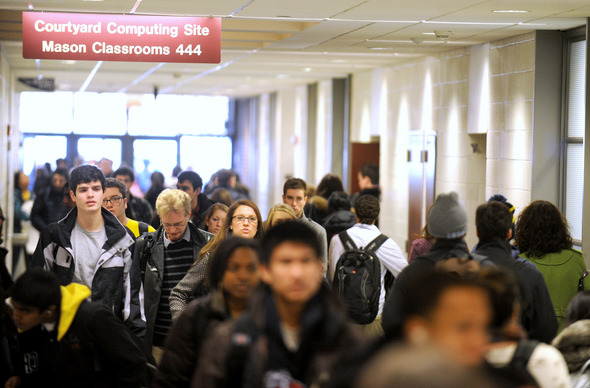
University of Michigan students between classes at Angell Hall.
Angela J. Cesere | AnnArbor.com
When Emma Huntley graduates from the University of Michigan next year, she won't have to worry about having amassed tens of thousands of dollars in student debt.
Huntley is one of thousands of students at U-M —and one of millions nationwide— that receives sizable financial support from her parents, who pay her tuition, food and housing expenses.
"I can't imagine having to deal with school and having to get the money for it," the senior elementary education major said. "I have no idea what I would do."
More than 60 percent of college-age individuals receive money from mom and dad, according to a recently published study conducted by the U-M Institute for Social Research. The average amount young adults receive—including help with college tuition, rent and transportation—is roughly $7,500 a year.
"Young people in the U.S. are taking longer to leave home, finish their schooling, get stable jobs, get married and have children," said Patrick Wightman, a research fellow at the Gerald R. Ford School of Public Policy. His research team interviewed 2,098 19- to 21-year-olds and their families for the study. "And the slow transition to traditional adult roles has been accompanied by an increase in the financial support young adults receive from their parents."
Zach Wahid's parents pay for his $485-a-month off-campus rent, groceries, vehicle and roughly half his tuition. The ecology and evolutionary biology major also has a debit card his parents let him use for social outings and discretionary costs.
"They love me," Wahid said. "They value higher education. They want to make sure I get a degree so I can support myself later."
Of the tuition-related debt Wahid will owe after graduating, he said: "I still worry about it. I am constantly thinking about the money I will have to pay back."
The U-M study found that 35 percent of young adults received tuition assistance from parents at an average of $10,100 per individual.
Additionally, 42 percent of young adults reported their parents helped them pay an average of $1,700 in bills, 23 percent received an average of $9,700 to help with vehicle costs and 22 percent received an average of $4,000 to pay rent.
Another 11 percent said they received loans from their parents and nearly 7 percent said they received financial gifts, which averaged $8,220.
"It's pretty essential. I would have to take out loans otherwise," said senior bio-psychology major Lauren Dubosh, whose parents pay for U-M tuition and her $600-a-month off-campus rent. "Most of my friends have help from their parents. .... Coming out of high school you're more willing to go to college if your parents are paying."
Dubosh added: "It depends where you come from. If you’re from a wealthier area, your parents are more willing to pay."
Study findings agree: 80 percent of high-income parents provided help to young adult children.
"We found a large difference between high- and low-income families," Wrightman said. "The gap is especially large for education-related assistance."
Roughly 11 percent of low-income youth received tuition assistance from their parents, whereas 66 percent of high-income youth did. Among those who did get help, students from high-income families received an average of $12,900, compared to $5,800 for those from low-income families.
The majority of U-M students come from middle-class families and wealthy backgrounds, according to the 2011 Entering Student Factbook, a survey of the 2011-2012 entering freshmen class. That survey found that 21 percent of incoming freshman households make more than $250,000, 9 percent of parents make between $200,000 and $249,999 and 32 percent of parents earn between $100,000 and $199,999.
"We’re experiencing the national trend. We do have a large number of students coming from upper-income families," said Malinda Matney, senior research associate for the U-M Division of Student Affairs. Matney said U-M has a higher number of wealthy students than the average university but a similar amount as its "peer institutions," such as the University of California's Los Angeles and Berkley campuses.
At U-M, 66.7 percent of incoming 2011-2012 freshmen reported received more than $10,000 from their families to cover the cost of freshman tuition, up roughly 6 percent from last year.
Wightman added that parental support can strengthen the relationship between parent and child during the giving period, but that prolonged support can lead to over-reliance by adult children, which can lead to depression.
Over the past four decades, according to Wightman, "there has been a steady increase in the percentage of kids who are getting support" and the length of time parents are willing to support their children.
From a young age, Huntley's parents promised her they'd pay for her tuition.
"Their parents didn’t help them at all and so they did it all themselves and they told me and my brother since we were little that they would deal with our college stuff," she said, adding that the financial assistance could possibly continue into her first year in the work force.
"My mom will be in favor of stopping that but my dad is the complete opposite. He gets me anything I need anytime I need."
Kellie Woodhouse covers higher education for AnnArbor.com. Reach her at kelliewoodhouse@annarbor.com or 734-623-4602 and follow her on twitter.
Comments
Macabre Sunset
Fri, May 4, 2012 : 5:34 p.m.
What's shocking to me is the rate of tuition increase. When I was an undergrad, my parents paid tuition and I worked a job maybe 10-20 hours a week. I appreciated that. When I graduated and decided I wanted to continue at Michigan, I had a scholarship at first, and then paid tuition myself. It was about $1,000 a semester in-state. With two part-time jobs, I could afford that and still maintain a good GPA. One semester I moved back in with my parents because I didn't want to ask them for money. This was only about 20 years ago. Now it's at least $7,000 in-state per semester in tuition alone at Michigan. This is a very different ballgame. Part-time jobs help, but the days where you could get through without asking a lot from loans or from parents are very much over.
Dr. I. Emsayin
Fri, May 4, 2012 : 4:47 p.m.
Sad when I, as a middle aged person , have to buy my used car from a college kid who is upgrading.
mixmaster
Fri, May 4, 2012 : 3:10 p.m.
When will we learn. This is unsustainable. Everyone knows it but nobody is willing to be the first to get off the merry go round. I feel terrible for all the students carrying six figure debt, but hey, the believed the hype and made the decision. Just think of what could be if they had learned a trade and invested in tools and workspace. Maybe they'd be hiring an employee or two by now. Sad
rensational
Fri, May 4, 2012 : 2:47 p.m.
Also, I did work while I was at Michigan for a while. Like someone else said, it doesn't even make a dent...
rensational
Fri, May 4, 2012 : 2:45 p.m.
I hate that a lot of people will come away from this article feeling their idea about who attends Michigan is "confirmed," i.e. Michigan is full of rich brats and elitists. I attended Emory for college and Michigan for graduate school, and between these two schools I left school owing about $180,000, which will actually be more than that whenever it's eventually paid off. Maybe I will die before it's all paid off. My parents didn't pay for a car, rent, books and whatever else is mentioned here. My parents didn't make $100000+ a year. I met other students at Michigan who were in the same boat and left Michigan with a lot of debt. When you borrow loans, you get a small check with what's left over after tuition and room/board are paid. My parents basically gave me money when THAT ran out, which it did every year. I lived on campus at Emory and Michigan, and I never had a car. Because I spend at least half of my earnings on paying student loans every month (even with my fed. loans on income contingent repayment), I still don't have a car. My point is not everyone at Michigan is bankrolled by parents, and Michigan has more diversity in their student body than we're maybe being led to believe when it comes to financial background. There were certainly a lot of privileged kids at Michigan, but I, personally, will pay dearly for decades for having attended Michigan (as well as Emory)...and the money I make now doesn't even justify having all this debt to attend Michigan, to be honest. I love Michigan--Go Blue and all that--but I'm just sayin'.
psaume23
Fri, May 4, 2012 : 2:23 p.m.
Good article and the headline isn't awkward. In the '60s and early '70s, many of my fellow UM alums worked all summers between semesters and had part-time jobs during school. Paid our own way with loans at decent interest rates and provided our own discretionary funds. Same with law school. But it seems like it was much easier for young people to get part-time jobs back then. Focus on studies was more sharp when we had to pay our own way, and I believe students should not be completely dependent on their parents while going through school.
Polyjuce123
Fri, May 4, 2012 : 1:43 p.m.
"I can't imagine having to deal with school and having to get the money for it," the senior elementary education major said. "I have no idea what I would do." What to do? WORK. These kids will be gravely disadvantaged once they are unleashed in the violate and merciless workforce. Even though my parents were more than able to foot the bill for my entire education, I'm fortunate they didn't. Learning resourcefulness, and money management skills is required for one to succeed in today's workforce. Extending the right hand and taking from ma and pa does nothing to prepare a child for what may lie ahead.
kuriooo
Fri, May 4, 2012 : 1:39 p.m.
I think the claims "it's horrible and unfair that parents pay for everything" and "It's wonderful to struggle and do it all yourself" to be a bit simplistic. Many of the people from non-WASP backgrounds have varying degrees of family support - financial and otherwise, but also have higher cultural expectations as to their family responsibilities. I'm sure I would have gotten better grades if I didn't have to work. I did get some benefits from that. But I'm a little bit tired of this whole "total independence" thing and I can really see the advantages to valuing a collective family experience vs. the "pull yourself up by your bootstraps" model.
Woman in Ypsilanti
Fri, May 4, 2012 : 4:54 p.m.
I completely agree. Even though I don't have kids of my own, I have been putting money aside to help out my nieces and nephews go to college. Between me, my other childless siblings, my parents, and the children's parents, I am pretty sure that we as a family are going to be able to put everyone through college. There is value to pulling oneself up by the bootstraps but I figure that if any of these family members of mine want to get ambitious, it wont hurt them to have had a family that supported them.
Lemmy Caution
Fri, May 4, 2012 : 1:29 p.m.
When future historians do research on the decline of the American empire, they'll be a special subset of experts on the "amenities arms race" at US colleges and universities and its role in the Latin Americanization of the US social structure prior to the authoritarian populist takeover. Exploring the exploding price of higher education (far beyond the rate of inflation), a subgroup of scholars will research the rise of luxury dorms at ostensibly public universities (hardwood floors, food court cafeterias), while a competing group will focus on deluxe recreation and fitness facilities and the role of the enhanced "smart classroom" in the viral collapse of advanced literacy. History in the making. Ain't it great?
Geoff Larcom
Fri, May 4, 2012 : 1:19 p.m.
A very interesting story. Washtenaw County is also fortunate to also have WCC and Eastern Michigan, both of which have student bodies with widely varying economic circumstances – traditional freshman students, transfers, mid-career changers, students with their own families, students working multiple jobs to support themselves along with financial aid, etc. etc.
u812
Sat, May 5, 2012 : 12:53 a.m.
Eastern is not cheap
Fatkitty
Fri, May 4, 2012 : 1:08 p.m.
Pitiful. The young people who "have no idea what I would do" and know that M & P will foot the bill, will continue to expect M&P to bail them out. The sad day will come when M or P requires assisted living, have no idea what to do, and ask Jr. to bail them out.
Woman in Ypsilanti
Fri, May 4, 2012 : 4:58 p.m.
The funny thing is that if my parents ever do need assistance, I am way more likely to come to their aid because they were so supportive of me in my youth. I mean the value they taught me wasn't that I am entitled to whatever I want but rather that family members help out other family members. It doesn't matter if it is college tuition or assisted living.
mixmaster
Fri, May 4, 2012 : 12:58 p.m.
They can get their education here and leave after 4 years for all I care. Just as long as they spend mummy and daddy's money right here in Ann Arbor while they're here.
walker101
Fri, May 4, 2012 : 11:23 a.m.
Not to worry if the Democrats have it their way in Michigan the costs well be picked up by everyone and corporate taxes will be cut. Mass exodus and no jobs for everyone that resides here, just what we need more taxes to support the enabel.
Sparty
Fri, May 4, 2012 : 1:31 p.m.
The alternative being public universities only for the very wealthy, I suppose? $18 billion Not given back to businesses could pay to support a lot of poor and middle class academically eligible students!
Halter
Fri, May 4, 2012 : 10:24 a.m.
Hmmm.....Talk about an article about nothing... Go back about 30 years and the parental portion of the college costs was probably about 95% of all college kids... What's changed is the amount of public aide and work-study now available...
Tru2Blu76
Fri, May 4, 2012 : 4:46 a.m.
"I swear by my life and my love of it that I will never live for the sake of another man, nor ask another man to live for mine." – Quoting the character Francisco D' Anconia in Atlas Shrugged. Well, Francisco, we know from your statement that you've never had a kid in college. LOL! ;-) Seriously, doesn't anyone see a trend here - the one which ends when only the children of the moneyed elite (and those children they may from time to time decide to help out a little) will be able to get the "right education" to be admitted into the "right job with the right corporation." I once lived briefly in student housing with 10 other people, a few of which were from wealthy families. I remember one day hearing the voice of a young man coming from his 2nd floor room: he was screaming at the top of his lungs - a string of insults at someone on the other end. It took only a minute before I realized that he was complaining about not getting enough "support." And a minute more to realize (with real horror) that he was talking to: his own father! I was horrified: because our daughter was at that time a U of M student herself. She worked every summer, she was SO grateful that I had managed to get her $2000 in savings bonds when she was in middle school - to help her in college. Her mother and stepfather also contributed some but the three of us together never came close to footing the whole bill. I told her the story about that young man screaming at his father and she told me that one of the biggest shocks of early college life was witnessing such evident loathing some kids have for their parents. We then hugged each other tightly. In the years since, I keep thinking that these ungrateful offspring of the moneyed elite go to the commencements and get the same highly valued degrees as those like our daughter. Question: what are those privileged ungrateful youths commencing?
Sparty
Fri, May 4, 2012 : 1:28 p.m.
Yes, that sense of entitlement I mentioned some wealthy are passing on to their wealthy children ..... LoL.
BernieP
Fri, May 4, 2012 : 1:42 a.m.
What of the option in the poll? "Yes my parents financed my education through the undergraduate degree, but I did my best to support them financially and emotionally in their senior years." This will be the reality of most answering this poll wheter they realize it or not.
Arborcomment
Fri, May 4, 2012 : 12:05 a.m.
As UM outprices itself beyond all but the upper middle class and above, plan B for those still wishing to attend could consider joining the military. Take some college courses while you are in the service. Apply for UM when you get out and use the "new" GI bill to pay for it.
Arborcomment
Fri, May 4, 2012 : 9:07 p.m.
Actually there Sparty, we've been taking the "Democratic 101" for quite a while. The continual throwing of money in the trough, tuition increases consistently over the rate of inflation, mega endowments, and no action or lip service to cost constraints has made many realize it's time to change the curriculum.
Sparty
Fri, May 4, 2012 : 3:23 a.m.
Yes, and you paid for your kids to attend, however, right? Let's save Public Universities only for the wealthy (and those coming back from War). No need for the State to subsidize higher education expenses for the poor and middle class, right? Republican strategy 101.
Quo
Fri, May 4, 2012 : 2:46 a.m.
Assuming you're good with doing the time overseas in potenially unfriendly climates, prior to starting the learning immersion... As it happened, I tried - had the conditional Army ROTC fullride for UM but couldn't quite make the statory 20/20 vision requirement at the time. Parents bailed me out freshman year, I covered the balance with concurrent work and some student loans (which were paid off before starting grad school). My oldest kid, whose uncorrected vision is far superior to mine, is now considering the miliary option both for its own sake (service, structure, adventure..) and as a means to a debt free higher education.
Arborcomment
Fri, May 4, 2012 : 1:27 a.m.
Me too, and with the "new" GI bill, more is paid for. Carter-era program did not come close to meeting the bill.
a2citizen
Fri, May 4, 2012 : 12:47 a.m.
People have been doing just that, me included, for over 50 years.
eagleman
Thu, May 3, 2012 : 11:46 p.m.
No one seems to want to mention the fact that MSU and UM are wealthier than ever. If these schools are so hard up for money then why are they constantly constructing new buildings, dorms, etc? One would think they could find a way to replace the loss of revenue from state funding to compensate outside of raising tuition. UM has not been dependent on state funding for a while now. Those who think lack of state funding is driving the expensive tuition are wrong. It is UM's desire to be elite in everything that has seen their costs rise so much. Being the Leaders and Best is expensive .
SMC
Thu, May 3, 2012 : 11:42 p.m.
Wait, you mean all those BMWs and Mercedes with NY/NJ license plates were paid for by the parents? I always thought the students were making the lease payments with the money they earned working in the cafeteria or the library. Thanks so much for this hard-hitting investigative journalism. We're fortunate to have a news source like annarbor.com in this town, I tell you.
elGato
Thu, May 3, 2012 : 10:55 p.m.
U of M is not for Michiganders anymore (if it was ever) it's for elitists. Michigan State still serves the average Michigander and I am a proud Spartan alumnus. Boo to the U!
Edward R Murrow's Ghost
Fri, May 4, 2012 : 1:33 a.m.
FYI: MSU tuition is higher than UM tuition. http://www.ro.umich.edu/tuition/tuition-fees.php http://admissions.msu.edu/finances/tuition.asp So not only do M-S-Moooooooooooooo graduates receive a second-rate education, but they pay more for it.
SMC
Thu, May 3, 2012 : 11:43 p.m.
...And UofM has a few hot girls.
eagleman
Thu, May 3, 2012 : 11:40 p.m.
Nope. MSU has quite a few bourgeois students.
Kea
Thu, May 3, 2012 : 9:35 p.m.
Students shouldn't expect their parents to help with their university costs --- they should sell part of their stock portfolio to pay for it. Ask Mitt.
trespass
Thu, May 3, 2012 : 9:27 p.m.
The fact that the average family income for a student at UM is $180,000 means that most families have enough money to help support there child's expenses but it also means that UM is not for the leaders and the best but the best of the those rich enough to afford UM.
trespass
Fri, May 4, 2012 : 8:23 p.m.
It came from UM Provost Hanlon
lynel
Fri, May 4, 2012 : 1:07 a.m.
That "fact" came from where?
Seasoned Cit
Thu, May 3, 2012 : 9:23 p.m.
Just look around campus to see the cars today's students are driving. No beat up used cars.. a lot of Lexus and Jeeps that were probably HS graduation gifts. The "rich" who can afford it are helping to subsidize those getting aid.. much like those of us with insurance are helping to cover the emergency room fees for those who walk in and are unable to pay. My roommate paid for his room and board while working in the dorm kitchen every day.. with today's fees.. there is no way it can be done today!
Fatkitty
Fri, May 4, 2012 : 1:11 p.m.
Jeeps? in the same class with Lexus? hmmmmm
widmer
Fri, May 4, 2012 : 2:07 a.m.
Totally agree with your point about today's fees. But for as much as we all love to fixate on our envy of having seen young people driving nicer cars than us on occasion, anyone who looks around the massive undergradville that is the collection of houses on the South side of campus is likely to find most of the cars are in fact pretty crappy.
xmo
Thu, May 3, 2012 : 8:49 p.m.
I am glad that "Rich" 1% parents bankroll their students at U of M. I guess all of that stuff about students loans was just made up! ""We're experiencing the national trend. We do have a large number of students coming from upper-income families," said Malinda Matney,"
RuralMom
Thu, May 3, 2012 : 8:17 p.m.
Or the alternative is for your kid to be very studious and EARN a almost completely paid for first 4 yrs! That's what our oldest did, just turned down Harvard not ONCE but TWICE for the MD PhD program, because Michigan is where she wants to continue her education. You not only receive scholarships, grants, and other opportunities, you get to really choose your life's path and location, when you very hard work. GO BLUE!
widmer
Fri, May 4, 2012 : 6:45 p.m.
I am sure your child has worked very hard, again, for which you should be proud. But you are definitively wrong to imply that working hard enough is a certain way to receive things in life such as a free ride through college. Let me give you an example just from my field: Getting into pharmacy school is so competitive that every year, there are many many excellent applicants who are not accepted. Among those that do not make the cut, many have perfect 4.0 GPAs, excellent extracurriculars, etc etc. Now for those of us who are close to the end of our pharmacy doctoral program, we are constantly evaluating which residencies we may apply to, knowing full well that many of these residencies will be turning away many of us who have received perfect 4.0 GPAs in pharmacy school. Therefore, I find it to actually be quite a disrespectful thing to say that if a person needs financial assistance in order to fund college it just means they are not working hard enough. I have just known too many outstanding peers over the years, who have perfect grades, etc etc etc, but there just are not enough free rides available to just hand out to them, so they therefore have had to keep working as hard as possible, but to keep paying as well. Please continue to feel proud of your child and happy of her achievements, but also be mindful of others' hard work.
dotdash
Fri, May 4, 2012 : 5:43 p.m.
Everyone has expressed admiration and good wishes towards you and yours, RuralMom.
RuralMom
Fri, May 4, 2012 : 11:44 a.m.
Luck? No its called HARD WORK. We have beaten all those stats you all love to use to say people CAN'T achieve success. I worked my tail off to raise them, as a single mother, getting no child support, and yes at one time I received assistance to help me raise them. I worked my butt off to be self sufficient and taught them that the ONLY person you can really rely on is YOURSELF. You don't need hand outs to be successful, you need determination. Do you want it bad enough to give up Saturday night party for a Monday morning A+ on a test? Just as simple as having clear priorities and being driven. @Dotdash, not peculiar at all, she loves the U of M, she has wonderful support system educationally, medically (during this time she fought off Leukemia) and family. Harvard has a huge pool of brilliant people, U of M does too only not quite as packed in the fields she has majored in. The actual point is that if they REALLY want it, they can achieve it without Mommy and Daddy footing their bills. That attitude is why lots of people come to college and leave shortly thereafter from being pulled into the party scene. They don't have anything vested in their education monetarily.
dotdash
Fri, May 4, 2012 : 2:12 a.m.
Very peculiar decision. But congratulations to you both.
widmer
Fri, May 4, 2012 : 2:02 a.m.
It is nice that you are proud of your child's academic success, as you should be - but it is also hardly reasonable to suggest that the general public achieve the same. Depending on your definition, many more students may already be earning though not receiving a free ride: The vast majority of classes, especially hard science classes, are required to provide a Mendelian distribution of grades, such that only a small portion of students receive As. Therefore, in a class where maybe all students should get As for effort, only the small top percentage are awarded them. Beyond perfect grades, the merit-based and demographic-based scholarships are much fewer in number, and from having played roles in admission and award processes, I can promise you that there is a certain degree of luck at play here.
bhall
Thu, May 3, 2012 : 7:26 p.m.
The difference between then and now in regards to college costs at state universities is simple: Back then, you could pay your own way because OTHER PEOPLE -- yes, taxpayers -- were also footing the bill. State taxpayer support for higher education at places like U-M accounted for quite a larger share of the costs. Today, you largely cannot pay your own way while in school because taxpayer support has dwindled to a much lower share of the costs. Tuition is a much greater percentage of the pie, and costs more in real dollars today than it did back then. We can argue about whether higher ed is doing enough to control its costs, but let's not lose sight that the old adage of paying your own way while in college really does not apply to today's students.
eagleman
Thu, May 3, 2012 : 11:39 p.m.
It should read wealthier.
eagleman
Thu, May 3, 2012 : 11:39 p.m.
Sparty, nope. Bhall is ignoring the fact that college tuition has been rising independent of how much tax dollars have gone to college. And let's be brutally honest here, UM is not hurting for money. The school has a multibillion dollar endowment and generates billions more in revenue from many sources. UM--and MSU--are both beneficiaries of federal and private grants. UM received only a small fraction of its total revenue from the state. This has been the case for DECADES. To connect the two is being a misleading. Yes, there is some correlation, but when a school like UM has so many ways to make money it makes one wonder how they cannot find a way to make up $20 million. UM and MSU are weather than they have ever been. The argument advanced by Sparty and bhall looks a bit absurd in view of this fact. In light of the poor performance of American K-12 schools it also makes one wonder why you support giving them more money.Michigan ranks 12th in teacher salary, but 30th in student performance. And you are complaining about a lack of funding? Really?
Sparty
Thu, May 3, 2012 : 8:33 p.m.
Yes, that would be because the Republicans have decimated higher education, and K-12, funding wouldn't it ?
A2comments
Thu, May 3, 2012 : 7:25 p.m.
Really bad survey. It stops at $20k. Tuition plus room and board is higher than $20k, for in-state students. For out of state it's closer to $50k for U of M. We paid everything for both our children (including one current there) - tuition, room and board. They pay all discretionary costs like party money, "I need a pizza", etc. And they are held to a high standard - learn or come home.
mw
Fri, May 4, 2012 : 12:05 p.m.
Same deal that we did for our kids (one at MSU one at UM). If they'd decided to go to a more expensive private school, they would have had to take out the difference in loans (which we encouraged them not to do). And, of course, we paid full rate at both MSU and UM (if you make the 'mistake' of putting away money for college costs, then 'no discount for you!').
Gorc
Fri, May 4, 2012 : 11:26 a.m.
Sparty....the great spender of other people's money.
Woman in Ypsilanti
Fri, May 4, 2012 : 4:09 a.m.
I think more need based scholarships are the solution to that problem, Sparty. Well, the wealthy kids will probably still feel entitled to an education but it wont seem so bad when lower income students have the same opportunities.
Sparty
Fri, May 4, 2012 : 3:12 a.m.
It bothers me when the wealthy think it's ok for their children to feel entitled to a free ride at university but an academically smart but feel that a financially poor child isn't entitled to some form of State support to help equalize the situation in a PUBLICALLY supported State University?
Woman in Ypsilanti
Thu, May 3, 2012 : 11:33 p.m.
@A2comments I was thinking the same thing about the survey! There is a *huge* gap between $20k and blank check. @Sparty You don't think people are entitled to allow their parents to give them such a gift? Or is it just when they feel entitled that it bothers you?
eagleman
Thu, May 3, 2012 : 11:27 p.m.
Sparty, it is one thing to pay for YOUR children's higher education. It is quite another to pay for someone else's education. If you cannot understand that then I don't know what to say to you.
Sparty
Thu, May 3, 2012 : 8:32 p.m.
AW .... talk about a sense of entitlement being created. And yet some people talk about the Democrats in Government creating a sense of entitlement. I think that sense is being created a lot closer to home, hmmmmm ?
Lewanster
Thu, May 3, 2012 : 7:47 p.m.
Not only do I agree, but we did exactly the same thing. First four years for both boys were courtesy of Mom and Dad. They are on their own for grad school - although we may have to help a bit as current student is at UM Pre-Med, so grad school will be a major expense.
leezee
Thu, May 3, 2012 : 7:15 p.m.
I paid my own way. My father had recently lost his job and my mother's job was fairly low-paying. They helped with the occasional purchase of groceries and a $20 here and there - for which I was so grateful. I'm proud of the fact that I did it on my own. If I could help my kids, I would, but I would encourage them to work part-time while in school. It's a great way to learn a bit about the working world and how to juggle multiple priorities prior to leaving school.
widmer
Fri, May 4, 2012 : 12:58 a.m.
I just finished my third year of pharmacy school here at UM, and have been constantly employed since the beginning of my nonstop college career which began 8 years ago. I believe that these days there is ONE single benefit to have a part-time job during school, and that is to keep a person grounded and remembering that in the real world, money comes from work and not loans. Apart from that, I have found it to be more harm than good to have stayed employed while school is in session. I cannot begin to say how many days I have been at work, wishing the entire time that I had that time to study and perform better on exams. I also cannot begin to say how many college events I missed both in my undergrad and in pharmacy school because I had to go in to work. My advice to those coming after me is that you've got your whole life to work, but college is just a few short years. It should also be said that while it certainly USED TO BE true, anyone who says that working is a good way to pay for even part of college while in college is not up to date with reality. The situations where this is possible and sensible are few and far between.
Angry Moderate
Thu, May 3, 2012 : 7:55 p.m.
Tuition is ridiculous now. Working part time doesn't even put a dent in it.