

Majority of University of Michigan students at odds with key state policies
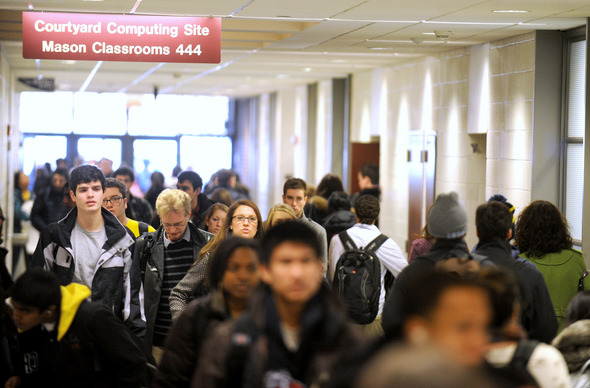
University of Michigan students between classes at Angell Hall.
Angela J. Cesere | AnnArbor.com
The University of Michigan is no exception, according to the results of an annual freshman survey conducted jointly by the University of California's Cooperative Institutional Research Program and U-M.
That survey found that just 21 percent of U-M freshmen consider themselves conservative, while 41 percent of students identify as members of the political left and another 39 percent consider themselves moderates.
On key issues, survey results reveal that the majority of U-M freshmen hold beliefs that are directly at odds with Michigan policies and statutes.
For example, an overwhelming majority of U-M freshman think same sex couples should have the right to marry. In 2011, 81 percent of the school's 5,359 incoming freshmen respondents said they support same-sex marriage, up roughly 8 percent from 2009.
The belief is not held just by liberal students. More than half of conservative students agreed with same-sex marriage. In fact, U-M freshmen are 9 percent more supportive of same-sex marriage than students elsewhere.
Yet in Michigan civil unions and same-sex marriage are illegal and, recently, have led to political contention. In December the Michigan legislature passed a law banning gay and lesbian state employees from extending health care benefits to their partners, causing dissent from democratic leaders and civil rights activists.
"Students are flying in the face in terms of what has been passed" in the State of Michigan, said Malinda Matney, senior research associate for the U-M Division of Student Affairs. Matney said university students are largely champions of individual rights.
"When you look at some of the (state) policies that happened (recently) they have been specifically about not having individual rights," Matney said. "In the case of same sex partner recognition, that’s definietely a rights question that the voters and the students disagree on."
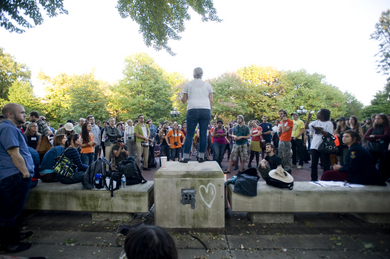
Wayne State University student and former Ann Arbor resident Lucianna Sabgash, center, speaks to the crowd during a Wall Street protest open forum in the Diag at the Univeristy of Michigan's campus in Ann Arbor last fall.
Joseph Tobianski I AnnArbor.com
The state also is in a legal battle over a statute that prevents homosexual couples from adopting children together. April DeBoer and Jayne Rowse raise two adopted children together in Detroit, but only DeBoer has legal guardianship over the children. The couple filed a lawsuit in January.
Survey results suggest that the couple has a strong backing at U-M. Nearly 84 percent of students said gays and lesbians should have the right to adopt.
Diference 'not surprising'
Amanda Caldwell, president of the U-M College Democrats, says that many fiscally conservative students hold more liberal social values than most Republican lawmakers in Lansing.
“It just shows at the state level how far removed our politicians are form the beliefs and the values of Michiganders and Michigan’s young people,” she said. “At Michigan, you really see a large percentage of students in the classroom —not just the social realm where you associate yourself with other students who share your values— supporting issues like gay marriage.”
“Young people understand that even if they are against gay marriage and that it it against their personal beliefs, it’s not necessarily something that the sate should be deciding," Caldwell continued.
Michael Heaney, a U-M professor specializing in organizational studies and political science, says part of the reason students hold liberal opinions on social issues is that "young people have less at stake with the current status quo."
Heaney said he is unsurprised that U-M students, roughly two-thirds of whom are from Michigan, are at odds with state policies on social issues
"It doesn’t surprise me at all. You’ve got to think about the demographics of the state of Michigan. There’s a difference between people who chose to live in Michigan verses people who are born in Michigan," he explained. "More liberal people… are going to leave Michigan and go to larger urban areas."
"A lot of those more liberal folks are going to select out so the residue, the people that stay, are more likely to be conservative," Heaney continued.
Two representatives of U-M's College Republicans did not respond to requests for comment.
Affirmative action and marijuana
In 1972, the Ann Arbor Hash Bash was started by U-M students. It appears that the desire to legalize marijuana is still alive at U-M today. Fifty-five percent of survey respondents said cannabis should be legalized, up nearly 17 percent since 2006.
The significant jump in support occurred in the midst of a 2008 law legalizing medical marijuana in Michigan. Since then, Republicans have assumed control of Lansing and Michigan Attorney General Bill Schuette has claimed that the state's medical marijuana law has been abused. Last year Schuette led a statewide effort to close multiple dispensaries, contending the establishments could be shut down under a state public nuisance law.
There's also a petition circulating throughout the state that seeks to amend the Michigan Constitution to make pot legal for people 21 and older. The petition needs more than 322,600 signatures from registered voters in Michigan to put the issue on a statewide ballot.
While gay rights issues and marijuana legalization are supported by the majority of U-M students, using affirmative action in admission policies has not received as much student support.
Proposal 2, a state law banning public universities from considering race in admissions, is currently under review in federal court. Affirmative action policies in university admissions have been a controversial state issue for more than a decade due to a U.S. Supreme Court battle that questioned a since-retired race consideration policy at U-M.
Michigan voters originally passed Proposal 2, a ban on considering race in admissions, in 2006, three years after a U.S. Supreme Court ruling found that U-M could work toward achieving diversity in its admissions policy, but that the school's existing policy considered race too heavily.
According to survey results, 33 percent of U-M freshmen agreed that "students from disadvantaged social backgrounds should be given preferential treatment in college admissions," a slight change from 32 percent of freshmen in 2009.
U-M freshmen support of weighted admissions policies is lower than the national average of 42 percent.
Matney said the relative steadiness of weighted admissions is due, in part, to an overexposure to news about the issue.
"The nation did grow in their support of affirmative action, our students did not. Our students quite simply are tired of the national debate and, quite frankly, the debate here in Michigan," she said. "This has been in the news every single week, and sometimes every single day, since they were in kindergarden."
Kellie Woodhouse covers higher education for AnnArbor.com. Reach her at kelliewoodhouse@annarbor.com or 734-623-4602 and follow her on twitter.
Comments
hank
Tue, Feb 28, 2012 : 3:45 p.m.
It seems the republicans are alienating just about everybody. Students,women,middle class, several religions, gays,thinking folks. Whose left, the t-party types I'm guessing.
Goober
Mon, Feb 27, 2012 : 10:46 p.m.
Who cares what UofM students think. Until they take more meaningful roles in society, all they have are opinions which might be quite shaded.
hank
Tue, Feb 28, 2012 : 1:26 p.m.
Meaningful roles like medical doctors,engineers and business leaders. Did you forget U of M grants those degrees?
Sparty
Tue, Feb 28, 2012 : 4:22 a.m.
And they also have votes at each election, let's not forget that! I'd also say they have very meaningful roles in society as students, the future leaders of the US, children, possibly spouses/parents/boyfriends/girlfriends, employees, and probably many other meaningful roles as contributing members of th human race.
groland
Mon, Feb 27, 2012 : 8:35 p.m.
The comments here are typical and generally miss the point. A real conservative would have no problem with gay marriage, it shows commitment and reflects conservative values. Conservatives used to want government out of people's lives. Today's pseudo-conservatives are more theocrats who wish to impose their religious beliefs upon society. Students are smart enough to see the difference and to realize that Harry and Steve getting married does not affect them.
A2James
Mon, Feb 27, 2012 : 7:26 p.m.
The comments on this article are incredible. So if a student (who is able to vote) expresses their dislike of current policies, they are labeled as sheep and being clueless? I would much rather our young people be involved with politics and be informed on current events, instead of being apathetic and uninformed...even if I personally don't agree with their viewpoints. As for keeping topics such as religion out of politics, I absolutely agree with that. And, as a moderate, I applaud anybody who is able to think for themselves politically without constraining themselves to absolute liberal or conservative beliefs.
Sparty
Tue, Feb 28, 2012 : 4:16 a.m.
Amen - A2James !
f4phantomII
Mon, Feb 27, 2012 : 9:23 p.m.
I think what a lot of commenters are saying is that the life experiences of the average college student that informs their political views are limited or incomplete. Does this invalidate them? No. We let them vote if they so choose. My worldview has changed a good bit in the 30+ years since college graduation. As a husband, father, business owner, net tax payer, etc., I'm concerned with a whole different set of issues than I was at 22. Also, my college education (NOT from U-M) and some years in the real world has helped me to be able to think critically and form opinions based on years of knowledge and experience gained. Try to see past the hyperbole.
mohomed
Mon, Feb 27, 2012 : 6:46 p.m.
Wow! I'm sure conservative policy makers are going to change their beliefs and policies if they read this enlightening article about what a bunch of 19 year old college students think from a hippie town.
hank
Tue, Feb 28, 2012 : 1:32 p.m.
Just reading these slurs from the right would be reason to stand in a snow storm to vote. Go out and vote young Americans.
Sparty
Tue, Feb 28, 2012 : 4:14 a.m.
If I was looking for votes in a tight election, I would consider every demographic and not ridicule an eligible, sizable voting block.
mohomed
Mon, Feb 27, 2012 : 7:22 p.m.
LOL, ya right Mr. Sparty... would you change yours based on what a 19 year old's "opinion" was.
Sparty
Mon, Feb 27, 2012 : 7:15 p.m.
They should .... voting age is 18 and above.
Mick52
Mon, Feb 27, 2012 : 4:51 p.m.
I was interested in this article when I saw the headline, but I thought the story would report on more issues and what IMHO are more important issues, such as the economy, taxes and jobs. Please add "social issue" between key and policies in your headline. I am not downplaying the issue of gay rights and gay marriage. I am on the fence on that. None of these conclusions are a surprise at all. I think what is key though it that the majority of UM students is against preferential treatment in admissions for applicants from disadvantaged social backgrounds. That indicates, I think, that they want a fair and equal opportunity and something of a reverse of typical liberal thought. Matney is way off base, it has nothing to do with "national debate." I have never thought adjusting college admissions was a proper fix to unbalanced opportunity of people meeting the disadvantaged social background status. Fix the problem.
CobraII
Mon, Feb 27, 2012 : 4:11 p.m.
They are liberal until they get into the real world & have to start paying taxes!!
hank
Tue, Feb 28, 2012 : 2:03 p.m.
Their they go again , with that real world line again. What is that real world your talking about? Is it the one without a strong middle class that republicans have demolished?
aareader
Mon, Feb 27, 2012 : 3:30 p.m.
Duh... Most college students are quite smart. They read, see the world around them, enjoy diversity at most colleges and have not been excessively biased by special interests... yet. So... it makes sense they see the value of policies that help everyone not a special few. Too bad many of our "leaders" have lost this understanding.
clownfish
Mon, Feb 27, 2012 : 3:16 p.m.
"Real" conservatives should be in favor of (or at least not against) same sex unions, legislation limiting peoples decisions is by definition anti-freedom. Same goes for the decriminalization of marijuana. But, what we have in this country is not really "real" conservatism, it is a mish mash of Randian economic theory mixed with a large dose of right wing biblical doctrine (based on a couple of lines from Leviticus, but ignoring most of the Beatitudes due to conflict with Randian Theory)
Michael J
Mon, Feb 27, 2012 : 11:12 p.m.
You said it buddy!
Lolly
Mon, Feb 27, 2012 : 3:08 p.m.
I think there is quite a bit of spoon-feeding going on at Fox News.
metrichead
Tue, Feb 28, 2012 : 2:52 a.m.
Ever watch MSNBC? Sheesh.
nekm1
Mon, Feb 27, 2012 : 1:19 p.m.
Let's see. Two years after graduating from college and voting for Jimmy Carter, I became a conservative and never looked back. Unfortunately both the Army and the Democrats (Liberals) love young minds because they are so easy to sway. Live a little in the real world and you will change your political tune quickly. The sad news is that all of these young people will have to pay for these mistakes, literally, the rest of their lives with real money. Most have never experienced the whole "teach a man to fish" concept, and continue to think that life is somehow free on the backs of others. Look to cities that fail, and you will see the constant... bloated unions, Liberals stealing from each other, politics from the pulpit, and blame. Sad, as it continues to fester upon itself, and continues to support the same political beliefs!
hank
Tue, Feb 28, 2012 : 1:56 p.m.
That real world line never ceases to amaze me . Do you mean a world that shows the wealthy getting more and paying less? The middle class disappearing? Wages and benefits dropping. Is that the (real world) your referencing?
leaguebus
Mon, Feb 27, 2012 : 4:40 p.m.
As I got older, my compassion for those less fortunate has gotten greater. Cities that fail, like Detroit, lost hundreds of thousands of jobs, their tax base, and ran out of money. For every Kwame you name, I can throw a name out like Newt, who left Congress in disgrace. Unions built the middle class by making corporations "share the wealth". They also instituted work rules that made workers jobs more safe and secure. The Unions just got the GM workers $7000 each in bonuses from the record profits that GM made, through their workers.
clownfish
Mon, Feb 27, 2012 : 3:20 p.m.
I guess it a good thing that our GOP governors, congressmen and presidents NEVER ran up any debt! Phew, that might say something about our system, and it is easier to blame Other People than The System.
Nick Danger
Mon, Feb 27, 2012 : 1:06 p.m.
I am glad to hear that the majority of students are liberal or moderate. It would be nice if these students were more active politically. Where is the opposition to the war, the concern over the the unequal distribution of wealth and the fight for the protection of individual rights for all people. Sitting back and watching the right wing dictate foreign and domestic policies is a tragedy. Close the Ipad and get involved
Mush Room
Mon, Feb 27, 2012 : 4:26 p.m.
Exactly. Having a political opinion doesn't mean much if you don't vote, and most in this age bracket don't.
metrichead
Mon, Feb 27, 2012 : 4:05 a.m.
The head of the College Democrats at Michigan, Ms. Caldwell said "It just shows at the state level how far removed our politicians are form the beliefs and the values of Michiganders and Michigan's young people." Umm, no, I think politicians that are elected there show a great reflection of this state. Otherwise, they would not have been elected. More to the point, it's not so much that they're removed. Maybe it's more of a generational thing. Younger conservatives tend to favor gay marriage because they too question the status quo.
Mick52
Mon, Feb 27, 2012 : 4:59 p.m.
Apparently Ms. Caldwell thinks the opinions of her generation should be more important to politicians than the number of people they represent. The opinions of the young will matter when the numbers are immense. Through my life constantly, I have found the younger generations very ignorant of current issues. That is not a criticism, it is just that with their studies and other pursuits, they just do not find time to review the news. I am guilty of this myself. In my undergrad years I was not able to read the paper, and we had no television. I did not find out someone attempted to shoot President Ford for 3 days.
Usual Suspect
Mon, Feb 27, 2012 : 3:07 a.m.
"That survey found that just 21 percent of U-M freshmen consider themselves conservative" That's actually a lot more than I had assumed. Maybe there is hope for these kids after all.
Michael K.
Mon, Feb 27, 2012 : 1:22 a.m.
Our children are the future. This is why in have faith in evolution. The old, bigoted ways die off. It is amazing how far we have already come in 50 years, since the start of the civil rights movement. Never fast enough though.
nekm1
Mon, Feb 27, 2012 : 3:02 p.m.
Try your thinking in North Korea or Iran, Egypt or Syria. See how far they have come! Stoning folks for being gay or an extramarital affair. Check and see how integrated Europe is! Or the former Soviet Union. Quit picking on Americans with differing opinions.
Usual Suspect
Mon, Feb 27, 2012 : 1:14 p.m.
Actual bigotry is bigotry. However, that term, like the term "racist," is often thrown by many on the left toward anybody with a differing opinion.
metrichead
Mon, Feb 27, 2012 : 4:07 a.m.
I doubt the old, bigoted ways ever die off. Bigotry is as much a part of human behavior as any other behavior. I would agree with Dave Briegel's comment about different opinions though.
Usual Suspect
Mon, Feb 27, 2012 : 3:06 a.m.
Now all we have to do is stop calling people "bigoted" just because they hold a different opinion.
Michael K.
Mon, Feb 27, 2012 : 1:20 a.m.
I have always loved this alleged "media liberal bias" theory. Do you believe in free markets? If so, you have to believe that those outlets that deliver the news that more people judge to be accurate and what they want to hear, will prosper. The others should go out of business Today moreso than ever before, people are free to pick their preferred media outlets. So, on average, the media - by definition of free market economics - must fit the perception of the population. It is therefore the person complaining who is to the right of the average of the population, rather than media overall that is skewed to the left. **QED**
lumberg48108
Mon, Feb 27, 2012 : 3:46 p.m.
The definition of "media" has changed over time but survey after survey (unofficial and official) identified the majority of those in the media identify themselves as democrats - why is it so hard to believe there is an natural bias to these issues. Fox News and the like are recent trends ... To quote a famous story - after Nixon was elected in '72 the New York Times publisher was at a cocktail party and announced her shock he was re-elected she said "how did he get elected, I do not know a single person that voted for him" says it all and talk radio rose to prominence because its listeners felt their values were not reflected in traditional national media
Dcam
Mon, Feb 27, 2012 : 10:36 a.m.
You're a long way from QED; your attempted syllogism is false.
jhammer
Mon, Feb 27, 2012 : 12:13 a.m.
When I was 19, I thought I was pretty enlightened. I was simply a moron who hadn't really lived yet.
Dcam
Mon, Feb 27, 2012 : 11:56 p.m.
'When I Was One and Twenty' - A.E. Houseman.
Thomas
Sun, Feb 26, 2012 : 10:45 p.m.
In other news water is wet. Just further example of liberal brainwashing in so-called 'education' institutions.
mun
Tue, Feb 28, 2012 : 1:13 a.m.
Yeah, they should do conservative brainwashing, like at Liberty University or Bob Jones U.
packman
Sun, Feb 26, 2012 : 9:43 p.m.
If you're not liberal when you're 21, you have no heart...if you're not conservative by 40, you have no brain! Churchill
hank
Tue, Feb 28, 2012 : 1:43 p.m.
It seems beeswing gave you some book learnen.
beeswing
Mon, Feb 27, 2012 : 3:33 p.m.
There is no record of Churchill ever speaking these words, and it is highly unlikely that he would have because Churchill himself did precisely the opposite. He entered politics as a Conservative and was a Conservative at age 25. He switched to the Liberal Party at age 29 and was a Liberal at age 35. (He returned to the Conservatives at age 49.) Also, his beloved wife, Clementine, was a life-long Liberal, and Churchill would hardly have delivered such an indirect insult to her. It should also be remembered that "Liberal" and "Conservative" are the proper names of British political parties and do not translate precisely to theleft and right wings of the American political spectrum. <a href="http://www.phrases.org.uk/bulletin_board/33/messages/799.html" rel='nofollow'>http://www.phrases.org.uk/bulletin_board/33/messages/799.html</a>
Arborcomment
Sun, Feb 26, 2012 : 8:23 p.m.
@Dcam, you will note that the students responded to a question on "students from disadvantaged social backgrounds" not minority preference for admissions. Survey wording is key.
David Briegel
Sun, Feb 26, 2012 : 8:11 p.m.
It is simply proof that our leaders and policymakers could use some education!
Mick52
Mon, Feb 27, 2012 : 5:06 p.m.
As I became educated including grad school, I drifted to the right. But I do not care if people go left or right. For me, and I suppose for anyone, your political leanings develop based on your personal situation. It can be affected by occupation, your beliefs and your personal opinions on issues, based on your life experiences. I do not care that some of my friends are liberal. I just choose not to argue politics with them because it gets testy.
David Briegel
Mon, Feb 27, 2012 : 3:35 a.m.
I agree with you Bob but I can't forsake my optimism.
Basic Bob
Sun, Feb 26, 2012 : 9:56 p.m.
I used to think that when the liberals of the 60's and 70's got older, many of the restrictions that the government places on us would be removed by them. The first one that I thought to go would be the seemingly arbitrary prohibition of marijuana. Next would be the brutal support of unpopular governments and silly wars in developing countries. In spite of our liberal education, we have become our parents.
Dcam
Sun, Feb 26, 2012 : 7:25 p.m.
It's not surprising to see over 30% favoring allowing minority based preference for admission - given the students favoring it have already been admitted. But, what if they were still waiting for their acceptance, knowing a minority applicant is in the queue ahead of them due entirely to racial quotas?
Mick52
Mon, Feb 27, 2012 : 5:09 p.m.
I think it is a perfect indicator that students do not blindly follow any political agenda, but they are concerned about policies that affect them.
Mike
Mon, Feb 27, 2012 : 3:04 a.m.
No preferences of any kind should be allowed anymore. Discrimination is a double edged sword and needs to end for any race....
joe.blow
Sun, Feb 26, 2012 : 7:24 p.m.
Students are sheep. They've had over a decade of teachers who are thought to be all knowing, tell them that liberals are good and conservatives are evil. They when they hit the real world, they change there tunes quickly. Unless you have a cushy Union job where you don't have to work all that hard to make double the national average, you turn into a conservative.
mun
Tue, Feb 28, 2012 : 1:12 a.m.
Sheep? You mean like the Koch Bros. sponsored Tea Party?
Mick52
Mon, Feb 27, 2012 : 5:11 p.m.
I think its parents more than teachers. I was a democrat because my parents were. But as I aged, learned and worked, my leanings went to the right.
joe.blow
Mon, Feb 27, 2012 : 4:09 p.m.
Number one comment ... yet again. And, nine angry liberal responses. How about them apples!
clownfish
Mon, Feb 27, 2012 : 3:25 p.m.
Can you show me this union job that makes 200% of this "national average"?
clownfish
Mon, Feb 27, 2012 : 3:11 p.m.
Well, if they go by posts on AnnArbor.com they might learn that lots of self described "conservatives" are somewhat unpleasant, judgmental and often have a desire to set state policy based on stereotype and ideology. Just look at the posts today!
Mike
Mon, Feb 27, 2012 : 3:03 a.m.
@sh1 - I guess you've never attended the University of Michigan or gone to any rallies...........
sh1
Sun, Feb 26, 2012 : 8:52 p.m.
Can you point me to the sources you used regarding educators teaching kids that liberals are good and conservatives are evil? I'm curious which districts are doing that.
David Briegel
Sun, Feb 26, 2012 : 8:12 p.m.
it's more than just the typo
joe.blow
Sun, Feb 26, 2012 : 7:25 p.m.
Sorry for the typo.
j
Sun, Feb 26, 2012 : 7:10 p.m.
Not disagreeing or agreeing with anything in this article but; It should point out the percentage of U of M students are from Michigan. This website says 32% <a href="http://www.insidecollege.com/reno/Percentage-of-OutofState-Students-at-Public-Universities/360/list.do" rel='nofollow'>http://www.insidecollege.com/reno/Percentage-of-OutofState-Students-at-Public-Universities/360/list.do</a> Basically i am saying that 3 of 10 students are just like any person from out of state that dosen't agree with the states policies
j
Sun, Feb 26, 2012 : 8:46 p.m.
Sorry I typed it wrong. However, If you look at the sentence below the stat was used correctly. Regardless the sample does not reflect an accurate view of michiganders view of the michigan government. I care much more about what michiganders think of the michigan government
Eep
Sun, Feb 26, 2012 : 7:23 p.m.
The website that you linked does NOT say that 32% of UofM students are from Michigan. It says that 32% are from out of state, meaning that 68% are from Michigan.
xmo
Sun, Feb 26, 2012 : 7:06 p.m.
39% of U of M students are Moderates? I guess they never read the book about "GREAT MODERATES" in American History! Please name a few Great Moderates? It is not surprising that so many are Liberals since they have been spoon fed Liberalism in school, in pop culture and in the news. I guess it is easier to "fit in" than question Authority. Conservatives are always portrayed as Gun toting, Bible reading, wacko's.
hank
Tue, Feb 28, 2012 : 1:39 p.m.
If the shoe fits wear it.
groland
Mon, Feb 27, 2012 : 9:54 p.m.
By today's standards Ronald Reagan was pretty moderate. He, along with Nixon, Ford, Dole, and the Rockefellers, would be drummed out of the radical Republican party today.
metrichead
Mon, Feb 27, 2012 : 4:10 a.m.
Great moderates - Henry Clay. Dwight Eisenhower. Gerald Ford.
sh1
Sun, Feb 26, 2012 : 10:50 p.m.
@gene, does mainstream media include AM radio?
genetracy
Sun, Feb 26, 2012 : 9:44 p.m.
sh1, Try the mainstream media and Hollywood.
sh1
Sun, Feb 26, 2012 : 8:50 p.m.
"Conservatives are always portrayed as Gun toting, Bible reading, wacko's." Where do you get your information?!