

Committee recommends creating historic district for Ann Arbor's Germantown neighborhood
A study committee evaluating the historic significance of Ann Arbor's Germantown neighborhood has completed its research and recommended in a new report that the area be granted official historic district status.
The committee, appointed by the Ann Arbor City Council last September after controversy arose over the proposed City Place development, submitted a 28-page report to the city's Planning Commission on Tuesday.
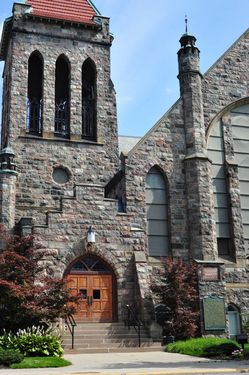
The Bethlehem United Church of Christ, dedicated in 1896 by German congregants whose ancestors first settled in the area in the 1820s and 1830s, is part of of the proposed historic district in Germantown.
Ryan J. Stanton | AnnArbor.com
The report suggests the district is significant for the physical link it maintains to the early settlement period of Ann Arbor, its association with early German life in Ann Arbor and its historic ties to several past civic and political leaders who lived in houses in the area.
"I think the district is important for its architecture," said Kristine Kidorf, a Detroit-based historic preservation consultant who has been working with the city on the proposed historic district.
"It's very intact architecturally and represents a really interesting period of Ann Arbor's history from the settlement days up until the development of the university and the development of the city really," Kidorf said. "There's a lot from the early families and a couple of early mayors that lived there, and early political leaders and judges. Those are the houses that they lived in and they tell Ann Arbor's story."
The proposed district includes properties running along both sides of South Fourth and South Fifth avenues, south of William Street, and extending to properties on the south side of Packard. That's a larger district than the study area originally encompassed last fall.
"We actually had a lot of debate about boundaries and things like that," said Patrick McCauley, chairman of the study committee and a board member for the city's Historic District Commission.
"We felt that the story of the neighborhood, historically, included that south side of Packard, which was developed pretty early on," he said. "There were some quality houses that were basically built by the founders of Ann Arbor on that side of Packard. Believe me, we went back and forth on all of this. There was quite a bit of debate over what to include and what not to include."
The committee's recommendation remains in a mandatory 60-day waiting period. The report has been submitted to the Michigan State Historic Preservation Office, which must give its blessing to create the district, as well as the city's Historic District Commission and Planning Commission. By early May, there will be a public hearing, after which the creation of the district will go to the City Council for approval.
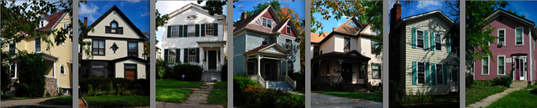
These seven houses along South Fifth Avenue were slated to be demolished a year ago. They're now part of an area being recommended for historic district status.
Ryan J. Stanton | AnnArbor.com
A moratorium on any demolition or development work within the proposed district remains in effect through Aug. 6.
If approved, the so-called Fourth and Fifth Avenue Historic District would be Ann Arbor's 15th historic district. Some others in existence include Main Street, Cobblestone Farm, Northern Brewery, the Old Fourth Ward and the Old West Side.
City Planner Jill Thacher, the city's historic preservation coordinator, said if Germantown officially becomes a historic district, all future building work beyond basic repairs would need to be reviewed by the city's Historic District Commission. If the work proposed is not appropriate or doesn't meet certain standards, the commission can reject it based on historic grounds alone.
Residents along Fourth and Fifth avenues took it upon themselves to begin branding their neighborhood as "Germantown" in recent months as development threatened the historic integrity of century-old structures along Fifth Avenue. Through research, they found the neighborhood - including houses slated for demolition last year - have historic worth.
One example is the Beakes house at 415 S. Fifth Ave., believed to be one of the oldest surviving houses in the city. The house, which dates back to the 1830s, has served at different times as home for two of Ann Arbor's mayors - Hiram Beakes, who was mayor from 1873 to 1875, and Samuel Beakes, who was mayor from 1888 to 1890, as well as the editor of the Ann Arbor Argus.
On Fourth Avenue is the castle-like Bethlehem United Church of Christ, which was dedicated in 1896 by German congregants whose ancestors first settled in the area in the 1820s and 1830s. They built two other churches, along with some of the earliest houses in the neighborhood.
Several members of the Ann Arbor City Council, including Carsten Hohnke, D-5th Ward, have gone on record indicating support for creating a historic district. Hohnke said the committee's report is good news.
"I think that's great, and I appreciate all of the work that the residents have put into that," he said. "These are volunteers that spent a lot of time looking at the historic contributing resources there."
The proposed district doesn't encompass the portion of the Germantown neighborhood where a developer plans to knock down old buildings to build an apartment complex called the Moravian.
The district does include the area where developer Alex de Parry had proposed demolishing seven houses to make way for City Place. De Parry recently announced plans to revise his project, which now is called Heritage Row. He plans to follow federal guidelines for historic renovations and preserve the historic integrity of the houses while adding three new brick apartment buildings behind them.
De Parry said he's prepared to take his project before the city's Historic District Commission for approval if the area becomes a historic district.
Ryan J. Stanton covers government for AnnArbor.com. Reach him at ryanstanton@annarbor.com or 734-623-2529.
Comments
Alex de Parry
Thu, Mar 4, 2010 : 10:52 a.m.
This was posted by Susan in an earlier posting from last September. I'm all for preserving this neighborhood. With that said, however I would warn Tom Whitaker and the others in Germantown that any historical designation will bring all kinds of unwanted regulations. The "Hysterical Society", as I like to refer to them, is made up of a number of folks who have nothing better to do than arbitrarily make judgements about what you can and can't do to the outside of your home. Example: One family had to go to court in Detroit last year to get a judge to overturn a ruling by the H.S. in the old west side over replacement of windows. The windows to be replaced were NOT original and had been repaired over and over and were perpetually attracting ants and termites. The H.S. decided they could be repaired yet again instead of approving new (energy efficient) windows. Apparently, the rules state that if the windows are original, you must do everything possible to preserve them before they can eventually be replaced. Again, these were not original windows. Another account from an old west sider had to do with a 100 year old tree that fell on her house. The H.S. said she had to replace it with something comparable. I'm told that originally the H.S. only controlled what you could do to the front of your home, but now they control the whole footprint. These rules were changed under the public radar a couple of years ago. So if this is what you want, go for it but if there is another way, I would suggest looking into it.
Alex de Parry
Thu, Mar 4, 2010 : 9:09 a.m.
There are also a lot of questions being raised as to how and why the boundary was even established. According to National Register Bulletin 15: How to Apply the National Register Criteria: A district must be a definable geographic area that can be distinguished from surrounding properties by changes such as density, scale, type, age, style of sites, buildings, structures, and objects or by documented differences in patterns of historic development or associations. It is seldom defined, however, by the limits of current parcels of ownership, management or planning boundaries. The boundaries must be based upon a shared relationship among the properties constituting the district. Is this proposed two block German Town (and I note with interest the comment made by a long time German resident) so uniquely different from the immediately adjoining area east of Fifth Avenue to Division and the area south of Packard?
Alex de Parry
Thu, Mar 4, 2010 : 8:12 a.m.
Ryan, comments have been made that theoretically up to 45 percent of qualified renovation costs for historic renovations can be tax-deductible. The Tax Reform Act of 1986 establishes a 20% tax credit for the substantial, certified rehabilitation of certified historic structures for commercial, industrial and rental residential purposes, and a 10% tax credit for the substantial rehabilitation for nonresidential purposes of buildings built before 1936. This is per the State Historic Preservation Office web site. A homeowner is treated differently than an owner of rental income property. A certified historic structure is any building that is listed individually in the National Register of Historic Places, or located in a registered historic distinct and certified as being of historic significance to the district. A registered historic district is any district that is listed in the National Register of Historic Places, or designated under a local ordinance under Michigan Public Act 169 of 1970, as amended, which has been certified by the National Park Service as substantially meeting all the requirements for listing of districts in the National Register. SIMPLY BEING LISTED IN A LOCALLY DESIGNATED HISTORIC DISTRICT IS NOT SUFFICIENT TO GAIN ACCESS TO THE FEDERAL TAX CREDITS. A number of provisions in the Internal Revenue Code affect the way in which real estate investments are treated generally. These provisions include the "at-risk" rules, the passive activity limitation, and the alternative minimum tax. What these provisions mean, in practice, is that many taxpayers may not be able to even use tax credits earned in a certified rehabilitation project. German Town does not meet the federal guidelines for a historic district, but that is whole discussion unto itself. So I am not sure how you came up with the 45% tax credit you state is available. I have also stated publicly that we would follow the federal rehabilitation guidelines for the existing seven buildings, not that we would take the project before the city's Historic District Commission for approval if the area becomes a historic district
Ryan J. Stanton
Wed, Mar 3, 2010 : 10:36 p.m.
A little further explanation on why the district boundaries stopped where they did: McCauley said there were some "architectural integrity" issues on Fourth Avenue, south of Packard. Fifth Avenue, south of Packard, actually had a high level of architectural integrity, he said, and the committee debated including that area in the study, but in the end decided to leave it out for a number of reasons. "This part of the neighborhood, south of Packard, down to Madison, while old and containing significant architecture, tells as different story historically than the area we were studying," McCauley wrote in an e-mail to me. "The architecture is different (more working class) and was developed slightly later. The boundaries of a district are very important to the state of Michigan and we were trying very hard to have a very good reason to stop at a certain boundary or expand in another direction. This is why we included the south side of Packard in our study area. We felt that historically and architecturally, this fit the same story we were trying to tell in our report and strengthened the boundary justification. Had we expanded further down 4th or 5th, it raised the questions on why we were expanding in one direction and not another, say up East Jefferson."
treetowncartel
Wed, Mar 3, 2010 : 10:34 p.m.
Uhm, 20% in one category of taxes and 25% in another area of taxes does not equate to a grand total of 45% if the first two numbers come out of 100%. I'm no math major, but that just doesn't sound right. Plus, improvements may increase your property tax assessment.
Craig Lounsbury
Wed, Mar 3, 2010 : 5:34 p.m.
May God have mercy on the residents and home owners if they get branded a hysterical district
InsideTheHall
Wed, Mar 3, 2010 : 5:21 p.m.
I get it Ryan. Designate a historic area and let other foot the bills for up keep of the property. This is a sham. Tea Party this!
Ryan J. Stanton
Wed, Mar 3, 2010 : 3:54 p.m.
@PersonX You're exactly right. As Tom Whitaker, former president of the Germantown Neighborhood Association and study committee member, stated in my last story, the historic designation actually can be a benefit to homeowners in the area as it would help them pay for exterior renovations on their houses. There would be a 25 percent state tax credit for properties in the historic district for renovation costs and, for income properties (like one Whitaker owns on Fifth Avenue and rents out), you can combine the 25 percent state tax credit with a 20 percent federal credit, so theoretically up to 45 percent of qualified renovation costs for historic renovations can be tax-deductible. Proponents of the historic district say that's an incentive for improving the exterior aesthetics of the housing stock, which beautifies the neighborhood.
Freemind42
Wed, Mar 3, 2010 : 3:06 p.m.
There are so many beautiful houses in this city that are destroyed by students. Here's an idea, why not let the deveopers build more apartments and force students to live closer to campus and away from the residential neighborhoods that used to house normal families. Students are spreading out across the city and they have no real attachement to it. Walk around a student neighborhood, you'll see more solo cups and paper plates all over the ground than you could ever imagine.
tlb1201
Wed, Mar 3, 2010 : 2:21 p.m.
Others have already said it very well, but what is at issue here is more restriction of individual property rights because some rebels-in-search-of-a-cause feel the need to preseve one more thing. They don't stop! What is next?! Ann Arbor has turned into an environment where we are giving up our rights and our hard-earned money, a little here and a litle there, because of everyone else's pet crusades. Cumulatively, it's crushing load is now being felt more than ever. Just flip through the local cable channels sometime and watch some of the mind-numbing committee discussions that go on and on like a bad Saturday Night Live sketch. I can't think of a better example of that than the historic commission meetings. Well, maybe it's not so funny if it's your property they are discussing. Think about what all of the overhead for all of those pet causes costs and how it all relates to why all of our units of government are short of money. Lines of priority have to be drawn. We can't pay for everything and can't preserve everything. It is a simple prioritization of needs versus wants. Effective planning and zoning, and targeting of individual historic structures, with the owner's up-front consent are much more efficient ways of preserving without undue restriction and burden on the rest of us. Preserving "real" history is good, but sometimes, old is just old. Forcing preservation for the sake of preservation on existing property owners without their consent is a taking of rights and freedom and is a further growth of costly bureaucracy.
Lokalisierung
Wed, Mar 3, 2010 : 2:12 p.m.
"C'mon Loka. Just admit when you are caught making something up without waffling about it. You never watched what you claim to watch." I said that townie was correct. I was wrong there's no hiding that. Heck, I still remeber seeing it in person quite frankly, but if it's against the rules I guess I remebered it wrong. Totally my mistake.
My2bits
Wed, Mar 3, 2010 : 1:58 p.m.
C'mon Loka. Just admit when you are caught making something up without waffling about it. You never watched what you claim to watch. The Ann Arbor Historic District Commission doesn't regulate paint colors. This is an urban myth that you tried to perpetuate by falsely claiming what you watched. There are many issues in city planning and governing that we can all debate; the debate is valid if people with different views, opinions and interests HONESTLY partake in sharing those with their fellow citizens.
Old West Sider
Wed, Mar 3, 2010 : 1:55 p.m.
Call the area whatever you want but do not call it " German Town" My family came from Germany I was baptized in Bethlehem Church my certificate is in German, But if you must have an area designated " German Town" it should be the areas West of Main Street,South of West Washington Street North of WestJefferson and East of Soule Blvd. The original Bethlehem Church building was in that area,not where it is now. I was born in the area I describe and still live in that area.
Lokalisierung
Wed, Mar 3, 2010 : 12:58 p.m.
"As an alternative to regulation, a commission can develop a palette of paint colors that are appropriate for the style and time period of the houses in the district and make it available to property owners. You're totally correct Townie...that is my mistake. What I have seen is most likely a common commission tactic of "asking" someone, or telling them, what the historic colors are and trying to almost guilt trip them into doing what they want. This is more common on planning commission though.
townie
Wed, Mar 3, 2010 : 12:45 p.m.
"This area was only deemed "historic" upon Mr. de Parry's proposal of a very nice building that would replace old junky homes." WRONG! Three of the houses de Parry originally proposed to destroy were previously designated as historic, with de Parry's encouragement, as part of the individual sites historic district. (That district was ruled invalid, because the designated properties were not contiguous, after a lawsuit by the owner of the Anbery Apartment building. The Anbery was subsequently torn down for Zaragon Place.) De Parry's office, on the same row of houses at Fifth and William, is still in the William Street historic district, but is not considered part of the Heritage Row proposal. " If we are going to require that current owners adhere to strict rules when it comes to remodeling or repairs for the common good, then we the common should foot part of the bill." "The Common" does indeed help foot the bill via State and Federal tax credits for designated properties. Income properties can stack the credits with the potential of getting a 40% tax credit on approved restoration work, including furnaces, etc. "...if you've ever watched the Historic District Commission tell a homeowner they can't paint their house a certain color becasue it sisn't in a historic pallet it may turn you off a little." Ann Arbor does not regulate paint colors in historic districts. Ypsilanti does, but not Ann Arbor. So many myths and misinformation, so little time...
Lokalisierung
Wed, Mar 3, 2010 : 12:28 p.m.
"Preservation is not the evil monster that the above comments suggest. Rather it is a great city planning tool that stabilizes property values," Disagree. I think in theory that's true but if you've ever watched the Historic District Commission tell a homeowner they can't paint their house a certain color becasue it sisn't in a historic pallet it may turn you off a little.
Mick52
Wed, Mar 3, 2010 : 11:24 a.m.
I was told in a history tour that the German immigrants lived in the old west side. This reports notes: "The report suggests the district is significant for the physical link it maintains to the early settlement period of Ann Arbor, its association with early German life in Ann Arbor and its historic ties to several past civic and political leaders who lived in houses in the area." Does the "physical link" make it the Germantown neighborhood?" What the heck does this mean? German neighborhood or not, or just a connection with the German immigrants?" This area was only deemed "historic" upon Mr. de Parry's proposal of a very nice building that would replace old junky homes. So two mayors, who served a total of 4 years between them (worthy of re-election NOT) lived in one of the homes. Is that enough? Are the former homes of Gerry Ford, Arthur Miller, etc., now worthy of historic designation? If this area is a historic district, it should have been designated as such long ago. I studied this issue for a graduate level class. Mr de Parry has been attacked ad naseum for a plan that as originally designed would have greatly enhanced this area. A high level local official who I promised anonymity told me it is very likely that opponents to de Parry's plan, those seeking historic designation, are likely landlords that fear only the new construction that will draw tenants to a modern building. That plan had a lot of parking and open areas. Go take a look at the site now. Check the parking lots and back yards. Yup REAL historic. I prefer protection of large public buildings for historic designation, but when it is extended to housing, other than very significant homes (Monticello) it is much more invasive on personal rights. At one time property rights were highly protected in this country, but now more than ever, our rights are being infringed on."A government big enough to give you everything you want is a government big enough to take from you everything you have." - Gerald Ford
Brian Kuehn
Wed, Mar 3, 2010 : 11 a.m.
I am all in favor of "Historic District" designation for an area if: 1. All property owners within the proposed district agree unanimously to the designation; or 2. Existing property owners within the proposed district are allowed to opt-out of the restrictions until they sell the property. In the context of creating a "Historic District", any approach that allows a group to dictate to an individual property owner on how they may use their property is not right. If one purchases a home in a "District", at least one is going into the venture with open eyes.
uawisok
Wed, Mar 3, 2010 : 10:52 a.m.
Turf wars and everyones a nimby....north of miller and west of main neighborhood is as "old" as area being discussed but of little value because it is where the "blacks" lived. My home was built on a former dumping site were whites would come and dump their trash, I argue it has as much if not more historical value??
Raggety Andy
Wed, Mar 3, 2010 : 10:51 a.m.
Preservation is not the evil monster that the above comments suggest. Rather it is a great city planning tool that stabilizes property values, creates jobs through rehabilitation projects, and protects the aesthetic standards and unique historic character of a community. Property owners within Historic Districts benefit from rehabilitation tax credits as well as higher property values (the Old West Side is a perfect example of this). In addition, preserving and maintaining historic structures is a boon to the efforts of sustainability as "the greenest building is one that is already built."
My2bits
Wed, Mar 3, 2010 : 10:32 a.m.
A bit of news for those commenting already: 1. Historic homes in this area were studied several years ago for historic district designation. That effort was squashed. 2. These homes are historic, not just old. 3. Historic Districts are a valid tool, combined with zoning. Zoning alone does not do the trick. 4. Historic Districts do promote better care of the properties in the district. 5. Yes, extra hoops are there in an historic district, but they do allow home owners to put the investment into their homes knowing that the rules are there to protect that investment. 6. Tax credits are available to encourage and offset the investment in these homes, but only with official historic district designation. Some people will always fight any new rules, but let's please know the real facts, not the old wives tales.
PersonX
Wed, Mar 3, 2010 : 10:29 a.m.
1. The notion that the area around 4th and 5th Ave. and Packard is historically significant is not new; there was a different for of historic district there years ago that was overturned in a law suit. 2. I would only ask that those who seem so angry about historic preservation take a look at the Old West Side and imagine it as Southfield. If this is what you would prefer, then I suppose we have different ideas as to the kind of place we would like to live in. 3. Study after study has shown that historic preservation is economically sound. Enough people do not want to live in and visit places that have destroyed their pasts in order to look like every other place. There is enough room for development in Ann Arbor without completely changing its character.
Hactin
Wed, Mar 3, 2010 : 9:58 a.m.
Taxes. Lower taxes for these owners. There's no other subject here.
annarboral
Wed, Mar 3, 2010 : 9:57 a.m.
I drive down East Anne St. most every day and laugh whenever I notice the "historic district" signs. All that area has is marginally maintained student housing. Most of those homes would be an embarrassment in any good neighborhood. They all have signs advertising "fall availability" and the signs keep getting bigger, a real eye sore. If that's what Ann Arbor considers "historic" we can live without it.
MB111
Wed, Mar 3, 2010 : 9:24 a.m.
This is unsurprising. Set up a committee of preservationaists and lo and behold the conclusion is to create a historic district. also, where was this impetus 5/10/20 years ago? There was none because there were no proposed projects. This is NiMBY work at its finest.
jcj
Wed, Mar 3, 2010 : 9:12 a.m.
While I wonder if any "historic preservation consultant" has ever not found that a proposed historic site should not be saved. When I saw the headline I was prepared to lambaste one more area of government takeover. And I am generally against this type of control. And I too thought especially in these times we need fewer restrictions on growth. Then I started thinking about the new buildings that sit empty or barely used. I don't know where the balance is but I would rather not have more buildings only to sit empty. And I don't think it is fair to penalize current property owners when it comes to upgrading or maintaining their homes. Once a new buyer comes in to an historic district they know what they are getting into. If we are going to require that current owners adhere to strict rules when it comes to remodeling or repairs for the common good, then we the common should foot part of the bill.
InsideTheHall
Wed, Mar 3, 2010 : 8:26 a.m.
With the economy in shambles and unemployment soaring why not put one more limit of private property and possible future growth. This is the Socialist Republic of Ann Arbor at it's finest. The building is on the fire and they are looking for marshmallows.
Brian Kuehn
Wed, Mar 3, 2010 : 8:12 a.m.
I know very little of the rules surrounding a "Historic District". The goals of preserving interesting or unique buildings is laudable. However, it seems to me that forcing this designation on even one property owner runs contrary to an individual's ownership rights. If everyone within the proposed district agreed to sign-on, that is fine, but to retroactively designate an area "historic" after someone has purchased property strikes this writer as patently unfair.
Arboriginal
Wed, Mar 3, 2010 : 8:08 a.m.
Maybe these control freaks should find a new hobby, or get a job at Colonial Williamsburg. Historically speaking, this area was once covered by trees. Yeah...the GOOD old days!
PersonX
Wed, Mar 3, 2010 : 8:06 a.m.
Here we go.... The historic district rules are not part of what a committee debates--there are strict rules for that. The ad hoc committee had experienced people on it who studied the problem within the limits of existing laws and rules, and not simply as an emotional or strategic issue. I would agree that some houses are not being well maintained, but one thing that a district does is to provide tax credits for historic preservation and therefore, if approved, would provide incentives for better maintenance. Most of the houses that are in worse shape are owned by people who do not live in the area. There are rentals owned by those who do live here and most of those are very well maintained.
Eric S
Wed, Mar 3, 2010 : 7:32 a.m.
Is this neighborhood really historic or is it merely old? Not everything that is old has historic value. From the beginning, this historic district proposal has been an attempt to restrict new building types and not much about history. If you want better zoning, fix the zoning rules. A historic district is the wrong tool. If this neighborhood actually has historic value that should be saved, then the historic district rules need to do more than preserve what's there now. Much of the housing there is rentals whose historic fabric continues to decay, and including them in a district is not enough to preserve them.