

Controversial restoration of Malletts Creek 'substantially complete'

More Galleries
 The Lunch Room does vegan food in a way that even non-vegans can enjoy
 Images from Dawn Farm's 40th Anniversary Jamboree
 See photos from Kerrytown BookFest
 Images from Michigan's 41-30 win over Notre Dame under the lights
The creek bed was widened and the slope of the bank was decreased to allow for more natural flow of the river as part of the restoration of the Malletts Creek drain. Melanie Maxwell I AnnArbor.com
-
 The creek bed was widened and the slope of the bank was decreased to allow for more natural flow of the river as part of the restoration of the Malletts Creek drain. Melanie Maxwell I AnnArbor.com
/calendar/photologue/photos/050812_NEWS_Malletts_Creek_MRM/cache/050812_NEWS_Malletts_Creek_MRM_01_fullsize.jpg
The creek bed was widened and the slope of the bank was decreased to allow for more natural flow of the river as part of the restoration of the Malletts Creek drain. Melanie Maxwell I AnnArbor.com
/calendar/photologue/photos/050812_NEWS_Malletts_Creek_MRM/cache/050812_NEWS_Malletts_Creek_MRM_01_fullsize.jpg
-
 The creek bed was widened and the slope of the bank was decreased to allow for more natural flow of the river as part of the restoration of the Malletts Creek drain. Melanie Maxwell I AnnArbor.com
/calendar/photologue/photos/050812_NEWS_Malletts_Creek_MRM/cache/050812_NEWS_Malletts_Creek_MRM_06_fullsize.jpg
The creek bed was widened and the slope of the bank was decreased to allow for more natural flow of the river as part of the restoration of the Malletts Creek drain. Melanie Maxwell I AnnArbor.com
/calendar/photologue/photos/050812_NEWS_Malletts_Creek_MRM/cache/050812_NEWS_Malletts_Creek_MRM_06_fullsize.jpg
-
 Harry Sheehan, environmental manager of Washtenaw County, leads a tour through part of the restoration of the Malletts Creek drain. Melanie Maxwell I AnnArbor.com
/calendar/photologue/photos/050812_NEWS_Malletts_Creek_MRM/cache/050812_NEWS_Malletts_Creek_MRM_05_fullsize.jpg
Harry Sheehan, environmental manager of Washtenaw County, leads a tour through part of the restoration of the Malletts Creek drain. Melanie Maxwell I AnnArbor.com
/calendar/photologue/photos/050812_NEWS_Malletts_Creek_MRM/cache/050812_NEWS_Malletts_Creek_MRM_05_fullsize.jpg
-
 Don Gray kneels down to get a better angle as he takes a photograph of part of the restoration of the Malletts Creek drain. Melanie Maxwell I AnnArbor.com
/calendar/photologue/photos/050812_NEWS_Malletts_Creek_MRM/cache/050812_NEWS_Malletts_Creek_MRM_03_fullsize.jpg
Don Gray kneels down to get a better angle as he takes a photograph of part of the restoration of the Malletts Creek drain. Melanie Maxwell I AnnArbor.com
/calendar/photologue/photos/050812_NEWS_Malletts_Creek_MRM/cache/050812_NEWS_Malletts_Creek_MRM_03_fullsize.jpg
-
 The creek bed was widened and the slope of the bank was decreased to allow for more natural flow of the river as part of the restoration of the Malletts Creek drain. Melanie Maxwell I AnnArbor.com
/calendar/photologue/photos/050812_NEWS_Malletts_Creek_MRM/cache/050812_NEWS_Malletts_Creek_MRM_02_fullsize.jpg
The creek bed was widened and the slope of the bank was decreased to allow for more natural flow of the river as part of the restoration of the Malletts Creek drain. Melanie Maxwell I AnnArbor.com
/calendar/photologue/photos/050812_NEWS_Malletts_Creek_MRM/cache/050812_NEWS_Malletts_Creek_MRM_02_fullsize.jpg
-
 Brush and non-native plants were cleared from part of the park adjacent to Washtenaw Ave. to make room for a new wetland as part of the restoration of the Malletts Creek drain. Melanie Maxwell I AnnArbor.com
/calendar/photologue/photos/050812_NEWS_Malletts_Creek_MRM/cache/050812_NEWS_Malletts_Creek_MRM_04_fullsize.jpg
Brush and non-native plants were cleared from part of the park adjacent to Washtenaw Ave. to make room for a new wetland as part of the restoration of the Malletts Creek drain. Melanie Maxwell I AnnArbor.com
/calendar/photologue/photos/050812_NEWS_Malletts_Creek_MRM/cache/050812_NEWS_Malletts_Creek_MRM_04_fullsize.jpg
-
 A runners makes his way down a trail and past restoration of the Malletts Creek drain. Melanie Maxwell I AnnArbor.com
/calendar/photologue/photos/050812_NEWS_Malletts_Creek_MRM/cache/050812_NEWS_Malletts_Creek_MRM_10_fullsize.jpg
A runners makes his way down a trail and past restoration of the Malletts Creek drain. Melanie Maxwell I AnnArbor.com
/calendar/photologue/photos/050812_NEWS_Malletts_Creek_MRM/cache/050812_NEWS_Malletts_Creek_MRM_10_fullsize.jpg
-
 Brush and non-native plants were cleared from part of the park adjacent to Washtenaw Ave. to make room for a new wetland as part of the restoration of the Malletts Creek drain. Melanie Maxwell I AnnArbor.com
/calendar/photologue/photos/050812_NEWS_Malletts_Creek_MRM/cache/050812_NEWS_Malletts_Creek_MRM_09_fullsize.jpg
Brush and non-native plants were cleared from part of the park adjacent to Washtenaw Ave. to make room for a new wetland as part of the restoration of the Malletts Creek drain. Melanie Maxwell I AnnArbor.com
/calendar/photologue/photos/050812_NEWS_Malletts_Creek_MRM/cache/050812_NEWS_Malletts_Creek_MRM_09_fullsize.jpg
-
 Stormwater runoff from a nearby neighborhood passes through a culvert into Malletts Creek. Melanie Maxwell I AnnArbor.com
/calendar/photologue/photos/050812_NEWS_Malletts_Creek_MRM/cache/050812_NEWS_Malletts_Creek_MRM_08_fullsize.jpg
Stormwater runoff from a nearby neighborhood passes through a culvert into Malletts Creek. Melanie Maxwell I AnnArbor.com
/calendar/photologue/photos/050812_NEWS_Malletts_Creek_MRM/cache/050812_NEWS_Malletts_Creek_MRM_08_fullsize.jpg


A multi-million dollar environmental restoration project rife with controversy and bad luck has wrapped up in part of the Malletts Creek drain.
The county drain is the main outlet for stormwater runoff from the city of Ann Arbor and dumps into the Huron River. After phosphorus loading into the river caused numerous ecological problems - including algal blooms - state officials declared the need for remediation.
Washtenaw County officials gave project managers from the Michigan Department of Environmental Quality a tour Tuesday morning at the work sites on the creek south of Washtenaw Avenue near Platt Road and the Washtenaw-Stadium split.
Drain Commissioner Janis Bobrin and her Environmental Manager Harry Sheehan escorted Karol Patton, senior project manager for the Malletts Creek work, as well as DEQ project managers Karen Nickols and JoAnn Kalemkiewicz through three sites where the majority of the work had been done.
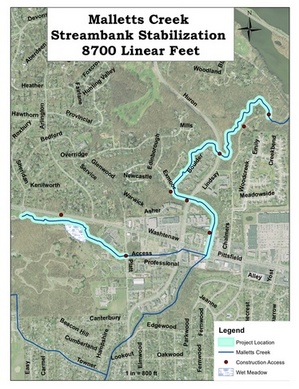
The plan, approved in 2000, did not account for the ban on phosphorus fertilizer imposed by the city of Ann Arbor in 2006. Improvements to Mary Beth Doyle Park, completed in 2008, effectively reduced 25 percent of the phosphorus in Malletts Creek, Sheehan said.
The $2.8 million project is funded by a grant from the DEQ and a revolving loan from the state -- which will be paid back at a 2.5 percent rate over 20 years using funds from the stormwater portion of city of Ann Arbor water bills, Sheehan said.
Mead Bros. Excavating, which secured the contract for much of the work done on the project, suffered a blow in December when an accident left an employee dead. The small company - of which many of its employees are related - was rattled after Wayne Mead was pinned by an excavator while working on the restoration at the County Farm Park on Platt Road.
Though initial reactions from area residents at public meetings held on the project were negative, Bobrin said she believes public perception has turned around.
“This park was a hidden gem,” Bobrin said.
Embankments that were once steep - causing a narrow, fast flow in the drain that swept sediment straight into the river - are now more gradual.
Non-native tree species and acres of invasive honeysuckle bushes have been removed. Willow and dogwood cuttings have been planted along the banks of the drain.
Sections of the drain have been bolstered with rock, and diversions have been created to prevent further erosion of embankments.
Sheehan said the way the water is now flowing through the creek bed is promising - the current is carving a new route through the channel, depositing once-troublesome sediment.
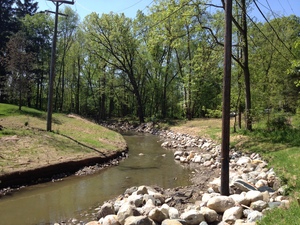
A portion of the Malletts Creek drain by Exmoor Road. The utility pole in the photo used to be on the embankment - but erosion washed the soil away.
Amy Biolchini | AnnArbor.com
Instead of sending water into the severe bend of the creek where it would carve away sediment and carry it downstream, bands of large boulders - termed “rock veins” - channel the water into the center of the creek.
Part of the drain at the County Park has been engineered to be a new, three-acre storm water detention wetland that will collect sediment once it is fully operational. While newly planted vegetation takes root, a steel wall will keep water out of a lowland.
Within several years time, Sheehan said the wall would be cut open to allow water to flow into the area.
The wetland is designed to collect sediment in one of its first pools - which will require periodic dredging, Sheehan said.
The sediment collection basin is part of the overall efforts to keep dirt - which contains phosphorus - out of the Huron River.
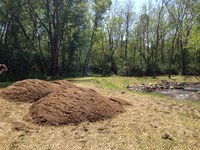
Piles of sand along the Malletts Creek drain near Chalmers Drive have been dumped for turtle habitat.
Amy Biolchini | AnnArbor.com
A native seed mix has been spread across the restored area at the County Park adjacent to Washtenaw Avenue where the wetland has been created.
A new pedestrian access point to the County Park will be created from the multi-use path that runs along Washtenaw Avenue.
Though some complained that the removal of the trees and brush - which Sheehan acknowledged was a clear-cut activity - a prairie has now been created that Sheehan said will be maintained through controlled burns.
Sheehan said regular burns will help keep invasive species out of the prairie.
Along the creek several piles of sand have been placed to serve as turtle habitat.
While there are still minor parts of the restoration project that need to be finished, Sheehan is calling the Malletts Creek work “substantially complete.”
Amy Biolchini covers Washtenaw County, health and environmental issues for AnnArbor.com. Reach her at (734) 623-2552, amybiolchini@annarbor.com or on Twitter @amywrites_.
Comments
Carolyn
Thu, May 10, 2012 : 1:32 p.m.
Great project. Mosquitoes don't breed on moving water - this will help. The creek is still a floodplain - a pth next to it would undoubtedly wash out at some point. Geez - Doesn't anyone in Ann Arbor have SOMETHING good to say about ANYTHING?
Tru2Blu76
Wed, May 9, 2012 : 9:51 p.m.
22 years ago, a 14 year-old girl (and Girl Scout) named Erika volunteered to adopt "the Pittsfield-Ann Arbor Drain" (as it was designated on maps of the time) - under the program of the Huron River Watershed Council. She got her parents and neighbors to come for a volunteer trash clean up. After getting a copy of an 1836 postal map from a local historian, she discovered the original name for that stream to be Mallet's Creek. She then went to the drain commissioner and made a presentation to city council, asking that the original name be restored. Thanks to the education and support of HRWC, Erika learned a lot about the condition of Mallet's Creek and what it would take to restore it. She once asked her father why her little project impressed him. He (I) told her that, it would take years but, eventually, her initial success in getting more attention focused on this little "drain" with great potential would be more significant than either of us could guess. A million thanks to fellow tax payers and to all those who've invested effort in restoring Mallet's Creek. A million thanks also to Ann Arbor.com for keeping the story of Mallet's Creek in the public eye and updating us on the progress of this great project. We all, just like Erika, are acting as a community to restore natural beauty to our great town of Ann Arbor. Erika went on to get degrees in Natural Science from U of M. She's now teaching science to other kids - with the same spirit and hope that she's displayed all of her life. I can assure, Erika's eye's will brim with tears of happiness and gratitude when she reads this story about her beloved Mallet's Creek. Be not simply good - be good for something. – Henry David Thoreau
Tru2Blu76
Thu, May 10, 2012 : 3:47 a.m.
Yes, TreeTown, Mallet's Creek does run through Sheffler Park and northward roughly along Huron Parkway until it crossed under Chalmers Dr. and then empties into the Huron River approx. at Chalmers and E. Huron River Dr. You can see it (some of it) using Google Maps, especially the part which visibly starts at I-94 and then creates the collection pond at the W. edge of Mary Beth Doyle Park. I believe the Huron River Watershed Council has a complete mapping, including branches and parts which are completely underground in storm drains. We learned back around 1990 that one branch runs from the parking lots at Briarwood. That's the reason the creek has had so much fouling from parking lot runoff. 176 years ago, the entire creek was wild and open with only one landmark on the 1836 postal map: Mallet's Landing - which was located far South of where I-94 now runs.
treetowncartel
Thu, May 10, 2012 : 2:10 a.m.
Is that the creek tha runs through Sheffler parK? The one in this story feeds into it, correct? I hope kids are still catching crawfish out these creeks. Its a shame you can let your 8 year old go wandering around aimlessly catching things away from home anymore.
Tru2Blu76
Thu, May 10, 2012 : 1:27 a.m.
Thank you, Rose. I only wanted to provide the "where did all this start?" part of Mallet Creek's story. I hope others understand that as you do. :-)
Rose Garden
Wed, May 9, 2012 : 10:47 p.m.
Thanks for relaying this delightful information.
treetowncartel
Wed, May 9, 2012 : 7:26 p.m.
Now the fox will have to be very crafty when they venture down to the water for a drink.
jns131
Wed, May 9, 2012 : 5:36 p.m.
Nice pictures. Glad I can't see that from the road. Otherwise I may end up in it. Great job.
dd
Wed, May 9, 2012 : 4:58 p.m.
I have to say the restoration along Washtenaw looks pretty good, plus we're really looking forward to using the new entrance that has been created there to access the park and our commmunity garden.
daytona084
Wed, May 9, 2012 : 4:15 p.m.
The name of the chemical element is "phosphorus" not "phosphorous"
Amy Biolchini
Wed, May 9, 2012 : 4:29 p.m.
Thank you for bringing that to my attention. I've fixed it on my end -- the changes should appear in the story soon.
Michigander74
Wed, May 9, 2012 : 4:25 p.m.
So they meant for it to keep flooding like it did two months ago?
opal
Wed, May 9, 2012 : 1:54 p.m.
Living next to Mary Beth Doyle Park, I am grateful for the time and money spent to make this park one of the most beautiful parks in Ann Arbor. One can walk and see natural plants, it is a bird sanctuary, deer, rabbits just come out of the woods ...it is peaceful. The frisbe golf is distracting, but the visitors are respectful and keep the park clean. The basketball courts are in use most of the time and the playground is clean and inviting. The path around the pond is great for walking or biking.
EBL
Wed, May 9, 2012 : 1:52 p.m.
Two weeks ago, I passed by the Mallets Creek project and looked at it from Washtenaw and from above, from the Rec Center walking track. I have to say that although it is still not complete, it looks great. The County has been so lucky to have Janice Bobrin as Water Resources Commissioner--a person who sees the value in healthy streams and does not just see them as "drains." It would have been so much easier and cheaper to just put Mallets Creek into an underground sewer, rather than to painstakingly remove the invasives, re-shape the banks, install silt removing systems, replant the banks, and all of the other wonderful and skillful efforts she and her team are putting forth to re-create a healthy stream-bed. It is really inspiring. She has proven to be the model for what a "public servant" should be. She made as her goal the things that her office is supposed to do, and done an excellent job. She has been responsive to the citizenry. She has not hired relatives, sent jobs to friends, created a political patronage system. She has made the water resources of Washtenaw County her highest priority. She has created a healthier, more verdant Washtenaw county, and have crafted a culture of appreciation and stewardship for our waterways, ranging from research projects with school children, successful federal funding of stormwater detention projects, reducing phosphates in our waterways, and developing consortiums with other environmental and stewardship organizations. I once heard her say that the streams of Washtenaw County were her children. That attitude is reflected in the way she has conducted business. On behalf of the water resources and citizens of Washtenaw County I would like to say: Thank you for an excellent job. Best regards, Eric Lipson
Rose Garden
Wed, May 9, 2012 : 10:44 p.m.
Thank you for this information which helps me understand and appreciate the project more.
Drew
Wed, May 9, 2012 : 1:31 p.m.
I understand why people think that "substantially complete" is confusing because of the way the creek looks now. I think what officials mean by that is that the stormwater remediation portion is nearly done. Clearly, the vegetation has not yet filled in and it looks very incomplete at the present time. Plants take time to grow and removal of all the invasive species and replacement with native species WILL make this area look like a gem in the future. Instead of impenetrable thickets of invasive buckthorn and honeysuckle that serve no ecological purpose at all, there will be a prairie which will be ablaze in color in two to three years. The wildlife it will attract will be awesome with butterflies and other insects that will attract all kinds of birds. So, in addition to improving water quality of a river from which we all drink, these so-called dumb officials have been quite smart to take the opportunity to restore habitat that will also enhance the aesthetics of the creek. We need to stop watching so much TV in which all problems are solved in 30 minutes and understand that nature takes a little time.
JanS
Thu, May 10, 2012 : 1:42 a.m.
Drew, I couldn't agree more. Brad, you are very short-sighted.
Brad
Wed, May 9, 2012 : 1:34 p.m.
Nature, some rip rap and a bunch of Caterpillar equipment you mean.
Brad
Wed, May 9, 2012 : 1:11 p.m.
I just walked through there last week and it didn't look all that "complete" to me. Plus you can really hear the road noise in the park now. I'm also concerned about mosquitos in the summer with the extra water surface area. Seems like a lot of work on a little creek. As far as "restoring" it, I grew up in that neighborhood and used to play in the creek as far back as the 1960s and all it ever looked like was a little creek.
treetowncartel
Wed, May 9, 2012 : 7:23 p.m.
I spent many of my childhood days all over Washtenaw Woods. They should have built a replica of that old wooden bridge that crossed over the creek on the northeast corenr of the property.
Robert Hughes
Wed, May 9, 2012 : 12:48 p.m.
Presumably, the trees will take a while to mature, at which point the park will be less "open to washtenaw".
CincoDeMayo
Wed, May 9, 2012 : 5:45 p.m.
let's hope so
zags
Wed, May 9, 2012 : 12:18 p.m.
This article was almost unreadable. Hopefully the author will try harder next time.
zags
Wed, May 9, 2012 : 9:02 p.m.
It read like a fifth grade book report.
Hexagenia
Wed, May 9, 2012 : 12:27 p.m.
i understood it no problem
thinker
Wed, May 9, 2012 : 12:18 p.m.
"Multi-million dollars" to Gaia, instead of the hungry and homeless!
bedrog
Wed, May 9, 2012 : 2:45 p.m.
From your comments on other sites, as well as this one, you seem bent on insuring there will be increasing numbers of 'hungry and homeless" via the overpopulation you clearly encourage, along with your obvious distain for the idea that we are a part of a wider web of life/nature.
eastsider2
Wed, May 9, 2012 : 12:14 p.m.
to quote the article: "This park was a hidden gem," Bobrin said. Well, it USED to be a hidden gem. It's now a "wide open to washtenaw" gem. While I agree it is important to keep our river healthy, it would have been nicer for County Farm Park if a buffer of vegetation between Washtenaw Avenue and the North edge of the park had been kept. It used to be hard to tell, while walking in County Farm, that you were so close to the busy Washtenaw commuting/shopping areas. It was a peaceful walk. Now you can watch the traffic go by.
mixmaster
Wed, May 9, 2012 : 1:38 p.m.
Vegetation takes time to grow. Pay it forward.
Rose Garden
Wed, May 9, 2012 : 12:05 p.m.
What? Complete? I walk the County Park 3-4 times a week and have been watching the progress. The explanation about the project said that all the trash trees that were removed would be replaced with native trees. I expected hundreds of replacement trees. The creek bed was supposed to be lined with decorative rocks. I expected a walking path to follow the winding path of the creek so that walkers could enjoy its beauty. There will not be a new walking path? I am hugely disappointed.
Michigander74
Wed, May 9, 2012 : 4:24 p.m.
I'm hugely disappointed because the very same creek that doesn't have "decorative rocks" and a walking path and "hundreds of replacement trees" floods my property at least once a year. I would like to trade lives with you.
AAW
Wed, May 9, 2012 : 11:35 a.m.
I would be nice if the map was inter-active.
Amy Biolchini
Wed, May 9, 2012 : 3:10 p.m.
I added a link that leads to a PDF copy of the map seen in the article -- you can find it by clicking on the hyperlink on the words "work sites on the creek south of Washtenaw Avenue near Platt Road and the Washtenaw-Stadium split."