

Graffiti costing frustrated Ann Arbor property owners thousands of dollars
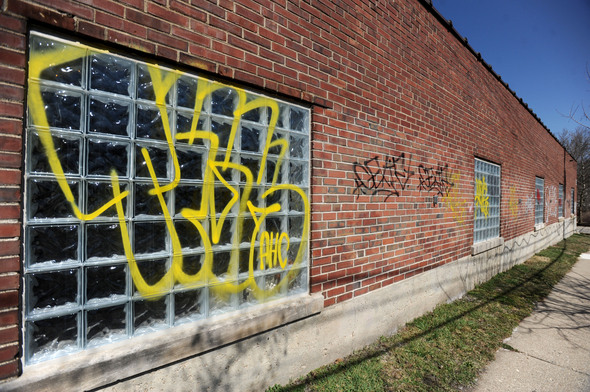
Graffiti has become a problem not just downtown, but across Ann Arbor, officials say. Property owner Rob Cleveland paid thousands of dollars to remove graffiti from this building he owns at 220 Felch St., but taggers struck again just a few days later.
Angela J. Cesere | AnnArbor.com
Although some business owners believe they’ve identified at least two of the taggers, city officials said graffiti is taking a back seat to more serious crimes, such as the recent spike in break-ins.
Rob Cleveland, who owns a building at 220 Felch St., said he understands the decision but he’s frustrated by his building being continually targeted by vandals.
Cleveland said he paid $3,000 to have the building cleaned of all graffiti on March 10. However, when he went back just four days later, it was once again covered with graffiti.
“It’s a huge setback and it takes the incentive to pour money into the building right out of you,” he said.
While the evidence of tagging can readily be found on downtown businesses, property owners and city officials alike emphasize that graffiti has become a citywide problem.
It’s something that the city government has attempted to clean up by enforcing a city ordinance.
On Nov. 1, the city’s community standards officers began citing property owners who had graffiti on their buildings. Cleveland said he’s received a citation and it was immensely frustrating.
City officials he spoke to regarding the citation were sympathetic to his situation, but had to issue the citation, he said.
City Administrator Steve Powers said property owners in the city have complained to officials that they’re being cited for a graffiti problem they don’t believe that they have any control over.
However, with a police force that’s been significantly downsized in recent years, graffiti is not at the top of the force’s list of concerns.
“The city did devote resources to the graffiti eradication,” Powers said. “The police department needed to divert its resources to other crimes, specifically the breaking-and-entering crimes that were occurring.”
Under the city’s ordinance, it’s up to property owners to clean up their buildings after a citation has been issued. The ordinance is complaint-driven and property owners have seven days to remove graffiti after a citation has been given.
Cleveland said he feels taggers are particularly targeting 220 Felch, which he bought three years ago. Not only was the freshly cleaned building targeted last Wednesday, but the skylights he installed on the top of the building were painted as well. The taggers went so far as to etch their marks into the glass, which Cleveland said he’s now planning to replace.
Cleveland said he's heard through the grapevine that property owners in the city are aware of who at least some of the taggers are, but many are reluctant to go to police.
Cleveland and Jim Chaconas, part owner of The State Theater, both reported spending thousands of dollars cleaning their buildings. Chaconas said gallons of paint are now just kept at the building to paint over tags that pop up during the middle of the night.
Chaconas said the “craziness” of Ann Arbor is one of the best traits of the city, but he wishes that taggers — none of the owners or city officials referred to the vandals as artists — would go after the backs of buildings instead of storefronts.
“We’re trying to rebuild retail in this town as it is,” he said. “The image has to be up there in order to keep Main Street, Liberty Street and State Street alive.”
Much of the problem could be solved if the city had police officers do foot patrols down city sidewalks at night, Chaconas said. He said many property owners that he’s talked to have been requesting more foot patrols.
While the expense of cleaning up the graffiti hurts businesses and property owners throughout the city, Chaconas said the community has pulled together and done its best to clean up the tags.
If that diligence faded away, he’s concerned about what the city would end up looking like.
“It starts to make the town look trashy,” he said. “Any bridge, the backs of buildings; if people weren’t as diligent, these (taggers) might make the town look really bad.”
There are resources to help business owners take down graffiti, said Susan Pollay, director of the Downtown Development Authority.
She said the DDA is continuing a grant that allows downtown business owners or property owners to visit Fingerle Lumber or Anderson’s Paint and receive free anti-graffiti supplies.
Pollay said the Mayor’s Downtown Marketing Task Force met last week and graffiti was a major agenda item. Ann Arbor police Deputy Chief John Seto was in attendance and he was made aware of property owners’ concerns regarding police presence downtown and the rest of the city.
While graffiti might not be the most dangerous crime, it is hurting Ann Arbor, according to Pollay. She said police have told her that they’re looking to catch taggers in the act because vandalism is otherwise hard case to prosecute.
Seeing the tags all over town is disconcerting for many Ann Arbor residents, she said.
“All of us have enormous pride in our community and we love our town,” she said. “We don’t want to see people desecrating it just for the sake of desecrating it. It’s not without pain when I see a building that’s been defaced just so people can announce themselves.”
Perhaps the best way to keep the graffiti problem from spreading, and a possible way to limit it, is simply keeping up the effort to paint over tags, Pollay said. The diligence that Chaconas spoke about is one of the things that discourages vandals from coming back to the same buildings over and over again.
She pointed to Republic Parking as an example. Every day, maintenance crews walk through the company’s garages cleaning up debris and looking for any graffiti or vandalism that’s been committed.
“They do such a good job and it’s one way to keep that part from being tagged over and over (because vandals know their work will be erased),” she said.
However, being victimized repeatedly has left Cleveland discouraged.
After having the building cleaned and then tagged again 72 hours later, he’s struggling to see the point in spending thousands to clean up his building when he knows the taggers will likely be back.
He knows he can’t blame the police because their staffing levels are low and they have other priorities. He knows he can’t blame city officials for citing him because that’s the law. But, spending thousands of dollars over and over again to clean up the building will surely run him out of business, he said.
“I’m not smoking cigars and lighting them with $50 bills. I bought the building because it made good sense, and I have good tenants that are as frustrated as I am,” he said.
“It’s harder to do business when it looks like you’re doing business out of a crackhouse.”
Cleveland is offering $2,500 to anyone who provides information to him or the Ann Arbor police that leads to a conviction for the vandalizing of his building. Email him at rob.cleveland@iconinteract.com.
Kyle Feldscher covers cops and courts for AnnArbor.com. He can be reached at kylefeldscher@annarbor.com or you can follow him on Twitter.
Comments
Lincoln8
Wed, Mar 21, 2012 : 12:18 a.m.
While I agree with posters here about how the city is handle this stituation is wrong, the posters are wrong about the "process". The way it works is that the city recieves a complaint. They then issue a notice to have it cleaned up, and then in 7-9 day later if it is not done, it forwarded to parks to be removed. The property owner will be charged for the removal. They can get a extension if they ask for one.
JRW
Tue, Mar 20, 2012 : 5:51 p.m.
"Taggers" are criminals. Period. They need to be caught and punished with some jail time, not a slap on the wrist and a wink. Graffiti is spreading around A2, and the area parks are full of nasty defacements under bridges, on bridges, and on park facilities. It's disgusting. Driving around town, there is more and more graffiti on street signs, buildings and communication boxes. It makes the town look trashy and will attract more of the wrong elements. There are not artists, they are criminals. Last fall, one neighborhood in the Pattingil area had a rash of graffiti on homeowner's cars, houses and fences. Report all that you see around town to the police. Zero tolerance is the only way to stop it. Businesses need to install cameras so these perps can be caught. People who think this is a non-problem or "art" should think about how they would react if a thug sprayed their caror house with black spray paint.
Jim Osborn
Tue, Mar 20, 2012 : 12:19 p.m.
For the past several years, our tax dollars via the Ann Arbor District Library have sponsored a graffiti educational how-to-do-it or a Get-interested-in-it. Drive during the Art Fair for teens. They provide big white sheets and paint and make it seems cool. After it is over, and the adults and the free sheets are gone, the teens quickly figure out that they do not need a sheet, but a white wall of a building. 12 years ago, Ann Arbor had no graffiti problem, and then the library began to encourage teens to do this. Why? This has to be one of the worst examples of tax dollar expenditures in this city; a small amount spent that causes a lot of damage. I would like to hear from Josie Parker why she thinks this is a good idea.
toothless wonder
Tue, Mar 20, 2012 : 6:37 a.m.
A company could be created to deal with such scenarios! Ever notice how terrible the images are on outside security cameras? Well, if someone had one of those bucket-vans they could be for hire. Install temporarily, a laptop system with night vision excellent image cameras,Zoom in capability, hidden. Rent your service out! It aint magic.. You want to get to the bottom of things or not? At crime scenes, bar parking lots, banks, graffiti magnets... It may seem Greek at first but the pieces will come together by association. Is there an actual active gang in the area? Are there punks gettting off the freight train nearby and marking stuff? Hate crimes, or college pranks, etc etc.
Jon Saalberg
Tue, Mar 20, 2012 : 2:24 a.m.
Hmm, and at the same time, annarbor.com publishes a story about the glorious weather, with a photo of the artfully-covered train car down by Main Street, with the story caption, "Walkers make their way past a colorful train car covered with graffiti as they walk along the Huron River on Monday morning..." So it seem that one story's vandalism is another story's enhancement of a lovely day.
mcdunnough
Tue, Mar 27, 2012 : 1:03 a.m.
Jon heard your artist is on ice in Livonia. Hope he has a lovely day. More to come I would imagine.
John Minock
Wed, Mar 21, 2012 : 10:05 p.m.
Leaving aside the fact that this is crap and not artistic by any stretch, when tagging is done without the owner's permission and causes expenses to clean the damage, that is a crime, and the tagger is a felon.
decaad
Tue, Mar 20, 2012 : 2:15 a.m.
Even if they are caught these staggers will most likely be place on probation change there tag and be right Back at it in no time
alterego
Tue, Mar 20, 2012 : 12:51 a.m.
So it's okay for a business owner or entertainer to post paper flyers on utility poles without ever having to take them down and using metal staples which are left there permanently. But it's not okay for private citizen to leave permanent marks on a business. But it is okay to make the business pay to remove these marks. But it is okay for a private citizen to allow their own personal property to fall into disrepair until it becomes so blighted that the city considers giving it a facelift. To me, none of these are acceptable. But we send mixed messages with our rules and regulations. We either need to learn to tolerate these behaviors or figure out a way to make them unappealing to the perpetrators.
firstfolio
Mon, Mar 19, 2012 : 11:22 p.m.
graffiti is part of urban living,saw it in Paris and London
spm
Tue, Mar 20, 2012 : 1:54 a.m.
Right, I saw it too. They were tagging castles and it looked horrible. NY's idea of the broken window theory worked. We need a mayor who will nip this type of crime in the bud.
firstfolio
Mon, Mar 19, 2012 : 11:43 p.m.
it's just not a big deal for me,graffiti,...and the origin of the word is mid 19th century Italian...
Hot Sam
Mon, Mar 19, 2012 : 11:27 p.m.
Imported from America...makes you proud doesn't it?
The Great Gazoo
Mon, Mar 19, 2012 : 10:46 p.m.
Here is an idea …. If these poor misunderstood 'taggers' need an artistic outlet. Round them all up and give them a couple of cans of paint and drop them off in the front of the mayor's house and the homes of each member of the DDA. Then they too can enjoy the pleasure of these poor misguided peoples 'Art'
Pappa
Mon, Mar 19, 2012 : 9:51 p.m.
I agree with some of the other posters... stake it out with multiple tough friends, maybe bring a gun or two in case things get crazy, precede to kick anyone's ass that spray paints your building.
bunnyabbot
Mon, Mar 19, 2012 : 9:30 p.m.
Mr. Cleveland might want to take a drive down to Cabelas and pick up some hunters nightvision camera, they have models that are motion activated. They can be easily be installed on trees and poles. It might also be advantageous to hire someone to "stake" the place out for a couple weeks. Someone might be willing to do it for an extra $100 a day or so? Then offer them the balance of the $2500 reward if they catch the culprites.
The Great Gazoo
Mon, Mar 19, 2012 : 8:30 p.m.
It all boils down to respect… This is what we get for the past two decades of parents that simply walk away from their responsibility of raising their children, and the remaining group for parents going overboard not to hurt their children's feeling's by putting them into time out or by not holding their children accountable for their actions while growing up. Now what do we have, but a load of trolls that roam free throughout the town and aren't worried by any consequences because they have the idea that they can and will get away with it. I believe that the penalties for these non-violent crimes should be more severe and not simply a slap on the wrist. Besides full restitution, they should be required to work around our town cleaning up trash and removing Graffiti from area's that have become targets. Make them work to pay back society, stop sending them to day camp where they get to see their friends and watch TV. If the risk of getting caught is more severe that the 'street cred' they receive for being a fool with a can of spray paint, and if they are forced to work of their debt to the property owners, I bet that it would curb alot of these problems. It's time for Ann Arbor's parents and citizens to stand up and no longer allow this behavior to be allowed, take control of your lives and stand up to your children and teach them respect. If you see someone committing a crime report it, yell at them, take a picture with your cell phone and send to everyone so the word gets out. We won't put up with this crud anymore !!! Because if you don't stand up for yourself or what is right then why should anyone else ?
Richard C
Mon, Mar 19, 2012 : 8:20 p.m.
I wish the city and the police would see the benefit of going after taggers - isn't the there a theory about how cracking down on this kind of thing reduces crime overall? If the police can't do it afford patrols, maybe the property owners victimized or potentially victimized can organize a camera-patrol that might get enough evidence for the police and prosecutors to nail the taggers. Or if the prosecutors aren't willing to try, maybe bring a civil suit for "defamation" against the taggers. Could cab drivers and local delivery companies be brought into this as a neighborhood watch sort of thing?
FedUpinA2
Mon, Mar 19, 2012 : 6:50 p.m.
Having read the article, and all the comments, I must say someone may have found a solution by having a public wall, in a public place, where the "artists" can do their thing. I know they have such a wall on Venice Beach in California, and it seems to work very well. The added benefit of such a wall is that the new artist covers the old artists' crap. We can't rely on the police department with it's current under staffing. What would a painting wall cost? Put it in a park for all the world to see! It certainly wouldn't cost $750,000.00, like the city hall "sculpture."
The Great Gazoo
Mon, Mar 19, 2012 : 8:37 p.m.
A2 already has an area for this crap... it's called the rock and it look awful.
Stephen Landes
Mon, Mar 19, 2012 : 8:24 p.m.
No! Allowing this crap anywhere gives it justification. It will not remain confined to an "approved" wall. Those who believe they should be able to tag stuff now will do it wherever they go.
Berda Green
Mon, Mar 19, 2012 : 5:18 p.m.
i hope they can catch them cause i dont like it its everywhere
EyeHeartA2
Mon, Mar 19, 2012 : 5:03 p.m.
Yep. We do it up different. Wonder why this fantastic street art didn't make the video? Anyway, if it cost $3000 to clean up, how does this compare with the loss of a B&E? If they know who the vandals are, why not go get the ones they know about at least?
lefty48197
Mon, Mar 19, 2012 : 4:54 p.m.
Detroit had a problem with taggers downtown a couple of years ago. They caught two taggers who from out of state. They tossed the guys in jail for 90 days. I don't think they've been back to Detroit since. Ann Arbor and U of M police are far more interested in handing out tickets to people who turn right without using a turn signal. The property owners are going to have to police this situation themselves since the city and the police department have no interest in doing so. I suggest that the property owners take turns patrolling downtown at night and that they carry legal firearms in case there is an altercation of some sort.
nowayjose
Mon, Mar 19, 2012 : 10:32 p.m.
Spoken like a true traffic violator
newsboy
Mon, Mar 19, 2012 : 4:47 p.m.
I got to thinking about the reward being offered; was that dead or barely alive?
newsboy
Mon, Mar 19, 2012 : 3:56 p.m.
If you profile these culprits you will find that they are generally young males with little or no adult supervision. The adult males in their lives are generally absent or lacking in positive influences. These "taggers" as they are known, have little or no travel experience feeling that the "center of the universe" is where they reside. "Taggers" generally do not possess transportation greater than a bicycle or public transportation. From what I've read if at all possible; they seem to be almost completely illiterate and incapable of clear and concise communication skills. "Taggers" may possibly be in possession of some form of secrete, unknown, primitive or tribal language. One would assume these individuals have little control in their own lives, most possibly living on some type of "public assistance" or "public housing." Paints are generally stolen if higher quality, or purchased at a second hand store if lower quality. Tagging is inherent to the male species, as a means of warning, turf identification and ownership. Tagging can also be a statement that one simply exists on a planet occupied by billions of people. If you want to catch these individuals it's quite simple; but if you want to solve these problems you must "dig a little deeper" and eliminate the causes. Orphanages, Good schools, Teachers and Moral education come to mind! Welfare, Public Housing and Children as means of income are a dead-end street riddled with the signs of poverty and disparity. The children of the affluent are just as at risk as those with little means. Spend some quality time with your kids and their friends, it does make a difference.
JRW
Tue, Mar 20, 2012 : 5:54 p.m.
You can provide all the info you want about "tagging" but it is a criminal activity and needs to be treated as such. Find the punks and prosecute.
YpsiLivin
Mon, Mar 19, 2012 : 3:54 p.m.
I agree that something needs to be done about the problem. My initial suggestion involves a late-night stakeout and some paintball guns. (After all, turnabout is fair play, right?) The real solution is a security camera set-up. Find out who's doing it and turn them in. It's likely to be a small number of individuals who haven't yet gotten caught, and they haven't gotten caught because catching taggers isn't a policing priority. Unfortunately, when it's not a policing priority, graffiti simply begets more graffiti, and people who would otherwise be comfortable in a neighborhood move elsewhere. When the taggers do get caught, deal with them very harshly and very publicly. Fine the he!! out of them for each instance of their graffiti. Make them clean up all of the graffiti in a specific area, whether it's theirs or not. Make them reimburse (double) the building owners who have already had to clean/remove graffiti and restore a building, and make them spend some time in jail. Further, make sure all of the hardware stores in the area know who the tagger is, and ask them to report their subsequent paint purchases to the police department. Yes, you can find anti-graffiti coatings for buildings. Paint applied on top of the coating simply beads up and rolls off. You can wash off any remaining residue with a hose.
ddjames
Mon, Mar 19, 2012 : 3:51 p.m.
They are like dogs, cats, bears, and monkeys. Why? Read on. I DETEST graffiti because it signifies an increasing societal disrespect and imaginary ownership of something that is not theirs. It's NOT just downtown Ann Arbor. It's all along the I-94 Jackson Road Corridor. This is another example of a sense of ENTITLEMENT attitude that continues to take hold in our nation. These people have No respect for anything or anyone. These people are hoodlums. Occupied, unoccupied--they don't care. It ALL BELONGS TO THEM. They walk, they see, they possess. Just like dogs mark their territory--these unintelligent creatures are marking theirs. And WE--the law abiding taxpayers, home owners, and business owners--have to look at it. Ann Arbor is quickly LOSING all of the reasons we chose to move here, raise our children here, buy homes, and open businesses here. Isn't it true, we are always are own worst enemies. Good bye Tree Town...forget Technology Town...it's Hello Graffiti Town.
Wolf's Bane
Mon, Mar 19, 2012 : 11:31 p.m.
I love, love, love Graffiti because it hints at how wonderfully creative the town is.
Hot Sam
Mon, Mar 19, 2012 : 9:14 p.m.
Well said DD
Jim
Mon, Mar 19, 2012 : 3:38 p.m.
For not much money, some discreet wireless cameras could be installed to monitor areas at risk. If I owned a large property plagued by this problem, I would be looking into this sort of technology very closely.
Wolf's Bane
Mon, Mar 19, 2012 : 3:20 p.m.
I believe Councilman Taylor is behind the tough anti-Graffiti ordinance. Link: http://votetaylora2.com/graffiti/
grimmk
Mon, Mar 19, 2012 : 3:18 p.m.
I wonder if they could make a Teflon kind of coating that wouldn't let the spray paint stick?
Hot Sam
Mon, Mar 19, 2012 : 9:11 p.m.
No, make the consequence WAY worse than any reward...
grimmk
Mon, Mar 19, 2012 : 7:54 p.m.
Ok, then how about cattle fencing around all the buildings? Electric shocks will keep "taggers" away. But that's a lot of money. No, we shouldn't have to do anything. I was just putting something out there. FAR out there. Maybe it could be clear coating?
justcurious
Mon, Mar 19, 2012 : 4:34 p.m.
Who wants to paint a nice brick building. Should not have to.
Wolf's Bane
Mon, Mar 19, 2012 : 3:16 p.m.
But Graffiti is street art!!! This is what the city wants, don't hate, let's award them the city's coveted "Golden Paint Brush" award for beautifying our city!
grye
Mon, Mar 19, 2012 : 3:15 p.m.
It is definitely absurd that the city would fine a business for failure to cleanup vandalism, however is there any correlation to the influx of new residents to the increase in "tags" being spray painted on buildings? if so, then target those people. This has become more of a nuisance recently. If a building is being re-tagged within a week after being cleaned-up, the police and volunteers could easily set up a surveillance on a building to catch a few of these twerps and make and example out of them.
MIKE
Mon, Mar 19, 2012 : 3:14 p.m.
Ann Arbor has a relatively small graffiti problem. The way to nip it in the bud is to make it a priority. Assign 1 officer to it, call him the "vandal squad", and let him learn who is doing what. Let him cultivate a few informants, and stake out locations that are likely to be hit. This it what NYC did in the 70's and 80's, when they had a huge problem. Of course, Ann Arbor believes in less policing, not more, so there's probably nothing that can be done.
Mark
Mon, Mar 19, 2012 : 3:14 p.m.
It's vandalism. Catching a tagger in the act followed by an ass-kicking would deter him. My personal preference would be to punish with community service -- to remove their stupid "dog marking" routines. However, if it were my business and I caught someone spraying their paint on my walls, holding the perp down and spray-painting his entire body might be a good punishment to start with.
DENNIS
Mon, Mar 19, 2012 : 3:04 p.m.
Property owners should check with Overspray Experts . They helped me and I didn't pay near that much.
Stephen Landes
Mon, Mar 19, 2012 : 2:52 p.m.
Graffiti isn't just tolerated -- it is encouraged by people who praise some of this vandalism as "art". We may need more police involvement and building owners may need to install trail cams or other devices to catch these perps, but our greatest need is to get the Arts community to stop encouraging these people to damage other people's property. There is no place for this kind of disrespect in a civil society. If we can leave it up to graffiti-ers and taggers to decide what needs their work to make it beautiful, what will artists say when their public work is tagged and marked because some vandal thought their work was ugly and needed beautifying?
John Minock
Mon, Mar 19, 2012 : 2:42 p.m.
The tagging is getting worse and will likely increase. And it is spreading beyond downtown to residential areas. This should be of concern to neighborhood associations throughout the city. Consider joining your association and make this an issue. From the geographic distribution of the tags, it is very likely that 2 of the most prolific taggers live in the near northwest side. The third one referenced in the article is from a suburb.
DNB
Mon, Mar 19, 2012 : 2:57 p.m.
It has spread to residential neighborhoods around A2, too. Vandals went crazy tagging brand new privacy fencing in Boulder Ridge sub last year; they're still doing it. It gets cleaned up, or stained, and they do it again. They were even bold enough to tag Pittsfield Twp's Chief of Public Safety's new fencing, too.
Ron Granger
Mon, Mar 19, 2012 : 2:41 p.m.
No amount of police will stop determined vandals. People need to stop fixating on that. I am not going to pay to station a cop outside your business all night long. Cameras are cheap. Buy some. Figure out what time they strike. Use the images to identify the perps. You may even need to team up with other business owners to stake out properties. Hire someone for $5 an hour to watch a frequent target property all night. 5 hours a night x $5/hr = $25/night. $3000 will buy 120 days of coverage. Or, take turns with other business owners and do it yourself. How long do you really think it will take to catch them if they keep hitting the same places? Get a commitment from the prosecutor to impose stiff sentences. If the law in A2 is not strict enough, pressure the council to change it.
MIKE
Mon, Mar 19, 2012 : 3:09 p.m.
$5 dollars an hour? What's the minimum wage these days?
Dexterdriver
Mon, Mar 19, 2012 : 2:40 p.m.
Ann Arbor is one of those places that gives the "green light" to almost every sort of kooky, misfit behavior. "Occupiers" are allowed to squat on public property. Illegal aliens roam the area without risk of arrest. So why is there surprise that street jokers assume the "community" would endorse their wonderfully creative scrawlings on public and private structures in the City? This dumb behavior has been elevated almost to an art in some parts of the country, probably out of fear of retribution from these pseudo-artists, more like scrawling scratchers. Bust 'em and lock 'em up!
Arboriginal
Mon, Mar 19, 2012 : 2:40 p.m.
Tagging is not art. It is crap.
Bob Heinold
Mon, Mar 19, 2012 : 2:34 p.m.
Another stride to a pre-Giuliani NYC. Same routine: priority enforcement due to poor $ priorities, then piously tell property owners they are responsible. Calling PD about anything less than a break-in or murder is a waste of time, which I found out when I called the desk--everything was done to downplay my concerns. I know AAPD cites crime statistics, only problem is that what is reported is a matter of interpretation by the police. -Bob
leaguebus
Mon, Mar 19, 2012 : 2:30 p.m.
A couple of motion sensitive lights on the back of the building, a wireless router, several wireless cams, and a computer would probably catch these guys in a few weeks. Then when caught, put them on probation and use the them to clean up the graffiti in the city.
Jojo B
Mon, Mar 19, 2012 : 2:26 p.m.
Attention A2 graffiti "artists": Your "work" sucks and your tags are lame. Take a lesson from Banksy or other street artists and do something more creative and target spots or projects that people will actually appreciate. Channel all of that negative garbage into something better and you might one day get an audience.
annarboral
Mon, Mar 19, 2012 : 1:59 p.m.
Why don't we create a place where the graffiti taggers can go without fear of being arrested? How about the new city hall & courts? Spray painting what looks like recycled WWII quonset huts would be an improvement. Also, spray painting "the finger" would be an enhanced art project. Hey, free art, less crime and no cost.
zanzerbar
Mon, Mar 19, 2012 : 3:45 p.m.
"recycled WWII quonset huts "...I agree.
Greg M
Mon, Mar 19, 2012 : 1:57 p.m.
It's amazing that they penalize the victims for graffiti. I'd take that to court. It's simple. The police department gets paid to perform a service to the community. That service is to serve and protect and uphold law and order. Now, if law and order in a community isn't controlled, who's fault is it? The taxpayers? I think not…The problem is when local government agencies decide to, let's say, shrink the police force, don't make them more efficient before doing so. Now you have an imbalance of authority verses crime. When that happens, crime runs amuck. Regain control by enforcing stiffer penalties. Let's say a tagger get's caught, or any other criminal, for that matter, make it something the criminal remembers. If convicted the criminal should have severe community service duties to perform. Make them do community service that would be added onto their current employers requirement for a total 120 hours per week for 3 months straight. If they don't have a job, well, they get to do 120 hours of community service alone per week. There are lot's of projects that can be done around the city that would save the taxpayers money if handed out in punishment without pay. They wouldn't have time to cause any more trouble and they just might learn to appreciate their responsibility as a part of the community to make it a better place to live. I'll bet they would even do their part to deter vandals, otherwise, they'll be cleaning it all up right next to them. Raise the stakes in a poker game and see how many fold when the cards they hold can't beat the dealer.
bluetonguedlizard
Mon, Mar 19, 2012 : 1:56 p.m.
If you paint over it you are just asking for them to come back again and again. A friend who owns a warehouse in a foreign city tried dealing with graffiti for years, he finally installed a chalkboard on the side of his building and left plenty of chalk for the artists to use - guess what he never had graffiti again.
ranger007
Mon, Mar 19, 2012 : 1:51 p.m.
I hope they arn't leaving their car idling.
cornelius McDougenschniefferburgenstein jr. 3 esq.
Mon, Mar 19, 2012 : 4:09 p.m.
or looking out thier window or driving when there is a pedestrian on sidewalk.
Brad
Mon, Mar 19, 2012 : 1:40 p.m.
Do you have a home/business downtown that's been vandalized? Then the DDA will help you out using diverted property tax dollars. In the other 95% of town? Too bad - quit whining and clean up your graffiti before we fine you.
jcj
Mon, Mar 19, 2012 : 1:39 p.m.
My advice would be to get an infrared trail cam. Cost about $100. The CRIMINALS would not even know they were being photographed because they use no flash.
DNB
Mon, Mar 19, 2012 : 1:22 p.m.
Maybe it's time for some good old vigilantism; protect our businesses and common areas. Stake out your property and wait for the vandals; I remember my Dad always taking matters into his own hands back-in-the day. He would sit in his truck until they showed up, but he usually caught them: vandalizing our property during contruction, cutting down blue spruce trees, dumping garbage in the ditch, and pulverizing the mail box. They were usually teens, the usual trouble-makers that lived down the street. Same type of miscreants we have today tagging our properties.
hard core ann arborite
Mon, Mar 19, 2012 : 1:09 p.m.
A hidden night vision-capable camera or two would be cheaper than graffiti remediation. If it's just a few taggers then one of them getting caught might dissuade the rest. Are there any neighborhood watch groups that could be alerted to this? There are always people jogging and walking dogs around this town, even at night, who could call 911 if they see tagging going on. It does seem like the ordinance punishes the victim. I would not like being a property owner and being forced again and again to get rid of graffiti within 7 days at significant cost - between the ordinance and the taggers, owning a building in Ann Arbor gets a LOT less attractive.
decaad
Tue, Mar 20, 2012 : 4:20 a.m.
That's a really great idea I use trail came for hunting they are night vision and motion activated and some will even shoot video. They run from a couple hundred to four or five hundred bucks. They could easily be positioned in high graffiti area at a nominal cost.
StephinA2
Mon, Mar 19, 2012 : 1:08 p.m.
But . . . isn't this public art? Art made by the "public" on public property? Seems somewhat hypocritical that the City should object to it and find it distasteful. (heavy sarcasm intended here) But, seriously, maybe the City should use some of the funds from the public art bucket to clean it up rather than penalize the innocent property owners/victims.
Long Time No See
Mon, Mar 19, 2012 : 6:40 p.m.
This seems like a good idea to me. Why not go further and use some of the art bucket funds to help protect the art by paying for nighttime police foot/bicycle patrols? (or is paying for the maintenance of the art not allowed?)
JMK
Mon, Mar 19, 2012 : 1:03 p.m.
It is interesting the building owners are fined if they do not clean up after someone else, yet there isn't help from the city. I say stop cleaning up, stop paying fines and the city will have to step up for resolution that is win win for all. And, I know this is extreme but vigilantism may need to happen. I find it very interesting if someone is committing a crime and the "victim" fights back the assailant is protected. People will stop messing with others if they think there is a chance they will not be protected from the law. My grandmother use to say, "your rights end where mine begin".
cornelius McDougenschniefferburgenstein jr. 3 esq.
Mon, Mar 19, 2012 : 4:07 p.m.
then the city would take the property.its part of the plan.
Rob
Mon, Mar 19, 2012 : 12:54 p.m.
I bet the B&E and the graffiti are related. No, really - the B&E crimes are intended as distractions to the police so that the vandals can go and piss their territory markers all over. The cops are so busy reacting to the B&E reports that the graffiti goes unchecked! It makes TOTAL SENSE!
thinker
Mon, Mar 19, 2012 : 12:53 p.m.
MSU had problems with all the paint and graffiti on the Sparty statue outside their stadium, and had it coated with an anti-graffiti substance. There are many (a quick google search reveals that) that are environmentally safe and effective. While education and enforcement are important, some kids just cannot resist a blank slate. How about when they are finally arrested they are made to help apply the protective coating to their canvas? Maybe even get a job and help pay for it?
JRW
Tue, Mar 20, 2012 : 5:55 p.m.
No, if they are caught, they need to spend some time in jail to understand that vandalism is a serious crime.
JMK
Mon, Mar 19, 2012 : 12:53 p.m.
why not install security cameras?
jns131
Tue, Mar 20, 2012 : 3:05 p.m.
We are talking about those as well in our area. Those things are expensive to install and maintain. But, once installed? They do help. It is getting it approved by the counsel and board to get it moving. We are still fighting our township to get them in. Good luck.
rusty shackelford
Mon, Mar 19, 2012 : 12:46 p.m.
I'm not down with these people for reasons stated above, but I hope you all realize that provoking the local yokels is probably the most fun part of all this for the people doing the graffiti. So far you haven't disappointed, and I'm sure it will only get more entertaining from here.
a2cents
Mon, Mar 19, 2012 : 2:41 p.m.
jcj: wanna be?... that is not part of the low life's equation
jcj
Mon, Mar 19, 2012 : 1:37 p.m.
And "for reasons stated above" You would not find it so funny if you worked for what you had and some lazy wanna be destroyed it!
Brad
Mon, Mar 19, 2012 : 12:44 p.m.
The vandals have also been visiting the Georgetown Mall corpse at regular intervals. I'd report it to the city except I've yet to decide if it makes it look better or worse. One thing I'm sure about - the city leaders don't care much if they can't see the blight from downtown.
63Townie
Mon, Mar 19, 2012 : 12:43 p.m.
No surprise here. AAPD doesn't have enough resources to apprehend a rapist or the people responsible for the recent rash of B&Es. Painting over tags just gives the tagger a clean slate.
joe.blow
Mon, Mar 19, 2012 : 12:42 p.m.
Think of how us citizens feel about the city council blowing millions of our money on "art" that we think is an eye sore and then know will never go away!
Brad
Mon, Mar 19, 2012 : 1:26 p.m.
Dali "Llama"? Actually that would be Mahatma Gandhi who is not related to any member of the llama family.
clownfish
Mon, Mar 19, 2012 : 1:03 p.m.
Run for office. Be the change you want to see- Dali Llama.
Rob
Mon, Mar 19, 2012 : 12:53 p.m.
The vandals could always target the "art" - nobody would care, and it might even improve some of it!
xmo
Mon, Mar 19, 2012 : 12:41 p.m.
Once again, You voted for these ANTI-BUSINESS city council members. Its cool in public to bad mouth business people and conservatives but when it hits your wallet or purse you realize being liberal is not affordable!
clownfish
Mon, Mar 19, 2012 : 1:02 p.m.
What are vacancy rates in zoned business districts in Ann Arbor? If your claim that council members are ANTI-BUSINESS is true, then I think we would see high vacancy rates. could this be anything like claiming the president is ANTI-BUSINESS when corporate profits hit record highs, the stock market is at near record levels and hiring is better than it has been for years? Could be.
The Picker
Mon, Mar 19, 2012 : 12:38 p.m.
This article would be better if the reporter could tell us how many vandals have been caught and convicted for this crime, by city police. My guess is none ! If the police can't improve their success rate, vigilantism could become the next problem, and that's a vicious cycle we can do without.
JRW
Tue, Mar 20, 2012 : 5:58 p.m.
If any have been caught, what has been the consequence? A slap on the wrist? If so, that's not going to stop any punk from continuing his or her criminal activity of damaging and defacing property.
AnnieWood
Mon, Mar 19, 2012 : 12:33 p.m.
The City completely blew my Westside neighborhood off when we complained about tagging last year. Since then I see one of our little friends has tagged his/her droppings everywhere about town. It's not so fun when it happens to your property, is it? When you catch up with this "artist", we would like to submit a bill for vandalized property.
jns131
Mon, Mar 19, 2012 : 9:16 p.m.
Sounds like your Neighborhood Watch people are lacking. Need to get vigilant and get the bugger. We are taking ours back and it is making a difference. We see cops all over the place whence we start complaining. But then again, Ann Arbor is cutting back on its force, right?
Unusual Suspect
Mon, Mar 19, 2012 : 12:19 p.m.
"Taggers?" I'd suggest the term "vandals."
Unusual Suspect
Mon, Mar 19, 2012 : 1:34 p.m.
It's not semantics to point out crime is crime. It's the use of words like "tagging" that seek to introduce a moral relativity on the vandalism and shift the problem to hose of us who just don't understand art and the expression of some youth's angst. It's like saying if somebody were to say something completely ridiculous like, "Some wall painting can look kind of cool--e.g. the stuff .. on the railroad bridges on the west side." Kind of cool? Causing tens of thousands of dollars of damage to private property is "kind of cool?" Only in Ann Arbor.
rusty shackelford
Mon, Mar 19, 2012 : 12:48 p.m.
Um...OK? You're the one who brought up semantics. Pointless comment is pointless.
Unusual Suspect
Mon, Mar 19, 2012 : 12:40 p.m.
Thanks, Rusty, we're all familiar with the terminology. However, I really don't think a property owner who has to spend thousands of dollars for repairs gives much a care to whether pop culture wants to call it "tagging" or "vandalism." Either way, it's crime and it's expensive.
rusty shackelford
Mon, Mar 19, 2012 : 12:23 p.m.
"tagger" is a term to distinguish those who merely write their name or handle on things vs. people who paint murals, etc. both are technically vandalism, but the former is generally a lot uglier, especially when teenagers from a small town are responsible, as in this case.
smokeblwr
Mon, Mar 19, 2012 : 12:08 p.m.
"Cleveland said he's heard through the grapevine that property owners in the city are aware of who at least some of the taggers are, but many are reluctant to go to police." Why would somebody be reluctant to go to the police to report these artists?
Unusual Suspect
Mon, Mar 19, 2012 : 12:22 p.m.
"Artists?"
justcurious
Mon, Mar 19, 2012 : 11:58 a.m.
"Tagging" and "taggers" sound so innocent and sort of cute. You want to turn Ann Arbor into a big city, you get big city problems- crime and graffiti. I'm afraid these problems are here to stay. Maybe the city could set aside a "bucket" to collect funds to clean up the graffiti, like they do for art. But actually, the dirty streets and unkept public landscaping make the graffiti kind of "fit in".
rusty shackelford
Mon, Mar 19, 2012 : 11:42 a.m.
I wouldn't have quite as big a problem with this if the new taggers weren't so wack. I mean, I've seen the new tags, and they just show absolutely 0 skill. Some wall painting can look kind of cool--e.g. the stuff behind Mich Theater and on the railroad bridges on the west side. Even some taggers can do cool stuff--MARM or duck as 2 examples. But most taggers are just...a word I can't use here. I remember someone had done a really cool abstract piece on the side of a building on South U, and a bunch of taggers just scribbled over it with a bunch of homophobic epithets. This stuff is just weak. If this is the best you can bring, do yourself a favor and stick to MS Paint in your basement studio apt.
unclemercy
Mon, Mar 19, 2012 : 1:45 p.m.
toys.
jcj
Mon, Mar 19, 2012 : 1:35 p.m.
You are no better than any in this country that think it's fine to take what belongs to others. Same difference here! You are: a) joking b) not a property owner c) out of your mind
rusty shackelford
Mon, Mar 19, 2012 : 12:58 p.m.
Commenter 1 changes the terms in order to avoid acknowledging the qualitative difference he himself demonstrated in the first place. Commenter 2: in short, yes. There's a difference between people who try to beautify an ugly area (e.g. a train overpass) and those whose actions make something uglier. I'd also be fine with seeing Starbucks, 7/11 etc tagged vs local businesses. I have degrees of reprobation beyond "rabble rabble."
justcurious
Mon, Mar 19, 2012 : 12:49 p.m.
So Rusty, it's ok with you if people vandalize public property or even private property if you like their "art"? That's the kind of attitude that perpetuates this stuff.
aajeff
Mon, Mar 19, 2012 : 12:47 p.m.
"House" = "property". So it's okay if this is done on someone else's property as long as you think it is cool?
rusty shackelford
Mon, Mar 19, 2012 : 12:21 p.m.
seems irrelevant given that neither of them has either tagged a house to my knowledge. if you've seen one of their tags on someone's house, let me know.
aajeff
Mon, Mar 19, 2012 : 12:12 p.m.
Bet this "cool stuff" that two of your favorites do would not be quite so well received by you if it was done on the front, back or sides of your house.
walker101
Mon, Mar 19, 2012 : 11:35 a.m.
Starting to look more like Detroit inner city.
jns131
Mon, Mar 19, 2012 : 3:14 p.m.
I disagree with this one. Detroit is taking a pro active stance on graffiti. Once seen? Removed. Yes, it does cost money, but it is better in the long run to get rid of it quickly. Ann Arbor may be balking, but heck, gotta get it done. Right?
rs
Mon, Mar 19, 2012 : 11:23 a.m.
I was driving down 7th St last week and just about every street sign had been tagged. It would be refreshing if the city would lead by example and clean the tags off their own property before fining property owners for being victims of the same crime.
lefty48197
Mon, Mar 19, 2012 : 4:58 p.m.
GREAT point! Any property owner who gets fined, should turn around and sue the city for failing to repair graffitti on their own property.
Stephen Lange Ranzini
Mon, Mar 19, 2012 : 11:23 a.m.
The spread of graffiti downtown and then throughout the city has increased significantly over time. It is a problem that if not addressed will undermine the quality of life in Ann Arbor. Solving this problem requires dedicated law enforcement resources. Having just five officers on patrol each shift in a city of 114,000 across 27 square miles is insufficient. We need more police. Here is a good quote that sums up why pretty well: "Residents often complain about having to wait for hours for officers to show up to crime scenes and car wrecks. The head of the patrol officers' union said in July 2011: 'Ten years ago, we used to catch people. Now we just don't even have the staffing to set up a perimeter or bring in a K-9 unit — we're so reactive now.' Shouldn't residents in the city expect pro-active and as opposed to reactive policing? The cops are saying they don't have enough officers to catch the bad guys and investigate the crimes." From http://www.a2politico.com/2012/03/lanx-satura-sat-ahyuhr-ann-arbors-mayor-hieftje-talks-about-crime-spree/
aajeff
Mon, Mar 19, 2012 : 11:21 a.m.
It is utterly outrageous that this City not only fines the victims of these crimes but gives them seven days to remove the evidence of the crime. Find a contractor, purchase the paint and then hope the weather cooperates so the job can be completed in seven days!!! And the DDA says the best way is to continue to paint over the graffitti time and time again and this will deter the taggers? Really? Guess the business owner wouldn't have to keep repeatedly doing this if that worked. If the City treated the criminal with the same heavy hand as they treat the business owner we might just see some improvement to what really is a serious problem. I'd like AA.com to find out what really happens to the taggers that are caught. We might understand then why this continues on the scale that it does.
Carole
Mon, Mar 19, 2012 : 2:29 p.m.
Have to love DDA's response -- maybe they should take time off and clean up the mess.
motorcycleminer
Mon, Mar 19, 2012 : 11:06 a.m.
Graffiti here in OZ...Oh no Toto.....looks like somebody left the bubbles back door open..welcome to the nanny state and the permissive society ..parental controls... oh thats so old school...just let the stray dogs run amok and leave their mark be they 99% er's or gang bangers...it's the new world order get used to it..maybe if they tag the tongue depressor it might get the merry bands attention..but I doubt it
ChrisW
Mon, Mar 19, 2012 : 10:52 a.m.
The city blames the victim. Nice. What next, fining people who have their cars stolen or get mugged?
getmoney
Mon, Mar 19, 2012 : 3:43 p.m.
Uh, only in a2. Tagging victims on par with mugging victim or even car theft victim? Really?
Rob
Mon, Mar 19, 2012 : 12:51 p.m.
Well, you know - it DOES result in costly police time being used.
aa1940
Mon, Mar 19, 2012 : 10:51 a.m.
This is just another example of the city government shirking their duty. Susan Pollay says " We love out town". I have news for her AnnArbor is a city, get use to it.
cornelius McDougenschniefferburgenstein jr. 3 esq.
Mon, Mar 19, 2012 : 4 p.m.
if city buildings were painted who would the city send thier fines to?
cook1888
Mon, Mar 19, 2012 : 10:47 a.m.
So - the victims of a crime are being fined for the crime. I guess Ann Arbor does do it "different."
getmoney
Mon, Mar 19, 2012 : 3:41 p.m.
Aren't they given a chance to remove the tagging? I thought that was why they are fined.
Carole
Mon, Mar 19, 2012 : 2:28 p.m.
Maybe if they were made to clean up their mess and fined it might be a tad helpful.
a2grateful
Mon, Mar 19, 2012 : 10:42 a.m.
"There are resources to help business owners take down graffiti, said Susan Pollay, director of the Downtown Development Authority." DDA solution is to paint over graffiti? Certainly, owners of natural brick buildings, like the one pictured, are reluctant to paint over natural brick. I would be discouraged as well. More discouraging is how the city marshals resources to combat graffiti: Stiff fines to owners that leave graffiti . . .
Silly Sally
Tue, Mar 20, 2012 : 3:24 a.m.
this silly city actually taxes us to then have the library teach young teens how to use spray paint on white sheets. This is done during the Art Fairs. Now we have a problem. Then they move onwards to buildings. So silly. This practice should stop
simply amazed
Mon, Mar 19, 2012 : 2:22 p.m.
Beware of "resources". Those resources are limited to $50. So if you go to Fingerle's to buy elephant snot (the only really good graffiti remover for natural brick), you will pay the balance since this cleaner exceeds the allowable resource.
Carole
Mon, Mar 19, 2012 : 10:40 a.m.
Because of the shortage of police, we all have to help out and assist. Whenever we see actions that are questionable, we need to call dispatch or whatever action possible to help.
a2grateful
Mon, Mar 19, 2012 : 11:18 a.m.
Calling dispatch is the safest response. However, low priority = low (or no) response . . . depending on other concurrent response events. "Whatever action possible" to "help". . . . Be very careful, and likely avoid this advice.
Hot Sam
Mon, Mar 19, 2012 : 10:19 a.m.
I'll say it again... We get what we tolerate...