

Debate continues over local speed limits at Ann Arbor City Council meeting
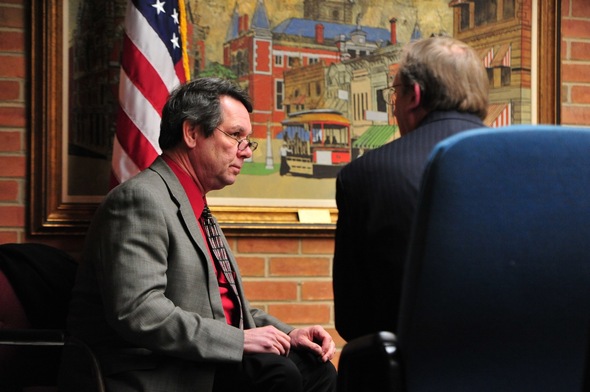
Robert West, Ann Arbor's senior assistant city attorney, left, confers with City Attorney Stephen Postema before Monday's Ann Arbor City Council meeting. On the advice of the city attorney's office, the council gave preliminary approval to move forward with ordinance changes that will make the city's speed limits more defensible in court.
Ryan J. Stanton | AnnArbor.com
As motor vehicle speeds increase from 20 to 30 to 40 mph, the likelihood of death for a pedestrian struck by a vehicle goes up from 5 to 45 to 85 percent.
Those were among the statistics cited by members of the Washtenaw Bicycling and Walking Coalition Monday night during an emotional debate over the issue of speed limits before the Ann Arbor City Council. The group argued speed limit increases on Ann Arbor streets could increase the number of pedestrians seriously injured or killed.
Jeff Gaynor, a teacher at Clague Middle School and a member of the Safe Routes to School Coalition, said he recently showed his students a video about the ancient Aztecs.
"The students were quite horrified by the idea of ritual sacrifice," he said. "And when we look at our priorities in America, we sacrifice over 40,000 people a year to our god the automobile."
On the advice of the city attorney's office, the City Council voted 11-0 Monday night to readopt sections of the Michigan Vehicle Code that it rejected two years ago — specifically those dealing with how speed limits should be set.
The ordinance changes also include adopting the Michigan Uniform Traffic Code. That will allow the city's traffic engineers to conduct studies to justify setting speed limits at levels that might differ from the Michigan Vehicle Code's access-point formula.
The changes will put the city in a better position to defend its speed limits in court, said Robert West, senior assistant city attorney. He acknowledged it also likely will result in raising speed limits on certain roads where motorists have complained for years about speed traps.
Monday's vote was expected to be the final say on the issue. But because of minor changes in the ordinance language during the meeting, City Attorney Stephen Postema recommended the council hold another reading of the ordinance and give final approval on Jan. 3.
The city's move to better comply with state law on how speed limits are set comes after multiple legal challenges and the threat of a class-action lawsuit.
Attorney Tom Wieder and Jim Walker of the National Motorists Association appeared before the City Council Monday night. Their opinion has been that the city can't pick and choose which portions of the Michigan Vehicle Code it wants to adopt or reject, and that local rules concerning speed limits can't legally override state statute.
"I think you have to deal with the fact that you're not in compliance with state law right now," Wieder told council members, hinting at the threat of a more thorough and comprehensive legal challenge to the city's speed limits if it didn't take action.
The Michigan Vehicle Code offers a vehicle access-point formula as the primary means for setting speed limits. It requires cities to measure the number of driveways and intersections along a half-mile stretch of road. The fewer access points, the higher the speed limit.
In 2008, city officials cited difficulties applying the formula, as well as concerns that it could result in speed limits being dramatically increased. And so the City Council passed a resolution that rescinded its adoption of sections of the Michigan Vehicle Code that dealt with speed limits.
Since that time, the Ann Arbor Police Department has been writing speeding tickets using provisions of the city code, an approach that has come under legal challenge.
In addition to the access-point formula, state law gives cities other options. One is conducting traffic studies and setting the limit at the 85th percentile speed of free-flowing traffic — an approach that is espoused by the Michigan State Police.
But Ann Arbor officials don't think either method is always reliable, and they want the city's traffic engineers to be able to study local streets and determine limits they think are appropriate.
West acknowledged the ordinance change is an attempt by the city to get back in step with state law, while also continuing to conduct its own traffic studies to justify setting speed limits that might vary from those determined by the vehicle code's formula.
"I don't see anything in the Michigan Vehicle Code that precludes us from being able to apply a different sort of engineering study," he said, adding there's no clear mandate that cities must set speed limits based on the 85th percentile speed.
"I just don't see that in there," he said. "Indeed, there's a specific provision in Section 627 that indicates 'nothing in this section shall be construed to deny local communities from conducting a traffic study.' It doesn't say if they can utilize it. But as a basic principle of statutory construction, the Legislature didn't put that language in there for nothing."
Noting that's never been litigated to the Michigan Court of Appeals, he said it's his opinion the city is not constrained to using just the access-point formula or the 85th percentile rule.

Ann Arbor resident Jim Walker of the National Motorists Association addresses the City Council Monday night. He believes many of the city's speed limits are too low.
Ryan J. Stanton | AnnArbor.com
The enforceability of the city's speed limits was challenged by Walker and another resident two years ago. Both men won their cases in court and had their speeding tickets thrown out.
AnnArbor.com has learned the city more recently lost another case — one involving Scio Township resident Mike Weikle, who was ticketed for driving over the limit on Huron River Drive in October 2009. Weikle was driving over 50 mph, but was cited for doing 40 in a 35.
Weikle argued the city's 35 mph speed limit was improper because it was not set according to the state's vehicle access-point formula.
The city answered that the Michigan Vehicle Code allows local governments to reduce speed limits on local roadways adjacent to park land to as low as 25 mph. District Judge Chris Easthope ruled that since the city had rescinded its earlier adoption of certain sections of the Michigan Vehicle Code, it could not rely on that authority for lowering the speed limit.
"Judge Easthope ruled that the city's speed limits did not comply with state law … and that the city basically could not adopt its own limits outside of the Motor Vehicle Code recommendations," said Weikle, who is an attorney licensed in Ohio. "So the city already did lose on that, and the city didn't appeal. They did try to rewrite the ticket under another section of the law, and Judge Easthope threw that out, too."
West considers that another good reason for readopting the Michigan Vehicle Code in its entirety. After that, he said, the next time Weikle is stopped for traveling 51 mph on Huron River Drive, he will get four points on his Michigan driving record.
But until that happens, "They've got a precedent out there that says their speeding tickets are illegal, basically," Weikle said.
Weikle said the interesting part is that Easthope was on the Ann Arbor City Council two years ago when the city decided to toss out those sections of the Michigan Vehicle Code.
"Before he ruled on the case, because of his involvement, he offered to recuse himself, but neither the city nor myself felt that was necessary," Weikle said. "He just looked at it on the basis of the law, and there was no bias in his ruling whatsoever."
City officials have indicated the city's speed limits could increase on multiple roads if new traffic and engineering studies are done. The Washtenaw Bicycling and Walking Coalition is urging the city to take special measures to ensure safety for all road users if that happens.
Two of the group's board members, Erica Briggs and Joel Batterman, sent a letter to the mayor and council members prior to Monday's meeting. They're asking that the city work with the Michigan Municipal League and other cities to seek reforms to the Michigan Vehicle Code and its "one-size-fits-all formula" for setting speed limits on local roads.
They say the "narrow scope of the formula" excludes consideration of road users other than motorists and doesn't account for variations in land use.
They also claim a formula that "regulates traffic solely on the basis of a single user group" is inconsistent with the spirit of the state's new Complete Streets law. The law requires that roadways be planned and designed “to provide appropriate access to all legal users,” whether they travel by “car, truck, transit, assistive device, foot or bicycle.”
Chris Hackbarth, legislative associate for the Michigan Municipal League, said he agrees with that contention. He said his group will be pushing for reforms in the next legislative session.
"This issue has been raised in a numerous communities," he said, calling the state law on setting speed limits a "Frankenstein creation."
"We've had a lot of confusion about what it takes to set a speed limit and then, if you take a look at the things in these formulas, they're just outright arbitrary," he said. "There's no definition of what a road segment is. Where does a segment start and end?"
Hackbarth said it's the Michigan Municipal League's belief that a local community is best equipped to decide what its speed limits should be, and "not some arbitrary formula."
Walker argues there's a fair amount of science behind the state's access-point formula and the 85th percentile rule. He said data show that speed limits can be lowered or raised by up to 20 mph and the actual traffic speeds change very little.
"I think the reposted limits in the two sections of Washtenaw prove my point exactly," he said. "The previous limits were 30 and 35. They're now 40 and 45, and the actual travel speeds — the 85th percentile — did not change. That's normal. They don't."
He said setting limits at the 85th percentile speed "tends to give you the smoothest and safest traffic flow, the least variance between vehicles, least passing, least aggressive driving," and "it's the best way to go."
Ryan J. Stanton covers government and politics for AnnArbor.com. Reach him at ryanstanton@annarbor.com or 734-623-2529.
Comments
Snarf Oscar Boondoggle
Tue, Dec 28, 2010 : 2:22 a.m.
ummmm, anytiong wroing with the 82th... or the 87th percentile for setting speed limits? i;ve never gotten a spleeding tickie in a2 because 'way back wehn' i had a cabbie for a housemate.. and learned all about teh extant speedtraps. soem wer obvious, some weren;t. i;m surprised taht no cabdrivers seem to have responded here. they put 12hrs/day on teh local roads.
Tom Wieder
Fri, Dec 24, 2010 : 12:49 p.m.
@Speechless - "'... What I disagree with Tom is your blind faith in the 85th percentile speed... even the State Police recognize that it's simply one factor in setting speed limits...' Maybe it offers the only narrative the NMA can hope to sell publicly or in court." For the record, I have no affiliation, whatsoever, with the NMA and am not familiar with its stands on most issues. As far as selling things to the public and courts, all that is at issue here is the city adhering to a law that has already been passed and upheld in the courts. And the "narrative" that passed it came primarily from the state police. "... If increasing speed limits doesn't affect pedestrian safety, why do we have school speed zones? Why shouldn't you be allowed to speed through a school zone at 40 or 50 mph?...." First, a flippant response: If black people weren't inferior, why was segregation the law of the land for so long? If abortion wasn't a matter for the state to decide, why was it illegal in every state? Just because a law or regulation has been put into effect doesn't mean that it makes sense. Now, a more substantive response. Lower speeds may, in some circumstances, increase pedestrian safety. Lower speed limits, unless they produce lower speeds, do nothing. But this doesn't mean that I don't support school area speed limits, or that the state law that we want the city to follow doesn't provide for them, because it does - explicitly, in the very language of the law. And cities, upon doing an appropriate traffic study, could even broaden the school safety zones beyond what's specifically in the statute. So, what's the problem in following the law?
Will Warner
Fri, Dec 24, 2010 : 7:18 a.m.
John Qs motivations seem to be straightforward. I think he is genuinely concerned about the safety of pedestrians and cyclists and is not persuaded by what might be called counterintuitive evidence. Fair enough. For other posters it is more complicated. They write of the need for a progressive overhaul of the traffic laws, of peoples attempts to evade their social responsibility and of Americas social backwardness. These are the sentiments of someone for whom every issue is political. I use the term political here in the way people do when, for example, they observe that feminist theory makes a womans decision to stay home with her children into a political statement. Similarly, ones choice of transportation becomes a political statement. Enlightened are the walkers and cyclists. So, too, the riders of public transportation: Everyone on a bus is equal, gets to his destination at the same time as the others, and suppresses his individuality in a demonstration of interdependence. Such is the nature of the personal is the political that no self-respecting progressive community could forego public transportation even if found to be disproportionally polluting, energy-wasting and so underutilized as to require subsidizationits still better than watching people just go wherever they want whenever they want. Posters here use the terms car culture and car-centric as pejoratives. In a progressive critique of society, these terms are pejorative because a car-centric society is exactly what a nation of individuals would fashion. In this critique, America is socially backward because it clings to its heritage of individualism. And long may it.
Speechless
Fri, Dec 24, 2010 : 12:38 a.m.
"... If increasing speed limits doesn't affect pedestrian safety, why do we have school speed zones? Why shouldn't you be allowed to speed through a school zone at 40 or 50 mph?...." Very good point. By motorists association (NMA) logic, school zones present outrageous speed traps, an intense violation of the 85th-percentile driving standard. If, for some political reason or other, the NMA chooses not to challenge this common practice, then they're guilty of a clear double standard. That is, it's just fine to very egregiously ignore the 85th percentile in front of schools — with all the added "danger" for drivers which that implies, according to the NMA — yet it's not o.k. for communities to employ traffic calming under other circumstances to protect non-drivers. "... What I disagree with Tom is your blind faith in the 85th percentile speed... even the State Police recognize that it's simply one factor in setting speed limits...." Maybe it offers the only narrative the NMA can hope to sell publicly or in court.
Tom Wieder
Thu, Dec 23, 2010 : 10:56 p.m.
@John Q - "What I disagree with Tom is your blind faith in the 85th percentile speed. If there was no other considerations other than you being able to drive at whatever speed you want, you could make the case for setting speed limits on that. But even the State Police recognize that it's simply one factor in setting speed limits. If increasing speed limits doesn't affect pedestrian safety, why do we have school speed zones? Why shouldn't you be allowed to speed through a school zone at 40 or 50 mph? I said before that speed limits are not the only or necessarily even the most effective way to protect pedestrians. But increasing speed limits does lead to increased speeds, and I've read speed studies showing that, and those increases in speed lead to more pedestrian and bicycling injuries and fatalities." I don't have "blind faith" in the 85th percentile. I'm accepting decades of traffic engineering practice and theory which says that it represents, in most cases, the optimal speed limit. If there is contrary theory and evidence, I'm open to it, but I haven't seen it. I'm not asking to "drive at whatever speed I want." I'm asking that speed limits be set at the 85th percentile of what ALL drivers do. If I want to drive at 55, and the 85th percentile is 40, and the speed limit is set at 40, I'd be going 15 over and would probably get tickets - as I should. No one that I know is suggesting that the 85th percentile is the only factor in setting limits. The law that we are asking the city to follow allows the city to do a traffic study to determine if there are such other factors which override the presumptive speed limits set forth in the law. The state police, Jim Walker and I have no problem with that, whatsover, as long as the studies are conducted competently and in good faith. You say that you've seen studies showing that higher limits produce higher actual speeds. I would be happy to look at anything you can cite on that, because everything I've seen disproves that.
David Cahill
Thu, Dec 23, 2010 : 10:51 p.m.
There are old drivers. There are bold drivers. There are no old, bold drivers.
Betty
Thu, Dec 23, 2010 : 10:18 p.m.
There is a real budget issue here. If we make our speed limits reasonable, well thought out, and suitable for the traffic needs of everyone (Bikers/pedestrians and autos), how does the AAPD plan to make up for the short fall in revenue? We are still trying to make up the losses incurred when M-14 went to 65MPH (at main). Haven't seen a cop on that stretch of road...'protecting OR serving'... since the speed limit was changed. Must be a coincidence.
AlphaAlpha
Thu, Dec 23, 2010 : 8:11 p.m.
Mr. Brown - I believe most of the community sincerely appreciates your astute observations. Here, and on other recent threads. Thank you.
Stuart Brown
Thu, Dec 23, 2010 : 5:41 p.m.
Another one two FUD (Fear, Uncertainty, Doubt) punch by the usual suspects. Speechless just knows her personal observations trump a valid statistical sampling and John Q just can't get stand the idea of setting speed limits in such a way as to classify most drivers as being in compliance with the road rules. These control freaks insist that we are all driving too fast and they'll be dammed if anyone is going to tell them otherwise. John Q can't stand the notion of the 85 percentile because it means control freaks like him can't set the speed limits to his liking. Never mind that enforcement by police has almost no impact whatsoever on driver speeds in the upper half of the speed spectrum; these two just know otherwise.
John Q
Thu, Dec 23, 2010 : 11:39 a.m.
What I disagree with Tom is your blind faith in the 85th percentile speed. If there was no other considerations other than you being able to drive at whatever speed you want, you could make the case for setting speed limits on that. But even the State Police recognize that it's simply one factor in setting speed limits. If increasing speed limits doesn't affect pedestrian safety, why do we have school speed zones? Why shouldn't you be allowed to speed through a school zone at 40 or 50 mph? I said before that speed limits are not the only or necessarily even the most effective way to protect pedestrians. But increasing speed limits does lead to increased speeds, and I've read speed studies showing that, and those increases in speed lead to more pedestrian and bicycling injuries and fatalities.
Speechless
Thu, Dec 23, 2010 : 10:56 a.m.
"... Sharing the road is not mutually exclusive to getting rid of speed traps. Huron Parkway at 35mph between Geddes and Washtenaw is a speed trap...." It's fine to identify a specific stretch of road as a possible "true" speed trap and then call for public discussion and deliberation at the city council level. However, the unfortunate process currently being 'driven' by speed advocates constitutes a systemic attack on local speed limit policies. It should be opposed by anyone who cares about the overall quality of life in town. Roads can't just be all about a certain class of drivers and their "need" for get somewhere a minute sooner. All the bellowing over speed traps is bait used to attract and justify public support for wide, systemic change. As for Huron Parkway, in dry weather it seems the 35 mph limit should be set at 40 mph, but under icy or rainy conditions the slower speed is prudent, given the curve in the road followed by apartments and a shopping mall. ------------ "... You reject the access-point formula and 85th percentile approach to setting limits. Do us all a favor and give your proposal...." No need for a proposal — I'm fine with most posted speed limits in town. This insistince on a "proposal" (?) is a requirement of your own creation. As for other current procedures worthy of support, here I will provocatively repeat NMA curse language:  Traffic Calming! (Moderators:  Please forgive this profanity!) It's disappointing that Washtenaw north of Tappan school had to increase to 40 mph, as that's a residential stretch with narrow lanes. Back when the posted limit was 30 mph, most drivers did not tool along at 40-45 mph as you keep insisting they must have. On Plymouth, posted speed went down, instead of up, in response to pedestrian killings, and I no longer see vehicles routinely speeding at 45-50+ mph; overall speed is now slower. Lengthy posts of mine following the earlier article gave further examples. The more I read posts from Wieder and Walker, the more I'm at a complete loss to understand why they, or anyone, would spend so much time trying to overturn city policies and crank up speeds on local roads. It's an obsession which promotes a hostile road environment that will also increase body count for pedestrians and bikers. If it succeeds, eventually the dangers seen on Carpenter Rd. will become more prevalent. We will be Oakland County.
Tom Wieder
Wed, Dec 22, 2010 : 11:08 p.m.
John Q- "you are deliberately ignoring the safety of pedestrians and bikers... quit pretending that what you are an advocate for isn't going to lead to more pedestrian and bicyclist injuries and deaths." John, we are not ignoring the safety of walkers and cyclists, and we're not pretending anything. The point is, their safety, while it may be related to actual speeds, is not related to posted speeds. This is true, because posted speeds have little or no effect on actual speeds. This has been tested again and again. Measure the speeds on a given road. Change the posted limit up or down by as much as 15 mph, and the actual average speed hardly budges. If raising the limit doesn't change the actual speeds, then there's no change in the safety of walkers and cyclists. Would you disagree with that? If so, how and why? If you accept the logic of that, do you think we and the state police are making up these test results that show that changes in posted limits don't affect actual speeds? If you think he answer to the second question is "yes," I don't know what else to say. Is there any data source you would rely upon on this empirically measurable point? Speechless - Do you have any evidence that our statement that changes in posted limits don't change actual speed limits is "a lie?" Or do you just rely on name-calling when people disagree with you and you have no facts? You reject the access-point formula and 85th percentile approach to setting limits. Do us all a favor and give your proposal. And by that I don't mean your philosophies about sharing and livability, etc., but an actual process which can be used to appropriately set speed limits.
Speechless
Wed, Dec 22, 2010 : 9:59 p.m.
Can't speak for John Q or others of similar view on this, but speech-ifying for myself, my agenda isn't about "pet minority groups" but all about the genuine sharing of streets and roads among multiple modes of transport.... Just as is done in relatively more civilized places of the world, such as western Europe. Over there, it's typical to plan transportation networks that go well out of their way to accommodate several different means of getting around. We're socially more backward, and the National Motorists Association is a reflection. In practice, they call out not for sharing but for dominance by one mode only. No other priorities will be considered valid. This is as mature as when auto companies whine about "subjugation" to air quality standards. The ex-Big 3 prefer freedom to pollute, and NMA wants freedom to speed.
Stuart Brown
Wed, Dec 22, 2010 : 7:20 p.m.
Speechless said, "...This is the same lie, restated. Through experience, everyone knows that lowering the speed limit, in combination with even occasional enforcement afterward, will lead to an overall reduction in average vehicle speed. In the previous article, prior to the council meeting, I discussed a few specific, local examples. According to the speeding advocates, my real, everyday experiences and yours do not matter, and did not happen, if they fail to conform closely with the numbers they present to the public." Spoken with all the conviction of a true believer; just declare your opponents liars and flame on. Speechless has apparently never operated a radar speed detector and has never measured speeds on actual roads but knows, just knows that conventional wisdom always holds, especially as it relates to vehicle speeds and enforcement of said speeds. For a view of the results of someone who has operated a speed radar gun to measure traffic speeds, look here: http://blog.motorists.org/the-effect-of-speed-limits-on-actual-travel-speeds/. Apparently, Speechless and John Q don't care if motorists are placed at increased risk as long as their pet minority group is taken care of. The best part is that they are diverting resources and attention away from things that would actually increase safety for bicyclists and pedestrians. They prattle on about the alleged motives of others while failing to acknowledge their own biases and motives.
grye
Wed, Dec 22, 2010 : 3:58 p.m.
For David Cahill: Yes, obedience to the law is a good thing except when the law is faulty. To change these laws requires approval from the law makers. We are beholden to them without any recourse if their beliefs oppose those of the majority. Excessively low speed limits need to be changed. And failure to obey state law by imposing city council authority is wrong. So what do we do? Follow along like dumb sheep to the slaughter house or make a stink to right what is wrong?
Rhe Buttle
Wed, Dec 22, 2010 : 12:42 p.m.
Gas at $5 per gallon and electricity at $50 per kilowatt. Its time for Segways for the masses!
Hemenway
Wed, Dec 22, 2010 : 12:12 p.m.
The entire context of this discussion will change when fuel is 5 dollars per gallon or more.
Speechless
Wed, Dec 22, 2010 : 11:38 a.m.
"... You keep missing the point, when you say "allowing people to drive at the 85th percentile." All of the evidence shows that people drive at the speed that...well...at the speed at which they drive. The behavior is little affected by posted limits or anything other than impractical 24/7 enforcement...." This is a lie. "... I'm not disagreeing with your assertion that absent enforcement, people will drive whatever speed they want...." This is why the first statement is a lie — it relies on near-zero enforcement. "... The data shows that drivers drive at a speed that they consider safe regardless of the posted speed limit...' This is the same lie, restated. Through experience, everyone knows that lowering the speed limit, in combination with even occasional enforcement afterward, will lead to an overall reduction in average vehicle speed. In the previous article, prior to the council meeting, I discussed a few specific, local examples. According to the speeding advocates, my real, everyday experiences — and yours — do not matter, and did not happen, if they fail to conform closely with the numbers they present to the public. Keeping the posted speed higher may allow for somewhat more consistent speeds among drivers. However, as many have already said, this largely constitutes an arbitrary concession to the fastest common denominator. Hence, this is not a neutral, "value-free" assessment, but instead a highly biased choice of measurement designed to champion a car-centric culture with faster road traffic. Again, higher rates of death and major injury for walkers and bikers are but collateral damage which must not be allowed to interrupt the cause of raising speeds and eliminating traffic calming policies. The solution, apparently, is to blame non-drivers for not being more careful. The motorists association, to their obvious delight, has had the good fortune of being able to use the state police as their personal front group. Rather than encourage speed, police ought to advocate for street redesign and other calming procedures to get people to slow down and increase safey. On their site, the National Motorists Association approvingly displays an 80 mph speed limit sign (65 mph minimum) on their page for speed activism. They also offer resources for defeating neighborhood use of speed bumps, so residents along Broadway, Devonshire and elsewhere should beware.
David Frye
Wed, Dec 22, 2010 : 11:14 a.m.
Stuart Brown - I agree. We need more cobblestones.
Christian
Wed, Dec 22, 2010 : 11:13 a.m.
Two points on the discussions so far: 1. It is not about lowering the speed limit for biker's safety / convenience. Of course, there should be certain roads in, and especially around AA, where it should be allowed to speed up to 45mph (in the outskirts) or 35mph (in AA proper). At the same time, it is also reasonable that any roads lacking separate bike lanes should have a speed limit of at most 25mph. Thus, the best solution is probably to build new bike lanes (and no "sharrows") such that the speed limit can be raised on certain roads. E.g. Geddes is one of those roads where a separate bike lane is more than needed, and so as soon as there is one, one can raise the speed limit and everybody is happy (and no, sidewalks are not for bikes because cyclists don't "walk"). 2. I am always very surprised by the lack of signage and measures for traffic calming on certain roads. There are a lot of ways to lower the traffic speed without any need to impose actual speed limits. Of course, on a four lanes road that is a broad as football field I want to speed up to 50mph and if I can't because the speed limit is set to 35mph, I get angry. As soon as streets get narrower drivers lower their speed naturally. There are a lot of good practices with plenty of possibilities for Ann Arbor: see e.g. this information provided by the city of Zurich, including a whole documentary on that topic: http://www.laerm.zh.ch/index.html?/fals/6-vorsorge/planen_im_laerm/verkehr_beruhigen.html,http://www.laerm.zh.ch/fals/1-start/laermschutz/nav/nav62.html
Mike
Wed, Dec 22, 2010 : 10:02 a.m.
The data shows that drivers drive at a speed that they consider safe regardless of the posted speed limit. Let's put an end to the excess of Ann Arbor cops who are turning artificially low speed limits into a fund raising opportunity. Let's lay off police, severely limit overtime and get a new chief of police. Speed traps cause accidents by creating panic braking and by clogging streets with ticket writing pullovers. What is worse is the complicity of the courts in this fund raising. What is needed is a class action lawsuit against the Ann Arbor city government to recover wrongfully levied fines and reimburse Ann Arbor drivers for their elevated insurance premiums.
John Q
Wed, Dec 22, 2010 : 9:19 a.m.
"I will gladly support lower limits, if some evidence - not assumptions or ideology - demonstrates that a safer result is achieved, and not just a false sense of safety." You're missing the point Tom. I'm not disagreeing with your assertion that absent enforcement, people will drive whatever speed they want. My point is that when you and Jim keep parroting the claim that allowing drivers to drive this way is "safer", you are deliberately ignoring the safety of pedestrians and bikers. It may be safer for drivers but it's absolutely not safer for pedestrians and bikers. I'm not saying that lowering the speed limits is the solution. But quit pretending that what you are an advocate for isn't going to lead to more pedestrian and bicyclist injuries and deaths.
Roaring_Chicken
Wed, Dec 22, 2010 : 8:36 a.m.
We'll see how our local "responsible" drivers manage the weather conditions this morning. Last evening I watched two of these "responsible" drivers, in separate incidents, go the wrong way on visibly posted ONE WAY streets. Then there was the kindly pickup driver who turned through the red light, at speed (NOT from a stop) from Hill onto n.b. Division at 7:15am this morning, under conditions of slushy snow. (That is, happily, BEFORE I entered the pedestrian crosswalk.) Local drivers do not obey the posted laws, let alone speed limits low or otherwise. They do not drive with conditions. They do not drive "defensively" (if any of you who tried to implement the antiquated concept of "space cushion" have found out), but tailgate and crowd. As for the herd of deer that stepped out of the dark on Liberty last night, just past the Polo Fields... I was happily going the "artificially low" 45 m.p.h. speed limit, much to the duress of the driver behind me. My favorite bumper sticker: "Drive like Hades... you'll get there." Sure! Raise the limits anywhere you find people disobeying them. By the same logic, as long as they don't hurt themselves or anyone else, less whining about cyclists blowing through STOP signs. Ditto cars that run red lights on Sunday mornings. As I said: let's see who slides off US23 this morning trying to drive 70 m.p.h. in light snow.
Tom Wieder
Wed, Dec 22, 2010 : 8:05 a.m.
Will - Beautifully, and logically, said. John Q - You keep missing the point, when you say "allowing people to drive at the 85th percentile." All of the evidence shows that people drive at the speed that...well...at the speed at which they drive. The behavior is little affected by posted limits or anything other than impractical 24/7 enforcement, with the exception of physical changes in the roadway, such as speed bumps, etc. Will you feel better, as a pedestrian or cyclist, if you are struck by a car traveling at 35, where the posted limit is 25, than you will feel if struck by a car traveling at 35, where the posted limit is 35? Of course, the advocates of the higher limits want everyone to be safe. But, if lower posted limits do not produce that result, and only result in wasting resources on enforcement, and punishing people for reasonable behavior, what's the point of posting lower limits? I will gladly support lower limits, if some evidence - not assumptions or ideology - demonstrates that a safer result is achieved, and not just a false sense of safety.
Stuart Brown
Wed, Dec 22, 2010 : 7:54 a.m.
It's clear why some here can't be reasoned with or take rational positions on matters of critical importance to the public; they have an agenda and are too heavily invested into group think. And much worse, they are extreamly dogmatic about it; conformance to correct group think is their mantra regardless of what the reality is. So, they bellow, the 85 percentile speed of free flowing traffic does not take into account pedestrians or bicycles. Good! Because it should not nor, more fundamentally could it. The FARS database for 2009 shows that 87% of fatalities involve motor vehicles only. About 11% involve pedestrians and motor vehicles and 2% involve bicycles and motor vehicles. Some here want to sacrifice the safety of motor vehicle operators in order to save non-motorists; they will deny it but the reality is otherwise. Not setting speed limits at the safest point for motorists or the 85 percentile of free flowing traffic is to expose the people most at risk to greater risk, pure and simple. The way to protect non-motorists is through means that have nothing to do with speed limits; that is, better design of pedestrian and bicycle lanes. Most people in Ann Arbor do not know that most of the speed limits the city of Ann Arbor sets are set at the 5-30th percentile of free flowing traffic. That means, if has so piously been pointed out, that if you want to avoid a ticket, drive the limit and in so doing be one of the few sticks in the mud clogging traffic and making the roads less safe. That's right, our City Council in its infinite wisdom, has made us choose between being safe and being in compliance with the law. Most drivers in Ann Arbor are rule breakers (70-95%) at any given time on the road, some of whom will complain about the speed of traffic in their own neighborhoods and drive through someone else neighborhood well in excess of the posted limit. The 85th percentile criteria works because the sticks in the mud clogging traffic no longer fear a ticket and drive at the same speed as most drivers on the road, making the roads safer for the people most at risk of a fatal accident. The material fact most relevant to this discussion that these la la land lugheads refuse to acknowledge is the police enforcement of speed limits is ineffective and hopeless when it comes to changing the speeds most people choose to drive at. As has been stated in Ann Arbor on any given route controlled by the City, no more than 5-30% of drivers are obeying the posted limit. Do some people really expect us to believe that the world will go to hell in a hand basket if the few people who are driving 25 in a 25 drive at 30 when the speed is set to the 85th percentile? When considering safety, the threat posed by the roughly 50% increase in energy for this one vehicle is offset by the reduction in probability of a crash since the driver will be moving more in line with the flow of traffic. Note here that the drivers already near the 85th percentile of traffic flow who are most at risk of getting a ticket will not adjust their speed significantly. The current system tickets some of the safest drivers on the road and offers almost no deterrence at all. Try this experiment, measure the speed distribution on any given road in Ann Arbor on any given day; give out a ton of tickets to hapless motorists exceeding the speed limit; come back a few days later and measure the speed distribution again. Usually, the people who do this report no statistical difference from the before and after. Posting speed limits at the 85th percentile usually results in a much higher compliance rate and does not result in the faster drivers going any faster. There is a final point that needs to be made here; this is a civil rights issue. The government has no business passing laws and rules that are easy for citizens to violate. It should be hard for someone to break a rule especially when the effectiveness of enforcement is questionable at best. We have a dysfunctional method of traffic control when it comes to speed limits. The only way to actually lower the speeds people choose to drive at would be to intentionally make the road rough so people would slow down (like using cobblestone or brick.) The State law mandating the method of setting speed limits in communities was a move in the right direction and should be supported.
John Q
Wed, Dec 22, 2010 : 7:13 a.m.
"But, unlike the posters here, our elected officials cannot hide from facts about what contributes to traffic safety in order to give play to their progressive sensibilities." Hey Will, nice job avoiding the most common line of reasoning which is that the "scientific standard" doesn't take into account pedestrian and bicyclist safety. Jim's made it clear that he's unwilling and unable to engage in that debate because he knows there's no science that backs up a claim that by allowing cars to drive at the 85th percentile makes pedestrians and bicyclists safer. T
Will Warner
Wed, Dec 22, 2010 : 12:10 a.m.
There are a number of interesting lines of thought in these posts... Paraphrasing: The law is the law; obey it, dont question it. I would expect to hear this from a Canadian, but from Americans? Surely no American believes that governments are infallible, that their decisions are, by definition, correct. Sometimes laws violate constitutional principles, or local law clashes with that of a higher authority (I mean the State or Federal governments, not the Almighty), which apparently is the reason why tickets given pursuant to Ann Arbors laws dont always stick. Sometimes laws are counterproductive, have unintended consequences or are just too damn controlling, in which case people will eventually force a change, possibly using the club of a class-action lawsuit. Paraphrasing: It is counterintuitive to believe that a higher speed limit could reduce accidents, so I dont believe it. When the evidence becomes compelling that artificially low speed limits make things worse, posters impugn the source: Michigan State Police were rolled by the fast car lobby. Or deliberately misstate their opponents argument: hence the new state code which basically says that driving any speed at all is OK as long as everyone drives that fast. And, having mischaracterized the argument, label the straw man nonsense. Paraphrasing: Those pushing for higher speed limits are just looking for greater freedom from social responsibility, and when we achieve a progressive overhaul of the vehicle codes, members of the rapacious car-culture will not be able to use the mythical 85th percentile to justify their selfishness. If history is any guide, however, a progressive overhaul will produce vehicle codes that are light on facts (about what people and the world actually are) and heavy on ideology (about what progressives wish they were). Call me nave, but I dont believe that Ann Arbor city fathers set artificially low speed limits in order to create revenue streams from speed traps. I think they do it because they are progressives and committed to the green, the livable, the sustainable as progressives understand those terms. But, unlike the posters here, our elected officials cannot hide from facts about what contributes to traffic safety in order to give play to their progressive sensibilities.
David Frye
Tue, Dec 21, 2010 : 11:32 p.m.
To Steve Pierce: I can't find data on Ann Arbor alone, but http://www-nrd.nhtsa.dot.gov/departments/nrd-30/ncsa/STSI/26_MI/2009/26_MI_2009.htm has data for Washtenaw County over the past five years (2005-2009). The total traffic fatalities over those five years for Washtenaw County was 157 (the average was 31.4 per year). Of those, there were: fatalities involving large trucks, 21 (4.2/year); family cars, 63 (12.6/year); light trucks and vans, 42 (8.4/year); motorcycles, 22 (4.4/year); pedestrians, 16 (3.2/year); pedal cyclists, 7 (1.4/year). No explanation of why the totals don't coincide, but I suppose some accidents involve more than one type of vehicle. Note that in spite of the "low" number of pedal cyclist fatalities, that is the only category in which Washtenaw is above the national average. In all other categories, the accident rate puts Washtenaw in the lower third of all US counties.
Heardoc
Tue, Dec 21, 2010 : 11:24 p.m.
The city is losing money -- better put -- they are unable to confiscate as much money as they had anticipated prior to having to follow the law with regards to setting and enforcing legal speed limits. The radicals in the bicycle community are out in force trying to lower the limit set by state law. The city, in attempting to accommodate these radicals, has lowered speed limits illegally. Concerned citizens challenged this illegality by the city and the city of Ann Arbor lost -- three times. Now the radicals are at it again and are attempting to misinterpret the law so as to try to make legal what is now illegal -- just plain wrong and these people should be out of office. Bicyclists should be licensed for the road and required to carry insurance just like an automobile. The licenses should be visible enough to be as easily seen as those on automobiles. Finally, we should have a task force set up to monitor and write tickets to bicyclists who disobey the law. AN finally, we should require all bicyclists, as a requirement for licensing, to take sensitivity training and self awareness training so that they can better cope and communicate with the world around them.
Speechless
Tue, Dec 21, 2010 : 10:57 p.m.
I'm appreciative for the comment excerpts copied below. These nicely sum up much of what I've tried to say over two discussion threads on this topic: "... It would be much more convenient for me to live in Oakland, however I live here precisely because Ann Arbor is NOT car-centric like Oakland County. Many of my co-workers who dwell in Oakland County comment to me how they like the fact that Ann Arbor pays a lot of attention to keeping the city on a walkable scale. They lament that in Oakland County it is very difficult to ride bikes for transportation.... I work in the automotive industry... and my occupation is not slighted by keeping cars in their place...." The National Motorists Association, as a matter of stated purpose, strives to eliminate what makes this area so different from southern Oakland County. They maintain a strong committment to ending traffic calming measures which make urban areas generally more walkable, bikeable — and liveable. For the group, it's all about a single-minded devotion to driving fast with as few impediments as possible. They're certainly aware that higher speeds will literally "drive away" pedestrians and bicycles, and for them that's just fine. Falsehoods about "border-to-border speed traps" offer them a contrived narrative that can be used to forge a legal weapon against traffic calming. [ en.wikipedia.org/wiki/Smart_growth#Criticism ] [ www.motorists.org/traffic-calming/ ]  [ www.motorists.org/speed-limits/ ] The association pursues its secular goals with an uncompromising, religious zeal. The Washtenaw Bicycling and Walking Coalition, and allies similarly favoring a more diverse use of public spaces, should plan on long, ongoing battles at city, county and state levels. They'll need to regularly challenge propaganda based on the pseudo-scientific "85th percentile," such as: "...That said, the state police have it right and the opposition to safer 85th percentile posted speed limits is grounded in false beliefs and is counter productive to overall safety for all of us...." As we have seen in multiple instances, anyone who voices a sensibility not closely aligned with this artificial '85th' concept will quickly be smeared as "unscientific' and 'emotional.' This echoes a form of argumentative approach used by the right against those who wanted to end the Bush-era tax breaks for the super-rich. Those big tax cuts, as we know, are based on the rational science of "trickle-down," the economics equivalent of "85th percentile."
Engineer
Tue, Dec 21, 2010 : 10:32 p.m.
City is simply trying to raise money. Van Buren Twp does it all the time on Michigan Ave near the Washtenaw border. It is a divided highway that should be posted reasonable and prudent or at the minimum 70 MPH but instead they have it at 55 and then pull you over at 63 and give you a impeading traffic ticket and collect the funds. Totally bogus. Speed limits in MIchigan are way low. Out west 70 is norm on 2 lane road and highways are at least 75. Much more reasonable than our ridiculous rules. I cant drive 55! Dont tread on my pursuit of happiness!
rulieg
Tue, Dec 21, 2010 : 10:28 p.m.
Ann Arbor's speed limits must have been set by "a team of monkeys working around the clock" (quote from The Usual Suspects) because they make absolutely no sense. that long sweep of Huron Parkway that runs past the (soon to be gone?) golf course is 35mph. WHY? so the ducks don't get scared? yet on Oak Valley the speed limit is 45mph, even by the crosswalk for the library, which is so counterintuitive that even I don't speed there. between the arbitrary and generally too-low speed limits, the "traffic calming" (translation: traffic gridlock), and the truly random lane revisions (take away the needed left-turn lane at Busch's and put in an utterly pointless right-turn lane), it is impossible to drive in this town anymore. which, I believe, has been the mayor's intention all along.
cornelius McDougenschniefferburgenstein jr. 3 esq.
Tue, Dec 21, 2010 : 10:18 p.m.
bikeriding on sidewalk is illegal.riding too close to parked cars is dangerous due to doors opening.we are forced to take up a full "vehichle" lane.
Ryan J. Stanton
Tue, Dec 21, 2010 : 8:31 p.m.
A typo in the story has been fixed.
Steve Pierce
Tue, Dec 21, 2010 : 6:08 p.m.
Does anyone know how many Vehicle, vehicle-bicyclist and vehicle-pedestrian crashes and deaths occurred in Ann Arbor year-to-year over the last 10 years? And I hate to let facts get in the way of a good argument but in 2009, deaths from motor vehicle crashes was 33,808. Of those 4,092 were pedestrians and 630 Pedalcyclists. http://www-fars.nhtsa.dot.gov/Main/index.aspx - Steve
DonW
Tue, Dec 21, 2010 : 5:45 p.m.
I work in Oakland County, and drive there almost every day, however I live in Ann Arbor. It would be much more convenient for me to live in Oakland, however I live here precisely because Ann Arbor is NOT car-centric like Oakland County. Many of my co-workers who dwell in Oakland County comment to me how they like the fact that Ann Arbor pays a lot of attention to keeping the city on a walkable scale. They lament that in Oakland County it is very difficult to ride bikes for transportation. For example, kids are limited to riding in "subs" rather than being able to explore the city on their bikes as I did when I was a kid. A big part of that is keeping speed limits low. That's just one example of the end result of giving into the the car-centric mindset. It is a slippery slope. We have freeways in the county, as well as thoroughfares with sufficient speed limits that have adequately allow me to get around for the 25+ years I have lived here. I do not feel slighted or delayed by low speed limits in any of the places mentioned by Mr. Walker, (except maybe Huron Parkway between Geddes and Washtenaw, which has a nice big bike path beside it). Everyplace else, I think that City Council should do their best to find a way to keep speed limits where they are. I work in the automotive industry. I depend on the automobile for my livelihood. However I believe that cars have their place, and my occupation is not slighted by keeping cars in their place. I applaud those who have spoken out against raising speed limits and hope city council can help maintain Ann Arbor's unique place in SE Michigan. Please help keep it a place where I want to raise my kids.
David Frye
Tue, Dec 21, 2010 : 5:22 p.m.
I generally agree with Jeff Gaynor's view on this issue, but it is also worth noting the (relatively) good news that traffic mortality has fallen dramatically over the past two years. There were 37,423 traffic fatalities in the US in 2008, and 33,808 in 2009. Of course, this has as much to do with the recession and the price of gas as it does with increased safety. (Data: http://www-fars.nhtsa.dot.gov/Main/index.aspx )
Lenore
Tue, Dec 21, 2010 : 4:33 p.m.
Is this the city counsel that has all roads going out of ann arbor made into a one way. Road Commission? The idiot who made that decision is obviously not from A2 or just plain stupid.
Jim Walker
Tue, Dec 21, 2010 : 4:02 p.m.
leaguebus has it exactly right. James C. Walker, NMA
Roaring_Chicken
Tue, Dec 21, 2010 : 3:28 p.m.
What a great Website! From NMA.org: "7) Speed limits should be consistent with the typical speeds of normal, responsible drivers. Speed limits should be based on sound traffic-engineering principles that consider responsible motorists' actual travel speeds." I have seen the Light! In 30+ years of driving, I've never once been stopped for speeding or have been ticketed for poor driving behavior. Knowing myself to be responsible, it's time to take my 9-3 Turbo out for some 75mph+ recreation on I-96! WHO'S WITH ME?!
leaguebus
Tue, Dec 21, 2010 : 3:12 p.m.
The 85th percentile rule assumes that most drivers are good drivers and drive at a speed that they feel safe with on any road and that 15% either drive way too slow or way too fast. I usually don't do 45 on Washtenaw because it feels too fast to me, especially at busy times. At the same time when it was 35, I was always hitting the brakes and watching for cops. Now I can just drive and not worry about going over the limit. Most people are good drivers and should not be penalized with artificially low speed limits because of the 15% that are not good drivers.
Greggy_D
Tue, Dec 21, 2010 : 2:57 p.m.
@David..."For the rest, instant relief can be obtained by obedience to the law." Which (again) in this case is the City of Ann Arbor, who is not following State law.
L. C. Burgundy
Tue, Dec 21, 2010 : 2:53 p.m.
"... Personal modes of transport will be important for at least the next 100 years in North America...." Personal, as in bicycles, feet, and one's commuter pass. As for cars, how do you plan to acquire fuel decades from now? Squeeze it from rocks? Plus, the longer we rely on autos, the more that gridlock becomes a way of life. --- I don't know exactly - I think the market will take care of that. If not, alternatives will be found. Where do you think a fleet of trains and buses will get fuel from? Don't be so concerned with planning markets 50 to 100 years from now. That's not how it works. Again, Americans will not settle for being tied down the way people tolerate it in, say, Europe.
Ace Ventura
Tue, Dec 21, 2010 : 2:48 p.m.
Illegal speed limits are subject to driver nullification.
David Cahill
Tue, Dec 21, 2010 : 2:40 p.m.
People who just can't bear to obey the posted speed limits (scofflaws) should consider moving to Montana. They can become dental floss tycoons. For the rest, instant relief can be obtained by obedience to the law.
jacquelyn wright
Tue, Dec 21, 2010 : 2:30 p.m.
anyone who thinks driving 50 mph on Huron River Drive is safe and necessary should rethink their priorities.I don't even understand why we're having these discussions. If you arrive at your destination five minutes later than anticipated the world will continue to spin and you might have enjoyed the scenery. To say nothing of not endangering a bicyclist. Who are the members of the National Motorists Association?
Greggy_D
Tue, Dec 21, 2010 : 2:15 p.m.
Or Ron, if the "speeder" was going 80 he would have been out of the danger zone even before the wrong way driver made an appearance.;)
Ron Granger
Tue, Dec 21, 2010 : 2:07 p.m.
@Greggy_D: There is no question the wrong-way doofus was the big problem. The point is, accidents happen - speed is a major factor in whether people get hurt. If the run-the-yellow driver had been going slower (30 mph limit, he was closer to 40), he likely could have avoided the accident. Speed turns the avoidable into the deadly.
Greggy_D
Tue, Dec 21, 2010 : 1:55 p.m.
@Ron I'd say the wrong way driver was the major factor in your example, not speeding.
mstairs
Tue, Dec 21, 2010 : 1:29 p.m.
@Ron Granger- Too many people are killed by drivers who are in a huge hurry to get somewhere that isn't even important, like the shopping mall, or to eat fast food. Really? I usually speed and am in a huge hurry to eat at sit-down restaurants.
Ron Granger
Tue, Dec 21, 2010 : 1:24 p.m.
@Greggy_D: "I'm still trying to comprehend how speed limits and pedestrian safety are related to one another. Personally, I look to see if traffic is clear before I cross the street." -- If only it were that simple. So there are so many examples of how speed kills pedestrians. If you truly want to know, do some searches. If you want it first hand, do some ride-alongs with your local rescue/fire/police. Or, ask any ambulence/rescue/fire/cop how speed kills pedestrians. One month ago, I was standing on a corner, waiting for the light to change so I could cross. Both streets were one-way. A driver came up the street the wrong way and entered the intersection. She was clipped by a car that was speeding (trying to beat the light). Fortunately no one was hurt. If the situation had been just the slightest bit different, it is likely her car (or debris) would have struck those of us standing on the corner. The vehicle speed greatly influences how far everything "flies" on impact. Speed greatly increases the likelihood that pedestrians getting in or out of parked cars are hurt. It increases the chance that people will be pinned between parked cars. Etc. There is also a lot of scholorly research on the impact of speed on pedestrian safety. Stuff like: "THE IMPACT OF SPEED AND OTHER VARIABLES ON PEDESTRIAN SAFETY IN MAINE The pedestrian safety in the United States is worse than in most 'civilized' countries. The pedestrian fatality rate in Maine is noticeably better than in the average state. The purpose of this study was to analyze pedestrian accidents with focus on how actual travel speeds and characteristics of the locations influence crash numbers. The results of this study show that the pedestrian safety problem in Maine is focused to its arterials and major collectors, where highways pass through villages and towns. The risk faced by pedestrians crossing such a street is almost 50 times higher than the risk a pedestrian faces in a low speed environment such as the University of Maine campus. The paper's main conclusion is that lower speed can help any group of pedestrians more than any other measure."
Speechless
Tue, Dec 21, 2010 : 1:12 p.m.
"... Several years ago, the Michigan State Police were "rolled" by the fast car lobby; hence the new state code which basically says that driving any speed at all is OK as long as everyone drives that fast. Nonsense...." Thank you for providing some confirmation of my suspicion on this. Essentially, the MSP carries water for car-centric lobbies and interest groups. This way, groups like the motorists association can play a game where they convince the MSP to embrace their key positions, and then turn around and claim that they merely follow the "wisdom" promulgated by the MSP. ----------- "... I am interested in starting a Horse and Buggy coalition in Washtenaw County. Why move forward when we can remain stuck in the past...." Yep, maiming and killing a greater number of pedestrian and bicyclists will demonstrate by example how our city can move forward into the future.... ------------ "... Personal modes of transport will be important for at least the next 100 years in North America...." Personal, as in bicycles, feet, and one's commuter pass. As for cars, how do you plan to acquire fuel decades from now? Squeeze it from rocks? Plus, the longer we rely on autos, the more that gridlock becomes a way of life. ------------ "... If you want to drive fast, get on the highway...." Yes, the I-94 and US-23 racetracks are currently open for public enjoyment — no need to drive like that on Stadium, Jackson, State, or Huron Parkway.
Greggy_D
Tue, Dec 21, 2010 : 1:11 p.m.
I'm still trying to comprehend how speed limits and pedestrian safety are related to one another. Personally, I look to see if traffic is clear before I cross the street.
grye
Tue, Dec 21, 2010 : 1:11 p.m.
The areas of town that are being considered for higher speeds really are lower than comparable areas with higher speed limits. So what is the issue with raising the speed limits to improve standarization. For those that are truly against this change, would you rather have the speed limit at 25 mph throughout the town? Still unsafe? How about 20 mph? Still scared to cross the street? How about 15, 10 or maybe even 5 mph? Wait, I can almost walk that fast. Maybe we should have speed limits on walkers, runners, and bicyclists just to make sure everyone is completely safe. Get a life.
Ignatz
Tue, Dec 21, 2010 : 12:55 p.m.
If I saw motorized vehicles constantly careening out of control and invading the sidewalks, I might be sympathetic to reduced speeds for the sake of pedestrians and bicyclists. However, what I do see in this town are those on foot crossing agaist lights or in the middle of streets between parked cars or other obtructions. I also see bicyclists flying through intersections without regard to traffic control devices or zipping down pedestrian crowded sidewalks. Cars, trucks and SUVs have the advantage of size in collisions with those not in such contraptions and are not always the innocent ones. However, if we ALL moved about in a safe manner, there would be fewer tragedies. Those on the road need to drive to the conditions and pay attention to driving. Those crossing streets need to look both ways (remember that?) before crossing. Those on bicycles need to not act like they're the only ones on the road and stop once in a while.
John Q
Tue, Dec 21, 2010 : 12:47 p.m.
"That said, the state police have it right and the opposition to safer 85th percentile posted speed limits is grounded in false beliefs and is counter productive to overall safety for all of us." Good job ignoring any concerns about pedestrian and bicyclist safety Jim!
Ron Granger
Tue, Dec 21, 2010 : 12:40 p.m.
@msclean: "Roads were built for cars not bicycles" Actually, roads were first built for pedestrians and horses. Then bicycles. Cars came later. If you want to drive fast, get on the highway. Ann Arbor is a small town. Priority should be given to pedestrian safety, and bicycles. Too many people are killed by drivers who are in a huge hurry to get somewhere that isn't even important, like the shopping mall, or to eat fast food. And for those crowing about their entitlement to the roads - pedestrians and bicyclists subsidize cars with their taxes. An SUV is just a motorized couch.
L. C. Burgundy
Tue, Dec 21, 2010 : 12:28 p.m.
"... Heck, even mainland China is getting out of their bicycles and buying cars...." Hence, an environmental and social catastrophe with global implications is now in the making. We owe it to China to demonstrate that we're capable, in earnest, of pulling out the syringe to go cold turkey on our auto addiction. After all, our unsustainable, car-centric culture is destined to steadily decline and fade away in the coming decades, whether anyone likes that or not. --- Nonsense. Personal modes of transport will be important for at least the next 100 years in North America, your wishful thinking aside. What's actually unsustainable is when we subsidize the marginal costs of things like buses with municipal taxation to the tune of 80%+ (see: TheRide).
Roaring_Chicken
Tue, Dec 21, 2010 : 12:17 p.m.
So safety is the REAL issue? Laws *by themselves* have no effect -- it takes ENFORCEMENT. Do we enforce the 15mph roundabout speed limit? Do we enforce the Vehicle Code on cyclists? Do we enforce the Pedestrian Crosswalk ordinance? I put it to you that a city that allows cyclists to run red lights and STOP signs yet ticket people doing 40 mph on Huron Parkway is not interested in safety. It's why Willie Sutton robbed banks: that's where the money is. It's easy revenue.
Jim Walker
Tue, Dec 21, 2010 : 12:15 p.m.
The Traffic Services Section of the Michigan State Police, part of the Traffic Safety Division, are the ones charged with reducing the rates of accidents, injuries and fatalities - statewide. They strongly support 85th percentile posted speed limits for one reason - they improve safety by promoting a smoother and safer traffic flow with fewer conflicts between users. It is astonishing to me that some people think or imply that the command officers in the safety department of the state police would promote measures that would actually decrease safety. One key measure of traffic safety statewide is the fatality rate per 100 million vehicle miles traveled. In 2009, Michigan had 871 total traffic fatalities with 100.9 billion miles traveled for a fatality rate of 0.86 fatalities per 100 million VMT. In 1999 we had 1,386 fatalities with 93.1 billion miles traveled for a fatality rate of 1.49 fatalities per 100 million vehicle miles traveled. The national rates were 1.16 in 2009 and 1.55 in 1999. PLEASE NOTE that the Michigan and national rates were about the same in 1999 and the Michigan rate is about 25% lower than the national rate in 2009. There are many reasons for the better Michigan data, including country-leading seatbelt use. That said, the state police have it right and the opposition to safer 85th percentile posted speed limits is grounded in false beliefs and is counter productive to overall safety for all of us. Mike D. has it right, with a bit of good humor at the end of his comment. Regards, James C. Walker, NMA
Killroy
Tue, Dec 21, 2010 : 12:13 p.m.
I think the real reason why this is even an issue is that the city has done a bad job in keeping up with the changing needs of the citizens of Ann Arbor. Since the 70s, our fair city has nearly doubled in population which means far more additional stress on our diminished infrastructure, e.g. roads, bridges, etc. While agree with a number of the posts regarding some of the illogical speed traps, that really isn't the central issue here. What we need is not higher speed limits, more lights, and more police, but better alternatives to driving our cars every day. The AATA buses are part of the problem as well, e.g. stench, exhaust, use roads, limited space etc. I suggest bringing back the trolley or building a subway!
Jon Saalberg
Tue, Dec 21, 2010 : 12:03 p.m.
@Major: More than one study has clearly shown that roundabouts are much safer and provide more consistent traffic flow, than traditional intersections with stoplights. There isn't a downside to roundabouts, unless poorly trained drivers who do not understand how they work counts as a downside.
Richard C
Tue, Dec 21, 2010 : 12:03 p.m.
So, the Michigan code ignores things like pedestrian crossings? Or do they count if it's possible for a motorized wheel chair to use? Growing up on the west side of the state, the local newspaper seemed to take special delight in publishing pictures of mangled wrecks of car crashes - whereas the local papers here seem to prefer to show long distance shots of intersections lit by emergency lights. Frankly, showing the carnage (or other horrific consequences) of automobile crashes sounds like a GOOD idea to me, even if it offends the local automobile culture. Perhaps that won't convince self-centered, automobile crazed people who can't imagine why there might be anything non-motorized on our streets - but maybe a few pictures of automobiles wrapped around trees or concrete pillars will get them to slow down a bit.
Pablo
Tue, Dec 21, 2010 : 11:45 a.m.
So...if we (or 85% of us) drive 50 mph on Stadium Blvd., that should be the new standard for which a revised speed limit should be set? So is faster always better? Slow down and smell the roses.
Ace Ventura
Tue, Dec 21, 2010 : 11:40 a.m.
I am interested in starting a Horse and Buggy coalition in Washtenaw County. Why move forward when we can remain stuck in the past.
David Cahill
Tue, Dec 21, 2010 : 11:33 a.m.
Why set the speed limits based on how fast drivers like to drive? Several years ago, the Michigan State Police were "rolled" by the fast car lobby; hence the new state code which basically says that driving any speed at all is OK as long as everyone drives that fast. Nonsense. Speed limits should be prescriptive, not descriptive. They should take into account bikers and pedestrians, not just cars.
SillyTree
Tue, Dec 21, 2010 : 11:31 a.m.
A common misunderstanding about traffic lights is that they have a sole purpose. The timing of traffic lights is not simple and Ann Arbor does have some streets where some flow is maintained. The lights on Huron downtown change in a way that allows you to clear most of them from 1st to 5th Ave. Division is not. The neat thing is that this works in both directions. Fifth Ave, when open, allowed you to go from Huron to Packard without stopping. Division does the same going the other way. You can travel one direction on Washington without too many stops and the other way down William doing the same. One other purpose for traffic lights is to break up traffic. Long streams of traffic that travel non stop make it hard for traffic to enter from side streets and driveways. There is even more to this traffic game than this, but these are just a few of the complications that civil engineers have to account for in a system.
Speechless
Tue, Dec 21, 2010 : 11:17 a.m.
"... I spoke last night to thank Ann Arbor city council for considering all users of roadways. I understand they have to adopt the MVC to defend traffic tickets when fought in court.... I appreciate teachers who spoke in support of their students and took the time to contribute to the conversation of safety within our city. What excellent role models!" Thanks to all of you for being voices of reason and compassion on this issue. ------------ "... Heck, even mainland China is getting out of their bicycles and buying cars...." Hence, an environmental and social catastrophe with global implications is now in the making. We owe it to China to demonstrate that we're capable, in earnest, of pulling out the syringe to go cold turkey on our auto addiction. After all, our unsustainable, car-centric culture is destined to steadily decline and fade away in the coming decades, whether anyone likes that or not. ------------ "... The 85th percentile rule is complete nonsense. If enough people drive like maniacs, we raise the speed limit...." Yes!  Yes!  Yes!  Pedal to the metal for rising speeds! ------------ "... Scio Township resident Mike Weikle, who was ticketed for driving over the limit on Huron River Drive.... Weikle was driving over 50 mph...." Over 50 mph on Huron River Drive?? Wow, is that sociopathic! Yet he gets seen as a valiant warrior fighting against driver oppression by city call. That tells us all we need to know about the values of the motorists association. I look forward to having a racetrack nestling the banks of the Huron River....
avida2reader
Tue, Dec 21, 2010 : 11:01 a.m.
I fail to see why some of you don't understand the concept of "artificially low" speed limits - designed to get more tickets because the speed is lower than most cars will travel. The speed limits proposal changes are ONLY for certain streets where there are not a lot of pedestrians and where the police have been trapping people for years. No one is proposing driving 50 miles per hour on campus, but on Huron River Drive? Yes! I agree with another poster too that the use of "no turn on red" in this town is absurd. Traffic flow would increase immeasurably if this was changed. Not to mention how poorly most of the lights are NOT coordinated - green light one street and then almost to the next one it turns red. Lastly how often have I driven behind a COP only to find them going 10 more than the speed limit - always a nice example.
Speechless
Tue, Dec 21, 2010 : 10:52 a.m.
"... Ann Arbor--where Luddites are alive and well, two centuries later." Alan, first I'd suggest doing some background reading on the Luddites. They weren't really anti-technology, but were, for whatever odd or selfish reason, opposed to seeing their rather independent, artisan lifestyles destroyed. In return, they were offered grinding, 70-80 hour work weeks in Dickensian factories for next to nothing in pay. It wasn't about technology in general, but its ultra-violent application within the then-emerging industrial revolution. Yet the Luddite campaign against the destruction of their more humane standard of living does draw a modest parallel with the communtiy opposition expressed last night. The current effort to force all Ann Arborites to tolerate significantly raised speed limits will create a more hostile roadway environment and an increase in the severity of violent accidents involving pedestrians and bicycles. Merry Xmas, Ann Arbor, from Scrooge! The motorist association folks quite angrily reply to this by telling us that it's "emotional" or "immature" to give consideration to higher rates of death and major injuries. For them, this is acceptable collateral damage for being able to tool along local roadways a a healthy clip without geting a ticket. Greater "freedom" from social responsibility when driving vehicles means greater marginalization for other forms of community activity along public roads — this is a straightforward reflection of libertarian & tea party mentalities. It's clear that the supposedly sober "85th percentile," which is continually repeated like a chant, acts a legal billy club being wielded by an interest group to have its way with the city. The 85% death rate for pedestrians in higher-speed accidents offers an all-too-appropriate, macabre counterpart. From these developments, it's also abundantly clear that the Michigan's vehicle code is in major need of progressive overhaul (just like the state's taxation system). However, the big Republican state victories in this fall's election will, for the time being, insulate the motorists association from any chance for progressive change recognizing greater rights for pedestrians, bikers and commuters. This election has brought them such good fortune! Although, early next year, members of the Washtenaw Bicycling and Walking Coalition might wish to stroll or pedal their way over for a visit with Jeff Irwin and Rebekah Warren to begin discussions on worthwhile changes. At some point — somewhere down the road — a more humane and constructive highway code revision might have a real chance to move through the Michigan legislature. May this prove to be a long-term legacy for any short-term defeat the motorists association now inflicts at our expense.
Pika
Tue, Dec 21, 2010 : 10:42 a.m.
jcj, Yeah, bikes are another story entirely! Some ride around in the dark as if they really don't care. And in the center of the road no less! It is actually amazing how little regard they have for their own safety. I'm guilty of crossing traffic while running with dark clothing and a weak headlight but I'm aware that I may be invisible and I take steps to insure my safety. I don't rely on the driver "seeing" me. That would be way too dangerous. Some bikes in the city take proper precautions. Kudos to these folks. But some bicyclists just ride in the dark with nothing and simultaneously ignore traffic rules while assuming cars will see them. Amazing!
a2karen
Tue, Dec 21, 2010 : 10:41 a.m.
I spoke last night to thank Ann Arbor city council for considering all users of roadways. I understand they have to adopt the MVC to defend traffic tickets when fought in court. "AnnArbor.com has learned the city more recently lost another case one involving Scio Township resident Mike Weikle, who was ticketed for driving over the limit on Huron River Drive in October 2009. Weikle was driving over 50 mph, but was cited for doing 40 in a 35." 51 MPH on Huron River Drive folks! I'm glad I wasn't ride my bike on HRD when Mike Weikle was on this road. If he had hit me, would he still have been able to elude culpability? Huron River Drive has many "share the road" signs and yet he drives this fast? Traffic engineers should consider ALL traffic and use Complete Streets guidelines as well for determining speed limits. I appreciate teachers who spoke in support of their students and took the time to contribute to the conversation of safety within our city. What excellent role models!
grye
Tue, Dec 21, 2010 : 10:39 a.m.
You've got to be kidding. People can be so ridiculous. To ensure the safety of all pedestrians and bicyclists, should we ban all cars from the city limits? That would surely have a positive impact on our economy. HA! There needs to be a balance between the 2 sides. The city needs to abide by the state law and up the speeds where it is needed. Pedestrians need to watch where they are going. You're always going to come out second best with a car encounter so pay attention. If you choose not to keep your eyes open and walk into the path of a moving vehicle, then this is nature's way of culling of the herd.
jcj
Tue, Dec 21, 2010 : 10:17 a.m.
@jimlup You are absolutely right about some bikers at night. They don't seem to realize that the "lights" on some of their bikes are worthless. If they would get off their seats and into the dreaded auto and drive around at night they might see (or not) how hard it is to see cyclist with their dim lights and dark clothing. I am perfectly willing to share the road with the cyclist I can see. Wake up and act like your life is worth the trouble of wearing bright clothing and using lights that can be seen!
Pika
Tue, Dec 21, 2010 : 9:59 a.m.
Ah come on people give Gaynor a break. He was simply making an analogy. Perhaps it was a weak one but all he was really saying was that traffic deaths should be a significant consideration in our society. I have only skimmed this article but I'm generally against raising speed limits in the city. Over time, this city has become more and more automobile friendly why saying that it isn't. I'd rather see us move in a different direction. We are uniquely different from most cities in America. Why don't we do the opposite and make the city uniquely car unfriendly and simultaneously increase public transportation so that it is a reasonable way to get around our town? I will say that I have trouble seeing pedestrians in the city at night. And sometimes they are on cell phones and oblivious to the traffic situation around them. I'm worried about higher speed limits and can think of many situations over just the past month when I had trouble noticing a pedestrian. This is not to mention the trouble I have crossing Plymouth every day that I run.
John Q
Tue, Dec 21, 2010 : 9:55 a.m.
"He said setting limits at the 85th percentile speed "tends to give you the smoothest and safest traffic flow, the least variance between vehicles, least passing, least aggressive driving," and "it's the best way to go." Let me help you Mr. Walker, add the words "for cars and trucks" to the end of your sentence. The 85th percentile doesn't take into account pedestrian or bicyclist safety. It may help you get from point A to point B as fast as you in your car but it doesn't ensure that other users of the road, who have a legal right to use the road, can do so in a safe manner.
Henry Ruger
Tue, Dec 21, 2010 : 9:50 a.m.
The 85th percentile rule is complete nonsense. If enough people drive like maniacs, we raise the speed limit? Hey, let's do that with bank robbers, too. If enough people knock over banks, let's ease up on those obviously unreasonable laws against armed robbery... Define a scheme for speed limits based on number of driveways, presence of on-street parking, width of the road, sight lines, likelihood of pedestrians, complexity of intersections and merges, and similar concerns.
FMD3
Tue, Dec 21, 2010 : 9:45 a.m.
"The students were quite horrified by the idea of ritual sacrifice," he said. "And when we look at our priorities in America, we sacrifice over 40,000 people a year to our god the automobile." Imagine if they were told 1,000,000 children are killed in abortion each year in the United States.
Major
Tue, Dec 21, 2010 : 9:40 a.m.
The speed limits, the stop-lights and stops signs on EVERY corner in Ann Arbor. The poorly designed and horrendously dangerous "roundabouts", the pedestrian stop lights, the reduction of lanes for the sake of (seldom if ever used) bike lanes... the powers that be, here in tree town, are so out of touch with reality they don't even have a clue about safety. The "complete streets law" is a joke and dangerous as well. IMO, the MASSIVE increase in traffic and the MASSIVE lack of traffic flow, due to implementation of some of these laws is what needs to be addressed, not how to make it easier for bicyclists and pedestrians, who pay no tax on use of these roads, not to mention only use them 6 months of the year due to weather and the fact Ann Arbor doesn't even clean up snow or leaves anymore. Who are these morons the run this town anyway?
stunhsif
Tue, Dec 21, 2010 : 9:34 a.m.
Clague middle school teacher Jeff Gaynor said: "The students were quite horrified by the idea of ritual sacrifice," he said. "And when we look at our priorities in America, we sacrifice over 40,000 people a year to our god the automobile." You have got to be kidding us right? Imagine the audience broke out in laughter at that ridiculous comment. As I have stated before, I no longer ride my bicycle on any paved roads with posted speeds above 25 mph because it simply is not safe. Anyone willing to take the risk must know that they may die doing it. Same reason I gave up motorcycles in 1987 after too many close encounters.
Phillip Lyon
Tue, Dec 21, 2010 : 9:34 a.m.
Another debate again illustrating another example of MI lagging, not leading. Consider the absurd number of street signs, posts, bolts and maintenance dedicated to this issue in contrast to Germany or Netherlands which uses a simple stepped process that minimalizes signs, confusion and increases compliance. Instead, we have never ending variance from block to block, street to street. Forget minimal stretches of unlimited autobahn, they manage to drive at 85 mph using electronic signage that changes speed limits with weather or traffic flow and in-town, consider speed as part of courtesy and skill. That we would spend money on a study must be someone's idea of job creation and the same goes for the maintenance of all the traffic signs. Now, notice them as you drive, a literal steel forest of blight saving idiots from themselves, obviously not. Now, consider how all that money could have been used for other purposes. Instead we waste the human capital for install and maintenance. Gee, don't even get me started on the on/off ramps every mile on MI roads to accomodate sprawl and, at what cost of paving, maintenance, plowing, etc. It must be so we can have gas stations on all four corners? And, cars do not kill people. Our fellow citizens driving skills do that job very successfully along with wasting fuel. Those citizens that cannot stay right except to pass, cannot put lights on with thier wipers when in inclement weather, that speed on ice and snow, that see thier SUV as "tonnage rules", that see flipping the bird as "Welcome to Pure MI" simply need a $1500 wake-up call once and the word will spread. Instead we equip an army of police with radar and laser to try to herd these cats. And, we tolerate over-wieght semi trucks in the middle lane as if they are our life blood of commerce. We are pathetic in our stewardship and now the Counsel needs a "study". No, they need a common sense direct assualt against the Code and a push for immediate change in Lansing.
xmo
Tue, Dec 21, 2010 : 8:57 a.m.
I love Ann Arbor, where else could you have a teacher compare traffic deaths to ritual sacrifices, I guess they both involve humans. As far as traffic speed limits go, don't we hire civil engineers to design roads for a certain speed and traffic volume? Maybe we should use our engineering experts to tell us what the speed limits should be instead of making this an emotional issue!
Rhe Buttle
Tue, Dec 21, 2010 : 8:47 a.m.
I don't get it, what does it mean "more defensible in court"? Seems to me, a motorist is either driving below or at the speed limit, or above it. Doesn't matter what the speed limit is, those are the only 2 conditions. And if you are below or at the speed limit, you don't get a ticket. Above the speed limit, you get a ticket and points. So what all the young people are telling us is that now, today, with digital speed measuring equipment, they are unable to maintain their speed at the posted limit? And those of us who have been driving since the 1960's somehow can do it, even with our older, analog measured speed, vehicles? I don't get it.
golfer
Tue, Dec 21, 2010 : 8:43 a.m.
should not raise it by the highschool. the new road with bike paths takes it down to one lane. it will be a mess. the layout is a big big mistake. should have kept it to two lanes vs in and out.
Rabid Wolverine
Tue, Dec 21, 2010 : 8:41 a.m.
So if bicyclists had it there way the speeds on all roads would be 25 mph just for their convenience/safety? My wife doesn't complain ever about the speed of cars on the road while commuting to work. 99% of the time her complaint is about drivers not paying attention at intersections and almost clipping her. That has nothing to do with speeds set on the roads and everything to do with dumb, distracted drivers.
Mike D.
Tue, Dec 21, 2010 : 8:37 a.m.
It's a pretty sleazy move to cite an arbitrary statistic about the likelihood of death at various speeds given raising speed limits to reflect traffic flow doesn't actually change the average speed people drive. Every traffic study I've seen shows that the most deaths occur because of speed differentials, not speed traveled. I've been driving in Ann Arbor for 20 years and I'd buy this notion that it's about safety if it weren't for the enforcement tactics. The police consistently run radar in low-pedestrian, low-limit, high-speed areas. Until the limit was raised on Washtenaw, it was one of those areas. Now people are driving the same speed and getting fewer tickets. How can you argue against that? Oh right, I forgot, we're all going to give up our cars, close the Whole Foods, and sustain ourselves out of our community gardens where we'll just smoke dope and enjoy free love. Get real, people.
local
Tue, Dec 21, 2010 : 8:15 a.m.
Once again, Ann Arbor feels like they don't need to follow state law, why are any of us surprised by this. Follow the law and get speed limits to the proper speed, enough said. However, the safety of bicycles as once again come about. If the city council is truly keeping speed limits lower for the safety of bikers, that's not okay. Like a few posters commented below, bikers don't always follow the rules either. If it were me, I would require bikers to take classes, those that want to travel on main roads. I would require them to pay a fee to register their bikes. And I would tell our police force to ticket bikers as well as those people in cars. This way, everyone on the road knows the laws and is expected to follow them. I know every biker supporter is going to be angry, but Ann Arbor continues to make bike paths all over the city for your safety. Now do your part and follow the rules of the road like you expect car drivers to do.
Brad
Tue, Dec 21, 2010 : 8:11 a.m.
Just think of the irony if one of those "automotive sacrifices" occurred due to a Pontiac Aztek. You can't make this stuff up!
msclean
Tue, Dec 21, 2010 : 7:35 a.m.
I have seen people on bike's not following the same laws of the road as those in cars, they seem to think they are above the laws. You have to go out of your lane to go around these people on bike's, then when you get to a red light they sneak by you again by going along side your car and the curb, just so you can go out of your lane again to pass them or you go 15 mph behind them when the speed limit is higher. Roads were built for cars not bicycles, and if you are going to use the road on a bicycle then do the speed limit, and follow the laws like you have to do in a car. Like stopping at red lights and not sneaking by cars that have to wait in line. I get as close to the curb as I can when I pass a bike and then get a red light. The example used in this article by Mr. Gaynor is way over the top. Use the sidewalks and you won't get hit by cars, because to many on bikes don't follow the laws.
sbbuilder
Tue, Dec 21, 2010 : 7:32 a.m.
"I think the reposted limits in the two sections of Washtenaw prove my point exactly," he said. "The previous limits were 30 and 35. They're now 40 and 45, and the actual travel speeds the 85th percentile did not change. That's normal. They don't." Point, set, match. (Sorry, Speechless, but you were wrong on this one.) "...we sacrifice over 40,000 people a year to our god the automobile." Is there a local 'Church of the Automobile'? Haven't been to the worship gathering in a while. And to think the Aztec's didn't even need cars to do their sacrificing.
Terry Redding
Tue, Dec 21, 2010 : 7:27 a.m.
While we are at it, could we also look at the placement of "No turn on red" restrictions? There are a lot of instances around the city that strike me as equaly questionable in the logic of their placement. The basic logic I see in play is that they are at low traffic corners where motorists can become impatient and run them thus generating more ticket revenue for the city.
KJMClark
Tue, Dec 21, 2010 : 7:24 a.m.
Actually dakabk, there's every reason to believe that Ann Arbor would be pretty much the size it is, whether or not there was an auto industry in SE Michigan, since there would have been other industries, and UM is here. It's not like Wisconsin is desolate. If we had reason to believe that motorists were being reasonable and prudent with their choice of free-flowing speeds, then the 85th percentile speed would make sense. However, anyone who uses our roads knows they're full of tailgating cowboys who think speeding is one of our God-given American freedoms. Maybe we could hire a group of Minnesotans to do our 85th percentile speed studies? Actually, we could just go to the UP. They don't seem as out for blood up there. Just bus them down, give them some rental cars, and let them set the 85th percentile speed. In the meantime, adopting Uniform Traffic Code is a reasonable and prudent thing for AA City Council to do.
dakabk
Tue, Dec 21, 2010 : 7:02 a.m.
Jeff Gaynor, a teacher at Clague Middle School and a member of the Safe Routes to School Coalition, said he recently showed his students a video about the ancient Aztecs. "The students were quite horrified by the idea of ritual sacrifice," he said. "And when we look at our priorities in America, we sacrifice over 40,000 people a year to our god the automobile." Exaggeration and sensationalism is alive and well, unfortunately in this case its being perpetuated by a Middle School teacher. Without the automobile, there is little doubt that our local economy in general and Mr. Gaynor's standard of living would be markedly different. Take away the domestic auto industry from Southeast Michigan and Mr. Gaynor wouldn't be peddling his bicycle to an $80k teaching job at Clague every day.
Ryan J. Stanton
Tue, Dec 21, 2010 : 6:47 a.m.
@foobar417 No, that's Weikle talking.
foobar417
Tue, Dec 21, 2010 : 6:40 a.m.
In these paragraphs... === But until that happens, "They've got a precedent out there that says their speeding tickets are illegal, basically," Weikle said. Weikle said the interesting part is that Easthope was on the Ann Arbor City Council two years ago when the city decided to toss out those sections of the Michigan Vehicle Code. "Before he ruled on the case, because of his involvement, he offered to recuse himself, but neither the city nor myself felt that was necessary," Weikle said. "He just looked at it on the basis of the law, and there was no bias in his ruling whatsoever." ===... you say "Weikle said" repeatedly. I think you meant "West said".
racerx
Tue, Dec 21, 2010 : 6:32 a.m.
The A2 city council acts as though theyre part of the Tea Party; dont like a State Law, simply dont enforce it. The gall of the city to preempt state law simply because it doesnt agree with it. Only the threat of successful lawsuits or, worst, clogging local courts to fight unjust speeding tickets, they eventually came to their senses. I never brought the argument from Mayor Heijte that speeding was the biggest complaint he received from citizens without offering any proof. The police department is worst. While knowing that 85th percent of the traffic is traveling at a higher rate, issuing tickets due to those lower posted speed limits, is like shooting fish in a barrel. Kudos to Jim Walker. As far as the Bicycling and Walking Coalition, just be more careful. How are cars traveling at a higher rate going to directly impact them? Key word here is directly. And thank goodness my child isnt taught by Jeff Gaynor and his single opinion of the sacrificing 40K people to our got the car. Little over the top dont you think? Until society as a whole gives up the automobile, it will be a way of life to efficiently move people by how they want to travel. Not some forced mass mode of transportation. Heck, even mainland China is getting out of their bicycles and buying cars!