

Eastern Michigan University struggles to increase football attendance
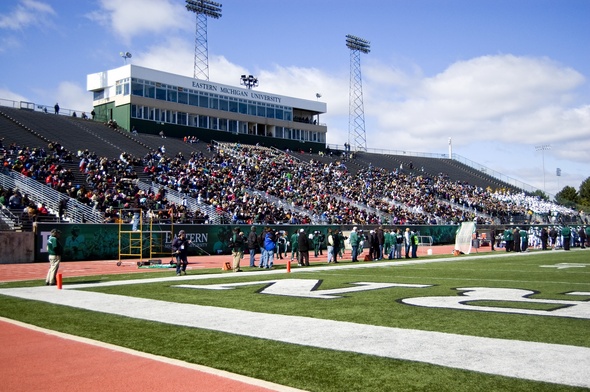
Sparse attendance at EMU's home football games - like this one on Oct. 1 - prompted the university to strike a deal to pay area schools if their students redeem free tickets at upcoming games.
Joseph Tobianski | AnnArbor.com
And despite a surge of efforts from EMU’s athletic department, EMU’s three home games so far this season have averaged an attendance of 3,903 - well below the 15,000 required by the NCAA.
This year's most promising chance of a highly attended game will come Saturday when the Eagles match-off against Western Michigan University at EMU's homecoming game.
After a win against Central Michigan University last weekend, the Eagles are 4-3 going into their game against the Broncos. EMU football hasn't had such a winning start since 1995.
Additionally, EMU won't have to compete with its Ann Arbor neighbor for attention. Tens of thousands of University of Michigan fans won't be flocking to the Big House, as it's a bye week for the Wolverines.
The question is, will all these ingredients mix to give EMU the attendance it seeks?
Since 2005, the school has been thrice ranked last among fellow NCAA Division I Football Bowl Subdivision teams for attendance levels per game. Other years, EMU has ranked in the bottom 15 percent.
In fact, for the past decade EMU has kept its FBS status by selling tens of thousands of tickets to Pepsi —one of the corporate sponsors for the athletic department— during NCAA count years, which are every other year.
Last year, an NCAA count year, average attendance was about 6,400. To reach the 15,000-attendance level required for an FBS team, EMU sold Pepsi 50,000 tickets at $3 apiece. Tickets are normally sold at $9 apiece. EMU students receive free entry.
EMU also sold tickets to Pepsi in 2008 and 2006. Both years were NCAA count years.
EMU’s entire athletic department made $133,000 in ticket sales last year and just $2,400 in concessions, according to NCAA figures. $16.5 million —or 83.4 percent— of athletic department funding comes from EMU’s general fund, the highest percentage of general fund support among all 13 athletic departments in the Mid-American Conference. “We have a big stadium, and we have not been that competitive,” said EMU President Susan Martin. She remarked that last year’s 6,400 per-game attendance average was a 25 percent increase from the year before —when levels were at 5,000 per game— but not where the university wants to be.
“For some of the big games we should be doing better than that,” Martin said. “We’re seeing that build. We have a lot more work to do, but I’m confident that we’re going to see increased attendance.”
To increase attendance, EMU has begun offering money to local school systems to get fans filling the seats at Rynearson Stadium, which can hold 30,200 fans.
Last fall the university launched a ticket stimulus program that offers free tickets to students, faculty and staff from more than a dozen local school districts. In addition to the free entry, EMU donates a dollar to a student’s school district every time they attend a game.
“We thought ‘How could we help teachers? How could we help students? And how could we help get more people to the games?'” said Ted Coutilish, who is in charge of marketing EMU’s athletic programs.
Coutilish said that last year EMU sold about 3,000 tickets through the stimulus program.
The school also has moved from a traditional marketing scheme consisting of billboards and media ads to a grass-roots method that thrives on events.
Every Thursday, EMU’s athletic department hosts a lunchtime tailgate party on campus with music, food and giveaways. Every sports season the school has athletes serve EMU students and faculty at a picnic.
“We’ve switched the way we do things, and we saw a big push up in the attendance last year with both basketball and football from that approach,” Coutilish said. “The story I think is a positive one: That we were able to increase attendance… we put in a lot of effort.”
But even though the Eagles are undefeated at home this year, attendance levels at the next three home games will need to increase if EMU doesn't want a repeat of 2009, when EMU's attendance levels were at record-lows and game averages were at least 5,000 fans fewer than all other FBS schools.
Coutilish in part blames this year's low attendance on the weather.
So far this year, each of EMU’s home games has coincided with rainy weather. The first game, against Howard University, was canceled and postponed to the next day. Coutilish estimates that 6,700 people showed up to attend the rainy opener Sept. 3, the day it was canceled. But attendance levels shrunk to 3,563 during the rain date, Sept. 4.
The next game, on Sept. 10, saw 4,771 fans. But attendance at the Oct. 1 game slipped to the lowest level of the year, 3,375.
“At the last two games, we had severe thunderstorms and raining for at least part of the game,” Coutilish said. “The weather plays a big role in attendance.”
Coutilish said that EMU’s proximity to the University of Michigan —which is consistently among the top ranked universities in football attendance and has the largest football venue in the nation— is not helpful.
“There’s no other university in the state that has another university 6 to 7 miles away,” he said. “Certainly that is a factor, but we don’t try to get involved in what they’re doing.”
Three of EMU’s six home games are scheduled on the same day as U-M home games this year.
Below is the average attendance at EMU football games for seven of the past eight years, according to NCAA attendance figures:
- 2010: 15,885
- 2009: 5,016
- 2008: 18,951
- 2007: 7,448
- 2006: 14, 734
- 2005: 5,219
- 2004: not available
- 2003: 11, 258
Kellie Woodhouse covers higher education for AnnArbor.com. Reach her at kelliewoodhouse@annarbor.com or 734-623-4602 and follow her on twitter.
Comments
15crown00
Fri, Oct 21, 2011 : 5:51 p.m.
the last game i went to was several years ago.they played Buffalo and it was Senior Day.Buffalo had many more spectators than EMU.THAT should tell u something.
15crown00
Fri, Oct 21, 2011 : 5:46 p.m.
Hurons that's what they are and will always be.Eagles is a PC response and needs to fly away. Poor teams over the years hurts bad. Paying high schools to get their students to use free tickets makes no sense to me. It is and always has been a bad situation.
ypsiRK
Fri, Oct 21, 2011 : 11:47 a.m.
This is an easy one, the University doesn't really like students to tailgate in the traditional sense of getting up early, drinking, and then heading to the game. The last game I went to was Homecoming in probably 2005ish and they were only allowing a 6 pack of 12 oz beers per 21 yr old. Each and every person entering the "tailgate" area had their ID checked and beer examined. I saw a guy with plastic bottles get told they couldn't be brought in because they weren't cans and looked like glass. Now, before you tell me that drinking beer shouldn't be a major factor in whether or not a student attends a game, I agree. However, it's the only school I've been to with these rules and also the only D1 school I've seen with a 1/4 filled stadium consistently. Try letting the students have a traditional college experience. Going to watch an awful football team while completely sober is not a winning combination..
Riskay
Fri, Oct 21, 2011 : 4:45 a.m.
The majority of the members of the EMU community (faculty, staff, students, and most importantly, ALUMNI) could care less about EMU football. The numbers ("EMU's three home games so far this season have averaged an attendance of 3,903") prove that ... no doubt. To try and insinuate that UM football game attendees would somehow try and attend EMU football games is ridiculous. The attendees at UM football games are passionate about their alma mater and the Michigan brand in general. BTW, EMU's marketing director is blaming the "weather"? At EMU, it's ALWAYS someone else's fault.
hammer
Fri, Oct 21, 2011 : 1:38 a.m.
Division 1 football is killing athletic opportunities for many prospective college athletes. The amount of resources that go into trying to field a comptetive FBS football team are enormous, especially for a program like EMU's who brings in very little revenue. Meanwhile, male Olympic sports in the MAC and other non-BCS conferences are becoming a thing of the past. EMU fields the bare minimum sports to be a member of the MAC. In my time there, 2 mens sports were cut (tennis and soccer) all in the name of football. While people say that those sports do not bring in any revenue, they also do not require the amount of expenses that the football team does either. Actually, all non-football/basketball sports have many more athletes than scholarships (track and cross country has around 45-50 athletes and 6 scholarships). So really these programs are bringing students to the school that may not have attended had there not been the opportunity to compete in their sport. Thereby increasing tuition revenue far more than the expense to field the team. No MAC team will ever compete at a high level in football at the FBS level. I do not know why they keep throwing money in the blackhole to try.
Likearock
Fri, Oct 21, 2011 : 3:09 a.m.
Hammer - I've got to correct you. EMU offers more varsity sports than any other MAC school. Look it up. And EMU cut men's tennis and soccer to stay compliant with Title IX. They added women's rowing.
treetowncartel
Thu, Oct 20, 2011 : 8:36 p.m.
Try some night games, do some marketing and maybe buy a jumbo tron and show the Michigan game to the fans in the stadium.
Macabre Sunset
Thu, Oct 20, 2011 : 8:32 p.m.
The missing attendance figure from 2004 is 16,060, by the way. The fact is that the MAC, the Sun Belt and the WAC are just barely hanging on to FBS status. And EMU has to "cheat" just to meet a requirement that makes no sense.
Anthony Clark
Fri, Oct 21, 2011 : 12:58 a.m.
Why don't those conferences simply drop to FCS status? That would make so much more sense. Realistically, none of those schools will ever compete for a national championship or even a major bowl berth. Isn't that the whole reason for having different divisions? To get like schools competing with each other. Same reason high schools have class A,B,C,D. So Lincoln doesn't compete with Plymouth-Canton.
Bill
Thu, Oct 20, 2011 : 7:42 p.m.
With such a long history of defeat, why not simply cut the program back to the bare minimum or eliminate it entirely. If EMU is investing over $16 million into a department each year that has almost no return, what benefit does the university receive to justify the expenditure? EMU overall does a very poor job at keeping the public up-to-date on what is happening on campus. I have friends that are staff and faculty members at EMU and this is the only way I receive information about activities on campus. The school does have some great programs that offer events such as musicals and plays. I attended Rocky Horror at EMU and was as impressed with their performance as I have been with performances on Broadway. EMU just lacks the ability to promote itself.
Ryan Munson
Thu, Oct 20, 2011 : 5:03 p.m.
I think part of the issue is that Eastern is a commuter school with most students drive.
lumberg48108
Thu, Oct 20, 2011 : 8:27 p.m.
not most ... if you count dorms and those that live off-campus but in Ypsi (which are counted as commuters but they are not really) the number is less than 1/2 are actual commuters who live far away and drive and leave after class
Dog Guy
Thu, Oct 20, 2011 : 4:56 p.m.
What a shame--considering that EMU spent the library appropriation on a stadium with luxury boxes.
Craig Lounsbury
Thu, Oct 20, 2011 : 5:56 p.m.
for whats worth with respect to the library they are in their 3rd building in my memory.
information please
Thu, Oct 20, 2011 : 5:28 p.m.
It's my understanding that the library is already underfunded by about $1M per year as compared to peer institutions in MI. They just took another $200K cut to the collections budget this year.
JimB
Thu, Oct 20, 2011 : 4:16 p.m.
EMU shouldn't be worried about playing games at the same time as UofM. Eastern appeals to fans who may: take their family to the game since it is affordable, students or corporate/local busibness sponsors. Families won't go to the game if it is scheduled at night, after the Michigan game, where it may be extremely cold late in the fall. I feel sorry for the school because they have good facilities to see a game, even for basketball. Just not good teams.
quitoslady
Thu, Oct 20, 2011 : 3:22 p.m.
make the tickets cheaper
cinnabar7071
Thu, Oct 20, 2011 : 6:15 p.m.
Tickets are very cheap, cheaper then going to a movie.
Steve Hendel
Thu, Oct 20, 2011 : 3:14 p.m.
Apparently, giving away tickets or even PAYING people to attend counts towards total attendance, at least as far as the NCAA is concerned. Not much ethical difference between that and ballot box stuffing.
lumberg48108
Thu, Oct 20, 2011 : 3:20 p.m.
you are comparing rigging an election of public officials with skirting attendence requirements through (legal) sponsorships????????
catfishrisin
Thu, Oct 20, 2011 : 3:06 p.m.
Maybe EMU is not meant to be a football school. There's nothing wrong with that. What is wrong is knowing that the program is not viable but continue to pump resources into it anyway. Instead, develop the basketball program which is less resource intensive, and other financially-challenged entities on campus.
Buster W.
Thu, Oct 20, 2011 : 2:51 p.m.
I'll ask the question...what would happen if EMU allowed itself to average less than 15K/football game? Would only the football program drop to DIV-II? What's wrong with that? My guess is they'd be much more competitive. They need to stop being something they're not.
Basic Bob
Fri, Oct 21, 2011 : 4:37 a.m.
Ever wonder how so many Big Ten schools go to bowls when they having losing conference records? They load up on cream puffs early in the season to ensure their bowl eligibility. FCS schools like App State don't count toward bowl eligibility. So the Big Ten actively supports their "little brothers" in the MAC. And some of the MAC teams play well from time to time. Just not Eastern.
Anthony Clark
Fri, Oct 21, 2011 : 12:50 a.m.
I always wondered why the MAC was division IA. Makes no sense. The MAC should be a IAA or FCS conference.
lumberg48108
Thu, Oct 20, 2011 : 3:59 p.m.
Good catch on my mistake ... It was easier when things were D1-A and D1-AA ... I think they added more confusion with the FBs nonsense
Likearock
Thu, Oct 20, 2011 : 3:54 p.m.
Minor correction to lumberg's reply... Division 1 is split in to two sub-divisions - FBS and FCS. FBS is formerly D1A. FCS is formerly D1AA. There are 11 FBS conferences, including the MAC and Big 10. 120 schools total. There are no FCS schools in MI but there are a lot of DII schools like Grand Valley, Wayne St and the rest of the GLIAC.
lumberg48108
Thu, Oct 20, 2011 : 3:19 p.m.
The drop would be to what is formerly called Division 1-A and they could still play the same schedule the problem is they would have to leave the MAC
Likearock
Thu, Oct 20, 2011 : 2:41 p.m.
Kind of ironic that annabor.com writes a report about attendance when, in my opinion, you contribute to poor attendance by not covering EMU. Hello! There are two D1A (FBS) programs in this county. We EMU fans rarely get any detailed coverage on subjects like game strategy, injuries, recruiting. The only EMU coverage we get from Annarbor.com are skimpy game reports. Nothing that we can't find through other sources. Of course, if Denard Robinson were to have a hang nail we'd get a full report. It's also a shame that many EMU alums are big UM fans and don't even pay attention to the program at the school they attended. I'd rather support MY school than be "living the lie" as a pretend UM alum. This is not just EMU's problem as I know alums of WMU and CMU that are also Walmart Woverines. Unfortunately most people don't even know that EMU and the MAC teams are amongst the 120 FBS teams in the country. EMU's program is much improved and as the wins increase so will attendance. The games are affordable for families too. Where else can you pay $9 and sit in great seats? The only criticism I have for EMU is that they should play more night games in Sept and Oct. Many families can not attend games early in the day because their kids are involved in sports that play Saturday. Games should be at 6PM.
lumberg48108
Thu, Oct 20, 2011 : 3:35 p.m.
AGREE 100% regarding the abysmal coverage from the local press but I am on the fence regarding start times and the possible impact. But if you want them make your voice heard - as I mentioned there are often surveys seeking feedback about start times. Or just email to AD ... he often replies (when I am nice) But let's be realistic - college football has always been a day event and its not like EMU would pack the stadium simply because the games start later. Other (peer) programs do well attendence wise with afternoon starts and those people have kids with soccer too.
Buster W.
Thu, Oct 20, 2011 : 3:28 p.m.
As a parent of two young kids that are active on Saturday mornings, I fully support 6PM kickoffs.
Craig Lounsbury
Thu, Oct 20, 2011 : 2:14 p.m.
"We have a big stadium, and we have not been that competitive," said EMU President Susan Martin." In the big scheme it probably matters little but the stadium is pretty isolated from the general campus. Ironically only the President in her multimillion dollar presidential palace...errr..... mansion...errrr...... home is within reasonable walking distance of the stadium. That is because the Presidents residence is now isolated from campus too.
Anthony Clark
Fri, Oct 21, 2011 : 12:46 a.m.
When I was a student at EMU, they ran a shuttle from the residence halls to the stadium. Getting to the games was not a problem for anyone who wanted to go. Some of my friends and I did occasionally walk. It's not that far.
Craig Lounsbury
Thu, Oct 20, 2011 : 4:18 p.m.
I didn't mean to suggest she did. I only suggest that the decisions to move both the athletic facilities and the Presidents home away from campus are debatable as to their ultimate wisdom.
jrigglem
Thu, Oct 20, 2011 : 2:26 p.m.
Well it's not like she put it there.
Craig Lounsbury
Thu, Oct 20, 2011 : 2:21 p.m.
I will add my dad (RIP pop) was a sports fan and a professor at EMU during the 60's. As a youngster I remember going to University of Georgia games when he spent a semester as a visiting professor at UofG. We had season tickets to the Lions at Tiger Stadium for a few years. Later when he left EMU to move out west he had season tickets to ASU Sun Devil football for 20 plus years. But I don't ever remember him going to an Eastern game.
Eric Huston
Thu, Oct 20, 2011 : 1:52 p.m.
As a disclaimer, I am not an EMU alum, but I know many EMU alums have very strong feelings about this issue. However, I think it is important to mention what is not being said so far in this discussion: The fact that, as stated in the article, EMU's athletic department brings in just $133k a year, plus 2400 bucks in concessions. Yet the athletic department receives over 16.5 MILLION dollars from the school's general fund. I think the university needs to take a hard look at whether or not some or all of that 16.5 million is worth it, especially given that football games are so poorly attended, and that the state of Michigan continues to cut back on funding for public universities. A lot of that funding could be going towards hiring more professors and improving academic programs, or by lowering tuition to make it more affordable for all to get a college education, or some combination of both. Isn't getting a degree supposed to be the real reason people go to college anyway? Or, as another idea, some of it could be used to fund the university's radio station, WEMU, which is a valuable community resource that I am fairly certain is listened to by a heck of a lot more people than the number of those who attend football games.
lumberg48108
Thu, Oct 20, 2011 : 2:35 p.m.
WEMU does not serve the campus or students - it serves the community. Which is fine but most students do not even know there is a "campus" station nor could they ID the frquency. There is ZERO programming aimed at students. So while your points are valid, until WEMU serves the campus more, I would not invest more money in them.
Kevin S. Devine
Thu, Oct 20, 2011 : 1:50 p.m.
If it's press coverage you want, check out The Eastern Echo in print on Mondays and Thursdays all over campus and around Ypsi or online at EasternEcho.com. Today's edition is a great example of the depth and breadth of coverage in the Echo -- the six-page sports section has football and volleyball player profiles, senior snapshots, a game preview and volleyball and soccer stories as well -- plus great photos of student athletes. Online you'll find more stories and photos and a link to the Echo's YouTube channel where you'll find plenty of videos of EMU's student athletes in action.
lumberg48108
Thu, Oct 20, 2011 : 2:33 p.m.
Yes, the Echo has bene good but I was referring to media sources that the public reads -- annarbor.com, Freep, Det News and ot be honest, the Echo sports coverage often lacks - I routinely read wire reports for away games (games that are sometimes less than an hour away) .. This Monday I went to the Echo online and had to do a search for the CMU game story???
lumberg48108
Thu, Oct 20, 2011 : 1:22 p.m.
The school often surveys its students and ticket holders to gauge when the best times for games would be ... U-M has EIGHT HOME GAMES and every game is on TV -- you simply cannot work around U-M every week; it's not realistic. Logistics play a role in EMU's attendence woes but its a combination of things. Fifteen years of mediocre to poor football has created a stigma that is hard to overcome. Games in October need to be relvant. November too! Apathy among alumni (many former Hurons) hurts a great deal too. Lack of media coverage plays a role too becuase if the "press" does not see it as a big deal than most casual fans wont either. AnnArbor.com had a great chance to feature EMU players this year (the week they played U-M when the stories would actually get read) and instead they focus on a third year coach and his journey -- how lazy is that? Relevance goes a long way and right now, the program has not been relevant. Only winning will change that - and getting players that have become BMOC -- when was the last time EMU had a BMOC in any sport? CMU fans LOVED their QB (Dan LeFevour) - they carried signs with his name and wore his jeresy on campus ... that is all part of it folks. His likeness was on buildings downtown - that was awesome. EMU is getting there - but its not a simple answer as to why attendence struggles. Winning breads relevance and hopefully media coverage which will lead to casual fan interest etc etc etc ...
xmo
Thu, Oct 20, 2011 : 1:19 p.m.
There was a really big crowd last year when the Huron's played Army but then the score board clock didn't work after the 2nd qrt. Why not have an "Occupy Rynearson Stadium" class and make All Freshmen & Freshwomen attend the game and give them 1 credit hour for school Spirit/History/Culture. This would bring people to the game and they might even have fun and return after their first year. Also, a great way to develop knowledge of the school's traditions and rich history. At the present time, EMU is U of M's little sister which nobody knows anything about. EMU, I am available for hire.
glimmertwin
Thu, Oct 20, 2011 : 1:04 p.m.
I'm curious if other spectator sports suffer from the same lack of spectators compared to other MAC schools. If basketball and other sports suffer, that throws out the UM portion of the argument.
Calimom88
Thu, Oct 20, 2011 : 1:04 p.m.
I have been working in Ypsilanti for the past 10 years and my girls are students at Eastern. We go to the games and have a great time. I am disappointed that the local business promote U of M and State and do very little to promote Eastern. I think the whole communnity needs to activiely root for them. The Football program is building and getting better every year. Eastern never very little recognition, its a great school and a great community. Come on Wolverine Fans, the football coach is an ex-Michigan coach, you all need to support your neighbor!
Buster W.
Thu, Oct 20, 2011 : 12:27 p.m.
Is Pepsi really getting a bang for their buck by buying up these tickets??? I understand EMU can't dodge all UM home game weekends (and don't suggest they should), but I always shake my head when they schedule kickoffs at about the same time for home games. I think this actually goes for when UM is away, too. Many football fans would rather watch UM on TV than attend an EMU game which is essentially free.
Buster W.
Fri, Oct 21, 2011 : 2:19 a.m.
info please Thanks for the info.
information please
Thu, Oct 20, 2011 : 3:05 p.m.
Yes, they are. Pepsi has the vending rights on campus as part of this deal. All vending machines stock Pepsi products, and any Coke products in the campus convenience stores are hidden away at the bottom of the coolers. Here's the document about the agreement from the Board of Regents: <a href="http://www.emich.edu/regents/meetings/meeting091608/Section17.pdf" rel='nofollow'>http://www.emich.edu/regents/meetings/meeting091608/Section17.pdf</a>
Buster W.
Thu, Oct 20, 2011 : 12:29 p.m.
BTW, I'll always be a "Huron".
discgolfgeek
Thu, Oct 20, 2011 : 12:01 p.m.
Not that this has anything to do with whether I attend or not but: ONCE A HURON, ALWAYS A HURON !!!!
deetdeedee
Thu, Oct 20, 2011 : 11:37 a.m.
Can't this Saturday, Beerfest at Eastern Market, it's Detroit Beer Week don't ya know!
sellers
Thu, Oct 20, 2011 : 11:32 a.m.
Can you compete in the M.A.C. w/o a football team? Or would you have to goto D-II ?
Charlie Brown's Ghost
Thu, Oct 20, 2011 : 11:16 a.m.
There are only two ways you can get me to show up: free beer, or a good football team. Wait, there is a third way: reverse your mistake of changing the mascot of my school from "Hurons" to "Eagles."
Hmm
Thu, Oct 20, 2011 : 5:26 p.m.
You're boycotting Easter Michigan football because they changed their name from the Huron's (which may or may not be a politically insensitive name) to the Eagles? Doesn't sound like you were much of a fan to begin with then
Jim Pryce
Thu, Oct 20, 2011 : 11:06 a.m.
I think your earlier comment about U of M being just down the road is accurate. Usually, the EMU scheduled Home games are the same weekends, & folks go to the Michigan game.
A2comments
Thu, Oct 20, 2011 : 10:43 a.m.
It says a lot about society when a corporate sponsor can buy tickets to meet attendance requirements and that's ok. Keep in mind that no one uses the tickets...
cinnabar7071
Thu, Oct 20, 2011 : 12:05 p.m.
That used to happen all the time with the Detroit Lions. My girlfriend picked up a 6 pack of free tickets yesterday from some source, not sure who but thanks to whom ever bought these tickets and gave them away.