

Ann Arbor school board approves first purchases from $45.8 million technology bond
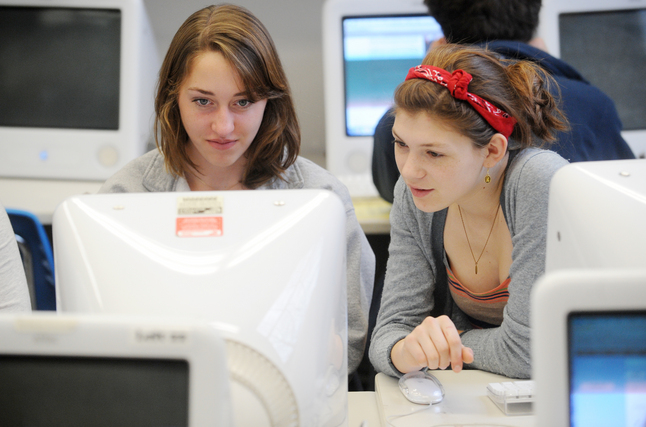
Community High School students work on outdated eMacs last school year.
Melanie Maxwell | AnnArbor.com
But school officials warned the speed at which they’ll roll out the plan will not match the speed of the district’s new beefed-up Internet connection.
The Ann Arbor Public Schools Board of Education approved two first purchases of the 10-year, three-phase $45.8 million bond at Wednesday’s regular meeting.
The purchases were $76,436 for wireless infrastructure and server equipment and $54,540 for 30 15-inch MacBook Pro laptop computers.
The infrastructure upgrade and installation of the new server will improve the district’s network and firewall security and reliability, said Randy Trent, director of physical properties for AAPS. It also will increase the district’s internal and external bandwidth and scalability for future needs, he said. Bandwidth is defined as the rate at which data can be made available.
Students have contributed to the current bandwidth problem at AAPS by carrying personal technology devices such as cell phones and tablets that can, at high-traffic times, bombard the district’s public and private networks, causing frequent crashes, Trent said. The new infrastructure will help prevent this.
Other infrastructure, wiring and equipment improvements will be coming this fall. Central administration plans to bring a complete report on the technology bond plan before the school board sometime in October, and they will have more purchases ready for approval in November.
Administrators wanted to bring the technology infrastructure item to the board for early approval so the installation of this equipment could take place as soon as possible. Trustee Glenn Nelson said he supported the move because AAPS currently is “at risk of the larger part of the system shutting down. And that would be quite a consequential thing for 17,000 students.”
Board of Education President Deb Mexicotte echoed his sentiments.
“I see it as a modest move forward for a very important and missing piece,” she said. “Our ability to do multi-media has become prudent and necessary. And I think this would be approved in several weeks anyway, so I’m very interested in ‘getting a jump on it,’ as Trustee Nelson said.”
The second purchase approved Wednesday also was placed on the board’s agenda ahead of the other technology bond items for a specific reason.
The 30 laptops will be given to members of the district’s information technology department to pilot, prior to the district potentially purchasing thousands of them in fall 2013.
Trent said the MacBook Pros have a new operating system called Mountain Lion. IT staff will need to test the operating system against the district’s current software applications to ensure a smooth transition as computers are replaced district wide.
“The entire staff will have to be trained on the software compatibility of (the Macs),” Trent said. “If you were to set one down on a desk tomorrow, a large portion of our existing software wouldn’t run on it. … We have to work through (the new system) and see where some of the problems are … and work through all of the bugs before putting this in the hands of students and teachers next fall.”
As an educational institution, Apple gave the district a 13-percent discount and threw in two other computer models, an iMac desktop and a MacBook Air laptop, for the district to try out for free.
Several school board members praised Trent and his team for their deliberate actions in structuring the technology bond plan and rollout.
“I really appreciate the sequential planning that has gone into this, Nelson said. “It really has been designed to get the most out of the tech bond money, rather than to rush out and get a whole bunch of stuff right on day one.”
Trent said district officials learned from their 2004 bond, which had about $20 million going toward technology.
“We’re working closely with (the) instruction (services department), trying to make sure we know what they want and need so we can deliver,” Trent said. “We learned that last time… when they couldn’t run some stuff. We want to make sure it doesn’t happen this time.”
Danielle Arndt covers K-12 education for AnnArbor.com. Follow her on Twitter @DanielleArndt or email her at daniellearndt@annarbor.com.
Comments
dexterreader
Fri, Sep 7, 2012 : 3:56 p.m.
It is interesting how the world has embraced iPhones, iPods, and iPads, yet the same people who own those devices and wouldn't think of being without them are reluctant to use Apple computers. Why is that?
SuperiorMother
Fri, Sep 7, 2012 : 6:20 p.m.
Mainly price, I'd bet. I'd love to have a Mac laptop, but when my choices are a good PC laptop for $600 or $1000+ for a laptop, it's hard to justify the extra $400 (or more, depending on model ... the $1000 model has only a 11" screen).
PineyWoodsGuy
Fri, Sep 7, 2012 : 4:44 a.m.
I l-o-v-e Apple Macs. A romance of more than 30 yrs with every version along the way. However, I think the Board could have driven a harder deal on the price.
Basic Bob
Fri, Sep 7, 2012 : 9:20 a.m.
They won't accept alternatives. They have no leverage. No deal.
jns131
Thu, Sep 6, 2012 : 10:06 p.m.
I just saw clips from that new television show Revolution. I hate to say it, this world would not survive. Need to go back to chalk and brain usage.
Basic Bob
Fri, Sep 7, 2012 : 9:22 a.m.
We've been turned into vidiots.
Stephen Landes
Thu, Sep 6, 2012 : 6:28 p.m.
There is something terribly wrong with the way our school system IT department is running its business if new Mac Pros don't work with existing AAPS software. If the school system is standardizing on Apple equipment they should have a close relationship with Apple to make sure that whatever software they specify works with Apple/Mac operating systems. This is pretty basic stuff. I can't think of any excuse for lack of downward compatibility of hardware.
Klayton
Fri, Sep 7, 2012 : 12:09 a.m.
I wonder why they don't just go to the cloud and use web-based software...then the platform does not matter.
Angry Moderate
Thu, Sep 6, 2012 : 7:41 p.m.
Yeah, it's hard to imagine what important software is going to have problems going from older versions of OS X to Mountain Lion. Especially because the District's whole justification for buying these new computers is that their software doesn't work on the OLD ones!
Basic Bob
Thu, Sep 6, 2012 : 6:59 p.m.
I bet it works already but they have a budget to justify.
Klayton
Thu, Sep 6, 2012 : 6:17 p.m.
Wonderful! I'm happy about the purchase....Now maybe they can upgrade the antiquated school websites...these are horrible...they look like a 10 year old made them and the sites are not updated...there are teachers with webpages from 2 years ago still up. For a "great" school district this is embarrassing.
Jay Thomas
Thu, Sep 6, 2012 : 6:35 p.m.
Someone is being paid to take care of that but they obviously think it is just fine as it is. I recommend working in government to all the young people I know; it is so much different than the private sector.
Belgium
Thu, Sep 6, 2012 : 5:56 p.m.
The cost of computer hardware is only a small part of the cost of ownership over the lifetime of the hardware. Many commentators here seem to think the cost of providing computers to students ends after the hardware is purchased. Nothing could be further from the truth. Buying easier to support hardware often costs less over the lifetime of the computer making Apple a logical choice. I can't say what analysis they did prior to purchasing the hardware, but the comments on this thread reveal a lack of understanding as to the cost of providing hardware in a educational (or otherwise) setting.
Belgium
Fri, Sep 7, 2012 : 7:42 p.m.
We used about 1 tech per 250 to 300 CPUs but it would depend on their location. Off site took more time in travel, so there was a smaller number of CPUs per worker. 20 per 1000? 1:50? Seriously? Sounds crazy.
Angry Moderate
Thu, Sep 6, 2012 : 7:59 p.m.
20 techs per 1000 PCs?? Only in the public sector....the IT departments I worked in never needed anywhere near that many people.
djacks24
Thu, Sep 6, 2012 : 7:42 p.m.
" Have you ever worked IT in a school district?" Yeah, as a matter of fact repairing Macs for UM, EMU, and several school districts. The 1st year hardware failure rate is completely false or I'd like to see a valid reference. But anyway, it doesn't matter because the 1st year there is no cost in repair anyway. The main factor is USER SUPPORT for which is all most in house IT departments do anyway. For the same number of PCs to Macs it will take for example, a crew of 20 support techs to support and maintain 1000 deployed PCs, where it will take 1 or 2 maximum (assuming these techs actually know Macs, and not PC techs fumbling their way around a Mac) to support the same number of Macs. Most school districts we support don't need someone full time on staff to support Macs, because even with a large number of deployed Macs, they can just have us come out once a week and handle all of the Macs and this counts for new and old machines. Also, the reason schools hold onto their Macs forever is because they generally are reliable and still cost less to support.
Angry Moderate
Thu, Sep 6, 2012 : 7:40 p.m.
It is much easier and cheaper to upgrade parts on PCs than Macs because they aren't locked down by Apple's (nearly fascist) proprietary features.
Hume
Thu, Sep 6, 2012 : 7:15 p.m.
I also work support in a large Mac and PC environment. In a three year period you do not save the original cost difference between the two in support costs. Macs have a higher hardware failure rate for their first year vs PCs. Also schools tend to hold on to their Macs forever! The cost of supporting these computers actually goes way up because replacement parts start going up after 5 years or so. Have you ever worked IT in a school district?
Basic Bob
Thu, Sep 6, 2012 : 6:54 p.m.
Most *commenters* on this thread understand the lifetime costs. There was no analysis by the IT department since they only accept brand A.
jns131
Thu, Sep 6, 2012 : 5:28 p.m.
We saw a television show that was made in the 60's. In it was some school children in the office waiting to talk to the principal. You what I did not see? Computers. Just simple hand writing stuff. O those where the days these electronics did not suck the school district dry. Can't believe how much we depend on this stuff so much.
Louis
Thu, Sep 6, 2012 : 4:30 p.m.
One word - Ubuntu! https://wiki.edubuntu.org/Education/UbuntuSchools
Dog Guy
Fri, Sep 7, 2012 : 1:22 a.m.
Shhhhhh, Louis, the smartest people in the cosmos don't know there is anything other than Apple and Microsoft. Linux has about 62,000,000 "registered" users this week (https://linuxcounter.net/). Of these, Ubuntu has only 20,000,000 "registered" users ( http://www.ubuntu.com/ ). A quick poll of students using Ubuntu reveals that none have bothered to register (well, neither have I). Certainly, Louis, you must never mention free, more-secure, faster, Mac and PC compatible, constantly updated, user supportive operating systems and thousands of free software programs around people with enormous amounts of tax money which they are paid to spend. You would make them and the taxpayers look like ignorant fools.
xmo
Thu, Sep 6, 2012 : 4:19 p.m.
Are there any other kind of computers that students might use or should be trained on so that they can assimulate into the business world? I guess everybody uses a MAC? ""The entire staff will have to be trained on the software compatibility of (the Macs),"
mw
Thu, Sep 6, 2012 : 4:05 p.m.
Gad what a huge waste of money. Laptop computers that would be much more than capable of handling the needs of a K-12 student can be had for $400 or less. There is no possible way that MacBook Pros costing 4-6 times more are going to be more cost effective. And before anybody pipes up and says such basic machines are crap and will break right away -- nonsense. Both my kids took similar computers away to college and they're both going strong 3-5 years later. We're talking about school kids -- these machines are inevitably going to get abused, broken, lost, and/or stolen. It's nuts to have school kids running around with $1800 electronic devices of any kind. K-12 students just don't need the BMW 7-series of laptops.
Angry Moderate
Thu, Sep 6, 2012 : 7:39 p.m.
These are a very poor choice for school computers. The vast majority of students are just browsing the web, doing word processing, making spreadsheets, etc. A small number of more expensive computers could be purchased for graphics design classes, yearbook clubs, etc.
djacks24
Thu, Sep 6, 2012 : 5:04 p.m.
The problem is really that Apple has essentially abandoned the educational market when it comes to portable computers. There used to be the polycarbonate Macbooks, but now a low end Apple portable is the Macbook Air. The Macbook Air is entirely too delicate to give to students. I do agree an a professional grade portable machine is complete overkill if they plan to deploy these machines to the students. We support a school district that is still running thousands of polycarbonate unibody Macbooks which were the last of the Macbook line. When this particular school district decides to replace their fleet of machines, I honestly can't see what a reasonable Apple replacement would be?
Basic Bob
Thu, Sep 6, 2012 : 3:40 p.m.
Ok, I understand why AAPS bought Apple. Apple bought their way into education a long time ago and schools are de facto Apple shops. But I am confused about the durability argument since it is being played two ways. 1. Apples last forever, you can put them with the Samsonite gorilla and they will still power up. 2. This is technology, in 3 years everything is obsolete thanks to companies like Apple. I personally don't believe either argument is completely true and the solution is to find a happy medium. Just as we stopped buying cars that were disposable after 80000 miles, we need to do the same with electronics. There is a reason Apple is the wealthiest company in the world and half of it is in the hands of American high school students.
Dog Guy
Fri, Sep 7, 2012 : 1:03 a.m.
How much, Basic Bob, does this happy medium you say is the solution charge for a consultation?
tmad40blue
Thu, Sep 6, 2012 : 2:04 p.m.
"The second purchase approved Wednesday also was placed on the board's agenda ahead of the other technology bond items for a specific reason." This is terrible writing. Please proof-read your articles, AA.com. I would even do it for you. It isn't that difficult.
Dog Guy
Thu, Sep 6, 2012 : 2 p.m.
Apple vs Microsoft is a hard choice for school system computer gurus, but if you are flush with cash there are no alternatives. If you must spend millions, Bentley vs Rolls-Royce is a problem.
Basic Bob
Thu, Sep 6, 2012 : 3:14 p.m.
Apple: You can buy better, but you won't pay more.
sigdiamond
Thu, Sep 6, 2012 : 1:13 p.m.
I heard students can use these electronic whatsits to buy reefer pills and graffiti paint from something called "www.computer.com," otherwise known as the World Wide Internet. This alone should outrage any parent or any senior citizen who feels existentially threatened by this frightening alien space technology.
Barb
Thu, Sep 6, 2012 : 1:08 p.m.
Comment on the photo caption: emacs? Are those for ewoks?
dexterreader
Fri, Sep 7, 2012 : 3:54 p.m.
It also shows their durability if they are still in use 7 years after first being implemented. Again, another plus in Apple's favor.
Unusual Suspect
Thu, Sep 6, 2012 : 2:27 p.m.
Ron FTW with a good geek joke. Shows your age, too.
Ron Granger
Thu, Sep 6, 2012 : 2:05 p.m.
One thing is certain: emacs is much better than vi
Steve Norton, MIPFS
Thu, Sep 6, 2012 : 1:58 p.m.
eMacs were Apple's somewhat limited version of the all-in-one iMac for the education market. Those in AAPS are at least 7 years old and run on PowerPC chips (not Intel), meaning they cannot run most software created in the last 2-3 years, nor the last three major updates of the OS.
dexterreader
Thu, Sep 6, 2012 : 12:47 p.m.
This was a wise decision. As others have noted, a comparable pc would probably run about the same amount, especially if that price factors in a 3-yr warranty. However, Macs are durable, long lasting, and require far less support than a pc. Ask a $500 pc laptop to stand up against the abuse handed out by constant student use!! Given the choice between supporting a "lab" of 30 pc laptops and a "lab" of 30 MacBook Pros, I'd pick the MacBooks in a heartbeat. Good choice Ann Arbor!!
djacks24
Thu, Sep 6, 2012 : 2:41 p.m.
"Sorry no...a comparable PC laptop would be more than 50% less....you must not look at computer pricing very often...." 50%! Just WOW is all I can say about that comment. Oh my...If anyone hadn't been looking that would be you.
RUKiddingMe
Thu, Sep 6, 2012 : 1:28 p.m.
Billy, it is SOMETIMES true that a PC equivalent of a Mac product could potentially be described as close in price (but never the same or more, in my experience). Even in the rare instance that this is the case, however, it is LUDICROUS to think that any typical public school would come anyhere close to justifying that kind of build for school-use only for students from grades 12 down.
Billy
Thu, Sep 6, 2012 : 1:20 p.m.
Sorry no...a comparable PC laptop would be more than 50% less....you must not look at computer pricing very often....
Gardener1
Thu, Sep 6, 2012 : 12:27 p.m.
I hope they are looking at iPads for the classrooms. They are at least half the cost of the Pros and with apps are very versatile. A charter school in another state requires their middle school students to buy their own for school. Of course the new ones would go to the district's tech department. They are the people who have to service the computer usage at the schools and work out all the glitches.
Brad
Thu, Sep 6, 2012 : 12:22 p.m.
Students have contributed to the "bandwidth problem" only because they are allowed to do so. Do they really need constant access to Facebook during school hours?
Blerg
Thu, Sep 6, 2012 : 11:07 p.m.
It could easily be solved if parents insisted their students turn off their phone, or (gasp!) leave them at home/in the car during the school day. Sadly, many parents have the nerve to call their student's cell during class time and are enraged when teachers discourage such use.
Unusual Suspect
Thu, Sep 6, 2012 : 12:08 p.m.
A fifteen-inch MacBook Pro starts at $1800 at store.apple.com. Add $60 for Pages, Notes and Numbers, $30 for a projector connection dongle, probably add some sort of service contract, take the 13% off, and it could look about right. A PC could be purchased for less, but I believe there will be savings in maintenance and training with a Mac (and that's a PC user saying that).
RUKiddingMe
Thu, Sep 6, 2012 : 3:09 p.m.
Unusual, while I don't think it's a big part of the discussion, it DOES seem like the cherry topper that the kids learn on Macs, and then will most likely be required to use PCs when they get a job, at which point there WILL be a learning curve (though, again, not much; it's just another little piece that completes the nonsense in my eyes).
Unusual Suspect
Thu, Sep 6, 2012 : 2:25 p.m.
Billy, the students are accustomed to Macs at school. That's not a learning curve, unless there's something I don't know about Mountain Lion (which is everything) that requires re-learning a new GUI. I'm actually considering purchasing my first Mac for home because every kid in the house is familiar with it and uses one nearly every day at school.
Unusual Suspect
Thu, Sep 6, 2012 : 2:23 p.m.
RUK, gotcha. My experience is wholly in PC and those were assumptions. I know the user experience is better with Macs. I use PCs, but when my own Father-in-law wanted to get a laptop, I suggested a Mac because I knew it would be easier for him. You can't tell your Father-in-law "shut-up and reboot" (per Dogbert) like you can with members of your own family. And the last thing I need is yet another family member asking for tech support.
Billy
Thu, Sep 6, 2012 : 1:17 p.m.
The school is ALREADY paying for IT....all schools already have IT people. They wouldn't have to "hire new people" to maintain the computers if they bought PCs instead of apples. There is no extra maintenance costs there unless you'er talking about hardware breaking or something...and apple hardware breaks just the same as any other computer hardware... Instead you're paying for that EXTRA service contracts on the apples....and you are FORCED into buying it because apple requires educational organizations to purchase service contracts with all computers....and the service contracts are by FAR their largest profit margin (this is how it is in almost ALL industries). This is one of the biggest myths that gets pushed around the educational system about apples.....that they're somehow a savings on "maintenance." Also......MORE people have used and are comfortable with the windows UI than the apple UI...do NOT even start to argue this...this is statistical fact due to overwhelming market share. I will not link statistics for this since you can find it in SECONDS on google on your own. So I ask, how is there going to be a savings in training when you will most likely have to spend more time "teaching the UI" to students with apples than windows machines? Now if you want to run a custom linux distro that is designed for the district then I could see there being a need to hire in some extra IT guys. There would also be a LOT more training involved because most students would have ZERO experience with linux.
RUKiddingMe
Thu, Sep 6, 2012 : 12:47 p.m.
Unusual, I have also been in IT for some time, often involved in some way with the asessment and procurement of equipment, and I have never seen a scenario in which Macs are more cost effective, regardless of whether support is provided internally or externally or not at all. It has also been very rare that the use of the equipment would show Macs, regardless of cost, to be superior. I've seen some graphics/video work shops opt for this, but it has still been a close call costwise, even with the artistically-inclined's penchant for using Macs.
Unusual Suspect
Thu, Sep 6, 2012 : 12:39 p.m.
Sellers, I think you're right. RUK, point taken. In my experience, as a 25-year veteran of IT, is that if a company is large enough to have a good IT staff, it can deploy PCs and maintain them for less.
RUKiddingMe
Thu, Sep 6, 2012 : 12:30 p.m.
I suppose it's this cost savings of Macs over PCs that explains why just about every business around the world exclusively uses Macs in the office and remote employee environments. ...oh, wait...
sellers
Thu, Sep 6, 2012 : 12:17 p.m.
Compare components and options - and you'll find a similarly configured computer not from Apple would come very close.
RUKiddingMe
Thu, Sep 6, 2012 : 11:46 a.m.
I really hope the people who approved this millage do some laptop shopping and see what you can get for $1818 and how that compares to a Macbook. I ALSO hope they ask around and see whether or not it makes ANY sense to get such a laptop for someone in school from 12th grade DOWN. Every single person who voted to approve this millage should be outraged and should show up at some meetings and demand, LOUDLY, to know why the money they made everyone give for the benefit of thier children was wasted in such a despicable manner. Absolutely shameful. I am disgusted. And people who see this and STILL try to make some argument for it are really suffering from an incredible, debilitating denial.
RUKiddingMe
Thu, Sep 6, 2012 : 3:04 p.m.
djacks, I got the impression that these would be for students from this: "The 30 laptops will be given to members of the district's information technology department to pilot, prior to the district potentially purchasing thousands of them in fall 2013." I also DID shop around before posting, and as I commented earlier, it is possible that a similarly equipped machine might be CLOSE (but still LESS) in price. Given that, there is the insurmountable evidence that, unless the main focus of every grade's curriculum is 3-D rendering a visual process of complete genome sequencing, these laptops are shamefully over the top. Next stop, Dolce and Gabbana uniforms.
djacks24
Thu, Sep 6, 2012 : 2:28 p.m.
I really wish the readers that comment here themselves would practice what they preach and shop around themselves before spewing their ridiculously uninformed opinions. Furthermore, I don't see anything where they said that the students would get these same machines? I'd suspect that's why Apple has furnished the MBAir for them to try free of charge (much cheaper model than the pro). Then the iMacs that are being tested free would be lab machines.
RUKiddingMe
Thu, Sep 6, 2012 : 11:39 a.m.
Can we find out what the 13% discount brought the final price of the Macbooks to? I suspect (but am hoping I'm wrong, of course) that this discount resulted in a computer still 20% or more expensive than a similarly equipped PC machine. And if that is the case, why would they do that?
RUKiddingMe
Thu, Sep 6, 2012 : 11:41 a.m.
Oops, nevermind; just saw the price myself
Billy
Thu, Sep 6, 2012 : 11:24 a.m.
"$54,540 for 30 15-inch MacBook Pro laptop computers." That's $1818 APIECE...AT EDUCATIONAL PRICING....for itty bitty screen laptops that are PROBABLY their lowest line..... You could have gotten PC laptops that work just as well for $500 a piece......or for 1818 have a VERY powerful one......WITHOUT EDUCATIONAL PRICING.... Not trying to say PC is better than MAC.....just that it is FAR more practical from a budget perspective.
GoNavy
Thu, Sep 6, 2012 : 8 p.m.
@Belgium - Do you work with organizations comprised largely of children?
Belgium
Thu, Sep 6, 2012 : 5:53 p.m.
The major cost associated with hardware during it's lifetime is the cost of support, not the original cost of the hardware. The cost of the initial hardware purchase is only a small part of the lifetime cost of ownership. For that reason, purchasing easier to support hardware (Apple) makes a lot of sense. My background is in providing support to large organizations and have managed mixed networks of Macs and PCs (about 3500 of them) and can tell you, it's cheaper in the long run to purchase Macs.
RUKiddingMe
Thu, Sep 6, 2012 : 3:30 p.m.
In addition, BPF, do you really think the schools are going to keep these items for their useful life? Their stats when they asked for this and other millages was that a majority of their machines were 3 years old or older. I don't remember the exact numbers, but it was definitely NOT a strong argument for the NECESSARY replacement of computers. In A2, thouhg, all they had to do was use the words "school" and "students," and everyone's snowballed enough to assume the money will be spent wisely. Hey, the proposal said "for the kids."
GoNavy
Thu, Sep 6, 2012 : 3:24 p.m.
@ Bpf: We should all keep in the forefront of our minds that children do not treat these devices as you and I would: That is, with the care and respect that usually accompanies the personal outlay of $1,800 hard-earned after-tax dollars. Children are like locusts. They'll stuff Cheetos into their mouth then pound away on the keyboard without thinking twice. They'll download whatever they want, leave devices running all the time, and toss them around without a second thought as to who paid for these things or where the money comes from. With that in mind, the cheaper option is the way to go.
Bpf
Thu, Sep 6, 2012 : 3:07 p.m.
Yeah, they should have bought Dells. That way they will need to be replaced in 2-3 years. Majority of PCs are straight garbage. I used an old powerbook for 10 YEARS!
Unusual Suspect
Thu, Sep 6, 2012 : 2:32 p.m.
http://store.apple.com/us/browse/home/shop_mac/family/macbook_pro "MacBook Pro ... 15-inch from $1799."
djacks24
Thu, Sep 6, 2012 : 1:43 p.m.
The macbook pro 15-inch is NOT a low end machine starting @ $1799. I repair these machines daily and considering Apple has done away with the 17-inch macbook pro, the 15-inch pro is pretty much top of the line, with the largest screen available. The only Apple portable that is higher priced would be the 15-inch Retina Macbook Pro starting @ $2199. Off the top of my head, there is not a PC laptop made that would spec out anywhere near a low end Macbook pro for anywhere near $500. But for all the Apple haters here, just think how much money will be saved on maintenance, where most PCs need to be re-imaged almost all the time due to malware, constant maintenance, and almost constant other software problems. Provided these machines don't suffer any accidental damage, they will mostly run problem free. Any (non accidental) hardware issues will be addressed the 1st year free of charge and by getting the Applecare protection plan, the warranty should be extended another 3 years beyond the one year for education.
GoNavy
Thu, Sep 6, 2012 : 1:15 p.m.
There is something to be said, in this case, for going with the cheaper PC option. Considering that the goal is to put one of these in the lap of every student, and that 90% of each student's time will be spent using platform-independent web applications, we should have been thinking "let's spend money where it's important," as opposed to spending money on "good looks and aesthetics." I support spending on wired/wireless infrastructure, but we could have gotten more bang for our buck with PC's over Macs. PS I use both Macs and PC's, own many Apple products, and have a deep technology background. I'm also an Apple shareholder.
Billy
Thu, Sep 6, 2012 : 1:06 p.m.
Looks like we have a bunch of "geniuses" here...... Gotta love the superiority complex it seems ALL apple fans have.....
RUKiddingMe
Thu, Sep 6, 2012 : 1 p.m.
Sellers, for one thing, that is false. For another, even if your $2000 claim were true, I would doubt that a high school student would need a $2000 laptop for school use only.
sellers
Thu, Sep 6, 2012 : 12:15 p.m.
I believe you need to check your facts on "their lowest line". You also should note that Apple does not sell a low-end line, as they claim to not compete in that sub $1000 market. The same computer your company would buy you would be $2000, and more if you factor in extra power adapters or accessories such as a mouse or keyboard.
HB11
Thu, Sep 6, 2012 : 10:39 a.m.
Are the current computers leased? If so, how are they being disposed? Is there a public auction? At over $1800 apiece, it sounds as if the new Macbooks are purchased.
DonBee
Thu, Sep 6, 2012 : 12:18 p.m.
HB11 and Billy - The millage this is being purchased under, does not allow leasing of equipment. Also it does not allow (with exceptions) the purchase of software or services. So the laptops are probably being bundled with pre-installed software and a service contract.
Billy
Thu, Sep 6, 2012 : 11:24 a.m.
IF that was a lease price then SOMEONE is doing something scummy with department dollars.
DonBee
Thu, Sep 6, 2012 : 10:34 a.m.
30 laptops - the administration gets theirs, the students wait. No administrator was harmed in the making of this year's school budget.
DonBee
Sat, Sep 8, 2012 : 2:01 a.m.
elise - I am aware of the people count in the IT department, but almost no building has a full time IT/Computer person anymore. My children have been using their lunch period to work on messed up computers at the request of teachers in their school.
elise
Sat, Sep 8, 2012 : 12:41 a.m.
Actually, DonBee, schools do have IT people in the building. For example, one IT person I know works in Dicken Elementary and Slauson Middle School.
DonBee
Thu, Sep 6, 2012 : 12:15 p.m.
sh1 - Since when did AAPS have 30 IT people, and if they do, what do they all do? They are not in the school buildings anymore.
Basic Bob
Thu, Sep 6, 2012 : 11:26 a.m.
One is needed to test software compatibility, which is probably already supported by the software vendors and Apple consultants. Certainly the blind squirrels in IT will not be doing it. The rest will be used for checking email and web surfing. My eight year old computer is quite competent for this. But it sounds better to call it a pilot plan.
sh1
Thu, Sep 6, 2012 : 11:17 a.m.
I believe it says the IT department will be piloting the computers. They are not administration, but the people who help those with computer problems in their classrooms. They are not paid like administration, either. ; )