

Ann Arbor school officials: No plans to reinstate police liaison officers
Police liaison officers will not be returning to Ann Arbor high schools this year despite the urging of some parents, district officials say.
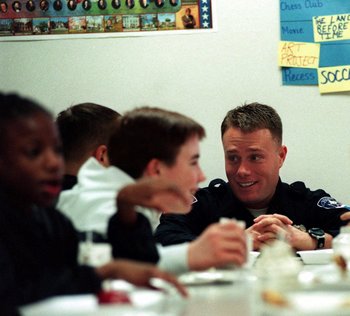
Questions remain about the role of police liaison officers in the Ann Arbor Public Schools.
AP file photo
A parent raised the question of whether the officers would return during the Board of Education meeting last week in response to rumors circulating at the Ann Arbor Open School that officials were considering bringing the officers back for this school year.
The district eliminated its three police liaison officers in June, when the board approved $3.84 million in cuts en route to passing a balanced, $188.5 million budget for the 2012-13 academic year.
The parent who addressed the board advised district officials not to bring back the officers, but other parents have contacted board members and administrators in the months since the decision asking for the district to reconsider.
“We can’t,” Green said. “We’re looking at another close to $20 million from the budget that we’re going to have to cut again next year. It wouldn’t make sense.”
Parent Scott Farrell said he received a letter from the AAO Coordinating Council, the K-8 school’s version of a parent-teacher-student organization, stating the topic would be discussed at last week’s school board meeting. The AAO Coordinating Council posted a notice on its website, as well as a list of duties, patrols and investigative services the liaison officers provided to AAO.
Farrell called the district and learned that the board did not have any items on its agenda relating to the police liaison officers, but came to the meeting anyway.
“There has been a good deal of talk about how to find funding to restore these positions,” he said, but he urged board members to allow children to attend school “without the presence of police.”
“Studies have shown that students learn best when they are in an environment free from fear,” Farrell said. “This is why we espouse a zero tolerance policy toward bullying. It is perhaps somewhat counterproductive then to replace this with … police liaisons.”
School board trustee Susan Baskett said she has not heard of any organized effort to bring back the liaison officers.
With it costing $350,000 in total for the officers’ services, it was somewhat of an easy decision for Ann Arbor school board members, who ended the 50-plus year contract with the Ann Arbor Police Department with little fanfare in June.
Vice President Christine Stead was the only trustee to express uneasiness with cutting the positions — primarily because she did not have sufficient information from the district about the officers’ roles in the schools to understand the impact of the cut, she said.
Farrell also cited a “lack of accessible local data” in his statement to board members Wednesday. He presented national data from several studies showing that “children with disabilities and children of color are disproportionately affected by police in schools, leading to decreased motivation and increased drop-out rates.”
“Police liaisons in schools provide a means to funnel kids into the juvenile justice system,” Farrell said.
Police officers had been stationed in the Ann Arbor Public Schools since the mid- to late-1960s. Most recently, the officers were assigned to Ann Arbor’s three primary high schools — Huron, Pioneer and Skyline. Each of the three officers also served the feeder elementary and middle schools that fed into their particular high school.
While Ann Arbor Public Schools paid the officers’ salaries, all reports or documentation of incidents made by the police liaisons were deemed “official police reports and property of the AAPD” and were never retained by the district, said spokeswoman Liz Margolis.
If the district needed a copy of a report — for a student discipline hearing, for example — it requested one from the police department, she said.

Liz Margolis
"...If the incident happened on school property, it will mean that the district's disciplinary policies come into play," Margolis said, adding police action or charges would be separate from district action. "They follow separate paths."
Ann Arbor Deputy Chief Greg Bazick confirmed Margolis' assessment of the liaison officers' role in incidents at AAPS. He said the process of investigating a larceny or an assault, for example, would be no different than if the officer were dispatched to the school or to a store down the street.
“If the incident does not have legal ramifications and can be addressed through the district's Rights and Responsibilities Guidelines, then the liaison officer is not involved,” Margolis said.
The benefit to having officers stationed at the schools was they often were involved in counseling troubled youth, acting as social workers in some instances, providing education and awareness of substance abuse and risky behavior to classrooms and engaging in other community policing efforts, Bazick said. He added community policing essentially is a "deliberate and focused" initiative to integrate police officers with the community to "problem solve and empower the community to self regulate."
"Police officers are never going to be able to solve all of the problems with society or in a neighborhood or an institution on their own. ... It's about acting as a team," he said. "Police officers bring in different training ... and they are legally vested with the authority to arrest and provide other enforcement" but they are just one piece of the puzzle.
While stationed at AAPS, police liaison officers did not provide any regular summaries or presentations to administrators about the incidents they responded to, their observations from spending time at the schools or other activities they participated in at the buildings, Margolis said. They also were not contractually obligated to do so.
"The district maintained close contact throughout the year with the police administration on the ongoing performance of the officers," Margolis said. "If there were any performance issues, those were addressed immediately with the officers' superiors."

Deputy Chief Greg Bazick
Ryan J. Stanton | AnnArbor.com
He said there is no existing documentation of how hours were spent at the schools: "We wouldn't have anything that is not anecdotal."
"The bureau did not require a daily log of activities. ...The officers would check in with the supervisors, though not with any hard and fast frequency."
He said the sergeants used to meet with school administrators at the beginning of each academic year and, when possible, at the end of the year to "debrief" or get feedback on any enhancements the officers could make to the service they provided.
In the past, Ann Arbor school board members asked for a report on the police liaison officers, their duties and impact, the number of incidents reported on by the officers and other information, Stead said. However, there was never one in her years on the board, she added.
Danielle Arndt covers K-12 education for AnnArbor.com. Follow her on Twitter @DanielleArndt or email her at daniellearndt@annarbor.com.
Comments
jns131
Fri, Aug 24, 2012 : 5:59 p.m.
I hate to say it, time to arm the children with mace. I have mine.
Frustrated in A2
Fri, Aug 24, 2012 : 3:38 a.m.
I'm still convinced that this is going to come back and bite the school board on their backside. I have a feeling the regular patrol officers are going to put the effort and attention into the schools that they need and deserve.
jns131
Fri, Aug 24, 2012 : 6:01 p.m.
I could not agree more with this one.
bluejunk
Thu, Aug 23, 2012 : 6:52 p.m.
What has not been mentioned is that the three high schools have also reduced the number of assistant principals. Now with the loss of the police liaisons, any type of problem, 911 will have to be called. In the past the police liaison were instrumental in stopping major fights, drug use, etc from happening and being able to talk with the administrators about it with a police report not having to be filed. That will not be happening now and we will most likely see an increase in the number of police reports being filed which can go on a student's record. I know that the police liaisons also visited homes of students who had not been coming to school, looking out for students who may have been steering their life in the wrong direction. Time will tell, but I can almost guarantee that if one major incident happens at one of the high school this year due to a lack of a police liaison they will be reinstated.
towncryer
Thu, Aug 23, 2012 : 6:11 p.m.
So the parent who thinks police liaisons are not needed for a host of reasons has kids at Open, a K-8 school. Does he have kids in one of the high schools also? If not, then this is like armchair quarterbacking.
CPS
Thu, Aug 23, 2012 : 6:06 p.m.
That Ann Arbor has law enforcement officers does not mean that our CITY is full of fear, so why would their presence in the schools equate to a SCHOOL that is full or fear??? How many assaults have to happen to our students and/or our teachers before we wake up and realize that teaching our children that the real world has its rough spots--and its rough people--and being PREPARED to deal with adverse situations better prepares them for life beyond the school walls? Isn't being PREPARED a lesson we want to teach our children? Isn't that why we all keep fire extinguishers and smoke alarms in our homes? Does this mean that our children grow up fearful that they will die in a fire??? For almost every crime that has ever occurred, there is someone who will say, "We never thought it would happen [to me or here]." Think Columbine, think William Petit and Cheshire CT, think the Nickel Mines schoolhouse, ...a quick Google search comes up with a stabbing on school grounds in La Puente, CA only 14 hours ago! Whomever wants their kid to be the victim that finally creates a turning point, raise their hand!
RayA2
Thu, Aug 23, 2012 : 4:51 p.m.
Another example of the consequences of taxpayer miserliness, especially among the wealthy. Having had an older child go through the A2 public HS I am all too aware of the potential for serious violence there. I think that this step, made necessary by teaparty-like tax misers, will cause me to reluctantly not send my younger daughter to an A2 public school. The stupidity of the misers on display here is in the fact that the A2 school system will lose their thousands of dollars in funding for my child, and I will have to pay private school. Paying a police officer to protect our children would have collectively cost all of us a few bucks. Absolutely ridiculous.
Mike
Thu, Aug 23, 2012 : 8:02 p.m.
Yes...the miserly rich....those would be the very same miserly rich who donate more of their income to charity as a percentage than you ever will. Those would be the same miserly rich who pay many people in their organizations a handsome salary and benefits......are these the same miserly rich who buy the cars and build the homes so those who are less educated car make a decent living and have benefits......those would be the same miserly rich who are supposed to carry the water in your world because you elect incompetent public officials who mismanage the public funds that we all work so hard to give them.....Is that the miserly rich you are referring to?
a2roots
Thu, Aug 23, 2012 : 3:58 p.m.
The schools are in for a big and rude wake up call with the removal of the officers. I have seen both Officer Gold(Huron) and Officer Morales(Skyline) who has recently retired in action. Their interaction with the students and ability to relate to them is a major factor in these schools being safe places. Don't get me wrong, all the schools have issues even with officers in them, but without them there will be many more issues that will arise. The idea that minorities are unjustly targeted is absolutely ridiculous. To think that fear arises and causes difficulty in learning when officers are present in a school is also an absurd assumption. The officers in the schools have usually maintained a low profile but it certainly is nice to know they are around. Many kids this school year will find it difficult to learn in the absence of the officers.
SonnyDog09
Thu, Aug 23, 2012 : 3:22 p.m.
I feel bad for the former Police Liaison Officers that will lose their cushy gig and now have to go out and man speed traps like the rest of the coppers.
Jay Thomas
Thu, Aug 23, 2012 : 6:38 p.m.
I recall seeing an "on the job" police officer sleeping in the UM graduate library once but I don't think that would happen here. At least I hope not.
a2roots
Thu, Aug 23, 2012 : 4:42 p.m.
Appears you have quite a lot to learn about our high schools and the role these officers have filled. Not sure who said it but a short statement comes to mind regarding your post, "ignorance is bliss."
janna
Thu, Aug 23, 2012 : 3:06 p.m.
What bothers me about this whole situation is that we have this new superintendent who is calling all this shots and has not made her self known in the school community. How does she know these officers aren't needed? If she were truly concerned, then why hasn't she spoken with those in the community & the schools this is affecting. I think this is one more thing that will make Ann Arbor Public Schools another step down in education. These officers were a great asset to the schools and communities.
Basic Bob
Thu, Aug 23, 2012 : 4:26 p.m.
She's been here a year and still keeps a low profile unless you are a board member or part of the inner circle. She reminds me of a guy named Fornero who was here a short while. Another double-dipper from two states away.
xmo
Thu, Aug 23, 2012 : 2:48 p.m.
The school spent a lot of time and money on the ANTI-BULLYING" campaign and now we get a chance to see if it was wroth it!
Ricardo Queso
Thu, Aug 23, 2012 : 2:13 p.m.
If children are taught to fear the police at home they will fear them in school. Why penalize the majority for the poor parenting skills of a few?
Ricardo Queso
Thu, Aug 23, 2012 : 7:10 p.m.
The kids and teachers that will have to put up with the "Snitches get stiches" crowd.
Basic Bob
Thu, Aug 23, 2012 : 4:21 p.m.
So who is being penalized exactly by taking the cops out?
ahi
Thu, Aug 23, 2012 : 1:46 p.m.
At least when I was in high school (not AA), the school PO was mostly just an embarrassment and did far more harm than good. If you want someone around to help troubled kids, get a social worker. Police are not trained for that and suck at it. If you treat school like a prison, don't be surprised when the students start acting like prisoners.
Basic Bob
Thu, Aug 23, 2012 : 1:35 p.m.
Too bad they can't get the police department to donate their time like they do at Saline High School.
RayA2
Thu, Aug 23, 2012 : 4:56 p.m.
Bob, maybe you could grab a nightstick, literally put your safety on the line, and go spend your entire day in a public school? Maybe you'd need a little training? Just pay for it yourself and go get some. Pick up a nightstick while you're at it. If you won't do it yourself, don't ask anyone else.
nowayjose
Thu, Aug 23, 2012 : 12:44 p.m.
I'll tell you what makes it hard for students to learn. When a nut job brings a ak47 to one of the schools and there is no one there to stop them. It is insane in today's society not to have school resource officers. These kids get to know the officers in the school they attended and become like any other faculty to them. I doubt many kids fear them as Mr. Farrell states.
Jay Thomas
Thu, Aug 23, 2012 : 6:35 p.m.
Yeah, killing someone does make it difficult to learn. Any other sharp observations?
Angry Moderate
Thu, Aug 23, 2012 : 3:53 p.m.
I can assure you that not a single student "feared" either of the 2 police officers that were liaisons to my AAPS high school.
bananas
Thu, Aug 23, 2012 : 3:07 p.m.
@nowayjose - I can't speak for Mr Farrell nor link to the specific stats he is referring to but I do recommend googling "The New Jim Crow" or 'unequal punishment by race' to get a sense of what it is like to grow up poor and black in this country. There is no doubt in my mind that many minority kids are wary of cops in general and with good reason. The racist application of laws and sentencing/punishment in this country shows that overall, police 'serve and protect' only a portion of the population, and poor black people aren't among them for the most part. Anecdotes and exceptions aside, statistics bear this out in many ways and contradict your 'doubts'.
EyeHeartA2
Thu, Aug 23, 2012 : 12:17 p.m.
"We can't," Green said. "We're looking at another close to $20 million from the budget that we're going to have to cut again next year. It wouldn't make sense." Wait....what? She spoke? She took a position? I thought all she did was cash her paycheck.
A2comments
Thu, Aug 23, 2012 : 10:50 a.m.
So the school district paid $350k a year for services that they had no information on as far as effectiveness, then chose to eliminate the services with no analysis as to whether it was needed or not? And they used to ask for a report, but then stopped? Good stuff! My confidence in the ability of the school board grows each day! Why no statement from Deb Mexicotte? Something like "I didn't know we paid them $350k" or "there were police into the high schools?". Or she could explain why the reports stopped. Mr. Farrell presented evidence that High Schools without police are safer than those with police, did he? I'd love to see that data. I for one am glad that my children have graduated from the school system. I hope that when the board realizes the error of their decision it isn't due to a serious crime with awful impact. In my non-professional opinion, the schools are not safe enough. For example, Skyline was built without cameras when the other high schools were installing or about to install cameras...