

Federal budget spells good news for Ann Arbor's Stadium bridges, bad news for high-speed rail
(This story has been updated with comment from City Administrator Roger Fraser.)
Historic spending cuts negotiated in the nation's capital will leave intact a federal grant program expected to help fund replacement of Ann Arbor's Stadium bridges, but President Barack Obama's plan for a national high-speed rail network has been dealt a heavy blow.
U.S. House Appropriations Committee Chairman Hal Rogers has released a summary of the budget bill that will carry the federal government through the rest of fiscal year 2011.
For the U.S. Department of Transportation, the bill eliminates new funding for high-speed rail and rescinds $400 million in previous year funds, for a total reduction of $2.9 billion, according to the summary. The bill also reduces funding for transit by $991 million, but preserves $528 million in funding for the TIGER grant program.
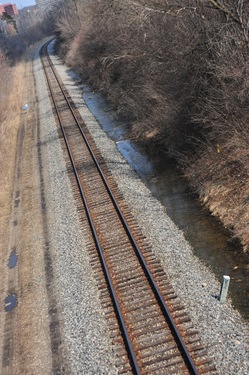
The train tracks near the University of Michigan Hospital off of Fuller Road, where the city of Ann Arbor plans a new train station.
Ryan J. Stanton | AnnArbor.com
Federal Rail Administration officials claim they lost what amounts to $1.4 billion in funds for high-speed rail, CNN reported today. That differs from other published reports, including Rogers' summary, that have put the figure higher.
The San Jose Mercury News is reporting that officials said on Monday the deal reached in Washington would cut this year's high-speed rail budget from $2.5 to $1 billion, but on Tuesday officials eliminated the final $1 billion, essentially erasing all subsidies for local high-speed rail projects, including California's 520-mile line from San Francisco to Los Angeles.
CNN reported the federal cuts will not affect high-speed rail projects already under way across the United States, and projects that have been awarded grants will keep their funding, according to US-DOT officials. But concerns about future funding remain.
U.S. Rep. John Dingell, D-Dearborn, who has lobbied for the TIGER grants for Ann Arbor's Stadium bridges, applauded the decision to keep the program alive. TIGER is an acronym standing for Transportation Investment Generating Economic Recovery.
The TIGER grants are expected to provide $13.9 million of the $23 million needed for Ann Arbor's Stadium bridges replacement project slated to start later this year.
“I am ecstatic that the program will continue on as planned and I will continue to work with all parties to see that it is implemented and funded appropriately," Dingell said in a statement. "Last month, the Department of Transportation obligated the first phase funds in the amount of $800,000. The remaining funds will be obligated later this summer. This funding will save more than $33 million a year in traffic delays, vehicle operation and crash costs, and will also generate more than $53 million in real economic benefit and create an estimated 450 jobs.”
City Administrator Roger Fraser also welcomed the news.
"We're delighted about that," Fraser said. "In the absence of that, we would be cutting virtually all of our significant road improvements for the next three to four years in order to pay for the repair of the bridge, but we don't have to do that."
The high-speed rail cuts could affect future funding to improve rail service between Detroit and Chicago. The busiest Amtrak station between those two points is in Ann Arbor, and city officials have high hopes for more activity with a new train station proposed along Fuller Road.
Dingell announced last fall that Michigan would receive $150 million for high-speed rail improvements along the Dearborn-to-Kalamazoo portion of the tracks, but the state Legislature still hasn't taken action to secure those funds by putting up required matching money. Gov. Rick Snyder last week said his administration would be seeking additional funding, but he still hasn't fully made up his mind about high-speed rail.
The deal negotiated between the House, Senate and White House on a final continuing resolution will prevent a government shutdown and fund the entire federal government until Sept. 30, but will cut nearly $40 billion in federal spending.
"When this agreement is signed into law, Congress will have taken the unprecedented step of passing the largest non-defense spending cut in the history of our nation — tens of billions larger than any other non-defense reduction, and the biggest overall reduction since World War II," Rogers' summary reads, adding it has been the goal of the new Republican majority to keep tax dollars where they're needed most: in the hands of businesses and individuals.
Ryan J. Stanton covers government and politics for AnnArbor.com. Reach him at ryanstanton@annarbor.com or 734-623-2529. You also can follow him on Twitter or subscribe to AnnArbor.com's e-mail newsletters.
Comments
15crown00
Sun, Jul 31, 2011 : 1:54 p.m.
just don't bring the Chinese in to build a high speed rail service.there just was a terrible accident over there and they're talking seriously about bad workmanship and bad equipment as the cause of the problem.just a warning.
Diagenes
Fri, Apr 15, 2011 : 2:16 a.m.
Mr. Dingell states that the rebuilding of the Stadium bridges will result in 450 jobs and generate $53 million dollars in economic benefit. How? Will it take 450 workers to rebuld the bridges? The cost is estimated at $23 million. How do you get to $53 million? Is Mr. Dingell guilty of typical Washington hyperbole?
KJMClark
Thu, Apr 14, 2011 : 12:51 a.m.
It's funny. For years those of us who follow peak oil have been arguing over how bad it will be. The answer is always along the lines of "we *could* deal well with oil production peaking, but it depends on people making good decisions." To which someone points out that old Winston Churchill quote: "Americans can always be counted on to do the right thing...after they have exhausted all other possibilities." (I love that quote.) So now, when gas prices are quickly headed to a new record, when the EIA *today* reported a surprise 7 million barrel drop in US gasoline inventories over the past week, and when the Financial Times (and some top-notch blogs) realized that the Saudis actually didn't raise their production to compensate for Libyan oil going off-line, we find out that Congress has killed high-speed rail funding. Just goes to show how few people pay attention to the International Energy Agency and understand what peak oil is all about. Apparently we'll have to figure it out the hard way, just like Churchill said.
KJMClark
Thu, Apr 14, 2011 : 11:10 a.m.
You're not paying attention. Light sweet, the kind that Libya produces, peaked several years ago. IEA has already acknowledged that. Oil-from-the-ground has probably already peaked as well, it's hard to tell because all the agencies have moved to "all liquids" as a measurement, which includes ethanol. The only real question at this point is whether Iraqi production will come online fast enough to deal with the decline in the rest of the world. Geez, even CERA has agreed that we have a problem. Where have you been?
5c0++ H4d13y
Thu, Apr 14, 2011 : 4:42 a.m.
When's that peak coming? 10 years ago? 10 years from now? Oh and Israel is now starting to exploit a huge reserve of shale oil (or some such thing) that will eclipse the middle east. Peak oil ... coming soon. Just don't ask when.
katie
Thu, Apr 14, 2011 : 12:24 a.m.
I'd like to see them invest in repairing the tracks for regular-speed rail before investing in high speed. This would be a sensible thing to do since rail transport is cost-effective. It also cuts down on wear and tear on the interstate highway system. BTW, the interstate system is another way the federal government has served the public with (gasp!) tax dollars. Of course, now private companies are poised to take that over and make us pay again to give them a profit. Repairing what we have is not so glitzy sounding as high-speed rail. I'm happy to travel to Chicago on regular speed rail, just make sure the tracks and trains are in good working order. It would be good to have those bridges repaired, too. No need for a fancy conference center, just maintain what we have like frugal folks everywhere do. No need to risk tax dollars on glitzy projects of any kind. Just keep things in working order.
Ron
Wed, Apr 13, 2011 : 11:55 p.m.
How many billions of dollars were the oil companies fined in that disaster down off Louisiana, several years ago? If federal lawmakers are casting about for funds to fill the railroads' pockets, perhaps they should earmark those billions that Big Oil forks - er, ladles - out every time they foul the waters. Also, levying a healthy tax on drilling for oil would yield additional dollars for high speed rail. Personally, I'd rather see that money go to mass transit on a smaller scale - hybrid intercity transit systems would serve more of the people who really need it. Let the private sector figure out how to fund high speed rail. The demographic that would find high speed rail most useful can probably afford to pay the fares that private railroads would charge - much like the airline industry.
logo
Wed, Apr 13, 2011 : 10:24 p.m.
You are all missing the point that Michigan's rail money is still in place all $150 million, the legislature needs to come up with the match but they are pursuing it. Ghost: Ms. Lesko ran in the primary election in Aug. of 10, the announcement of the bridges winning the Tiger Grants came out in October.
Edward R Murrow's Ghost
Wed, Apr 13, 2011 : 10:48 p.m.
Oh Man!! Two factual errors in the same post!! (the first pointed out above) I really am becoming a typical A2.com commenter, aren't I? But point taken. Still sounds, however, like Ms. Lesko needs a large block of cheese. Good Night and Good Luck
Tru2Blu76
Wed, Apr 13, 2011 : 9:37 p.m.
Fun fact: the federal government led the charge for a nationwide system of freeways for single passenger autos. BUT - the idea of spending a small fraction of the amount spent on those now deteriorating highways on high speed mass transit seems to upset some folks. Just like the under-informed, overwrought protests against universal health care, we're seeing this knee-jerk politically based "wisdom" handed out on forums like this all the time. Small political minorities have to make big (and continuous) noise to mislead people into thinking they're the actual majority. I for one am not impressed (just annoyed). Catch a train or drive or fly from Ann Arbor to Chicago: you'll learn soon enough how much we need new high speed rail service to REPLACE the doomed car / truck infrastructure and the ever more onerous air travel systems. Spending .003 of the total federal budget on high speed rail will create a market for this form of middle-distance and some long-distance travel. Take a clue from: all of Europe. Compare that rail system to what we have now.
Tru2Blu76
Wed, Apr 13, 2011 : 9:23 p.m.
The FA-22 Raptor is the most expensive war plane in our inventory. It costs $260 million (each). Where did you get "$600 million" Top Cat? And what would you suggest be done with 250 war planes like that? NOT that they've been used in the UN police action against Libya's Kadaffi. So why is funding high speed rail "worthless?" In view of the fact that alternatives for airline travel are essential for middle-distances (since those aircraft lift off with 4700 gallons of fuel and burn most of it before landing), such alternatives as high speed rail are the best deal going. Sometimes, "it appears" political critics are just pulling random examples out of thin air to use against those they disagree with.
peg dash fab
Thu, Apr 14, 2011 : 4:36 a.m.
top cat's claim was not intended to be factual.
MikeyP
Wed, Apr 13, 2011 : 9:17 p.m.
Axing the high speed rail funding is very good fiscal policy IMHO. Those projects NEVER turn a profit, they have to be constantly subsidized by the taxpayers the vast majority of whom don't benefit from said projects at all (since they don't go where the rail would take them they never ride it, but they still get to pay for it!) So not only do we save money on the original outlay but we avoid the endless subsidies... axing these projects is the gift that keeps on giving so to speak!
Edward R Murrow's Ghost
Fri, Apr 15, 2011 : 12:12 a.m.
MA: Yes, one is different from the others. It does not have high-speed rail. Glad you noticed that. 5: You can provide a link to a source for the "facts" you cite? Of course you can. "It's the 21st century and we want to bolt rails to the ground permanently and run 100 ton trains on them slower than a plane can fly?" So many opinions. So few facts. So little logic. 1) A typical low-speed AMTRAK loco weighs 140 tons; a car 70 tons. An entire train will be much more than 100 tons. I have no idea (nor do you) what the weight of HS train might be. Source: <a href="http://www.trainorders.com/discussion/read.php?4,1824865" rel='nofollow'>http://www.trainorders.com/discussion/read.php?4,1824865</a> 2) Unless you can tell me what it costs to maintain a mile of RR track vs. a mile of I/S highway, you have no basis for suggesting rail is any less efficient or desirable than road. 3) The ONLY mode of personal transportation that is more energy efficient than passenger rail of any type is a motorcycle. We are past peak oil and we will need more efficient means of short-, medium, and long-distance travel. Source: table 2-12 in <a href="http://cta.ornl.gov/data/tedb29/Edition29_Full_Doc.pdf" rel='nofollow'>http://cta.ornl.gov/data/tedb29/Edition29_Full_Doc.pdf</a> Good Night and Good Luck
5c0++ H4d13y
Thu, Apr 14, 2011 : 4:39 a.m.
@Edward High speed rail in Europe is losing to regional jets. Jets are faster and cheaper than HSR. And they go more places. I mean really? It's the 21st century and we want to bolt rails to the ground permanently and run 100 ton trains on them slower than a plane can fly? Winning!
Marshall Applewhite
Thu, Apr 14, 2011 : 3:51 a.m.
@ERMG "Except Japan, China, Britain, France, Germany, Spain, Belgium, the Netherlands, Denmark, Norway, Sweden, Finland, Italy, Switzerland . . . " and the United States. One of these things is not like the others.
Edward R Murrow's Ghost
Wed, Apr 13, 2011 : 9:52 p.m.
Yeah, you're right. High speed rail works nowhere else in the world. Except Japan, China, Britain, France, Germany, Spain, Belgium, the Netherlands, Denmark, Norway, Sweden, Finland, Italy, Switzerland . . . But what do they know. Good Night and Good Luck
MikeyP
Wed, Apr 13, 2011 : 9:33 p.m.
I-94 and Metro Airport are at least good for boosting the economy even if they themselves don't turn a profit. Are you going to get 100,000+ people here eight times a year via high-speed rail? Uh, no, not possible. Are you going to get thousands of people from around the country/around the world to campus via high speed rail? Nope. Are you going to ship millions of tons of goods from all over the country via those rails? Nope, they're primarily for commuting. For the small number of people who would benefit it most certainly is NOT worth the enormous cost IMHO. I mean, just look at what supporters say, "Hey, I can go from here to LA without flying, yay!" Well gee, I guess I'd be happy if someone else was subsidizing my travel to a huge degree too... but being one of the people doing the subsidizing isn't all that great a deal as it turns out. I don't even get copies of the vacation photos! So it's a hard sell from a dollars and cents POV.
Edward R Murrow's Ghost
Wed, Apr 13, 2011 : 9:19 p.m.
I-94 and Metro Airport don't turn profits, either. And your point is . . . .? Good Night and Good Luck
shepard145
Wed, Apr 13, 2011 : 9:11 p.m.
High speed rail MATCHING funds that few states would have been able to capitalize on. While mass transit is a very valuable regional amenity to Michigan and worth investing what ever it takes in federal dollars – $3 billion +, high speed rail is a different issue entirely. HSR is a fast train connecting stops spread very very far apart to major population centers and competes with air transit – think New York, Boston, DC. Detroit, Ann Arbor or Lansing to Chicago would be of little value to anyone other then those paid to build it - does GE have a construction division yet? While this is NOT the time for high speed rail, it is the time for light or rapid rail. ...but the fact is that boomers are retiring as scheduled at birth, spent almost every time they had and more along the way, Washington refused to lead by planning for it and now two generations of Americans will be poorer under the burden of providing for them and nobody in DC will be held responsible for epic incompetence that is the hallmark of government.
shepard145
Fri, Apr 15, 2011 : 12:44 a.m.
What are you yammering about and the NYT is no longer an authority on nothing but the latest government issued talking points - did you miss the memo? They work for obama now - not the people. What is not true? President Ford offered $500 million dollars for mass transit to connect Detroit the world - what happened to that? Clinton balanced nothing - he tried to ram through Hilary care socialist med and when that failed, he moved center after losing the houses and gutted national defense as terrorists trained in Florida for two years prior to 9-11. Clinton also rode the wave of prosperity established by Reagan and squandered the heart of the tech boom with high taxes as computer tech revolutionized the business world - we will never see that again. The "tax cuts do nothing" and "trickle down economics" mantras are long dead as your hero obama and his party of misfits are bankrupting the US - you need to stop reading the leftist crank web sites and pick up a book.
johnnya2
Wed, Apr 13, 2011 : 9:29 p.m.
Not true. In fact this was planned for in the 80's when Reagan raised SS taxes AND again when Clinton balanced the budget in the late 90's. The biggest monkey wrench were irresponsible tax cuts which did NOTHING for the economy. <a href="http://www.nytimes.com/2011/04/13/opinion/13wed1.html" rel='nofollow'>http://www.nytimes.com/2011/04/13/opinion/13wed1.html</a>
Edward R Murrow's Ghost
Wed, Apr 13, 2011 : 9:06 p.m.
"Prior guarantees were false promises told to hide the incompetence of city staffers and elected officials." Ah, yes. The October Surprise. Gee, if the announcement of the bridge funding had waited until now, the most unpopular mayoral candidate in modern memory would have lost by only half as many votes as the lost by. And it still would have been a landslide. A little cheese with that whine, Ms. Lesko? Good Night and Good Luck
Edward R Murrow's Ghost
Wed, Apr 13, 2011 : 10:12 p.m.
Thanks for the correction, Roadman. Close but no cigar. Good Night and Good Luck
Roadman
Wed, Apr 13, 2011 : 10:07 p.m.
She isn't the most unpopular. Libertarian Party nominee Eric Plourde - a U-M student - finished with only 14.72% of the popular vote in the 2008 mayoral election. Lesko finished with 15.54% of the vote in her run to beat King John. Eric was ecstatic with his showing, however Patty Lesko was somewhat less than ebullient about hers. Good night and good luck.
Ryan J. Stanton
Wed, Apr 13, 2011 : 9:03 p.m.
Dingell has put out a broader statement on the federal budget here: <a href="http://dingell.house.gov/issue/budget-taxes/2011/04/dingell-applauds-obamas-forward-thinking-balanced-approach.shtml" rel='nofollow'>http://dingell.house.gov/issue/budget-taxes/2011/04/dingell-applauds-obamas-forward-thinking-balanced-approach.shtml</a>
Jenna Thom
Wed, Apr 13, 2011 : 8:52 p.m.
@ Patricia lesko You miss the point. Politics are politics...politics take time to play out. You seem to think that making predictions before all the plays are done is good journalism, it is not. It is creating problems or instigating panic unnecessarily. The public is smarter than you think and understand what is going on with the bridge. The city has no control over what is happening in Washington DC. I find it disgusting that you are wishing for the city to lose out on this money just so you can make more non-sensical claims against the city because of your sour grapes over the mayoral election. Of course the money is not here until it is obligated but it still remains in the budget, which is a good thing. There were no false promises made by anyone at the city or by any elected official, there were just procedures that everyone was following. It amazes me that you don't understand how public policy works, yet you ran for office.
Roadman
Wed, Apr 13, 2011 : 10:02 p.m.
Pat Lesko was right - the financing via the TIGER II never vested absolutely but was subject to the whims of Congress. What if the Congressional Budget Committee had decided to cut out TIGER II funding entirely? Lesko would be smelling like a rose! And Dingell and Hiefje would look like a couple of very foolish elected officials. It did have a happy ending, however, and Dingell and Hieftje can breathe a huge sigh of relief.
Patricia Lesko
Wed, Apr 13, 2011 : 8:43 p.m.
Prior guarantees were false promises told to hide the incompetence of city staffers and elected officials. They were, unfortunately, repeated by Ann Arbor.com without verification. Until Mr. Dingell gets an email from the office of the Secretary of Transportation announcing that the money has been obligated, the funding is not guaranteed. To claim otherwise (or "report" otherwise) is misleading. Mr. Dingell is quoted here by saying that the money will be obligated in the SUMMER. Translation: It hasn't been obligated yet. It wasn't obligated when John Hieftje told AnnArbor.com it was not once, but twice. It wasn't obligated when a city staffer claimed to AnnArbor.com it was, and those specious claims were repeated without verifying them with the DOT or the Office of Sec. LaHood. Here's a news story: Why have millions in TIGER II money already been distributed to similar projects around the country since March while Ann Arbor has to wait until summer (presumably after the U.S. Budget passes)? Why haven't Michigan's U.S. Senators, our Governor, state senators and representatives worked to get this funding secured, as have elected officials in states around the country? DOT officials have no record of communications from Michigan's U.S. Senators about TIGER II funding requests. When he was in DC for the U.S. Governor's conference, the Governor of New Hampshire met with Mr. LaHood. Rick Snyder went to DC and told everyone not to feel sorry for him. New Hampshire/Maine got $20 million in TIGER II funding for their bridge project obligated on March 30th (<a href="http://www.nh.gov/dot/media/nr2011/nr033011tigerii.htm)" rel='nofollow'>http://www.nh.gov/dot/media/nr2011/nr033011tigerii.htm)</a>. An official from the U.S. DOT told me recently: "Until the budget passes Congress and is signed by the President, no TIGER II grant money is guaranteed."
Dog Guy
Wed, Apr 13, 2011 : 10:40 p.m.
Dingell will present the check at an October, 2012, photo op.
Jenna Thom
Wed, Apr 13, 2011 : 8:36 p.m.
I am grateful that these funds were not cut for the bridge, but am disappointed that the funds for the high speed rail are gone. My hope is that one day in better times the government can once again support high speed rail. Patience is a virtue. It works out in one's best interest to allow all the politics to play out before crying the "sky is falling" and claiming conspiracy theories. Lesko and her conspirators will now have to jump the gun on some other issue to panic about so that their names can stay in the press. They (Lesko and her conspirators) should be ashamed of themselves for basically wishing for the loss of the funds that would have hurt our city. Lesko's 15 minutes of fame are up .
Dog Guy
Wed, Apr 13, 2011 : 7:33 p.m.
Thank you for mentioning the train station hizzoner is going to build for the U of M. If you can't be generous to your friends and your employer with others' money, what good is being mayor? The photo is worth 1,001 words.
grye
Wed, Apr 13, 2011 : 7:10 p.m.
A national high speed rail system would be of great use by many who can take a little longer to travel, who may be afraid of flying, or as an alternative to the knee jerk reaction TSA security requirements. Having a system that allows for coast to coast travel with minimal stops and local service hubbed from regional stops would be great. However it will be costly to purchase the equipment, land rights, and infrastructure. Not a small task. No single company can do it. Possible several large companies combined may be able to tackle the task. Only the federal govt has the ability to put together a complete system. Maybe someday we can travel on a maglev train at 450 mph. Someday.
Moscow On The Huron
Wed, Apr 13, 2011 : 7:01 p.m.
High-speed rail in this corridor is certainly not a critical project. It's more of a, "Well, that would be kinda nice" project. Cutting it is fine. Hopefully, this will also deal a blow to the city's imagined need for a new transit station.
sellers
Wed, Apr 13, 2011 : 6:55 p.m.
Why are we so dependent on Federal government, oversight, funding? How did we become so reliant on the federal government to give us answers? When did the local and state government become second chair? Does anyone remember a time when the Federal government was not the answer to our problems for just about everything? Does anyone alive recall a time when local elections received the same turnout and attention as federal? Was it The New Deal that sealed that swing or did it happen before? Ponders. Should brush up on my modern economic history I suppose.
Tru2Blu76
Wed, Apr 13, 2011 : 9:55 p.m.
First, we should ask who you mean when you say "we." Is it us as a nation or just some special interest group? Dependency can be viewed in different ways. The most likely answer to your question is that "we" found that "we " cannot depend on private enterprise to do everything (like they claim in TV advertisements ). If we had: there wouldn't be a space program, there wouldn't be a national program of disease control, there wouldn't be public education, there wouldn't be public highways or MANY other etceteras. The appropriate alternative question is: Why are we so dependent on private companies for: the "safety of our investments," for "the 8th best medical care system" and for jobs: which disappear from our shores after millions of Americans spent time and money LEARNING to work at those jobs?! You have one thing right: Americans need to learn to be more attentive and more active and more directive with our government(s). We are too dependent: on dishonest political propaganda provided by – private enterprise.
Top Cat
Wed, Apr 13, 2011 : 6:52 p.m.
The high speed rail thing was a waste of money from the get go. The only thing worse is spending money to intervene in a civil war in Libya. I know that flying aircraft and losing one of them is expensive. I heard one estimate that the cost is already at $600 million. We never learn.
Roadman
Wed, Apr 13, 2011 : 6:14 p.m.
The fact that it is only now confirmed the TIGER II funding will be a sure thing shows that all the promises and assurances that it was done deal long ago was just a lot of smoke-and-mirrors by Dingell and Hieftje and their respective cronies.
Edward R Murrow's Ghost
Wed, Apr 13, 2011 : 8:38 p.m.
Nope. Not hardly. It confirms that Republicans in Congress wanted to cut funding for projects approved in the previous fiscal year but for which the funds had not yet been spent. Good Night and Good Luck