

Federal officials meet at U-M to call for tobacco-free college campuses nationwide
- Related coverage: U-M officials say campus-wide smoking ban making some progress in breaking cycle of addiction
The University of Michigan’s national clout and efforts to ban smoking on its campuses made it an apt setting for the federal government to announce Wednesday afternoon an initiative to ban smoking on college campuses across the country, officials said.
Howard Koh, assistant secretary for health at the U.S. Department of Health and Human Services, first thanked U-M for its leadership in creating a tobacco-free environment before launching into a description of the need for the Tobacco-Free College Campus Initiative.
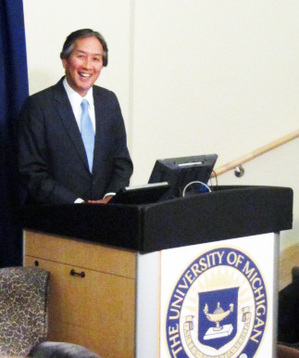
Howard Koh, assistant secretary for health for the U.S. Department of Health and Human Services, speaks Wednesday at the University of Michigan's School of Public Health in Ann Arbor.
Amy Biolchini | AnnArbor.com
About 774 — or 17 percent — of college campuses and universities have implemented smoking bans in the U.S. so far, and Koh said the momentum has been building particularly in the past year.
“We want the momentum to continue into the future,” Koh said. “Let’s make smoking history.”
The federal initiative is something university officials across the country can use in efforts to push tobacco-free policies forward. While the government is urging campuses to ban smoking, Wednesday's announcement provided no description of incentives for doing so.
Dr. Robert Winfield, chief health officer for U-M, said it was important to have high-level support from university executives. The change was possible at U-M because of U-M President Mary Sue Coleman's 2004 initiative to create MHealthy, an organization for faculty and staff.
Coleman spoke briefly at the university’s School of Public Health, where the event took place Wednesday. The university’s deliberate decision to go smoke-free created cleaner, safer and healthier environments at its campuses, she said.
Martin Philbert, dean of the U-M School of Public Health, called the announcement by the federal department a momentous one.
“Smoking is the leading cause of preventable and premature death in the U.S. and the world, Philbert said, noting that U-M’s smoking ban promises potential reduction in health care costs. “The reduction of tobacco use is the greatest public health accomplishment of our time.”
All of U-M's campuses — Dearborn, Flint and Ann Arbor — went tobacco-free July 1, 2011, an effort that has drawn mixed reactions from administrators and students.
Winfield said the number of established smokers on staff has declined from 6.2 percent in 2009, to 5.6 percent in 2010, to 4.8 percent in 2011 — a change he called substantial.
Treating smokers with respect is important in breaking the cycle of behavior, Winfield said.
Amy Biolchini covers Washtenaw County, health and environmental issues for AnnArbor.com. Reach her at (734) 623-2552, amybiolchini@annarbor.com or on Twitter.
Comments
Davidian
Thu, Sep 13, 2012 : 4:25 p.m.
I think smoking is disgusting, it makes me sick. But why are so many people hell-bent on taking away personal freedoms? What is next? Fatty foods and ice cream? Then popcorn? Then beef? You can't look me in the eye and tell me that a smoker 50 feet away from me is going to give me lung cancer as I inhale the fumes from the thousands of cars passing by. It's absurd. This is all about one thing: control. Period.
Jeffersonian Liberal
Thu, Sep 13, 2012 : 12:12 p.m.
This much like everything that goes on in the peoples republic is a joke. There is no scientific evidence linking second hand smoke and lung cancer. It's not good enough to make the evil smokers stand x number of feet from a door way we need to ban it totally. Are the non-smokers running up and huffing the smoke? Good luck it didn't work at Washtenaw or Eastern.
brian
Thu, Sep 13, 2012 : 3:31 a.m.
I'll smoke to that.
martini man
Thu, Sep 13, 2012 : 12:09 a.m.
Hire a special "Smoker's Task Force" to swoop down a la SWAT team, on anyone smoking. What's a few home invasions , beatings, rapes and robberies, when the authorities could be used as Tobbaco Police?? I am so glad they finally have their priorities straight. Next ..maybe FOOD POLICE a la Mayor Loonburg of NYC. Ya gotta love dem ol liberals. get 'em Mary Sue ..you go girl !!!
brian
Thu, Sep 13, 2012 : 3:33 a.m.
Don't laugh about it, it may be right around the corner. Hate Government, just saying.
Dog Guy
Wed, Sep 12, 2012 : 11:12 p.m.
I'm in favor or anything that bans Obama from campuses.
trespass
Wed, Sep 12, 2012 : 10:26 p.m.
"Winfield said the number of established smokers on staff has declined from 6.2 percent in 2009, to 5.6 percent in 2010, to 4.8 percent in 2011" Is that because people have quit smoking or have fewer smokers applied for jobs at U-M? Treating smokers with respect is important in breaking the cycle of behavior, Winfield said. Respect includes respecting the decisions people make. The policy is the ultimate in disrespect.
M
Wed, Sep 12, 2012 : 10:57 p.m.
@Brad - You don't like it, don't work there. We call that "Freedom", and we're serious about it round these parts.
Brad
Wed, Sep 12, 2012 : 10:51 p.m.
The policy that makes nonsmokers not have to breathe toxic smoke at work is disrespectful? Is that seriously your position?
xmo
Wed, Sep 12, 2012 : 10:09 p.m.
Why does the Federal Government need to be involved? Should this be a "State by State" or "University by University" decision?
clownfish
Thu, Sep 13, 2012 : 12:26 p.m.
Because "Smoking is the leading cause of preventable and premature death in the U.S. and the world? "